Original Research Article
Comparing infrastructure of anganwadi centres under integrated child
development services of urban and rural Bangalore:
a cross sectional study
Abhijnana G.
*
, Selvi Thangaraj, Ranganath T. S., Vishwanath
INTRODUCTION
Integrated child development services (ICDS) is the one of the most important scheme in Child Welfare field.1 The huge task portrayed by this programme made to take up in an experimental basis of 33 projects in the year 1975-76 in 4 urban, 19 rural and 10 tribal areas spread all over Indian states and Union territories.2 Currently the ICDS network has 7072 projects and 13,46,186 anganwadi centres (AWC) operational across rural and urban slum pockets of India.3 The scheme has package of
six services such as supplementary nutrition, pre-school non-formal education, nutrition and health education, health check-up of antenatal mothers and adolescent girls, immunization for antenatal mothers and under-5 children and referral services for high risk antenatal mothers and adolescents.4
The anganwadi centres cater to pregnant women, nursing mothers, women in reproductive age 15-44 years, children below 6 years old, adolescent girls of 11-18 years.5 The services provided by the anganwadi centres
ABSTRACT
Background: Anganwadi centres under integrated child development services is the largest Project in India to improve not only child health but reproductive, maternal and adolescent health. The aim of the present study is to compare the infrastructure of urban and rural anganwadi which is one of the basic need to provide quality services.
Methods: A total of 30 anganwadi centres are involved in our study in which 20 are from rural and 10 are from urban field practice area of Department of Community Medicine, Bangalore Medical College and Research Institute, Bangalore. This study employed interview method with anganwadi worker’s and observation of anganwadi centre using pre-designed, semi structured questionnaire and checklist.
Results: 85% of rural and 60% urban anganwadi centres have their own buildings to carry out the services. 20% of rural anganwadi centres lack fixed name boards compared to urban anganwadi centres. 55% of rural anganwadi centres and 90% of urban anganwadi centres lack separate storage for raw food materials. 15% of rural anganwadi centres lack functional toilet facility. 40% of rural anganwadi centres lack functional weighing machine.
Conclusions: Anganwadi centres are remote contact point of health care system within the community. The infrastructure of anganwadi centre such as type of building, space for cooking and activities, availability of functional equipments ensure the quality service deliveries which in turn are enhanced by timely supervision from higher authorities.
Keywords: Infrastructure, Anganwadi centre, Anganwadi workers, ICDS
Department of Community Medicine, Bangalore Medical College and Research Institute, Bangalore, Karnataka, India
Received: 13 July 2019
Accepted: 13 September 2019
*Correspondence:
Dr. Abhijnana G.,
E-mail: [email protected]
Copyright: © the author(s), publisher and licensee Medip Academy. This is an open-access article distributed under the terms of the Creative Commons Attribution Non-Commercial License, which permits unrestricted non-commercial use, distribution, and reproduction in any medium, provided the original work is properly cited.
are independent of all religion and socio-economic status of the beneficiaries which means anganwadi centre is point of service delivery to numerous beneficiaries.6
As per revised norm, 1 anganwadi centre (AWC) for 400-800 population, 2 anganwadi centres for 400-800-1600, 3 anganwadi centres for 1600-2400, thereafter one anganwadi centre for every 800 increased populations. Mini anganwadi centre for 150-400 population.7 If more than 40 children of under 6 years of age are in the given area with no working anganwadi centre then anganwadi on demand should be established.8
Currently, ICDS is named as Umbrella ICDS scheme which includes Anganwadi Services Scheme, Pradhan Mantri Matru Vandana Yojana, National Creche Scheme, Scheme for Adolescent Girls, Child Protection Scheme, POSHAN Abhiyaan by Government of India and SRUSTI-providing egg per day per child, Ksheera Bhagya- providing milk of 150 ml per day per normal child, Mathrupoorna Yojana- providing one full meal (600 calories per day for six days of week) scheme to pregnant and lactating mothers by Government of Karnataka.9,10 To provide such expanded services, infrastructure and logistics of AWC plays an important role.
A good quality infrastructure can work as magnet for parents and thereby encouraging them to send their children for supplementary feeding and pre-school education to nearby anganwadi centres. Hence the following study will help us to compare the quality of infrastructure among urban and rural anganwadi centres.
METHODS
The present study is a cross-sectional comparison study done in urban and rural practice area of Department of Community Medicine of Bangalore Medical College and Research Institute, Bangalore from July 2017 to December 2017.
All 10 centres under Urban Health Training Centre and one of the rural practice area (comprises of 20 anganwadi centres) was selected randomly among 4 rural practice areas. Total 30 anganwadi centres were visited for evaluation of quality of infrastructure during the study period with the help of pre-designed, pretested and semi structured questionnaire and checklist.11,12
Information was collected by interviewing respondents (anganwadi workers and anganwadi helpers) with predesigned, pre-tested questionnaire and checklist with consent from respondent and prior consent from Child Development Project Officer (CDPO). Each anganwadi centre was visited thrice, only the first visit was scheduled and subsequent were random visits to assess the cleanliness of internal and external environment of the anganwadi centres.
Infrastructure of anganwadi centres which included type and ownership of building, availability of indoor and outdoor space, availability of toys, medicine kits, functional weighing machines, safe drinking water, functional toilet and handwashing facilities were assessed. Information regarding frequency of supervisory visits by health worker, medical officer, supervisor and CDPO in last 3 months was collected by interviewing anganwadi worker and reviewing records.
The data collected was entered in MS excel sheet and analysed using Statistical package for the social sciences (SPSS) Software version 20.0. Chi-square or Fischer exact test was applied and results were considered significant if p<0.05.
RESULTS
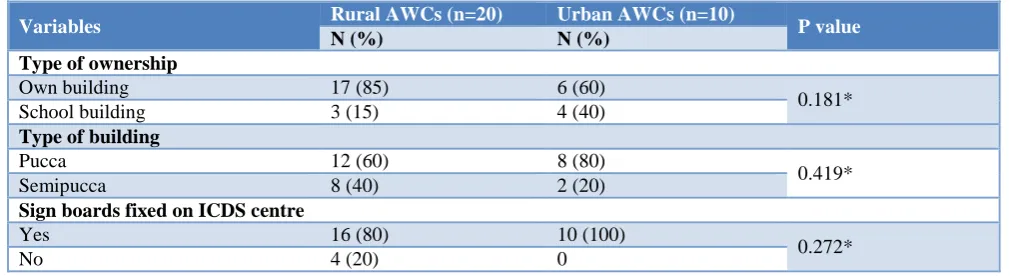
85% of rural AWC and 60% of urban AWC have their own building while other AWC were run in school buildings. Even though majority of rural AWCs had their own building only 59% were pucca. All the urban AWCs have sign board fixed but 20% of rural AWCs lack fixed sign board (Table 1).
Table 1: Comparison between location, type of building in rural and urban ICDS centre.
Variables Rural AWCs (n=20) Urban AWCs (n=10) P value
N (%) N (%)
Type of ownership
Own building 17 (85) 6 (60)
0.181* School building 3 (15) 4 (40)
Type of building
Pucca 12 (60) 8 (80)
0.419*
Semipucca 8 (40) 2 (20)
Sign boards fixed on ICDS centre
Yes 16 (80) 10 (100)
0.272*
No 4 (20) 0
*: Fischer exact test.
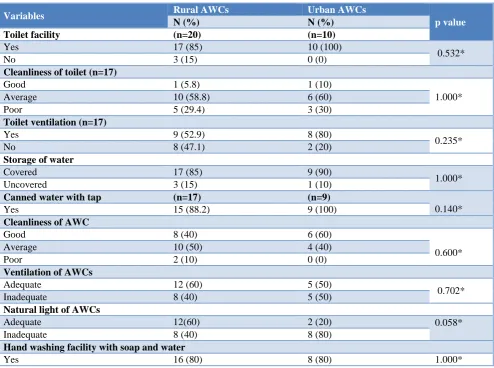
15% of rural AWCs lack functional toilet facility and most of them are unhygienic to use and do not have immediate access to soap and water after using toilets. 47% of rural AWCs lack toilet ventilation (Table 3).
40% of rural AWCs have inadequate functional weighing machines and 20% have inadequate medicine kit supplies (Table 4).
Table 2: Comparison of adequacy of space in urban and rural anganwadi centres.
Variables Rural AWCs (n=20) Urban AWCs (n=10) p value
N (%) N (%)
Separate space for cooking
Yes 13 (65) 10 (100)
0.064*
No 7 (35) 0 (0)
Separate space for storage
Yes 9 (45) 1 (10)
0.101*
No 11 (55) 9 (90)
Sufficient space for outdoor activity
Yes 16 (80) 5 (50)
1.000*
No 4 (20) 5 (50)
Sufficient space for indoor activity
Yes 16 (80) 6 (60)
0.384*
No 4 (20) 4 (40)
*: Fischer exact test.
Table 3: Comparison of environmental, sanitation and hygiene of rural and urban anganwadi centres.
Variables Rural AWCs Urban AWCs
p value
N (%) N (%)
Toilet facility (n=20) (n=10)
Yes 17 (85) 10 (100)
0.532*
No 3 (15) 0 (0)
Cleanliness of toilet (n=17)
Good 1 (5.8) 1 (10)
1.000*
Average 10 (58.8) 6 (60)
Poor 5 (29.4) 3 (30)
Toilet ventilation (n=17)
Yes 9 (52.9) 8 (80)
0.235*
No 8 (47.1) 2 (20)
Storage of water
Covered 17 (85) 9 (90)
1.000*
Uncovered 3 (15) 1 (10)
Canned water with tap (n=17) (n=9)
0.140*
Yes 15 (88.2) 9 (100)
Cleanliness of AWC
Good 8 (40) 6 (60)
0.600*
Average 10 (50) 4 (40)
Poor 2 (10) 0 (0)
Ventilation of AWCs
Adequate 12 (60) 5 (50)
0.702*
Inadequate 8 (40) 5 (50)
Natural light of AWCs
Adequate 12(60) 2 (20) 0.058*
Inadequate 8 (40) 8 (80)
Hand washing facility with soap and water
Yes 16 (80) 8 (80) 1.000*
Table 4: Comparison of adequacy of logistics in urban and rural AWCs.
Variables
Rural AWCs (n=20) Urban AWCs (n=10)
Adequate Inadequate Not available Adequate Inadequate Not available
N (%) N (%) N (%) N (%) N (%) N (%)
Low wooden table 0 (0) 4 (20) 16 (80) 0 (0) 1 (10) 9 (90)
Chairs 16 (80) 3 (15) 1 (5) 7 (70) 1 (10) 2 (20)
Functional weighing
machine 12 (60) 8(40) 0 (0) 9 (90) 0 (0) 1 (10)
Cooking vessels 11 (55) 9 (45) 0 (0) 8 (80) 2 (20) 0 (0)
Storage vessels 7 (35) 13 (65) 0 (0) 8 (80) 2 (20) 0 (0)
Mats 12 (60) 6 (30) 2 (10) 10 (100) 0 (0) 0 (0)
Almirah 6 (30) 12 (60) 2 (10) 8 (80) 2 (20) 0 (0)
Medicine kits 14 (70) 6 (30) 0 (0) 9 (90) 1 (10) 0 (0)
Posters or charts 16 (80) 4 (20) 0 (0) 10 (100) 0 (0) 0 (0)
Cleaning material 16 (80) 4 (20) 0 (0) 10 (100) 0 (0) 0 (0)
Toilet equipment 16 (80) 1 (5) 3 (15) 10 (100) 0 (0) 0 (0)
Fischer exact test, p value found to be >0.05.
Table 5: Comparison of supply of food items and fuel given by rural and urban anganwadi centres.
Variables Rural AWC (n=20) Urban AWC (n=10) P value
N (%) N (%)
Supply of food items or ingredients
Adequate 18 (90) 10 (100)
0.540
Inadequate 2 (10) 0 (0)
Supply of fuel
Adequate 20 (100) 9 (90)
0.333
Inadequate 0 (0) 1 (10)
Fischer exact test, p value found to be >0.05.
Table 6: Comparison of supervision of AWC during last 3 months.
Number of visits by
Rural AWC (n=20) Urban AWC (n=10)
P value
N (%) N (%)
No visit Only 1 >1 No visit Only 1 >1
Supervisors 0 2 (10) 18 (90) 3 (30) 1 (10) 6 (60) 0.059*
CDPO 15 (75) 3 (15) 2 (10) 6 (60) 2 (20) 2 (20) 0.59*
Health worker 3 (15) 0 17 (85) 0 3 (30) 7 (70) 0.03*
Medical officer 4 (20) 0 16 (80) 1 (10) 1 (10) 8 (80) 0.53*
*: Fischer exact test.
All the AWCs have sufficient supply of raw food material and fuel but the quality of supplementary nutrition is not up to the mark due to lack of proper storage where food gets spoiled fast (Table 5).
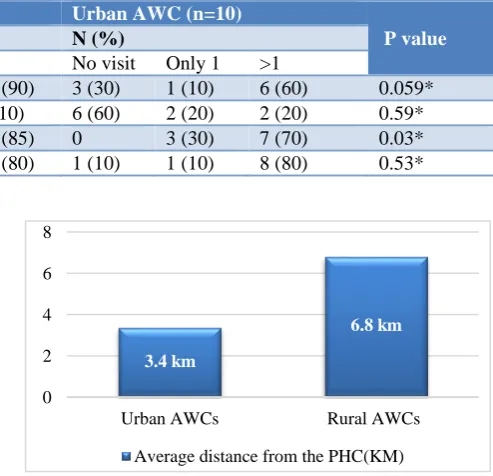
Frequency of health worker’s visit in rural is more than urban anganwadi centres in last 3 months. (Statistically significant p<0.05) (Table 6).
Rural anganwadi centres were situated far from their primary health centre than urban AWC (Figure 1).
Figure 1: Average distance urban and rural AWC from their respective primary health centres.
3.4 km
6.8 km
0 2 4 6 8
Urban AWCs Rural AWCs
DISCUSSION
In the present study, 85% of rural and 60% of urban anganwadi centres has own building and 40% of rural and 20% of urban anganwadi centre run in semi-pucca building. A study done by urban and rural anganwadi centre of Rajasthan by Mahathma Gandhi Medical college and Hospital, Jaipur shows that only 22.2% of urban anganwadi centres had own buildings and none in rural.13 22.2% AWCs in urban and 2.7% AWC in rural did not own their building. In Karnataka state, only 64.68% of AWC are running in own buildings.14 This shows that situation is better in Bangalore urban and rural than in Rajasthan regarding type of building for AWCs.
All urban AWC have separate space for cooking but only 85% of rural AWC have separate space for cooking. There is ample space for outdoor activities in rural AWC than urban AWC in this study. The Rathore et al study shows that only 16.7% and 22.2% of urban AWC and 44.4% and 41.6% rural AWC have separate space for cooking and storage respectively.15
All urban AWC have functional toilet facility and but 15% of rural AWC lack functional toilets. None of them are child friendly toilets. In India, only 50% of AWCs have built their own toilets.16 Compared to Indian scenario, Bangalore urban and rural AWCs have better toilet facilities. The Rathore et al study shows none of the toilets are child friendly thereby depicting the necessity of building hygienic toilets in AWCs.15
In this study, only 60% of rural AWCs and 90% of urban AWCs have functional weighing machine. A study done by Gill et al shows that only 31.5% of rural and 45% urban AWCs have functional weighing machine.17 Anganwadi workers must maintain the growth chart by measuring height and weight of the all children and monitoring weight gain of antenatal mothers. The functional weighing machine is one of the very important assets to provide best quality services.18
85% of rural AWCs and 70% of urban AWCs have more than 1 visit from health workers. A study done in Kolkata by Pal et al shows that only 11.1% of health worker visited more than once in last 3 months.19 The supervision and monitoring is stringent in urban and rural AWCs of Bangalore.
CONCLUSION
In this study, both urban and rural AWC have their own lacunae in the infrastructure, logistics and supervision by superior authorities. Utmost importance should be given to provide safe environment to children who learn, eat, sleep and play in the AWC which also involves preparing supplement nutrition and storing raw food materials in the hygienic environment.
Recommendations
Materials provided for beneficiaries to sit, play and learn should be in adequate quantity to ensure maximum development of cognitive, psychomotor and social domains of children. Urban AWCs are concentrated in school buildings which results in insufficient space for cooking, storage and other activities. Children friendly toilets should be constructed in all anganwadi centres (if possible separate toilet for girls and boys) as per rules and maintained properly. Supplementary nutrition provided should be of good quality in all anganwadi centres. Stringent and regular monitoring of anganwadi centres should be done by health workers, supervisors, primary health centre medical officers and Child development project officers (CDPO). Community should be educated and made proactive via mass media, road or stage shows etc., for healthy utilization of the services from the anganwadi centres.
ACKNOWLEDGEMENTS
I acknowledge Dean and Director of Bangalore Medical College and Research Institute for permitting to conduct the study. I acknowledge Child Development Project Officer of Bangalore urban and rural district and anganwadi workers and helpers for allowing conducting study in anganwadi centre. I also acknowledge medical officers of urban and rural field practice area of Bangalore Medical College and Research Institute. I acknowledge our Head of the department, faculty and postgraduates for their support.
Funding: No funding sources Conflict of interest: None declared
Ethical approval: The study was approved by the Institutional Ethics Committee
REFERENCES
1. Park K. Preventive Medicine in Obstetrics, Paediatrics and Geriatrics. Park’s Textbook of Preventive and Social Medicine. 25th ed. India: Banaridas Bhanot Publishers; 2019: 647-648. 2. Khadri AM. Health Policies and Programs in India.
In: Banerjee B, Banerjee R, ed. IAPSM’s Textbook of Community Medicine. 1st ed. India: Jaypee Brothers Medical Publishers (P) Ltd; 2019: 1127-1128.
3. Integrated Child Development Services Scheme. All India Status of ICDS Scheme, 2015. Available at: https://icdwcd.nic.in/Qpr0314forwebsite23092014/c urrentstatus.htm. Accessed on 30 July 2019.
4. Kishore J. Integrated Child Development Service (ICDS) Scheme. National Health Programs of India. 12th ed. Delhi, India: Century Publications; 2017: 495.
Child Health. 4th ed. New Delhi: Jaypee Brothers Medical Publishers (P) Ltd; 2013: 600.
6. Balwar R. Nutritional Programmes in India. In: Vaidya R, Gupta RK, Tilak R, Kunte R. Text book of Public Health and Community Medicine. 1st ed. New Delhi: Department of Community Medicine. Armed Forces Medical College, Pune in Collaboration with WHO; 2009: 782-783.
7. Integrated Child Development Services Scheme. Government of Karnataka. Department of Women and Child Development. Available at: http://dwcd.kar.nic.in:8080/icds.jsp#icds_object. Accessed on 1 August 2019.
8. Vikaspedia. Social Welfare, Intergrated Child Development Services Scheme. Norms for anganwadi centres establishment. Available at: http://vikaspedia.in/social-welfare/women-and- child-development/child-development-1/intregrated-child-development-scheme. Accessed on 1 August 2019.
9. Accountability Initiatives India. Budget Briefs on Integrated development Child Services Schemes 2018-2019. Available at: https://accountabilityindia. in/sites/default/files/pdf_files/Integrated%20Child% 20Development%20Services.pdf. Accessed on 1 August 2019.
10. Integrated Child Development Services, Supplementary Nutrition Programmes, Government of Karnataka. Available at: http://dwcd.kar.nic.in: 8080/icds.jsp#icds_nutrition. Accessed on 1 August 2019.
11. National Institute of Public Cooperation and Child Development. Guidelines for Monitoring and Supervision of the Scheme Central Monitoring Unit (ICDS). Available at: http://nipccd.nic.in/cmu/gd. pdf. Accessed on 1 August 2019.
12. National Institute of Public co-operation and Child Development. Guidelines for Monitoring and Supervision for ICDS Scheme. 2016-2017. Available at: http://www.nipccd.nic.in/file/cmu /Reports/2016-17/AWC-Ann.2016-17.pdf Accessed on 1 August 2019.
13. Rathore MS, Vohra R, Sharma BN, Chaudary RC, Bhardwaj SL, Vohra A. Evaluation of integrated child development services program in Rajasthan, India. Int J Adv Med Health Res. 2015;2:95-101. 14. Integrated Child Development Services Scheme.
Government of Karnataka. Department of Women and child development. Infrastructure of anganwadi centres in Karnataka. Available at: http://dwcd.Kar .nic.in:8080/icds.jsp#icds_Anganwadi. Accessed on 2 August 2019.
15. Rathore M, Vohra R, Sharma N, Chaudhary C, Bhardwaj S, Vohra A. Evaluation of integrated child development services program in Gujarat, India. Indian Pediatric. 2014;51(9):707-11.
16. Integrated Child Development Services Scheme. Ministry of Women and Child Development. Government of India. Anganwadi centre infrastructure, fact sheet 2015. Available at: https://icds-wcd.nic.in/icds.aspx. Accessed on 2 August 2019.
17. Gill KPK, Devgun P, Mahajan SL, Kaur H, Kaur A. Assessment of basic infrastructure in anganwadi centres under integrated child development services scheme in district Amritsar of Punjab. Int J Community Med Public health. 2017;4:2973-6. 18. Objectives of ICDS Mission. District Manual.
Integrated Child Development Services Scheme. MOWCD. GOI. Available at: http://icds-wcd.nic.in/icds/. Accessed on 2 August 2019. 19. Pal J, Dasgupta A, Prabhakar R, Ray S. An
evaluation of quality of infrastructure of ICDS centres in a slum area of Kolkata. Indian J Maternal Child Health. 2014;16(1):1-10.
Cite this article as: Abhijnana G, Thangaraj S, Ranganath TS, Vishwanath. Comparing infrastructure of anganwadi centres under integrated child