ISSN: 2149-214X
www.jeseh.net
Improving
the Pedagogical
Content
Knowledge (PCK) among Cycle 3
In-Service Chemistry Teachers Attending
the Training Program at the Faculty of
Education, Lebanese University
Zalpha Ayoubi, Suzanne El Takach, Muhammad Rawas Lebanese University
To cite this article:
Ayoubi, Z., El Takach, S. & Rawas, M. (2017). Improving the pedagogical content
knowledge (PCK) among cycle 3 in-service chemistry teachers attending the training
program at the faculty of education, Lebanese University.
Journal of Education in Science,
Environment and Health (JESEH), 3
(2), 196-212. DOI:10.21891/jeseh.326753
This article may be used for research, teaching, and private study purposes.
Any substantial or systematic reproduction, redistribution, reselling, loan, sub-licensing,
systematic supply, or distribution in any form to anyone is expressly forbidden.
Authors alone are responsible for the contents of their articles. The journal owns the
copyright of the articles.
Improving the Pedagogical Content Knowledge (PCK) among Cycle 3
In-Service Chemistry Teachers Attending the Training Program at the
Faculty of Education, Lebanese University
Zalpha Ayoubi, Suzanne El Takach, Muhammad Rawas
Article Info
Abstract
Article History
Received: 03 August 2016
The purpose of this study was to explore to what extent the in-service chemistry teachers‟ improved their PCK after attending the training program at the Faculty of Education. The research questions were: 1. How do in-service teachers‟ personal perceptions about the teaching/learning process change after attending the training course at the Faculty of Education? 2. How do in-service chemistry teachers‟ beliefs about the nature of science and scientific literacy change after attending the training course at the Faculty of Education? 3. Do in-service chemistry teachers make use of the newly acquired skills and knowledge about teaching at the end of the training program? Results indicated that teachers‟ beliefs about teaching and learning have changed away from the behaviorist towards more constructivist beliefs. Their conception of the nature of science has slightly inclined toward more “science as a way of knowing” and the “interaction of science with technology and society”. Finally, their teaching practices have developed toward more use of more active teaching strategies. Finally recommendations were made to enhance the development and improvement of PCK for both pre-service and in-service teachers.
Accepted: 20 April 2017
Keywords
PCK(Pedagogical content knowledge)
In-service teachers Teaching/learning conceptions Scientific literacy Nature of science Teaching strategies
Introduction
The Lebanese Ministry of Education and Higher Education (MEHE) cooperates with the Faculty of Education at the Lebanese University in training in-service teachers. To become public tenured teachers, in-service contractual teachers should pass the civic service exam and then should attend and pass a training program at the Faculty of Education, Lebanese University. In 2012, a group of more than 1200 in-service cycle 3 contractual teachers from all over Lebanon, of which 116 were chemistry teachers, were admitted to the Faculty of Education to pursue a training program in order to be tenured as public school teachers. A special training program was prepared for those in-service teachers aiming at helping them acquire the knowledge and skills required to deliver high-quality science teaching.
As instructors at the Faculty of Education and engaged in the training of chemistry teachers, we noticed that most of the in-service chemistry teachers focused in their teaching mainly on transmitting the science content in a traditional way. This is not surprising, since all these teachers hold a B.S in Chemistry or Biochemistry from the Faculty of Science and most of them did not enroll in any professional training course before. They have no idea about diverse teaching strategies nor relevant assessment procedures. Kind (2009) noted that the possession of a good Bachelor„s degree in a science subject is not a de facto guarantee that someone will teach that subject effectively. The Office for Standards in Education (Ofsted) reported that with the extensive subject knowledge of most secondary science teachers much teaching paid scant regard to what and how pupils were learning, teachers simply passed on information without any expectation of pupils‟ direct engagement in the process (Ofsted, 2008, p. 17). Bucat (2005) also stated that there is a vast difference between knowing about a topic and knowledge about the teaching and learning of that topic.
(Shulman, 1987, p. 8). He argued that teachers need a large spectrum of rather different competencies. In teacher education programs, teachers are usually taught content knowledge and pedagogical knowledge and the link between the two kinds of knowledge is usually missing. Shulman believed that this kind of knowledge, the PCK, is the major key to successful teaching. Linking competencies provided by the content domain and competencies from various other disciplines, especially pedagogy and psychology is at the heart of the conception of science education (Duit, 2007). According to Chiappetta and Koballa (2010), “PCK fuses the „what‟ and the „how‟ of instruction in a way that facilitates learning” (p.33).
PCK Components
Shulman (1986) proposed a general description of PCK to include three components: (1) knowledge of topics regularly taught in one‟s subject area, (2) knowledge of forms of representation of those ideas, and (3) knowledge of students‟ understanding of the topics. Subsequent researchers expanded PCK components. Grossmann (1990), for example, clarified four components: (1) conceptions of purpose for teaching subject matter, (2) knowledge of students understanding, (3) curricular knowledge, and (4) knowledge of instructional strategies. Tamir (1988) extended Shulman‟s clarification to include knowledge of evaluation. Magnusson, Krajcik, and Borko (1999) conceptualized PCK for science teaching as consisting of five components: (1) orientations toward science teaching, (2) science curriculum knowledge, (3) knowledge of the students, (4) assessment, and (5) instructional strategies.
The traditional separation of content and pedagogy in science preparation programs has lead Veal and Makinster (1999) to develop two PCK taxonomies that can serve as models for secondary science teachers‟ preparation: General taxonomy of PCK and taxonomy of PCK attributes. The General Taxonomy of PCK was organized hierarchically from the broadest conception „general PCK‟ to a more specific „Domain PCK‟ to the most specific „topic specific PCK‟. The Taxonomy of PCK attributes has ten attributes that are inter-related. „Content knowledge‟ and „knowledge of students‟ are two attributes that should be developed before the other eight attributes are integrated into a coherent manner. The eight attributes include: Content, environment, nature of science, assessment, pedagogy, curriculum, socioculturalism and classroom management (Veal & Makinster, 1999).
Van Driel et al. (1998) defined craft knowledge as an “integrated knowledge which represents teachers‟ accumulated wisdom with respect to their teaching practice” (p. 674). This definition is restricted to types of knowledge which actually guide the teachers‟ behavior during classroom practice, thus PCK is a specific form and an essential component of craft knowledge. They indicated that pre-service teachers had inadequate content knowledge and PCK and could not use teaching methods effectively and concluded that without a strong PCK, science teachers are said to have little knowledge of potential student‟s problems and specific preconceptions and have difficulties selecting appropriate representation of subject matter (van Driel et al., 1998). Van Driel et al. (2002) also investigated the development of pedagogical content knowledge (PCK) within a group of 12 pre-service chemistry teachers. They found that classroom experience had the strongest impact on PCK development. These experiences include activities and events in classroom teaching which also positively affected the knowledge of representation and teaching strategies among the pre-service teachers.
Teaching and Learning Conceptions
Generally there are two major conceptions of teaching: The traditional approach and the constructivist approach. The traditional approach is a teacher-centered approach characterized by the direct transmission of knowledge from the teacher to the passive, receivers of knowledge students. This teacher-centered method of teaching assumes that all students have the same level of background knowledge in the subject matter and are able to absorb the material at the same pace (Lord, 1999). On the other hand, in the constructivist approach, students are actively involved in the learning process and the teacher guides them in constructing their own knowledge. Learner-centered methods allow students the opportunity to take responsibility for their learning by being actively involved in the learning process rather than simply passively receiving information from a lecture (Slunt & Giancario, 2004).
relationship among the teaching-learning conceptions and epistemological beliefs of student teachers. He concluded that: “Student teachers‟ epistemological beliefs and conceptions of teaching and learning are viewed as important since they will influence their behavior in classroom and determine their teaching strategies” (p. 2600). Teachers‟ teaching/learning conceptions were found to have an impact on students‟ conceptions and learning strategies (Igwebuike et al, 2013). Donche et al (2007) indicated clear relationships between teachers‟ conceptions of learning and teaching and students‟ learning strategies. They found that how teachers think about learning and teaching is associated with how their students learn and consequently have a differential impact on different learning strategies.
Nature of Science and Scientific Literacy
The phrase “nature of science” typically refers to the epistemology of science, science as a way of knowing, or the values and beliefs inherent to the development of scientific knowledge (Lederman, 1992). Philosophers of science, historians of science, sociologists of science, scientists, and science educators disagree on a specific definition for NOS. The NOS has been defined in many ways throughout the decades. The 1907 report of the Central Association of Science and Mathematics Teachers emphasized in the definition of NOS on the scientific method and the processes of science (Lederman, 1992). However, Lederman and Zeidler (1987) referred to the values and beliefs inherent in scientific knowledge and its development. This lack of consensus is not surprising given the multifaceted and complex nature of the scientific endeavor.
Like scientific knowledge, conceptions of NOS are dynamic and have changed throughout the development of science and systematic thinking about science (Abd-El-Khalick & Lederman, 2000a). More importantly, for purposes of teaching and learning about NOS at the precollege level, they stressed that for science teachers to be able to convey adequate NOS conceptions to their students, they should themselves possess informed conceptions of the scientific enterprise. Abd-El-Khalick and Lederman (2000b) advocated that science teachers need to have more than a rudimentary or superficial knowledge and understanding of various NOS aspects in order to be able to effectively teach NOS to K-12 students. Teachers need to know a wide range of related examples, explanations, demonstrations, and historical episodes. They should be able to comfortably discourse about various NOS aspects, contextualize their NOS teaching with some examples or „stories‟ from HOS, and design science-based activities to render the target NOS aspects accessible and understandable to K-12 students. Traditionally, science content primarily denotes science concepts and principles. However, recent views of scientific literacy claim that also science processes, views of the nature of science, and views of the relevance of science in daily life and society should be given substantial attention in science instruction (Bybee, 1997 as cited in Duit, 2007). Assessing beliefs on various dimensions of science education has become an important research topic in the field of science education. Amongst these dimensions, the assessment of teachers‟ beliefs regarding the nature of science (NOS) has been the focus of attention in the last two decades with the assumption that teachers‟ beliefs about the subject matter they teach exert a powerful influence on their instructional practice (Shulman, 1986).
Researchers argue that NOS can be seen as a part of subject matter knowledge (SMK). Mihladiz and Dogan (2011) conducted a research to determine the status of pre-service teachers‟ subject matter knowledge of the nature of science by investigating in which contents they were inadequate and/or they have naïve view about the NOS. They concluded that improvement is needed and teachers should be educated about philosophy, history, sociology and psychology of science.
Project 2061 (AAAS 1989) defined a scientifically literate person as one who is: “Aware that science, math, and technology are independent human enterprises with strengths and limitations; understands key concepts and principles of science; is familiar with the natural world and recognizes both its diversity and unity; and uses scientific knowledge and scientific ways of thinking for individual and social purposes” (AAAS, 1989, p.4). Holbrook and Rannikmae (2009), recognized two points of view regarding the meaning of scientific literacy: a) those that advocate a central role for the knowledge of science; and b) those who see scientific literacy referring to a society usefulness.
eventually acquire to be considered fully proficient in science. They claimed that students who are proficient in science (p. 36):
1. know, use, and interpret scientific explanations of the natural world; 2. generate and evaluate scientific evidence and explanations;
3. understand the nature and development of scientific knowledge; and 4. participate productively in scientific practices and discourse.
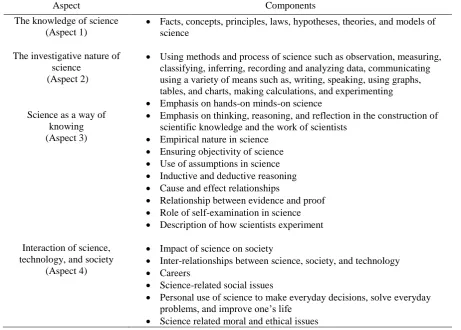
Chiapetta et al. (1991) proposed a scientific literacy framework and identified the four aspects that seem to permeate all definitions of scientific literacy: 1) the knowledge of science, 2) the investigative nature of science, 3) science as a way of thinking, and 4) the interaction of science, technology and society (STS). BouJaoude (2002) adopted these four aspects to investigate the balance of scientific literacy themes in the Lebanese science curriculum. Results showed that the Lebanese curriculum emphasizes the knowledge of science, the investigative nature of science, and the interactions of science technology and society, but neglects „science as a way of knowing‟. These four aspects of science were used in this study to investigate the teachers‟ understanding of the nature of science and scientific literacy. The components of the four aspects appear in Table 1.
Table 1. Aspects of scientific literacy
Aspect Components
The knowledge of science (Aspect 1)
Facts, concepts, principles, laws, hypotheses, theories, and models of science
The investigative nature of science
(Aspect 2)
Using methods and process of science such as observation, measuring, classifying, inferring, recording and analyzing data, communicating using a variety of means such as, writing, speaking, using graphs, tables, and charts, making calculations, and experimenting
Emphasis on hands-on minds-on science Science as a way of
knowing (Aspect 3)
Emphasis on thinking, reasoning, and reflection in the construction of scientific knowledge and the work of scientists
Empirical nature in science
Ensuring objectivity of science
Use of assumptions in science
Inductive and deductive reasoning
Cause and effect relationships
Relationship between evidence and proof
Role of self-examination in science
Description of how scientists experiment
Interaction of science, technology, and society
(Aspect 4)
Impact of science on society
Inter-relationships between science, society, and technology
Careers
Science-related social issues
Personal use of science to make everyday decisions, solve everyday problems, and improve one‟s life
Science related moral and ethical issues
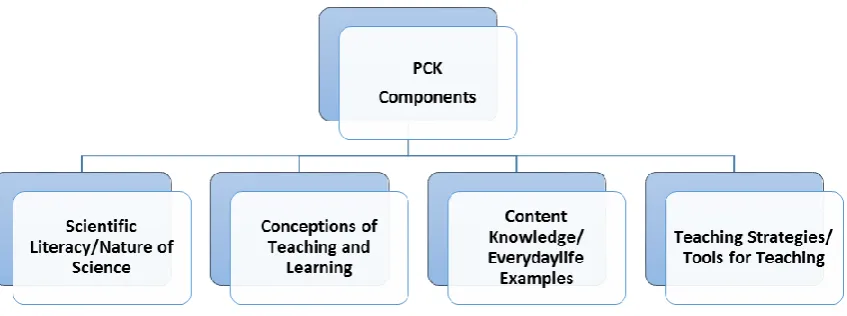
PCK components related to the present research
Figure 1. PCK components used in this research
Purpose of the Study
It is agreed that if teachers‟ PCK expands, both in pedagogy and content, their ability to impact students‟ learning increases. Accordingly, the teachers‟ training programs should emphasize developing teachers‟ PCK. In their review of studies related to PCK in the context of science teacher education, Aydin and Boz (2012) found that among the twenty eight studies, only three studies focused on determining in-service teachers‟ PCK. Since studies mainly focused on pre-service teachers‟ PCK, the purpose of this study is to explore to what extent the in-service chemistry teachers‟ improved their PCK after attending the training program at the Faculty of Education. The main research questions investigated were:
1. How do in-service teachers‟ personal perceptions about the teaching/learning process change after attending the training course at the Faculty of Education?
2. How do in-service chemistry teachers‟ beliefs about the nature of science and scientific literacy change after attending the training course at the Faculty of Education?
3. Do in-service chemistry teachers make use of the newly acquired skills and knowledge about teaching at the end of the training program?
Methodology
This study is a descriptive one and of an exploratory nature. As the aim of this study was to explore in-service teachers‟ PCK improvement after attending the training program, and not to emphasize causality or generalize results, a qualitative approach is preferable (Johnson & Christensen, 2008). For the purposes of this study a mixed design with more qualitative data than quantitative ones was used.
Participants
A total of 116 in-service chemistry teachers, who attended the training program at the Faculty of Education, participated in this research. Thirty were males (26%) and 86 were females (74%), the English teachers were 42 (36%) and the French teachers were 74 (64%). Participants were: Forty two (36%) from the North and Akkar, 6 (5%) from Beirut, 28 (24%) from Bekaa, 16 (14%) from Mount Lebanon, and 24 (21%) from The South and Nabatiyeh. All the French in-service teachers were graduates from the Lebanese University while only almost half of the English in-service teachers graduated from the Lebanese University. The number of years of teaching experience ranged from 2 to 22 years with an average of 9.33 years.
Data Collection Tools
The pre- questionnaire questions aimed to collect trainees‟ personal and professional profile. Part of the questions were used to collect personal data such as: Name, phone number, e-mail address, and education. Other questions aimed to collect data related to the trainees previous experiences such that if they have participated in a training program before and if they have access to the Internet. The rest of the questions were intended to collect data regarding their pre- PCK knowledge such as: their knowledge of the newest trends in science teaching, teaching strategies they consider most effective for teaching science, and their beliefs related to the teaching/learning process and the nature of science.
The Post-questionnaire questions aimed to collect data related to teachers‟ ideas and beliefs regarding the teaching/learning process and the nature of science.
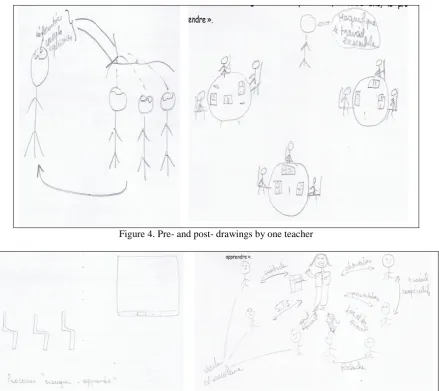
Drawings were used in the pre- and post- questionnaires to collect data related to the teachers‟ beliefs regarding teaching and learning by asking them to draw their mental image of what they think of the teaching/learning process and to write an explanation of their drawings to aid in the analysis of the drawings.
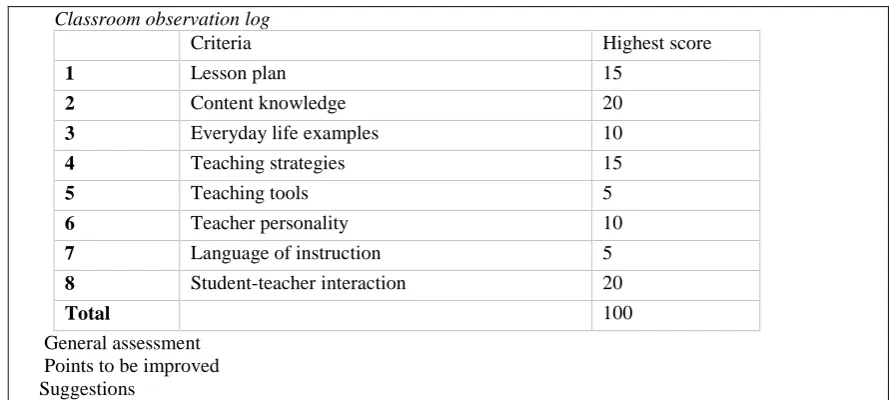
Classroom observations were another data collection tools. Participant observers observed trainee teachers twice, one time during the training program and the second at its end. They filled an observation log for every teacher composed of eight criteria and wrote a brief report concerning the strong points, points that need improvement and suggestions for the future (Figure 2).
Classroom observation log
Criteria Highest score
1 Lesson plan 15
2 Content knowledge 20
3 Everyday life examples 10
4 Teaching strategies 15
5 Teaching tools 5
6 Teacher personality 10
7 Language of instruction 5
8 Student-teacher interaction 20
Total 100
General assessment Points to be improved Suggestions
Figure 2. Classroom observation log
Scores on four criteria of the observation log and the participant observers‟ field notes and comments were used as data in this research. Scores on „content knowledge‟ and „examples from everyday life‟ were used as a measure of teachers‟ subject knowledge. The „content knowledge‟ score was related to the teacher‟s knowledge of the specific content of the lesson taught at the time of observation and the score on „examples from everyday life‟ reflected teachers‟ chemistry knowledge as it is assumed that good teachers can relate everyday life examples to the chemistry content taught. The sum of the scores on „teaching strategies‟ and „teaching tools‟ was assumed to measure improvement in the use of the teaching strategies.
Achievement test scores of the two courses: „Methodology of teaching chemistry‟ and „practicum‟ were also used as quantitative data to measure improvement in PCK.
Description of the Training Program
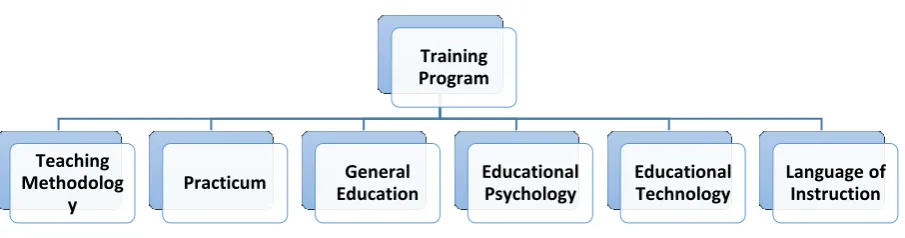
Figure 3. The training program
The two core courses are “Teaching Methodology” and “Practicum”, the first deals with the theoretical knowledge needed for the teaching of chemistry and it includes the following themes: Learning theories, lesson planning, science literacy, conceptual change and common students‟ alternative conceptions, teaching strategies, the chemistry curriculum and students‟ evaluation and assessment. The second course deals with the practical knowledge of teaching chemistry at the intermediate level (cycle 3).
It is composed of two components, one is done in the Faculty where issues related to teaching from lesson planning to actual teaching are discussed and the other is practice teaching in the schools where they are supervised by participant observers who observed every teacher twice and filled the observation log at the end of the second observation. The other four courses were: General Education, where teachers were introduced to the fundamentals of education stressing classroom management, curriculum and evaluation, Educational Psychology, stressing topics related to child development and learning theories, Educational Technology, stressing computer skills and use of the active board and ActiveInspire software to prepare lessons, and Language of Instruction to upgrade teachers‟ English or French language as it is the language of science instruction in the schools.
Results
Results related to Research Question 1 (RQ1)
RQ1 stated: How do trainee teachers‟ personal perceptions about the teaching/learning process change after attending the training course at the Faculty of Education?
To answer this question teachers‟ pre- and post- drawings of their mental images of the learning-teaching process and their comments on the drawings, were analyzed and compared based on the following criteria:
1. Teaching practices (e.g. frontal teaching, group work…)
2. Teacher face expression (e.g. no expression, happy face, smiling…) 3. Class management (e.g. how students are seated)
4. Use of technology in instruction (e.g. computer, LCD projector, screen…) 5. Indoor/outdoor instruction (e.g. classroom, laboratory, outdoor activity…) 6. Captions (e.g. teacher‟s talk, students‟ talk)
7. Use of philosophical metaphors displaying the role of a teacher (e.g. burning candle, watering plants…) In the pre-questionnaire, many teachers left blank the box addressed to the drawing of the mental image of the learning-teaching process. Teachers who drew pictures of their mental image, their drawings were very simple and represented the teacher in the classical cliché as standing in the middle of the class with the chalk and the board as the only teaching tools, while students are small in size sitting in rows with no facial expressions. This shows that these teachers held a traditional behavioristic view about teaching and learning where the teacher is in charge of the teaching/learning process and that knowledge is transmitted from the teacher to his passive students through the only chalk-and-talk instruction. Teachers also drew learning as happening in an isolated place where students gain knowledge irrelevant to the outside world.
Training Program
Teaching Methodolog
y
Practicum General
Education
Educational Psychology
Educational Technology
In the post-questionnaire, more teachers drew their mental image of the teaching/learning process. Although few drawings representing the traditional teaching remained, most teachers presented richer drawings. These drawings reflected an emphasis on the learning environment, by showing a smiling teacher whose role is to create an engaging and a comfortable environment to students. Drawings also represented the teacher guiding the students while they are working in the laboratory, working in groups, or learning outside the classroom in a field trip. In addition, they emphasized the use of more active teaching methods mainly the use of group work and technology. Examples of pre and post drawings appear in figures 4, 5, and 6.
Comparing the teachers‟ written explanations showed that in the post-questionnaire they used richer vocabulary to explain their drawings as one can read now about developing creativity, critical thinking and imagination, terms that were missing in the pre-questionnaire. They started to think that one of the objectives in science education is to prepare scientifically literate future citizens as some teachers admitted the role of the teacher as the bridge between the learners and their needs to know about the society. They also started to think of the teaching-learning as an active process where students work together and the teacher guides them and facilitates their learning. These results revealed that most of the teachers‟ beliefs about the teaching and learning of science has changed from a traditional behavioristic conception to a more constructivist facilitator conception. Excerpts from the teachers‟ comments in the pre-questionnaire:
The learning –teaching process is an exchange of information between the learner and the teacher. In the post-questionnaire, another teacher wrote:
After this course, I found that a learner can learn through discovery-based with the help of his teacher and he becomes autonomous layperson.
Figure 4. Pre- and post- drawings by one teacher
A recipient to be filled Teaching as discovery. Students use inductive/deductive reasoning in order to find a conclusion by cooperative work. Teacher guides them and makes a sum-up at the end-of-lesson.
Figure 6. Pre- and post- drawings and the explanations written by one of the teachers
Results Related To Research Question 2 (RQ2)
RQ2 stated: How do in-service chemistry teachers‟ beliefs about the nature of science and scientific literacy change after attending the training course at the Faculty of Education?
To answer this question, chemistry in-service teachers‟ responses to the question: What does science mean to you? fromthe pre- and post-questionnaires were coded, analyzed, and categorized according to the four aspects of „Scientific Literacy‟ presented by Chiappetta and Koballa (2010, p.105): 1. Science as a body of knowledge, 2. Science as a way of investigating, 3. Science as a way of knowing and 4. Interaction of Science with Society and Technology (STS).
Table 2 shows the percentages of teachers‟ responses aligned with the four aspects before and after the training program. It shows that almost half of the teachers at the beginning of the training program thought of science as „body of knowledge‟ and more than one third of them said that science is related to investigation while only 2.9% thought of it as a „way of knowing‟ and only 8.1% considered „STS‟ in their responses, reflecting that almost 90% of the teachers considered science as the knowledge produced by doing experiments. After training, the percentages of the „body of knowledge‟ aspect decreased to 27.9% and the „way of knowing‟ aspect increased to 10.9%, of the „STS‟ aspect increased dramatically to 26.3% with that of the „way of investigating‟ aspect slightly decreasing to 34.9%. These results indicate a slight shift from understanding science as a „body of knowledge‟ more towards the „STS‟ and to a lesser degree towards science as a „way of knowing‟.
Table 2. Percentages of teachers‟ responses aligned with the four aspects of scientific literacy before and after the training program
Aspects of Scientific Literacy Body of Knowledge
Way of Investigating
Way of Knowing STS
Before training 51.5% 37.5% 2.9% 8.1%
After training 27.9% 34.9% 10.9% 26.3%
Table 3. Percentages of teachers‟ different combinations of the four aspects of scientific literacy before and after the training program
One aspect Two aspects Three aspects Four aspects
Before 62.6% 37.4% 0% 0%
After 55.2% 34.9% 7.6% 2.3%
Excerpts of same teachers‟ responses to the question what science means to you, before and after the training program appear in Table 4.
Table 4. Excerpts of definitions of science before and after the training
Before training After training
It is life science, it is the study of living species
Science is a way of thinking, it is interaction between science and technology, it is investigating.
It is understanding the world Science means to continue learning, to be creative, to be organized and disciplined, to do research and to continue to learn and to develop new skills
Science is to explain everything around us
Science is to learn lots of knowledge and to relate them to daily life, to try to solve societal problems, such as related to our environment. In this way we become good citizens
Science means everything you need to know about. It is the knowledge of life
S stands for science, C stands for create, I stands for identify, E stands for explore, N stands for note, C stands for cooperate and E stands for evaluate
Results Related To Research Question 3 (RQ3)
RQ3 stated: Do in-service chemistry teachers make use of the newly acquired skills and knowledge about teaching at the end of the training program? To answer RQ3, teachers‟ responses to the questions in the pre-questionnaire related to what is considered a pre-PCK knowledge were analyzed and compared to the quantitative and qualitative data gathered from achievement scores and classroom observations respectively. Teachers‟ experiences before attending the training program appear in Table 5. It shows that only 46.5% of the teachers did participate in short-duration fragmented training programs while 41.4% did not participate in any training course. Table 5 also indicates that almost half of those who have access to the internet do not use technology in their teaching and that almost two thirds (67.2%) of the teachers admitted that they were not well informed about the newest trends in science education and referred this lack of information to heavy work load, lack of time, lack of technological skills and lack of continuous professional development courses.
Analysis of the responses to the question related to teachers‟ perceived needs at the beginning of the training course revealed that although they were not novice teachers, their needs revolved around basics in teaching chemistry. Almost half of the teachers‟ responses were related to the need to learn about teaching strategies, 16.1% need to improve general pedagogical skills (lesson planning, assessment, classroom management) and 18.1% need to learn how to improve students‟ lab skills. The need to learn more about chemistry including content knowledge, nature of science and science literacy, constituted only 4.4% of the responses, the same percentage for the need to improve their technology skills.
Table 5. Percentages of teachers‟ responses to questions related to their experience
Question Yes No No Answer Total
Did you participate to any training program before? 41.4% 46.5% 12.1% 100% Do you have a regular access to the internet? 52.6% 28.4% 19% 100%
Do you use technology in teaching 26.7% 55.2% 18.1% 100%
Do you feel informed with the newest trends in teaching?
16.4 % 67.2% 16.4% 100%
Excerpts of the teachers‟ responses to the question about how to teach chemistry for students for the first time are: One teacher wrote
Yes, I start a small class discussion, then I name some concepts and I ask them to name some chemical products from their daily life, then I start the explanation”. Another one wrote: “I give examples from their everyday life and classify them into physical and chemical.
The quantitative post data concerning teaching strategies came from teachers‟ achievement scores in the „methodology of teaching chemistry‟ and the „practicum‟ courses and from scores on the components of the practicum evaluation considered important in revealing improvement in PCK criteria scores: „content knowledge‟, „use of everyday life examples‟, and „use of teaching strategies and tools‟. Descriptive statistics of these scores appear in Table 6.
Table 6. Descriptive statistics of teachers‟ achievement scores
Scores Minimum Maximum Mean SD
Teaching Chemistry 54 87 68.91 6.693
Practicum 60 92 78.28 5.976
Content Knowledge 60 95 81.25 8.794
Everyday life examples 40 90 70.17 12.299
Teaching Strategies and Tools 50 95 77.93 8.749
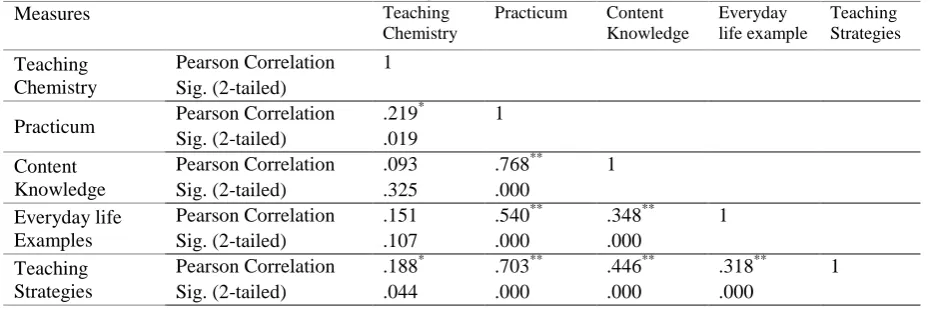
Spearman correlation coefficients among the above mentioned scores were obtained (Table 7). They revealed that strong significant correlations were obtained between „Practicum‟ and two of its criteria: „Content Knowledge‟ and „Teaching Strategies‟ and moderate significant correlation with „Everyday Life Examples‟, indicating that even when teachers know their subject matter they do not, during their teaching, often relate chemistry to everyday life. This can also be concluded from the weak significant correlation between „Teaching Strategies‟ and „Everyday Life Examples‟. Surprisingly, weak significant correlations existed between „Teaching Chemistry‟, on one hand, and „Practicum‟ and „Teaching Strategies‟ on the other, and no correlations existed between „Teaching Chemistry‟ and „Content knowledge‟ and „Everyday life examples‟
Table 7. Correlations among the different achievement measures
Measures Teaching
Chemistry
Practicum Content Knowledge
Everyday life example
Teaching Strategies
Teaching Chemistry
Pearson Correlation 1 Sig. (2-tailed)
Practicum Pearson Correlation .219
* 1
Sig. (2-tailed) .019 Content
Knowledge
Pearson Correlation .093 .768** 1
Sig. (2-tailed) .325 .000
Everyday life Examples
Pearson Correlation .151 .540** .348** 1
Sig. (2-tailed) .107 .000 .000
Teaching Strategies
Pearson Correlation .188* .703** .446** .318** 1
Sig. (2-tailed) .044 .000 .000 .000
Qualitative analysis of the participant observers‟ field notes and written comments revealed that, even though not all teachers at the end of the training program have acquired the necessary skills to be qualified teachers, most of them have improved their pedagogical knowledge and skills. Observers‟ comments revealed that many chemistry teachers started to use technology in their daily routine, e.g., using the internet to back up their lessons with science examples and writing exams for their students. Also, most of them were using a variety of teaching strategies and tools such as group work, classroom demonstrations, and PowerPoint presentations. Detailed analysis of the observers‟ comments regarding the teachers‟ strong points, weak points and suggestions for improvement revealed that although most of the teachers had a good command of the content they are teaching but not all of them were able to relate the chemistry lesson they are teaching to everyday life. Results also revealed that more teachers started to use more student-centered approaches and a variety of teaching strategies such as group work, lab work, technology, and questioning and wait time. They became more aware of the importance of involving students and capturing their attention by relating topic taught to previous knowledge and putting students in problem situations to motivate their thinking and participation. Observers‟ comments also included teachers‟ needs to improve their understanding of the chemistry content in its minute details, to use chemistry language correctly and to relate content they are teaching to everyday life. Still some teachers need to work on varying the teaching strategies and using more teaching aids and others need to align activities with the lesson objectives and to use more active teaching methods.
Although the strong points exceeded the points that need improvement, participant observers suggested that almost one third of the teachers still need to master the middle school chemistry curriculum, to vary the teaching strategies to actively involve the students, to use laboratory experiments and technology more effectively and to relate chemistry content with everyday life. Excerpts from the observers‟ reports regarding teachers‟ strong points, weak points and suggestions follow:
Strong points
Invests tools from everyday life in learning, uses purposeful questioning and wait time, positive environment for learning, varies activities, respect and love relationship with students
Uses lots of examples from everyday life which increased interaction with students, active classroom environment
Ability to attract students’ attention all the time by using LCD and putting students in problem situations to motivate their thinking
Confident in her abilities, active, captures her students’ attention, varies in teaching methods, can work with whole class and with individuals, achieve the objectives
Encourages students to induce and analyze by using variety of teaching strategies, good class manager, good questioning techniques to deepen understanding, good language of instruction and good use of chemistry language
The teacher is self-confident, she is a happy and enthusiastic teacher and she uses various science activities. She is flexible, she is able to address to the whole class as well as to small groups and she can help students who have difficulties in understanding.
Weak points
Some activities do not align with objectives, sometimes no connection with students
No good investment of activities in improving higher level thinking skills
She did not relate lesson with everyday life, lesson planning is limited to textbook
Lacks precision in chemistry content details
Lacks the use of lab wares, limiting her planning with the textbook
Weak involvement of students in learning and difficulty in managing group work
Some activities do not align with objectives, no variety of activities, no good management of objectives and time
No use of misconceptions to build learning, does not involve all students while using questioning leading to less interaction with all students.
Suggestions
Look up in internet for everyday life examples and applications of chemistry
Focus on learning outcomes while preparing activities and align activities with learning objectives
Focus on the students as the center of the teaching/learning process
Learn more about the chemistry curriculum for cycle 3 and lab work
Use group work and students’ misconceptions in the learning process
Involve students in constructing their knowledge by using a variety of teaching strategies and activities and linking the content to everyday life
Improve group work and involve students in problem solving and high level thinking activities
Discussion
The PCK used in this study is described as composed of two major components: Content knowledge and pedagogical knowledge. In this research, teachers‟ understanding of the nature of science and scientific literacy in addition to their ability to relate the chemistry content to everyday life were considered as measuring the chemistry content knowledge. Pedagogical knowledge was aligned with both teachers‟ conceptions of the teaching/learning process and the teaching strategies, tools, and activities they use while practicing teaching. Discussion of the findings from the three research questions in connection with the PCK components used in this research follows.
First, it was found that teachers at the beginning of the training program held a traditional behavioristic conception about teaching and learning as revealed by the drawings of their mental images of the teaching/learning process. At the end of the training program, teachers presented a wide variety of drawings revealing a change in their conceptions towards more active teaching and learning. Most of the teachers‟ beliefs about the teaching and learning of science has changed from a traditional behavioristic conception to a more constructivist conception. In-service teachers became more aware of their role as facilitators of learning where they guide students‟ work and support the development of their higher order skills.
The finding that teachers at the beginning of the training program viewed science as a „body of knowledge‟ produced by doing experiments, is in accordance with findings from Abd-El-Khalick and Boujaoude (2003) who found that science teachers defined science as an academic subject whose purpose is to give information about the world, and most of them saw themselves and others using science in academic rather than everyday life settings. Ayoubi and Boujaoude (2006) found that chemistry teachers focused heavily, in their teaching, on academic objectives, with some apparent attention to STS objectives, and almost total negligence of history of chemistry. These findings might explain the lack of the attainment of currently advocated goals for science education, which mainly aim to help students internalize more informed views of NOS as a process and a way of generating valid knowledge about the natural world that is relevant to students‟ everyday personal and social, as well as, academic lives.
The fact that after training there was a slight shift in teachers views from science as „content knowledge‟ to science as a „way of knowing‟ and „STS‟ while the view of science as a 'way of investigation‟ remained unchanged, may be explained as a consequence of the training program which emphasized the nature of science and scientific literacy. Integrating explicit, reflective discussions about nature of science into an inquiry curriculum showed some success in shifting students‟ conceptions of the nature of science (Kenyon & Reiser, 2005). Similar findings were obtained from other studies concluding that if we want to improve students‟ understandings about NOS, then we should teach it explicitly through investigative activities and reflective discussions (Abd-El- Khalick & Lederman, 2000b; Bartholomew, Osborne, & Ratcliffe, 2004; and Schwartz, Lederman, & Crawford, 2004). Bartholomew, Osborne and Ratcliffe (2004) added that as pre-service teachers will be teaching about science and not “doing” science, they must have knowledge of the concepts and effective approaches to teaching science. As such, to teach NOS, teachers need knowledge and pedagogical knowledge of NOS. Schwartz, Lederman, and Crawford (2004) suggested that, as the purpose of teaching about NOS and scientific inquiry is to enhance scientific literacy and not necessarily to train students to be scientists, the development of NOS views in an inquiry context can be achieved through explicit attention to NOS issues and guided reflection.
The lack in teachers‟ perceptions about NOS, although most of them hold a diploma in Chemistry or Biochemistry from the Faculty of Science, implies that the regular chemistry preparation programs do not emphasize the understanding of the nature of science or the structure of chemistry. This requires that teachers should be compensated for this lack by providing them with opportunities to participate in meaningful professional development activities aiming at improving their understanding of the NOS and teaching about the NOS. Teachers should be able to use teaching approaches that focus on the use of the history of science or the history of chemistry (e.g., scientist biography, the history of inventions) to enhance students‟ understanding of all aspects of scientific literacy especially science as a „way of knowing‟ or a „way of thinking‟.
Finally, at the beginning of the training program, it was found that most teachers could be identified as traditional teachers. The pre-PCK knowledge, related to teachers‟ experiences before attending the training program, indicated that they were not well informed about the newest trends in science education and most of them admitted the need to learn about the new teaching strategies especially about conducting laboratory experiments and relating chemistry to everyday life. Observations revealed that, at the end of the training program, most teachers started to use more active teaching strategies, linked content knowledge to everyday life and used technology in meaningful ways but only in schools that are equipped with computers. Moreover observers‟ comments indicated that most of the teachers have improved the second time they were observed but still some of them need to master the middle school chemistry curriculum, to vary the teaching strategies, to actively involve the students, to use laboratory experiments and technology more effectively, and to relate chemistry content with everyday life. Even though teachers were found to know their subject matter well, they did not often relate the chemistry content they are teaching to everyday life.
Recommendations
Based on the results of this research we recommend that in-service teachers‟ should be involved in continuous training and professional development programs to keep them informed and up-to-date in both content and pedagogy. Improving the content PCK comprise understanding the structure of chemistry knowledge, nature of chemistry, how it is produced and its relation to everyday life and society. To improve pedagogy, professional development programs should pay special attention to developing teachers‟ understanding of the constructivist conceptions of teaching and learning and consequently should focus on planning and implementing the active and student-centered teaching strategies, and not forgetting the integration of technology in their teaching. In addition, special attention should be paid to the understanding of the chemistry curriculum and the assessment of student learning procedures. The organization of workshops, seminars and any other forms of in-service training should be targeted toward exposing chemistry teachers to the various components of PCK to support their PCK which in turn will enhance the effectiveness of teaching chemistry in the classroom. The same is true for pre-service teaching, the teachers of methodology of chemistry teaching in the teacher education programs should expose the student-teachers PCK and its various components.
We recommend that more research should be conducted focusing on the effect of the teachers‟ acquired PCK on students‟ learning outcomes especially on higher order outcomes. Improving the quality of student learning requires working with future teachers and encouraging them to adopt higher quality approaches to teaching as they are the critical factors in students‟ learning. In the same manner, future research should be conducted on improving PCK for university educators and science educators since they are the ones who are in direct contact with the future teachers and responsible for their preparation for teaching. If teachers are to be well qualified to teach in the schools, their teachers should be well qualified to teach them. There is an ample research on teachers' PCK and it is time to explore how the university professors‟ construct and implement their PCK. Finally, as technology is becoming more and more an important factor in teaching, and as it is becoming an important part of teachers‟ PCK, Mishra and Koehler (2006) proposed a TPCK framework that they believe can guide further research and curriculum development work in the area of teacher education and teacher professional development around technology. The TPCK framework allows viewing the entire process of technology integration in teaching. It is vital to explore how teachers are integrating technology in their teaching practices and to focus on studying how the integration of technology into teaching affects students‟ learning.
Limitations
At the end we have to report some limitations that could be avoided in future research. First, we measured content knowledge of the chemistry teachers by their views about the nature of science and scientific literacy, as it was assumed that in-service teachers have acquired the chemistry content knowledge they have bachelor degrees in chemistry or biochemistry. This might not be the case since the chemistry knowledge acquired at the university might not be the knowledge needed to teach at the school level. Future research should focus on this area. Also, the focus of this research was mainly on general PCK (teaching/learning process and teaching strategies) and on domain PCK (NOS, scientific literacy), future research should focus on topic PCK where PCK related to specific topics in chemistry is investigated. Another limitation emanates from the fact that not all teachers drew their conceptions of the teaching/learning process or answered all the open ended questions which might have affected the results. Future research should compensate for this validity issue by adding closed questions as well as conducting structured and/or focus group interviews.
Acknowledgements
Special thanks are dedicated to the Lebanese University for supporting this research study.
References
AAAS. (1989). American Association for Advancement of Science. Science for all Americans, Washington, D.C, American Association for the Advancement of Science.
Abd-El-Khalick, F., & Boujaoude, S. (2003). Lebanese students‟ views of the nature of science. Mediterranean Journal of Educational Studies, 8(1), 61-79.
Abd-El-Khalick, F., & Lederman, N.G. (2000a). Improving science teachers‟ conceptions of nature of science: a critical review of the literature. International Journal of Science Education, 22(7), 665-701.
Abd-El-Khalick, F., & Lederman, N.G. (2000b). The influence of history of science courses on students' views of nature of science. Journal of Research in Science Teaching, 37(10), 1057-1095.
Aydin, S., & Boz, Y. (2012). Review of studies related to pedagogical content knowledge in the Context of science teacher education: Turkish case. Educational Sciences: Theory and practice, 12(1), 497-505. Ayoubi, Z., & BouJaoude, S. (2006). A profile of pre-college chemistry teaching in Beirut. Eurasia Journal of
Mathematics, Science and Technology Education, 2(3), 2006.
Aypay, A. (2010). Teacher education student‟s epistemological beliefs and their conceptions about teaching and learning. Procedia Social and Behavioral Science, 2, 2599-2604.
Bartholomew, H., Osborne, J. & Ratcliffe, M. (2004). Teaching students “ideas-about-science”: Five dimensions of effective practice. Science Education, 88(5), 655–682.
BouJaoude, S. (2000). Conceptions of science teaching revealed by metaphors and by answers to open-ended questions. The Journal of Science Teacher Education, 11, 173-186.
BouJaoude, S. (2002). Balance of scientific literacy themes in science curricula: the case of Lebanon.
International Journal of Science Education, 24(2), 139-156.
Bucat, R. (2005). Implications of chemistry education research for teaching practice: Pedagogical content knowledge as a way forward. Chemistry EducationInternational 6 (1), 1 -2.
Chan, K.W. (2004). Pre-service teachers‟ epistemological beliefs and conceptions about teaching and learning: Cultural implications for research in teacher education. Australian Journal of TeacherEducation, 29, 2-13.
Chiapetta, E., Fillman, D. & Sethna, G. (1991). Procedures for conducting content analysis of science textbooks. University of Houston, Department of Curriculum and Instruction, Houston.
Chiapetta, E. L., & Koballa, T.R. Jr. (2010). Science instruction in the middle and secondary schools.
Developing fundamental knowledge and skills for teaching. Upper Saddle River: Prentice Hall.
Dani, Danielle (2009). Scientific literacy and purposes for teaching science: A case study of Lebanese private school teachers. International Journal of Environmental & Science Education, 4(3), 289-299.
Donche, V., De Maeyer, S., & Van Petegem, P. (2007). Teachers’ conceptions of learning and teaching and
their effect on student learning. Paper presented at the British Educational Research Association Annual Conference, Institute of Education, University of London.
Duit, R. (2007). Science Education Research Internationally: Conceptions, Research Methods, Domains of Research. Eurasia Journal of Mathematics, Science & Technology Education, 3(1), 3-15.
Duschl,R. A., Schweingruber, H. A., & Shouse, A. W. (Eds.). (2007). Taking science to school: Learning and teaching science in grades K-8. Washington, DC: The National Academies Press.
Grossman, P. L. (1990). The making of a teacher: Teacher knowledge and teacher education. New York, NY: Teachers College Press.
Holbrook, J., & Rannikmae, M. (2009). The meaning of scientific literacy. International Journal of Environmental & Science Education, 4(3), 275-288.
Igwebuike, T.B., Okandeji, C.O., & Ekwevugbe, A.O, (2013). Teacher educators‟ conception of teaching and learning in teacher education institutions. International Journal of Research Studies in Education, 2(2), 43-52.
Johnson, B. & Christensen, L. (2008). Educational research: Quantitative, qualitative and mixed approaches. Boston: Pearson Education, Inc.
Kenyon, L.O. & Reiser, B.J. (2005). Students’ epistemologies of science and their influence on inquiry
practices. Paper presented at the annual meeting of the National Association for Research in Science Teaching, Dallas, TX.
Kind, V. (2009). Pedagogical content knowledge in science education: Potential and perspectives for progress.
Studies in Science Education, 45 (2), 169-204. http://dx.doi.org/10.1080/03057260903142285Lederman, N.G. (1992). Students‟ and teachers‟ conceptions about the nature of science: A review of the research.
Journal of Research in Science Teaching, 29, 331-359.
Lederman, N.G. (1992). Students‟ and teachers‟ conceptions about the nature of science: A review of the research. Journal of Research in Science Teaching, 29, 331-359.
Lederman, N. G., & Zeidler, D. L. (1987). Science teachers‟ conceptions of the nature of science: Do they really influence teaching behavior? Science Education, 71(5), 721-734.
Lord, T. R. (1999). A comparison between traditional and constructivist teaching in environmental science.
Journal of Environmental Education, 30 (3), 22-28.
content knowledge: The construct and its implications for science education. Dordrecht, the Netherlands: Kluwer Academic.
Mihladiz, G. & Dogan, A. (2011). Pre-service science teachers‟ subject matter knowledge of nature of science.
Western Anatolia Journal of Educational Sciences (WAJES), Special Issue: Selected papers presented at
WCNTSE (World Conference on New Trends in Science Education), 311- 316.
Mishra, P. & Koehler, M.J. (2006). Technological pedagogical content knowledge: A framework for teacher knowledge. Teachers College Record, 108(6), 1017-1054.
NSTA. (2004). The highly qualified teacher and pedagogical content knowledge. Retrieved from: http://www.nsta.org/docs/2004CongressPedContentKnowledge.pdf
Ofsted (2008). Success in Science. London: Office for Standards in Education.
Schwartz, R.S., Lederman, N.G. & Crawford, B.A. (2004). Developing views of nature of science in an authentic context: An explicit approach to bridging the gap between nature of science and scientific inquiry. Science Education, 88 (4), 610–645.
Shulman, L.S. (1986). Those who understand: Knowledge growth in teaching. Educational Researcher, 15(2), 1-32.
Shulman, L.S. (1987). Knowledge and teaching: Foundations of the new reform. Harvard Educational Review,
57(1), 1-22.
Slunt, K. M., & Giancarlo, L. C. (2004). Student centered learning: A comparison of two different methods of instruction. Journal of Chemical Education, 81(7), 985-988.
Tamir, P. (1988). Subject matter and related pedagogical knowledge in teacher education. Teaching and Teacher Education, 4(2), 99-110.
Trigwell, K., Prosser, M. &Waterhouse, F. (1997). Relations between Teachers‟ approaches to teaching and students‟ approaches to learning. Higher Education, 37(1), 57-70.
Usaka, M., Ozdenb, M., & Eilksc, I (2011). A case study of beginning science teachers‟ subject matter (SMK) and pedagogical content knowledge (PCK) of teaching chemical reaction in Turkey. European Journal of Teacher Education, 34(4), 407–429.
Veal, W. R. & MaKinster, J. G. (1999). Pedagogical content knowledge taxonomies. Electronic Journal of Science Education, 3(4). Retrieved from: http://wolfweb.unr.edu/homepage/crowther/ejse/vealmak.html Van Driel, J.H., Verloop, N., & De Vos, W. (1998). Developing science teachers‟ pedagogical content
knowledge. Journal of Research in Science Teaching, 35, 673-695.
Van Driel, J.H., De Jong, O., & Verloop, N. (2002). The development of preservice chemistry teachers‟ pedagogical knowledge. Science Education, 86, 572–590.
Varnava-Marouchou, D. (2012). The impact students‟ conceptions of learning may have on students‟ learning outcomes. Higher Learning Research Communications, 2 (2), 18-36.
Author Information
Zalpha AyoubiLebanese University Beirut, Lebanon
Contact e-mail: [email protected]
Suzanne El Takach Lebanese University Beirut, Lebanon