www.jeseh.net
Investigating
Pre-service
Chemistry
Teachers’ Problem Solving Strategies:
Towards Developing a Framework in
Teaching Stoichiometry
Allen A. Espinosa, Rebecca C. Nueva España, Arlyne C. Marasigan
Philippine Normal University, Philippines
To cite this article:
Espinosa, A., Nueva España, R. & Marasigan, A. (2016). Investigating pre-service chemistry
teachers’ problem solving strategies: Towards developing a framework in teaching
stoichiometry.
Journal of Education in Science, Environment and Health (JESEH), Vol 2
(2),
104-124.
This article may be used for research, teaching, and private study purposes.
Any substantial or systematic reproduction, redistribution, reselling, loan, sub-licensing,
systematic supply, or distribution in any form to anyone is expressly forbidden.
Authors alone are responsible for the contents of their articles. The journal owns the
copyright of the articles.
Investigating Pre-Service Chemistry Teachers’ Problem Solving Strategies:
Towards Developing a Framework in Teaching Stoichiometry
Allen A. Espinosa*, Rebecca C. Nueva España & Arlyne C. Marasigan Philippine Normal University
Abstract
The present study investigated pre-service chemistry teachers’ problem solving strategies and alternative conceptions in solving stoichiometric problems and later on formulate a teaching framework based from the result of the study. The pre-service chemistry teachers were given four stoichiometric problems with increasing complexity and they need to write the process that they undertake to solve the problem. The study found out that the most prominent strategy among pre-service chemistry teachers is the mole method, which is algorithmic by nature. Very few of them used the proportionality method and none made use of the logical method. Alternative conception noted among the pre-service chemistry teachers is that some of them rely on Avogadro’s number in converting between moles with a given mass. The results indicate that these pre-service chemistry teachers has the tendency to teach stoichiometry using the mole method only and that they might carry on the alternative conception about Avogadro’s number as they start their teaching career. It is therefore suggested that the teaching of stoichiometry to pre-service chemistry teachers should not be confined to demonstration as they will imitate such technique when they are already a full pledged chemistry teacher. They should be involved in the process of thinking of ways to solve the stoichiometric problem in such a way that it will help them become independent thinkers and be responsible for their own learning by developing metacognitive and critical thinking strategies.
Key words: Stoichiometry, Avogadro’s number, Mole method, Proportionality method, Pre-service chemistry teacher
Introduction
It is devastating that no matter how much effort the Philippine government exerts to improve the quality of science education, the country still gets dismal results in national and international competency-based examinations. In chemistry, specifically, the 2003 Trends in International Mathematics and Science Study (TIMSS) reported that Filipino students got 30% average correct answers, which is way below the international average of 45% (Martin, Mullis, Gonzales, Gregory & Smith, 2004).
As agreed upon by both teachers and researchers, one of the most difficult topics in chemistry is stoichimetry. Stoichiometry is a branch of chemistry evaluating the results of quantitative measurements connected to chemical compounds and reactions. Therefore, students find it as very mathematical and cumulative that one gets lost when a particular topic is missed (Schmidt & Jigneus, 2003). Recurring yearly, teachers observed that students have different strategies or approaches in solving stoichiometric problems. Some follows an algorithmic step-by-step procedure while some others deviate from the usual technique but still come up with the correct answer. This project would like to know the origin of how most students solve problems in stoichiometry – strategies which might have originated from their teachers during their pre-service preparation.
This exploratory study, therefore, seeks to answer the following research questions: (1) What are the problem solving strategies used by pre-service chemistry teachers in answering stoichiometric problems?; (2) What are the similarities and differences in the way pre-service chemistry teachers answer stoichiometric problems?; (3) What are the common errors committed by pre-service chemistry teachers in solving stoichiometric problems?; (4) What are the observations of chemistry education academics in the way pre-service chemistry teachers solve stoichiometric problems?; (5) What does the result imply to teaching and learning chemistry?; and (6) What teaching framework can be formulated based on the results of the study?.
*
Literature Review
Recently, a number of literatures swarmed the research arena that entail the perpetual malady in Chemistry education, is solving Stoichiometric problems. Stoichiometry is a branch of chemistry, which provides quantitative information about chemical reactions that involves problem solving. In this regard, researchers claimed that the following are some of the reasons which impede to the understanding of Stoichiometry: (1) misconception to chemistry language (Glazar & Devtak, 2001; Okanlawon,2010); (2) no specific organization of thoughts in solving problems (Schmidt & Jigneus, 2003); (3) incorrect application of reasoning specially in solving very difficult tasks which involved Stoichiometry (Schmidt & Jigneus, 2003; Fach, De Boer, & Parchman, 2006); and (4) unsupportive environment.
One of the most pronounced deficiencies in understanding Chemistry that involves calculations is the illiteracy on the Chemistry language. Glazar and Devetak (2001) proved in their study that students even after long years of studying Chemistry, still, are having difficulty in writing symbols and equations and solving Chemistry mathematical problems. This is also true in the arguments made by Fatch, De Boer & Parchman (2006), where the learners’ deficiency might have been rooted to misconception if not lacking on the knowledge of stoichiometric entities such as “molar masses and amounts of substance”. Further, Johnstone (2006) claimed the same in his study, that learners acquired techniques but found short in acquiring fundamental concepts. For these reasons, learners’ long-term memory couldn’t be established because it could not make any connection to the basic skills, because they are hardly founded.
While students expressed a number of deficiencies in the underlying aspects of Chemistry, It is good to point out that there are also reports were students proved to be using varied strategies in solving Stoichiometric problems; however, these are not properly organized for they have only created their own based from the problems given at hand and did not utilize the ones that were taught in Chemistry classes (Schmidt, 1990 & Schmidt & Jigneus, 2003). In some cases where students found to be using the learned techniques in school, it is proved that that there were only two strategies taught in school that are commonly used: mole and proportionality methods (Toth & Sebestyen, 2009). Moreover, these techniques and the ones originally made by learners are used successfully only when dealing with simple mathematical problems but students cringed when faced with difficult ones (Schmidt & Jignéus, 2003; BouJaoude & Barakat, 2003).
Recently, reports proved that students seem fail to realize that they are already using the basic tenets of reasoning which are useful to solving Stoichiometric problems, yet afraid to take more risks in giving extra effort when faced with more challenging tasks. This was evident in the study made by Schmidt (1997), where most students apply reasoning strategies to easy problems but tend to go back to algorithmic skills ones the task becomes challenging. This was substantiated by the recent study of Schmidt and Jigneus, (2003) among Swedish learners. They are confident in adopting logical strategy when solving easy chemistry problems; however, most of them recoiled and utilized “mathematical strategy” when answering the complicated ones. Not surprisingly, in the recent interview results of Fach, De Boer, & Parchman (2006), there were only few among those who participated used “reflective strategies” and the rest failed to do so but applied Algorithm.
Moreover, literature speaks that educators have a great impact on the success and the failure of mathematical skills acquisition among students that is relative to understanding the aspects of Stoichiometry. It is believed that whatever strategies developed by students, these could always be thrown back to the teachers. Interview reports revealed that students don’t conceptualize formula but simply memorize what has been commonly taught to use (Howe & Johnstone, 1971 as cited in Johnstone, 2005). On the historical aspect, since the early of 1900s rote learning had received a lot of favour from educators and this had been instilled into the minds of students that it in the process of repetition comes learning (Roediger, 2013). This idea contradicted the beliefs of Piaget that to facilitate learning, students should be provided with tangible “hands on” and challenging tasks. This was also corroborated in the study made by Feyzioğlu (2009), where the efficient utilization of laboratory skills proved a significant progress on the solving problem skills among learners. Therefore, it is best to emphasize that knowledge on theories and how the effective process of transferring specific skills to students must be well underpinned and fossilized among educators, specifically Chemistry teachers to fully grasp the idea of solving Stiochiometric problems correctly (Okanlawon, 2010).
Methods
The study utilized the case study qualitative research design to formulate a teaching framework for stoichiometry by investigating pre-service chemistry teacher’s problem solving strategies in solving stoichiometric problems as well as their common errors in solving.
Participants
The study involved thirty three (33) junior pre-service chemistry teachers who are currently enrolled in Analytical Chemistry course during the first semester of school year 2014-2015.
Stoichiometry Questionnaire
The researchers developed the stoichiometry questionnaire intentionally for this study. The questionnaire was content and face validated by panel of experts coming from the fields of chemistry and chemistry education. Moreover, the questionnaire was pilot tested to senior pre-service chemistry teachers from a state university in Manila during the first semester of school year 2014-2015. The pilot testing was conducted to determine the readability of the questionnaire and the approximate length of time the students need to answer it. On the average, students finish answering the questionnaire in sixty (60) minutes.
The questionnaire contains three problems about stoichiometry with increasing complexity. Pre-service chemistry teachers need to solve each problem and show their complete solutions for each on the leftmost box. On the rightmost box, students need to explain how they come up with their answer by describing the procedure they undertake to solve it.
The first problem is the simplest among the three because the chemical equation is already given as part of the problem. They just need to balance the equation and solve the questions that follow. The given equation though is already balanced. The questions that follow are mole-to-mole conversion, mass-to-mole conversion, and mass-to-mass conversion. Below is problem number 1.
Heating calcium carbonate (CaCO3) or limestone at a very high temperature yields calcium oxide (CaO) or lime and carbon dioxide (CO2). Lime is used in industry for the manufacture of plaster of paris, mortar, and cement. The decomposition of limestone to lime is given by the chemical equation below.
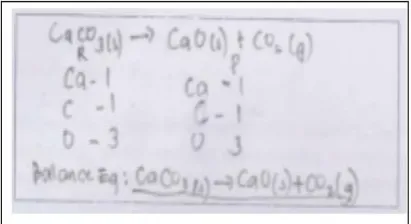
CaCO3 (s) CaO (s) + CO2 (g) 1. Rewrite and balance the chemical equation.
2. How many moles of CaCO3 are heated to produce 1.25 moles of CaO? 3. How many grams of CaO do 2.75 moles of CaCO3 produce?
4. How many grams of CaCO3 are needed to produce 9.50 grams of CaO?
The second problem gave a situation about two different substances than when in contact with each other reacts to form a new compound. The chemical equation for the reaction was not given as part of the problem. Pre-service chemistry teachers need to formulate the chemical equation and balance it as well. This time, they really need to balance the chemical equation. The questions that follow are mole-to-mole conversion, mole-to-mass conversion, and mass-to-mass conversion. Below is problem number 2.
Zinc (Zn) is a metal used in the automotive industry, building industry, and construction industry, for hot tip galvanizing, for zinc castings, brass making, bronze making, and in steel making. Hydrochloric acid (HCl) or commonly known as muriatic acid, on the other hand, is a popular cleaning agent. Anything that is made of zinc should not be cleaned with muriatic acid because they react drastically to produce a zinc chloride residue (ZnCl2).
1. Write the chemical equation for the reaction of zinc and hydrochloric acid. Balance the equation. 2. How many moles of ZnCl2 do 2.0 moles of Zn produce?
3. How many grams of HCl are needed to produce 3.15 moles of ZnCl2? 4. How many grams of Zn are needed to produce 7.35 grams of ZnCl2?
mass-to-mole conversion, and mass-to-mass conversion. The name and the formula of the product are not given. So, they still have to predict what the product is. The problem is a revised form of a question in the Chemical Concepts Inventory (CCI), which was developed by Doug Mulford in 1996 and was published in Journal of Chemical Education On-Line: Library of Conceptual Questions in 2001. Below is problem number 3.
The diagram below represents a mixture of sulfur (S) atoms and molecular oxygen (O2) in a closed container.
O2 molecule
S atom
The diagram below, on the other hand, shows the product after the mixture reacts as completely as possible.
1. Write the chemical equation for the reaction of sulfur atom and molecular oxygen. Balance the equation. 2. How many moles of molecular oxygen are needed to produce the 2.35 moles of the product?
3. How many moles of the product will be produced by 4.21 grams of the sulfur atom? 4. How many grams of the product will be produced by 5.89 grams of the sulfur atom?
Results and Discussion
Data were gathered during the prelims grading period of the first semester of school year 2014-2015 in in a state university in Manila. The stoichiometry questionnaire was administered to pre-service chemistry teachers. After checking, an interview was conducted to each pre-service chemistry teacher who participated in the study. All interviews were digitally recorded and were fully transcribed in accordance with the guidelines presented by Bogdan and Biklen (2007) that interview lengths should range from 30 to 55 minutes, with 38 minutes being the suggested average. The protocols and the accompanying written explanations on the answer sheets served as sources of data for the study.
Table 1. Percentage of correct response
Problem Correct Response
N=33
Percentage (%)
1 1
2 3 4 33 10 14 17 100 30 42 52
2 1
2 3 4 14 9 10 19 42 27 30 58
3 1
2 3 4 3 6 4 6 9 18 12 18
affected their scores – starting from how they balance chemical equations to how they utilize dimensional analysis or factor-label method to solve stoichiometric problems. Another hindrance is their misconceptions when solving problems in stoichiometry.
Strategies of Students in Balancing Chemical Equations
It was not a surprise that all of the students balanced the chemical equation by trial and error. Trial and error means manipulating the coefficients of a chemical equation until such time that the numbers of atoms in the reactant and product sides are the same or equal. Below are selected unedited responses of students on how they balance a chemical equation with exception to problem 1-1 since it is already balanced.
Problem 2-1
Student 3
1. Write the reactants to the left side of the equation and products to the right side. (Zn + HCl ZnCl2).
2. Count the no. of Zn, H and Cl atom on the left side and compare to that of the right side. 3. If the numbers on the left are not equal to the right, manipulate the coefficients. You can notice
that H2 will be released because there is no H atom on the product side.
Figure 1. Answer of student 3 to problem 2-1
Student 10
1. Write the equation.
2. Count the number of each atom in the equation.
3. Compare the number of each atom in the reactant and the product.
4. Multiply the no. of atom to the number of which is needed to equalize the no. of atom in the reactant and in the product.
Figure 2. Answer of student 10 to problem 2-1
Student 19:
Figure 3. Answer of student 19 to problem 2-1
Problem 3-1
Student 3
1. Write the chemical equation based on the diagram.
2. Compare the number of S and O atoms from the reactant side to that of the product side. 3. Manipulate the coefficients of the elements/compounds in the equation until it became balanced.
Student 14
In writing the chemical equation if the reaction of sulfur atom and molecular oxygen, first count the number of individual atoms for each element or compound. After writing the chemical equation, count the number of atoms for each part (Reactant and products). And lastly, balanced it by comparing the number of atoms comprising in each part.
Figure 4. Answer of student 3 to problem 3-1
Student 25
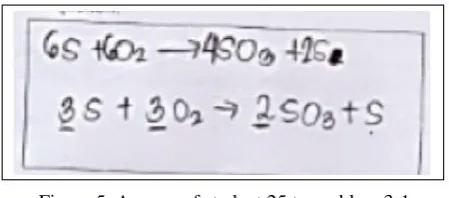
Count the number of atoms to the left and compare it to product side put the appropriate coefficient to make a balance number of every atom.
Figure 5. Answer of student 25 to problem 3-1
Strategies of Students in Solving Mole-to-Mole Stoichiometric Problems
In the case of mole-to-mole stoichiometric problems, pre-service chemistry teachers tend to rely on the balanced chemical equation to convert the given mole to the mole that is required to find. Students check the mole ratio of the two given substances from the balanced chemical equation. After getting the mole ratio, they perform a dimensional analysis or factor-label method to arrive at the number of moles of the unknown. Below are selected unedited explanations of students on how they solved problems 1-2, 2-2 and 3-2. All of which are mole-to-mole conversion problems. No other strategies of solving mole-to-mole conversion problems was noted in the accompanying written explanations on the answer sheets of students or even during the interview.
Problem 1-2
Student 26
Start the computation with the given moles of CaO.
To find out the number of moles of CaCO3, use the number of moles of CaCO3 and the number of moles of CaO in the equation.
Write the unit for the answer.
Box the final answer.
Figure 6. Answer of student 26 to problem 1-2
Student 28
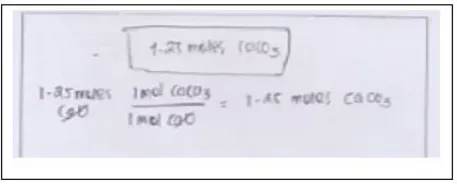
I just multiply the no. of moles of the product CaO to the ratio of CaCO3 and CaO (which) can be identify on the chemical equation.
Figure 7. Answer of student 28 to problem 1-2
Student 32
First, since the chemical equation is already balanced. I made the ratio based on it that for every mole of CaCO3 it is equal to mol of CaO also. So, I used that ratio to expressed the # of moles of CaCO3 if 1.25 moles of CaO is produced.
Problem 2-2
Student 14
In finding the number of moles of ZnCl2 produced by 2.0 moles of Zn, the first thing you have to do is to find the number of moles per ZnCl2 and Zn using the balanced equation for item#1 (ZnCl2= 1mole; Zn = 1mole). Using factor label method, multiply the given amount of Zn to the number of mole of ZnCl2 over number of mole of Zn to cancel the mole unit of Zn and simplify using arithmetic. And now you’ll get the answer.
Figure 9. Answer of student 14 to problem 2-2
Student 27
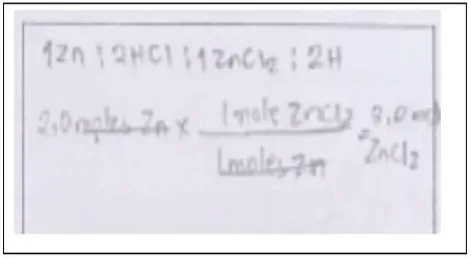
The ratio of the equation is 1 Zn: 2HCl : 1 ZnCl :2H . Showing that in every 1 mole Zn will produced 1 mole ZnCl so that I did the mole to mole stoichiometry and do the cancelation process the result is 2.0 moles of ZnCl will produced by 2.0 moles of Zn.
Figure 10. Answer of student 27 on problem 2-2
Problem 3-2
Student 3
1. Identify the number of moles of O2 needed to produce 6 moles of product. 2. Use that as conversion factor.
3. Perform the operations and cancel units to get the final answer.
Student 14
Figure 11. Answer of student 14 on problem 3-2
Student 26
Start the computation with the given no. of moles of SO
To find the number of moles of oxygen, use the number of mol of O and number of mol of SO in the balanced equation.
Write the unit of the answer.
Box the final answer.
Figure 12. Answer of student 26 to problem 3-2
Strategies of Students in Solving Mole to Mass Stoichiometric Problems
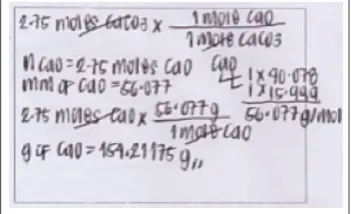
The same result was noted in solving problems involving mole to mass conversions. Pre-service chemistry teachers used the algorithmic methods in solving the problem. The study also proves the work of Schmidt (1994) that the use of algorithmic methods deviates on the complexity of the problem. In this case, aside from checking the mole ratio from the balanced chemical equation, students also need to calculate the molar mass or formula mass of the unknown substance before performing dimensional analysis or the factor-label method. Below are selected unedited explanations of students for problems 1-3 and 2-3. Both are mole to mass conversion problems. No other strategies were noted on the answer sheets of the students.
Problem 1-3
Student 14
Find the number of moles of CaO. Then find the molar mass of CaO which is 56.077 g/mol. To find the grams of CaO produced by 2.75moles of CaCO3, multiply the number of moles of CaO to the quotient of molar mass of CaO and number of mole of CaO. Cancel the same unit and multiply the remaining data and you’ll get the answer.
Student 24
Determine the molar proportion of CaCO3 and CaO in the balanced equation.
Get the molar mass of CaO.
Solve for the mass of CaO in terms of mole to gram conversion.
Figure 14. Answer of student 24 to problem 1-3
Student 26
Start the computation with the given moles of CaO.
To find out the number of moles of CaCO3, use the number of moles of CaCO3 and the number of moles of CaO in the equation.
Write the unit for the answer.
Box the final answer.
Figure 15. Answer of student 26 to problem 1-3
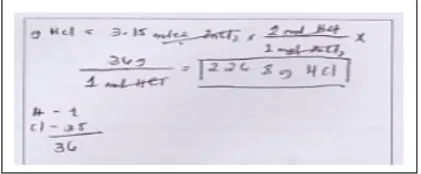
Problem 2-3 Student 24
Determine the molar proportion of HCl and ZnCl2 in the balanced equation.
Find the molar mass of HCl.
Solve for the mass of HCl through the mole to gram conversion.
Figure 16. Answer of student 24 to problem 2-3
Student 26
Get the molar mass of HCl.
Start the computation with the given moles of ZnCl2
Use the no. of moles of HCl and no. of moles of ZnCl2 in the balanced equation and the molar mass of HCl to get the mass in grams of HCl.
Write the unit of the answer.
Figure 17. Answer of student 26 to problem 2-3
Student 27
Find the no. of mole HCl that will produced in 3.15 mol ZnCl. There are 2 mole HCl in 1 mol ZnCl (ratio in the equation)
Convert the moles of HCl to grams using mole to grams stoichiometry then the result is 229.635 g HCl.
Figure 18. Answer of student 27 to problem 2-3
Strategies of Students in Solving Mass to Mole Stoichiometric Problems
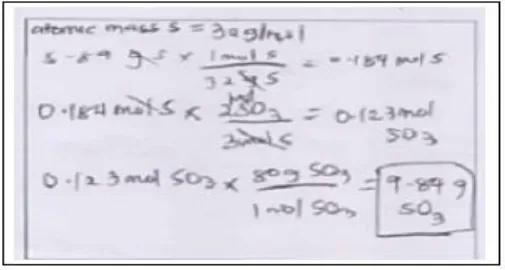
This stoichiometric problem is the reverse of the previous one. Expectedly, students utilized the algorithmic methods in solving the problem. Pre-service chemistry teachers calculated the molar mass or formula mass of the known substance. Then, they checked the mole ratio from the balanced chemical equation and perform dimensional analysis or factor-label method to arrive at the answer. Below are selected unedited explanations of students on how they solved problem 3-3. Problem 3-3 is a mass to mole conversion problem. No other strategies were noted on the answer sheets though.
Problem 3-3 Student 14
In finding the moles of the product it will be produced by 4.21 g of S, you need to find the molar mass of S which is 32.05 g/mol. Then find the number of moles of SO3 and S using the balanced equation in item no.1. Multiply the calculated answer to the number of moles of SO3 over moles of S to cancel the mole unit of S. And lastly, perform simple arithmetic to get the answer.
Figure 19. Answer of student 14 to problem 3-3
Find the molar mass of S.
Start the computation with the given mass of sulfur in grams.
Use the molar mass of S and the no. of moles of SO3 and S in the balanced equation to get the number of SO3
Write the unit of the answer.
Box the final answer.
Figure 20. Asnwer of student 26 to problem 3-3
Strategies of Students in Solving Mass-to-Mass Stoichiometric Problems
Schmidt (1994) hypothesized that students tend to use different strategies conforming to the difficulty or complexity of the problem. This type of problem proves the study of Schmidt (1994) since students need to calculate two molar masses and they also need to look at the balanced chemical equation to get the mole ratio before they perform dimensional analysis or factor label method. Below are selected unedited explanations of pre-service chemistry teachers on how they solved problems 1-4, 2-4 and 3-4. All of these problems are mass-to-mass conversion problems. No other strategies were noted on the answer sheets though.
Problem 1-4
Student 14
In finding the grams of CaCO3 needed to produce 9.50 grams of CaO. You need to find first the molar masses of CaCO3and CaO. (CaO=56.077 g/mol and CaCO3= 68.089 g/mol). Using factor label method, multiply the given mass to the number of moles of CaO over its molar mass. Using the balanced chemical equation in item #1, multiply the answer gathered to the number of mole of CaCO3 over the numberof mole to cancel the mole unit of CaO. Lastly, multiply the answer calculated to the molar mass of CaCO3, over its no number of mole to cancel the mole unit of CaCO3. Then simplify using simple arithmetic and you’ll get the answer.
Figure 21. Answer of student 14 to problem 1-4
Student 32
CaCO3 it is equal to 1 mol CaO. Lastly, for every 100 g of CaCO3 it is equal to 1mol CaCO3.I made these ratio to arrived at my answer.
Figure 22. Answer of student 32 to problem 1-4
Problem 2-4
Student 3
1. Get the molar mass of the Zn and ZnCl2.
2. Use the molar mass of the ZnCl2 as conversion factor.
3. Identify the number of moles of Zn needed to produce 1 mole ZnCl2and use as conversion factor (from balanced equation).
4. Use the molar mass of Zn as conversion factor to get the number of grams of Zn. 5. Perform the operations and cancel the units to come up with the final answer.
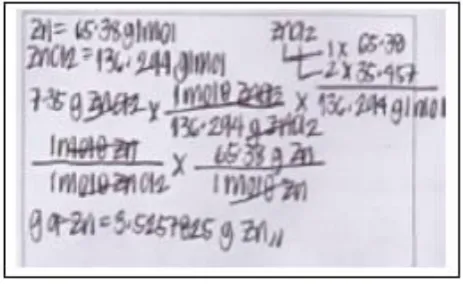
Student 14
In finding the grams of Zn needed to produce 7.35g of ZnCl2, the first thing you have to do is to get the molar mass of Zn and ZnCl2. After getting the molar masses, multiply the given mass of ZnCl2 to 1 mole ZnCl2 over its molar mass. After that, get the number of moles of Zn and ZnCl2 using the balanced equation in item #1. To cancel the mole unit of ZnCl2, multiply the calculated answer to number of mole of Zn over number of mole of ZnCl2. And lastly, multiply the calculated answer to the molar mass of Zn over its number of mole. Perform simple arithmetic to get the final answer.
Figure 23. Answer of student 14 to problem 2-4
Student 26
Get the molar mass of ZnCl2
Get the molar mass of Zn.
Using the molar mass of ZnCl2 and molar mass of Zn and the no. of moles of Zn and ZnCl2 in the balanced equation, solve for the mass of Zn in grams.
Start the computation with the given mass of ZnCl2
Figure 24. Answer of student 26 to problem 2-4
Problem 3-4 Student 14
In finding the grams of the product mole will be produced by 5.89g of S, find the molar mass of S and SO3 because it is needed to the next step. Then multiply the given mass of S to mole of S over its molar mass. After that, multiply the calculated answer to the number of moles of SO3 over moles of S (from the balanced equation) to cancel the mole unit of S and multiply the calculated answer to the molar mass of SO3 over mole of SO3 to cancel the mole unit of SO3. Finally, perform simple arithmetic to get the final answer.
Figure 25. Answer of student 14 to problem 3-4
Student 26
Find the molar mass of S and SO
Start the computation with the given mass of sulfur in grams.
Use the molar mass of S and SO and no. of moles of SO and S in the balanced equation to get the mass of SO in grams.
Write the unit of the answer.
Box the final answer.
Figure 26. Answer of student 26 to problem 3-4
I look for the atomic mass of sulfur
I multiply the given mass (g) of Sulfur atom to its atomic mass.
I multiply the no. of mole of sulfur to the ratio of SO3 and S.
To find the no. of grams of product, I multiply no. of mol of SO3 to if molar mass.
Figure 27. Answer of student 28 to problem 3-4
Misconceptions of Students in Balancing Chemical Equations
No misconception was noted in balancing chemical equations. Misconceptions noted were on writing chemical formulas from a sentence equation and from a visual conception model.
Misconceptions of Students in Solving Mole-to-Mole Stoichiometric Problems
No other problem solving strategies were noted but misconceptions are noticeable in some of the paper of pre-service chemistry teachers. In problem 1-2, instead of just checking the balanced chemical equation, some students computed for the molar masses of the two compounds and perform dimensional analysis or factor-label method to solve for the unknown mole. Below are selected unedited explanations of students.
Problem 1-2
Student 1
1. “Write the balanced equation.
2. Calculate the total number of the whole chemical formula.
3. Then, from the given there are 1.25 mol of CaO multiply by the sum of CaO. We find the 112.02 g of CaO over 1 mol and the answer will be 140.025 g of CaO.
4. From 140.025 g of CaO, we then get the sum of CaCO3 molecules multiply by 140.025 CaO we get the final answer 0.700 mol CaCO3”
Student 4
“First you must calculate the molar mass of the compound. Find the mole of the CaO, from that you can now look for the grams of CaCO3 then convert grams to moles. You will find the answer.”
In problem 2-2, three misconceptions were noted. The first is that instead of just checking the balanced chemical equation, some pre-service chemistry teachers computed for the molar masses of the two compounds and perform dimensional analysis or factor-label method to solve for the unknown mole. Students 1 and 5 apparently commit this mistake. The second is that students used the balanced equation but resorted to relate it to Avogadro’s number to arrive at the answer. Student 24 represents this. The third one is that they computed for the molar mass but resorted to relate it to Avogadro’s number too. Student 21 represents this.
Problem 2-2
Student 1
Student 5
2.0 mol of Zn times 1 mole of Zn over the molar mass of Zn times the molar mass of the ZnCl2 over the 1 mol of Zn will result to the moles of ZnCl2that is needed to produce 2.0 moles of Zn.
Student 21
Just divide the total grams of ZnCl2 to Avogadro’s number to get its mole.
Student 24
Determine the molar proportion of Zn and ZnCl2 in the balanced equation
Use the Avogadro’s mole constant to find the moles ZnCl2.
Solve for the mole of ZnCl2 in terms of mole to mole conversion.
In problem 3-2, some students used the balanced equation but resorted to relate it to Avogadro’s number to arrive at the answer as well. Student 24 represents this.
Problem 3-2 Student 24
Use the Avogadro’s number to find the moles of O2. Refer to the balanced equation for the molar proportional.
Solve for the mole of O2 through mole to mole conversion.
Figure 28. Answer of student 24 to problem 3-2
In problem 3-2, some students used the balanced equation but resorted to relate it to Avogadro’s number to arrive at the answer as well. Student 24 represents this.
Problem 3-2 Student 24
Use the Avogadro’s number to find the moles of O2. Refer to the balanced equation for the molar proportional.
Solve for the mole of O2 through mole to mole conversion.
Misconceptions of Students in Solving Mole to Mass Stoichiometric Problems
In problem 1-3, it was noted that some pre-service chemistry teachers tend to forget to indicate where they got the mole ratio of the conversion factor, which is from the balanced chemical equation. If a person with no stoichiometry background will read his/her answer, he/she will not be able to grasp the explanation on how the problem was solved. Student 10 represents this.
A misconception was also noted in problem 1-3, some students, represented by student 18, solved the problem without using the balanced chemical equation. After using the molar mass of CaCO3, they eventually resorted relating it to Avogadro’s number to arrive at the number of moles of CaO. After that they relate the moles of CaO to its molar mass.
Problem 1-3
Student 10
1. Write first the given and the unknown. 2. Get the molar mass of the CaO and CaCO3.
3. Solve for the mass of CaCO3 by deriving the formula of getting the mass on the formula of getting the moles.
4. After getting the moles of CaCO3, multiply it by the MM of CaCO3. (By the form of dimensional analysis) multiply the answer to the mol of CaO and the MM of CaO by the form dimensional analysis.
Figure 30. Answer of student 10 to problem 1-3
Student 18
Multiply the moles of CaCO3 that is given by the mass of CaCO3 then multiply with the avogadro’s number then divide to the mass of CaO.
Figure 31. Answer of student 18 to problem 1-3
Problem 2-3 shows another misconception. Student 19 wrote on his paper that the molarity of ZnCl2 would be multiplied with its atomic mass even though no molarity was given. In the interview, student 19 said that it was just a typographical error.
Problem 2-3
To compute the amount on grams of HCl that will produce 3.15 moles of ZnCl2, we multiply the molarity of ZnCl2 with its atomic mass and the atomic mass of HCl.
Figure 32. Answer of student 19 to problem 2-3
Misconceptions of Students in Solving Mass to Mole Stoichiometric Problems
The use of Avogadro’s number was also noted in solving mass to mole problems. Student 18 resorted using the mole concept in getting the number of moles of sulfur instead of looking at the balanced chemical equation. Moreover, student 18 has also a misconception in writing chemical formula for sulfur trioxide. He/she placed a negative (-) sign on the molecule indicating that it is not a neutral species.
Problem 3-3
Student 18
Given of 4.21 g of S atom by multiply it by 1 mol of S in 2SO3- compound. Then using avogadro’s number, multiply it to mole them divide by the mass of 2SO3-.
Figure 33. Answer of student 18 to pronlem 3-3
Misconceptions of Students in Solving Mass-to-Mass Stoichiometric Problems
The use of Avogadro’s number is very noticeable among students’ responses. Even in mass-to-mass conversion problems, some students still find the mole concept useful to convert moles of known compounds to moles of the unknown compound instead of just using the balanced equation. Student 1 committed this mistake in problem 1-4.
Problem 1-4
Student 1
From the given 9.50 g of CaO, we convert it to get the mol of CaO from 9.50 g CaO and we come up with 0.085 mol CaO. Then from 0.085 mol CaO we convert it again to find the moles of CaO, we use the avogadro’s number to convert it then we come up with 5.119x1027
moles CaO answer then to get the grams CaCO3 needed to produce 9.50 grams of CaO, we come up with the answer 1.024x1026
Implications for Teaching and Learning Chemistry
that students usually use three ways in solving problems: (1) the mole method; (2) the proportionality method; and (3) the “logical method”. The mole method describes the relations between the given and the required substance via amount of substance. Proportionality method, on the other hand, is a method used by creating a relationship between the given and the required substances via a proportion. The “logical method” described the relations between variables in their own words, for example “twice as much”, “same proportion” instead of applying mathematical algorithms.
The mole method and the proportionality method were the most prominent strategies used by students in the present study. It confirms the work of Schmidt and Jigneus (2003), Gabel and Bunce (1994) and Nakleh and Mitchell (1993) that these algorithmic methods are indeed the methods used by most students in stoichiometric problems. The “logical method”, on the other hand is limited to chemical compounds with a 1:1 mass ratio of its elements. The stoichiometry questionnaire did not provide problems with 1:1 mass ratio of elements so it is also expected that students will not rely on using the “logical method”. Teachers should also expose students to simple stoichiometric problems to exercise the “logical method” among students.
In an interview with their teacher in general chemistry, where stoichiometry was first taught, the teacher mentioned that algorithmic methods was the prominent strategy of students in solving problems. In addition, the mole method was the most commonly used by students during class discourse. Proportionality method is the second widely used strategy. Students, on the other hand, least utilize the logical method, because the teacher gives them challenging problems instead of easy ones.
Misconceptions were also noted in solving stoichiometric problems. The most prominent is the use of Avogadro’s number to convert moles of given substance to the moles of unknown substance. In some cases, students even use this converted moles to solve for the mass of the unknown substance, which is incorrect. Caution should be made when teaching the mole concept and stoichiometry.
In view of students’ strategies and misconceptions in solving stoichiometric problems, the following teaching framework is suggested.
Figure 34. Suggested Teaching Framework
Conclusion
The algorithmic methods such as the mole method and the proportionality method were the most prominent strategies used by pre-service chemistry teachers in the present study. Misconceptions were also noted in solving stoichiometric problems. Students use Avogadro’s number to convert moles of given substance to the moles of unknown substance. In some cases, students even use this converted moles to solve for the mass of the unknown substance, which is incorrect. A teaching framework was formulated from the result of the study wherein teachers are advised not to teach stoichiometry by demonstration instead let students think of ways to solve the problem in which their higher order cognitive skills are being developed.
Recommendations
It is suggested therefore to investigate the effectiveness of the formulated teaching framework both to the high school and collegiate levels. The same study is also suggested to be done with high school participants to find out if they have the same problem solving skills and misconceptions as collegiate students.
Acknowledgements
We would like to thank the Project-Based Research Grant Batch 4 program of the Philippine Normal University for funding the project.
References
Bogdan, R.C., & Biklen, S.K. (2007). Qualitative research for education: An introduction to theories and methods (5th ed.). Boston: Pearson Education
BouJaoude S. & Barakat H., (2003), Students’ problem solving strategies in stoichiometry and their relationships to conceptual understanding and learning approaches, Electronic Journal of Science Education. 7(3)
Gabel, D.L. & Bunce, D. M. (1994). Research on problem solving. In D. Gabel (ed.), Handbook of research on science teaching and learning, pp. 301-326. New York: Mac Millan.
Glazar, S.A. & Devtak, I. (2001). Secondary school students’ knowledge of stoichiometry, Acta Chim. Slov., Vol. 49, 43-53, University of Ljubljana, Kardeljeva
Fach, M., De Boer, T. & Parchman, I. (2006). Results of an interview study as basis for the development of stepped supporting tools for stoichiometrics problems, University of Oldenburg of Pure and Applied Chemistry. The Royal Society of Chemistry, Germany
Feyzioğlu T. (2009). Does good financial performance mean good financial intermediation in China I F Working Paper WP/09/170
Howe T.V. and Johnstone A.H., (1971), Reason or memory? The learning of formulae and equations, Edinburgh, National Curriculum Development Centre Bulletin 1.
Johnstone, A.H. (2005). Chemical education research in Glasgow in perspective. The Royal Society of Chemistry, Vol. 7, No. 2, 49-63, Glasgow, UK
Martin, M.O., Mullis, I. V.S., Gonzales, E.J., Gregory, K.D., Smith, T.A.,& Chrostowski, S.J. (2004). TIMSS 2003: International science report; findings from IEA's report of the Trends in International Mathematics and Science Study. Chestnut Hill, MA: The International Study Center, Lynch School of Education, Boston College.
Mulford, D. R. (2001). An Inventory for Measuring College Students' Level Of Misconceptions in First Semester Chemistry. Journal of Chemical Education On-Line: Library of Conceptual Questions. American Chemical Society Division of Chemical Education. December 13 2001. http://jchemed.chem.wisc.edu/JCEWWW/ Features/CQandChP/CQs/ConceptsInventory/CCIIntro.html Nakhleh, M. B. & Mitchell, R. C. J. (1993). Are Our Students Conceptual Thinkers or Algorithmic Problem
Solvers? Chemical Education, 70 (3), 190- 192.
Okanlawon, A.E. (2010). Constructing a framework for teaching reaction stoichiometry using pedagogical content knowledge, Journal of Chemistry, Vol. 19., Iss. 2., Osun State University, Nigeria
Schmidt, H.-J. (1990). Secondary school students' strategies in stoichiometry. International Journal of Science Education. 12, 457-471
Schmidt, H.J. & Jigneus, C. (2003). Students strategies in solving algorithmic stoichiometry problems. Chemistry of education: Research and Practice, Vol. 4, Iss. 3, pp. 305-317
Schmidt, H.-J. (1994). Stoichiometric problem solving in high school chemistry. International Journal of Science Education, 16, 191-200.
Schmidt, H.-J. (1997). An alternate path to stoichiometric problem solving. Research in Science Education, 27, 237-249.
Toth, Z & Sebastyen, A. (2009). Relationship between Students’ Knowledge Structure and Problem-Solving Strategy in Stoichiometric Problems based on the Chemical Equation. Eurasian J. Phys. Chem. Educ. 1(1):8-20