Two-Way Relaying for Multiple Applications in
Wireless Sensor Networks
Zhiliang Chen
∗, Alexander Kuehne
∗, Anja Klein
∗, Adrian Loch
†, Matthias Hollick
†and Joerg Widmer
‡∗Communications Engineering Lab, Technische Universit¨at Darmstadt, Germany Email:{z.chen,a.kuehne,a.klein}@nt.tu-darmstadt.de
†Secure Mobile Networking Lab, Technische Universit¨at Darmstadt, Germany Email:{adrian.loch,matthias.hollick}@seemoo.tu-darmstadt.de
‡Institute IMDEA Networks, Spain Email: [email protected]
Abstract—Recent work in wireless sensor networks implies possibilities of concurrent support of multiple applications. In this paper, we discuss a novel scheme called hybrid computation in two-way relaying, which introduces cooperation of three sensor nodes to support bi-directional communications of two applications. Applications in wireless sensor networks require different computations and forms of aggregation. In the proposed scheme, different computations at the intermediate node are integrated in a two-way relaying scheme. For computations and transmissions in the proposed scheme, data from all three nodes are considered. We propose a superposition coding protocol and a time division protocol to handle the transmission of the messages from the intermediate node. The problem of maximizing the sum rate is discussed. The results show that the superposition coding protocol outperforms the time division protocol.
I. INTRODUCTION
Wireless Sensor Networks (WSNs) are networks with densely deployed sensor nodes. Sensor nodes observe in-formation from the physical world and transmit it to the desired sinks [1]. In WSNs, computation (data aggregation) and transmission are always paired with each other, which highlights a property of WSNs that the data itself, rather than its identity, is important [2].
An efficient design of a WSN is a cross-layer problem, because joint optimization in cross-layer design is capable of considering data computation, routing, power consumption and throughput requirement [3]. Most works which jointly consider communications between sensor nodes and computations usu-ally assume only a single application supported in a WSN [4], [5]. In this paper, we discuss a scheme where multiple applications are running in a WSN.
Recent works such as [6] and [7] start to consider sensor networks with concurrent support of multiple applications. In [6], a WSN is partitioned with a weighted balanced two-slice problem in order to support two applications running in a WSN concurrently. However, sensor nodes can only process a single application at a time in this work. This solution may compromise the coverage for each application since it reduces the number of sensor nodes activated for each application and lacks the possibility of introducing cooperation between sensor nodes. The work in [7] proposes a network layer protocol that forwards data packets of different applications one after
another towards multiple gateways. This idea does not develop the feature of combining computation and transmission in a WSN, and there is no cooperation among sensor nodes. In this paper, sensor nodes cooperate to exchange messages.
In the case that data from two applications are forwarded in opposite directions in WSNs, bi-directional transmission has to be involved. A way to handle bi-directional transmission is to use two-way relaying [8]. In two-way relaying, two partner nodes exchange messages with the cooperation of a relay node within two transmission phases. At the relay node, messages are superimposed and broadcast. The partner nodes can perform an interference-free decoding of their partner’s message by cancelling their own message in the received signal.
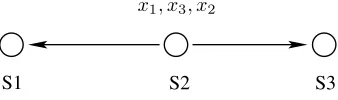
When two-way relaying is used in WSNs to support bi-directional communications, extra problems need to be consid-ered in comparison to the two-way relaying introduced in [8]. Firstly, the relay node itself shall also be a node exchanging own messages of two applications with the partner nodes. Secondly, the relay node (or the intermediate node) can apply computation to the signal received in the multiple-access phase (MAC-phase). Therefore, Self-Interference Cancellation (SIC) may not be possible at the partner nodes in the broadcast phase (BC-phase). Works in [9] and [10] extend the usual two-way relaying in the first point.
S1 S2 S3
x1, x3, x2
Fig. 1. Piggyback in two-way relaying
capacities of transmittingx1 andx3in the BC-phase shall be no less than those in the MAC-phase. Combinatorial analysis and simulation results show that such piggyback solution gives larger sum rate than the solutions where messages are transmitted in time division in the BC-phase.
In [10], the authors analyse a two-way relaying scenario where each partner node has an individual private message for the intermediate node. Two MAC-phase solutions are proposed in this work. In the first solution, the private messages for the intermediate node are extracted as a computation over MAC in addition to the messages for exchange. The second solution applies a time sharing of two sub-schemes. In the first sub-scheme, the partner nodes transmit only the private messages for the intermediate node. In the second sub-scheme, the partner nodes transmit messages for exchange onto which the node with larger transmit power superimposes the private message for the intermediate node. A merge of the two MAC-phase solutions is shown by the simulation results in [10].
Works in [9] and [10] both extend the usual two-way relay-ing with the consideration of extra message exchange among the three-node network. However, the works did not cover the problem in WSNs when computation shall be introduced at the intermediate node in order to perform data aggregation. In this paper, we consider the scenario of multiple applications running simultaneously in a WSN where both of the problems are covered by jointly considering the computations and the communications. All three sensor nodes generate data of two applications requiring different aggregation functions and forward them to the other two nodes. Two-way relaying is employed for the bi-directional transmission while taking into account that the intermediate node transmits and receives extra messages along with the messages exchanged between the partner nodes.
The system model, the problem statement and the aggrega-tion funcaggrega-tions, are given in Secaggrega-tion II. The hybrid computaaggrega-tion in two-way relaying using superposition coding protocol is shown in detail in Section III. The time division protocol is presented in Section IV. In Section V, we give performance results. Section VI concludes this paper.
II. SYSTEMMODEL, PROBLEMSTATEMENT AND
AGGREGATIONFUNCTIONS
In this section, we firstly present the system model followed by the problem statement and the aggregation functions based on the concept of the divisible functions.
In this paper, a three-node network model as shown in Figure 2 is considered. Nodes S1, S2 and S3 observe data of two applications, denoted by x1, y1 at S1, x2 ,y2 at S2
and x3, y3 at S3. We define the application by its function applied to the data. In such case,xi(i= 1,2,3)is the data for applicationfXandyj(j= 1,2,3)is for applicationfY. Nodes S1, S2 and S3 are all half-duplex, i.e. they cannot transmit and receive at the same time. Furthermore, nodes S1 and S3 can only communicate with each other via the intermediate node S2.
S1 S2 S3
x1, y1 x2, y2 x3, y3
Fig. 2. Three sensor nodes and their data
We are interested in the case that two applications are running in a WSN concurrently. In Table I, it is shown that sensor nodes S1, S2 and S3 generate messages of two applications. We consider the case that the function output
fX(x1, x2, x3)is required at node S1 while the function output
fY(y1, y2, y3)is required at node S3.
TABLE I
DATA AND FUNCTION REQUIREMENT
S1 S2 S3
Message x1, y1 x2, y2 x3, y3 Requirement fX(x1, x2, x3) - fY(y1, y2, y3)
In this paper, we assume fX and fY are the download function and the mean function, respectively. These two func-tions are typical examples for WSNs. The download function usually refers to an application that a sensor network has to report its sensing status (GPS, object sensing, etc.) or its own status (battery status, geographical locations) to gateways. The mean function is useful when the application requires the average value of the sensed data. Temperature measurement, distributed voting, and other consensus problems [11], [12] belong to such an application. With the download function, node S1 requires the result of fX(x1, x2, x3) ={x1, x2, x3}, with the requirement of the output of the mean function, node S3 requires the result offY(y1, y2, y3) = 31(y1+y2+y3).
Since node S1 does not have messages of x2 and x3, communications are needed so that S1 can successfully deter-minefX(x1, x2, x3)by receiving messages from node S2 and from node S3. Similarly, node S3 requires communications to receive messages from node S2 and node S1 in order to determine fY(y1, y2, y3). With the assumption that node S1 and S3 cannot directly communicate with each other, they have to forward their messages via the intermediate node S2.
TABLE II
FUNCTIONOUTPUTS ATS1, S2ANDS3
S1 S2 S3
ApplicationfX fX(x1, φ, φ) fX(φ, x2, φ) fX(φ, φ, x3)
ApplicationfY fY(y1, φ, φ) fY(φ, y2, φ) fY(φ, φ, y3)
In Table II,fX(x1, φ, φ) ={x1},fX(φ, x2, φ) ={x2}and
fX(φ, φ, x3) = {x3}, fY(y1, φ, φ) = 13y1, fY(φ, y2, φ) = 1
3y2 and fY(φ, φ, y3) = 13y3. To meet the requirement in
Table I, node S1 transmitsfY(y1, φ, φ) to node S2, node S2 calculatesfY(y1, y2, φ) = 13(y1+y2)and transmits it to node S3 where the final output fY(y1, y2, y3) can be calculated. Similarly, node S3 transmitsfX(φ, φ, x3) ={x3}to node S2, node S2 determines fX(φ, x2, x3) = {x2, x3} and transmits it to node S1. Node S1 yields the outputfX(x1, x2, x3). To simplify the notation, in the remainder of this paper, we omit the symbolφwhen the variables are not available at the sensor nodes, e.g.fX(x1, φ, φ) =fX(x1), etc..
Such as the download function and the mean function, the aggregation functions supported in WSNs which follow the ”calculate-forward-calculate” way to calculate the function outputs in a distributed way are so-called divisible functions. Other examples of divisible functions are the max/min func-tion, histogram, etc. [5].
The communication protocol for the requirement in Table I is still unknown. In sections III and IV, we propose a solution scheme called hybrid computation in two-way relaying which includes two realization protocols, namely superposition cod-ing and time division. The term ’hybrid’ indicates that multiple applications with different aggregation functions are running concurrently.
III. HYBRIDCOMPUTATION INTWO-WAYRELAYING USINGSUPERPOSITIONCODINGPROTOCOL
In this section, the hybrid computation in two-way relaying using superposition coding protocol for the requirement in Table I is briefly introduced. The details of the MAC-phase and the BC-phase are presented subsequently.
A. Protocol Description
Using superposition coding in the scheme of the hybrid computation in two-way relaying, there are of two commu-nication phases, the MAC-phase and the BC-phase. Before exchanging messages in the MAC-phase, nodes S1, S2 and S3 firstly apply functions fX and fY to their own data of the two applications, i.e., fX(x1) and fY(y1) at node S1,
fX(x2) and fY(y2) at node S2 and fX(x3) and fY(y3) at
node S3 are determined. In the MAC-phase, nodes S1 and S3 use Gaussian distributed codebooks to encode messages
fY(y1) and fX(x3) individually, yielding the outputfYC(y1)
and fXC(x3), respectively, and transmit to the intermediate node S2. The super-script C is to denote that the message has been encoded with Gaussian distributed codebook. The intermediate node S2 decodes these two messages, calculates function outputsfY(y1, y2) = 13(y1+y2) andfX(x2, x3) = {fX(x2), fX(x3)}={x2, x3}from the received message and
its own one. In the BC-phase, node S2 encodes fY(y1, y2),
fX(x2) and fX(x3) with three independent Gaussian
dis-tributed codebooks, respectively, and allocates a portion of its total transmit power to each encoded message. The superim-posed messages are broadcast to nodes S1 and S3. Similar to [9], we useτMACandτBCto indicate the time allocated to the MAC-phase and the BC-phase ,respectively, and define their ratio as
τ =τMAC
τBC . (1)
In the following, details of the MAC-phase and the BC-phase are discussed.
B. MAC-Phase
SymbolsP1,P2andP3denote the transmit power of nodes S1, S2 and S3, respectively. Symbol hij denotes the channel between the transmit node i and the receive node j. The channels in the MAC-phase and the BC-phase are assumed to be memoryless, reciprocal and block static. The fading factors are hence h12 = h21 = h1 and h32 = h23 = h3. The receive noise at node S1, S2 and S3 is denoted as n1,
n2 and n3, respectively, where the noise power is assumed
to be the same at all nodes, denoted as N. The transmit SNR is defined as γi = Pi/N, i = 1,2,3. We denote by
W(fC
Y(y1)), W(fXC(x3)) the single letters of the codewords
fC
Y(y1) and fXC(x3) at nodes S1 and S3, respectively [9].
W(fC
Y(y1)), W(fXC(x3)) are assumed to be complex normal distributed random variables with zero-mean and variance equal to one (CN(0,1)). In the MAC-phase, nodes S1 and S3 allocate transmit power P1 and P3 to W(fYC(y1)) and
W(fC
X(x3)), respectively, and transmit to the intermediate
node S2. Node S2 receives signal
r2=h1
P1W(fYC(y1)) +h3
P3W(fXC(x3)) +n2 (2)
from nodes S1 and S3.
S2 decodes fY(y1) and fX(x3) error-free with rates R1 andR3, respectively, which are bounded by the MAC capacity region [13]. The region is formulated as
RMAC=[R
1, R3]∈R2+: R1≤C1MAC, R3≤C3MAC, R1+R3≤CΣMAC
,
(3)
where
CMAC
1 = log
1 +|h1|2γ1 (4)
CMAC
3 = log
1 +|h3|2γ3 (5)
CMAC
Σ = log
1 +|h1|2γ1+|h3|2γ3 , (6)
andR+ is the set of non-negative real numbers.
Node S2 computes the functions fX(x1, x2) = {fX(x1), fX(x2)} and fY(y1, y2) = 13(y1 + y2) after
C. BC-Phase
In the BC-phase, node S2 encodes three messagesfX(x2),
fX(x3) and fY(y1, y2) with three independent Gaussian distributed codebooks, where the output codewords are
fC
X(x2), fXC(x3)andfYC(y1, y2), respectively. As done in the MAC-phase, W(fXC(x2)), W(fXC(x3))andW(fYC(y1, y2))∼
CN(0,1)denote the single letters of the respective codeword. The total transmit powerP2 of node S2 is distributed into three portions:β1 forW(fXC(x2)),β2forW(fXC(x3))andβ3
forW(fYC(y1, y2))withβ1+β2+β3= 1. Node S2 broadcasts the superimposed signal√β1W(fXC(x2))+√β2W(fXC(x3))+
√
β3W(fYC(y1, y2))to nodes S1 and S3. The receive signal at node S1 is
z1=h1
P2
β1W(fXC(x2)) +
β2W(fXC(x3))
+β3W(fYC(y1, y2))
+n1.
(7)
Similarly, node S3 receives signal
z3=h3
P2
β1W(fXC(x2)) +
β2W(fXC(x3))
+β3W(fYC(y1, y2))
+n3.
(8)
In order to calculate the function fX(x1, x2, x3) at node S1, messagesfX(x2) andfX(x3)shall be decoded from the receive signalz1. However, the interferencefY(y1, y2)cannot be cancelled by SIC at node S1 because it does not contain the same message asfY(y1)which is transmitted from S1 in the MAC-phase. This highlights that in the hybrid computation in two-way relaying, a difference to the two-way relaying without computation is that SIC cannot always be performed at the partner nodes. At the other partner node S3, the message
fX(x3) of the download function remains the same as what has been transmitted from node S3 in the MAC-phase. There-fore, node S3 is able to perform SIC to cancelfXC(x3)from its received signalz3. This results in three unknown messages at node S1 and two unknown messages at node S3. Since superposition coding is employed in the BC-phase, different decoding orders are possible at nodes S1 and S3, shown in Table III. For simplicity of referring, we abbreviate the decoding orders listed in Table III using A1, A2, B1, ... B4, C1, C2. Decoding orders A1 and A2 at node S1 do not decode the unwanted messagefY(y1, y2), whereas decoding orders B1 -B4 decode message fY(y1, y2) before decoding the wanted messages in order to eliminate fY(y1, y2) as interference. According to Table III, 12 decoding order combinations at node S1 and node S3 are possible. In comparison to what has been discussed in [9], we cannot simply conclude which decoding order is always optimum. Therefore, all 12 decoding orders have to be discussed. In the further discussion, we use
Λ={A1-C1, A1-C2, A2-C1, ... B4-C1, B4-C2}to denote all possible decoding order combinations at node S1 and node S3, whereλ∈Λ is the decoding order combination that the nodes S1 and S3 are using. For example, when λ= B1-C2, node S1 firstly decodes messagefX(x2)with the interference caused byfY(y1, y2)andfX(x3). After cancellingfX(x2), S1
decodes messagefY(y1, y2)with interferencefX(x3). Finally, S1 decodesfX(x3)interference-free by cancellingfY(y1, y2) from the receive signal. Similarly, node S3 in decoding order combination B1-C2 firstly decodes message fX(x2)with the interference caused byfY(y1, y2). Then it decodesfY(y1, y2) interference-free after cancelling fX(x2) from its received signal.
Besides the combinations of decoding orders at nodes S1 and S3, two rate constraints shall also be considered:
• In the BC-phase, the rate of transmittingfX(x3)should be at least equal to the rate with which S3 transmits
fX(x3) in the MAC-phase. In the remainder of this
work, we consider the equality in this constraint since it guarantees the error-free transmission of messagefX(x3) in the BC-phase.
• In the BC-phase, the rate of transmitting fY(y1, y2) should be no less than the rate with which S1 transmits
fY(y1)in the MAC-phase. We use ’no less than’ here due
to the fact that message fY(y1, y2) includes data from node S1 as well as the data from node S2.
Taking into account the time ratio τ between the MAC and the BC-phase shown in (1), we can translate these two constraints to
CBC,x3 = τR
3and (9)
CBC,y ≥ τR
1, (10)
where CBC,x3 denotes the maximum rate of transmitting fX(x3) in the BC-phase andCBC,y is the maximum rate of transmitting fY(y1, y2).
An optimization problem in the BC-phase is proposed to maximize the sum rate of node S2 broadcasting to nodes S1 and S3. In the BC-phase, message fX(x3) requires only the same rate as that in the MAC-phase. Therefore, the optimization objective function considers only the sum rate of transmitting fX(x2) and fY(y1, y2) which are functions of the non-negative power portion factorsβ1, β2 and β3 and the decoding ordersλat nodes S1 and S3. The maximization problem is given by
max
β1,β2,β3,λ
CBC,x2(β
1, β2, β3, λ) +CBC,y(β1, β2, β3, λ)
s.t.
β1+β2+β3= 1, βi≥0,fori= 1,2,3, λ∈Λ,
CBC,x3(β
1, β2, β3, λ) =τR3, CBC,y(β
1, β2, β3, λ)≥τR1,
(11)
where CBC,x2 denotes the maximum rate of transmitting fX(x2)in the BC-phase.
TABLE III
POSSIBLE DECODING ORDERS AT NODESS1ANDS3
S1 fX(x2),fX(x3): A1 fX(x3),fX(x2): A2 fY(y1, y2),fX(x2),fX(x3): B1
fX(x2),fY(y1, y2),fX(x3): B2 fy(y1, y2),fX(x3),fX(x2): B3 fX(x3),fY(y1, y2),fX(x1): B4 S3 fY(y1, y2)): C1 fX(x2),fY(y1, y2)): C2
fY(y1, y2) treating fX(x2) and fX(x3) as interference with
rate
CS1BC,B1,y = log 1 + |h1|2P2β3
N+|h1|2P2β1+|h1|2P2β3
. (12)
We define symbolq1 as |h1|2γ2= 1/q1 and simplify (12) as
CS1BC,B1,y = log 1 + β3
q1+β1+β3
. (13)
Afterwards, S1 subtractsfY(y1, y2)and decodesfX(x2)with the interference caused by fX(x3). The rate of decoding
fX(x2)is
CBC,x2
S1,B1 = log 1 + |h1| 2P2β1 N+|h1|2P2β2
. (14)
With the definition ofq1, (14) is simplified as
CBC,x2
S1,B1 = log 1 + q β1 1+β2
. (15)
The interference-free decoding offX(x3) is performed after cancellingfX(x2)with the maximum rate
CBC,x3
S1,B1 = log 1 + βq2 1
. (16)
At node S3, message fX(x3) is cancelled by SIC. With decoding order combination B1-C2, S3 decodes the unwanted messagefX(x2)at first treatingfY(y1, y2)as interference. By denoting |h3|2γ2 = 1/q3, the maximum rate of transmitting
fX(x2)is
CBC,x2
S3,C2 = log 1 + q β1 3+β3
. (17)
After eliminating fX(x3), node S3 can decode fY(y1, y2) interference-free with maximum rate
CS3BC,C2,y = log 1 + β3
q3
. (18)
Because all the decoding has to be error-free, the rates of trans-mittingx2 and transmittingy should be chosen asCBC,x2 =
min{CBC,x2
S1,B1, CS3BC,C2,x2} andCBC,y= min{CS1BC,B1,y, CS3BC,C2,y}.
Usinglog(1+r1) =τR1andlog(1+r3) =τR3, we define two signal-to-interference-plus-noise ratio (SINR) parameters,
r1= 2τR1−1andr3= 2τR3−1. The rate constraintCBC,x3 = τR3 in (9) can be replaced by
β2
q1 =r3, (19)
and the constraintCBC,y≥τR1 of (10) can be transformed to
min
β3 q1+β1+β2,
β3 q3
≥r1. (20)
Due to (20), it can be seen that the problem in (11) is a combinatorial problem. We can re-formulate the maximization with decoding order combinationλ=B1-C2 as
max
min
log 1 + β1
q1+β2
,log 1 + β1
q3+β3
+ min
log 1 + β3
q1+β1+β2
,log 1 +β3
q3
s.t.
if q1+β1+β2> q3,then
β1≤1−r3q1−1 +r1qr1−r1r3q1
1 ,
β2=r3q1, β3= 1−β2−β1;
else
β1≤1−q1r3−r1q3, β2=r3q1,
β3= 1−β2−β1.
(21)
The total transmit power constraint at node S2 gives the condition β1+β2+β3 = 1. Hence it is always possible to express one power portion factor with the other two. In the optimization problem in (21) with the given decoding order combination, we use a two dimensional numerical search to find the optimum solution of the power portion factors, which optimizes maximum sum rate in (11).
For the other decoding order combinations λ ∈ Λ, the objective functions and the two rate constraints of (9) and (10) are listed in Table IV.
IV. HYBRIDCOMPUTATION INTWO-WAYRELAYING USINGTIMEDIVISIONPROTOCOL
An alternative protocol which provides a performance benchmark for the superposition coding protocol is using time division (TD) and is introduced in the following.
The MAC-phase in the TD protocol is the same as for the superposition coding protocol. The difference is that in the BC-phase, node S2 transmitsfX(x2),fX(x3)andfY(y1, y2)one after another instead of superimposing them and transmitting them simultaneously. The time duration of the BC-phase will be split into three non-negative time portionsα1,α2 andα3, withα1+α2+α3= 1, for transmittingfX(x2),fX(x3)and
fY(y1, y2), respectively.
TABLE IV
OBJECTIVE FUNCTIONS AND RATE CONSTRAINTS FOR DIFFERENT DECODING ORDER COMBINATIONS
λ Objective function
Rate Constraint (9) Rate Constraint (10)
A1-C1 C
BC,x2
S1,A1 +CS3BC,C1,y
β1
q1+β3 =r3
β3
q3+β1 ≥r1
A2-C1 C
BC,x2
S1,A2 +CS3BC,C1,y
β2
q1+β1+β3 =r3
β3
q3+β1 ≥r1 A1-C2 max{min{C
BC,x2
S1,A1, CS3BC,C2,x2}+CS3BC,C2,y}
β2
q1+β3 =r3
β3
q3 ≥r1 A2-C2 max{min{C
BC,x2
S1,A2, CS3BC,C2,x2}+CS3BC,C2,y}
β2
q1+β1+β3 =r3
β3
q3 ≥r1 B1-C1 max{C
BC,x2
S1,B1 + min{CS1BC,B1,y, CS3BC,C1,y}}
β2
q1 =r3 min{
β3
q1+β1+β2,
β3
q3+β1} ≥r1 B1-C2 min{C
BC,x2
S1,B1, CBCS3,C2,x2}+ min{CS1BC,B1,y, CS3,C2BC,y}
β2
q1 =r3 min{
β3
q1+β2,
β3
q3+β1} ≥r1
B2-C1 C
BC,x2
S1,B2 + min{CS1BC,B2,y, CS3BC,C1,y}
β2
q1 =r3 min{
β3
q1+β2,
β3
q3+β1} ≥r1 B2-C2 min{C
BC,x2
S1,B2, CS3BC,C2,x2}+ min{CS1BC,B2,y, CS3BC,C2,y}
β2
q1 =r3 min{
β3
q1+β2,
β3
q3} ≥r1
B3-C1 C
BC,x2
S1,B3 + min{CS1BC,B3,y, CS3BC,C1,y}
β2
q1+β1 =r3 min{
β3
q1+β1+β2,
β3
q3+β1} ≥r1 B3-C2 min{C
BC,x2
S1,B3, CS3BC,C2,x2}+ min{CS1BC,B3,y, CS3BC,C2,y}
β2
q1+β1 =r3 min{
β3
q1+β1+β2,
β3
q3} ≥r1
B4-C1 C
BC,x2
S1,B4 + min{CS1BC,B4,y, CS3BC,C1,y}
β2
q1+β1+β3 =r3 min{
β3
q1+β1,
β3
q3+β1} ≥r1 B4-C2 min{C
BC,x2
S1,3y2, CBCS3,2,xy2}+ min{CS1BC,3,yy2, CS3BC,2,yy} β2
q1+β1+β3 =r3 min{
β3
q1+β1,
β3
q3} ≥r1
messages is then scaled by the time portion in addition to the time scalingτ between the MAC-phase and the BC-phase as introduced in (1). Therefore we can directly give the rates of transmittingfX(x2),fX(x3)andfY(y1, y2)as
CBC,x2
TD = α1log1 +|h1|2γ2 , (22)
CBC,x3
TD = α2log
1 +|h1|2γ2 and (23)
CTDBC,y = α3log1 +|h3|2γ2 , (24) respectively.
The rate constraints in the TD protocol are identical to the constraints in the superposition coding protocol. The maximum rate of transmittingfX(x3)at S1 is bounded by
CBC,x3
TD =τR3. (25)
At node S3, the maximum rate of transmitting message
fY(y1, y2)fulfils the rate constraint given by
CTDBC,y ≥τR1. (26)
In the following, a maximization problem with the same objective function as utilized in Section III is formulated. However, the constraints are changed according to the TD protocol in the BC-phase. This yields
max
α1,α2,α3
CBC,x2
TD (α1) +CTDBC,y (α3)
s.t.
α1+α2+α3= 1, αi≥0,fori= 1,2,3, CBC,x3
TD (α2) =τR3, CTDBC,y (α3)≥τR1.
(27)
The two rate constraints in (27) give the solution of the parameter
α2= log (1 +τR|h3
1|2γ2) (28)
and the range
α3≥ log (1 +τR|h1
3|2γ2) (29)
by using equations (23) - (26). The objective function in (27) can be simplified by using the solution of α2, α3 and the relationα1+α2+α3= 1. The monotonicity of the resulting objective function depends on the relation between the channel coefficients |h1|2 and |h3|2, which results in the following solution:
if |h3|2≥ |h1|2
max
α1,α2,α3
CBC,x2
TD +CTDBC,y
= 1−log(1 +τR|h3
1|2γ2)
log(1 +|h3|2γ2),
if |h3|2<|h1|2
max
α1,α2,α3
CBC,x2
TD +CTDBC,y
= 1−log(1 +τR|h1
3|2γ2)
log(1 +|h1|2γ2)
+τ(R1−R3).
(30)
V. PERFORMANCERESULTS
In this section, we analyse the performance of the hybrid computation in two-way relaying using the superposition pro-tocol and compare it with the time division propro-tocol. We consider the channel parameters |h1|2 = 1 and |h3|2 = 0.5 together with the simulation parameters given in Table V as these parameters lead to feasible non-negative solutions of (11) and (30).
TABLE V SIMULATIONPARAMETERS
γ1 1
γ2 11
γ3 1
τ 0.5
0
0.5
1 0 0.2
0.4 0.6 0.8 2.6
2.8 3 3.2 3.4 3.6
R1in bit/s/Hz R3in bit/s/Hz
Su
m
rate
b
it/s/Hz
TD
B3-C1(SP)
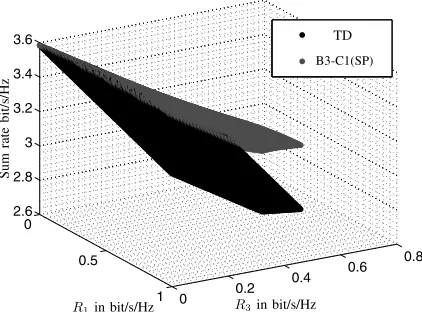
Fig. 3. Simulation Results (TD - Time Division Protocol, SP - Superposition Coding Protocol)
Therefore, the projection of all planes in the figure to the bot-tomR1-R3 plane is the MAC capacity region, where the cor-ner value is[CΣMAC−C3MAC, C3MAC] = [0.737,0.585]bit/s/Hz and[C1MAC, CΣMAC−C1MAC] = [1,0.3219]bit/s/Hz. For com-parison, the performances of the TD protocol and of the su-perposition coding protocol with decoding order combination B3-C1 are shown. To maintain the readability, we omit the performance of the superposition coding protocol with other decoding order combinations, because the performances are worse. When nodes S1 and S3 do not transmit anything in the MAC-phase, i.e., R1 = R3 = 0, only node S2 transmits messages to nodes S1 and S3 in the BC-phase, the performances of the TD protocol and the superposition coding protocol with decoding order combination B3-C1 are the same. For other rate pairs than R1 = R3 = 0, the superposition coding protocol with the decoding order combination B3-C1 outperforms the TD protocol for the chosen parameters. Approximately 14% gain is achieved by the superposition coding protocol compared to the TD protocol at the rate pair [R
1, R3] = [CΣMAC−C3MAC, C3MAC]. The performance of
the superposition coding protocol with other decoding order combinations can be worse than the performance of the TD protocol, i.e., the decoding order combination of the superposi-tion coding protocol is crucial for its performance considering our proposed hybrid computation in two-way relaying scheme.
VI. CONCLUSION
In this paper, we consider a three-node wireless sensor network which runs two applications with the download func-tion and the mean funcfunc-tion, respectively, as the aggregafunc-tion functions. In order to support the requirement that one partner node in the three-node network downloads all the sensor nodes’ data of the first application and the other partner node calculates the mean value of all the sensor nodes’ data of the second application, we propose a communication scheme named hybrid computation in two-way relaying with two protocols, the superposition coding protocol and the time
division protocol. In the proposed scheme, there are two communication phases, the MAC-phase and the BC-phase. In the MAC-phase, the two partner nodes transmit messages of both applications to the intermediate node where hybrid computations are performed. In the BC-phase, the intermediate node broadcasts the computed data to the partner nodes where the required application functions are determined. In both protocols, we give optimization problems which maximize the sum rate.In the superposition coding protocol, we show that 12 different decoding order combinations at the partner nodes are possible since SIC cannot be performed at one of the partner nodes. The sum rate is maximized with re-spect to the power portion for each superimposed message, and the constraints guarantee the successful transmission of the messages from the partner nodes. In the time division protocol, the optimization is performed with respect to the time portion allocated to the message that is broadcast from the intermediate node to the partner nodes. Simulation results shows that the decoding order combination is crucial to the performance of the superposition coding protocol. Under the given system settings, we show that the superposition coding protocol with certain decoding order combination outperforms the time division protocol.
REFERENCES
[1] I. F. Akyildiz, W. Su, Y. Sankarasubramaniam, and E. Cayirci, “A survey on sensor networks,”IEEE Communications Magazine, vol. 40, pp. 102– 114, Aug. 2002.
[2] R. Rajagopalan and P. K. Varshney, “Data-aggregation techniques in sen-sor networks: A survey,”IEEE Communications Survey and Tutorials, vol. 8, no. 4, pp. 48 – 63, 2006.
[3] I. F. Akyildiz, M. C. Vuran, and O. B. Akan, “A cross-layer protocol for wireless sensor networks,” in Proc. 40th Annual Conference on Information Sciences and Systems, 2006.
[4] M. Goldenbaum, S. Stanczak, and M. Kaliszan, “On function com-putation via wireless sensor multiple-access channels,” inProc. IEEE Wireless Communications and Networking Conference, 2009. [5] A. Giridhar and P. R. Kumar, “Computing and communicating functions
over sensor networks,”IEEE Journal on Selected Areas in Communica-tions, vol. 23, pp. 755 – 764, Apr. 2005.
[6] M. Shazly, E. S. Elmallah, and J. Harms, “Balanced slices in wireless sensor networks,” inProc. 2011 IEEE Wireless Communications and Networking Conference, 2011.
[7] A. Alomar and A. Akbar, “C R C: Carrefour routing for cluster-based wireless sensor network to support multiple applications in multiple gateway environments,” inProc. International Conference on Mobile Ad-hoc and Sensor Networks, 2009.
[8] B. Rankov and A. Wittneben, “Achievable rate regions for the two-way relay channel,” inProc. 2006 IEEE International Symposium on Information Theory, 2006.
[9] T. J. Oechtering and H. Boche, “Piggyback a common message on half-duplex bidirectional relaying,”IEEE Transactions on Wireless Commu-nications, vol. 7, no. 9, pp. 3397 – 3406, Sept. 2007.
[10] C. K. Ho, K. T. Gowda, and S. Sun, “A generalized two-way relay channel with private information for the relay,” in Proc. 2009 IEEE International Conference on Communications, 2009.
[11] H. Ayad and M. Kamel, “Cumulative voting consensus method for partitions with a variable number of clusters,” IEEE Transactions on Pattern Analysis and Machine Intelligence, vol. 30, no. 1, pp. 160– 173, Jan. 2008.
[12] T. C. Aysal, M. E. Yildiz, A. D. Sarwate, and A. Scaglione, “Broadcast gossip algorithms for consensus,”IEEE Transactions on Signal Process-ing, vol. 57, no. 7, pp. 2748 – 2761, Jul. 2009.