IJSRSET21841127 | Received : 10 Sep 2018 | Accepted : 20 Sep 2018 | September-October-2018 [ 4 (10) : 408-412]
Themed Section : Engineering and Technology
Study Related to the Use of Multicast Technique over Wired
Network for Communication among the Nodes
Abdul Ahad
1, Pervez Rauf Khan
2, Dr. Shafeeq Ahmad
31
Department of Computer Science and Engineering / Information Technology, Azad institute of
Engineering and Technology, Lucknow Uttar Pradesh, India
2
Assistant Professor, Department of Computer Science and Engineering, Azad institute of Engineering
and Technology, Lucknow Uttar Pradesh, India
3
Professor, Azad Institute of Engineering and Technology, Lucknow, India
ABSTRACT
In this paper we survey some of the recent service management efforts, that have been successful in the intra-domain, as fall short for the inter-domain. In particular, as we focus on important topics like (1) monitoring multicast reachability between receivers and sources ; (2) understanding the different solutions and challenges between inter- and intra domain service management; and (3) surveying existing solutions for determining whether multicast capability exists on an end-to-end path. Multicast is one of the first “value-added” services to
be developed and deployed in the Internet. In evaluating the success of multicast, if ubiquitous deployment has been the goal, multicast was not been successful. However, if widespread use of multicast as bandwidth savings technique has been the goal, multicast has indeed been successful. Upon closer investigation, one of the reasons for only partial success is a lack of support for a service management. Multicast is particularly hard to manage in the inter-domain where it has been less successful, but easier to manage within the domain where network administrators have more smaller networks and control to manage. Our investigation shows that while not much attention was initially given to the multicast service management, more recent efforts have been successful at developing good tools and solutions.
Keywords : Multicast, Prons and Cons, Unicast Vs Multicast, Ethernet Multicast, Network Congestion, Multicast Application, Conclusion.
I. INTRODUCTION
Multicast is a technique for one-to-many communication over an IP network. The destination nodes send
Internet
Group
Management
Protocol
leave and join messages, Example in the case of IPTV when the user changes from 1 TV channel to another.[1] IP multicast scales to a much larger receiver population by not requiring pre knowledge of who or how many receivers there are. Multicast uses network infrastructure efficiently by requiring the source to send a packet only once, evenif it needs to be delivered to a large number of receivers. The nodes in the network take care of replicating the packet to reach multiple receivers only when necessary.[8]
The most similar
transport layer
protocol to use multicast addressing is (UDP)User Datagram
Protocol
. By its nature, UDP is not much reliable—various
middleware
products,[4] e.g. those that implement theReal-Time Publish-Subscribe (RTPS)
Protocol
of theObject
Management
Group
(OMG)Data
Distribution
Service
(DDS) standard, as well as by special transport protocols such asPragmatic General Multicast
(PGM).[6]Multicast is often employed in
Internet Protocol
(IP) applications ofstreaming
media
, such asIPTV
andmultipoint videoconferencing
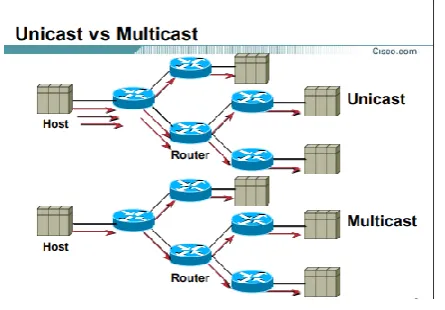
.[7] Refer FIG 1.Why multicast is used?
1. When sending same data to multiple 2. receivers Better bandwidth utilization 3. Less host/router processing
4. Receivers’ addresses unknown
Figure 1. Unicast Vs Multicast
✓ Unicast transmission sends similar copies of data, one copy for each receiver – Ex: host transmits 4 copies of data and network forwards each to 4 separate receivers – Ex: host can only send to one receiver at a time[3]
✓ Multicast transmission sends a one copy of data to multiple receivers – Ex: host transmits one copy of data and network replicates at last possible hop for each receiver, each packet exists only 1 time on any given net work – Ex: host can send to multiple receivers simultaneously[2]
Multicast transmission affords many advantages over unicast transmission in a one-to-many or many-to-many environment
Enhanced Efficiency: available network bandwidth is utilized more efficiently since multiple streams of data are replaced with a single transmission
Effective Performance: less number of copies of data require forwarding and processing [6] Distributed Applications: multipoint applications would not be possible as demand and usage grows because unicast transmission will not scale
Ex: traffic level and clients increase at a 1:1 rate with unicast transmission
Ex: traffic level and clients do not increase at a greatly reduced rate with multicast transmission
II. METHODS AND MATERIAL
Multicast Disadvantages
Most Multicast Applications are UDP based. This results in some undesirable side effects when compared to similar unicast, TCP applications. [5] Best Effort Delivery results in occasional packet drops. Many multicast applications that operate in real-time (e.g. Video, Audio) can be impacted by these losses. Also, requesting retransmission of the lost data at the application layer in these sort of real-time applications is not feasible.
Heavy drops on Voice applications result in jerky, missed speech patterns that can make the content unintelligible when the drop rate gets high enough.
Moderate to Heavy drops in Video is sometimes better tolerated by the human eye and appear as unusual “artifacts” on the picture.[5] However, some
compression algorithms can be severely impacted by even low drop rates; causing the picture to become jerky or freeze for several seconds while the decompression algorithm recovers.
Multicast applications growing duplicate. Duplicate packets can most likely be generated as multicast network topologies change. Applications should expect most likely duplicate packets to arrive and Eshould be designed accordingly.
III. ETHERNET MULTICAST
Ethernet frames with a value of 1 in the least-significant bit of the first octet of the destination address are treated as multicast frames and are flooded to all points on the network. This mechanism constitutes multicast at the data link layer. This mechanism is used by IP multicast to achieve one-to-many transmission for IP on Ethernet networks. Modern Ethernet controllers filter received packets to reduce CPU load, by looking up the hash of a multicast destination address in a table, initialized by software, which controls whether a multicast packet is dropped or fully received. Refer FIG 2.
IV.UNICAST VERSUS MULTICAST BANDWIDTH FOR VIDEO
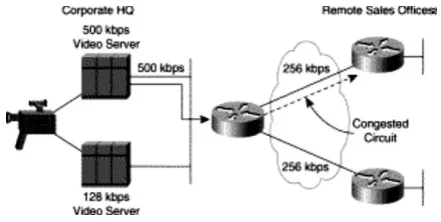
Figure 2. Unicast Vs Multicast Bandwidth
Assuming that, in the future, more and more Internet-connected subscribers have the ISDN, ADSL, or other medium-rate Internet connections necessary to watch ACME's program content and are tuned in, bandwidth demands can approach the multimegabit range.
If you further consider that some form of competition in this marketplace exists, ACME will not be the only
supplier of this sort of program content. Other companies will begin offering similar services via the Internet, which will place additional demands on the Internet's infrastructure. At this writing, several movie services were beginning to investigate the possibilities of distributing movies via data networks. Considering that a typical MPEG-2 video stream requires roughly 1.5 Mbps
of bandwidth for a reasonably artifact-free video, IP multicasting is clearly an excellent choice for delivering this type of program content.
V. NETWORK CONGESTION
In the TCP unicast case, the standard TCP backoff and slow-start window mechanisms automatically adjust the speed of the data transfer and therefore provide a degree of congestion avoidance within the network. Because IP multicasting cannot use TCP (due to its connectionless, one-to-many nature), there is no built-in congestion avoidance mechanism to prevent a multicast stream from exhausting link bandwidth or other critical router resources. Having said that, it is important for you to note that UDP unicast data streams suffer the same congestion avoidance problems! Furthermore, the recent growth in popularity of multimedia audio and video applications both on the Internet and within private intranets is increasing the amount of UDP unicast traffic. Refer FIG 3.
Figure 3. Network Congestion
It's not uncommon for people to think of IP multicasting and video conferencing as almost the same thing. Although the first application to be used on an IP multicast-enabled network is often video conferencing, video is only one of many IP multicast applications that can add value to a company's business model. In fact, after some initial experiments with video conferencing over the IP multicast network, many companies find that for the bandwidth consumed, the talking head in a typical audio/ video conference provides little added value to the communication process.
This section looks at some other IP multicast applications that have the potential for improving productivity, including multimedia conferencing, data replication, real-time data multicasts, and gaming and simulation applications.
a. Multimedia Conferencing
Some excellent IP multicast, multimedia conferencing tools were developed for the UNIX environment for use over the MBone (the next few sections discuss more about the MBone). These tools (many of which have recently been ported to the Windows 95 and NT platforms) permit a many-to-many audio only or audio/video conference to take place via IP multicast. In addition to the audio and video tools, a UNIX-based Whiteboard tool was developed that permits users to share a common, electronic whiteboard. Besides these MBone freeware tools for multimedia conferencing over IP multicast networks, other companies are now beginning to offer commercial forms of these tools with other value added features.
b. Real-Time Data Multicasts
The delivery of real-time data to large groups of hosts is another area where IP multicasting is becoming popular.[6] A good example is the delivery of stock ticker information to workstations on the trading
floor. Previously, special applications were built to deliver this time-critical information to traders on the trading floor.[1] More and more financial and investment firms are also investigating the use of IP multicasting to deliver information to their customers as another revenue-generating financial and trading service.
c. Gaming and Simulations
IP multicasting is very well suited for use in network gaming or simulation applications.[8] Although numerous PC games and simulations permit groups of networked gamers to battle each other in simulated dogfights or other fantasy environments such as Doom, virtually all these applications make use of unicast, point-to-point connections.[8]
VII. CONCLUSION
In this paper, we focused on service monitoring as one of the most important management functions for IP multicast. We have presented an summary view of the recent work in multicast monitoring in three different dimensions: intra-domain, inter-domain, and end-user level monitoring. Most important conclusion that we have reached from this study is the fact that before using multicast networking or any hybrid technique we can improve the process of packet drop and hence it will improve the communication between 2 nodes, there still exists a need for additional primitives and tools to help application developers to interact with the underlying multicast service to make the most effective use of it.
VIII.
REFERENCES
[1]. Media-communication based on Application-Layer Multicast
[2]. Jump up^ Lawrence Harte, Introduction to Data Multicasting, Althos Publishing 2008.
Multipoint Transfers Across Datacenters". USENIX. Retrieved July 26, 2017.
[4]. Jump up^ RFC 1324 2.5.1 Size, IETF. [5]. Jump up^ White paper, EU: PSYC.
[6]. Jump up^ Rick Boivie; Nancy Feldman; Yuji Imai; Wim Livens & Dirk Ooms (November 2007). "Explicit Multicast (Xcast) Concepts and Options". Retrieved May 25, 2013.
[7]. Jump up^ M. Eriksson, S.M. Hasibur Rahman, F. Fraille, M. Sjostrom, "Efficient Interactive Multicast over DVB-T2 - Utilizing Dynamic SFNs and PARPS", 2013 IEEE International Conference on Computer and Information
Technology (BMSB’13), London, UK, June 2013.
[8]. Jump up^ N. Sinha, R. Oz and S. V. Vasudevan,
“The statistics of switched broadcast",
Proceedings of the SCTE 2005 Conference on Emerging Technologies, Tampa, FL, USA, January 2005
[9]. Jump up Edition 345 RF Exclusive Edition, EU: RTG.
AUTHOR’S PROFILE
Abdul Ahad had completed Btech from Integral university Lucknow and pursuing M tech from Azad institute of engineering & technology lucknow and currently working in Same filed of interest in UAE. My area of interest are Computer Network and Operating System.
Pervez Rauf Khan :
Assistant Professor, Department of Computer Science and Engineering, Azad institute of Engineering and Technology, Lucknow Uttar Pradesh, IndiaDr. Shafeeq Ahmad, Professor and Director, Azad Institute of
Engineering and
Technology, Lucknow, India