Decentralized Management of Building Indoors
through Embedded Software Agents
Giancarlo Fortino1and Antonio Guerrieri2
DEIS - University of Calabria
Via P. Bucci, cubo 41c, Rende (CS), 87036, Italy 1
[email protected],[email protected]
Abstract. In order to support personalized people comfort and building energy efficiency as well as safety, emergency, and context-aware infor-mation exchange scenarios, next-generation buildings will be smart. In this paper we propose an agent-oriented decentralized and embedded architecture based on wireless sensor and actuator networks (WSANs) for enabling efficient and effective management of buildings. The main objective of the proposed architecture is to fully support distributed and coordinated sensing and actuation operations. The building management architecture is implemented at the WSAN side through MAPS (Mobile Agent Platform for Sun SPOTs), an agent-based framework for program-ming WSN applications based on the Sun SPOT sensor platform, and at the base station side through an OSGi-based application. The proposed agent-oriented architecture is demonstrated in a simple yet effective op-erating scenario related to monitoring workstation usage in computer lab-oratories/offices. The high modularity of the proposed architecture allows for easy adaptation of higher-level application-specific agents that can therefore exploit the architecture to implement intelligent building man-agement policies.
Keywords:Smart Buildings, Multi-Agent Systems, Wireless Sensor and Actuator Networks, Building Management Systems.
1.
Introduction
Nowadays, due to advances in communication and computing technologies, the need to have high comfort levels together with an optimization of the en-ergy consumption is becoming important for inhabitants of buildings. Moreover, buildings should also support their inhabitants with automatic emergency and safety procedures as well as context aware information services. To meet all these requirements, future buildings have to incorporate diversified forms of in-telligence [7].
even conflicting specific goals such as personalized people comfort and build-ing energy efficiency.
A few research efforts based on agents have been to date proposed to design and implement intelligent building systems [25] [17] [8] [28] [27] [23]. However, none of them provide agents embedded in the sensor and actuator devices that would introduce intelligence decentralization and improve system efficiency. This is due to the exploitation of conventional sensing and actua-tion systems that do not offer distributed computing devices for sensing and actuation. To overcome this limitation, wireless sensor and actuator networks (WSAN) [26] can be adopted. WSANs represent a viable and more flexible so-lution to traditional building monitoring and actuating systems (BMAS), which require retrofitting the whole building and therefore are difficult to implement in existing structures. In contrast, WSAN-based solutions for monitoring buildings and controlling equipment, such as electrical devices, heating, ventilation and cooling (HVAC), can be installed in existing structures with minimal effort. This should enable monitoring of structure conditions, and space and energy (elec-tricity, gas, water) usage while facilitating the design of techniques for intelligent device actuation.
The implementation of the proposed architecture is based on MAPS (Mobile Agent Platform for Java Sun SPOTs) [3] at sensor/actuator node side and on Jade [5] OSGi-based application at coordinator side.
The main contribution of this paper is the definition ofA-BMF (Agent based Building Management Framework), a decentralized and embedded agent ori-ented architecture for the management of intelligent buildings that is based on WSANs and overcomes the limitations of the aforementioned solutions [25] [17] [8] [28] [27] [23]. In particular, the aim of our architecture is to optimize and fully decentralize the sensing and actuation operations through distributed coopera-tive agents both embedded in sensor/actuator devices and running on more capable coordinators (PC, plug computers, PDA, smartphones). This would enable more effectiveness in programming the sensing and actuation opera-tions and more efficiency in the management of distributed sensor and actua-tor nodes. Moreover, the proposed architecture can be easily programmed to support a wide range of building management applications integrating comfort, energy efficiency, emergency, safety, and context-aware information exchange aspects.
2.
Related Work
In [25] the authors present the MASBO (Multi-Agent System for Building cOn-trol) architecture that aims to provide a set of software agents to support both on-line and off-line applications for intelligent work environments. MASBO is used to develop a multi-agent system (MAS) able to tradeoff energy saving and inhabitants’ preferences where preferences can be learnt and predicted through an unsupervised online real-time learning algorithm (analyzing inhab-itants’ behavior). MASBO agents reside on a server and constantly monitor data from sensors and eventually actuate some commands. MASBO works as an enhancement to an existing building automation system by adding learning, reasoning and autonomous capabilities. The responsibility of controlling sen-sors and actuators, and keeping a requested environmental value constant is not addressed by MASBO.
In [17] the authors propose a working solution to the problem of thermal resource distribution in a building using a market-based MAS. Computational agents representing individual temperature controllers bid to buy or sell cool or warm air. The agents, running in a monolithic process on a workstation, are able to distribute the thermal resources so that all the building offices have an equitable temperature distribution. Temperature sensors and air flow actuators are all accessible directly through distributed hardware modules via a network connection.
In [8] the authors describe a MAS that monitors and controls an office build-ing in order to provide added values like energy savbuild-ing together with the delivery of energy. The developed system is distributed in the sense that some agents are located on PDAs and others run on the Bluetooth access points (worksta-tions) that communicate with the PDAs. The system makes use of the existing power lines for communication between the agents and the sensing and actua-tion system controlling lights, heating, ventilaactua-tion, etc.
In [28] a conceptual framework, namely Cyber-enabled Efficient Building Energy Management System (CEBEMS), is presented. Its intent is increasing energy efficiency, lowering dependence on the energy grid, and providing an economic incentive for the end user. It enables distributed control methodol-ogy using MAS for efficient management of both electrical and thermal energy systems for realizing maximum efficiency energy management. MAS aim to achieve system-wide objectives, which may not be solved using a single agent, but by coordination and communication among the agents.
In [27] authors do a demonstration of data gathering from a WSN. In the system proposed, users can query and view the local data in an ad-hoc man-ner, and possibly remotely configure and manipulate the data capture process. For the purposes of this demonstration, authors adopted Agent Factory Micro Edition (AFME) [22]. The Agents, implemented on AFME, are programmed to answer users’ requests.
agents. Agents, that reside on workstations, process information and send them to a fuzzy controller [16] that eventually transmits a proper signal to switches, valves or other actuators.
Differently from the described approaches, our agent-based architecture embeds agents both into the wireless sensor and actuator network used as infrastructure for building monitoring and control and on more capable coor-dinators. This important feature would provide decentralized intelligence and improve system efficiency.
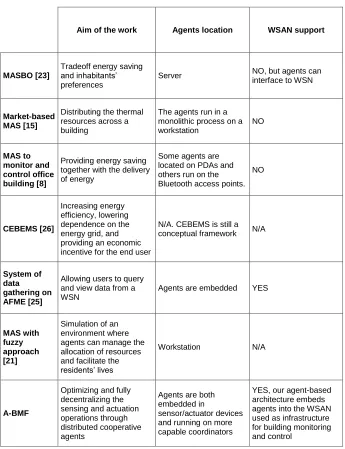
Table 1 summarizes the characteristics of the works reported above.
3.
Agent-based Architecture
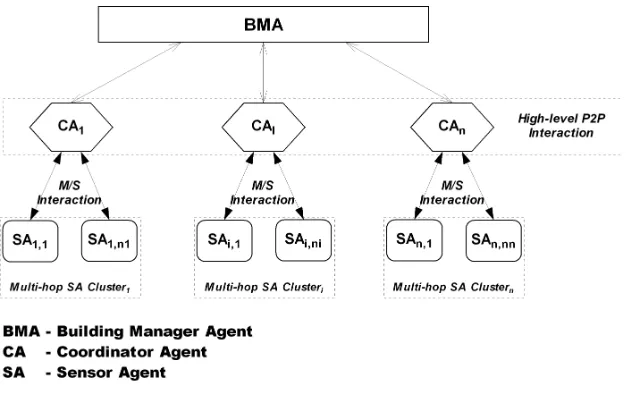
The agent-based architecture (see Fig. 1) of A-BMF for decentralized and em-bedded building management is composed of a building manager agent (BMA), which is installed in the control workstation, coordinator agents (CAs), which run in the basestations, and sensor agents (SAs), which are executed in the sen-sor/actuator nodes. Specifically, the architecture relies on a multi-basestation approach to allow for large buildings composed of multiple floors and diversi-fied environments. Thus, the architecture is purposely hybrid: hierarchical and peer-to-peer. Interaction between CAs is peer-to-peer whereas interactions be-tween CAs and their related SAs (or SA cluster) and bebe-tween BMA and CAs are usually master/slave. Moreover, SAs of the same cluster coordinate to dy-namically form up a multi-hop ad-hoc network rooted at the master CA.
Table 1.Related Work comparison.
Aim of the work Agents location WSAN support
MASBO [23]
Tradeoff energy saving and inhabitants’ preferences
Server NO, but agents can
interface to WSN
Market-based MAS [15]
Distributing the thermal resources across a building
The agents run in a monolithic process on a workstation NO MAS to monitor and control office building [8]
Providing energy saving together with the delivery of energy
Some agents are located on PDAs and others run on the Bluetooth access points.
NO
CEBEMS [26]
Increasing energy efficiency, lowering dependence on the energy grid, and providing an economic incentive for the end user
N/A. CEBEMS is still a conceptual framework N/A
System of data gathering on AFME [25]
Allowing users to query and view data from a WSN
Agents are embedded YES
MAS with fuzzy approach [21]
Simulation of an environment where agents can manage the allocation of resources and facilitate the residents’ lives
Workstation N/A
A-BMF
Optimizing and fully decentralizing the sensing and actuation operations through distributed cooperative agents
Agents are both embedded in
sensor/actuator devices and running on more capable coordinators
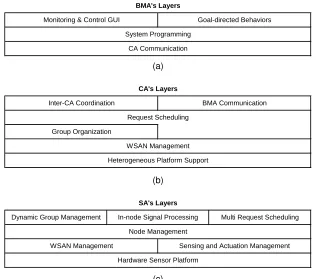
In Fig. 2 the main functionalities of BMA, CA and SA are shown according to a layered organization that is partially derived from the Building Management Framework (BMF) [15].
BMA's Layers
Monitoring & Control GUI Goal-directed Behaviors System Programming
CA Communication
(a)
Request Scheduling Group Organization
CA's Layers
Inter-CA Coordination BMA Communication
WSAN Management Heterogeneous Platform Support
(b)
Node Management
WSAN Management Sensing and Actuation Management Hardware Sensor Platform
SA's Layers
Dynamic Group Management In-node Signal Processing Multi Request Scheduling
(c)
Fig. 2.The layered organization of (a) BMA, (b) CA and (c) SA.
The BMA is the top level agent that manages the distributed agent based architecture. The BMA includes the following layers:
– CA Communication allows the message based communication between BMA and the CAs.
– System Programmingis the layer which allows to program the distributed agent network (SAs are reached through their CAs).
– Monitoring & Control GUIprovides a GUI through which the building man-ager can issue requests to configure/program the agent-based building net-work and visualize its status and the monitored data.
The CA is the middle level agent which is able to manage a cluster of SAs which refers to a given area of the intelligent building. The CA includes the following layers:
– Heterogeneous Platform Supportincorporates a set of adapters that allow interfacing the system with different type of sensor/actuator platforms. An adapter is linked to a specific hardware device able to communicate with a specific sensor platform in the network.
– WSAN Management allows to fully manage a WSAN cluster. This layer supports packet coding/decoding according to the A-BMF application-level protocol and packet transmission/reception to/from the WSAN cluster. More-over, this layer supports device discovery within the cluster.
– Group Organization provides group-based programming of sensors and actuators, tracking of nodes and groups in the system, and management of node configurations and group compositions. Node organization in groups is specifically defined to capture the morphology of buildings. Nodes belong to groups depending on their physical (location) or logical (operation type) characteristics.
– Request Scheduling allows the support for higher-level application-specific requests. Through this layer, a CA can ask for the execution of specific tasks to single or multiple SAs or groups of SAs. Moreover, this layer keeps track of the requests submitted to the system, waits for data from the nodes and passes them to the requesting applications. A request is formalized through the following tuple: R =<Obj, Act, R, LT>, where Obj is a specific sensor or actuator belonging to a node, Act is the action to be executed on Obj, R is the frequency of each executed Act, LT is the length of time over which these actions are to be reiterated. Moreover, a request can target a single node or a group of nodes having Obj.
– Inter-CA Coordinationoffers efficient mechanisms for coordination between CAs. Specifically, CAs cooperate for submitting queries and retrieving data spanning multiple SA clusters.
– BMA Communicationallows the message based communication between CA and the reference BMA.
The SA is the low level agent running on sensor/actuator nodes to perform given sensing/actuating operations. The SA is designed around the following layers:
– Hardware Sensor Platform allows to access the hardware sensor/actuator platform. In particular, the layer facilitates the configuration of the platform specific drivers and the use of the radio.
– WSAN Management manages the node communication with the refer-ence CA according to the A-BMF application protocol and among the cluster nodes through the network protocol provided by the node sensor platform.
– Node Management is the core of the SA and allows to coordinate all the layers for task execution. In particular, it handles events from the lower layers every time that a network packet arrives or data from sensor/actuator are available, and from the upper layers every time that data are processed or a stored request has to be executed.
– Dynamic Group Management provides group management functionali-ties to the SA. A node can belong to several groups at the same time and its membership can be dynamically updated on the basis of requests from CAs.
– In-node Signal Processing allows the SA to execute signal processing functions on data acquired from sensors [4]. It can compute simple aggre-gation functions (e.g. mean, min, max, variance, R.M.S.) and more complex user-defined functions on buffers of acquired data.
– Multi Request Scheduling allows the scheduling of sensing and actuation requests. In particular, it stores the requests from CAs and schedules them according to their execution rate.
4.
MAPS-Based Implementation
The agent-based building management architecture of A-BMF is currently im-plemented through MAPS [3], our agent-based framework for developing WSN applications on the Sun SPOT sensor platform. MAPS has been selected as one of the most representative frameworks for agent oriented programming of sensor/actuator nodes [2] [11] [12]. Only two other java-based platforms cur-rently exist: AFME [22] and MASPOT [19]. The former is based on a more complex programming model and provides basic operations less efficient than MAPS. The latter is mainly centered on agent mobility and does not provide a suitable API for programming complex agent behaviors. Thus MAPS has been adopted as the one fulfilling the needed requirements of effective agent pro-gramming and efficient operations. Moreover, currently the mobility feature of MAPS agents is not used in the current implementation of A-BMF. In this sec-tion we first provide a brief overview of MAPS (more details can be found in [3], [21]) and, then, present the MAPS-based implementation of the proposed build-ing management architecture at sensor-node side, specifically behavior and event-based interactions of the SA.
4.1. MAPS: a brief overview
MAPS [3] [21] [1] is an innovative Java-based framework specifically developed on Sun SPOT technology for enabling agent-oriented programming of WSN applications. It has been defined according to the following requirements:
– Component-based lightweight agent server architectureto avoid heavy con-currency and agents cooperation models.
– Minimal core servicesinvolving agent migration, agent naming, agent com-munication, timing and sensor node resources access (sensors, actuators, flash memory, and radio).
– Plug-in-based architectureextensions through which any other service can be defined in terms of one or more dynamically installable components im-plemented as single or cooperating (mobile) agents.
– Use of Java languagefor defining the mobile agent behavior.
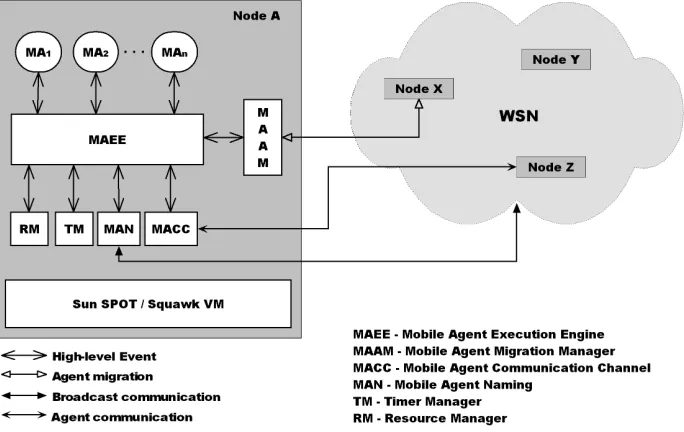
The architecture of MAPS (see Fig. 3) is based on several components inter-acting through events and offering a set of services to mobile agents, including message transmission, agent creation, agent cloning, agent migration, timer handling, and an easy access to the sensor node resources. In particular, the main components are the following:
Fig. 3.The architecture of MAPS.
– Mobile Agent (MA). MAs are the basic high-level component defined by user for constituting the agent-based applications.
– Mobile Agent Execution Engine (MAEE). It manages the execution of MAs by means of an event-based scheduler enabling lightweight concurrency. MAEE also interacts with the other services-provider components to fulfill service requests (message transmission, sensor reading, timer setting, etc) issued by MAs.
SPOT environment. The MAs hibernation and serialization involve data and execution state whereas the code must already reside at the destination node (this is a current limitation of the Sun SPOTs which do not support dynamic class loading and code migration).
– Mobile Agent Communication Channel (MACC). It enables inter-agent com-munications based on asynchronous messages (unicast or broadcast) sup-ported by the Radiogram protocol.
– Mobile Agent Naming (MAN). MAN provides agent naming based on prox-ies for supporting MAMM and MACC in their operations. It also manages the (dynamic) list of the neighbor sensor nodes which is updated through a beaconing mechanism based on broadcast messages.
– Timer Manager (TM). It manages the timer service for supporting timing of MA operations.
– Resource Manager (RM). RM allows access to the resources of the Sun SPOT node: sensors (3-axial accelerometer, temperature, light), switches, leds, battery, and flash memory.
The dynamic behavior of a mobile agent (MA) is modeled through a multi-plane state machine (MPSM). Each multi-plane [6] may represent the behavior of the MA in a specific role so enabling role-based programming. In particular, a plane is composed of local variables, local functions, and an automaton whose transitions are labeled by Event-Condition-Action (ECA) rules E[C]/A, where E is the event name, [C] is a boolean expression evaluated on global and local variables, and A is the atomic action. Thus, agents interact through events, which are asynchronously delivered and managed by the MAEE component.
It is worth noting that the MPSM-based agent behavior programming allows exploiting the benefits deriving from three main paradigms for WSN program-ming: event-driven programming, state-based programming and mobile agent-based programming.
MAPS is also interoperable with the JADE framework [5]. Specifically, a JADE-MAPS gateway [9] has been developed for allowing JADE agents to in-teract with MAPS agents and vice versa. While both MAPS and JADE are Java-based, they use a different communication method. JADE sends messages ac-cording to the FIPA standards (using the ACL specifications), while MAPS cre-ates its own messages based on events. Therefore, the JADE-MAPS Gateway facilitates message exchange between MAPS and JADE agents. This inter-platform communication infrastructure allows rapid prototyping of WSN-based distributed applications/systems that use JADE at the basestation/coordinator/ host sides and MAPS at the sensor node side.
4.2. MAPS-based sensor agents
interaction protocol allows to interact with the CA to provide the requested ser-vices. In the following subsections we first describe the event based interaction protocol between CA and SA which provide a consistent snapshot of the ser-vices that an SA can offer to a CA and how such serser-vices can be exploited; then we detail the SA’s behavior that shows the SA’s architecture composed of management and sensing planes defined as finite state machines.
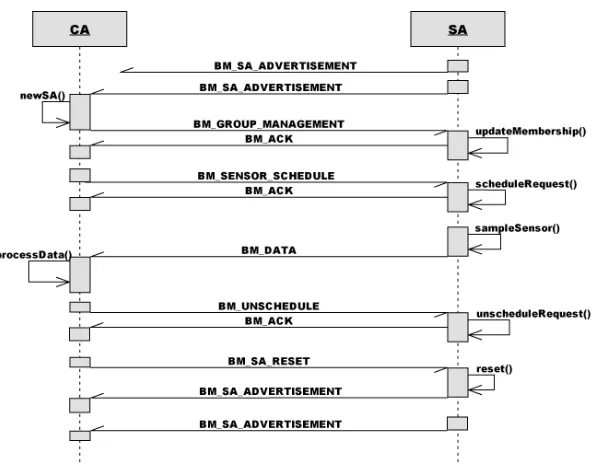
Event-based interaction protocol. The MAPS-based SA (hereafter simply named SA) interacts with its cluster CA through events as sketched in the se-quence diagram of Fig. 4. Once the SA is created, it periodically emits the BM SA ADVERTISEMENT event until the CA sends a configuring event (group management or request scheduling). Through the BM GROUP MANAGEMENT event, the CA manages the membership of target SAs (see Section 3). After the SA processes the received event, it sends the BM ACK event to the CA. The BM SENSOR SCHEDULE (or BM ACTUATOR SCHEDULE) event allows to request a specific sensing (or actuation) operation to target SAs. The SA trans-mits sensed (processed) data to the CA through the BM DATA event. The CA can unschedule previously scheduled requests through the BM UNSCHEDULE
event. Finally the CA sends out the
BM SA RESET event to reset target SAs.
Tables 4 and 5 in Appendix A report the defined MAPS-based building man-agement events and the predefined values of their parameters. In particular, an event is defined by its standard parameters: EventSender ID, EventTarget ID, Event Type, Event Occurrence. The defined events are of two possible super types: MSG (sent by CA to SA) and MSG TO BASESTATION (sent by SA to CA). Both types are further specialized in the defined BM events as reported in the pairs<MSG TYPE, BM event>of the 3rd column of Table 4 in Appendix A. Moreover, each event type has its own additional parameters, which are de-scribed in Table 5 in Appendix A. It is worth noting that the ADDRESSEE value can be set through the regular expression formalized in Eq. 1 where SA is a sensor agent of the building management architecture, G is an element from the set of defined groups, STO is a set theory operator (e.g. union, intersection, difference) and NOT is the negation. Thus, the addressee of an event can be either one or more SAs, or SAs belonging to groups or complex compositions of groups.
SA+|([N OT]G[ST O[N OT]G]∗) (1)
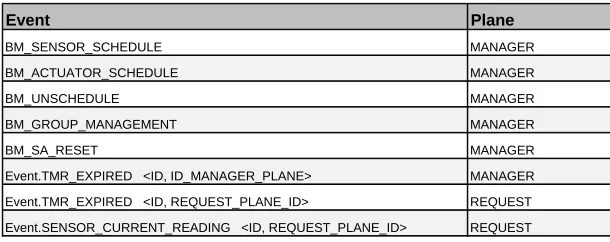
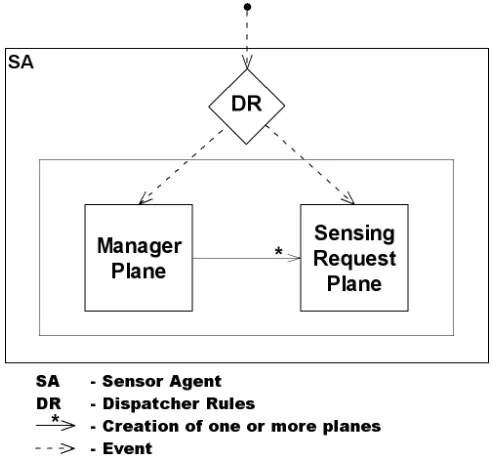
Sensor Agent behavior. The SA agent behavior consists of two types of planes: Manager plane and Request plane. While the Manager plane is created at the SA creation time and handles all node targeting events, a Request plane is created by the Manager plane every time that a new request schedule is re-ceived. This type of plane is removed when it completes its task or due to the reception of an unschedule event. Agent planes receive events from the MAPS dispatcher component that is programmed to deliver the events fetched from the agent queue to the plane in charge to process them according to some dis-patcher rules (DR). Fig. 5 shows the SA behavior architecture. The disdis-patcher rules are reported in Table 2.
Table 2.Dispatcher rules.
Event Plane
BM_SENSOR_SCHEDULE MANAGER
BM_ACTUATOR_SCHEDULE MANAGER
BM_UNSCHEDULE MANAGER
BM_GROUP_MANAGEMENT MANAGER
BM_SA_RESET MANAGER
Event.TMR_EXPIRED <ID, ID_MANAGER_PLANE> MANAGER
Event.TMR_EXPIRED <ID, REQUEST_PLANE_ID> REQUEST
Event.SENSOR_CURRENT_READING <ID, REQUEST_PLANE_ID> REQUEST
Fig. 5.The SA behavior architecture.
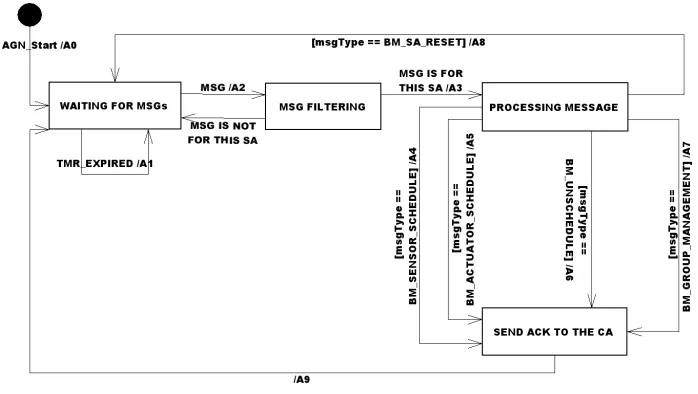
with its sensor/actuator available functions and waits for an incoming event from the CA. When it receives the first event, the timer is reset. Each received event is filtered against the current SA’s group membership. If the filtered event is for the current SA, it is processed according to its type. A more detailed description of each action of the Manager plane is provided using both a self-explanatory pseudocode (see Fig. 7) and the MAPS code (intended for MAPS programmers; see Fig. 17 in the Appendix B).
Fig. 6.The SA’s Manager plane.
A0: firstProcessedEvent=FALSE;
Start a periodic Event.TMR_EXPIRED to send the BM_SA_ADVERTISEMENT. A1: Send BM_SA_ADVERTISEMENT to CA
A2: if the MSG is for this SA
firstProcessedEvent=TRUE && resetTimer (ID_TIMER) A3: msgType = msgEvent.getParam(ParamsLabel.MSG_TYPE) A4: Create a new Sensor Plane:
PlaneID = ID_REQUEST, the Request as parameter and start it. A5: Create a new Actuator Plane:
PlaneID = ID_REQUEST, the Request as parameter and start it. A6: Unschedule the Request deallocating the Plane with ID = ID_REQUEST A7: Update current SA Group Membership
A8: Reset the SA and deallocate all the Request Planes; firstProcessedEvent=FALSE
A9: Send BM_ACK to CA
Fig. 8.The SA’s Sensing Request plane.
A0: Process Request
A1: Create and submint a Sensing Event on the Sensor Requested
A2: Inizialize and Submit a TMR_EXPIRED Event with the Params PERIOD and LIFETIME; Set dataToStore
A3: Store sensed data and increase the storedDataCounter A4: if DATA_TYPE.VALUE == "threshold notification"
Send sensed data to CA if the threshold is verified and reset the storedDataCounter
else Send sensed data to CA and reset the storedDataCounter A5: Calculate the SYNTHETIC_DATA_TYPE requested,
if DATA_TYPE.VALUE == "threshold notification"
Send synthetic data to CA if the threshold is verified and reset the storedDataCounter
else Send synthetic data to CA and reset the storedDataCounter
5.
A system deployment: monitoring workstation usage in
computer laboratories
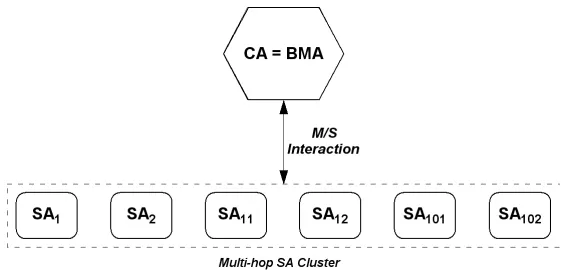
To show the functionality and effectiveness of the proposed architecture for the management of building indoors, we present an example of system deploy-ment for the monitoring of workstation usage in a computer laboratory or in offices. The wireless sensor network consists of heterogeneous sensor nodes based on Sun SPOTs that are used to collect information about the ambient light (through the standard Sun SPOT light sensor), the user presence (through a Wieye IR sensorboard [10]) and the electricity consumed by the workstation (through a customization of the ACme electricity sensorboard [18]). Every Sun SPOT holds a SA able to manage a set of requests while the basestation holds a CA that allows to manage the SAs. The SAs and CA in the system are shown in Fig. 10. In particular, while the interaction between SAs and CA is logically a direct interaction, SAs are organized in a multi-hop clusters which implies that a message sent by an SA may traverse such multi-hop networks before arriving at the CA.
It’s worth noting that in the implementation of the case study, as one only SA cluster was defined, the BMA and CA agents were collapsed in one only agent with the goal of energy monitoring.
In Fig. 11, the main window of the Building Management GUI is shown. It is organized in five main sections supporting all the functionalities provided by the system:
Fig. 10.The application Agents.
Fig. 11.The Building Management GUI.
– Request section allows to list details of scheduled requests, display data charts related to the scheduled requests, unschedule and schedule re-quests;
– Maps and Graphssection allows visualizing WSAN deployment maps and displaying charts of the data coming from the sensors (examples of charts are shown in Fig. 13, 14 and 15;
– Consolesection displays the real-time log of the activity of the system;
– File and Saving menu section enables to save data from the system in structured files and load stored files to display them in the GUI.
In Fig. 12, the graphical window for sensor/actuator request scheduling is shown. The window allows setting the parameter of a new request: name, des-tination (specific nodes or group composition), execution period, lifetime, one shot request or unlimited lifetime flags, action type and related device, possi-ble actuator parameters, requested sensed data possibly filtered by thresholds and/or synthetic data is requested and its type (average/max/min) and eventual threshold parameters can be set.
In the experimental system deployment the following requests were set:
– the average of the ambient temperature value (in C) is collected every 60 seconds from node 1;
– the average of the ambient light value (in lux) is collected every 60 seconds from node 2;
Fig. 12.The graphical window for sensor/actuator request scheduling.
– the max IR sensor value is sensed every minute on nodes 11 and 12.
The aim of the experiment was the monitoring of two workstations in a com-puter laboratory of the Technest incubator at University of Calabria to under-stand their users’ behavior. Several snapshots of a significant monitoring activ-ity of the duration of 90 min are shown in Fig. 13, 14 and 15.
In particular, Fig. 13 shows the real-time data of the ambient temperature and the ambient light. It is clear that while the temperature in the laboratory is almost constant, the light was switched off when the room was empty.
Fig. 14 shows the activity of the worker at the Desk 1. While in the first 15 minutes he was doing some word processing, before living the workstation, he started an hard processing task to his PC that ended at the minute 80.
(a)
(b)
(a)
(b)
(a)
(b)
off. Table 3 shows the mean and the standard deviation of the power consumed for the activities above.
Fig. 16.The signature of the PC at desk 2.
Table 3.Signature characteristics (Mean and Standard Deviation) per activity.
Mean [W] Standard Deviation [W]
Active 43,96 2,48
Active + Download 50,51 2,84
Inactive + Download 41,74 2,24
Inactive 34,02 3,01
6.
Conclusions and Future Work
proposed architecture is exploited to monitor the space occupation and energy expenditure in computer laboratories for students to analyze energy consump-tion patterns with respect to users’ behavior so as to semi-automatically imple-ment behavior policies. In the current impleimple-mentation, BMA and CA are merged into a component-based application implemented through OSGi [24]. Moreover, only one cluster can be deployed. On-going work is aimed at completing the JADE-based implementation of the multi-cluster architecture founded on the BMA and on multiple coordinated CAs. Future work will be devoted to: (i) the design of a higher-level agent-based architecture for Smart Buildings atop the proposed architecture to trade off inhabitants’ personal comfort and building energy expenditure; (ii) the support of user mobility in buildings based on the interoperation between body sensor network worn by users and the intelligent agent based building infrastructure; (iii) the formalization of the A-BMF system through communicating real time state machine-based formalisms [14] for verifi-cation of A-BMF-based appliverifi-cation scenarios; (iv) the exploitation of streaming techniques [13] to enhance sensor data collecting at application and network level.
Acknowledgments.This work has been partially supported by CONET, the Cooperating Objects Network of Excellence, funded by the European Commission under FP7 with contract number FP7-2007-2-224053, and by TETRis - TETRA Innovative Open Source Services, funded by the Italian Government (PON 01-00451).
References
1. Aiello, F., Bellifemine, F.L., Fortino, G., Galzarano, S., Gravina, R.: An agent-based signal processing in-node environment for real-time human ac-tivity monitoring based on wireless body sensor networks. Journal of Engi-neering Applications of Artificial Intelligence 24, 1147–1161 (October 2011), http://dx.doi.org/10.1016/j.engappai.2011.06.007
2. Aiello, F., Fortino, G., Galzarano, S., Gravina, R., Guerrieri, A.: An analysis of Java-based mobile agent platforms for Wireless Sensor Networks. Multi-Agent and GRID Systems 7(6), 243–267 (2011)
3. Aiello, F., Fortino, G., Gravina, R., Guerrieri, A.: A Java-Based Agent Platform for Programming Wireless Sensor Networks. The Computer Journal 54(3), 439–454 (2010)
4. Bellifemine, F., Fortino, G., Giannantonio, R., Gravina, R., Guerrieri, A., Sgroi, M.: SPINE: a domain-specific framework for rapid prototyping of WBSN applications. Software Practice & Experience 41, 237–265 (03 2011), http://dx.doi.org/10.1002/spe.998
5. Bellifemine, F., Rimassa, G.: Developing multi-agent systems with a FIPA-compliant agent framework. Softw. Pract. Exper. 31, 103–128 (February 2001), http://dx.doi.org/10.1002/1097-024X(200102)31:2¡103::AID-SPE358¿3.0.CO;2-O 6. B ¨ol ¨oni, L., Jun, K., Palacz, K., Sion, R., Marinescu, D.C.: The Bond Agent
7. Davidsson, P., Boman, M.: A Multi-Agent System for Controlling Intelligent Build-ings. In: Proceedings of the Fourth International Conference on MultiAgent Sys-tems (ICMAS-2000). pp. 377–. IEEE Computer Society, Boston, MA, USA (2000), http://dl.acm.org/citation.cfm?id=518904.878902
8. Davidsson, P., Boman, M.: Distributed monitoring and control of office buildings by embedded agents. Information Sciences-Informatics and Computer Science: An In-ternational Journal - Special issue: Intelligent embedded agents 171, 293–307 (05 2005), http://dl.acm.org/citation.cfm?id=1077829.1077831
9. Domanski, J., Dziadkiewicz, R., Ganzha, M., Gab, A., M.M., M.: Implementing Glid-erAgent - an agent-based decision support system for glider pilots. In: NATO ASI Book, vol. to appear. IOS press (2012)
10. EasySen LLC: WiEye - Sensor board for wireless surveillance and security (2011), [Online]. Available: http://www.easysen.com/WiEye.htm (current December 2011) 11. Essaaidi, M., Fortino, G.: Wireless Sensor Networks and Software Agents. In
Soft-ware Agents, Agent Systems and their Applications (M. Essaidi, M. Paprizicky and M. Ganzha, Eds.), Information and Communication Security Vol. 32., Chapter 3. IOS press., vol. 32 (2012)
12. Fortino, G., Galzarano, S.: On the development of mobile agent systems for wire-less sensor networks: issues and solutions. In Multiagent Systems and Applications: Practice and Experience. Maria Ganzha and Lakhmi Jain Eds. Studies in Computa-tional Intelligence, Springer-Verlag (2012)
13. Fortino, G., Nigro, L.: Development of virtual data acquisition systems based on multimedia internetworking. Computer Standards & Interfaces 21, 429–440 (1999) 14. Fortino, G., Nigro, L.: A toolset in Java2 for modelling, prototyping and implementing
communicating real-time state machines. Microprocessors and Microsystems 23, 573–586 (2000)
15. Guerrieri, A., Fortino, G., Ruzzelli, A., O’Hare, G.: A WSN-based Building Man-agement Framework to Support Energy-Saving Applications in Buildings. In Ad-vancements in Distributed Computing and Internet Technologies: Trends and Is-sues, Chapter 12. Hershey, PA, USA: IGI Global (2011)
16. Hagras, H., Callaghan, V., Colley, M., Clarke, G.: A hierarchical fuzzy-genetic multi-agent architecture for intelligent buildings online learning, adap-tation and control. Inf. Sci. Inf. Comput. Sci. 150, 33–57 (3 2003), http://dl.acm.org/citation.cfm?id=763284.763288
17. Huberman, B.A., Clearwater, S.H.: A Multi-Agent System for Controlling Building En-vironments. In: Lesser, V.R., Gasser, L. (eds.) Proceedings of the International Con-ference on Multiagent Systems (ICMAS-95). pp. 171–176. The MIT Press (1995) 18. Jiang, X., Dawson-Haggerty, S., Dutta, P., Culler, D.: Design and
implemen-tation of a high-fidelity AC metering network. In: Proceedings of the 2009 International Conference on Information Processing in Sensor Networks. pp. 253–264. IPSN ’09, IEEE Computer Society, Washington, DC, USA (2009), http://dl.acm.org/citation.cfm?id=1602165.1602189
19. Lopes, R., Assis, F., Montez, C.: MASPOT: A Mobile Agent System for Sun SPOT. In: Proceedings of the 2011 Tenth International Symposium on Autonomous Decen-tralized Systems. pp. 25–31. ISADS ’11, IEEE Computer Society, Washington, DC, USA (2011), http://dx.doi.org/10.1109/ISADS.2011.10
20. Luck, M., McBurney, P., Preist, C.: A Manifesto for Agent Technology: Towards Next Generation Computing. Autonomous Agents and Multi-Agent Systems 9, 203–252 (11 2004)
22. Muldoon, C., O’Hare, G.M.P., Collier, R., O’Grady, M.J.: Agent Factory Micro Edi-tion: A Framework for Ambient Applications. In: Proceedings of Intelligent Agents in Computing Systems Workshop (held in Conjunction with International Conference on Computational Science (ICCS)) Reading, UK. Lecture Notes in Computer Sci-ence (LNCS). pp. 727–734. Springer-Verlag Publishers (2006)
23. Naji, H., Meybodi, M., Falatouri, T.: Intelligent building management systems using multi agents: Fuzzy approach. International Journal of Computer Applications 14(6), 9–14 (02 2011), published by Foundation of Computer Science
24. OSGi Alliance: Open System Gateway Initiative (OSGi), documents and software (2011), [Online]. Available: http://www.osgi.org (current December 2011)
25. Qiao, B., Liu, K., Guy, C.: A Multi-Agent System for Building Control. In: Pro-ceedings of the IEEE/WIC/ACM international conference on Intelligent Agent Technology. pp. 653–659. IAT ’06, IEEE Computer Society, Hong Kong (2006), http://dx.doi.org/10.1109/IAT.2006.17
26. Stankovic, J.: When sensor and actuator cover the world. ETRI Journal 30(5), 627– 633 (2008)
27. Tynan, R., Muldoon, C., O’Grady, M.J., O’Hare, G.M.P.: A mobile agent ap-proach to opportunistic harvesting in wireless sensor networks. In: Proceed-ings of the 7th international joint conference on Autonomous agents and multi-agent systems: demo papers. pp. 1691–1692. AAMAS ’08, International Foun-dation for Autonomous Agents and Multiagent Systems, Richland, SC (2008), http://dl.acm.org/citation.cfm?id=1402744.1402768
Appendix
A.
Building Management Events
B.
SA’s MAPS actions
A0: addDispatcherRule(msgTypeList()); firstProcessedEvent=FALSE;
Event timer = new Event(agent.getId(), agent.getId(), Event.TMR_EXPIRED, Event.NOW );
timerID = agent.setTimer(true, advertisementTime(), timer); addDispatcherRule(timer);
A1: Event msg = new Event(agent.getId(), agent.getCAId(), Event.MSG_TO_BASESTATION, Event.NOW);
msg.setParam(ParamsLabel.MSG_TYPE, BM_SA_ADVERTISEMENT); setAdvertisementParams(msg);
agent.send(agent.getId(), agent.getCAId(), msg, true); A2: if(isMsgForCurrSA(msgEvent.getParam(ParamsLabel.ADDRESSEE),
msgEvent.getParam(ParamsLabel.ADDRESSEE_TYPE)){ firstProcessedEvent=TRUE;
removeDispatcherRule(timer);
agent.resetTimer(agent.getId(), timerID); }
A3: msgType = msgEvent.getParam(ParamsLabel.MSG_TYPE);
A4: plane = createSensorPlane(msgEvent.getParam(ParamsLabel.REQUEST_ID), msgEvent);
A5: plane = createActuatorPlane(msgEvent.getParam(ParamsLabel.REQUEST_ID), msgEvent);
A6: agent.removePlane(msgEvent.getParam(ParamsLabel.REQUEST_ID)); A7: updateMembership(msgEvent);
A8: Iterator i = agent.getPlaneList(); while(i.hasNext()){
plane = (Plane)i.next();
if(plane.getID() != this.getID()) agent.removePlane(plane.getID()); }
firstProcessedEvent=FALSE;
timer = new Event(agent.getId(), agent.getId(), Event.TMR_EXPIRED, Event.NOW ); timerID = agent.setTimer(true, advertisementTime(), timer);
addDispatcherRule(timer);
A9: Event msg = new Event(agent.getId(), agent.getCAId(), Event.MSG_TO_BASESTATION, Event.NOW);
msg.setParam(ParamsLabel.MSG_TYPE, BM_ACK); setAckParams(msg);
agent.send(agent.getId(), agent.getCAId(), msg, true);
A0: storedDataCounter = 0;
isOneShotRequest = isOneShot(request);
A1: Event sensing = new Event(agent.getId(), agent.getId(), request.getParam(ParamsLabel.SENSOR_TYPE), Event.NOW); agent.sense(sensing);
addDispatcherRule(sensing);
A2: Event timer = new Event(agent.getId(), agent.getId(), Event.TMR_EXPIRED, Event.NOW );
period = getPeriodTimer(request); lifetime = getLifetimeTimer(request);
timer.setParam(ParamsLabel.LIFETIME_ELAPSED, "false"); timerID = agent.setTimer(true, period, lifetime, timer); addDispatcherRule(timer);
dataToStore = getDataToStore(request); A3: storeData(event.getParam(SENSED_DATA));
storedDataCounter++;
A4: if(request.getParam(ParamsLabel.DATA_TYPE) != "THRESHOLD_NOTIFICATION" || isThresholdChecked(request, getStoredData())){
Event msg = new Event(agent.getId(), agent.getCAId(), Event.MSG_TO_BASESTATION, Event.NOW);
msg.setParam(ParamsLabel.MSG_TYPE, BM_DATA); setDataParams(msg, getStoredData());
agent.send(agent.getId(), agent.getCAId(), msg, true); }
storedDataCounter = 0;
A5: syntheticData = calculateSyntheticData(getStoredData(), request.getParam(ParamsLabel.SYNTHETIC_DATA_TYPE));
if(request.getParam(ParamsLabel.DATA_TYPE) != "THRESHOLD_NOTIFICATION" || isThresholdChecked (request.getParams(), syntheticData)){
Event msg = new Event(agent.getId(), agent.getCAId(), Event.MSG_TO_BASESTATION, Event.NOW);
msg.setParam(ParamsLabel.MSG_TYPE, BM_DATA); setDataParams(msg, syntheticData);
agent.send(agent.getId(), agent.getCAId(), msg, true); }
storedDataCounter = 0;
Fig. 18.The MAPS actions of the SA’s Sensing Request plane.
Giancarlo Fortino is an Associate Professor of computer engineering at the Department of Electronics, Informatics, and Systems of the University of Cal-abria, Italy. His research interests include distributed computing, wireless sen-sor networks, agent-based computing, and real-time systems. He is author of more than 170 papers in international journal, books and conference proceed-ings. He received a Laurea degree and a PhD in Computer Engineering from the University of Calabria in 1995 and 2000, respectively.
Antonio Guerrieriis a research fellow in Computer Engineering at the Univer-sity of Calabria. His research interests include high-level programming methods for wireless sensor networks with specific focus on methodologies and frame-works for building sensor netframe-works. He is author of several papers in interna-tional journal, books and conference proceedings. He received his Bachelor, Master and PhD in Computer Engineering from the University of Calabria in 2003, 2008, and 2012 respectively.