2219
Development Of Learning Devices Based
Onproblem-Based Learning Assisted Adobeflash
Cs 11 To Improve Combinatoric Ability Students
Wildah Romaito Napitupulu, Edi Syahputra, Bornok Sinaga
Abstract : This study aims to: 1) develop learning device through problem-based learning model with adobe flash are valid, practice, and effective; 2) analyze the combinatoric ability students in class XI of MAN 2 Deli Serdang through learning device developed by problem-based learning model with adobe flash. The type of This research is development research using the development model of the Thiagarajan 4-D model. Based on the results of trial I and trial II that have met valid criteria according to experts, were tested in class XI-MIA of MAN 2 Deli Serdang. The results of the analysis of the data obtained indicate that learning device based on PBL-AAF met the criteria of practice from the implementation of the learning device can be said good, effectiveness and can improve combinatoric ability. Based on the results of the study, it was suggested that device developed trial is better than trial I and can make an effort mathematics learning using learning device based PBL-AAF.
Index Terms: Development of learning device, 4-D Model, PBL-WAF, Combinatoric, Self-Regulated Learning.
—————————— ——————————
1.
INTRODUCTION
Today, the development of science and technology is very fast. Without us knowing it, we have entered the digital era with volume 4.0, meaning that the development of science and technology has brought change and influence in every order of human life. Including electronic needs have been influenced such as e-government, e-commerce, e-education, e-medicine, e-laboratory, and others [1]. Thus, education in the current technological era requires that teachers be able to operate computers/laptops and innovate to provide a new atmosphere in the learning environment. Current advances in technology can affect the field of education. For that reason, education must really be used as a foundation so that the use of technology can be effectively applied by teachers as suppliers of education because education is a gateway for anyone to receive knowledge in order to improve human resources to be more qualified [2]. The initial ability of students is a determining factor in the success of mathematics learning. Every individual has different learning abilities. Every individual has different learning abilities. The initial ability of students is the ability that has been owned by students before he followed the learning that will be given. This initial ability (entry behavior) illustrates the readiness of students in receiving lessons to be delivered by the teacher. Provide a new atmosphere in the learning environment. Current advances in technology can affect the field of education. For this reason, education must really be used as a foundation so that the use of technology can be effectively applied by teachers as suppliers of education.
Suggests students in understanding the subject matter is influenced by the initial abilities they have. The formation of initial abilities is influenced by the quality of learning experienced by students beforehand.mIf the previous learning is not effective, then the learning outcomes are not in following
the objectives set. If this happens, then to continue or understand the next material the student will experience difficulties due to the low level of knowledge he has from the previous material or prerequisite material for the next material. According to [3] good quality learning process becomes a necessity. The government has designed various efforts to improve the quality of human resources in Indonesia. One of the steps in developing learning tools which can increase students learning outcomes by up to 85%.
Curriculum development becomes very important in line with the continuity of the progress of science and technology in the future. Various advances and changes that produce internal and external challenges in the field of education in this case in particular mathematics subjects. To master and create future technology, mastery of mathematical concepts is needed from an early age [4]. Considering the large role of mathematics, it is no wonder that mathematics is given at every level from preschool (kindergarten), elementary school, junior high school, high school, to university and is used as a benchmark for student graduation through the testing of mathematics in national examinations. This is because mathematics plays an important role in life, especially in solving everyday problems. Based on observations made at MAN 2 Deli Serdang, researchers found facts in the field that the mathematics learning conducted by the teacher did not involve students, consequently, the students' responses were negative towards mathematics learning, ie students assumed that mathematics subjects were complicated and difficult to understand. In addition, lesson plans made by teachers have not used ICT-assisted models and media to activate students, teachers always provide routine questions that do not measure how students' combinatoric abilities, teachers have not designed LKPD themselves, students have difficulty in solving problems related to combinatoric abilities, learning that takes place still depends on factors teachers and friends, learning outcomes tests are only taken from the teacher's handbook exercises. The quality of the learning tools used also determines the quality of learning. Quality devices are learning devices that meet valid, practical and effective criteria. It can be emphasized that the effort to improve the learning process through the selection of appropriate and innovative learning models in learning mathematics in schools is a very important requirement to do. One of them is in making learning devices. ————————————————
Wildah Romaito Napitupulu, State University Of Medan, Indonesia, E-mail: [email protected]
Prof. Edi Syahputra, M.Pd, State University Of Medan, Indonesia, E-mail: [email protected]
2220 The material delivered must be combined with a learning
model that is appropriate to the needs of students so that learning is more meaningful (meaningful). One learning model that is thought to be used to improve the quality of the process and learning outcomes is a problem-based learning model. Problem-Based Learning (PBL) is an instructional approach, which use problem to trigger learning. Students are in-group to work collaboratively to search for resolution of the problem [5]. The teacher plays his role to facilitate learning with scaffolding technique by giving indirect hints or posing stimulating questions to help students make use of their reasoning and experiences to search for possibilities ways to get intermediate or even final solutions. Particularly for upper secondary students, theoretically speaking they have been informal deductive periods. It is time for them to grasp varieties of reasoning skills to solve problems either in mathematics or in other disciplines even in everyday life. PBL with all of its characteristics seems fit to help and facilitate students to achieve the cognitive and affective target mentioned earlier. Problem-based learning is learning that uses problems as a context for students to learn critical thinking and learning skills in problem-solving, and to construct important knowledge and concepts from problem-based learning [6]. This learning model helps students develop investigations and problem-solving abilities to give students experience with an adult role to gain confidence in thinking, and organize themselves against a given problem. Problem-based learning consists of five stages, namely: student orientation towards problems, organizing students to learn, guiding individual and group investigations, developing and presenting work and analyzing and evaluating problem-solving processes [7]. Therefore, it is particularly important to examine the effect of PBL on combinatoric ability students. In addition to the learning model used, of course, there are other things that need attention in improving the quality of learning, namely students' mathematical abilities. In fact, some research found that the mathematical ability of students, especially in comprehension, communication, connection, problem-solving and students' mathematical reasoning is not at the optimal result [8] For that reason, in making a learning device with a problem-based learning model should pay attention to students' mathematical abilities, especially combinatoric abilities. Combinatoric ability is a process of finding a number of alternative solutions to a discrete problem [9]. This was also expressed by Graumann [10] who revealed “combinatorial thinking as a fool for solving problems when he was experimenting with children doing geometrical tasks. The pupils must use their combinatorial thinking and find a systematic to be sure that all possibilities have been discussed”. Based on his statement combinatoric ability is a special aspect of mathematical thinking. The first reason is that combinatorics do not require the preconditions of calculus, so this topic can be taught early, independent of student mastery over the calculus. Then also combinatorics can be used to train students to calculate, make estimates, generalize, and think systematically [11]. Combinatorics can be applied in many other fields such as programming, physics, and engineering as well as other disciplines. Combinatorics can lead students to understand the strengths and limitations of mathematics. In addition, combinatorics play an important role in the science of arithmetic [12]. The student’s difficulties in solving the combinatoric problems are caused by a lack of student’s understanding of the given problem. Students also have difficulty in relation to permutation and combination.
Combinatorics is a field that most pupils find very difficult. Two fundamental steps for making the learning of this subject easier are understanding the nature of pupils’ mistakes when solving combinatorial problems and identifying the variables that might influence this difficulty [13]. Student’s understanding of the problem is very helpful for students in solving combinatorial problems. To be able to improve student’s combinatorial thinking skills, problem-solving skills must first be raised. In the problem-solving process, students' combinatorial reasoning ability can be trained. Combinatorics provides a student collaborative situation to develop verbal and written skills in the process of solving problems. So, it is necessary a way for students to always be involved in problem-solving that involves the process of combinatorial thinking. This relates to the appropriate learning model to be used in the learning process. At present, computer applications continue to grow even computer users can also interact directly with information sources both online and offline. The role of computers as a learning medium is to facilitate teachers in learning activities to make it more interesting, enjoyable, and achieve learning goals optimally. Good learning will mix and match the role of ICT in understanding concepts to solve problems. In this study, researchers used ICT media in the form of Adobe Flash. Adobe Flash CS 11 is the latest version of flash since it was taken over by a well-known software company in the United States namely Adobe System Incorporated. This program is an application used for design and presentation. The use of Adobe Flash CS 11 is the most appropriate teaching aid because the teacher can provide interesting and easy to understand learning for students. The reason for using Adobe Flash in this study is to help students understand the concept of enumeration rules which include, multiplication, permutation, and combination rules. This research development refers to previous research conducted by Nuryadi (2017) who developed Adobe Flash-assisted learning media in improving mathematical ability and mathematics learning outcomes stated that interactive learning media can increase student learning motivation by 7.14% where before using motivational media students learning mathematics by 71.78% and after using the adobe flash learning media students' mathematics learning motivation becomes 78.92%. This research development refers to previous research conducted by Nuryadi (2017) who developed Adobe Flash-assisted learning media in improving mathematical ability and mathematics learning outcomes stated that interactive learning media can increase student learning motivation by 7.14% where before using motivational media students learning mathematics by 71.78% and after using the adobe flash learning media students' mathematics learning motivation becomes 78.92%.To improve combinatoric abilities in this case the researchers tried to combine the learning tools of the Problem Based Learning model with computer technology media (Adobe Flash CS 6) For this reason researchers were encouraged to conduct research into the development of adobe flash assisted learning devices cs 11 through problem-based learning models to improve students' combinatoric abilities MAN 2 Deli Serdang.
2
RESEARCH
METHODS
2221 namely define, design, develop and disseminate. The
research was conducted at MAN 2 Deli Serdang, which is one of the senior high schools in Deli Serdang, North Sumatera, Indonesia. Subjects in this study were students of class XI-MIA 1 and XI-MIA 2 of MAN 2 Deli Serdang in the academic year 2019/2020 which amounted to 30 students. The object in this study is a learning device developed through a problem-based learning model-assisted adobe flash on topic kaidah pencacahan. In this study to be developed are lesson plans, teacher books, student books, student activity sheets, and combinatoric ability tests. The instruments used in this study were tests. Tests are used to measure combinatoric ability. A learning device is said to be of quality if it fulfills three aspects which are valid, practical, and effective. A learning device has a good degree of validity if the minimum level of validity achieved is in the valid category. If the level of validity is below the valid category then revisions are made based on the input of the validators. Revisions are carried out so that valid learning materials are obtained. Activities carried out to analyze this data are:
a. Recapitulating the validity assessment data of learning materials into a table which includes: aspects (Ai), indicators (Ii), and value (Vji) for each expert
b. Determine the average value of experts for each formula:
[15]
With:
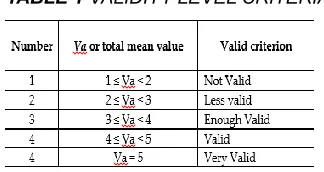
Vji is the data value of the j-appraiser against the indicator n is the number of assessors (experts and practitioners) The results obtained are then written in the following table:
TABLE 1 VALIDITY LEVEL CRITERIA
To determine the practicality of learning tools based on validator /expert assessment and observation sheet of adobe flash assisted learning device implementation through problem-based learning models starting from the teacher opening the lesson to closing the lesson. According to Hobri [16] adobe flash-assisted learning devices through problem-based learning models are said to be practical or easy to implement seen from the calculation of observations as follows:
a. Recapitulating the results of observations of the implementation of learning tools into a table that includes: aspects and scores.
b. Determine the average score of each aspect at each meeting with the formula:
[16]
With 𝑃 is the score of observations of the j meeting of i and n
aspects is the number of observers. Then the practicality criteria of this learning device are divided into 5 equal
sub-intervals, namely: Very low, if 0 ≤ 𝑃̅ < 1 Low, if 1 ≤ 𝑃̅ < 2 Enough, if 2 ≤ 𝑃̅ < 3 High, if 3 ≤ 𝑃̅ < 4 Very High, if 4 ≤ 𝑃̅ ≤ 5 Information:
𝑃̅ is the average score
The criteria for determining the effectiveness of adobe flash assisted learning devices through the problem-based learning model includes four indicators of effectiveness aspects, namely:
a. Completeness of student learning classically, minimum of 85% of students who participate in learning are able to achieve a minimum score of 75 out of twice the test of learning outcomes (maximum score is 100) using the formula:
While every student is said to have the combinatoric ability if the student's answer score is 75. To determine the combinatoric ability score, the following equation can be used:
[17]
Information:
KB: Mastery learning
T: Number of scores obtained by students Tt: Total score
TABLE 2 LEVELS OF COMBINATORIC CAPABILITY
Information:
SCA : Score Combinatoric Ability
b. Achievement of the ideal time percentage of student activity set.
Calculation of the percentage of student activities according to Komalasari [15], namely:
TABLE 3 EFFECTIVENESS OF STUDENT ACTIVITIES
m
I
A
m
j ij
i
12222 Student responses were analyzed by calculating the
percentage of many students who gave positive responses and in each category stated in the questionnaire sheet using the following formula:
[18]
Information:
𝑃𝑅𝑆: Percentage of many students who responded positively to each of the categories asked.
∑ 𝐴 : The proportion of students who choose ∑ 𝐵 : Number of students (respondents)
The criteria are set to say that students have a positive response to the learning device developed if the number of students who give a positive response is greater or equal to 80% of the many subjects studied for each field trial [15].
3 RESULTS
AND
DISCUSSION
This research is a research development (development research). The product of this research is the Adobe Flash Assisted Problem Based Learning Tool. The learning tools produced in this study are the Learning Implementation Plan (RPP), Teacher's Book (BG), Student's Book (BS), Student Activity Sheet (LKPD), Adobe Flash Media, and combinatoric ability test instruments. The research results obtained at each stage of development are presented as follows:
3.1 DEFINE STAGE
Based on the observations of learning device in MAN 2 Deli Serdang found some weaknesses in the learning device used by teacher because the teacher has not developed lesson plan according to student characteristics, subject matter in the book used by teacher and students do not present problem, not routines such as contextual problem related, and teacher does not use student activity sheet as a support for learning activities. Furthermore, in the learning process, the teacher still uses a conventional education.
3.2 DESIGN STAGE
At this stage, a learning device in the form of a prototype was produced (an example of a learning tool) for enumeration rules using adobe flash problem-based learning models. The initial draft of learning devices including the lesson plans for three meetings, Teacher books, student books, student activity sheets, and combinatoric ability tests. All the results of this design stage are called draft I.
3.3 DEVELOP STAGE
The results of the definition and design produce the initial design of a learning device called a draft I. The first phase of the development is to validate the draft I to the experts/experts and then a field trial is conducted. The results of expert validation in the form of validation values, corrections, criticisms, and suggestions are used as a basis for revising and refining the learning tools developed. The revised learning kit is a learning device that has met the valid criteria and hereinafter referred to as draft II. At this stage, the draft I that have been revised based on experts is tested on the outside class of research subject. The aim is to see the weaknesses in the draft I so that it can be revised and refined the learning
materials developed. The results of expert validation in the form of assessment of content validity which shows that all learning, installing again, have not demonstrated the accuracy of the combinatoric ability indicators, and the mechanism of using Adobe Flash. For teacher's books, it is better to add media usage instructions to the book. Then in the book, students should add a few examples of questions related to combinatoric ability. While the student activity sheet (student activity sheet) does not look at the steps of student activities in solving problems. After the revision is complete, trial II is conducted to determine the effectiveness of the learning device, as well as the improvement of combinatoric abilities.
3.4 DISSEMINATE STAGE
After the learning devices were valid, practical and effective is met at the end of trial II, then the final devices are obtained. The next step is to do a limited distribution of final devices to MAN 2 Deli Serdang. Submission of learning device to MAN 2 Deli Serdang in the hope that the math teachers incorporated in the forum can apply the learning devices to the next lesson.
Result of Trial I
Based on the results of the trial I obtained criteria developed learning devices. These criteria, namely:
1. Valid
TABLE 4: VALIDATION RESULTS FOR THE PRINCIPLES OF LEARNING LEARNING BY EXPERTS
2. Practical
Apart from the validity aspects of assessing the learning tools developed. Of course, there are practical aspects that need to be assessed. The practicality of the materials is obtained from the results of the assessment of observation of the implementation of learning, assessment by the teacher. The practicality of the observation results of learning implementation is fulfilled if the implementation of learning reaches a good minimum category. The results of observations on the implementation of learning are presented in Table 5:
TABLE 5 RESULTS OF OBSERVATION OF THE IMPLEMENTATION OF TRIAL LEARNING TOOLS I
Object Assessed Average Of
Total Validity Criterion
Lesson Plan 4,51 Valid
Teacher Book 4,42 Valid
Student Book 4,58 Valid
Student Activity Sheet 4,46 Valid
Instrumen Combinatoric
2223 PBM-BAF learning tools will be appropriate to use if they can
have a positive impact or significant influence on learning. Based on the results of the trial I obtained an average of the implementation of trial I was 3.73. This according to the practicality category is at a high level, if 3 ≤ 𝑃̅ < 4 this means that the level of practicality of the device in the trial I is high.
3. EFFECTIVE
After obtaining the validity and practicality of the developed learning tools, the final criterion is effective. The effectiveness of the developed device consists of :
a. The mastery of student learning classically
Classical student mastery learning, which is a minimum of 85% of students who participate in learning is able to achieve a score of 75. The following results are classical mastery:
TABLE 6 CLASSICAL MASTERY COMBINATORIC ABILITY LEVELS IN TRIAL I
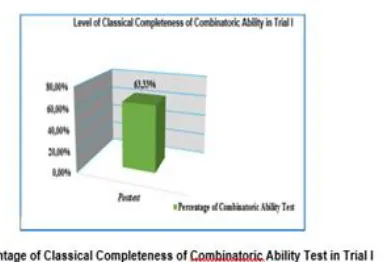
The percentage description of classical completeness criteria of combinatoric ability in the trial I is presented in Figure 1:
Based on the data in Table 1 and Figure 1, it can be seen that the classical completeness of the results of the combinatoric ability in the first test posttest was 63.33%. In accordance with the criteria for completeness of student learning outcomes in a classical way, at least 85% of students who take the combinatoric ability test are able to achieve a score. Thus, the results of the posttest combinatoric ability have not yet met classical completeness because it only obtained a percentage of completeness of 63.33%.
b. Student Activity
In determining the percentage of student activity time, researchers are assisted by one observer who observes student activity in accordance with the indicators of student activity that have been outlined in Chapter III. The data collected is the result of observing student activity for 3 meetings. The average percentage of student activity time in trial 1 will be outlined in Table 7 :
TABLE 7 AVERAGE PERCENTAGE OF IDEAL TIME OF STUDENT ACTIVITY IN TRIAL I
The second criterion of effectiveness is student's activity fulfills ideal time percentage and it is found that there are all categories (categories 1, 2, 3, 4 and 5) that have reached the percentage of ideal time in trial 1. The average percentage of ideal time of student activity time in the trial I will be outlined in Table 7.
c. Student response
The indicators of effectiveness that have been fulfilled in the trial I are the attainment of classical completeness, student activity, besides that it is the response of students, namely students respond positively to learning devices based on problem-based learning models with the average percentage of the total positive responses of students in the trial I was 89.84%.
Result of Trial II 1. Practice
The practicality of the device is obtained from the results of the assessment of observation of the implementation of learning, assessment by the teacher. The practicality of the observation results of learning implementation is fulfilled if the implementation of learning reaches a good minimum category. The results of observations on the implementation of learning are presented in Table 8.
TABLE 8 RESULTS OF OBSERVATION OF THE IMPLEMENTATION OF TRIAL LEARNING TOOLS II
2. Effective
In the second trial, this developed learning device was revised. The effectiveness of learning tools developed after revision consists of:
2224 Classical student mastery learning, which is a minimum of
85% of students who participate in learning is able to achieve a score of 75. The following results are classical mastery:
TABLE 9 CLASSICAL MASTERY COMBINATORIC ABILITY LEVELS IN TRIAL II
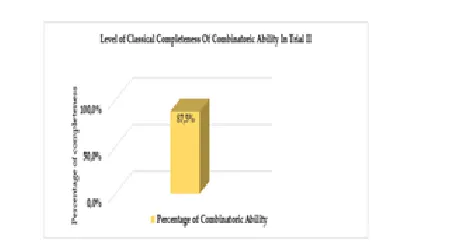
The percentage description of classical completeness criteria of combinatoric ability in trial II is presented in Figure 2
Based on the data in Table 1 and Figure 1 it can be seen that the classical completeness of the results of the combinatoric ability in the posttest II trial amounted to 87.5%. In accordance with the criteria for completeness of student learning outcomes in a classical way, at least 85% of students who take the combinatoric ability test are able to achieve a score. Thus, the results of the posttest combinatoric ability have met the completeness classically because only obtained a percentage of completeness 87.5%.
b. Student Activity
The results of observing student activities for 3 meetings in trial II will be set out in Table 4. Average Percentage of Ideal Time of Student Activity
TABLE 10 AVERAGE PERCENTAGE OF IDEAL TIME OF STUDENT ACTIVITY IN TRIAL II
The second criterion of effectiveness is student's activity fulfills ideal time percentage and it is found that there are all categories (categories 1, 2, 3, 4 and 5) that have reached the percentage of ideal time in trial 1. The average percentage of ideal time of student activity time in the trial I will be outlined in Table 10.
c. Student response
The indicators of effectiveness that have been fulfilled in the trial II are the attainment of classical completeness, student activity, besides that it is the response of students, namely students respond positively to learning devices based on problem based learning models with the average percentage of the the total positive responses of students in the trial II was 91.89%.
DISCUSSION
2225 of good or easy categories of implementation. Based on
observations of the feasibility of PBM-BAF devices, in the first trial, the level of feasibility of learning with P = 3.73 in trial II the level of feasibility of learning with P = 4.02 was in a very high category with a minimum range. Indeed in the trial I, some students were still unfamiliar with the use of PBL-BAF learning tools that demanded student activities, but in subsequent trials, students became more accustomed and happy. Thus it can be concluded that the PBL-BAF tool developed is practical in terms of the practicality of the learning kit. This is supported by the results of research by Yanti, Mulyono, and Minarni (2018) which shows that the development of learning tools with Learning with the Autograph Assisted Open-Ended Approach developed with the 4-D model produces practical learning tools. In addition, research conducted by Yuliana (2017) states that the learning device that is said to be practical is if the observation sheet of the implementation of learning meets the practical criteria of 70% ≤ P <80% and for the questionnaire the response of students meets an average score of 2.8 <X ≤ 3,4. Based on the description above it can be concluded that the PBL-BAF apparatus has fulfilled the expected practicality. Thus the PBL-BAF tool developed is easy and can be implemented by teachers and students. Based on the results of the posttest analysis of trial I and trial II it was found that the combinatoric ability of students had met the classical completeness criteria. This is due to the material and problems that exist in the student book and activity sheet that is developed in accordance with the conditions of the student learning environment and refers to problem-based learning tools. With the application of adobe flash-based problem-based learning tools, students will be actively involved in the problem-solving process. Students analyze and evaluate their own thinking processes and make conclusions from the knowledge that has been found with the guidance and instructions from the teacher or friend in the form of questions that lead. This is reinforced by Vygotsky's view (Rusman, 2012) that is, learning based on problems is an attempt to link new information with cognitive structures that have been possessed through learning activities in social interaction. Furthermore, Vygotsky (Arends, 2008), added that social interactions with others both teachers and peers can refer to the construction of new ideas and enhance students' intellectual development. Mastery learning students are also influenced by the learning model used in the problem-based learning process that makes students interested in learning and actively involved in the learning process. The same thing was stated by the results of research Ammamiarihta, Surya, and Syahputra (2017) stated, "Learning by using PBL is effective in improving the ability of combinatorial thinking for students". This implies that learning by using PBM is effective in increasing combinatorial thinking skills. Other research results regarding the problem-based learning model and students' mathematical abilities conducted by Phungsuk, Viriyavejakul, and Ratanaolarn (2017) with the title "Development of A Problem-Based Learning Model Via A Virtual Learning Environment." This implies that the results of the study indicate the development of problem-based learning models using virtual learning to provide a positive response to students' mathematical understanding abilities. This is also supported by research conducted by Syahputra & Rajagukguk (2015) saying that learning mathematics with Adobe Flash can increase students 'mastery learning by 88.10% in the high category and students' positive responses to the media are
2226 supporting research, it can be concluded that the components
of problem-based learning tools developed contribute positively to students' responses in learning. Thus, it was concluded that the components of the PBL-AAF device that were developed contributed positively to student responses in learning. One of the objectives obtained from the development of learning tools in this study is to improve students' combinatoric abilities. Improvement of students' combinatoric abilities can be seen through combinatoric ability tests based on posttest results. Based on the acquisition of posttest results in both trials I and II, it can be concluded that the combinatoric ability of students using PBL-AAF devices has increased. The increase in students' combinatoric abilities can be seen from the average posttest results of combinatoric abilities obtained by students in trial II. The average posttest score of students in the first try was 76.33 and in the second try posttest, the average value of students increased to 83.50. The results of this study are supported by the results of research by Nasution, Yerizon, and Gusmiyanti (2018). His research gave results with an average value of 82.29 for the experimental class and 70.27 for the control class. It can be seen that the combinatoric abilities of students according to the results of Ammamiarihta, Syahputra, and Surya (2017) states, "Learning devices oriented Problem Based Learning was categorized valid both in terms of content and construct, practical to use, and effective and students' combinatorial thinking abilities increased "which means that the development of PBL-oriented learning tools is valid, practical, and effective, as well as students' combinational thinking skills increase. Related to PBL models that have a cultural context, the results of Lubis, Harahap, and Derlina's research (2017) state, "The results obtained that the learning tools through learning-based models of learning based on Batak culture developed have met the valid, practical and effective criteria and there is an improvement of problem-solving skills. " This implies that PBL-based learning tools with a Batak cultural context are valid, practical, and effective and there is an increase in mathematical abilities. Learning by using PBL-BAF devices using ICT media in the form of Adobe Flash is interesting for students. The integration of Adobe Flash media in mathematics learning, as previously explained, also takes a role in improving combinatoric abilities. Based on the description and results of previous research above shows that learning with PBM models is significantly better in increasing students' combinatoric abilities. So it can be concluded that the PBM-BAF device has a positive impact on increasing students' combinatoric abilities
4 CONCLUSION
Based on the results of analysis and discussion in this study, it can be concluded that learning devices through Problem Based Learning assisted Adobe Flash (PBL-AAF) have met the valid, practical, and effectiveness criteria and combinatoric ability have improved. This research shows that learning device based PBL-AAF are important things to consider in an effort to maximize student mathematics learning achievement. Thus, it is expected that mathematics teachers seek mathematic devices using learning device through on PBL-AAF.
ACKNOWLEDGMENT
On this occasion, the authors would like to express their sincere thanks and highest appreciation to all those who have
helped the author: Prof. Dr. Edi Syahputra M.Pd as a supervisor I and Chair of the Mathematics Education Postgraduate Program Study State University of Medan, Prof. Dr.Bornok Sinaga, M.Pd as the supervisor II, Mr. Dr. H. Burhanuddin, M.Pd as the Head of MAN 2 Deli Serdang who has given permission and the opportunity for the writer to research the school that he is leading, as well as the teachers and administrative staff who have helped many writers in conducting this research.
REFERENCES
[1] Widodo, Wahyudin. "Selection of Learning Media Mathematics for Junior School Students". TOJET: The Turkish Online Journal of Educational Technology, vol.17, no. 7, Pp 154, 2018.
[2] [Haryanto. Educational technology. Yogyakarta: UNY Press. 2015
[3] Syahputra, E., & Utami. D. R., "The design of the IQF-oriented ARCS-based learning model", International Seminar on Applied Mathematics and Mathematics Education 2019: IOP Conf. Series: Journal of Physics: Conf. Series 1315 (2019) 012065, 2019, DOI: 10.1088 / 1742-6596 / 1315/1/012065.
[4] [4] Indonesia Ministry of Education. Memorandum of Education. Jakarta: Ministry of National Education.2006. [5] [5] Rohaeti, E. E., Budiyanto, A. M., & Sumarmo, U.
"Enhancing students' mathematical logical thinking ability and self-regulated learning through problem-based learning", International Journal of Education, Vol.8, no. 1, pp. 54-63, 2014.
[6] [Rusman. Learning Models Developing Teacher Professional Second Edition. Jakarta: PT Raja Grafindo Persada. 2012.
[7] Minarni, A., Napitupulu, E.E., & Husein, R. "Mathematical understanding and representation of public junior high school abilities
[8] in North Sumatra ", Journal on Mathematics Education, Vol. 7, no. 1, pp. 43-56, 2016.
[9] Napitupulu, E.E., Suryadi, D., & Kusumah, Y.S. "Mathematical Understanding and Representation of Ability of Public Junior High Schools in North Sumatra", Journal on Mathematics Education, vol. 7 no. 2, pp. 117-128, 2016.
[10] Syahputra, E. "Combinatorial Thinking Analysis of Student Difficulties and Alternative Examples of Mathematical Models", HIPPMI's National Mathematics Education seminar, 2015.
[11] Melusova, J., & Vidermanova, K. "Upper-secondary Students Strategies for Solving Combinatorial Problems". Procedia-Social and Behavioral Sciences, Vol. 197, pp. 1703-1709, 2015.
[12] Rezaie, M. And Gooya, Z. "What do I mean by Combinatorial Thinking? ", Procedia Social and Behavioral Sciences, Vo. 11, no.1, pp 122-126, 2011.
[13] Lockwood, E. "A Model of Student's Combinatorial Thinking", Journal of Mathematical Behavior, Vol. 3, no.2, pp 251-265, 2011.
[14] Batanero, Godino, & Navarro. "Combinatorial Reasoning and Its Assessment ". The Assessment Challenge in Statistics Education. Pp 239-252. ISBN 9051993331, IOS Press, 1997.
2227 Exceptional Children: A sourcebook. Indiana: Indiana
University, 1974
[16] Sinaga, B. "Development of Mathematical Learning Models Based on Problems Based on Batak Culture (PBM-B3)". Dissertation. Surabaya State University Graduate Program, 2007.
[17] Suryaningsih, Y. "Development of Student Books for Learning Problem Based on Prism and Limas Material at SMPN 1 Poncokusumo ". LENTERA Educational Scientific Journal, Vol. 9, no. 2, pp. 63-81, 2014
[18] Sudijono, A. Introduction to Educational Evaluation. Jakarta: Raja Grafindo Persada, 2007.