INTERNATIONAL RESEARCH JOURNAL OF PHARMACY
www.irjponline.com
ISSN 2230 – 8407
Research Article
BIOSYNTHESIS OF A POLYESTER POLY(3-HYDROXYBUTYRATE) FROM CRUDE PALM OIL (CPO)
BY USING
Bacillus
sp. UAAC 21501
Akmal Djamaan
1,2*, Rustini Ruslan
1, Putri Andini
1, Rika Sari Lalfari
3, Asiska Permata Dewi
4, Rizka Permata Suci
5 1Department of Pharmaceutical Chemistry, Faculty of Pharmacy, University of Andalas, Padang, Indonesia
2
Laboratory of Biotan Sumatra, University of Andalas, Padang, Indonesia
3
Department of Pharmacy, Faculty of Medicine, University of Abdurrab, Pekanbaru, Indonesia
4Department of Chemistry, Faculty of Science, University of Andalas, Padang, Indonesia
5Department of Chemistry, Faculty of Science, University of Indonesia, Jakarta, Indonesia
*Corresponding Author Email: [email protected]Article Received on: 15/07/18 Approved for publication: 24/09/18
DOI: 10.7897/2230-8407.099194
ABSTRACT
A polyester poly(3-hydroxybutyrate) or P(3HB) is a natural polymer produced by certain bacteria that can accumulate P(3HB) granules in their cytoplasmic fluid. For these bacteria, the granule P(3HB) acts as a food reserve that can be used if the environmental conditions is not profitable for the growth. In this paper we describe the biosynthesis process of poly(3-hydroxybutyrate) polyester compounds from crude palm oil (CPO) using Bacillus sp. UAAC 21501 with fermentation techniques that have been carried out at the Laboratory of Biotan Sumatra, University of Andalas, Padang, West Sumatra, Indonesia. The fermentation process was carried out in a 250 ml conical flask using a rotary shaker incubator at a temperature of 50ºC, pH 7 and 200 rpm agitation with variations in fermentation time and CPO concentration. P(3HB) content accumulated in bacterial cells was determined by gas chromatography method. Then P(3HB) formed was extracted and methanolysis (esterification) to 3-hydroxybutyrate-methyl-ester. Results showed that the best CPO concentration in producing the amount of Bacillus sp. UAAC 21501 is at a concentration of 0.5 g/100 ml substrate with 48 hours of culture duration. In this condition, the amount of biomass obtained from Bacillus sp. UAAC 21501 was 164 mg/100 ml substrate, and the percentage of P(3HB) content in the cell was 0.133% w/w.
Keywords: polyester, crude palm oil, poly(3-hidroxybutyrate), Bacillus sp. UAAC 21501
INTRODUCTION
The use of synthetic polymers in the form of plastic in various life sectors since the last few decades has increased rapidly. This is due to the nature of the material in the form of plastic which has good impact resistance, good stretching power, water resistance and not easily decomposed1. Due to the increasing use of plastic,
various problems arose in terms of environment and economy aspect. One of the environmental problems faced is the plastic accumulation in the ocean. For example, in a long-term study in the North Atlantic, one sample of seawater contained an equivalent of 580,000 pieces of plastic/km2. In addition to this condition, synthetic plastic cannot be decomposed and will survive in the environment for hundreds of years2.
In recent years, the emergence of problems concerning synthetic plastics utilization has triggered experts to develops materials that are environmentally friendl, biodegradable and produced from renewable natural resources such as bioplastics. Poly(3-hydroxybutyrate) is a bioplastic from the poly-β-hydroxyalkanoate (PHA) group which is widely studied because it has the same physical and chemical properties as synthetic plastics such as polypropylene, but when discharged into the environment it will break down completely within a certain period of time3.
One way to produce bioplastics that are widely studied is by fermentation using P(3HB)-producing bacteria using certain
carbon substrates. But in producing P(3HB), the cost for carbon substrates contributes around 30%-50% of the total production costs4. Therefore, alternative steps such as use of cheap and
renewable carbon substrate raw materials are needed to minimize the production cost of bioplastics.
Palm oil is potentially used as a carbon source to produce bioplastic P(3HB). Palm oil contains triglycerides which consist of saturated and unsaturated fatty acids which can be converted by bacteria into acetyl coA through the b-oxidation pathway5.
In previous studies, P(3HB)- bioplastic producing bacteria was isolated and characterized by namely Bacillus sp. UAAC 21501 from Mount Talang hot springs, SolokDistrict, West Sumatra, Indonesia. To continue the research, a fermentation study was conducted to determine the ability of bacteria to produce bioplastics from different concentrations of CPO palm oil carbon sources and also to determine whether there was an effect of fermentation time on bioplastic production P(3HB).
MATERIALS AND METHOD Materials and Equipments
chromatography, scissors, yarn, cotton, gauze and aluminum foil. The ingredients used were aquadest, nutrient agar, Bacillus sp. UAAC 21501, crude palm oil, barium chloride, diammonium phosphate, microelement solution, 0.1 M sodium hydroxide, phosphate buffer solution, 98% sulfuric acid, standard P(3HB) (Biopol®), chloroform and methanol6.
Equipments Sterilization
The tools used in the study were first washed and dried. Glassware that has a mouth covered with cotton wrapped in gauze, then all the tools were wrapped using parchment paper, then sterilized in an autoclave at 121 ˚C, 15 lbs pressure, for 15 minutes. Spatel and ose needles are sterilized by means of flambier above the flame of a spiritus lamp for 20 seconds. Aseptic cabinets were cleaned from dust and sterilized by spraying 70% alcohol throughout the cabinet. All work is done in an aseptic technique1.
Preparation of Medium
Nutrient Agar (NA) weighed as much as 20 g then dissolved in 1 liter of distilled water. Then, it was heated over the heater, then it was stirred until dissolves completely and transparent. Then it was covered with a cotton stopper wrapped in sterile gauze. Then it was sterilized with autoclave at 121˚C temperature, 15 lbs pressure, for 15 minutes 8,9,10. A total of 4 ml of sterile NA media
was put into a test tube, tilt it up to 10-20˚ on the mat, and left to solidify. All works was carried out aseptically in Laminar Air Flow11,12.
Enrichment of Bacillus sp. UAAC 21501 Isolates
Bacillus sp. UAAC 21501 isolates was obtained from the UAAC Culture Center at the Biota Laboratory of Biota Sumatra, Andalas University, Padang, Indonesia. The culture was transferred with the help of Ose needle to the tilted agar medium in a new tube. The transfer work is carried out in an aseptic technique on Laminar Air Flow. Then the bacterial culture was incubated for 24 hours in an incubator temperature of 50 ˚C. After incubation, the culture is then stored in a refrigerator at 4 °C13,14.
Preparation ofP(3HB)bioplastic-producing bacteria growth medium
The carbon source used in this study is crude palm oil with a concentration of 1 g/L, 5 g/L and 10 g/L. As a source of nitrogen, 1.1 g (NH4)2HPO4 was used. Meanwhile, microelement solution
was made by dissolving as much as 2.78 g FeSO4.7H2O; 1,98 g
MnCl2.4H2O; 2,81 g CoSO4.7H2O; 1,67 g CaCl2.2H2O; 0,17 g
CuCl2; and 0.29 g of ZnSO4.7H2O into 1 liter of 0.1 N. HCl. This
microelement solution was sterilized by autoclave process at 121˚C, 15 lbs pressure, for 15 minutes, then it was added to the substrate as much as 2 ml for 1 L substrate volume 1,8 .
Preparation of Bacillus sp. UAAC 21501 bacterial suspension
As much as 1-2 ounces of bacterial colonies was suspended into 9 ml of 0.9% NaCl in a sterile test tube and then vortex. Turbidity of the bacterial suspension was compared with the McFarlandstandard 0.5 with a bacterial concentration of 3 x 10⁸/
ml. McFarland standard solution was made by as much as 99.5 ml of 0.36 N H2SO4 solution mixed with BaCl2.2H2O 1.175%
solution as much as 0.5 ml in erlenmeyer. Then it was shaken until a cloudy solution was formed. This turbidity was used as a standard for bacterial suspension turbidity11.
Preparation of Bacillus sp. UAAC 21501 bacterial inoculum Bacillus sp. UAAC 21501 bacteria suspension was pipetted as much as 10 ml, then put into a conical flash 250 ml, then growth medium up to 100 ml was added to form a 10% inoculum.
Culture of Bacillus sp. UAAC 21501 in CPO medium
Culture of P(3HB) Bacillus sp. 21501-bioplastic producing bacteria was carried out at optimum conditions with 50 ˚C temperature and agitation 200 rpm. This culture was carried out at concentrations of 1g/L, 5g/L and 10 g/L of crude palm oil. Samples were taken at 36 hours, 42 hours and 48 hours. At each time period of sampling, as much as 100 ml sample was taken.
Separation of biomass and supernatant
The process of biomass and supernatant separation was carried out by centrifugation. As much as 100 ml of sample was centrifuged at 3000 rpm for 20 minutes. The clear layer of supernatant was separated from biomass deposits using pipette. The supernatant layer was used to determine pH, while dried biomass was used to determine dry weight and P(3HB) content5.
Measurement of pH supernatant
PH measurement was done using a pH meter. The measurements of pH were carried out to determine the acidity level of the result from final fermentation process and observe theeffect on biopolymer production14
Determination of Biomass Dry Weight
Biomass dry weight was determined gravimetrically using analytical scales. Determination was done after the biomass separated from the supernatant, then washed with distilled water. Then the biomass cells were dried using an oven with temperature below 70˚C for 24 hours or until constant weight obtained. Then the weight of dry cells was determined by weighing.
Metanolysis Process
Type P(3HB) wasdetermined using standard P(3HB) which has undergone standardization tests. Standard P(3HB) was methanolized by adding 1.7 ml of methanol; 0.3 ml of 98% H2SO4and 2 ml of CHCl3which were heated until 100˚C for 4
hours on the heater to convert P(3HB) to methyl ester group, which was then identified using Gas Chromatography1,15.
Determination of P(3HB) Bioplastic using Gas Chromatography
RESULTS AND DISCUSSION
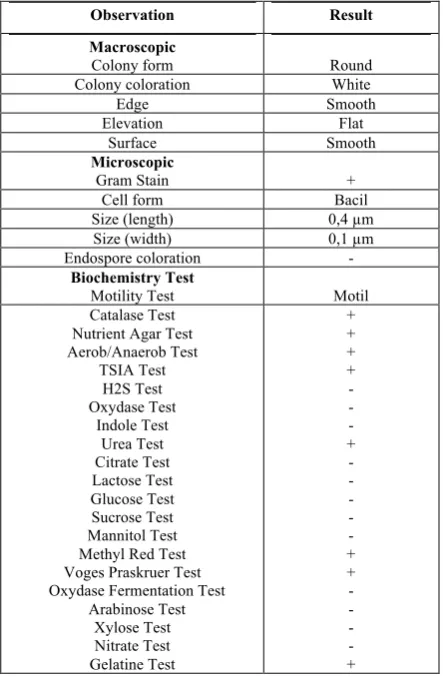
Bacillus sp. UAAC 21501 was obtained from UAAC Culture Center, Sumatran Biota Biotechnology Laboratory, Andalas University, Padang, Indonesia. We have isolated and purified this bacterium and identified biochemically, the results can be seen in Table 1. There is an indication that this bacterium was able to produce P(3HB) based on the test using Nile Blue A 1% reagent and incubation for 30 minutes, then viewed under UV light at 365 nm wave length, where bacterial colonies showed a yellowish
fluorescent color, so this bacterium was determined asP(3HB)-producing bacteria1,3.
The formation of bioplastic P(3HB) occurs when bacteria was grown in a medium using a substrate containing excessive carbon sources and reduced other important elements, such as nitrogen. As a result, the bacterial cell growth will occur in unbalanced conditions, and that bacteria tend to consume carbon sources excessively and stores as much as possible for food reserve granules in its cells (Anderson).
Table 1: Characteristics of Bacillus sp. UAAC 21501 producing bioplastic16
Observation Result
Macroscopic
Colony form Round
Colony coloration White
Edge Smooth
Elevation Flat
Surface Smooth
Microscopic
Gram Stain +
Cell form Bacil
Size (length) 0,4 µm Size (width) 0,1 µm Endospore coloration -
Biochemistry Test
Motility Test Motil Catalase Test
Nutrient Agar Test Aerob/Anaerob Test
TSIA Test H2S Test Oxydase Test
Indole Test Urea Test Citrate Test Lactose Test Glucose Test Sucrose Test Mannitol Test Methyl Red Test Voges Praskruer Test Oxydase Fermentation Test
Arabinose Test Xylose Test Nitrate Test Gelatine Test
+ + + + - - - + - - - - - + + - - - - +
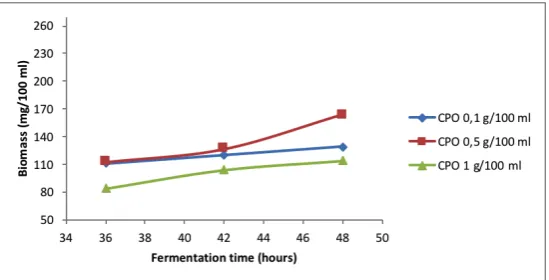
Table 2 and Figure 1 shows the results of biosynthesis of P(3-HB) using CPO as carbon sources using Bacillus subtilis UAAC 21501. In most bacteria, P(3HB) is synthesized from acetyl-CoA through the work of three types of enzymes, namely ketothiolase, acetoacetyl-CoA reductase and P(3HB) synthase17. Crude palm
oil (CPO) contains carbon sources in the form of fattyacids,
including: palmitic acid (43.7%), oleic acid (39.9%), linoleic acid (10.3%), and stearic acid (4.4%). According to Majid et al (1993), to be able to produce P(3HB) bioplastic-producing bacteria will try to convert these fatty acids into acetyl-coA with the help of the β-oxidase enzyme.
Table 2: Data of biomass weight (dry cells) and pH of Bacillus sp. UAAC 21501 fermentation media
No. CPO
(g/100ml)
Time (hour)
Biomass (mg/100 ml)
pH
1 0.1 36 111 6.6
2 42 120 6.5
3 48 129 6.5
4 0.5 36 113 6.6
5 42 127 6.6
6 48 164 6.5
7 1.0 36 84 6.6
8 42 104 6.6
Figure 1: Profile of relationship between the amount of biomass and fermentation time at various concentrations of crude palm oil (CPO)
Figure 2: Profile of relationship between the pH of fermentation media and fermentation time at crude palm oil (CPO) concentrations of 0.5 g/100 ml
Profile of relationship between the pH of fermentation media and fermentation time at crude palm oil (CPO) concentrations of 0.5 g/100 ml showed in Figure 2. Changes in pH means it will reduce the production of P(3HB) in the bacterial cells18. Changes in pH
during fermentation were caused by the formation of carboxylic acids as a by-product of fermentation. Therefore, to prevent a significant decrease in pH in the bacterial growth medium, phosphate buffer solution was added during the fermentation process.
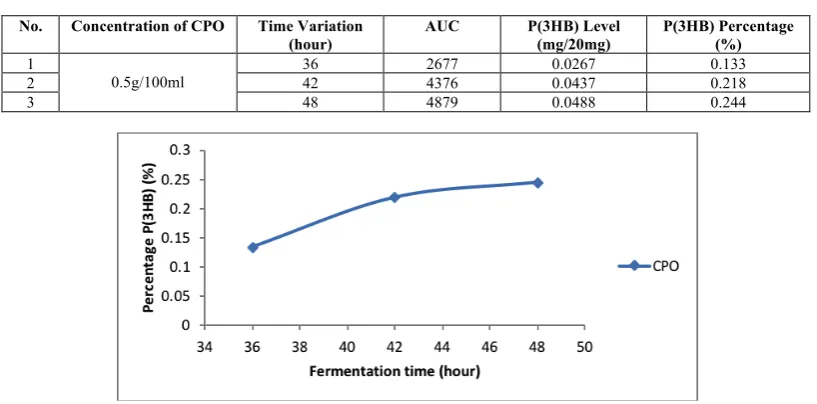
Table 3 shows the results for determination of the amount of P(3HB) content that was carried out using a Gas Chromatography (GC) methods. In this experiment, the standard P(3HB) used was 10 mg Biopol® to ensure that the polymer accumulated in the
Bacillus sp. UAAC 21501 bacterial cell was true P(3HB). Before it was injected into the GC device, the first sample was methanolysed, where as much as 20 mg of biomass was added to 1.7 ml of methanol, 0.3 ml of concentrated H2SO4 and 2 ml of
chloroform, then it was heated in an oven at 100 ºC for 4 hours in a tightly closed test tube. This process aims to convert 3-hydroxybutyrate monomer into the 3-hydroxymethyl ester form so that it turned into a gas form and can be detected by GC devices15.
Table 3: Data of P(3HB) level and percentage in Bacillus sp. UAAC 21501 bacterial cell at CPO concentration of 0.5 g/100 ml
No. Concentration of CPO Time Variation (hour)
AUC P(3HB) Level (mg/20mg)
P(3HB) Percentage (%)
1
0.5g/100ml 36 2677 0.0267 0.133
2 42 4376 0.0437 0.218
3 48 4879 0.0488 0.244
Figure 4: Graphic of the relationship between percentage of P(3HB) content with fermentation time in CPO concentration of 0.5 g/100 ml
Table 3 and Figure 4 showed that the relationship between percentage of P(3HB) content with fermentation time in CPO concentration of 0.5 g/100 ml. The maximum P(3HB) percentage accumulated in the cells is around of 0.244 % w/w detected after 48 hours of fermentation process. In previous study by Djamaan (2015)1, oleic acid was used as a carbon source by using Erwinia
sp. USMI-20 which able to produce P(3HB) of 55% b/ b. In addition, the use of glucose-peptone as a carbon source with Bacillus mycoides also produced P(3HB) with percentage of 35.60% b/b19 and Bacillus cereus SPV with a carbon source of
sugarcane molasses produced 61.07% b/b P(3HB)20. If the results
of the previous study were compared with the results of this study with a P(3HB) obtained only 0.133%, this acquisition was still relatively low. However, if it is calculated from the conversion factor and the increase in added value of CPO, from only 0.5g / 100 ml it able to produce 0.133% P(3HB), which is quite significant. The acquisition of bioplastic P(3HB) can be influenced by the carbon source used and the factor of bacterial compatibility with the fermentation substrate can give an effect on the production of bioplastic P(3HB).
Based on these data, it can be seen that further optimization of carbon substrate is needed for the production of P(3HB) using thermophylic bacteria Bacillus sp. UAAC 21501, so the optimum conditions for bacteria to maximized and increased P(3HB) content obtained from fermentationcan be determined. According to Doi (1990)21, a P(3HB) producing bacteriais able to accumulate
P(3HB)polymer granules in their cells to reach 85% of the total cell weight. Our previous research using CPO in producing other types of polyester, namely poly (3-hydroxybutyrate-co-3-hydroxyvalerate). Akmal et al., (2015) has been able to achieve the polymer content in Erwinia sp. USMI-20 as much as 53% of the cell weight1.
CONCLUSION
From the biosynthesis process of poly(3-hydroxybutyrate) polyester compounds from crude palm oil (CPO) using Bacillus sp. UAAC 21501 can be concluded that the best CPO concentration in producing biomass and P(3HB) polyester content was 0.5 g/100 ml with substrate biomass of 164 mg/100 ml and P(3HB) content of 0.133% b / b, with the fermentation duration of 48 hours.
AKNOWLEDGMENT
The author would like to say special thanks to The Dean of Faculty of Pharmacy, University of Andalas, Padang, Indonesia for her support this research under Lecturer Research Grant, Fiscal Year 2018, with Contract Number: 01/UN.16.10/DPPKM/FFARMASI/2018.
REFERENCES
1. Akmal D, Asiska P D, Wangi Q A, Rivai H and Agustien A. Biosynthesis of copolymer poly(3-hydroxybutyrate-co-3-hydroxyvalerate) from palm oil and n-pentanol in a10L bioreactor. Rasayan J. Chem, 2015; 8 (3): 389-395.
2. Arikan E B and Ozsoy H D. A review: investigation of bioplastics. J. Civil Eng. Arch. 2015; 9:188-192.
3. Anderson A J and Dawes E A. Occurrence, metabolism, metabolic role, and industrial uses of bacterial of polyhydroxy alkanoates. Microbial. Rev, 1990; 54:450-472.
4. Hassan M A. Sustainable production of polyhydroxyalkanoates from renewable oil-palm biomass. Biomass and Bioenergy, 2013; 50, 1-9. https://doi.org/ 10.1016/j.biombioe.2012.10.014
5. Djamaan A. P(3HB) and P(3HB-ko-3HV) Production Concept by Fermentation. Padang: Andalas University Press. 2015.
6. Djamaan A, Marjoni M R and Ismed F, The influence of pretreatment time, type and the concentration of yeast on ethanol production from rice straw, Res. J. Pharm. Biol. and Chem. Sci, 2015a; 6(3): 583-591.
7. Artasastra M A, Yanwirasti, Djamaan A, Handayani D. Cytotoxic activity screening of ethyl acetate fungal extract derived from the marine sponge Neopetrosia chaliniformis AR-01, J. Appl. Pharm. Sci. 2017; 7(12): 174-178.
8. Djamaan A, Fitriani L, Wangi Q A, Asiska P D, Ismed F and Zaini E. Production and characterization of microbial polyesters poly (3-hidroxybutyrat) from oleic acid as sole carbon source, Res. J. Pharm. Biol. and Chem. Sci, 2015b; 6 (1): 814-822.
10.Cappucino J G and Sherman N. Microbiology A Laboratory Manual. 7th Ed. Perason Education. Inc, Publishing as Benjamin Cummings. San Fransisco. CA, 2005.
11.Alen Y, Nufika Y, Suharti N, Nakajima S, Djamaan A. The determination of profenofos insecticide residue cabbage (Brassica oleracea), Der Pharmacia Lett, 2016; 8(8):137-140.
12.Kim B S. Production of poly (3-hydroxybutyrate) from inexpensive substrate. Enzym Microb. Technol. 2000; 27: 774-777. https://doi.org/10.1016/S0141-0229(00)00299-4 13.Sayuti I, Siregar Y I, Amin B, Agustien A, Djamaan A, 2017,
Identification of bacterial hydrocarbonoclastic in waste tanks, Petapahan, Riau, Indonesia, using 16s RNA, J. Pure Appl. Microbiol, 2017. 12(2): 671-677. https://doi.org/10.22207/ JPAM.12.2.25
14.Rivai H, Asia A, Rina W, Alen Y, Handayani D, Aldi Y, Marlina, and Djamaan A. Isolation of endophytic bacteria from bark, leaf, and pericarp of Mangosteen (Garcinia mangostana L.) and testing of the antimicrobial activity, Res. J. Pharm. Biol. and Chem. Sci, 2016; 7(1): 1910-1920. 15.Braugnegg G, Sonnleitner B and Lafferty R M. A rapid gas
chromatography method for the determination of poly-β-hydroxybutyric acid in microbial biomass. Eur. J. Appl. Microbiol. Biotechnol, 1978; 6: 29-37. https://doi.org/ 10.1007/BF00500854
16.Yulialdi Y. Agustien A, Djamaan A. Isolation of bioplastic producing thermopylic bacteria from hot spring water Mount Talang, Solok District, West Sumatra, Indonesia, University of Andalas Undergraduate Thesis. Padang, 2015.
17.Djamaan A, Agustien A, Zam S I, Jannah M, Lalfari R S, Aldi Y, Dewi A P, Suci R P. Selection of medium for biopesticides
fermentation process by Bacillus subtilis AAF2 UAAC 20701. Int. Res. J. Pharm, 2018; 9(8): 21-26. https://doi.org/10.7897/2230-8407.098158
18.Majid M I A, Akmal D, Few L L, Agustien A, Toh M S, Samian M R, Najimudin N and Azizan M N. Production of hydroxybutyrate) and its copolymer poly(3-hydroxybutyrate-co-3-hydroxyvalerate) by Erwinia sp. USMI-20. Int. J. Biol. Macromol, 1999; 25: 95-104. https://doi.org/10.1016/S0141-8130(99)00020-3
19.Aarthi N and Ramana K V. Identification and characterization of polyhydroxybutyrate producing Bacillus cereus and Bacillus mycoides strains. Int. J. Environ. Sci, 2011; 1(5): 744-756.
20.Akaraonye E, Moreno C, Knowles J C, Keshavarz T and Roy I. Poly(3-hydroxybutyrate) production by Bacillus cereus SPV using sugarcane molasses as the main carbon source. Biotechnol. J, 2012; 7: 293-303. https://doi.org/10.1002 /biot.201100122
21.Yamane T, Chen X and Ueda S. 1996. Polyhydroxyalkanoates syntesis from alcohol during the growth of Paracoccus denitrifications. FEMS Microbiol. Reff, 1996; 135: 207-211. https://doi.org/10.1111/j.1574-6968.1996.tb07991.x
Cite this article as:
Akmal Djamaan et al. Biosynthesis of a polyester poly(3-hydroxybutyrate) from crude palm oil (CPO) by using Bacillus sp. UAAC 21501. Int. Res. J. Pharm. 2018;9(9):93-98 http://dx.doi.org/10.7897/2230-8407.099194
Source of support: University of Andalas, Padang, Indonesia, Conflict of interest: None Declared