
The origin of cosmic rays and TeV gamma-ray astronomy
Gernot Maier1,a
1DESY, Platanenallee 7, 15738 Zeuthen, Germany
Abstract. Cosmic rays are accelerated to high energies in Galactic and extragalactic objects like Supernova remnants (SNR) and active galactic nuclei (AGN). How these accelerators work and how efficient they accel-erate different types of particles to energies of 1015eV or beyond, is 100 years after the discovery of cosmic rays by Victor Hess, still unknown. Gamma rays trace cosmic rays at their site of acceleration and give crucial information on the nature and inner workings of these extreme objects. Gamma rays can be used to find the sources of cosmic rays and to determine their type, age and dynamics. We review in these proceedings the observational techniques and recent findings on gamma-ray emission from Supernova remnants.
1 Introduction
In 1912, the Austrian physicist Victor F. Hess discovered by means of several balloon ascents the particle popula-tion in the universe of highest energy: cosmic rays. Their energy spectrum can be described by a power law cov-ering 10 order of magnitudes in energy (up to 1020 eV)
and about 30 orders of magnitude in flux. Cosmic rays consist mainly of nuclei like protons, helium and heav-ier types up to iron. Supernova remnants (SNRs) have been the prime candidates as sources of galactic cosmic rays since the 1960s. The working hypothesis is that a 10% conversion of the blast wave’s energy into relativis-tic parrelativis-ticles during the lifetime of a SNR are enough to fill the Galaxy with cosmic rays up to about 1015eV.
To-day, there is much unequivocal evidence for the accelera-tion of cosmic rays in SNRs from observaaccelera-tions at diff er-ent wavelengths: the expansion measuremer-ents in X-rays [1]; observation of magnetic field amplification as byprod-uct of particle acceleration [2]; dynamical measurements of shock positions and shock temperature [3] and non-thermal emission in gamma rays (e.g.[4]). The mechanism of diffusive shock acceleration is a solid theoretical base for the production of cosmic rays by SNRs.
Gamma rays can be used to trace and identify high-energy particles at or close to their acceleration site. The different production mechanisms for gamma rays depend on energy and type of the parent particle population and the surrounding photon, magnetic and matter fields. High-energy protons can produce gamma rays through proton-proton or proton-proton-gamma interaction, where secondary neutral pions decay into high-energy photons. Long-living secondary particles in these interactions can initiate parti-cle cascades where photons can be produced through pair production or synchrotron radiation. High-energy leptons
ae-mail: [email protected]
loose energy mainly through synchrotron radiation (which is in general below a few GeV), inverse Compton scatter-ing on low-energy photons or Bremsstrahlung. We will show, using a few examples, in Chapter 3 what can be learned about the acceleration conditions in SNRs from observing them at gamma-ray energies.
TeV gamma-ray astronomy is a broad and dynamic field with a large number of source types observed (e.g. ac-tive galactic nuclei, binaries or pulsar wind nebula, dif-fuse emission, sources with no counterparts at other wave-lengths). Significant progress has been made in the past decade in the understanding of our non-thermal Universe. We would like to refer the reader towards extensive re-views of the field, see e.g. [5–8].
2 Observing gamma rays
The energy spectrum of sources of high-energy gamma rays are approximately power-law like shape dN/dE ∝
E−Γwith spectral indicesΓbetween 2 and 4 above a few tens of GeV. This results in very small photon fluxes, es-pecially at high energies. As an example, the photon flux above 100 MeV and 1 TeV from the Crab Nebula, one of the strongest known gamma-ray emitter, is about 30 photons/m2/day and 10 photons/m2/year respectively. The Large Area Telescope (LAT) on the Fermi space telescope is currently the most sensitive detector for gamma rays in the 20 MeV to 100 GeV range. The pair conversion detec-tor has an effective area of about 1 square meter, which is too small to detect the faint sources of gamma rays above hundreds of GeV [9]. Ground-based detection techniques which measure the extensive air showers from the interac-tion of the high-energy photons with Earth’s atmosphere are most sensitive in this energy regime and are the main focus on in the following.
Imaging atmospheric Cherenkov telescopes (IACTs) collect the Cherenkov light emitted by relativistic parti-C
Owned by the authors, published by EDP Sciences, 2013
This is an Open Access article distributed under the terms of the Creative Commons Attribution License 2 0 , which . permits unrestricted use, distributi and reproduction in any medium, provided the original work is properly cited.
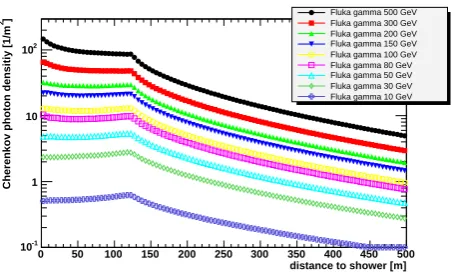
Figure 1. Average Cherenkov photon densities calculated by CORSIKA at an observation level of 1800m a.s.l. for vertical showers with different primary energies.
cles (mainly electrons and positrons) in air showers. The Cherenkov photons are produced along the shower axis with an emission maximum at about 10 km above ground; they form a short nanoseconds long bluish (300-550 nm) light flash. The emission angle changes with altitude from about 0.1 deg at 30 km height a.s.l. to about 1.3 deg at sea level. This results in an approximately flat lateral distribu-tion of Cherenkov photons on the ground, the so called light pool. The radius of the light pool is independent of the energy of the primary photon. It is at an observa-tion level of 1800m about 140 m. The photon densities drop exponentially beyond this radius. Typical densities in the light pool are about 2-3 photons/m2 at 30 GeV to thousands of photons/m2above a few TeVs, see Figure 1. Placing a single telescope anywhere inside the light pool results in a large sensitive detection area of about 105m2.
To measure the faint and short flashes of Cherenkov light from air showers, IACTs consist of large mirrors (mirror area >100 m2) to collect enough photons, pix-elated cameras with>500 photomultiplier, sophisticated trigger systems and fast electronics. Each IACT measures a projection of the longitudinal development of the air shower in its camera. Using several telescopes and stereo-scopic techniques allow the reconstruction of the direction of the incoming gamma ray; its energy can be estimated by the signal size. Fast trigger systems sensitive to the mor-phology of air showers are applied to suppress light from stars and other background sources. Readout rates for the current telescope systems are typically in the range of hun-dreds of Hz, with most events being initiated by charged cosmic rays and not by gamma rays. Cosmic ray air show-ers are in general much more irregular with significantly more energy transferred to larger lateral distances from the shower axis. Most of these background events can there-fore be eliminated by applying analysis cuts on the shape of their images in the camera.
The IACT technique was pioneered by the Whipple collaboration using a 10 m reflector located on Mt. Hop-kins, Arizona [10]. The Whipple 10 m telescope was in operation from 1968-2011 and sensitive to gamma rays in the energy range from 200 GeV to 20 TeV. The first
very-such as GRBs and flares from distant AGNs.
MAGIC is a two telescope system located on the Ca-nary island La Palma. The MAGIC collaboration pio-neered observations in the low-energy range between 25-100 GeV, which are challenging for ground-based instru-ments due to the small amount of light emitted by these kind of air showers. The camera of MAGIC I was up-graded in 2012 to achieve a more uniform focal plane instrumentation (number of pixels increased from 576 to 1039); a new readout system and a new trigger system was also installed.
VERITAS is a four-telescope array of IACTs located in Southern Arizona close to the Whipple site at Mt. Hop-kins. VERITAS has been in operation since 2007, the in-strument was upgraded several times: 1. a single telescope was moved to achieve a more uniform array layout, re-sulting in an increase in sensitivity of 30%; 2. the replace-ment of the second level trigger by a new improved version for better suppression of the night sky background; 3. an upgrade of all four cameras with high-efficiency PMTs to achieve higher sensitivity and a significantly lower trigger threshold of about 70 GeV.
All observatories have similar characteristics: an en-ergy range starting from 20-70 GeV to 30 TeV, a sensitiv-ity to detect a source with a flux of 1% of the Crab Nebula in about 20-40 hours, an effective area for gamma rays of >105m2, an energy resolution of 15-20% and an angular resolution of≈0.1 deg. The field of view of IACTs is 3-5 deg wide, limiting their sensitivity to point-like or moder-ately extended sources. The duty cycle of ground-based Cherenkov instruments is restricted to dark nights result-ing in about 1200 hours of observations per year. Obser-vation during moderate moonlight conditions can extend the amount of observing time by about 30%. These two limitations, the small field of view and duty cycle, means that large parts of the sky above 100 GeV are not surveyed with high sensitivity.
Beside the hardware upgrades mentioned above, sig-nificant progress has been made in understanding signal and background measurements. Several new approaches for gamma-hadron separation and shower reconstruction result in typically 40% less observation time needed to
Figure 2.Artists impression of CTA (from http://www.cta-observatory.org/) .
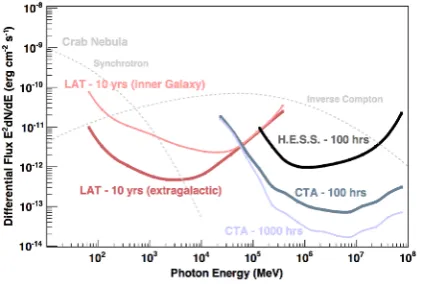
Figure 3. Expected point-source sensitivity of CTA in compar-ison with H.E.S.S. and the Fermi LAT. Four bins per decade of equal size on the logarithmic energy scale have been chosen for the calculation of the differential sensitivity. Figure taken from [15].
achieve the same sensitivity as with the "classical" geo-metrical reconstruction methods (e.g. [12–14]).
Non-imaging detectors measuring the shower particles reaching the ground measure continuously the sky at ener-gies much greater than IACTs. Two such detector systems are currently in the construction phase: the HAWC system in Mexico4and several instruments in Tibet (LAWCA,
Ti-bet MD and LHASOO5).
The next-generation gamma-ray observatory will be the Cherenkov Telescope Array6 (CTA; see Figure 2). It will consist of more than fifty IACTs of different size, cov-ering a wide energy range from 20 GeV to 200 TeV with a factor of 10 improvement in sensitivity and a significantly improved angular resolution in comparison with current generation instruments. The different telescope types are optimized for different energy ranges. The lowest ener-gies (10-100 GeV) will be covered by a few (3-4) large size telescopes with mirror areas>400 m2. The limiting
4http://hawc.umd.edu/
5http://english.ihep.cas.cn/ic/ip/LHAASO/ 6http://www.cta-observatory.org/
factors at these energies are photon collection efficiency, systematics and poor gamma-hadron separation. At en-ergies above 100 GeV, mid-size telescopes with 100 m2 photon collection area will provide milli-Crab sensitivity and arcminute angular resolution. For high energies above 5-10 TeV, small telescopes distributed over a large area will be used to reach a collection area of more than 5×10⁶
m2. CTA is currently in the prototyping phase. Its
con-struction will start in 2015, first science data is expected for 2016. The expected sensitivity of CTA for steady point sources in comparison with current generation instruments and the Fermi LAT at lower energies can be seen from Figure 3. Additionally, CTA will open a new window for high-energy transients with flare durations of less than a week. As an example, at 75 GeV, CTA’s sensitivity will result from its large sensitive area about a factor of 104 (103) greater than the current generation instruments for transient phenomena of 1 day (1 week) length [15].
3 Supernova as sources of cosmic rays
Cosmic rays are accelerated in the blast waves of Super-nova remnants to energies of 1015eV and possibly beyond.
The observation of gamma rays from SNRs give evidence of the environment in which acceleration take place, the efficiency and maximum energy of the accelerator. Three prominent examples of gamma-ray emitting SNRs are dis-cussed in the following.
3.1 Tycho
rem-Figure 4.Left: TeV gamma-ray count map of the region around Tycho’s SNR as measured by VERITAS [16]. The color scale indicate the number of excess events above 800 GeV. Overlaid are the X-ray image from a Chandra exposure and12CO emission from the FCRA survey (for references, see [16]). Right: broad-band spectral energy distribution of Tycho with measurements in radio, X-rays, GeV and TeV gamma rays (see [17] for references to the experimental data). Overlaid is a model curve from [17]. The curve shows synchrotron emission, thermal electron bremsstrahlung and pion decay.
nant. (e.g. [19]). Measurements of the location of the blast wave, the forward discontinuity and the reverse shock with Chandra confirm this and show that the shock dynamics are partly dominated by efficient cosmic acceleration [3].
Tycho has been recently discovered at gamma-ray en-ergies by VERITAS [16] and the Fermi LAT [20], see Fig-ure 4. Modeling of the broad-band spectral energy dis-tribution confirms that hadrons are accelerated up to knee energies. The gamma-ray emission is likely dominated by the decay of neutral pions produced in collisions of ac-celerated cosmic rays with the background medium. The models predict that about 10% of the kinetic energy in the blast wave are converted into cosmic rays [16, 17, 20]. While hadronic models are favored for the description of the spectral energy distribution of Tycho, a leptonic origin of the high-energy emission cannot be excluded. Multi-zone models with regions of higher and lower magnetic field strengths can also provide a good fit to the gamma-ray fluxes of Tycho [21].
3.2 RXJ 1713.7-3946
RXJ 1713.7-3946 is a young (≈1600 years old) shell-type SNR located at a distance of 1 kpc. It has a hard spec-trum and is a bright gamma ray source with a flux above 1 TeV of approximately 65% of the flux of the Crab Nebula. HESS and Fermi observations show an extended shell-like emission region with spatially correlated gamma and X-ray radiation [22, 23]. Are these gamma X-rays signatures of hadronic cosmic rays? The situation is far from clear. Observations and modeling indicate that the gamma-ray emission in RXJ 1713.7-3946 is predominately leptonic, see for example the results from [24] in Figure 5. The non-observation of thermal X-ray emission from the SNR with Suzaku indicate very low gas densities of the circum-stellar medium. The efficiency for gamma rays from de-caying pions produced in proton-gas collisions is very low
under the assumption of a uniform circumstellar medium and the high-energy photon originate from inverse Comp-ton scattering of relativistic electrons on ambient phoComp-tons. It should be stressed that in this leptonic model, about 25% of the shock ram kinetic energy flux goes into the acceleration of protons, while less than 1% into the high-energy electrons. A different and more detailed study of the molecular and atomic gas around RXJ 1713.7-3946 reports the observations of a low-density cavity created by the stellar wind of the progenitor with a surrounding denser wall [25]. The gamma rays are produced by proton-gas collisions in the dense wall while the low proton-gas densities in the inner part explain the non-observation of thermal X-ray emission by Suzaku. It is estimated from multi-zone hadronic modeling of RXJ 1713.7-3946 that about 0.1% of the kinetic energy of the SNR is converted into high-energy particles [25]. The future ground-based observa-tory CTA will have an angular resolution of 1-2 arcmin-utes. It will have the potential to differentiate the location of the gamma-emission and to reveal the origin of high-energy emission from RXJ 1713.7-3946.
3.3 Supernova remnants interacting with molecular clouds
Figure 5.Broadband energy spectrum of RXJ 1713-396 with measurements by HESS and the Fermi LAT in gamma rays, Suzaku in X-rays and at radio wavelengths (see [24] for references to the experimental data). A hadronic model is shown in the top panel and a leptonic model in the bottom panel [24].
4 Conclusion and outlook
The combination of observations at all wavelengths and theoretical work established SNRs as main sources of cos-mic rays. Many questions remain, not only regarding the details of cosmic ray acceleration in SNR as described above, but also the search for the sources of ultra-high en-ergy cosmic rays and understanding of high-enen-ergy emit-ters like pulsars, blazars or binary systems. The current ex-perimental situation in the field is unique: the Fermi LAT is taking data in its 5th year of operation and all ground-based instruments are entering a new phase with major up-grades just completed. The future is bright: new observa-tories like CTA and HAWC will answer and create many new questions of the high-energy Universe.
Acknowledgements
GM would like to thank the organizers of the ISVHECRI 2012 for the invitation to attend this interesting and inspiring confer-ence in the heart of Berlin. GM acknowledges support through the Young Investigators Program of the Helmholtz Association.
References
[1] Hughes, J.P et al, ApJ543L61 (2000)
[2] Berezhko, E.G. & Völk, H., A&A419L27 (2004) [3] Warren, J.S. et al, ApJ634376 (2005)
[4] Acciari, V. et al (The VERITAS Collaboration), ApJ 714163 (2010)
[14] Albert, J. et al, NIM A588, 424 (2008)
[15] Funk, S. & Hinton, J. (CTA Collaboration), As-troparticle Journal, accepted (2012)
[16] Acciari, V. et al (The VERITAS Collaboration), ApJ 730L20 (2011)
[17] Morlino, G. & Caprioli, D., A&A538A81 (2012) [18] Hwang, U. et al, ApJ581, 1101 (2002)
[19] Bell, A.R. & Lucek, S.G. MNRAS321, 433 (2001) [20] Giordano, F. et al. (for the Fermi-LAT collaboration)
PoS, proceedings of the 25th Texas Symposium, Hei-delberg, Germany (2010)
[21] Atyoan, A. and Dermer, C.D., ApJ749, L26 (2012) [22] Aharonian, F. et al(The H.E.S.S. collaboration) A&A
449, 223 (2006)
[23] Abdo, A.A. et al( The Fermi LAT collaboration) ApJ 734, 28 (2011)
[24] Ellison, D.C. et al, ApJ712, 287 (2010) [25] Fukui, Y. et al, ApJ746, 82 (2012) [26] Uchiyama, Y. et al, ApJ723, L22 (2010)
[27] Aharonian, F. A., & Atoyan, A. M., A&A,309, 917 (1996)
[28] Koo, B.-C., & Moon, D.-S., ApJ,475, 194 (1997) [29] Aleksic, J. et al (The MAGIC Collaboration), A&A
541, A13 (2012)
![Figure 4. Left: TeV gamma-ray count map of the region around Tycho’s SNR as measured by VERITAS [16]](https://thumb-us.123doks.com/thumbv2/123dok_us/8747413.1434920/4.595.61.530.84.255/figure-left-gamma-count-region-tycho-measured-veritas.webp)
![Figure 6. Broad-band spectral energy distribution of W51C with measurements in radio, GeV and TeV gamma rays (see [29] forreferences to the experimental data)](https://thumb-us.123doks.com/thumbv2/123dok_us/8747413.1434920/5.595.186.403.85.415/figure-broad-spectral-energy-distribution-measurements-forreferences-experimental.webp)
