IJEDR1804007
International Journal of Engineering Development and Research (
www.ijedr.org
)
27
A study on synthesis, characterization and dielectric
properties of PANI-NiO composites
1Mahadevi Konin, 2Vijayalaxmi Reddy, 3Dr. Anilkumar Bidve 1Assistant Professor, 2Assistant Professor, 3Professor
Appa Institute of Engineering and Technology, Kalaburagi, Karnataka-585 103 India
_____________________________________________________________________________________________________
Abstract - In the present work we report the development of PANI/NiO composites with varying NiO content by in situ polymerization technique. The developed composites were subjected to morphological characterization by scanning electron microscope and structural characterization by X-ray diffraction technique. The AC conductivity and dielectric constant of composites were studied as a function of frequency. All the composites displayed increase in conductivity and dielectric constant with the increase in NiO content. Uniform dispersion of NiO and increase in number of interfaces was attributed to increase in conductivity and dielectric constant of composites respectively.
Keywords - PANI-NiO, Scanning electron microscopy, X-ray diffraction.
_____________________________________________________________________________________________________
I.INTRODUCTION
Polymer based conducting composites have gained much attention in the recent years due to their excellent optical, electrical and structural properties. Especially these composites have played important role in various applications like rechargeable batteries, electromagnetic interference shielding, electric catalysis and sensors. Out of all available conducting polymers, polyaniline (PANI) is the most popular due to its outstanding properties. Since it is a unique polymer it exhibits three stable oxidation states which are, fully reduced state: leucoemeraldine, fully oxidized state: pernigraniline form and partially oxidized state: emeraldine. Out of the three oxidation states, the first two states are poor conductors while emeraldine is most attractive owing to its tunable states, emeraldine base and emeraldine salt. Polyaniline is synthesized by many routes out of which solution blending, enzymatic polymerization and in situ polymerization techniques are the most popular ones. Initially it was synthesized by oxidation of aniline and later by subjected aniline to anodic oxidation at carbon electrode. Owing to its popularity many groups across the world are working on various aspects of polyaniline like polymerization, electronic conductance and electrostatic interactions. The important properties which make PANI attractive for molecular electronics are its ease of synthesis, high electrical conductivity and good environmental stability [1-4].
In the past few years’ composites containing polyaniline and one more material which can be metal oxide, metal or organic materials are studied vastly. Polyaniline containing various filler materials like silver [5], graphite [6], carbon nanotube [7], zinc oxide [8], iron oxide [9] and titanium dioxide [10] have been studied. Most of these studies were concentrated on studying the dielectric behaviour of overall composite material. In addition to the present filler materials, a new material is being tried for development of polyaniline composites. This new filler material is basically nickel based metal oxide generally known as nickel oxide (NiO). Nickel oxide is quite an attractive material due to its high specific capacitance, chemical stability, electrical insulating properties and its low cost. It has complex band structure and due to hopping of charge carriers it has low conductivity. The conductivity can be increased by doping with monovalent cations or by introduction of Ni2+ vacancies [11, 12]. Further dielectric property of nickel oxide have been an important topic and many studies have been conducted on this. Biju and Khadar [13] studied the dielectric properties of nickel oxide synthesized by thermal decomposition of nickel carbonate nanoparticles. The study focussed on the dielectric relaxation mechanism of consolidated NiO nanoparticles of different particle size as a function of frequency of temperature and applied signal. The dielectric relaxation mechanism was studied by considering NiO as a carrier and it was found that the NiO was considered to be dielectric material with higher amount of hopping charge carriers. Gokul et al [12] studied the dielectric and structural properties of NiO particles prepared by wet chemical precipitation method. The dielectric response of NiO pellets was measured over a temperature range of 30 to 130°C and frequency range of 100 Hz to 1 MHz at voltage of 1 V. It was found that below 104 Hz the dielectric constant tend to decrease with the increase in temperature and above this frequency the dielectric constant start increasing with the increase in temperature. The increase in dielectric constant with the increase in temperature was due to accumulation of charges which overcome the potential barrier across the grain boundaries. Further the AC and DC conductivities of NiO were also found to increase with the increase in temperature which indicated dependence of electric behaviour of these materials on the temperature. Keeping all these properties in mind, Wang et al [14] studied the dielectric properties of polyaniline Ni0.5Zn0.5Fe2O4 composite nanofibers by in situ polymerization technique. Here in situ polymerization of polynaniline was carried out in the present of NiZn ferrite nano-particles to obtain the composite. The dielectric and magnetic properties of the composite was found to be dependent on the magnetic properties of NiZn content. For the frequency below 1 kHz the dielectric permittivity of composites along with the pure NiZn ferrite decrease very fast and for the frequency range from 103 to 107 Hz show slow reduction.
IJEDR1804007
International Journal of Engineering Development and Research (
www.ijedr.org
)
28
and Fourier transformation infrared spectroscopy (FTIR). The AC conductivity and dielectric properties of composites with varying NiO concentration was also studied.II.EXPERIMENTATION
Synthesis
Synthesis of the PANI–nickel oxide (NiO) composites was carried out by polymerization in situ. Aniline (0.2 mole) was dissolved in 1 M HCl and stirred for 2 hrs to form aniline hydrochloride. Nickel oxide was added in the mass fraction to the above solution with vigorous stirring in order to keep the NiO homogeneously suspended in the solution. To this mixture, 0.2 M of ammonium persulphate, which acts as an oxidant was slowly added drop-wise with continuous stirring at room temperature for 8 hrs to completely polymerize the monomer aniline. The precipitate was filtered, washed with demonized water, and finally dried in an oven for 24 hrs to achieve a constant mass. In this way, PANI–NiO composites containing various mass fractions of NiO (10%, 20%, 30%, 40% and 50%) in PANI were synthesized.
Characterization
The X-ray diffraction was carried out using Philips XPERT diffractometer using Cu Kα radiation (λ = 1.54 A˚).The powder morphology of synthesized PANI–NiO composites were analysed using scanning electron microscopy (SEM, JSM-6360LV, Japan). The Fourier transform infrared spectra (FTIR) were taken using Perkin Elmer (model 783) IR spectrophotometer in KBr medium to confirm the presence of NiO in PANI in the frequency range of 400 – 4000 cm-1. The AC conductivity of all the composites with different NiO content was studied in the frequency range of 100 Hz to 10 MHz using LCR-Q meter (Wayne Kerr, 4300) analyser.
III.RESULTS AND DISCUSSION
Characterization: SEM and X-ray diffraction
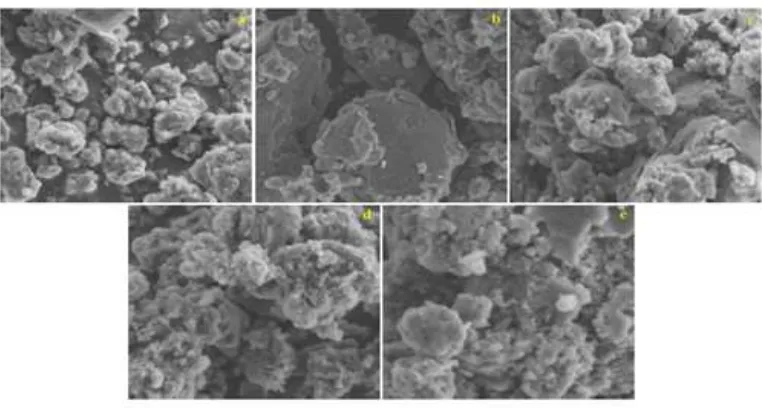
The morphology of developed PANI-NiO composites with varying NiO content studied using SEM are shown in figure 1 (a) – (e). It is well known that the size and shape of the composites depends upon the synthesizing technique adopted. Here in present case the PANI-NiO composites were synthesized using in situ polymerization technique. So the SEM images showed that all the composites consists of aggregates of submicron particles with smoother morphology. All the samples showed that smaller particles with irregular shape while few of them had near spherical shape. However the number of aggregates was found to increase in size with the increase in NiO content from 10% to 50%. The size of the nano-composite increase with the increase in NiO content and found to form bigger agglomerate at high NiO content of 50% which is shown in figure 1 (e). Further the careful observation of the SEM images tells us that the NiO particles are quite unidentifiable from the PANI matrix which implies that the dispersion of these NiO particles is uniform through the matrix without forming any clusters.
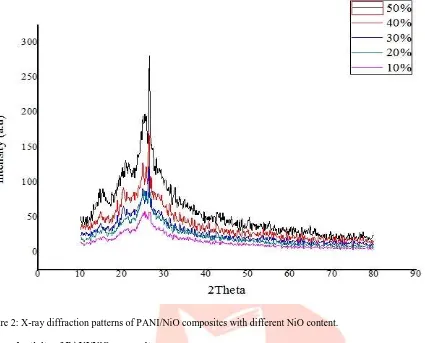
The X-ray diffraction patterns of PANI/NiO composites with different NiO content are shown in figure 2. It is well known from previous studies that the NiO shows peaks at 2θ at values at 37 and 43° while PANI shows characteristic peaks at 9, 20 and 25° [15, 16]. As seen from figure 2, all the XRD patterns corresponding to PANI/NiO composites are amorphous in nature. Two broad peaks centred at 2θ = 17 and 20° observed in all the PANI/NiO composites corresponds to polymeric chain of PANI. Further small sharp peaks were observed for composites with 30 to 50% NiO content centred at 2θ = 37 and 42.5°. These small sharp peaks correspond to cubic NiO which is also in consistent with JCPDS values. Similar XRD observations were reported by Aleahmad et al [17] in their work on PANI/NiO composites.
IJEDR1804007
International Journal of Engineering Development and Research (
www.ijedr.org
)
29
Figure 2: X-ray diffraction patterns of PANI/NiO composites with different NiO content.AC conductivity of PANI/NiO composites
The AC conductivity of all the composites as a function of frequency with varying NiO content is shown in figure 3. The observation tells us that all composites show similar behaviour up to a frequency of 3×10⁵ Hz and after that the conductivity increases significantly. With the increase in NiO content in composites from 20% to 50% the conductivity is found to increase at higher frequencies. High conductivity is observed in composites with NiO content of 50%. The increase in conductivity is mainly due to extended chain length of PANI which helps in polarisation of charge carriers between localized sites and offers a lot of conductive path. At lower frequency the low conductivity is attributed to occupancy of trap charges in the PANI but when frequency is increased the occupancy of trap charges are reduced. The activation energy required for conduction is dependent on the nature of trapping sites that is how strongly these electrons are bound to the tapping sites. So with the increase in frequency enables them for available for conduction and become more active by facilitating hopping of holes and electrons when the NiO content is increased. The hopping of electrons will be more dominant at higher frequencies due to increased activeness of grain boundaries and thereby increasing the conductivity [18].
Figure 3: AC conductivity of PANI/NiO composites as a function of frequency for different NiO content.
IJEDR1804007
International Journal of Engineering Development and Research (
www.ijedr.org
)
30
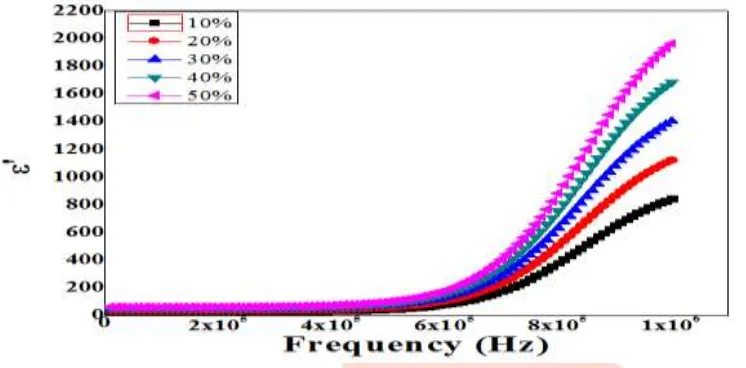
The dielectric behaviour (ε') as a function of frequency for PANI/NiO composites with varying NiO content is shown in figure 4. It can be observed that the dielectric constant ε' up to 5×10⁵ Hz for all the composites is constant but later it tends to increase with the increase in frequency. Incorporation of NiO resulted in significant increase in dielectric constant and further increase with increase in NiO content. Further homogenous dispersion of NiO in PANI matrix does play an important role in increasing the dielectric constant. Here the charges get accumulated at the NiO and PANI matrix due to their difference in dielectric constant and conductivity. This difference in dielectric constant results in strong orientation polarization and this interfacial polarization help in increasing the dielectric constant of the composites. Further with the increase in NiO content more number of interfaces is created which is why we are able to observe high dielectric constant for composite with higher NiO content. This improved dielectric constant for PANI/NiO composites indicates there ability to store more electric energy under the influence of electrical field [19].Figure 4: Variation of ε' for PANI/NiO composites as a function of frequency for different NiO content. IV. ACKNOWLEDGEMENT
The authors are thankful to Poojya Dr. Sharanbasvappa Appa, President Sharanbasveshwar Vidya vardhak Sangha, Kalaburagi, Prof. Dr. V D. Mytri, Principal, Appa Institute of Engineering and Technology, Kalaburagi, Karnataka, for encouragement during the process of carrying out this work.
V.CONCLUSIONS
In this work, we have reported the synthesis of PANI/NiO composites by in situ polymerization technique. The developed composites displayed uniform dispersion of NiO particles in PANI matrix. AC conductivity measured as a function of frequency displayed increase in conductivity with increase in NiO content. Highest conductivity was observed for composite with 50% of NiO content. Further the dielectric constants measured for all composites displayed increase in values with the increase in NiO content. The increase in dielectric constant can be attributed homogenous dispersion of NiO and increase in number of interfaces contributed for increase in dielectric constant.
VI.REFERENCES
[1] A.A. Syed, M.K. Dinesan, Review: polyaniline – a novel polymeric material, Talanta 38 (1991) 815–837.
[2] M. Thangarathinavelu, A.K. Tripathi, T.C. Goel, I.K. Varma, Preparation and characterization of polyaniline–PVC polymer composite film, J ApplPolymSci 51 (1994) 1347–1349.
[3] W. Liu, J. Kumar, S. Tripathy, K.J. Senecal, L. Samuelson, Enzymatically synthesized conducting polyaniline, J Am ChemSoc 121 (1998) 71–78.
[4] S.A. Chen, W.G. Fang, Electrically conductive polyaniline–poly(vinyl alcohol) composite films: physical properties and morphological structures. Macromolecules 24 (1991) 1242–1248.
[5] A.Choudhury, Polyaniline/silver nanocomposites: Dielectric properties and ethanol vapour sensitivity, Sens Actuators B 138 (2009) 318–325.
[6] C. Xiang, L. Li, S. Jin, B. Zhang, H. Qian, G. Tong, Expanded graphite/polyaniline electrical conducting composites: Synthesis, conductive and dielectric properties, Mater Lett 64 (2010) 1313–1315.
[7] C. Oueiny, S. Berlioz, F. Perrin, Carbon nanotube–polyaniline composites, ProgPolymSci 39 (2014) 707–748.
[8] B.K. Sharma, A.K. Gupta, N. Khare, S.K. Dhawan, H.C. Gupta, Synthesis and characterization of polyaniline–ZnO composite and its dielectric behaviour, Synth Met 159 (2009) 391–395.
IJEDR1804007
International Journal of Engineering Development and Research (
www.ijedr.org
)
31
[10] A. Dey, S. De, A. De, S.K. De, Characterization and dielectric properties of polyaniline–TiO2 nanocomposites,Nanotechnology 15 (2004) 1277–1283.
[11] S.A. Makhlouf, Electrical properties of NiO films obtained by high-temperature oxidation of nickel, Thin Solid Films 516 (2008) 3112-3116.
[12] B.Gokul, P.Matheswaran, K.M.Abhirami, R.Sathyamoorthy, Structural and dielectric properties of NiO nanoparticles, J Non-Cryst Solids 363 (2013) 161-166.
[13] V. Biju, M. A. Khadar, Dielectric properties of nanostructurednickel oxide, J Mater Sci 38 (2003) 4055 – 4063.
[14] C. Wang, Y. Niu, P. Pei, Y. Shen, H. Zhang, A. Xie, Synthesis, characterization and dielectric properties of [email protected] composite nanofibers, Mater SciSemicond Process 40 (2015) 140-144.
[15] D. Wang, W. Ni, H. Pang, Preparation of mesoporous NiO with a bimodal pore size distribution and application in electrochemical capacitors. ElectrochimActa 55 (2010) 6830-6835.
[16] S. BalSydulu, S. Palaniappan, P. Srinivas, Nano fibre polyaniline containing long chain and small molecule dopants and carbon composites for supercapacitor. ElectrochimActa 95 (2013) 251-259.
[17] M. Aleahmad, H. G. Taleghani, H. Eisazadeh, Preparation and characterization of PANI/NiO nanocomposite using various Surfactants, Synth Met 161 (2011) 990-995.
[18] V. B. Tare, J. B. Wagner, Electrical conductivity in two phase nickel–nickel oxide mixtures and conductivity of nickel oxide at the nickel–nickel oxide phase boundary, J. Appl. Phys. 54 (1983) 6459-6462.