Measurements of vector bosons plus jets production with the ATLAS detector
at the LHC
Lea Caminada1,aon behalf of the ATLAS Collaboration
1Lawrence Berkeley National Laboratory, 1 Cyclotron Road, Berkeley, CA 94720, USA
Abstract.The production of jets in association with aWorZboson in proton-proton collisions at√s=7 TeV is
measured with the ATLAS detector at the LHC. The cross sections, differential in several kinematic variables,
have been measured up to high jet multiplicities and are compared to new higher-order QCD calculations. Measurements of vector bosons in association with heavy flavor, such asW+candW+bproduction, have unique
sensitivity to the heavy quark density of the proton. Differential cross sections are presented and compared to
QCD predictions at NLO.
1 Introduction
Measurements of vector boson production in association with jets are important since they provide crucial informa-tion to improve our current understanding of strong inter-actions. The measurements test the predictions of pertur-bative QCD (pQCD) as well as their implementation in Monte Carlo (MC) simulations. Moreover, vector boson plus jets production presents a non-negligible background for studies of the Higgs bosons and other searches for new phenomena at the LHC and thus needs to be well under-stood.
High precision measurements of vector boson plus jets production are performed with the ATLAS experiment [1] at the LHC. The measurements use proton-proton colli-sion data at a center-of-mass energy of 7 TeV recorded by the ATLAS detector in 2010 and 2011. Cross sections of W or Z plus light jets production [2, 3] are determined in events with high jet multiplicities and covering a large range of transverse momentum. Furthermore, W+2 jet events are analyzed to study double-parton interactions in proton-proton collisions [4]. Measurements of vector bo-son plus heavy flavor production, W +b[5], W+c [6] andZ+b[7], are performed to probe pQCD calculations in the presence of heavy quarks. These processes are also sensitive to the quark content of the proton and intended to improve the current knowledge of the parton distribution functions (PDF) to allow for more accurate cross-section predictions.
In the following the most recent measurements of vec-tor boson plus jets production with the ATLAS experiment are presented.
ae-mail: [email protected]
2 Z+jets production
The production of jets in association with a Z boson is measured in data corresponding to an integrated lumi-nosity of 4.6 fb−1. The analysis is described in detail in Ref. [3]. Inclusive and differential cross sections are de-termined for jets with transverse momentumpT>30 GeV and rapidity|y| < 4.4 in events with aZ boson decaying leptonically to either electron or muon pairs. Cross sec-tions are quoted in the fiducial phase space at particle level defined by the jets kinematics and theZ-boson kinematics (leptonpT > 20 GeV, lepton pseudorapidity|η|<2.5 and the two-lepton invariant mass in the range of 66 GeV to 116 GeV).
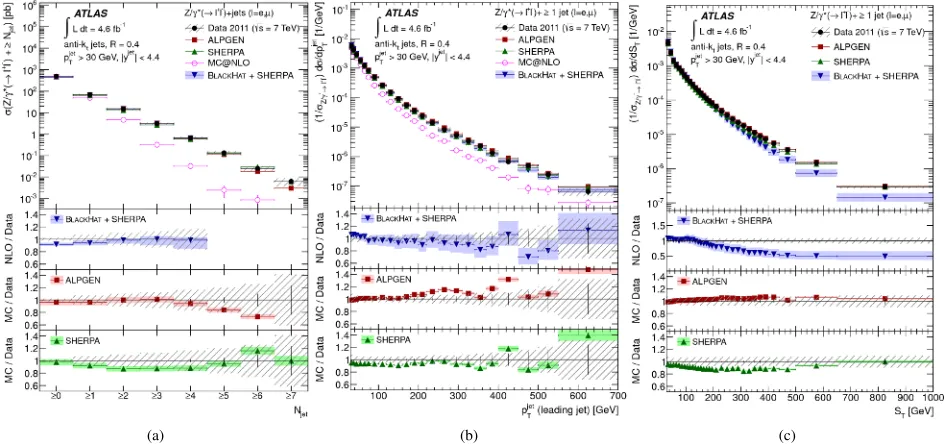
The high-statistics data sets allow cross sections of Z+jets production to be measured for multiplicities of up to seven jets as shown in Figure 1 (a). The total uncer-tainties on the inclusive cross sections range from 8% for Z+1 jet to 16-17% forZ+≥ 4 jets and are dominated by the uncertainty on the jet energy scale. The measurement is compared to fixed-order calculations at NLO pQCD computed using the BlackHat+SHERPA program [8–11]. These calculations are available up toZ+4 jets. Further-more, the results are compared to predictions from dif-ferent MC generators based on LO and NLO matrix el-ements supplemented by parton showers: ALPGEN [12] interfaced to HERWIG [13] for the modeling of the parton shower and to JIMMY [14] for the modeling of the under-lying event, SHERPA using the MEnloPS approach [15] and MC@NLO [16] interfaced to HERWIG. Both ALP-GEN and SHERPA employ matrix elements for up to five partons. MC@NLO generates the Drell-Yan process at NLO precision, which includes real emission of one ad-ditional parton. All higher parton multiplicities are gen-erated by the parton shower. The MC samples are nor-malized globally to the NNLO inclusiveZ cross-section prediction [17].
EPJ Web of Conferences 60, DOI: 10.1051/epjconf/201360
© Owned by the authors, published by EDP Sciences, 2013
(a) (b) (c)
Figure 1: Measured cross section forZ+jets production as a function of (a) the inclusive jet multiplicity, (b) the leading jet pTand (c) the scalarpTsum of the jets, ST. The data are compared to NLO pQCD predictions from BlackHat+SHERPA corrected to the particle level, and the predictions of MC event generators. The error bars indicate the statistical uncertainty on the data, and the hatched (shaded) bands the statistical and systematic uncertainties on data (prediction) added in quadrature. The figures are taken from [3].
The measured cross sections as a function of the in-clusive jet multiplicity are found to be consistent with the BlackHat+SHERPA calculation as well as with the pre-dictions of ALPGEN and SHERPA. The MC@NLO par-ton shower underestimates the observed rate for additional jet emission, which leads to large offsets to the data for higher jet multiplicities.
Furthermore, the cross section is measured as a func-tion of the jet pTof the first, the second, the third and the fourth leading jet for events with at least one, two, three and four jets in the final state, respectively. As an exam-ple, the cross section as a function of the leading jet pT is shown in Figure 1 (b). The cross sections are normal-ized to the inclusiveZ → ��cross section to reduce the systematic uncertainties. The BlackHat+SHERPA pre-diction is in good agreement with data for all jet multi-plicities. While the ALPGEN predictions for the jet pT spectrum of the subleading jets are consistent with data, the predictedpTspectrum of the leading jet is too hard for larger values ofpT. The SHERPA prediction is character-ized by a slight offsets to the data at the level of 5-15%. MC@NLO predicts a too-soft jetpTspectrum which is at-tributed to the fact that the fraction of events with a second resolved jet, which is modeled by the parton shower, in-creases considerably with jetpT. Accordingly, MC@NLO is found to provide a good description of the data if a veto on the second jet is applied.
Figure 1 (c) shows the cross section as a function of the inclusive quantity, ST, the scalar sumpTof the jets. ALP-GEN provides a good description of the data, while the SHERPA prediction slightly underestimates the data, in
line with the observation for the leading jetpT. The Black -Hat+SHERPA prediction deviates increasingly from the data for larger values of ST. The discrepancy is attributed to the missing higher jet multiplicities in the fixed-order calculation. The data is also compared to the exclusive sum of theZ+1-jet andZ+ ≥2-jets cross sections. The exclusive sum of the calculations provide a better descrip-tion of the data which supports the assumpdescrip-tion of missing higher order multiplicities in the inclusive calculation.
3 DPI in W+2 jets production
The production ofW bosons in association with two jets has been analyzed for the presence of double-parton in-teractions (DPI) using data corresponding to an integrated luminosity of 36 pb−1. In contrast to single parton interac-tions (SPI), in DPI events, theWboson and the two jets are produced from different parton-parton interactions within the same proton-proton collision as illustrated in Figure 2. The cross section for W +2 jets production in DPI events is described by an effective formalism as
ˆ
σ(DPI)W+2 jets= σˆW ·σˆ2 jets
σeff
whereσeffis a parameter related to the proton size.
In this analysis, the fraction ofW+2-jet events pro-duced in DPI, f(DPI), is measured through the transverse momentum balance between the jets. The fraction of DPI events is then used to determine the value ofσeffusing the
(a)
(b)
Figure 2: Leading-order Feynman diagrams forW+2 jets production in (a) single-parton interactions (SPI) and (b) double-parton interactions (DPI) [4].
following relation:
σeff=
σW0j·σ2j
f(DPI)·σ W+2j =
1 f(DPI)· L·
NW0j·N2j
NW+2j
whereLis the integrated luminosity,NW0j the number of
W+0-jet events,N2jthe number of 2-jet events andNW+2j
the number ofW+2-jet events. This relation holds because acceptance and efficiency correction factors cancel in the ratio.
The fraction,f(DPI), is extracted by a template fit to the distribution of the transverse momentum balance which provides a good discriminating power between SPI events and the back-to-back topology of jets in W +2-jet DPI events. The SPI template is obtained from simulation while a data-driven template from dijet events is used to describe the shape of the distribution in DPI events. The fits results in a fraction of DPI events of
f(DPI)=0.08±0.01(stat)±0.02(syst).
The total systematic uncertainty on the measurement of f(DPI)is 24% where theory uncertainties and experimental uncertainties due to pile-up, jet energy scale and resolution and background modeling contribute to a similar amount. The above result leads to a measured central value of
σeff=15±3(stat)+−53(syst) mb.
This value is consistent with values previously mea-sured in other experiments at lower center-of-mass ener-gies. More details about this measurement are presented in Ref. [4].
4 W+b
A measurement of the cross section forW-boson produc-tion in associaproduc-tion with b-quark jets is performed using data corresponding to an integrated luminosity of 4.6 fb−1. The measurement is performed differentially in the b-jet transverse momentum for the 1-jet and 2-jet final states.
TheW+b-jets cross section is measured in a restricted fiducial region: Events at the generator level are required to contain an electron or a muon with pT > 25 GeV and |η| < 2.5 and a neutrino with pT > 25 GeV originating from aW-boson decay (withmW
T > 60 GeV) and one or two hadron level jets withpT>25 GeV and|η|<2.1. At least one of the jets is required to be ab-jet, defined by the presence of a weakly decayingb-hadron withpT>5 GeV and within∆R≤0.3 of the jet axis.
At reconstruction level, events are required to contain aW-boson candidate and either one or two reconstructed jets of which exactly one is tagged as a b-jet. The b -tagging algorithm used in this analysis exploits theb-quark lifetime and decay topologies to discriminateb-jets from c-jets and light jets. The measurement of secondary ver-tices and impact parameters of tracks inside jets are com-bined using an artificial neural network to determine a sin-gle discriminant output [18]. The working point used for the selection corresponds to ab-tagging efficiency of about 40% at lowpT, increasing to a plateau of 57% forb-jets withpTabove 60 GeV, with rejection rates of about 10 for
c-jets and 1000 for light-jets.
The measurement ofW +bproduction is very chal-lenging due to the large background which amounts to 85% of the events passing the signal selection. The single-top,tt and multi-jet contributions are estimated either in background-enriched control regions or directly in the sig-nal regions using kinematic distributions. TheW+b-jets, W+c-jets andW+light-jets contributions are then statis-tically separated, and the number ofW+b-jets events is extracted, by fitting theb-tagging discriminant distribution ofb-tagged jets in data. For more information on the anal-ysis the reader is referred to Ref. [5].
An unfolding procedure is applied to correct the mea-suredW+byields to the fiducial region of the measure-ment to calculate the fiducial cross sections. The cross sections measured in the 1-jet and 2-jet fiducial regions and in the combined 1+2-jet fiducial region are:
σ(Wb,1 jet)=5.0±0.5(stat)±1.2(syst) pb
σ(Wb,2 jets)=2.2±0.2(stat)±0.5(syst) pb σ(Wb,1+2 jets)=7.1±0.5(stat)±1.4(syst) pb.
The systematic uncertainty of the measurement in the 1+2-jet bin amounts to 20% and is dominated by the uncertainty on the jet energy scale and resolution. The measured cross sections are compared to theoretical pre-dictions in Figure 3. The results are compared to the NLO predictions of MCFM [19] and Powheg[20], and to the predictions of ALPGEN interfaced to HERWIG and JIMMY scaled by the NNLO normalization factor for the
Figure 3: Measured fiducial W + b-jets cross sections with the statistical (inner error bar) and statistical plus systematic (outer error bar) uncertainties [5]. The mea-surements are compared with NLO predictions calculated with MCFM and corrected for hadronization and DPI ef-fects. The yellow bands represent the total uncertainty on the prediction (quadratic sum of uncertainties due to scale, PDF, DPI model and non-perturbative corrections). The NLO prediction from Powheginterfaced to PYTHIA, cor-rected for DPI effects, and the prediction from ALPGEN interfaced to HERWIG and scaled by the NNLO inclusive Wnormalization factor are also shown.
inclusiveWcross section [17]. To compare the NLO cal-culations with data, corrections for non-perturbative ef-fects are applied and the effect of DPI, which represents a 25% effect on the total cross section, is considered.
In the 1-jet fiducial region, the measured fiducial cross section is larger than the NLO predictions, but compati-ble within the theoretical and experimental uncertainties. The measurement is in good agreement with the predic-tion in the 2-jets bin. The cross secpredic-tion as a funcpredic-tion of theb-jetpTis measured in the range between 25 GeV and 140 GeV [5]. The theoretical predictions provide a good description of the data at lowb-jetpT(<40 GeV), but de-viates increasingly from the measuredW+bproduction rate at higher pT. The measured spectrum is harder than the prediction. A second set of measurements, including the single-top contribution, is also performed. The corre-spondingb-jet pT differential cross sections have signifi-cantly reduced uncertainties with respect to the single-top-subtracted measurements and can be compared to com-bined single top-quark andW+b-jets calculations in the future.
5 W+c
Thepp→ Wc+Xproduction process is sensitive to the s-quark distribution function in the proton, at values of the momentum transfer of the order of the mass of theW bo-son. The single-charm production process can be isolated from pp→Wcc+Xproduction by exploiting the charge
(a)
(b)
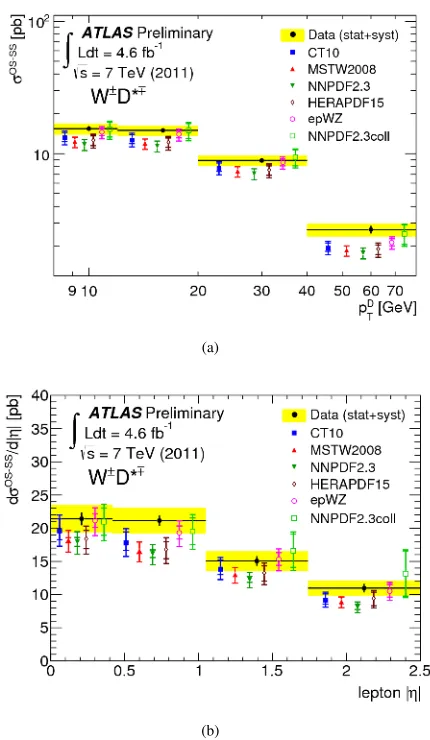
Figure 4: Measured differential cross sectionsσ(W±D∗∓) as a function of (a)pD
T and (b)|η�|compared to predictions obtained using different PDF sets [6]. The measurement is shown together with the statistical and systematical uncer-tainties. The inner error bars on the theoretical predictions show the 68% C.L. uncertainties obtained from the PDF error sets, while the outer error bars represent the total theoretical uncertainty (quadratic sum of PDF uncertainty, scale uncertainty and fragmentation uncertainty).
correlation between theWand the charm quark. This ap-proach is pursued in the ATLAS measurement ofW+c production presented here [6]. The measurement is based on a data set corresponding to an integrated luminosity of 4.6 fb−1.
In events where a W boson decays to an electron or muon, charmed mesons are reconstructed using the decay modes D+ → K−π+π+ and D∗+ → D0π+ with
D0 → K−π+, D0 → K−π+π0 or D0 → K−π+π−π+, and
their charge conjugates. Distributions in which the charm hadron and theW boson have opposite charge (OS) and where they have the same charge (SS) are formed. The single-charm yield is then extracted by fitting the mass (for theD+) or mass difference∆m =m(D∗)−m(D0) (for the
W±D(∗)∓ yields are corrected for detector effects and for their relative branching ratios [21], resulting in one mea-surement of the D+ spectrum and three measurements of
theD(∗)+spectra, where the latter are combined in the final
result.
The fiducial cross sectionsσ(W±D(∗)∓) are measured
inclusively and differentially as a function of theDhadron transverse momentum and as a function of the pseudora-pidity of the lepton from theWdecay. The fiducial region of the measurement is defined by the lepton transverse mo-mentum p�
T > 20 GeV and pseudorapidity ���η���� < 2.5, neutrino transverse momentum pν
T > 25 GeV, W trans-verse massmW
T >40 GeV and charm hadron (D∗+orD+) transverse momentum pD
T > 8 GeV and pseudorapidity ��
�ηD���<2.2.
The measured differential cross sections in the D∗+
channel are shown in Figure 4. The predictions are ob-tained using the aMC@NLO simulation [22], which is based on the MC@NLO formalism and the MadGraph5 framework [23], with Herwig++ [24] used to model the parton-shower, hadronization and underlying-event. The events are generated with different NLO and NNLO PDF sets that differ in their strange quark parameteri-zations: CT10 [25], MSTW2008 [26], NNPDF2.3 and NNPDF2.3coll [27], HERAPDF15 [28] and epWZ [29]. For MSTW2008, HERAPDF15 and NNPDF2.3, the s -quark sea is suppressed relative to thed-quark for all val-ues ofx. The strange sea in CT10 is less suppressed than in MSTW2008 or NNPDF2.3. NNPDF2.3coll and epWZ PDF sets are determined based on collider data only and have a comparables-quark sea andd-quark sea.
The shapes of thepD
T and|η�|distributions for the dif-ferent PDF sets are similar, but the predicted cross sections differ by as much as 25%. The measured integrated cross sections in OS-SS events are
σ(W±D∗∓)=42.4±1.0(stat)±3.6(syst) pb σ(W±D∓)=41.9±2.2(stat)±3.2(syst) pb.
The uncertainty of the measurement is dominated by the systematic uncertainty which arises mainly from the uncertainty on the tracking efficiency. The measurements agree well with the predictions obtained with the epWZ and NNPDF2.3coll PDF sets and lie about 1.1(1.7)σ
for D∗+(D+) above the central value of the CT10 PDF.
Somewhat larger discrepancies are seen with MSTW2008, HERAPDF15 and NNPDF2.3. These results favor PDFs where thes-quark andd-quark sea contributions are com-parable atx∼0.01.
6 Conclusion
The high-statistics data samples at a center-of-mass energy of 7 TeV collected with the ATLAS experiment allow for high precision measurements of vector boson plus jets pro-duction up to high jet multiplicities in a large kinematic phase space. In general, the NLO pQCD predictions pro-vide a good description of the measured data. However,
some tensions are observed in the comparison of kine-matic distributions at large transverse momenta. These are attributed to missing higher order corrections in the calcu-lation or to the matching scheme and are expected to be improved in the future.
The production ofW+2-jet events has been analyzed to derive information about the amount of DPI in proton-proton collisions at √s=7 TeV. The measurement ofσeff
is consistent with previous measurements at lower ener-gies.
The cross sections of vector boson plus heavy flavor production are found to be in good agreement with theo-retical prediction. The measurement ofW+cproduction shows sensitivity to the strange content of the proton and favors PDF sets which have a comparabled-quark ands -quark sea.
References
[1] ATLAS Collaboration, JINST3S08003 (2008) [2] ATLAS Collaboration, Phys. Rev.D85092002 (2012) [3] ATLAS Collaboration, arXiv:1304.7098 (2013),
ac-cepted by JHEP
[4] ATLAS Collaboration, New J. Phys. 15 033038 (2013)
[5] ATLAS Collaboration, arXiv:1302.2929 (2013), ac-cepted by JHEP
[6] ATLAS Collaboration, ATLAS-CONF-2013-045, http://cds.cern.ch/record/1546800
[7] ATLAS Collaboration, Phys. Lett. B706 295-313 (2012)
[8] C. F. Berger et al., Phys. Rev.D78036003 (2008) [9] C. F. Berger et al., Phys. Rev.D82074002 (2010) [10] H. Ita et al., Phys. Rev.D85031501 (2012) [11] T. Gleisberg et al., JHEP0902007 (2009) [12] M. L. Mangano et al., JHEP07001 (2003) [13] G. Corcella et al., JHEP01010 (2001)
[14] J. M. Butterworth et al., Z. Phys.C72637 (1996) [15] S. Hoeche et al., JHEP04027 (2013)
[16] S. Frixione and B. R. Webber, JHEP06029 (2002) [17] C. Anastasiou et al., Phys. Rev.D69094008 (2004) [18] ATLAS Collaboration, ATLAS-CONF-2011-102,
http://cds.cern.ch/record/1369219
[19] J. M. Campbell et al., Phys. Rev.D86034021 (2012) [20] S. Alioli et al., JHEP06043 (2010)
[21] J. Beringer et al. (Particle Data Group), Phys. Rev.
D86, 010001 (2012)
[22] R. Frederix et al., Phys. Lett.B701427-433 (2011) [23] J. Alwall et al., JHEP06128 (2011)
[24] M. Bahr et al., Eur. Phys. J.C58639-707 (2008) [25] H.-L. Lai et al., Phys. Rev.D82074024 (2010) [26] A. D. Martin et al., Eur. Phys. J.C63189-285 (2009) [27] R. D. Ball et al., Nucl. Phys.B8091-63 (2009) [28] H1 and ZEUS Collaborations, JHEP01109 (2010) [29] ATLAS Collaboration, Phys. Rev. Lett.109012001
(2012)
![Figure 2: Leading-order Feynman diagrams for W + 2 jetsproduction in (a) single-parton interactions (SPI) and (b)double-parton interactions (DPI) [4].](https://thumb-us.123doks.com/thumbv2/123dok_us/8642641.1432349/3.595.117.229.59.305/figure-leading-feynman-diagrams-jetsproduction-interactions-parton-interactions.webp)