2921
A Smart Automated System Model For Vehicles
Detection To Maintain Traffic By Image
Processing
F. M. Javed Mehedi Shamrat, Imran Mahmud, A.K.M Sazzadur Rahman, Anup Majumder, Zarrin Tasnim, Naimul Islam Nobel
Abstract: Dhaka, the capital of Bangladesh is the most densely populated city in the world and Traffic the ugliest side of Dhaka's development. The country is full of uneducated and undisciplined drivers who have no respect for the traffic rules and regulations. The tendency of breaking the law and overtaking of the drivers makes controlling the traffic harder for the traffic police. Sometimes this kind of tendency cause more traffic and sometimes it takes our lives. In recent times, the government has taken a few actions such as the enlargement of footpaths, building flyovers and footbridges, expanding the roads but yet, there was no advancement in the traffic condition. To prevent these incidents, a system names ―A smart automated system model for vehicles detection to maintain traffic by Image Processing‖ is proposed and developed that will automatically detect the traffic rules breaker vehicles through live streaming video. So, police can file a case or catch the rule breaker of that vehicle instantly. Besides, it will also count the number of vehicles passing through a specific area.
Keywords: Smart System, Automated System, Vehicles Detection, Automated Model, Image Processing, Data, Streaming Video. —————————— ——————————
1.
INTRODUCTION
Object detection based on digital image processing on vehicles is very essential for initiating a monitoring system or a substitute method to gather statistic data to make systematic traffic. A vehicle detecting program based on traffic video feed for the particular type of vehicle using Haar Cascade Classifier was made as the output of this research paper. Firstly, the color-to-grayscale algorithm was used to present optical shape of the vehicle, and haar cascade classifier was also used to make a strong classifier by combining specific classifier into a cascade filter to rapidly eliminate background regions of an image. At the testing section, the output was tested over 8 realistic video data and achieved high accuracy. Dhaka has already been categorized as one of the most unlivable cities in the world and the current situation of traffic management in the city shows why it got such a ranking. The most common example is the actual use of roads by vehicles. Transportation is a basic need for everyone in finding to most satisfactory daily transportation. But there is a huge problem. The unlimited personal transport growth has become one of the significant transportation problems. The transport growth has expanded high traffic density, especially if not being controlled properly. Establishing our experimental work in traffic management system we can easily get rid of this problem. The peoples who reside in the city are the daily sufferer of the
traffic problem. A distance of five to six kilometers can take about two hours to arrive. People fail to take in supreme meetings, late arrive for work, children and aged people fall sick. Occasionally, we can see a siren blaring ambulance stuck in the middle of a traffic jam trying severely to find a way. People lose their valuable time on their way for nothing. Traffic jam is blocking trade and commerce. All the megacities in the world experience hardship traffic jam at definite hours of the day and night. But what we have in Dhaka city is not the traffic jam, it is total traffic disorder and mismanagement. On the other side, there are big buses for highway travels which also enter the city in the daytime and arising heavy traffic jam. Besides, the tendency to break the traffic law and overtaking tendency of the drivers are also the main reason for causing traffic. That's why we build this system so that we can easily detect the vehicle who break the traffic law and create traffic in the road. Since we use live streaming so we can detect the responsible vehicle instantly.
The expanded number of transports is an alarming fact for our country. Each day Dhaka city gets a lots number of new vehicles. For these reasons, neither did Bangladesh government plan ahead, nor they are taking any important measures. So that day by day more and more traffic jam is making the lives of normal people a living hell. Traffic management system of Bangladesh is still the ones that were used to be in the 80s. Therefore, the new techniques of traffic management are not being executed appropriately. Besides, also recognized that during traffic jam the traffic police just let one side go for a sudden time like 5 minutes or more which increase the jam on the other side of the road. And have faith in that the complication lies in our etiquette. Many of us smash the rules in full concern of its existence and many don't even notice that they are doing something extremely illegal. So that we build such a system that is working correctly near 97%. Since it is live streaming and through this process, we can detect the exact vehicle. After detecting the vehicle the process will store the video file in a database. Once we succeed to detect the car then system can also count the car and by counting the car of a road, it will help us to tell, which road is going to face the traffic jam. And after resolving these issues, will also work for detecting the number plate ————————————————
F. M. Javed Mehedi Shamrat, completed his Bachelor’s degree program in Software Engineering at Daffodil International University, Bangladesh. E-mail: [email protected]
Dr. Imran mahmud is currently working as a Senior Lecturer at the graduate school of business, universiti sains Malaysia.. He has several publications and received many awards in the field of technology management. E-mail: [email protected]
A. k. M. Sazzadur Rahman Rahman, completed his MSc in Computer Science and Engineering at Daffodil International University, Bangladesh. E-mail: [email protected]
Anup Majumder is currently working as a Lecturer in Computer Science and Engineering at Jahangirnagar University, Dhaka, Bangladesh.. E-mail: [email protected]
Zarrin Tasnim, Completed BSc in Software Engineering at Daffodil International University, Bangladesh. E-mail: [email protected]
Naimul Islam Nobel, completed his BSc in Software Engineering at Daffodil International University, Bangladesh.
2922 recognition and automatically filed a case against the vehicle
who breaks the traffic rule. The rest of the paper discusses the literature review in part 2, the Methodology (Color to Grayscale Algorithm, Traffic Detection Using Cascade Classifiers, Traffic Detection Process) consist of part 3, in part 4 Description of Used Component’s, in part 5 Implementation and Experimental Result (Data Collection Procedure,Statistical Analysis, Result) and part 6 short brief on future work of paper in conclusion.
2 LITERATURE REVIEW
This is neither a unique nor another thought. There are many existing implementations like this system. However, this is a new plan for designing a smart traffic detection system with proper secure strengthen in low budget and real-time visualization. This research designs a classification system to determine object as the specific type of vehicle. Haar Cascade Classifier proposed by Paul Viola and Michael Jones is used to determine objects such as the car and the number of passing vehicles on the specific road using traffic videos as input. This paper [1] works with a total of 1000 vehicle images and 200 negative images where they used OpenCV library as the training procedure. Where positive samples were obtained by manually cropping and resizing to 30 x 30 pixels and the testing phase employed 8 videos as real data test of traffic surveillance video. Each video was taken using a 30 – 50 degree camera position facing down the road as illustrated. This paper [2] describes an end-to-end method for extracting moving targets from a real-time video stream, classifying them into predefined categories according to image-based properties, and then robustly tracking them. Moving targets are detected using the pixel-wise difference between consecutive image frames. A classification metric is applied these targets with a temporal consistency constraint to classify them into three categories: human, vehicle or background clutter Once classified, targets are tracked by a combination of temporal differencing and template matching. The resulting system robustly identify targets of interest, rejects background clutter; and continually tracks over large distances and periods of time despite occlusions, appearance changes and cessation of target motion. The system has been implemented on a Pentium 200Mhz the system under Microsoft Windows 95 with a Matrox Meteor digitizer. The system can detect, classify and track targets at 14 frames/second over a 320 x 240-pixel image. The system has been applied to large amounts of live video in unstructured environments in which human and vehicular activity is present. Over six hundred instances of vehicles and humans have been identified and target tracking has been performed over the lifespan of over two hundred targets. This paper [3] developed a feature-based tracking system for detecting vehicles under these challenging conditions. Instead of tracking entire vehicles, vehicle features are tracked to make the system robust to partial occlusion. The system is fully functional under changing lighting conditions because the most salient features at the given moment are tracked. After the features exit the tracking region, they are grouped into discrete vehicles using a common motion constraint. The groups represent individual vehicle trajectories which can be used to measure traditional traffic parameters as well as new metrics suitable for improved automated surveillance. This paperdescribes the issues associated with feature-based tracking, presents the real-time implementation of a prototype
system, and the performance of the system on a large data set. This paper [4] presented a novel representation and recognition technique for identifying actions. The approach is based on temporal templates and their dynamic matching in time. Initial experiments in both measuring the sensitivity of the representation and in constructing real-time recognition systems have shown the effectiveness of the method. After completing our work, we find an ideal solution for traffic detection and management system. All the paper shows different ways to eradicate or how to get rid of this traffic problem. But we work mostly on detecting the vehicle accurately and count the vehicle on a specific road. Because when you are detecting a vehicle successfully and more accurately then it is easier to complete the other task more quickly like detect the number plate of the vehicles. And with the help of this statistics, traffic problem can be easily solved.
3 METHODOLOGY
Automated proposed system will work for the live streaming video so that, the police or authority can detect the vehicles and get a data of counting vehicles at real time and can use it for the betterment of the traffic problem. The user can see the current situation of past activity from the database or server where the information is stored. As a result, the user can use matching vehicle data to take further action to control the traffic system. For the reason, this automated system needs real IP to communicated with Raspberry Pi through the internet. Using the Raspberry Pi camera module to live streaming and capture image. Raspberry Pi camera module's captured image depends on light and resolution of the camera for the best result to matching the image with the dataset and matching with the existing dataset. For these circumstences, we are facing some problem to the trained dataset and matching them with existing data. In this automated model to maintain traffic law internet is the most important part to communicate with the surveillance camera and control the activity of the traffic automatically. At the absence of the internet it is impossible to authorize the vehicle. Depends on these essentiality, the internet connection is principally needed in our system to be communicated. Proper light is must have to presence to matching an object from live streaming. Here used the Raspberry Pi camera module which is 5.0 megapixel with resolution and quality is not perfect when there is a lack of light. So that, we need to think the alternative way to supply more light to the camera for better performance to surveillance and detection the vehicle accurately. When a the user try to start the system and command it, to start the system, then the web sends a request to the raspberry pi to complete the action according to the command. Raspberry PI then catches the signal and sends it to the GPIO pin to do the action. To detect the vehicles and peoples on the road, we are using two methods. One is Color-to-Grayscale Algorithm and the another one is Cascade Classifier. Also used some hardware ccomponents to perform with the system to imply the proposed system
3.1. Color-to-Grayscale Algorithm
2923 The lightness method is used for averages the most prominent
color and the least prominent colors:
(𝑚𝑎𝑥(𝑅, 𝐺, 𝐵) + 𝑚𝑖𝑛(𝑅, 𝐺, 𝐵)) 2
⁄ (1)
The average method is used for simply averages the values:
(𝑅 + 𝐺 + 𝐵) 3
⁄ (2)
And the luminosity method is the more advanced version of the average method. Besides averages the values it also forms a weighted average to account for human perception. Green color is more sensitive than other colors, so green is weighted most heavily. The formula for luminosity is:
0.21𝑅 + 0.72𝐺 + 0.07𝐵 (3)
The lightness method has a tendency to reduce contrast. The average method produces the average result. And the luminosity method overall works best. But sometimes these three methods produce very similar results. Here is an example (Fig.1) of a full RGB color image converting to a grayscale image. The right column shows the isolated color channels in natural colors, while at left column there are their grayscale equivalences.
Fig. 1: Converting Color to Grayscale Algorithm [5].
3.2. Traffic Detection Using Cascading Classifiers
Cascade classifier is a method using for detecting objects. In this part, we work for detecting the traffic. For doing this, the cascade classifier needs a lot of positive images and negative images to train the classifier. For positive photos, we collect the image of different types of vehicle like Car, Bus, Truck, CNG, Motorcycle, Rickshaw and the images of people which is positive photos. Our target is to detect the positive photos. And for negative photos, we collect lots of roadside photos
that do not include the positive photos. A list of positive photos (Fig.2) and negative photos (Fig. 3) are given below:
Fig. 2: List of Positive Photos.
In the above picture (Fig.2) can recognized different types of vehicles including peoples too. These types of pictures are considered to be the positive photos. And when the video will continue then the automated system will detect the vehicles and peoples and identify where the traffic happens and if any car violates the traffic rules it will identify them. The data will save in the database and will be accessible in further use.
Fig. 3: List of Negetive Photos.
In the above picture (Fig. 3) can see the photos of road side which is negative photos for system. And the system will avoid identifying these negative photos during detect the traffic. We select the features with the minimum error rate, which implies they are the features that best classifies the face and non-face images.
3.3. Traffic Detecting Process
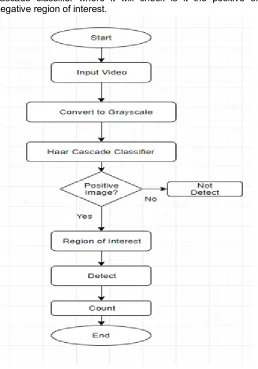
2924 process of our system. In the below flowchart (Fig.4) at first,
the process will start. Then we have to input the video and the video will convert into grayscale. Then it will go to the haar cascade classifier where it will check is it the positive or negative region of interest.
Fig. 4 Traffic Detecting Flowchart.
If the input video is not containing the frame of vehicles and peoples then it will not detect but if the video file contains the frame of vehicles and peoples then it will find the region of interest and detect the vehicles and peoples from the input video.
4 DESCRIPTION OF USED COMPONENT’S
Developing the proposed embedded smart automated traffic monitoring system, following hardware components are used. Here, the components with their Figures and description are presented.4.1. Raspberry Pi 3
The Raspberry Pi is a series of small single-board computers developed in the United Kingdom by the Raspberry Pi Foundation to promote the teaching of basic computer science in schools and in developing countries. The original model became far more popular than anticipated, selling outside its target market for uses such as robotics and dalmatics. Peripherals (such as keyboards, mice and cases) are not included with the raspberry pi [6][7]. It is also called the mini computer.
Fig. 5: Raspberry Pi 3 [6][7]
4.2. Raspberry Pi Camera Module
The Raspberry Pi camera module can be used to take high-definition video, as well as stills photographs. It’s easy to use for beginners, but has plenty to offer advanced users if you’re looking to expand your knowledge. Pi Camera Are Fixed focus lens on-board,8-megapixel native resolution sensor-capable of 3280 x 2464-pixel static images, supports 1080p30, 720p60 and 640x480p90 video, Size 25mm x 23mm x 9mm, Weight just over 3g, connects to the Raspberry Pi board via a short ribbon cable (supplied), Camera v2 is supported in the latest version of Raspbian, Raspberry Pi's preferred operating system [8][9].
Fig. 6: Raspberry Pi Camera Module V2 [8].
We create web interface page using Python, HTML, CSS and JavaScript. JavaScript allows user-friendly interaction with equipment to HTML. Interaction with the database of the traffic system is handled by page scripts which are embedded in or included with HTML pages. The user can access the web interface by common browsers and operating system.
5 IMPLEMENTION AND EXPERIMENTAL
RESULT
2925 Fig. 7: Data Collection Procedure.
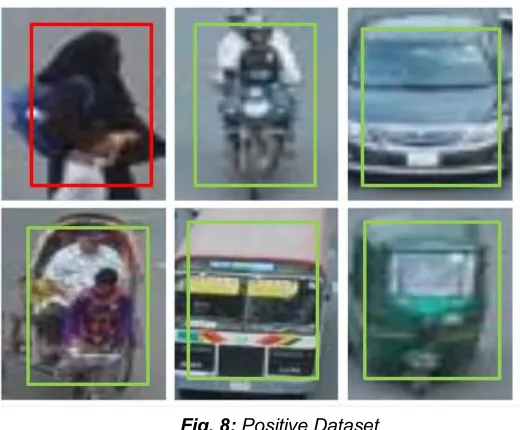
For doing this research, we have to collect lots of data. Here exist different sort of images of vehicles, peoples and roadside from many roads with different light and different conditions. To Collect the data, we followed some steps. On the software part, Raspbian OS is used as the operating systems for Raspberry Pi. Next, the Python and OpenCV library has installed for the algorithm implementation. To train the vehicles and peoples which is the positive image for our project and the roadside image which is negative images into the library we use haar cascade classifier. This classifier creates two different data set. One is for the positive dataset and another one is for the negative dataset.
Fig. 8: Positive Dataset.
After classifying the dataset, it will train both the dataset. It takes a few moments to train the dataset. When it finished to train the dataset then we will get our target file which displays in the .xml file. Then it will store the trained dataset into the
database.
Fig. 9: Negetive Dataset.
Finally, ports are initialized using the terminal in root mode to access the GPIO pins. When running the code, the terminal window on the Raspberry Pi is opened and the python code is executed. Then the code runs on the system and it will ready to execute vehicle and people detection.
5.2. Statistical Analysis
After analyzing the data, the calculation of the accuracy of the system is achieved by 97%. To calculate the data more accurately, we used some attributes which extracted with the help of the confusion matrix. For example, the confusion matrix of Matching vehicles and peoples which is given below (Table1).
TABLE 1
Confusion Matrix for Matching Vehicles and Peoples
Positive Negative
True 97 80
False 10 70
For measuring the performance of the system, we need to define TP, TN, FP and FN.
True Positive (TP) = True Positive is the number of cases correctly identified actual class.
False Positive (FP) = False Positive is the number of cases incorrectly identified actual class.
False negative (FN) = False Negative is the number of cases incorrectly identified negative classes.
2926 TABLE 2
Confusion Matrix for Detecting Vehicles and Peoples
Match Unknown
True Detect Not Detect
False Not Detect Detect
For implementing the system, we have to install: Platform: Raspberry Pi, Web.
Language: Programming Language Python, Markup Language HTML, Style Sheet Language CSS and
Scripting language JavaScript.
Tools: Python IDLE, Notepad, Open-CV, Raspberry Pi Camera Module.
5.2. Result
To get the best output, first, we were collected the raw image by Raspberry Pi camera module. Almost 5000 positive and negative images had been collected of the vehicles, peoples and roadside scenery to make our system more efficient. Took the maximum picture of the object so that the object will look clearer and more intelligible to our program. Since the working period with live video, we need the clear position of that object. We already knew live streaming is the moving object so that after taking the images of objects, need to train all image. After train the images, all the data our system will recognize the objects which are in the data set. For the purpose of the experiment, we collected firstly, we separated the object into four parts which are the Top part, Bottom part, Left side and Right side. Then we need to find matching between object and data set. We use Color to the Grayscale algorithm to convert the color image. This converting process is shown in Fig. 1. After converting in grayscale, the dataset looks like the below format (Fig. 10). In the below image we see both positive dataset and negative dataset are present. And our ultimate target is to detect only the positive dataset which we already trained and it is stored in our database.
Fig. 10: Experimental Dataset..
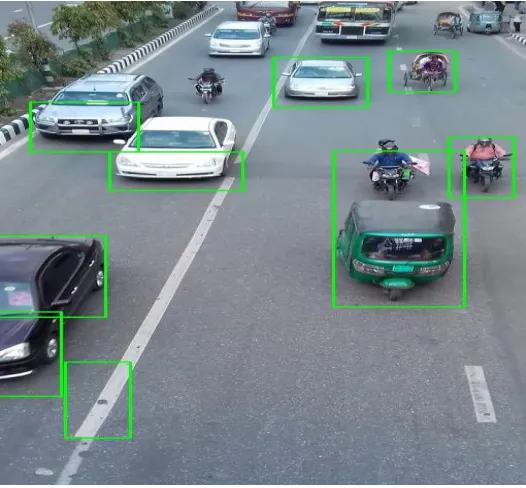
After matching the positive dataset with the dataset which is in a .xml file then our next task is to send a General-Purpose Input/output (GPIO) signal to the raspberry pi. After getting the signal from GPIO, Raspberry Pi check if the image matched with the dataset or not. If it finds the matching positive dataset then it will detect the vehicle and people. Otherwise, it will not detect the other object. The matching part is showing below (Fig. 11,12).
Fig. 11: Output Result [1].
Fig. 12: Output Result [2].
2927 TABLE 3
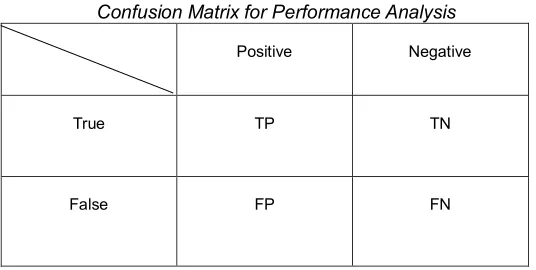
Confusion Matrix for Performance Analysis
Positive Negative
True TP TN
False FP FN
Accuracy: We find the accuracy of this system is 69%. To determine the accuracy, we need the actual class and negative classes correctly. To find the final accuracy mathematically, this can be stated as:
Accuracy = 𝑇�𝑃�+𝑇�𝑁� / 𝑇�𝑃�+𝑇�𝑁�+𝐹�𝑃�+𝐹�𝑁�×100%
2. Sensitivity: We find the sensitivity of this system is 58%. To determine the sensitivity correctly we need actual classes correctly. To find the final sensitivity mathematically, this can be stated as:
Sensitivity = 𝑇�𝑃�/ 𝑇�𝑃�+𝐹�𝑁�×100%
3. Specificity: We find the specificity of this system is 89%. To determine the specificity of this system we need to determine the negative cases correctly. To find the final specificity mathematically, this can be stated as:
Specificity = 𝑇�𝑁� / 𝐹�𝑃�+𝑇�𝑁�×100%
4. Precision: We find the precision of this system is 91%. To determine the precision, we need the number of relevant classes among all the positive cases. To find the final precision mathematically, this can be stated as:
Precision = TP / TP +𝐹�𝑃�×100%
6
CONCLUSION
Increase in the number of vehicles and poor traffic management system is the reason behind the huge traffic problem in our country. But when we establish an automatic traffic detecting system then we can easily handle the traffic. So, considering the necessities of this system we design our project. Because of our experimental result almost 95% satisfying to our expected result. Our traffic detection technique is more viable than others. In our study, we describe in details about our experimental work. It is a web-based system. Since it works for the live streaming video so that it can detect instantly where the traffic is happening right now. And the live streaming feature which shows in a web interface and the performance is so well. The streaming video will count the vehicles for a specific road. Everyone wants the best traffic system. Because no one wants to stick and sit in the traffic. For this purpose, if our experimental work is used in managing the traffic detecting system then it will more helpful to detect where the traffic is happening. Because our study gives the
best vehicle detecting system. And accessing through our database it will be easy to find which vehicle break the traffic rules and accountable for the traffic.
ACKNOWLEDGMENT
The authors are grateful and pleased to all the researchers in this research study.
REFERENCES
[1] Ramadhani, M., Minarno, A., & Cahyono, E. ―Vehicle Classification using Haar Cascade Classifier Method in Traffic Surveillance System‖, Kinetik: Game Technology, Information System, Computer Network, Computing, Electronics, and Control; Vol 3, No 3, August 2018; 237-246
[2] Alan J. Lipton, Hironobu Fujiyoshi, Raju S. Patil, ―Moving Target Classification and Tracking from Real-time Video‖, The Robotics Institute Carnegie Mellon University 5000 Forbes Ave Pittsburgh, PA, 15213
[3] D. Beymer, P. McLauchlan, B. Coifinan, and J. Malik, ―A real-time computer vision system for measuring traffic parameters‖, In Proceedings of IEEE CVPR 97, pages 495-501, 1997.
[4] J. Davis and A. Bobick, ―The representation and recognition of human movement using temporal templates‖, In Proceedings of IEEE CVPR 97, pages 928 - 934, 1997.
[5] Converting color to grayscale algorithm :-
https://desktop.arcgis.com/es/arcmap/latest/manage-data/raster-and-images/bil-format-example.htm, last accessed on: 17/12/2019, 01:37 pm
[6] Raspberry Pi 3 :-
https://www.aliexpress.com/item/2016-Original-UK-Made- Raspberry-Pi-3-Model-B-1GB-RAM-Quad-Core-1-2GHz-64bit/32619782913.html, last accessed on: 17/12/2019, 01:45 pm
[7] Raspberry Pi 3 :-
https://en.wikipedia.org/wiki/Raspberry_Pi, last accessed on: 17/12/2019, 01:53 pm
[8] Raspberry Pi Camera Module V2 :-
https://www.raspberrypi.org/products/camera-module-v2/, last accessed on: 17/12/2019, 02:00 pm
[9] Raspberry Pi camera module
http://www.geeetech.com/wiki/index.php/Raspberry_Pi_C amera_Module, last accessed on: 17/12/2019, 02:10 pm [10] N. Redhantika, "Traffic Density in Malang City,"
Universitas Merdeka Malang, Pp. 1-10, 2014.
[11] R. Anwar, "Measuring Passenger Car Unit in Banjarmasin Municipality," Vol. 1, No. 1, Pp. 22-27, 2000.
[12] Fajar Mit Cahyana, "Design Counting Program on the Number of Vehicles on Uni-directional Traffic Using C++ Programming Language with OpenCV Database," Universitas Brawijaya, 2014.
[13] A. Helmi, "Application of Traffic Density Level Detection Based on the Number of Passing Vehicles with OpenCV," 2015.
[14] C.-J. Lee, "Obstacle Detection and Avoidance Via Cascade Classifier for Wheeled Mobile Robot," Int. Conf. Mach. Learn. Cybern., Pp. 5, 2015.
2928 [16] C. Anderson, P. Burt, and G. van der Wal. Change
detec-tion and tracking using pyramid transformation techniques.In Proceedings of SPIE - Intelligent Robots and Computer Vision, volume 579, pages72–78, 1985. [17] D. Beymer, P. McLauchlan, B. Coifman, and J. Malik.
Areal-time computer vision system for measuring traffic pa-rameters. In Proceedings of IEEE CVPR97, pages495–501,1997.
[18] C. Bregler. Learning and recognizing human dynamics invideo sequences. In Proceedings of IEEE CVPR 97, pages568–574,1997.
[19] J. Davis and A. Bobick. The representation and
recognitionof human movement using temporal templates. In Proceed-ings of IEEE CVPR 97, pages928 – 934, 1997.
[20] M. Hansen, P. Anandan, K. Dana, G. van der Wal, andP. Burt. Real-time scene stabilization and mosaic construc-tion. In Proceedings of DARPA Image Understanding Work-shop, 1994.
[21] I. Haritaoglu, L. S. Davis, andD. Harwood.w4 who? when?where? what? a real time system for detecing and trackingpeople. In FGR98 (submitted), 1998.
[22] K. Ikeuchi, T. Shakunaga, M. Wheeler, and T. Yamazaki.Invariant histograms and deformable template matching forsar target recognition. In Proceedings of IEEE CVPR 96,pages100–105, 1996.
[23] M. Isard and A. Blake. Contourtracking bystochasticprop-agation of conditional density. In Proceedingsof EuropeanConferenceon ComputerVision 96, pages343– 356,1996.
[24] T. Kanade, R. Collins, A. Lipton, P. Anandan, and P.Burt.Cooperative multisensor video surveillance. In Proceedings of DARPA Image Understanding Workshop,volume1, pages3–10, May 1997.
[25] M. Oren, C. Papageorgiou, P. Sinha, E. Osuna, and T. Pog-gio. Pedestrian detection using wavelet templates. In Pro-ceedings of IEEE CVPR 97 , pages 193–199,1997. [26] K. Rangacharand R. C. Jain.Computer Vision;
Principles.IEEE Computer Society Press, 1998.
[27] D. Koller, K. Danilidis, and H.-H. Nagel. Model-based ob- ject tracking in monocular image sequences of road traf-fic scenes.
International Journal of Computer Vision,10(3):257–281, 1993.
[28] IEEE Transactionson Pattern Analysis and Machine Intelligence,19(7):780–785, 1997
[29] M. Turk and A. Pentland. Eigenfacesfor recognition.Jour-nal of Cognitive Neuroscience,3(1):71–86, 1991.