2716
A Study On Impact Of Cloud Based Computing
On Performance Of Human Resources In
Selected IT Industry In Odisha
Malaya Malla, Srinivas Subbarao Pasumarti, Sunil K. Dhal, Subash Chandra NathAbstract: The Global business adopts Information Technology to sustain in this business world. The growth of business depends on the q uick action and accuracy. The IT infrastructure provides the same. The biggest challenge of the recent business trend is to secure the database. The cloud based computing is the latest internet based technology to act the management functions quickly and safely. The record keeping of human resource database is the prime focus of Human Resource Management to measure the performance in overall. The study is aiming to examine how CBC affects the HRM performance successfully. The study is based on 40 respondents of IT companies in Odisha. The cloud based computing is interrelated to HRM principles to measure the performance. The correlation is incorporated for analyzing the data. It is found that HRM relates s ignificantly to the performance management but the successful CBC affects the performance of HRM more significantly.
Index Terms: Cloud Based Computing, HRM, Performance Management, IT, Performance appraisal —————————— ——————————
1
INTRODUCTION
The classical approach of management stands on development of the formal organization structure and achievement of the purpose. The complexity in management had arisen due to new trend and development. In the same time, it was very difficult to understand the all the business matters. The leading contributors to the school of management thoughts had developed new approaches to solve many complex structures of the organizational works such as F.W. Taylor (Scientific Management), Henry Fayol (Administrative management), Max Weber (Bureaucratic Management) and Peter F. Drucker (Management by Objectives). Again the organization structure and work load became more time bound and performance bound in modern trend. The role of IT plays a major part in solution to the many multi task jobs. The Human Resource and IT became two sides of a coin to ensure the performance of an organization. Senarathna Ishan, et al (2018) has found that cloud computing has positive influence on IT infrastructure, which helps in capacity building of organization. It helps the organization dynamically to the top management with knowledge and awareness. It also helps in decision making for proper utilization of resources, increase productivity, and cost/benefit analysis. It also provides advanced technology to the organization without significant financial outlays.
2. THEORETICAL BACKGROUND:
The evolution of management reflects the implementation of the human group intelligence, mental capabilities, learned skill with physical attachment in a group action to do the major social activities. The management concepts have been revised by many philosophers from the time handmade to time of machine made. The combination of social principles and science is used in building the business. But the complex form of business activities had demanded the automation.
The administrative process and scientific method of production are connected by automation of systems to complete the job quickly. But the Global business sustains in a bureaucratic approach irrespective of all technical advancement. The study of human behavior plays pivotal role in business building. The internal human capital management and external human capital management is being made by proven system approach. The Information Technology solves all the complexity of business to manage the all resources of business. The Human Resource Management (HRM) is the most important responsibility of Top management to ensure overall business performance. The use of IT improves HR practice efficiently which influence the management for implementing technology savvy results (Indranil, 2011; Polen,2009). In recent trend, the CBC implementation is gradually succeeding (Willcocks, Venters & Whitely, 2013) for HRM solutions, such as online preparation of brief profile processing in social media (Bohnert & Ross, 2010; Dickson & Nusair, 2010; Rickborn, 2012; SHRM, 2011; Sprague, 2011; The Resume, 2011; Weiss, 2011). However, many HR departments fails to do the same. The Cloud-Based Computing for the human resource management is the latest IT solution in the field of interview, screen, and evaluate the performance (Bohnert & Ross, 2010; SHRM, 2011; Sprague, 2011; Weiss, 2011).
2.1. Cloud Based Computing (CBC)
According to NIST, ―cloud computing is a model for enabling ever-present, suitable, on-demand network access to a collective pool of configurable computing resources (e.g., networks, servers, storage, applications and services) that can be speedily provisioned and released with minimal management effort or service provider interaction.‖ There are three main services are included in such as IaaS (Infrastructure as a Service), SaaS (Software as Service) and PaaS (Platform as a Service). It makes easy to manage the wage, attendance, performance management and personnel file although it faces non- canonical problems. It provides proper infrastructure for analyzing the big data using algorithm and acts to satisfy the customer satisfaction. The CBC denotes the term Cloud Client which is a computer program that runs by user friendly functional programs such as – (a)IaaS (Infrastructure as a Service): The CBC provider ______________________________
• Malay Malla, Research Scholar, Sri Sri University
• Srinivas Subbarao Pasumarti, Professor & Dean, FCMS, Sri Sri University
manages the infrastructure of storage, network and computing resources by deploying the run and control software. The Digital Ocean, Li no de, Rack space, Amazon Web Services (AWS), Cisco Meta pod, Microsoft Azure, Google Compute Engine (GCE) etc., are used to increase the computing efficiency and storage space.
(b) SaaS (Software as Service): SaaS is an internet based system to connect the user with many applications such as email, Microsoft office tools. The cloud based apps are used to render the job quickly and simultaneously. It is a complete software solution on the pay-as-you-go basis from a definite client as a cloud service provider with the agreement basis. The advantages of SaaS is such as (i) gain access to sophisticated application, (ii) pay only what you use, (iii) use free client software, (iv) recruitment of workforce easily, (v) access app data from anywhere etc. The public cloud service from a service provider is used to host the consumer‘s application with the minimum configuration IT infrastructure to provide the network, servers, operating system (OS) and middleware (Java, .NET, PHP, Python etc).
(c) PaaS (Platform as a Service): PaaS provides open source platform to run the applications in an open source environment such as Google App Engine, programming language, database, operating system etc. The services through PaaS are hosted in the cloud and accessed by the industry leaders for using application software. The cloud devises such as laptop, tablets, and smart mobile phones are frequently using cloud client network and rely on the CBC for serving many jobs.
2.2. HRM and e-HRM:
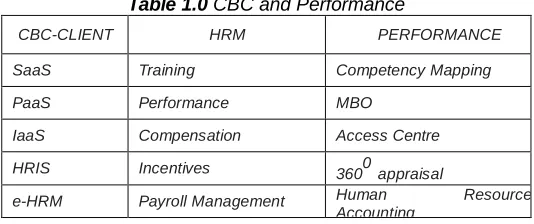
Kumar Renuka (2017) explained that HRM is now IT enabled is called e-HRM, uses HRMS (Human Resource Management System Software). It is used for updating the employees‘ history record, starting from interview to last end. The technology Cloud computing is added to the same system to make the e-HRM easy and faster. Now the system of HRIS (Human Resource Information System) is streamlines and updated as HCM (Human Capital Management) by the adoption of Cloud computing. It performs many function of an organization such as training and development, absent management, salary and compensation along with flow of work management. Dai Liangtie, He Yang, Xing Guangdong (2015) has explained that the Human Resource Management services face many challenges for performing the efficiency, cost saving and quick responding etc. Now the combination of HRM and Cloud Computing in service mode provides a new prospective to HRM. There are three main services are included in such as IaaS (Infrastructure as a Service), SaaS (Software as Service) and PaaS (Platform as a Service). It makes easy to manage the wage, attendance, performance and personnel file although it faces non-canonical problems. It provides proper infrastructure for analyzing the big data using algorithm and acts to satisfy the customer satisfaction. The technology Cloud computing is added to the many systems to make the e-HRM easy and faster. Now the system of HRIS (Human Resource Information System) is streamlines and updated as HCM (Human Capital Management) by the adoption of Cloud Based Computing (CBC). It performs many function of an organization such as training and development, absent Management, salary and compensation along with flow of work management. The relational model of the main study is given in the Table 1.0.
Table 1.0 CBC and Performance
CBC-CLIENT HRM PERFORMANCE
SaaS Training Competency Mapping
PaaS Performance MBO
IaaS Compensation Access Centre
HRIS Incentives 3600 appraisal
e-HRM Payroll Management Human Resource Accounting
3. LITERATURE REVIEW:
2718 computing arises due to (a) lack of skilled staff, (b) lack of
expertise in quick change and response in business requirements, (c) fundamental business practice is weakened and innovative collaboration is required, (d) strategic technologies are required for building capacities to plan excellent IT architecture, correct technical errors and third party management, which is not a easy task for any organization. Callender Craig, et. all (2015) explains that the obstacles in adoption of cloud computing are caused by (a) it does not give immediate economic gain, (b) where the performance matters a lot where there is slow internet connectivity, (c) it increases the hiring and (d) it needs transition planning. Dai, L.T., He, Y. and Xing, G.D. (2015) had said that HRM faced the challenges of cost efficiency and fast response etc. Due to the faced challenges in HRM, the Cloud computing is adopted with a hope of successful IT infrastructure. It provided a new prospective to the HRM. Navimipour Nima Jafari et al. (2015) said that people management is essential issue of a successful organization to achieve the pre-determined goal. It insight strength, knowledge, educational qualification, and skill are the major factors of Human resource management. The sharing of knowledge and skill is happened by suitable infrastructure but due to lack of proper infrastructure, these experiences are not followed by many. They said that Cloud Computing is the suitable IT infrastructure to address many problem of Human Resource Management. Dai Liangtie, He Yang, Xing Guangdong (2015) has explained that the Human Resource Management service faces many challenges for performing the efficiency, cost saving and quick responding etc. Now the combination of HRM and Cloud Computing in service mode provides a new prospective to HRM. There are three main services are included in such IT such as IaaS (Infrastructure as a Service), SaaS (Software as Service) and PaaS (Platform as a Service). It makes easy to manage the wage, attendance, performance management and individual file although it faces non-canonical problems. It provides proper infrastructure for analyzing the big data using algorithm and acts to satisfy the customer satisfaction. Xue Colin Ting Si et al. (2014) said that the cloud computing one of the best technologies which is used to solve the business problems by solving the inefficiencies of the business. Cloud computing increases the growth of the business by its‘ innovativeness. It gathers and combines many services to ensure the creativity and excellent productivity. It enhances the higher productivity, greater flexibility, economic cost and increase in revenue. Milian Eduardo Zied et al (2014) had said that the functions of cloud computing enable the management and communication in one platform by providing physical IT infrastructure (Tsagklis (2013). Howlett (2013) states the adoption CBC in accounting for quick result even in the accounting work of SMEs (CCH Research Report, 2013), Saasu (2013). According to Nixon (2013) "Accountants who do not embrace the benefits of cloud technology for SME's should see the new technology as a threat to their core business. The facts are that cloud based technology can and does reduce the time needed on compliance services. This drives competition and price pressure for compliance services. However, with real time data the Accountant can be more relevant by offering planning, monitoring and other advisory services. It's a win-win if the Accountant uses the data to add value. If they do not, then they will lose business".Williams, D. et at. (2013); Rochwerger, B. et al. (2009) pointed out that this model aims to provide the
cloud resources as a utility analogous to electricity. In this model, a number of cloud providers offer computing resources, which are consumed and made available as a commodity by a distributor. Users interact with the distributor to access the resources. Villegas, D (2012) have pointed out that layered cloud services (Saas, PaaS and IaaS) can leverage multiple things. Authors mentioned that federation of clouds should be isolated into identical layers - each of which has a broker, and which offers a different service to meet user requirements. For example, a SaaS broker, meanwhile a PaaS broker, compilation structure and an IaaS broker is mainly based on combining different types of resources such as VMs (with different cpu, ram and storage space etc) from different locations. All the services are paired services (Deloitte,2012). Stephen Kaisler, William H. Money, Stephen J. Cohen (2012) had explained that the Cloud computing technology has may benefits as time savings, ease to use, increases work flexibility and helps in controlling the resources etc... They have developed the decision framework model which will assist the managers who uses the Cloud computing to fulfill the precise obligation. The model shows that the share of outsourced data center. Al-Aqrabi, H. (2012) had pointed out that the user uses Virtual Private Networks (VPNs) for their security and privacy. The complexity of many things is being solved by Cloud (Liu,F., 2011). In this way, Mell, P. & Grance, T. (2011) pointed out that the practice of Cloud fulfills the enterprise objectives. So that Chinyao Low et al. (2011) have concluded that the benefits of Cloud should be promoted in all level. It will solve the demand of networks, servers, storage, applications, and services (NIST, 2011). Crago, S. et. al. (2011) also pointed out that the Cloud computing creates data center of huge interconnected servers. But the IT strategy and regulatory access are required to do so (Buyya, R. 2010). Sultan, N. (2010) found that the lack of sufficient finance, the Cloud is not adoption by schools and Universities. Armbrust et al., (2010) pointed out that the essentiality of CBC in modern business. Goscinski and Brock, (2010) had pointed out that the CBC can be adopted by ―public‖ cloud and ―private‖ cloud partnership basis. Wang et al. (2010 had said that the CBC can improve the work efficiency. Tuncay, (2010) had explained about the chargeback mechanism of CBC. Shainer et al., (2010) pointed out importance to CBC in e-government, e-business and hypervisors2 for storing huge dataLeung, (2010) pointed out that an increasing number of small HPC providers are now migrating some of their services to the cloud. For example, Silicon Graphics International (SGI), an HPC solution provider, recently launched a cloud-based platform named ‗Cyclone‘. Cyclone is expected to come. Krill, (2010) have pointed out CBC as the open source IT service. Penguin Computing, (2010) pointed out that another small HPC solution provider to enter the cloud market is Penguin Computing with its Penguin on Demand (POD). POD, according to Penguin Computing, CBC is a virtualized solution environment. Levy Paul E. and Williams Jane R. (2004) had explained about the performance appraisal of 10 years‘ data. The traditional methods along with the feedback system are presented by them. The HR strategies and economic condition of the organization are summarized to cater the organizational performance.
4. RESEARCH GAP:
HRM in Indian context and of Odisha. Odisha economy evokes the active participation in Indian economy. A number of large scale industries, heavy industries are well established in the soil of Odisha. The corporate offices of the maximum industries are operated from Bhubaneswar, the state capital of Odisha. Since year 2000 to recent time, the industries are struggling for search of quality manpower along with advanced data security. The major services are being done by third party and the role of IT infrastructure plays for addressing the third party services. The latest CBC technology is managed by IT companies as also third party as service provider. Now the IT professionals are to be taken as the part of this study for measuring their performance.
5. OBJECTIVE OF THE STUDY:
• To examine how successful Cloud-Based Computing affect the performance of HRM.
6. HYPOTHESES:
H0: Cloud Based Computing affects insignificantly to the performance of HRM. H1: Cloud Based Computing affects significantly to the performance of HRM.
7. RESEARCH METHODOLOGY:
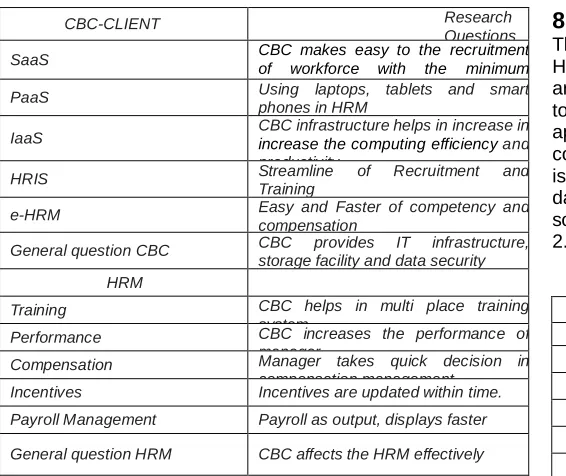
The quantitative research methodology is used to study the relationship among CBC, HRM and Performance of HRM. The correlation and regression method are used to address the result of the study. The 40 numbers of professionals from 20 IT companies from Bhubaneswar are taken as the sample. A research questionnaire (Table 1.1) is designed and distributed among 40 IT professionals. The direct personal interview and telephonic interview method are used to collect the required data. The data are collected and tabulated in the Table 1.2. The rating scale is used as the scale of measurement in this research. 1 to 9 parameters are taken as to mark the valid question statement of the research questionnaire. After tabulation of the collected data, the average of the responses is calculated in Table1.2
1.1 Research Question of Questionnaire
CBC-CLIENT Research
Questions SaaS CBC makes easy to the recruitment of workforce with the minimum
management effort.
PaaS Using laptops, tablets and smart phones in HRM
IaaS CBC infrastructure helps in increase in increase the computing efficiency and productivity.
HRIS Streamline of Recruitment and Training
e-HRM Easy and Faster of competency and compensation
General question CBC CBC provides IT infrastructure, storage facility and data security HRM
Training CBC helps in multi place training system
Performance CBC increases the performance of manager
Compensation Manager takes quick decision in compensation management
Incentives Incentives are updated within time.
Payroll Management Payroll as output, displays faster
General question HRM CBC affects the HRM effectively
PERFORMANCE
Competency Mapping Manages the core competency of employees
MBO Work to objectives by employees
Access Centre CBC makes easy to monitor the man, material and machine
3600 appraisal Feedback accuracy
Human Resource Accounting Quick action in trend analysis of competency and compensation
calculation General Question
Performance
CBC has role in performance management and decision making
Table 1.2 Data Collection and Tabulation
CBC-CLIENT TOTAL Average Round up
SaaS 325 8.12 8
PaaS 338 8.45 8
IaaS 263 6.67 7
HRIS 297 7.42 7
e-HRM 327 8.17 8
General question CBC 288 7.2 7
HRM
Training 332 8.3 8
Performance 305 7.62 8
Compensation 293 7.32 7
Incentives 326 8.15 8
Payroll Management 353 8.82 9
General question HRM 262 6.55 7
PERFORMANCE
Competency Mapping 302 7.55 8
MBO 343 8.57 9
Access Centre 283 7.07 7
3600 appraisal 271 6.77 7
Human Resource
Accounting 348 8.7 9
General question
PERFORMANCE 307 7.67 8
8. DATA ANALYSIS:
The correlation implies the mutual relationship between CBC, HRM and PERFORMANCE. The six functional relationships are existing in each group. They are theoretically interrelated to other group also. In statistical practice, the regression is approximated by a functional relationship. In both cases of correlation and regression, the significance of the relationship is determined. Now correlation is calculated by using Ms-Excel data analysis and regression is calculated by using SPSS 13.0 software. The frequency of three variables is given in Table 2.1.
Table 2.1 Average Responses (Frequency)
CBC- CLIENT HRM PERFORMANCE
8 8 8
8 8 9
7 7 7
7 8 7
8 9 9
2720
8.1. CORRELATION:
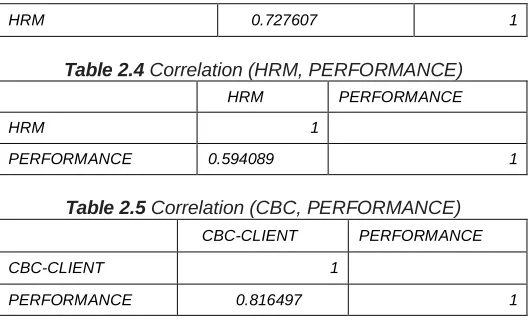
The correlations between three elements are plotted in Table 2.2. The correlation between CBC- CLIENT and HRM is 0.72, which is a positive correlation and it has significance. It means there is a good relationship between CBC-CLIENT and HRM. The adoption of successful CBC relates the HRM significantly. The correlation between HRM and PERFORMANCE is 0.59. It shows the relationship is satisfactory but less significant that the relationship between CBC CLIENT and HRM. But the relationship between the CBC-CLIENT and PERFORMANCE is outstanding and more significant. The correlation value is 0.81, which is more near to 1, in comparison to others value in this test. All the results of correlation are given in Table 2.2, 2.3, 2.4 and 2.5.
Table 2.2 Correlation (CBC, HRM, PERFORMANCE)
CBC-CLIENT HRM PERFORMANCE
CBC-CLIENT 1
HRM 0.727607 1
PERFORMANCE 0.816497 0.594089 1
Table 2.3 Correlation (CBC, HRM)
CBC-CLIENT HRM
CBC-CLIENT 1
HRM 0.727607 1
Table 2.4 Correlation (HRM, PERFORMANCE)
HRM PERFORMANCE
HRM 1
PERFORMANCE 0.594089 1
Table 2.5 Correlation (CBC, PERFORMANCE)
CBC-CLIENT PERFORMANCE
CBC-CLIENT 1
PERFORMANCE 0.816497 1
8.2. RANK AND PERCENTAGE (Frequency)
Now the frequency of all related variables are plotted in a order of Rank and Percentage. Here, it is found that the SaaS, PaaS and e-HRM of CBC- CLIENT have more influence in this study. They have rank and percentage as SaaS (1, 60%), Paas (1, 60%) and e-HRM (1, 60%). The Payroll system of HRM is well influenced by CBC. Because it results the rank and percentage as e-HRM (1,100%). It is predicted that the CBC-CLIENT has significant relationship with PERFORMANCE. Because the result of rank and percentage show as MBO (1, 80%), (1, 80%).
Table 2.6. Rank and Percentage
Point
CBC-
CLIENT Rank Percent Point HRM Rank Percent Point
PERFOR
MANCE Rank Percent
1 8 1 60.00% 5 9 1 100.00% 2 9 1 80.00%
2 8 1 60.00% 1 8 2 40.00% 5 9 1 80.00%
5 8 1 60.00% 2 8 2 40.00% 1 8 3 40.00%
3 7 4 0.00% 4 8 2 40.00% 6 8 3 40.00%
4 7 4 0.00% 3 7 5 0.00% 3 7 5 0.00%
6 7 4 0.00% 6 7 5 0.00% 4 7 5 0.00%
8.3. REGRESSION ANALYSIS:
Now the hypotheses of the study are tested by the regression analysis. The null hypothesis (H0)
and alternative hypothesis (H1) are given as under
H0: Cloud Based Computing affects insignificantly to the performance of HRM.
H1: Cloud Based Computing affects significantly to the performance of HRM.
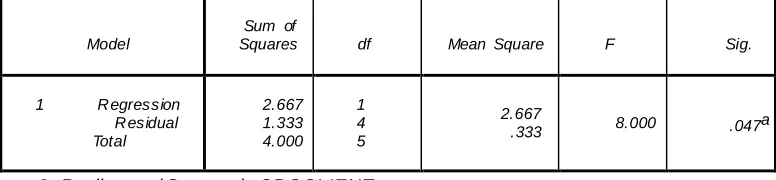
If P value is less or equal to 0.05, then H0 is rejected or vice versa. According to the results of frequency study and descriptive statistics, the null hypothesis and alternative hypothesis are determined for each Hypothesis. The null
hypothesis (H0) is assumed to disprove and to be rejected. Whereas the alternative hypothesis is considered as the real occurrence.
Regression: CBC-CLIENT and Performance of HRM
Table 2.7: Model Summary
Model R R Square
Adjusted R Square
Std. Error of the Est imat e
1 .816a .667 .583 .57735
a. Predictors: (Constant), CBCCLI ENT
Model
Sum of
Squares df Mean Square F Sig.
1 R egression R esidual Total
2.667 1.333 4.000
1 4 5
2.667
.333 8.000 .047a
a. Predictors: ( Constant), CBCCLIENT b. Dependent Va r ia b le : PERFORMANCE
Table 2.9 Coefficients
Model
U nstandardized Coef f ic ients
Standardized Coef f ic ients
t Sig.
B Std. Error Beta
1 (C onstant) CBCCLI EN T
-2.000 1.333
3.543
.471 .816
-.564 2.828
.603 .047
a. Dependent Va r ia b le : PERFORMANCE
The regression value 0.047 is less than 0.05 and also near to 0.05. So that the H0 is rejected. It means the alternative hypothesis H1 is accepted. Here the value of standardized coefficients (Beta) is 0.816, which is equal to
the correlation value between CBC-CLIENT and
PERFORMANCE of HRM. It is referred to Table 2.5, Table 2.7 and Table 2.9. As a result it is found that the Cloud Based Computing affects significantly to the performance of HRM.
9. FINDINGS:
It is found that the HRM has less influence on the PERFORMANCE of HRM. When the CBC- CLIENT is adopted by the IT professionals, the organizational performance is increased in a outstanding manner. The SaaS (Software as a Service) and PaaS (Platform as a Service) and e- HRM has maximum role in performance management of HRM. Due to the average 60% successful
adoption of CBC-CLIENT affects 100% in payroll
management and 80% in MBO, HRA of performance of HRM.
10. SUGGESTIONS AND CONCLUSION:
The suggestion is given to the professional of IT firms and heavy industries, to adopt the CBC- CLIENT of top Cloud providers. It will help in enhancement of performance of human capital of their industry. In this mode, the overall performance will increase in a safe and faster mode. The policy makers Odisha Government should show their sincere attention to adopt the CBE- CLIENT to address the people easily and quickly. The contribution of this study is purely authentic and will hell all level of management. There will be a proper and faster relationship among all the scalar chain in the management. The performance is really increasing due to the successful implementation of CBC in IT industry. It also affects to the other client industries in total.
11 REFERENCES:
[1] A Complete History of cloud computing. (2013).
Retrieved from Salesforce.com:
http://www.salesforce.com/uk/socialsuccess/cloud-computing/thecompletehistory-of cloud-computing.jsp
[2] Afriyie, R. (2013, June 26). Accounting in the cloud: How cloud computing can transform businesses. (E. M. Kyei, Interviewer)
[3] Al-Aqrabi , H. (2012) "Investigation of IT Security and Compliance Challenges in Security-as-a- Service for Cloud Computing," in the Proceedings of the 15th IEEE International Symposium on Object/Components/Service-Oriented Real-Time Distributed Computing Workshops, pp. 124-129, 2012.
[4] Alexa Huth, J. C. (2011). The basics of cloud computing, Carnegie Mellon University. Accounting in the cloud: How cloud computing can transform businesses 2013
[5] Angeles, S. (2013). Cloud Computing: A small business guide. Business News Daily, Are businesses in Ghana cloud ready?(2013). Retrieved from Dreamoval:
dreamoval.com/component/content/article/30-blog/57-arebusinesses-inghana-cloud ready.
[6] Armbrust, M., Fox, A., Griffith, R., Joseph, A.D., Katz, R., Konwinski, A., Lee, G., Patterson, D., Rabkin, A., Stoica, I. and Zaharia, M. (2010), ―A view of cloud computing‖, Communications of the ACM, Vol. 53, pp. 50-8.
[7] Ashon, P. K. (2013). MTN launches Cloud Services, says SMEs to experience advanced growth. Retrieved from Citi FM Online.
[8] Asprey, D. (2012). The State of Cloud Computing Security in Asia. Trend Micro Incorporated, https://www.trendmicro.de/cloud.../wp_state-of-cloud-computing-security-in-asia.pdf
[9] Bandoim (2013). More Businesses looking to Cloud Accounting Software. Retrieved from Technocratic: Be your future. The 5 essential Characteristics of cloud computing. Retrieved from Be your future: http://www.beyourfuture.net/2011/09/29/the-5-
2722 [10]C A Technologies. (2013). Cloud computing grows up:
Benefits exceed expectations according to Report. Retrieved from CMO: Chan, S. P. (2009, July 13). [11]Callender Craig, Marshall Bryan, Cardon Peter W.,
and Patel Nipul (2015), Obstacles to the Adoption of Cloud Computing: Best Practices In Technology and Communication, Issues in Information Systems, Volume 16, Issue II, pp. 133-139, 2015 133.
[12]Carr, N. (2009). The Big Switch: Re-Wiring the World, from Edison to Google. New York & London: W.W. Norton.
[13]Claycomb, W. R. (2012). Cloud Computing Security, Carnegie Mellon University. Cliffs Notes. (n.d.). The Accounting Cycle. Retrieved from
http://www.cliffsnotes.com/more- subjects/accounting/accountingprinciplesi/completion-ofthe-accounting-cycle/the-accounting-cycle
[14]Cloud Computing in Ghana. (2012). Retrieved from
WhichTech Solutions:
http://www.whichtech.com/services/cloud-computing-in-Ghana/ Cloud Readiness Index 2012. Retrieved March 1, 2013, from Asia cloud computing association: http://www.asiacloud.org/index.php/2012-07-17-08-33- 19/press-release-cloud-readiness-index-2012
[15]Crago. S. et al. (2011). "Heterogeneous Cloud Computing", IEEE International Conference on Cloud Computing.
[16]Craig, D. (2010). Cloud computing History 101. Retrieved July 20, 2013, from Construction cloud computing: Gartner says worldwide cloud services revenue will grow 21.3 percent in 2009.
[17]D Villegas et al. (2012) Cloud federation in a layered service model. J. Comput. Syst. Sci., 78(5):1330-1344.
[18]D Williams, et al. (2013) Plug into the super cloud. Internet Computing, IEEE, 17(2):28-34.
[19]Dai Liangtie, He Yang, Xing Guangdong (2015). The Construction of Human Resource Management Cloud Service Platform. Intelligent Information Management, 2015, 7, 1-6, published Online January 2015 in SciRes, http://www.scirp.org/journal/iim
http://dx.doi.org/10.4236/iim.2015.71001.
[20]Dai, L.T., He, Y. and Xing, G.D. (2015). The Construction of Human Resource Management Cloud Service Platform. Intelligent Information Management, 7, 1-6, http://dx.doi.org/10.4236/iim.2015.71001. [21]Ebenezer Eva Esther Shalin et al. (2014).
Proceedings of the Second International Conference on Global Business, Economics, Finance and Social Sciences (GB14Chennai Conference) ISBN: 978-1-941505-14-4,Chennai, India 11-13 July 2014, Paper ID: CF440
[22]G Manno, W Smari, and L Spalazzi. Fcfa: semantic-based federated cloud framework architecture. In High Performance Computing and Simulation (HPCS), 2012 International Conference on, pages 42-52, July 2012.
[23]Goscinski, A. and Brock, M. (2010), ―Toward dynamic and attribute based publication, discovery and selection for cloud computing‖, Future Generation Computer Systems, Vol. 26, pp. 947-70.
[24]Hiden H, W. P. et al. (2013) Woodman S and C J.
Developing cloud applications using the e-science central platform. Royal Society of London. Philosophical Transactions A. Mathematical, Physical and Engineering Sciences, 371:20120085.
[25]Internet Solutions Introduces 'cloud' to the Ghanaian
Market. (2012, August 25).
RetrievedfromBusinessWorld:seattletimes.com/html/m icrosoft/2009458942_microsoftazure13.html,www.busi nessworldghana.com/internet-solutions-introduces-cloud-to-the
ghanaianmarket/www.cmo.com.au/mediareleases/16 433/cloud-computing-grows-up-benefits-exceed/
[26]Krill, P (2010), ‗Cerf urges standards for cloud
computing‘, Info World,
h ttp://www.infoworld.com/d/cloud-computing/cerf-urges-standards-cloud-computing- 817.
[27]Kumar Renuka (2017). Cloud Technology and Human Resource Management. Annual Research Journal of SCMS, Pune, Vol. 5, March 2017.
[28]Leung, L (2010), ‗Scientists Offered Free Access to Azure Cloud‘, Data Center Knowledge. Retrieved from
http://www.datacenterknowledge.com/archives/2010/0 2/05/scientists-offered-free-accessto-azure-cloud/
[29]Levy Paul E. and Williams Jane R. (2004). The Social Context of Performance Appraisal: A Review and Framework for the Future, Journal of Management, 2004, 30(6) 881–905, © 2004 Elsevier Inc. All rights reserved doi:10.1016/j.jm.2004.06.005.
[30]Liu, F. (2011) "NIST Cloud Computing Reference Architectue: Recommendations of the National Institute of Standards and Technology", NIST Special Publication 500-292, 2011.
[31]Mell, P. & Grance, T. (2011). "The NIST Definition of Cloud Computing," National Institute of Science and Technology.
[32]Milian Eduardo Zied et al. (2014). An Analysis of the Advantages, Challenges and Obstacles of Cloud Computing Adoption to an Academic Control System. B. Grabot et al. (Eds.): APMS 2014, Part II, IFIP AICT 439, pp. 564–571, 2014. © IFIP International Federation for Information Processing 2014.
[33]Milian Eduardo Zied, Spinola Mauro, Gonçalves Rodrigo, Fleury Andre Leme (2016) An Analysis of the Advantages, Challenges and Obstacles of Cloud Computing Adoption to an Academic Control System, Distributed under a Creative Commons Attribution 4.0 International License. HAL Id: hal-01387932
https://hal.inria.fr/hal-01387932.
[34]Misra, S.C. and Mondal, A. (2010), ―Identification of a company‘s suitability for the adoption of cloud computing and modeling its corresponding return on investment‖, Mathematical and Computer Modeling, Vol. 53, pp. 504-21.
[35]Navimipour Nima Jafari et al.(2015). Expert Cloud: A Cloud-based framework to share the knowledge and skills of human resources. Computers in Human Behavior, @2015 Elsevier Ltd, 46 (2015), 57–74. [36]Oliveira, T. and Martins, M.F. (2010), ―Understanding e-business adoption across industries in European countries‖, Industrial Management & Data Systems, Vol. 110, pp. 1337-54.
http://www.penguincomputing.com/POD/ Summary. [38]Reddy Pulla (2018). A critical review on leadership in
the digital age. International Journal of Academic Research and Development, ISSN: 2455-4197, www.academicsjournal.com, Volume 3; Issue 1; January 2018; Page No. 467-468
[39]Senarathna Ishan, Wilkin Carla, Warren Matthew, Yeoh William, Salzman Scott (2018). Factors That Influence Adoption of Cloud Computing: An Empirical Study of Australian SMEs. Australasian Journal of Information Systems, 2018, Vol 22, pp 1-31.
[40]Shirish, C.S. and Teo, T.S.H. (2010), ―E-government, e-business, and national economic performance‖, Communications of the Association for Information Systems, Vol. 26, pp. 267-86.
[41]Stephen Kaisler, William H. Money, Stephen J. Cohen (2012). A Decision Framework for Cloud Computing, 45th Hawaii International Conference on System Sciences, 978-0-7695-4525-7/12 © 2012 IEEE, DOI 10.1109/ HICSS. 2012.52.
[42]Sultan, N. (2010), ―Cloud computing for education: a new dawn?‖ International Journal of Information Management, Vol. 30, pp. 109-16.