1673
Development Of Thermal Vacuum Forming
Machine
T.S. Sameer, Pradhuman Panigrahi, Palle Anirudh, S. Smrithin, U. Raghavendra.
Abstract: Thermo-forming normally consists of heating a thermoplastic semi-finished product until the forming temperature is reached, and subsequently the desired form is obtained by means of pressure difference and mechanic stretching. Thermo-forming is a forming method that, by means of several process steps, facilitates the production of an inherently stable plastic part. Basically, the raw material is transformed by heating into a viscous - flexible phase and a relatively low load. The formed part cools in the tooling and is subsequently demoulded. Thermal vacuum forming is a version of thermoforming, where a sheet of plastic is heated to a forming temperature, stretched onto a single-surface mold, and forced against the mold by a vacuum. This process can be used to form plastic into permanent objects such as turnpike signs and protective covers. Normally draft angles are present in the design of the mold (a recommended minimum of 3°C to ease removal of the formed plastic part from the mold. Relatively deep parts can be formed if the formable sheet is mechanically or pneumatically stretched prior to bringing it into contact with the mold surface and applying vacuum. Suitable materials for use in vacuum forming are conventionally thermoplastics. The most common and easiest to use thermoplastic is high impact polystyrene sheeting (HIPS) or Polypropylene Copolymer Grade (PP COPG). Vacuum forming is also appropriate for transparent materials such as acrylic. The machine mainly consists of a Heater, Vacuum pump, and Thermoplastics. The heater is used to heat the plastic material to the required temperature, then the plastic is forced on to the pattern whose replica is required. Vacuum pump is used to create the vacuum at the forming region to remove the air gaps within the pattern and the required shape is formed.
Index Terms: Electric Heater, Forming, Mold, Polypropylene Sheet, Pattern, Suction, Thermo Plastics, Vacuum Pump —————————— ——————————
1
INTRODUCTION
The typical process steps can be identified as follows: clamping, heating the sheet, pre-stretch, forming with plug assist, cooling with air and spray mist, release and trimming. All these processes are explained in detail. Clamping is a process where the designed frame needs to be sufficiently powerful enough to handle the thickest material likely to be formed on the machine – up to 3mm with our heater model. If an automated process is used the operation of the moving parts must be guarded and interlocked to avoid accidental damage. Heating is done by the heaters that are generally infra-red elements mounted within an aluminium reflector plate. In order to obtain the best vacuum forming results, using any material, it is essential that the sheet is heated uniformly over its entire surface area and throughout its thickness. In order to achieve this, it is necessary to have a series of zones which are controlled by energy regulators. Ceramics do have some disadvantage in that their high thermal mass makes them slow to warm up and slow in their response time when adjustments are made. Pre-stretch operation is done once the plastic has reached its forming temperature or ‗plastic‘ state it can be pre-stretched to ensure even wall thickness when the vacuum is applied. Pre-stretch is an invaluable feature when forming deep draw parts with minimum draft angles and high mold surface detail. The method of controlling the bubble height should be such that consistent results are obtainable. Once the material is suitably pre-stretching a vacuum can be applied to assist in forming the sheet.
A single stage vacuum pump is used to draw the air trapped between the sheet and the mold. The vacuum pump should be capable of maintaining a differential pressure of approximate 27mm of mercury. Once formed the plastic must be allowed to cool before being altered. If removed too soon then deformation of the moulding will result in a reject part. Trimming and Finishing can be done to the formed part has cooled and been removed from the machine the excess material is removed. Holes, slots and cut-outs are then drilled into the part. Other post-forming processes include decoration, printing, strengthening, reinforcing and assembly. A variety of different trimming methods are used to trim the product from the sheet. The type of equipment best suited depends largely on the type of cut, size of the part, draw ratio, thickness of material and the quantity required.
2
LITERATURE
SURVEY
Thermal Vacuum Forming machine can be made by using either of the two forms which are vacuum forming and pressure forming. Though in both the cases vacuum conditions is imperative, in vacuum forming we utilize a surge tank to create vacuum rapidly after the sheet is ready to form in between the shape cavity and formable sheet. Whereas in pressure forming the preheated sheet is put above a extruding shape on which a vacuum pressure is applied from the top to form the shape where force due the pressure is the cause of forming [1]. One of the vital components of the forming machine is the heater which must be arranged in such a way that uniform heat is spread over the sheet. Another most important component is the vacuum system which must be an integral part of the machine and should evacuate air approximately 0.83 bar vacuum pressure must be developed. Overall system of laying and removing the formable sheet must be carried out rapidly which requires a pneumatic, hydraulic or other mechanical system to be more precise [2]. Though the machine is precisely manufactured but the users must know mold design criteria. Mold must be capable of repeated thermal cycling, robust, easily modifiable and dimensionally accurate with considerations of shrinkage of forming material after cooling. Mold must be able to transmit ————————————————
• T.S Sameer is holding a graduate degree in mechanical engineering from Anurag Group of Institutions, Hyderabad, India, PH-9949647302. E-mail: [email protected]
1674 vacuum from all of its surfaces. The requirements are due to
thermal cycling, design modifiability, practicality and robustness. The impact of high temperature source and its benefit was understood and it helped us to know the range or amount of sheet thickness that had to be chosen for the process [3]. The advancements in the process mechanism can be used in making better quality Raw material sheets and the implementation of this kind of forming process to new set of products [4]. It helped us in knowing the potential of thermal Vacuum forming and encouraging us to take up the project. In order to obtain complex shapes and wider range of products, uniform distribution of temperature throughout the polymer sheet is required and at times the heat output should be varied at specific areas accordingly with the help of zone heater. Hence this study focuses on the development of an experimental capability to monitor polymer sheet temperature distributions during thermoforming, and the experimental and numerical analysis of the range of temperature distributions [5]. Unlike other thermoplastic forming processes, where powder or resin are the starting point, vacuum forming uses extruded plastic sheet. Also, the use of low forming pressures enables comparatively low-cost tooling. Another influential information this journal shares is regarding the use of rapid prototype models, that shortens the mold fabrication time. Using prototypes for the molds makes it economically feasible to produce low quantities of large parts and to operate medium size production runs.
3
DESIGN
AND
FABRICATION
3.1 Design of Thermoforming Units
Heater unit is one of the main parts of the machine, it holds and gives housing for the electric heater and also supports other components. It is designed in such a way that the heater can be fixed freely into it and allows air to pass through it and avoids overheating. It is in cuboid shape without the bottom and consists of ventilating slots at the top surface, circular holes for the fixing of motors and square shaped holes for fitting the axial fans.
Fig 1: Design of Heating Unit
The vacuum unit is present at the bottom of the machine and it supports the heater unit on its top at a distance with the help of supports. It has two important functions, first is to helping creating vacuum when the plastic is pressed on to the mold and the second is to support the pattern/mold on top of it. Many vent holes are provided on the top surface on which the pattern is kept. And a larger hole is made on one of the sides
of the box for the connecting the vacuum pump inlet through pipe.
Fig 2: Design of Vacuum Unit
The plastic sheet that has to be formed has to be fixed on to something and then forced on to the pattern. This clamping frames help in holding the plastic sheet and move it in between the heating unit and vacuum unit. The design of the clamping frame is such that it holds the plastic sheet firmly, covers minimum area over of the plastic and also easily adjusts to different thickness of plastic sheets. Along with these frames even clamping clips are also being used to hold the frame firmly and lock the plastic sheet.
Fig 3: Design of Clamping Frames
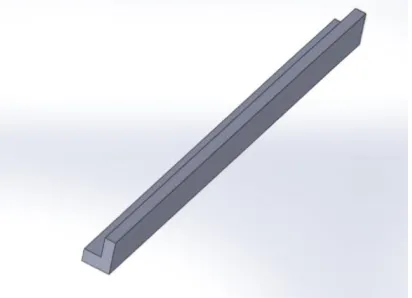
Both the heating unit and vacuum unit are joined together with the help of these members. These are angle rods that are bent at an angle of 90 degrees and can be fixed at the edges of the boxes. The length of these angles is based on the height of travel of the plastic sheet in between both the units.
1675 The movement of the clamping frame along with the plastic
sheet is being automated with the help of pulleys and cables. These pulleys are powered by DC Motors with the help of a switch. This switch helps the motor to rotate in two directions that results in winding and unwinding of the cables which helps the frame to move up & down. The pulleys and cables are designed based on the length of travel of the frame, winding capability and the dimensions are decided to make the fixture and removal easy. The pulleys will be mounted on the motor shaft with a closer tolerance such that there exists a transition fit between them. There will be key which would lock the pulley on the motor shaft as a part of precautions considered during design. The key of the inserted through the pulley and motor shaft by providing a small hole at the center of the pulley. Therefore, these are the various drafting parameters, dimensions and shapes that have been taken into account in the design of the entire thermal vacuum forming machine.
3.2 Fabrication and Assembly
Fabrication work mainly includes cutting of the wood in the required dimensions according to the design, making the required holes on it and aluminum angle cutting. A wood plank of 16.5mm thickness and dimension of 8ft x 10ft was taken and its cut into 5 rectangular pieces of the given dimensions with a circular machine saw. Then 4 holes were drilled on both the side surfaces (two on each) according to the design for the fixation of motors (the holes are made for transition fit with the motors). After the drilling process, 2 square holes were made on the same side where the circular holes were drilled (one on each side). And the ventilating slots were made with a Jigsaw on the top surface. Magnets were stuck on the bottom of the side surfaces with a screw inserted. These magnets help in holding the clamping frame when the move upward towards heater and hold them until the heating of the plastic is completed. All these surfaces were joined by gluing with synthetic adhesive and hammering the nails into the edges of these surfaces. At the end the box was coated with a primer and painting was done. The vacuum unit is fabricated in the same way as the heating unit is made. The wood is cut into different dimensions and the pieces were joined. Vent holes on the top surface were created with an electric drill.
3.2.1 Assembly
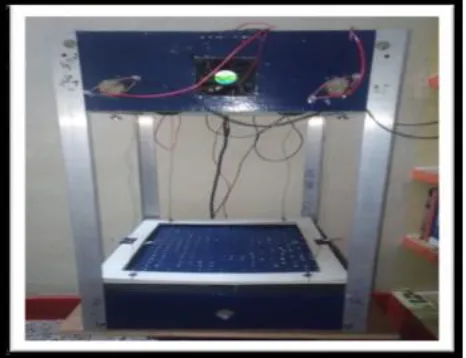
This is the stage at which all the fabricated units and cut parts are assembled together to build a machine so called as thermal vacuum forming machine. The assembly first comprised of the angles that were fixed to the 4 edges of the heating unit with help of nuts, bolts and washer and then the vacuum unit was fixed at the lower end of the angles with nuts and bolts. Next the various components are fitted at their respective positions. Four motors are inserted in the circular holes provide in the heating unit with their shafts inside the box. Pulleys are inserted into the shafts and the four cables are joined to them (one cable for each pulley). And the other end of the cable is fixed to the clamping frame. Two axial fans are fitted in their slots provided in the heating unit. The electric heater is mounted inside the heating unit facing downward and fitted to the top surface with the help of screws.
Fig 5: Heater Unit and Vacuum Unit Assembly.
The Vacuum Pump is connected to the vacuum unit with the help of an adjustable piping. Plastic sheet that has to be formed is fixed and sandwiched between the two clamping frames with the help of clamping clips. Finally, the joining of the electric wires to the motors, axial fans with the switch and preparing the circuit.
Fig 7: Assembled Thermal Vacuum Forming Machine
4
WORKING
1676 rotation of motors into opposite direction due to which the
cable unwinds bringing the frame down to the vacuum unit. When the plastic sheet is pressed on to the pattern, switch on the vacuum pump as this starts the suction of air and pulls the plastic on to the surface of the mold/pattern. Switch OFF all the connections and remove the formed plastic carefully by taking off the clamping clips and the required shape is obtained. After it cools down remove the pattern from it. This plastic sheet is then machined and the required part is cut of it and obtained. Thus, the thermal vacuum operation is completed. Testing of the machine mainly includes to examine its working and analysing its performance by using different types and grades of plastics. Mainly two types of plastics with various thickness were used to make different shapes as shown below.
5
RESULTS
AND
DISCUSSIONS
After the complete construction and development of the Thermal Vacuum forming machine the forming process was started on some simple objects using Polypropylene sheets as raw material. The observations that were made is the forming of Spherical and curved surfaces was easy compared to the objects with sharp edges and complex contour. Uniform heating of the polypropylene sheet was obtained by the Electric heater. Smooth movement of the sheet along with the clamping frame was achieved with the motor and pulley system. There is a good scope for future work to improve the efficiency of the forming process by reducing the cycle time, using programmable logic controllers, by installing a surge tank along with vacuum pump which can deliver the required pressure to release the plastic sheet from the mold after the suction and forming has happened. If there is more adhesion of the plastic on to the mold. When there is a need to form large components and the productivity should be high then Hydraulic and Pneumatic systems can be used for the movement of the plastic sheets and other required components.
TABLE 1
Observations made for Heating Time and Forming Time for two different plastic types and thickness.
Observations Types of Plastics Thickness (mm)
Heating Time (sec)
Forming Time (sec)
1
Poly-propylene 1 360 70
2
Poly-propylene 3 450 120
3
Poly-propylene Copolymer
(Forming grade)
1 250 55
4
Poly-propylene Copolymer
(Forming grade)
3 330 110
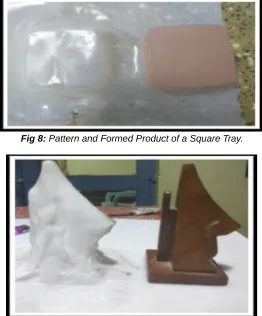
Fig 8: Pattern and Formed Product of a Square Tray.
Fig 9: Pattern and Formed Product of a Wooden Handicraft
6
CONCLUSION
1677 components. Hence, thermal vacuum forming must be used
and applied in manufacturing of products in packaging and plastic industry to reduce human effort and enable automation thus helping us to enter into modern era of forming technology.
5
REFERENCES
[1] Somase Babasaheb Baliram, Dond Rushikesh Dnyaneshwar, Unde Akshay Jagannath, Suryawanshi Avinash Bahusaheb, Baravkar pavan Subhash, ―Plan and Development of Vacuum Forming Machine and Die‖, International Research Journal of Engineering and Technology, Vol. 05, Issue. 02, 2018.
[2] Awari Mahesh Prakash, Pachpute Santosh Mahadeo, Navale Ganesh Vitthal, Deshmukh Ramchandra Ramesh, Gunjal Pramod Ashok, ―Design and Development of Vacuum Forming Machine and Die‖, International Journal on Theoritical and Applied research in Mechanical Engineering, Vol. 5, 2016.
[3] M.S. Jamil, R. Khalid, A. Zulqarnain, M. Salman, ―Improving Thermoform Productivity- Case of Design of Experiment‖, Journal of Quality and Technology Management, Vol. XV, Issue I, pp. 87-106, 2018.
[4] Dale Brosius, ―Thermoplastic Composites Replaces Metal‖, A Journal of the Thermoforming of Society of Plastic Engineers, Vol. 27, No. 3, 2008.