Distance Matching
Emilio Ferrara and Robert Baumgartner
AbstractInformation distributed through the Web keeps growing faster day by day, and for this reason, several techniques for extracting Web data have been suggested during last years. Often, extraction tasks are performed through so called wrappers, procedures extracting information from Web pages, e.g. implementing logic-based techniques. Many fields of application today require a strong degree of robustness of wrappers, in order not to compromise assets of information or reliability of data extracted.
Unfortunately, wrappers may fail in the task of extracting data from a Web page, if its structure changes, sometimes even slightly, thus requiring the exploiting of new techniques to be automatically held so as to adapt the wrapper to the new structure of the page, in case of failure. In this work we present a novel approach of auto-matic wrapper adaptationbased on the measurement of similarity of trees through improved tree edit distance matching techniques.
1 Introduction
Web data extraction, during last years, captured attention both of academic research and enterprise world because of the huge, and still growing, amount of information distributed through the Web. Online documents are published in several formats but previous work primarily focused on the extraction of information from HTML Web pages.
Emilio Ferrara
University of Messina, Dept. of Mathematics, Via Ferdinando Stagno D’Alcontres, Salita Sperone, n. 31, Italy, e-mail: [email protected]
Robert Baumgartner
Lixto Software GmbH, Favoritenstrasse 16/DG, 1040 Vienna, Austria, e-mail: [email protected]
Most of the wrapper generation tools developed during last years provide to full support for users in building data extraction programs (a.k.a. wrappers) automati-cally and in a visual way. They can reproduce the navigation flow simulating the human behavior, providing support for technologies adopted to develop Web pages, and so on. Unfortunately, a problem still holds: wrappers, because of their intrin-sic nature and the complexity of extraction tasks they perform, usually are strictly connected to the structure of Web pages (i.e. DOM tree) they handle. Sometimes, also slight changes to that structure can cause the failure of extraction tasks. A cou-ple of wrapper generation systems try to natively avoid problems caused by minor changes, usually building more elastic wrappers (e.g. working with relative, instead of absolute, XPath queries to identify elements).
Regardless of the degree of flexibility of the wrapper generator, wrapper main-tenance is still a required step of a wrapper life-cycle. Once the wrapper has been correctly developed, it could work for a long time without any malfunction. The main problem in the wrapper maintenance is that no one can predict when or what kind of changes could occur in Web pages.
Fortunately, local and minor changes in Web pages are much more frequent case than deep modifications (e.g. layout rebuilding, interfaces re-engineering, etc.). However, it could also be possible, after a minor modification on a page, that the wrapper keeps working but data extracted are incorrect; this is usually even worse, because it causes a lack of consistency of the whole data extracted. For this reason, state-of-the-art tools started to perform validation and cleansing on data extracted; they also provide caching services to keep copy of the last working version of Web pages involved in extraction tasks, so as to detect changes; finally, they notify to maintainers any change, letting possible to repair or rewrite the wrapper itself. De-pending on the complexity of the wrapper, it could be more convenient to rewrite it from scratch instead of trying to find causes of errors and fix them.
Ideally, a robust and reliable wrapper should include directives to auto-repair itself in case of malfunction or failure in performing its task. Our solution of au-tomatic wrapper adaptation relies on exploiting the possibility of comparing some structural information acquired from the old version of the Web page, with the new one, thus making it possible to re-induct automatically the wrapper, with a custom degree of accuracy.
2 Related Work
Theoretical background on techniques and algorithms widely adopted in this work relies on several Computer Science and Applied Mathematics fields such as Algo-rithms and Data Structures and Artificial Intelligence. In the setting of Web data ex-traction, especially algorithms on (DOM) trees play a predominant role. Approaches to analyze similarities between trees were developed starting from the well-known problem of finding the longest common subsequence(s) between two strings. Sev-eral algorithms were suggested, for example Hirshberg [5] provided the proof of correctness of three of them.
Soon, a strong interconnection between this problem and the similarity between trees has been pointed out: Tai [14] introduced the notion ofdistanceas measure of the (dis)similarity between two trees and extended the notion of longest common subsequence(s) between strings to trees. Severaltree edit distancealgorithms were suggested, providing a way to transform a labeled tree in another one through lo-cal operations, like inserting, deleting and relabeling nodes. Bille [1] reported, in a comprehensive survey on the tree edit distance and related problems, summarizing approaches and analyzing algorithms.
Algorithms based on the tree edit distance usually are complex to be imple-mented and imply a high computational cost. They also provide more information than needed, if one just wants to get an estimate on the similarity. Considering these reasons, Selkow [13] developed a top-down trees isomorphism algorithm called sim-ple tree matching, that establishes the degree of similarity between two trees, ana-lyzing subtrees recursively. Yang [17] suggested an improvement of the simple tree matching algorithm, introducing weights.
During years, some improvements to tree edit distance techniques have been in-troduced: Shasha and Zhang [19] provided proof of correctness and implementation of some new parallelizable algorithms for computing edit distances between trees, lowering complexity ofO(|T1| · |T2|·min(depth(T1),leaves(T1))·min(depth(T2), leaves(T2))), for the non parallel implementation, toO(|T1|+|T2|), for the parallel one; Klein [7], finally, suggested a fast method for computing the edit distance be-tween unrooted ordered trees inO(n3logn). An overview of interesting applications of these algorithms in Computer Science can be found in Tekli et al. [15].
Literature on Web data extraction is manifold: Ferrara et al. [4] provided a com-prehensive survey on application areas and used techniques, and Laender et al. [9] give a very good overview on wrapper generation techniques. Focusing onwrapper adaptation, Chidlovskii [2] presented some experimental results of combining and applying some grammatical and logic-based rules. Lerman et al. [10] developed a machine-learning based system for wrapper verification and reinduction in case of failure in extracting data from Web pages.
hyperlinks and annotations (e.g. descriptive information representing the semantic meaning of a piece of information in its context).
Wong [16] developed a probabilistic framework to adapt a previously learned wrapper to unseen Web pages, including the possibility of discovering new at-tributes, not included in the first one, relying on the extraction knowledge related to the first wrapping task and on the collection of items gathered from the first Web page. Raposo et al. [12] already suggested the possibility of exploiting previously acquired information, e.g. queries results, to re-induct a new wrapper from an old one not working anymore, because of structural changes in Web pages.
Kim et al. [6] compared results of simple tree matching and a modified weighed version of the same algorithm, in extracting information from HTML Web pages; this approach shares similarities to the one followed here to perform adaptation of wrappers. Kowalkiewicz et al. [8] focused on robustness of wrappers exploiting absolute and relative XPath queries.
3 Wrapper Adaptation
As previously mentioned, our idea is to compare some helpful structural information stored by applying the wrapper on the original version of the Web page, searching for similarities in the new one.
3.1 Primary Goals
Regardless of the method of extraction implemented by the wrapping system (e.g. we can consider a simple XPath), elements identified and represented as subtrees of the DOM tree of the Web page, can be exploited to find similarities between two different versions.
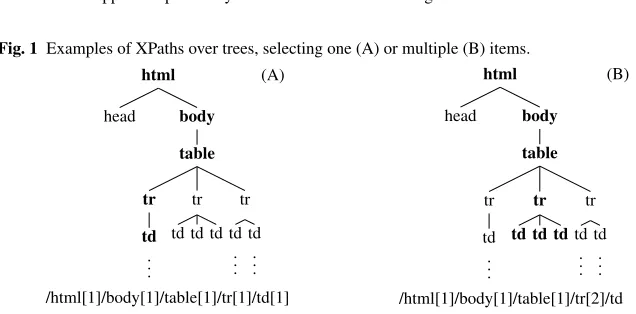
In the simplest case, the XPath identifies just a single element on the Web page (Figure 1.A); our idea is to look for some elements, in the new Web page, shar-ing similarities with the original one, evaluatshar-ing comparable features (e.g. subtrees, attributes, etc.); we call these elementscandidates; among candidates, the one show-ing the higher degree of similarity, probably, represents the new version of the orig-inal element.
Fig. 1 Examples of XPaths over trees, selecting one (A) or multiple (B) items.
html
head body
table
tr
td . . .
tr
td td td tr
td . . .
td . . .
(A)
/html[1]/body[1]/table[1]/tr[1]/td[1]
html
head body
table
tr
td . . .
tr
td td td tr
td . . .
td . . .
(B)
/html[1]/body[1]/table[1]/tr[2]/td
Once identified, elements in the new version of the Web page can be extracted as usual, for example just re-inducting the XPath. Our purpose is to define some rules to enable the wrapper to face the problem of automatically adapting itself to extract information from the new Web page.
We implemented this approach in a commercial tool1; the most efficient way to acquire some structural information about elements the original wrapper extracts, is to store them inside the definition of the wrapper itself. For example, generating sig-naturesrepresenting the DOM subtree of extracted elements from the original Web page, stored as a tree diagram, or a simple XML document (or, even, the HTML it-self). This shrewdness avoids that we need to store the whole original page, ensuring better performances and efficiency.
This technique requires just a few settings during the definition of the wrapper step: the user enables the automatic wrapper adaptation feature and set an accuracy threshold. During the execution of the wrapper, if some XPath definition does not match a node, the wrapper adaptation algorithm automatically starts and tries to find the new version of the missing node.
3.2 Details
First of all, to establish a measure of similarity between two trees we need to find some comparable properties between them. In HTML Web pages, each node of the DOM tree represents an HTML element defined by a tag (or, otherwise, free text). The simplest way to evaluate similarity between two elements is to compare their tag name. Elements own some particular common attributes (e.g.id,class, etc.) and some type-related attributes (e.g.hreffor anchors,srcfor images, etc.); it is possible to exploit this information for additional checks and comparisons.
The algorithm selects candidates between subtrees sharing the same root element, or, in some cases,comparable-but not identical- elements, analyzing tags. This is very effective in those cases of deep modification of the structure of an object (e.g. conversion of tables in divs).
As discussed in Section 2, several approaches have been developed to analyze similarities between HTML trees; for our purpose we improved a version of the simple tree matchingalgorithm, originally led by Selkow [13]; we call itclustered tree matching. There are two important novel aspects we are introducing in facing the problem of the automatic wrapper adaptation: first of all, exploiting previously acquired information through a smart and focused usage of the tree similarity com-parison; thus adopting a consolidated approach in a new field of application. More-over, we contributed applying some particular and useful changes to the algorithm itself, improving its behavior in the HTML trees similarity measurement.
3.3 Simple Tree Matching
Letd(n)to be the degree of a noden(i.e. the number of first-level children); let T(i) to be the i-thsubtree of the tree rooted at node T; this is a possible implementation of thesimple tree matchingalgorithm:
Algorithm 1SimpleTreeMatching(T0,T00) 1: ifT0has the same label ofT00then
2: m←d(T0) 3: n←d(T00) 4: fori=0 tomdo 5: M[i][0]←0; 6: forj=0 tondo 7: M[0][j]←0;
8: for allisuch that 1≤i≤mdo 9: for alljsuch that 1≤j≤ndo
10: M[i][j]←Max(M[i][j−1],M[i−1][j],M[i−1][j−1] +W[i][j]) whereW[i][j]=
SimpleTreeMatching(T0(i−1),T00(j−1)) 11: return M[m][n]+1
12: else 13: return 0
The computational cost isO(n2·max(leaves(T0),leaves(T00))·max(depth(T0), depth(T00))), thus ensuring good performances, applied to HTML trees. There are some limitations; most of them are irrelevant but there is an important one: this ap-proach can not match permutations of nodes. Despite this intrinsic limit, this tech-nique appears to fit very well to our purpose of measuring HTML trees similarity.
3.4 Clustered Tree Matching
Lett(n)to be the number of total siblings of a nodenincluding itself:
Algorithm 2ClusteredTreeMatching(T0,T00) 1: {Change line 11 with the following code} 2: ifm>0 ANDn>0then
3: return M[m][n] * 1 / Max(t(T0),t(T00)) 4: else
5: return M[m][n] + 1 / Max(t(T0),t(T00))
In order to better reflect a good measure of similarity between HTML trees, we applied some focused changes to the way of assignment of a value for each matching node.
In thesimple tree matchingalgorithm the assigned matching value is always 1. After leading some analysis and considerations on structure of HTML pages, our intuition was to assign a weighed value, with the purpose of attributing less impor-tance to slight changes, in the structure of the tree, when they occur in deep sublevels (e.g. missing/added leaves, small truncated/added branches, etc.) and also when they occur in sublevels with many nodes, because these mainly represent HTML list of items, table rows, etc., usually more likely to modifications.
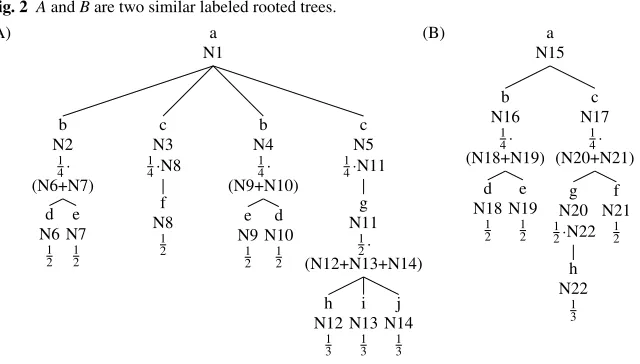
In theclustered tree matching, the weighed value assigned to a match between two nodes is 1, divided by the greater number of siblings with respect to the two compared nodes, considering nodes themselves (e.g. Figure 2.A, 2.B); thus reducing the impact of missing/added nodes.
will be evaluated. The resulting value at the end of the process is the measure of similarity between the two trees, expressed in the interval [0,1]. The closer the final value is to 1, the more the two trees are similar.
Fig. 2 AandBare two similar labeled rooted trees.
(A) a N1 b N2 1 4· (N6+N7) d N6 1 2 e N7 1 2 c N3 1 4·N8
f N8 1 2 b N4 1 4· (N9+N10) e N9 1 2 d N10 1 2 c N5 1 4·N11
g N11 1 2· (N12+N13+N14) h N12 1 3 i N13 1 3 j N14 1 3 (B) a N15 b N16 1 4· (N18+N19) d N18 1 2 e N19 1 2 c N17 1 4· (N20+N21) g N20 1 2·N22
h N22 1 3 f N21 1 2
Let us analyze the behavior of the algorithm with an example, already used by [17] and [18] to explain the simple tree matching (Figure 2): 2.A and 2.B are two very simple generic rooted labeled trees (i.e. the same structure of HTML trees). They show several similarities except for some missing nodes/branches.
Applying theclustered tree matchingalgorithm, in the first step (Figure 2.A, 2.B) contributions assigned to leaves, with respect to matches between the two trees, reflect the past considerations (e.g. a value of 13is established for nodes (h), (i) and (j), although two of them are missing in 2.B). Going up to parents, the summation of contributions of matching leaves is multiplied by the relative value of each node (e.g. in the first sublevel, the contribution of each node is 14 because of the four first-sublevel nodes in 2.A).
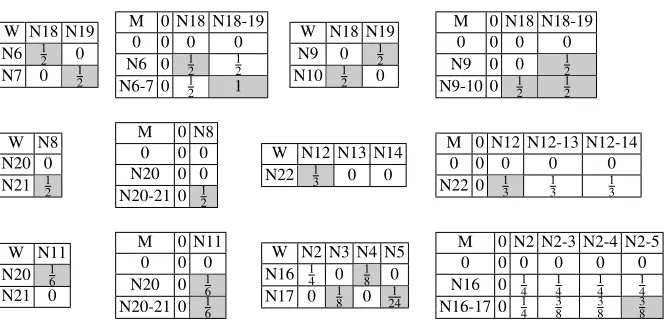
Once completed these operations for all nodes of the sublevel, values are added and the final measure of similarity for the two trees is obtained. Intuitively, in more complex and deeper trees, this process is iteratively executed for all the sublevels. The deeper a mismatch is found, the less its missing contribution will affect the final measure of similarity. Analogous considerations hold for missing/added nodes and branches, sublevels with many nodes, etc. Table 1 shows M and W matrices containing contributions and weights.
Table 1 WandMmatrices for each matching subtree.
W N18 N19 N6 12 0 N7 0 12
M 0 N18 N18-19
0 0 0 0
N6 0 12 12 N6-7 0 1
2 1
W N18 N19 N9 0 12 N10 12 0
M 0 N18 N18-19
0 0 0 0
N9 0 0 12 N9-10 0 1
2 1 2
W N8 N20 0 N21 12
M 0 N8
0 0 0
N20 0 0 N20-21 0 12
W N12 N13 N14 N22 13 0 0
M 0 N12 N12-13 N12-14
0 0 0 0 0
N22 0 13 13 13
W N11 N20 16 N21 0
M 0 N11
0 0 0
N20 0 16 N20-21 0 16
W N2 N3 N4 N5 N16 1
4 0 1 8 0 N17 0 18 0 241
M 0 N2 N2-3 N2-4 N2-5
0 0 0 0 0 0
N16 0 14 14 14 14 N16-17 0 14 38 38 38
following: ourclustered tree matchingintrinsically produces an absolute measure of similarity between the two compared trees; the simple tree matching, instead, returns the mapping value and then it needs subsequent operations to establish the measure of similarity.
Hypothetically, in thesimple tree matchingcase, we could suppose to establish a good estimation of similarity dividing the mapping value by the total number of nodes of the tree with more nodes; indeed, a value calculated in this way would be linear with respect to the number of nodes, thus ignoring important information as the position of mismatches, the number of mismatches with respect to the total number of subnodes/leaves in a particular sublevel, etc.
In this case, for example, the measure of similarity between 2.A and 2.B, ap-plying this approach, would be 147 (0.5). A greater value of similarity could sug-gest, wrongly, that this approach is more accurate. Experimentation showed us that, the closer the measure of similarity is to reflect changes in complex structures, the higher the accuracy of the matching process is. This fits particularly well for HTML trees, which often show very rich and articulated structures.
4 Experimentation
In this section we discuss some experimentation performed on common fields of application [4] and following results. We tried to automatically adapt wrappers, pre-viously built to extract information from particular Web pages, after some -often minor- structural changes.
All the followings are real use cases: we did not modify any Web page, original owners did; thus re-publishing pages with changes and altering the behavior of old wrappers. Our will to handle real use cases limits the number of examples of this study. These real use cases confirmed our expectations and simulations on ad hoc examples we prepared to test the algorithms.
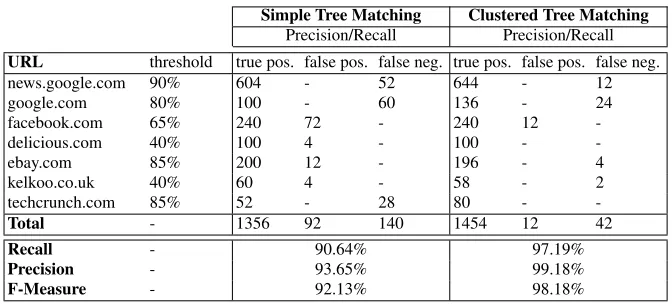
We obtained an acceptable degree of precision using thesimple tree matchingand a great rate of precision/recall using theclustered tree matching. Precision, Recall and F-Measure will summarize these results showed in Table 2. We focused on following areas, widely interested by Web data extraction:
• News and Information: Google News2is a valid use case for wrapper adaptation; templates change frequently and sometimes is not possible to identify elements with old wrappers.
• Web Search: Google Search3completely rebuilt the results page layout in the same period we started our experimentation 4; we exploited the possibility of automatically adapting wrappers built on the old version of theresult page.
• Social Networks: another great example of continuous restyling is represented by the most common social network, Facebook5; we successfully adapted wrappers extracting friend lists also exploiting additional checks performed on attributes.
• Social Bookmarking: buildingfolksonomiesandtaggingcontents is a common behavior of Web 2.0 users. Several Websites provide platforms to aggregate and classify sources of information and these could be extracted, so, as usual, wrapper adaptation is needed to face chages. We choose Delicious6for our experimenta-tion obtaining stunning results.
• Retail: these Websites are common fields of application of data extraction and Ebay 7 is a nice real use case for wrapper adaptation, continuously showing, often almost invisible, structural changes which require wrappers to be adapted to continue working correctly.
• Comparison Shopping: related to the previous category, many Websites provide tools to compare prices and features of products. Often, it is interesting to ex-tract this information and sometimes this task requires adaptation of wrappers to
2http://news.google.com
3http://www.google.com
4http://googleblog.blogspot.com/2010/05/spring-metamorphosis-googles-new-look.html
5http://www.facebook.com
6http://www.delicious.com
structural changes of Web pages. Kelkoo8provided us a good use case to test our approach.
• Journals and Communities: Web data extraction tasks can also be performed on the millions of online Web journals, blogs and forums, based on open source blog publishing applications (e.g. Wordpress9, Serendipity10, etc.), CMS (e.g. Joomla 11, Drupal12, etc.) and community management systems (e.g. phpBB13, SMF14, etc.). These platforms allow changing templates and often this implies wrappers must be adapted. We lead the automatic adaptation process on Techcrunch15, a tech journal built on Wordpress.
We adapted wrappers for these 7 use cases considering 70 Web pages; Table 2 summarizes results obtained comparing the two algorithms applied on the same page, with the same configuration (threshold, additional checks, etc.). Threshold represents the value of similarity required to match two trees. The columns true pos.,false pos.andfalse neg.represent true and false positive and false negative items extracted from Web pages through adapted wrappers.
Table 2 Experimental results.
Simple Tree Matching Clustered Tree Matching Precision/Recall Precision/Recall
URL threshold true pos. false pos. false neg. true pos. false pos. false neg.
news.google.com 90% 604 - 52 644 - 12
google.com 80% 100 - 60 136 - 24
facebook.com 65% 240 72 - 240 12
-delicious.com 40% 100 4 - 100 -
-ebay.com 85% 200 12 - 196 - 4
kelkoo.co.uk 40% 60 4 - 58 - 2
techcrunch.com 85% 52 - 28 80 -
-Total - 1356 92 140 1454 12 42
Recall - 90.64% 97.19%
Precision - 93.65% 99.18%
F-Measure - 92.13% 98.18%
In some situations of deep changes (Facebook, Kelkoo, Delicious) we had to lower the threshold in order to correctly match the most of the results. Both the al-gorithms show a great elasticity and it is possible to adapt wrappers with a high degree of reliability; the simple tree matching approach shows a weaker recall 8http://shopping.kelkoo.co.uk
9http://wordpress.org
10http://www.s9y.org
11http://www.joomla.org
12http://drupal.org
13http://www.phpbb.com
14http://www.simplemachines.org
value, whereas performances of theclustered tree matchingare stunning (F-Measure greater than 98% is an impressive result). Sometimes, additional checks on nodes attributes are performed to refine results of both the two algorithms. For example, we can additionally include attributes as part of the node label (e.g.id,nameand class) to refine results. Also without including these additional checks, the most of the time the false positive results are very limited in number (cfr. the Facebook use case).
Figure 3 shows a screenshot of the developed tool, performing an automatic wrapper adaptation task: in this example we adapted the wrapper defined for ex-tracting Google news, whereas the original XPath was not working because of some structural changes in the layout of news. Elements identified by the original XPath are highlighted in red in the upper browser, elements highlighted in the bottom browser represent the recognized ones through the wrapper adaptation process.
Fig. 3 An example of Wrapper Adaptation.
5 Conclusion
This work presents new scenarios, analyzing Wrapper Adaptation related problems from a novel point of view, introducing improvements to algorithms and new fields of application.
additional checks and it is possible, for example, to improve this aspect with a more complex matching technique, containing full path information, all attributes, etc.
It could be interesting to compare these algorithms, with other tree edit distance approaches working with permutations; although, intuitively,simple tree matching based algorithms can not handle permutations on nodes, maybe it is possible to develop some enhanced version which solves this limitation. Furthermore, just con-sidering the tree structure can be limiting in some particular situations: if a new node has only empty textual fields (or, equally, if a deleted node had only empty fields) we could suppose its weight should be null. In some particular situation this inference works well, in some others, instead, it could provoke mismatches. It could also be interesting to exploit textual properties, nevertheless, not necessarily adopting Natu-ral Language Processing techniques (e.g. using logic-based approaches, like regular expressions, or string edit distance algorithms, or just the length of strings – treating two nodes as equal only if the textual content is similar or of similar length).
The tree grammar could also be used in a machine learning approach, for exam-ple creating some tree templates to match similar structures or tree/cluster diagrams to classify and identify several different topologies of common substructures in Web pages. This process of simplification is already used to store a light-weight snapshot of elements identified by a wrapper applied on a Web page, at the time of extraction; actually, this feature allows the algorithm to work also without the original version of the page, but just exploiting some information about extracted items. This possi-bility opens new scenarios for future work on Wrapper Adaptation.
Concluding, theclustered tree matchingalgorithm we described is very extensi-ble and resilient, so as ensuring its use in several different fields, for example it per-fectly fits in identifying similar elements belonging to a same structure but showing some small differences among them. Experimentation on wrapper adaptation has already been performed inside a productive tool, the Lixto Suite [3], this because our approach has been shown to be solid enough to be implemented in real systems, ensuring great reliability and, generically, stunning results.
References
1. Bille, P.: A survey on tree edit distance and related problems. Theoretical Computer Science 337(1-3), 217–239 (2005). DOI 10.1016/j.tcs.2004.12.030
2. Chidlovskii, B.: Automatic repairing of web wrappers. In: Proceedings of the 3rd international workshop on Web information and data management, p. 30. ACM (2001)
3. Ferrara, E., Baumgartner, R.: Design of automatically adaptable web wrappers. In: ICAART ’11: Proceedings of the 3rd International Conference on Agents and Artificial Intelligence (2011)
4. Ferrara, E., Fiumara, G., Baumgartner, R.: Web Data Extraction, Applications and Techniques: A Survey. Technical Report (2010)
5. Hirschberg, D.: A linear space algorithm for computing maximal common subsequences. Communications of the ACM18(6), 343 (1975)
7. Klein, P.: Computing the edit-distance between unrooted ordered trees. In: Algorithms — ESA’ 98,Lecture Notes in Computer Science, vol. 1461, pp. 1–1. Springer Berlin / Heidelberg (1998)
8. Kowalkiewicz, M., Kaczmarek, T., Abramowicz, W.: MyPortal: robust extraction and aggre-gation of web content. In: Proceedings of the 32nd International Conference on Very Large Data Bases, pp. 1219–1222 (2006)
9. Laender, A., Ribeiro-Neto, B., Silva, A.D., JS: A brief survey of web data extraction tools. ACM Sigmod31(2), 84–93 (2002). DOI 10.1145/565117.565137
10. Lerman, K., Minton, S., Knoblock, C.: Wrapper maintenance: A machine learning approach. Journal of Artificial Intelligence Research18(2003), 149–181 (2003)
11. Meng, X., Hu, D., Li, C.: Schema-guided wrapper maintenance for web-data extraction. In: Proceedings of the 5th ACM international workshop on Web information and data manage-ment, pp. 1–8. ACM, New York, USA (2003). DOI 10.1145/956699.956701
12. Raposo, J., Pan, A., ´Alvarez, M., Vi˜na, A.: Automatic wrapper maintenance for semi-structured web sources using results from previous queries. In: Proceedings of the 2005 ACM symposium on Applied computing - SAC ’05, pp. 654–659. ACM Press, New York, New York, USA (2005). DOI 10.1145/1066677.1066826
13. Selkow, S.: The tree-to-tree editing problem. Information Processing Letters6(6), 184 – 186 (1977). DOI 10.1016/0020-0190(77)90064-3
14. Tai, K.: The tree-to-tree correction problem. Journal of the ACM (JACM)26(3), 433 (1979) 15. Tekli, J., Chbeir, R., Yetongnon, K.: An overview on XML similarity: Background,
cur-rent trends and future directions. Computer Science Review3(3), 151–173 (2009). DOI 10.1016/j.cosrev.2009.03.001
16. Wong, T.l.: A Probabilistic Approach for Adapting Information Extraction Wrappers and Dis-covering New Attributes. In: Proceedings of the Fourth IEEE International Conference on Data Mining, pp. 257–264. Ieee (2004). DOI 10.1109/ICDM.2004.10111
17. Yang, W.: Identifying syntactic differences between two programs. Software - Practice and Experience21(7), 739–755 (1991)
18. Zhai, Y., Liu, B.: Web data extraction based on partial tree alignment. In: Proceedings of the 14th international conference on World Wide Web, pp. 76–85. ACM, New York, NY, USA (2005). DOI 10.1145/1060745.1060761