E-Commerce & M-Commerce Growth, Issues &
Challenges In India
Sanjay Narayan Sinha, Dr. Goutam Tanty, Rashmi Ranjan Panigrahi
Abstract:Over the last decade, Internet have changed the language of E-Commerce transactions for customer towards purchase and sell of good and service. M-Commerce (through E-Commerce) has transform the shopping experiences of customer of India. Emergence of latest technology bring paradigm shift from E-commerce to M-Commerce in online business scenario. According to Data Via Statista source E-Commerce sales graph showing a rising trend and expected to cross a mark of USD 4.878 billion sales growth by the end of year 2021. E-commerce offers wide range of products, choice and convenient delivery options whereas M Commerce offers platform for online transaction through mobile phone. The research objective is to analyze the present status of e-commerce business, its issues & challenges for business growth in India. It is an explanatory and conceptual Paper based on the market study and customer response towards M/E- Commerce transaction.
Index Terms: E-business, E-commerce, M-commerce, Mobile applications, Transactional security, Internet Banking, EMI
—————————— ——————————
1.
INTRODUCTION
E-commerce means electronic commerce and the business is carried out for various products and services with the help of internet. It is buying and selling of various product and services on internet with the help of marketplace software, payment system & delivery system. E-commerce companies create their web portal and products/services are listed on the portal with product details, delivery options and price details. Different payment options are given to the consumer like internet banking, debit card, credit card, cash wallet, EMI and cash on delivery. E-commerce has turned the way people do the shopping in a very short span of time. E-commerce portals Amazon and eBay were launched in 1995, online payment system Paypal launched in 1998, Alibaba.com was launched in 1999 and since then e-commerce marketplaces are rising rapidly.E-commerce industry in India has evolved over a period with innovations e.g. Cash on delivery (COD). In India credit card penetration is low and use of COD has enhanced the e-commerce business significantly. [Raghunath, Alka & Murli Dhar Panga- 2013]. E-commerce has grown rapidly in past 10-15 years in India. Main reasons for growth of e-commerce are given below: Lower Price: Generally, products are available on lower than MRP on e-commerce websites. Companies offer handsome discounts & cashback on products through various schemes. After the order for the product is placed on the marketplace the product is directly shipped from warehouse to customer address. Generally no retail outlet is needed so product may be offered on discounted price by various market place as cost of running retail outlet is saved. Number of employees working at a market place is low with respect to number of orders processed. Various discount coupons and sales/ mega sales are offered by industry.
Time saving: Usually customers travel long way to visit their preferred store for shopping. With e-commerce there is no need to physically visit market for buying the products. Websites can be accessed 24x7. Customers can virtually visit the stores. Products can be located quickly. So it saves time and travelling cost. Items are delivered at home at low courier charges for customers. It is convenient for people living in remote area. Payment options: Option to pay through credit card, internet banking, cash wallets, cash on delivery. Multiple EMI options are offered including zero interest, nil processing fee, no down payment etc. Schemes for cash back/credit card points/reward schemes are offered on many credit/debit card/wallets. Product choices: It is convenient to check detailed specifications of different products before ordering. Compare features of similar products on multiple portals. Various size, color, specifications and choices are available for the products. Mobile applications: Availability of mobile applications for shopping. People can do shopping at convenient time and gets update on product offer, delivery immediately on their mobile. Target Audience: Customers register on e-commerce portal by submitting personal details, address and contact details. Products searched on web by the customer are tracked and companies used to display same/similar products on screen and send products details in email/SMS. Sustainable Business: E-business is one of main factor in globalization of business and e commerce is growing rapidly in India. Due to rise of e-business business firms have the ability to become virtual business. Virtual business uses electronic means for business transaction as opposed to the traditional way of face to face transactions. E-business proved quite cost effective for business as it cuts down the cost of inventory management, marketing, processing, of infrastructure and customer care. Consumer can do business transaction round the clock. [Malhotra, Bhavya- 2014]. Easy Access: Smart phones are easily available to younger generation with internet connection in India. Younger generation in India prefer online shopping for electronics and lifestyle categories products. Other Key drivers in Indian e-commerce are: Increase in Internet speed, rising living standards, Wide product range compared to retailers, time saving, Lower prices compared to retail stores, Increased usage of online portals as more consumer buying and selling second-hand products, Evolution of online marketplace model with sites like Flipkart, Amazon, Bigbasket, Paytm etc. [Malhotra, Bhavya- 2014].
________________________
1
Research Scholar, ICFAI University Jharkhand, Ranchi, India, E-mail: [email protected]
2 Associate Professor, Faculty of Management Science , ICFAI
University Jharkhand, Ranchi, India, E-mail: [email protected]
3
2971
2
LITERATURE
REVIEW
-CHALLENGES
FOR
E-COMMERCE
/
M-COMMERCE
FOR
PAPER
SUBMISSION
Web based e-business has numerous advantages but it has also postured some threats as it is prominently called faceless and borderless. A few cases of moral issues have risen as a consequence of electronic business. Stead and Gilbert reported the ethical issues with e-commerce. [Stead and Gilbert, 2001]. E-commerce industries are facing many challenges including economic, social, technical and legal. Economic challenges includes cost justification, infrastructure limitation and shortage of required skill especially in developing countries. There are number of technical issues like security, reliability and bandwidth availability. Social issues are trust, privacy, security and cultural diversity. On legal front, important challenges are intellectual property rights, taxation and validity of electronic transaction.[Prasad Bingi, Ali Mir and Joseph Khamalah – 2000]. Some old age people are innovative while shopping on e-commerce, while some old age people continue do things in traditional way. Adoption of e-commerce by an old age people should be considered as innovation and the problem should be dealt with innovation theory. [Tatnall, A. and Lepa, J. -2003]. Lack of trust in e-commerce transaction, confidentiality and out dated laws are main challenges to e-commerce. E-commerce companies should take steps to build security & trust to protect their consumers. If company takes steps to increase trust, security in their application and provide better support to their customer the company reputation will increases. [Velmurugan, Manivannan Senthil – 2009]. A more advanced e-banking environment is required for shifting the business from traditional way. The better payment schemes are e-payment, debit card, credit cards and inter bank transfers. Lack of awareness about the business is a big challenge. Many people think that only leading established companies are suited for the e-business environment. M-commerce is doing the transaction of selling and buying of products & services using wireless technology, mobile phones. Security is a main concern for m-commerce industry. [Iqbal, Badar Alam – 2013] [Iqbal, Badar Alam, "E-commerce vs mobile commerce", International Journal of Applied Research, Volume 2, 2013]. Infrastructural issues, economic disparity, vulnerabilities of the payment systems, inadequate legal laws are challenges that should be addressed by all stakeholders to promote e-commerce in the country. Mobile telephony & social sites are major trends influencing people across the country. Smart phones equipped with internet, powerful processors are fueling growth in mobile commerce. Enhanced and usable e-commerce experience generates greater user satisfaction & trust which lead to better customer loyalty and retention. [Sharma, Rajesh – 2014]. Payment collection, logistics, vendor management, taxation, limited internet access, security and privacy of personal data are main barrier to e-commerce. If payment is done using net banking/ credit card a significant amount of charge (up to 4 %) needs to be paid which reduces profit margin. Charges of Indian post office are not acceptable and courier charges are high. Insurance is required for shipping high value items which raises cost of items. Vendor deals with inefficient system for inventory management where daily price update, product photograph, digital sheets might
not be available. Other issues are high tax rate /GST rate and gaps in legal/regulatory framework. [Sharma, Abhilasha Sharma & Ankita Sharma – 2015]. Some barriers of e-commerce are (i) Lack of knowledge and information for use of e-commerce and internet, (ii) Protection of consumer rights (iii) Security of electronic funds transfer (iv) Low internet speed (V) Security and confidentiality of exchanged information [Nanehkaran , Yaser Ahangari -2013] . The growth of E-Commerce is due to increase in smart phones and internet services, government initiative of digitalization, awareness in public, advanced payment and shipping options, entry of foreign e-business players. Government should take steps for providing proper legal framework to e-commerce and reduce hurdles in the business. Barriers for e-commerce in India are poor Internet facilities, feeling unsecure, shipping in remote areas, extra cost for Cash on Delivery (COD), high competition, tax structure and cyber laws. People in most part of the country still prefer physical shopping. [Kumar, Naveen- 2018].
2.1 Objectives of Study
1. To identify the present need of E/M Commerce in modern business in India.
2. To analyze the present status of e-commerce business, its issues & challenges for business growth in India
2.2 Need of E/M Commerce in Modern Business
The need of e-commerce is helps to predict the switching interest of customer in case of online transaction-E-Commerce always providing convenient way of shopping in their local jurisdiction as per Alm & Melnik (2012). As per findings of Anesbury, Dawes, et.al. (2016) E-Commerce provide time efficiency in the purchase experience of online shopping helps to increase. intention of consumer to buying a product. Every organization wants to adopt e-commerce because it helps to improve organization performance and provide sustainable
competitive advantages according to Kasemsap, K. (2018)
3 MAJOR
CHALLENGES
FOR
E-COMMERCE
INDUSTRY
Accessibility: Internet is easily accessible to urban and rural areas of India. These days smart phone with net connectivity is available to large population.
Integrity: Data should not change during transmission/ processing.
Availability of data: Data should be retained for certain period of time in the system.
Government laws: Imposition of tax for certain category and some locality discourages e-commerce business in that area. Quality: Quality of e-commerce website, how well products are organized and displayed, security of customer information matters in the business.
Identity verification of consumer: E-commerce companies do not know about identity of the consumer when a consumer signs up. The consumer may run away with product after order COD (cash on delivery) which may lead to huge loss for the companies.
Customer support: Today there are many channels for communicating with consumers. The company should identify preferred way of communication mode in the locality/area and use it e.g. phone/chat/email/log complain on portal/video call etc. Good customer support is essential for increasing customer trust & confidence.
Analysis of competitor data: Companies need to do thorough research and find out same/similar product sold by competitor and their features. They should come out with strategy to outclass their competitor for surviving in the business.
Mobile Commerce: Mobile commerce is in initial stage in India. M-commerce provide convenient environment for customer and companies.
4 RESEARCH
METHODOLOGY
The paper is based on explanatory and conceptual analysis of existing published research papers, articles, surveys, data published by government of India on web sites and includes both present & historical information. Data have been collected from secondary sources towards developing this research paper.
4 E-COMMERCE
CURRENT
STATUS
IN
INDIA
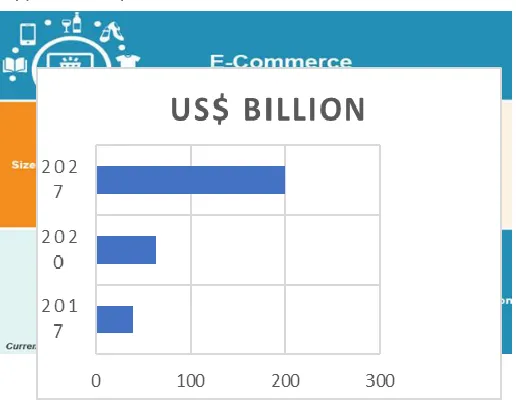
The Indian e-commerce market is expected to grow to US$ 200 billion by 2026 from US$ 38.5 billion as of 2017. Smart phones and use of internet has increased the e-commerce industry significantly. Current internet user base of India is 604.21 million as of Dec 2018 and it is expected to grow to 829 million by 2021.Internet economy of India is expected to grow to USD 250 billion by 2020 from USD 125 in April 2017. India’s E-commerce revenue is expected to grow from US$ 39 billion in 2017 to US$ 120 billion in 2020 and it is growing at an annual rate of 51 per cent approx.
4.1 Figure :1 Trend of E-Commerce market & Sectoral composition E/M Commerce platform in India
Sources-(https://www.ibef.org/industry/ecommerce/ infographic)
MARKET SIZE
With the launch of 4G wireless network and increased coverage of optical fiber network, the Indian e-commerce market is expected to reach to US$ 200 billion by 2026 from US$ 38.5 billion in 2017. [14]. In the electronics category product is currently the biggest contributor to e-commerce
retail sales in India with a share of 48 per cent, followed by apparel at 29 per cent.
Figure :2 Trend prediction of E-Commerce market in India
5 INVESTMENT
AND
DEVELOPMENT
IN
INDIA
Walmart has acquired Flipkart for US$ 16 Billion. Paytm is opening banking services. Google is entering in e-commerce business. Reliance retail is going to launch its online business.
6 G
OVERNMENT INITIATIVE:
The Government of India has announced many initiatives for industries including e-commerce e.g. Digital India, Make in
India, Skill India, Start-up India and Innovation
Fund. Government of India allowed 100 % FDI in E-commerce marketplace model (in B2B models).
7 MAJOR
PLAYERS
OF
E-COMMERCE
IN
INDIA
According to India Brand Equity Foundation (IBEF) , E-Commerce market is expected to reach USD 200 billion by the end of 2026.
7.1 Flipkart and e-commerce
2973
(Source (https://www.ibef.org/industry/ ecommerce.aspx)
7.2 Paytm and e-commerce
(Source( https://www.ibef.org/industry/ecommerce.aspx)
7.3 Infibeam.com and e-commerce
(Source (https://www.ibef.org/industry/ecommerce.aspx))
8 FUTURE
SCOPE
AND
PROSPECTIVE
:
Future of e-commerce is very bright. The e-commerce industry is impacting micro, small and medium enterprise (MSME) in India by providing means of technology and financing. The Indian e-commerce industry is growing rapidly and it is expected to surpass USA by 2034. The growth in e-commerce industry will provide employment and increase revenue for export. [10]
9
ACKNOWLEDGMENTS
I want to convey my thanks to Dr. Goutam Tanty for his
valuable suggestion and guidance to develop this article. The contribution from Mr. Sanjaya N. Sinha, research scholar of ICFAI, University cannot ignore. Above all I convey both the SOA Deemed to be University and ICFAI, University, Jharkhand, Ranchi for providing financial support to complete the article successfully.
10.
REFERENCES
[1] Alm, J., & Melnik, M. I. (2012). Cross‐border shopping and state use tax liabilities: Evidence from ebay transactions. Public Budgeting & Finance, 32(1), 5-35.
[2] Anesbury, Z., Nenycz‐Thiel, M., Dawes, J., & Kennedy, R. (2016). How do shoppers behave online? An observational study of online grocery shopping. Journal of Consumer Behaviour, 15(3), 261-270.
[3] Bingi, P., Mir, A., & Khamalah, J. N. (2000). The
challenges facing global e-commerce. IS
Management, 17(4), 1-9.
[4] E-Commerce Industry in India (April 2019) retrieve from https://www.ibef.org/industry/ecommerce.aspx
[5] Goyal, N., & Goyal, D. (2016). Impact of E-Commerce in India: Issues & Challenges. International Journal of Advanced Research in Computer Science, 7(6).
[6] Gupta, C, Chandhok, A, Gupta, M (2016). Hardship of M-commerce in India: Problems, Issues & challenges. IOSR Journal of Business and Management, 18 (1), 22-26
[7] Iqbal, A. (2013) E-commerce vs mobile commerce. International Journal of Applied Research.02-24
[8] Kasemsap, K. (2018). The importance of electronic commerce in modern business. In Encyclopedia of Information Science and Technology, Fourth Edition (pp. 2791-2801). IGI Global.
[9] Kumar, Naveen. (2018). E – Commerce in India: An Analysis of Present Status, Challenges and Opportunities International Journal of Management Studies, 5, 2(3).
[10]Malhotra, B. (2014). E-Business: Issues & Challenges in Indian Perspective. Global Journal of Business Management and Information Technology, 4(1), 11-16.
[11]Raghunath, A., & Panga, M. D. (2013). Problem and Prospects of E-Commerce. International Journal of Research and Development-A Management Review (IJRDMR), 2(1), 59-68.
[12]Sharma, A & Sharma, (2015). The emergence of e-commerce in India: a unique marketing strategy. Peer Reviewed International Journal ,3
[13]Sharma, R.(2014) Challenges and Opportunities of E-Commerce and Its Role in Management Education in India. International Journal of Current Trends in Engineering & Technology,1(1)
[14]Singh, A., & Badal, N. (2015, October). An efficient implementation of multi matrix clocks in the distributed system. In 2015 International Conference on Green Computing and Internet of Things (ICGCIoT) (pp. 209-213). IEEE.
[15]Stead, B. A., & Gilbert, J. (2001). Ethical issues in
electronic commerce. Journal of Business
[16]Tatnall, A., & Lepa, J. (2003). The Internet, e-commerce and older people: an actor-network approach to researching reasons for adoption and use. Logistics information management, 16(1), 56-63.