Licensed under Creative Common Page 244
http://ijecm.co.uk/
FRAUD AND PERFORMANCE OF THE NIGERIAN
BANKING INDUSTRY (2005 - 2016)
Abolade Francis AKINTOLA
Department of Finance Babcock University, Ilishan-Remo
Ogun State, Nigeria [email protected]
Olusola Babatunde OLUWALAIYE
Department Of Economics Babcock University, Ilishan-Remo,
Ogun State, Nigeria [email protected]
Abstract
The study examined fraud and performance of the Nigeria banking industry from 2005 to 2016.
Secondary data obtained from the Nigeria deposit insurance corporation annual report of
various year were used for the study. Ex –post facto research designed was adopted for this
study and the data were analysed using ordinary least square (OLS) method with the aid of
E-views. Findings from this study showed that there is a direct relationship between fraudulent
activities in the Nigeria banking industry and the expected loss of the banking industry. The
study therefore recommends appointment of trusted and honest officials to represent banks in
the clearing house. Bank official should be well trained and severe punishment should be
arranged for fraudulent personnel. Lastly, effective internal control should be put in place by
every bank to reduce incidence of fraud in banks.
Licensed under Creative Common Page 245 INTRODUCTION
Fraud is a universal phenomenon that has been in existence for so long, its magnitude cannot be known because much of it is undetected and not all that are detected are published (Mahdi & Zhila, 2008). The spate of fraud in the banking industry has lately become an embarrassment to the nation as apparent in the seeming ability of the law enforcement agents to successfully track down culprit. Fraud is the numbers one of the business world but the fear is now that if the increasing wave of fraud in the financial institutions as evident in the recent years if not arrested, it might pose certain threats to stability and the survival of individual financial institution and the performance of industries as a whole as no area of the economy is immuned from fraudsters, even the banking system (Olasunkanmi, 2010). The incidence of fraud that occurred 2008 in some Nigerian banks led to the change of ownership (acquisition) of those banks (Abdullahi, 2011). There are various types of fraud perpetrated in banks according to Eseoghene (2010). Embezzlement is a form of fraud which involves unlawful collection of monetary benefit such as cash, traveller’s cheques and foreign currencies. According to Owolabi (2010), bank failures are as old as banking industry itself. Despite the significant roles banks play in economic development, its failures are becoming well pronounced. Owolabi stated further that dictionary of economic and commerce confirmed that 200 banks failed in England between 1815 and 1850 just a period of 35 years, one of the reasons attributed to this failure is fraud.
Olasunkanmi (2010) defined fraud as known deception intended to wrongfully obtain money or property from the reliance of another on the deceptive statement or acts, believing them to be true. Eseoghene (2010) defined fraud as deceit or trickery deliberately practiced in other to gain some advantage dishonesty, by extension, fraud will include embezzlement, theft or any attempt to steal or unlawful obtain, misuse or harm the assets of banks. Ajisebutu (2006) stated that fraudulent practices has led to the fall of so many banks and organization in time past, thus, step was taken by government by introducing an agency called the Economic and Financial Crime Commission (EFCC) in the year 2003. It is in recognition of the discussion above, this study investigates fraud and the performance of the Nigeria banking industry from 2005 to 2016.
LITERATURE REVIEW
Conceptual Framework
Management Fraud
Licensed under Creative Common Page 246 perpetrating the fraud is financial statement. The predilection for management fraud in most cases is to pull in more investment from both existing and potential shareholders to the organization. Another motivation for management fraud is to paint the bank in good light in the eyes of the regulatory authorities such as Central Bank Of Nigeria (CBN), Nigerian Deposit Insurance Corporation (NDIC), and Nigerian Accounting Standards Board (NASB) etc. Additionally management fraud can also be effected to secure tax advantage from tax authorities. According to Idowu (2009), management fraud is the manipulation of records and the accounts, typically by the enterprise’s senior staff with a view to benefitting in some indirect ways. Deception and Deprivation are the two elements of fraud and management fraud meets the criteria. According to Ajisebutu (2006), the key elements of management frauds are material false statement,knowledge of its (statement) falsification; reliance on the false statement by victim; and damage suffered by victim. Management fraud manifests itself through overstatement of assest or revenues, and understatement of liabilities and expenses, fictitious revenues, timing differences, improper assest valuation, concealed liabilities and expenses, and improper and /or inadequate disclosure.
Insiders or Employees Frauds
Licensed under Creative Common Page 247
Advanced Fee Fraud
This may involve an agent approaching a bank, a company or an individual with an offer to access large funds at below market interest rates often for long term. The purported source of such funds is not specifically identified as the only way to have access to it is through the agent who must receive a fee or commission ‘’in advance’’. As soon as the agent collects the fee, he disappears into thin air and the facility never comes through. Any bank desperate for funds especially the distressed banks and banks needing huge funds to bid for foreign exchange can easily fall victim to this type of fraud. When the deal fails and the fees paid in advance are lost, these vicitims are not likely to report the losses to the police or to the authorities.(Alashi,1994)
Cheque Kiting
Kiting is defined by the US Comptroller of the Currency’s Policy Guidelines For National Bank Directors as ‘’a method whereby a depositor utilises the time required for cheque to clear to obtain an unauthorised loan without any interest charge”. The goal of the cheque kiter may be to use these uncollected funds, interest free, for a short time to overcome a temporary cash shortage or to withdraw the funds permanently for personal use. Competition among banks in the era of deregulation encourages banks to make funds available before actual collection of customers cheques in order to attract customers, especially business accounts.
Account Opening fraud
This involves the deposit and subsequent cashing of fraudulent cheques. It usually starts when a person not known to the bank asks to open a transaction account such as current and savings account with false identification but unknown to the bank.
Letters of Credit Fraud
Letters of credit generally arise out of international trade and commerce, they stimulate trade across national borders by providing a vehicle for ensuring prompt payment by financially sound institutions. In some areas of the world, fraud has historically been a problem especially in Nigeria.
Loan Fraud
Licensed under Creative Common Page 248 that there is an intent to conceal it from the head office (inspectorate) staff on routine check to deceive them with plausible but falsified statements, documents, etc. Advanced perpetrators of credit fraud go to the extent of applying credit facility approved for one customer to the credit of another who is often unrealated to the first customer. That is to say a credit facility for a customer ‘A’ yet to be drawn down is diverted for the use of customer ‘B’.
Counterfeit Securities
Like counterfeiting of money, counterfeiting of commercial financial instruments is one of the oldest forms of crime. Modern photographic and printing equipment has greatly aided criminals in reproducing good quality forged instruments. The documents may be total counterfeits, or may be genuine documents that are copied, forged or altered as to amount, payout date, payee or terms of payment. A common fraud is to present the counterfeit stocks, bonds, treasury notes, cashier’s cheques, bankers acceptances, or certificates of deposit in counterfeit or altered form, may be presented to a bank for redemption. The presenter would draw out the proceeds and disappear before the financial instruments are found to be counterfeit.
Theoretical Framework
Theory of Fraud Triangle
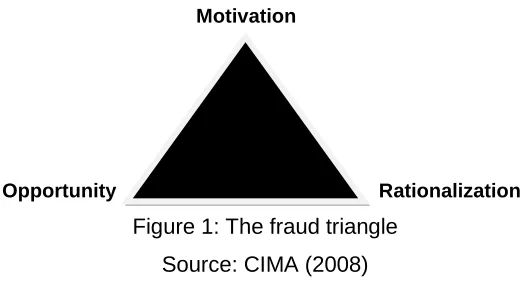
Cressey (1971) formulated fraud triangle theory. The fraud triangle theory consists of three (3) elements that are necessary for investigation of fraud. The three elements are: a)perceived pressure (b)opportunity and (c)rationalization. Pressure refers to needs or desires that have to be satisfied. It could be divided into financial pressure, vices, work-related pressure and other pressures (Adeniji,2012). Opportunity to commit fraud, conceal the fraud or avoid being punished fors the second elements of the fraud triangle. The third element is rationalization which entails giving unnecessary explanation (s) to justify ones involvement in fraud. There exists pressure, motivation or compulsion on the fraudster who identifies opportunity which he utilizes and tries to justify his actions by unnecessary rationalization.
Motivation
Opportunity Rationalization
Licensed under Creative Common Page 249
The Fraud Diamond Theory
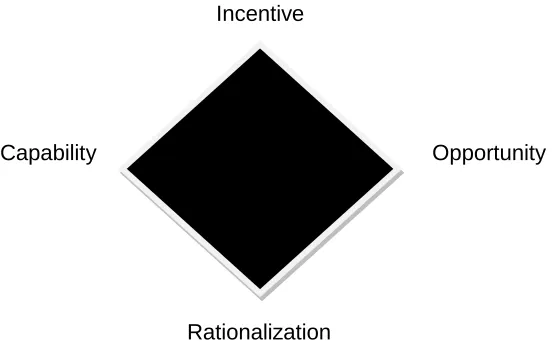
Udeh and Ugwu (2018) stated that Wolfe and Hermerson in 2004 postulated the fraud diamond theory. Fraud diamond added a fourth dimension to fraud triangle where it states that an individual’s capability, personality trait and abilities can play a major role in determination of fraud occurrence. Wolfe and Hermerson (2004) identified four observable traits related to individual capacity to commit fraud:
-Authoritative position or function within the organization
-Capability to understand and exploit the accounting and internal control systems weaknesses to the greatest advantage
-Confidence that fraudulent behaviours will not be detected (or that one can easily escape punishment if the behaviour is detected)
-Capability to effectively deal with stress in order to manage the fraud over a long period of time
Incentive
Capability Opportunity
Rationalization
Figure 2: The Fraud Diamond Model Source: Abdullahi & Mansor (2015)
Theory of Deviations
Licensed under Creative Common Page 250
Theory of Concealment
Concealment is an essential ingredient of most systematic fraud. Owolabi (2010) defined it as a manipulation of an accounting record or misinterpretation of a physical, personal or commercial reality intended to:
-Hide, disguise or alter an account / inventory discrepancy before, during or after a fraudulent act
-Disguise, confuse, or delay the recognition the perpetrators guilt (to avoid location of blame) or to establish a plausible excuse for dishonesty
-Enable the perpetrator to obtain, a dishonest advantage by deception. The theory explains the fact that the perpetrators deliberately introduce confusion during, or after the act, to conceal it or assist in its omission. Greed motivates this type of fraud to exploit any opportunities available.
Theory of Minimum and General Collusion
According to Owolabi (2010), collusion is a factor that is common in most fraudulent practices beyond imagination. It is usually practised under two common umbrella of:
-Providing the necessary opportunities, resources or skills to commit a fraudulent (minimum collusion)
-To share the benefits of frauds among the maximum member.
Minimum collusion exists where there is a need for a special skill to carry out a fraud. The smallest possible number required to carry out the act to succeed will be required.
Empirical Review
Some literatures were reviewed as relate to fraud and bank performance in Nigeria. Moyes and Baker (2003) carried out a study on auditors belief about the fraud detection effectiveness of standard audit procedures. The result shows that out of the 218 standard audit procedures, 56 were considered more effective in fraud detection. The study further reveals that the most effective procedures were those that related to internal controls in terms of it’s existence and or strength. ACFE (2008) provided relevant findings regarding how fraud can be uncovered using the formal mechanisms such as internal audits and internal control features. Informal mechanisms have served as the most frequent precursor to fraud detection.
Licensed under Creative Common Page 251 better knowledge is acquired, the unit could perform better. This implies that internal control do not deter fraudsters from committing fraud.
Adediran and Olugbenga (2010) explored the impact of fraud on bank performance in Nigeria for the period 2000-2007. OLS regression was adopted for the analysis. Findings were that total reported cases of fraud, amount involved in the fraud and the actual expected loss due to frauds had significant inverse relationship with commercial bank investment. Ademoye (2012) descriptively examined the nature, causes, effects, and remedy for bank frauds in Nigeria over the period 2000-2009. Ten banks with the highest number of fraud and forgeries cases were used for the study. Also examined were the categories of bank staff involved in the fraud and forgeries. It was discovered that from 2003-2009, a period of 7 years, a total of 656 members of bank staff were involved in 2,440 cases of frauds and forgeries with core operating staff numbering 431 involved, that is 65.7 percent. Equally noted was the devastating impact of fraud on bank performance such that out of the 24 banks in 2009, only 13 were adjudged sound, one was marginal while 10 were rated unsound as against one unsound the previous year.
Aruomoaghe and Ikyume (2013) examined fraud as a challenge to accurate financial reporting with focus on the banking sector. They adopted descriptive survey research. It was discovered that non accounting for fraud in the organizations financial statement do not reflect a true and fair view of such financial statement and may mislead the users of such financial statement. Afayi (2014) examined the effect of fraud on the performance of banking industry in the United States of America (USA). Banks as a whole was examined, give answers to why bank failed, examined how many banks have failed or what percentage of banks have failed in USA as a result of fraud, scrutinized the protective measures the banking industry have taken to prevent fraudulent practices and list any corrective action if need be. The study spanned from 2000-2014 in which about 523 banks have failed throughout USA. In method 1, the ratio of bank failure caused by fraud as opposed to other factors-out of 20 selected banks, 8 banks representing 40 percent failed due to fraudulent practices.
METHODOLOGY
The main objective of the study was to examine fraud and performance of the Nigerian banking industry from 2005 to 2016.
The Data
Licensed under Creative Common Page 252 analysis are quantitative time series data. The essence was to arrive at an objective result providing a quantitative measure of the impact of fraud on organizational performance in the Nigerian banking industry.
For this purpose, the data are those on: i)Expected losses (EL)
ii)Number of fraudulent cases (NFC) iii)Numbers of staff involved (NSI) iv)Total amount involved (TAI)
Multiple regression analysis with the aid of E-view software was used to analyze the data obtained.
Model Specification
The linear relationship between the dependent and independent variables in this study is functionally expressed below:
Y=f(X1,X2,X3)
Y=βO+β1X1+β2X2+β3X3+μ
Where:
Y=Expected losses (EL) βO=Autonomous (Intercept) β1-3=Coefficient of X1-3
X1=Number of fraudulent cases (NFC) X2=Number of staff involved (NSI) X3=Total amount involved (TAI) μ=Error term
Y represents the dependent variable X1-3 denotes the dependent variable
Model Estimation Techniques
Licensed under Creative Common Page 253 ANALYSIS AND FINDINGS
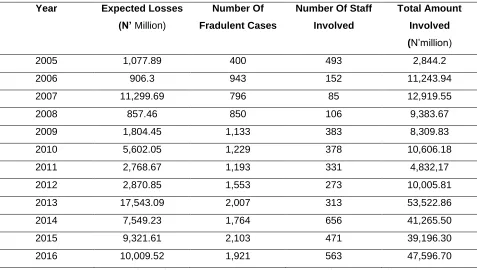
Table 1. Data Presentation
Year Expected Losses
(N’ Million)
Number Of
Fradulent Cases
Number Of Staff
Involved
Total Amount
Involved
(N’million)
2005 1,077.89 400 493 2,844.2
2006 906.3 943 152 11,243.94
2007 11,299.69 796 85 12,919.55
2008 857.46 850 106 9,383.67
2009 1,804.45 1,133 383 8,309.83
2010 5,602.05 1,229 378 10,606.18
2011 2,768.67 1,193 331 4,832,17
2012 2,870.85 1,553 273 10,005.81
2013 17,543.09 2,007 313 53,522.86
2014 7,549.23 1,764 656 41,265.50
2015 9,321.61 2,103 471 39,196.30
2016 10,009.52 1,921 563 47,596.70
Source: Adapted from NDIC ANNUAL REPORTS (2005 -2016)
The above table will be estimated with the aid of the computer based E-views software, the functional relationship between the independent and dependent variables of the specified model will be estimated via the OLS techniques.
Table 2 Result of Regression Analysis (E-view output) Dependent Variable: Y
Method: Least Squares
Date: 03/03/2020 Time: 18:22 Sample: 2005-2016 Included Observations: 12 Variable Coefficient Std. Error t-Statistic Prob.
C 4272.932 3267.093 1.307870 0.0002
X1 1.155623 3.398890 -0.340000 0.6907
X2 8.809449 6.138441 -1.435128 0.0000
X3 0.300865 0.100064 3.006711 0.1393
Licensed under Creative Common Page 254 The estimated model of the relationship between fraudulent activist’s indicators and expected loss in the banking industry is:
Y=4272.932+1.155623X1+8.809449X2+0.300865X3+ μ
The intercept of our regression result portraits a positive sign which can be deduced that the banking sector will be at a loss of N4272.932 million if the fraudulent activities indicators are constant, and moreover, the positive sign also signal that there is a direct relationship between fraudulent activities in the bank industry and the expected loss of the industry, i.e, a 1% rise/fall in the fraudulent indicators will bring about a N4272.932 loss in the industry vice versa.
From the result, it is asserted that as the number of fraudulent cases increased by 1%, it brings about a total of 1.15% increase in the expected loss of the banking industry. This assertion is in line with the real life scenario, because, as fraudulent activities are reducing, the expected loss should also reduce. The positive sign showing number of staff involved signifies that as the number of staff practising fraud increase by 1%, it will lead to a 8.8% increase in the expected loss in the banking industry, which serves as a red light for such firm in the industry. And taking into real life situation, the more the number of staff engaging in fraud practises in an organization, the more the loss such organization’s faces. The last variable indicator displays a positive trend also, as the amount involved in the fraud increases by 1%, it leads to a 0.330% increases in the expected loss of the industry.
Evaluation of Estimated Model
Statistical Significance, Explanatory Power of the Estimated Model
The model will be estimated for statistical significance, explanatory power, reliability of estimates of slope coefficient of our model. We reject or accept the research hypothesizes based on the statistical significance. Evaluation criteria for the statistical significance of individual parameters are statistical criterion based on t-statistic. Evaluation criterion for joint statistical significance will be detected with the use of the F-statistics. The goodness of fit of the model will be explained by the R2.
Individual Statistical Significance
Testing at 5% level of significant and 9 degree of freedom i.e. t9 0.05
Decision rule
With the respect to the respective explanatory variables, if:
Licensed under Creative Common Page 255 T cal < T tab, it is statistically not significant, thus, H1 should be rejected and H0 should be accepted.
Table 3 t- test output
Coefficient /tcal/ < or > T 90.05
β1 0.340000 < 1.833
β2 1.435128 < 1.833
β3 3.006711 < 1.833
Decision
From the above, based on the data used, it is clearly shown that β1 and β2 does not individually exert a statistical significant impact on the expected loss of the bank industry, but β3 does exert statistical significant on the expected loss of the banking industry.
Based on the above explanatory variables and there slope coefficient, we therefore conclude that the number of fraudulent cases (X1) the number of staff involved (X2) individually, has no statistical significant of the economic growth of the country, with this, we accept the null hypothesis (H0), and reject the alternate hypothesis (H1) in the two hypothesis. While the total amount involved in the fraud (X3) individually has a significant effect on the banking industry, therefore, we accept the alternate hypothesis (H1), and reject the null hypothesis (H0).
Joint statistical significant of the model parameters
The F-stats will be used to determine the overall statistical significant of the impact of fraud on organization performance in the banking industry. The test will be carried out at 5% level of significant.
Decision rule
If Fcal > F(k-1)(n-k) Df, parameters are significant jointly, therefore, we accept H1, and reject H0 on the other hand, if Fcal < F(k-1)(n-k) Degree of freedom (DF), parameters are jointly statistically insignificant, on this ground, we accept H0 and reject our H1.
F(k-1)(n-k) :where k=3, n=13 K-1=2, n-k=11
Therefore, F2,11
Decision
Licensed under Creative Common Page 256 that fraudulent practices significant impact on the bank profitability in Nigeria, through the positive effect of number of fraudulent cases (X1), number of staff involved (X2), and the total amount involved (X3). This indicated by the joint statistical significant impact of the slope of the coefficient of these variables on the bank profitability.
The model explanatory power
The coefficient of multiple determination (R2 = 0.737827) implies that the model exhibited high explanatory power, and is a good fit. That is, within the context of the model, about 73.7% of total variations in the fraudulent activities in the banking industry are explained by the moderating variables indicators, and only 26.3% unexplained variations can be attributed to other factors outside our model. The adjusted R-squared (R2=0.639512) shows high explanatory power still after adjustment for degree of freedom. The relevance is the need to emphasize moderating variables as critical factors to curb fraudulent practices in the Nigerian banking industry.
CONCLUSION
Fraud can be seen to be inevitable in the banking industry, it can be minimized to its lowest level if banks employees can imbibe the habit of being honest and disciplined while carrying out their duties. It can be noted that bank employees are the most important assets of the bank, at the same time, bank employees can be of disadvantage to the bank when they tend to effect evil through being involved in fraudulent activities. Fraud has several negative effects on the banking industry and the economy as a whole by increasing the expected losses, closure of banks as witnessed in the case of continental merchant bank, Allied Bank of Nigeria (In Liquidation), increase unemployment rate in the country and finally reduction of gross domestic product as a result of the multiplier effect of closure of banks.
RECOMMENDATIONS
Based on the above findings, the following recommendations are made:
1) Strong and effective internal control system should be put in place by banks to reduce incidence of frauds in Nigerian banks.
2) Adequate training facilities should be put in place by banks to enable staff members detect fraud at initial stage.
3) Inexperienced staff must not be exposed to work in sensitive areas
Licensed under Creative Common Page 257 5) Severe punishment should be arranged for fraudulent personnel because they are the key variables of fraud as fraud will not happen on its own.
6) Nigerian legal system should make provision for speedy dispensation of justice in respect of fraudulent activities.
7) Banks employment policy to be more stringent by making sure proper and adequate reference is obtained in respect of would be employees so that fraudulent persons are not put into the system.
SCOPE FOR FURTHER STUDIES
This study focused on “Fraud and Performance of the Nigerian Banking Industry from 2005 to 2016. Since fraud in this study is limited to the banking industry, a similar study should be conducted in other sectors of the Nigerian Financial system e.g insurance etc. In addition, a comparative study on the effects of fraud in the banking industry in Nigeria and other countries of the world should be carried out to establish a universal trend of fraud.
REFERENCES
Abdullahi, B.A. (2011). The effects of fraud on bank performances: A case study of Nigerian banks. An unpublished B.sc project submitted to the Department of Accounting and Finance University of Ilorin.
Abdullahi, R.& Mansor, N.(2015). Fraud triangle theory and fraud diamond theory: Understanding the convergent and divergent. International Journal of Academic Research in Accounting 5(4), 33-45.
Adediran, S.& Olugbenga, E.(2010). Impact of fraud on banks performance in Nigeria. The Nigerian Academy Forum 19(1).
Ademoye, K.A. (2012). Frauds in Nigerian banks: Nature, deep-seated causes, aftermath and probable remedies, Doi : 10.5901/MJSS.2012 3 (2),279-284.
Adeniji, A.A. (2012) Auditing and assurance services, Revised Edition, Lagos value Analysis consult.
Afayi, T. (2014). The effect of fraud on the performances of banks in the United States of America, https//www.academic.edu/7707784/ the effect of April 8.
Ajisebutu, A.(2006). Financial statement fraud. What auditors should know. The Nigerian Accountants 39(2) 17-25. Alashi, S.O.(1994) fraud prevention and control: Role of government and its agents. The Nigerian Banker, July-Dec.11-15.
Aruomoaghe, J.A & Ikyume, J.C. (2013) Accounting for fraud in Nigeria: The banking sector in focus. International Journal of Research in management 3(6), 59-73.
Association of Certified Fraud Examiners (ACFE,2008). Report to the nation: occupational fraud and abuse Austin, Tx Association of Certified Fraud Examiners.
Bangudu, O.(2011).”Bank Fraud Cases Under Reported.” NEXT 234, June 23.
Chartered Institute of Management Accountants (CIMA) (2008). Fraud risk management; A guide to good practice. Gateway series 57, 1-50.
Comer, M.J. (1985). Corporate fraud, London , McGraw-hills company (UK) limited.
Licensed under Creative Common Page 258 Eseoghene, J.J. (2010) Bank fraud: Underlying causes, effects and possible remedies. Journal of Accounting, Economics, Banking and Finance Research, 6(6), 62-67.
Idowu, A. (2009). An assessment of fraud and its management in Nigeria commercial banks. European Journal of social sciences 10(4), 628-640.
Mahdi, S & Zhila, A. (2008). Fraud detection and audit expectation gap. International Journal of Business and Management 3(10), 65-67.
Moyes, G. & Baker, C.R. (2003). Auditors belief about the fraud detection effectiveness of standard and procedures. Journal of Forensic Accounting 4(2), 199-216.
Olatunji, O.C. (2009). Impact of internal control system in banking sector in Nigeria. Pakistan Journal of social science 6; 181-189.
Olasunkanmi, O. (2010). Computer crime and counter measure in the Nigerian banking sector. Journal of internet Banking and commerce 15(1), 1-10.
Owolabi,S.A. (2010). Fraud and fraudulent practices in Nigeria banking industry. Babcock Journal of Management and social sciences 8(1&2), 283-298.
Udeh, S.N & Ugwu, J.I. (2018) Fraud in Nigerian Banking Sector. International Journal of Academic Research in Business & Social Sciences. Vol 6(5), 590-606.