Licensed under Creative Common Page 100
http://ijecm.co.uk/
ISSN 2348 0386
INTELLECTUAL CAPITAL AS THE FACILITATING
INFRASTRUCTURE OF KNOWLEDGE CREATING AND SHARING
Salman Ansari
Master of Industrial Management, Faculty of Management and Economics, Tarbiat Mosarres University, Tehran, Iran
Alireza Roodbari
Master of Industrial Management, Faculty of Management and Economics, Tarbiat Mosarres University, Tehran, Iran
Leili Rostami Aboosaeidi
Master of Science in Pure Mathematics, Shahid Bahonar University of Kerman, Kerman, Iran [email protected]
Hamed Nassaji
Senior Auditor of Supreme Audit Court of Iran, Tehran, Iran [email protected]
Abstract
In the knowledge-based era, knowledge and other intangible assets are the most important
assets of leading organizations and managing these capitals has become their most important
task. The nature and overlapping objectives of knowledge management and intellectual capital
has led to describe the role of intellectual capital in facilitating knowledge creation and sharing in
this study. This research is applied one in terms of objectives and descriptive-correlational
survey in terms of the quality of data collection and quantitative in terms of data types and
cross-sectional in terms of time view. The statistical population also includes 1958 managers
Licensed under Creative Common Page 101 random sampling. The results showed that all three dimensions of intellectual capital have a
significant and positive impact on creating and sharing knowledge. On this basis,
recommendations have been provided for the development of knowledge management through
improvement of intellectual capital in service organizations such as banks.
Keywords: Intellectual Capital, Knowledge Management, Human Capital, Structural Capital,
Customer Capital
INTRODUCTION
Nowadays most economic firms including banking industry compete in a very dynamic and competitive environment. In such conditions, successful and leading firms apply various and wide programs to guarantee the survival, efficacy and growth. Meanwhile, one of the important success factors of service firms is their ability to improve service quality. This has a considerable impact in attracting and retaining customers and consequently their growth and profitability. Providing high quality services to customers continuously leads to create competitive advantage. Therefore, many of successful service firms seek methods to improve the quality of their services and as a result customer satisfaction with their help. Since satisfied are considered as the source of probability and improving level of customer satisfaction leads to increase profitability of organization. To this end, various strategies and techniques are introduced. One of the most effective and common strategies is to apply method of knowledge management implementation.
Licensed under Creative Common Page 102 their activities and performance (Lee and Choi, 2003: 180). Knowledge management refers to efforts to systematically find, organize and access the organization's intellectual capital and fostering a culture of learning and knowledge sharing within organizations (Capelli, 2000: 12). Many organizations with a focus on knowledge management and extensive investments in information technology are trying to implement knowledge management, to improve their performance (Rastogi, 2000).
In facing with this situation, the first wave of efforts to improve the productivity and organizational effectiveness on hardware setup and use of up to dated equipment technologies and social- human factors attracted increasing attention gradually, and efforts were done to integrate software and brain ware with the above issues. From the perspective of Davenport and Prusak (2000) most organizations took the basic technological and equipment steps needed to improve the organization's productivity level, but have reached a constant status that does not create extra value for them. Changing this status requires the major changes and focusing on key aspects such as culture, structure and other social areas of organization, such as the use of corporate capital (Davenport and Prusak, 2000: 101).
In such circumstances, gaining productivity and sustainable competitive advantage requires to change the behavior of all members in all layers, and this depends on changing beliefs and attitudes of people. Changes in behavior and attitudes are not possible also with simple steps like buying technology, advanced accessories and tools and renaming the traditional phenomena to a new one and pretending to follow the leading organization and it needs a comprehensive approach to care about the hardware aspects along with social-human factors.
For a description of these factors the term "intellectual capital" can be used. A concept that means compound intangible assets of market, intellectual asset, human asset, infrastructure asset that empowered organization to do its activities (Brooking, 1996). Therefore, effective management and development of these assets can help to improve the success and competitive advantage.
Licensed under Creative Common Page 103 and sharing of knowledge. Explanation of this relationship can be synergized to create a whole set of factors that can help to facilitate the implementation of knowledge management.
Therefore, the main objective of this research is to explain how and effect of each of the dimensions of intellectual capital (human capital, structural capital and relational capital) on the creation and sharing of knowledge. Finally solutions to facilitate creating and sharing knowledge with the help of the organization's intellectual capital will be provided.
THEORETICAL BACKGROUND
Intellectual Capital
Intellectual capital contains knowledge, information, intellectual assets and experience that can be used for wealth creation. Intellectual asset consists of a set of collective subjective abilities or key knowledge (Skyrme, 2003). Bintis (1996:41) introduces capital intellectual as the effort to use knowledge (final product) effectively in opposite to information (raw material). Roos et al (1997:413) know intellectual capital involving all processes and assets that often are not shown in balance sheet and it includes all intangible assets (for example, trademarks, patents and brands) that are considered in developed accounting methods. Intellectual capital is a total knowledge of organization’s members and their knowledge application.
Although definitions of intellectual capital are not completely identical, it can be seen in the context of general convergence. Generally, scholars in the field of intellectual capital agree on its three main constructs: Human capital, structural capital and customer capital.
Human Capital
From the perspective of Roos et al (1997), employees create intellectual capital by their competency, attitudes and intellectual agility. Competency contains skills and education; the attitude covers Behavioral construct of what employees do. And intellectual agility also enables a person to change trends and thoughts about innovative solutions of problems. Brooking (1996) believes that human capital of organization covers skills, expertise, ability of solving problems and leadership styles.
Licensed under Creative Common Page 104 Table 1: Indicators of Capital Human
Competency of employees
Strategic leadership of management; characteristics of employees; learning ability of employees; education efficacy of employees, ability of employees to cooperate in decision making and management; technical and managerial education of employees Attitude of
employees
Gaining identity from organizational values; satisfaction rate, leaves of employees, average effective life of employees
Creativity of
employees Creativity ability of employees; income resulted from creative thoughts of employees Source: Chen et al., (2004:195)
Structural Capital
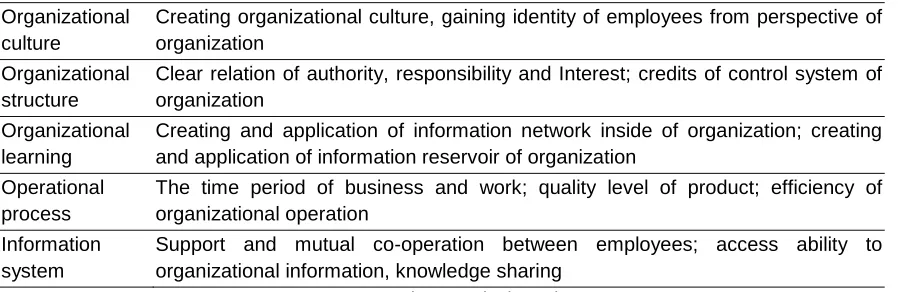
Youndth (2000) knows structural capital as an institutionalized knowledge of organization that is restored in databases, organizational charts, executive instructions, processes, strategies, executive programs and whatever that has higher intellectual value than material value (Roos et al, 1997). From Roos et al point of view (1997), structural capital is what remains in organization when employees leave for home. They believe it as an organizational capital like intellectual capital consists of innovation, processes and cultural asset and also modernization capital and development such as patent. In table 2 indicators of structural capital have been presented.
Table 2: Indicators of Structural Capital
Organizational culture
Creating organizational culture, gaining identity of employees from perspective of organization
Organizational structure
Clear relation of authority, responsibility and Interest; credits of control system of organization
Organizational learning
Creating and application of information network inside of organization; creating and application of information reservoir of organization
Operational process
The time period of business and work; quality level of product; efficiency of organizational operation
Information system
Support and mutual co-operation between employees; access ability to organizational information, knowledge sharing
Source: Chen et al., (2004)
Customer/Relational Capital
The customer capital means to use market information to attract and retain customers. The main issue of customer capital is the available knowledge in marketing channels and relations with customers. The customer capital shows the potential ability of organization due to its external intangible factors (Skyrme, 2003). Although the term "customer capital” first was introduced by Hubert Saint-Onge, new definitions developed its concept as “ relational capital’
Licensed under Creative Common Page 105 customers, competitors, suppliers, commercial associations or government (Bontis, 1999: 433). Roos et al (1997) know relational capital containing relationship with stakeholders inside and outside of organization. A sign of relational capital related to customers is “marketing” Chen et al
(2004) classify relational capital in a form of marketing capability, market strength and customer loyalty (table 3).
Table 3: Indicators of Customer Capital
Basic capability of marketing
Creation and application of customer database; capability of customer services; ability to identify the needs of customers
Market strength Market share; potential ability of market; sale units; the fame of trademark and brand; creating sale channel
Customer loyalty
Customer satisfaction; customer complaints; customer escape; investment on relationship with customers
Source: Chen et al., (2004:195)
Knowledge Management
Karl Wig promoted knowledge management concept for the first time in 1986. He knows knowledge management as a process of making and renewal, application and exploitation of knowledge to make background for knowledge effectiveness and returning its knowledge assets. Since then, many efforts have been done to define management. However, the definition of management is complex and the reason is its many interpretations resulting from multiple views and multiplicity of related fields (Martin, 2000: 17). Knowledge management means the development and exploitation of knowledge assets of organization. In other words, knowledge management refers to systematic and integrated process of collaboration enterprise-wide activities including acquirement, creation, storage, sharing and application of knowledge by individuals and groups in order to accomplish organizational objectives (Rastogi, 2002).
Knowledge Creation
Licensed under Creative Common Page 106 Table 4: Types of the Interaction between Tacit and Explicit Knowledge
To Tacit Knowledge To Explicit Knowledge From tacit knowledge 1. Socialization 2. Externalizing From Explicit knowledge 4. Internalization 3. Combination
Source: Nonaka and Takeuchi, 1995
Knowledge Sharing
Knowledge sharing by McDermott (1999) has been described in a way that talking about a person who shares his knowledge means he guides another person using his knowledge, insight and thoughts to help him see his status better. Additionally, the ideal is that a person shares his knowledge and has to be aware of objective of shared knowledge and its application and also needs and information gaps of a person who receives the knowledge.
Hislop (2009) knows the potential benefits of knowledge sharing in the rewards or incentives. Incentives can be used as tools to extract, enhance and maintain knowledge sharing behavior among employees. However, a study conducted by Wu and Zhu (2012) showed that incentives do not work on knowledge sharing behavior. It is like a trigger for knowledge sharing and cannot be something to keep it in forming the attitude of a person. In many situations, organizational factors such as job involvement and job satisfaction, performance evaluation and recognition act as stimuli for increasing knowledge sharing behavior among employees. In addition, organizational culture, top management support and organizational communication influence knowledge sharing behavior (Sizlivati and Heng, 2015: 233).
The Relationship betweenIntellectual Capital and Knowledge Management
Licensed under Creative Common Page 107 2010). In 2010 Shih and his colleagues also discovered the positive and significant relationship between knowledge management and intellectual capital (Shih et al, 2010). In addition, basic research on knowledge management focused on separate processes of knowledge management in an effort to identify and understand their distinct characteristics (Syed-Ikhsan and Rowland, 2004). So there are research on the relationship between intellectual capital and management complexity and their being critical towards understanding the concepts easily. Intellectual capital comes from a wide recognition of the knowledge that is important for the organization (Dumay, 2009). Knowledge management and intellectual capital encompass various purposes, such as the scope and range of intellectual activities from knowledge creation to make investments on the knowledge (Zhou and Fink, 2003). Ramirez and colleagues in 2007, introduced management of intellectual capital and knowledge management as a set of managerial activities aimed at identifying and assessing and valuing knowledge assets of the organization and also investing in assets through knowledge creation and sharing new knowledge. When knowledge management activities were used for the development and maintenance of intellectual capital was used as a source of competitive advantage (Seleim and Khalil, 2007). In other words, when the intellectual capital was used properly and exploited leads to increase the absorption capacity of the organization that will ultimately facilitate knowledge management processes. And in 2010, Cortini and Benevene also stated that knowledge can add value to the organization through intangible assets (Cortini and Benevene, 2010). In 2003, Zhou and Fink also stated that knowledge management and knowledge management processes influence intellectual capital and will lead to develop and accumulate of intellectual capital (Zhou and Fink, 2003). The relationship between intellectual capital and knowledge management and the impact that these two variables have, ultimately will affect the competitive advantage. In fact, knowledge management includes the dynamic meanings of organizational learning, innovation, competency, expertise and ability to develop intellectual capital (Rastogi,2000). And also knowledge management aims to build and efficient exploit intellectual by knowledge management. Huss adds that the intellectual capital is a set of daily decisions and experiences that occur in business processes and also training and guidance, forms and shapes that all of them create knowledge management mechanisms.
Conceptual Model
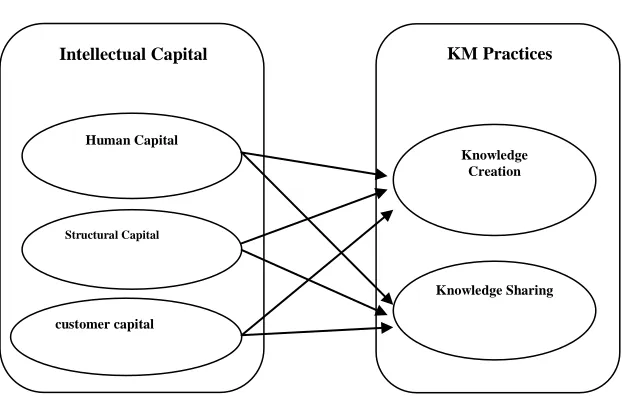
Licensed under Creative Common Page 108 intellectual capital and knowledge management and intellectual capital, comes from this general understanding that knowledge, is of vital importance for the organization (Dumay, 2009). Knowledge management and intellectual capital encompass the broad range of intellectual activities from the knowledge creation to leverage effect of knowledge (Zhou and Fink, 2003). Intellectual capital represents storage of organizational knowledge in the particular time and is the aggregate activities of knowledge (the knowledge processes) (Shih et al., 2010). It seems that there is a close relationship between knowledge management and intellectual capital. When knowledge management practices are used to develop and maintain intellectual capital, will become a source of sustainable competitive advantage of organization (Shih et al., 2010). On the other hand, when the intellectual capital is exploited well, it develops organization's ability to perform knowledge management processes. In addition, the knowledge can add value with intangible assets to the organization (Cortini and Benevene (2010). The impact of intellectual capital on knowledge management has been confirmed by multiple researches (Cortini and Benevene (2010). If intellectual capital is well exploited then it can improve organization's ability to perform knowledge management. Additionally, the building blocks of intellectual capital (intellectual capital, structural capital and relational capital) are important inputs to create knowledge (Huss, 2004) . Therefore, this it can be deduced that intellectual capital can make changes in knowledge management efforts and processes. In this study based on literature stated, knowledge creation and sharing have been considered as the dependent variable and intellectual capital (human capital, structural and customer capital) as independent variables. Figure 1 shows the conceptual model.
Figure 1: Conceptual Framework
Intellectual Capital
customer capital Human Capital
Structural Capital
KM Practices
Knowledge Sharing Knowledge
Licensed under Creative Common Page 109
Hypotheses
Based on the literature reviewed in this study, the following hypotheses are tested:
1. Human capital has a significant and positive impact on the creation and acquisition of knowledge.
2. Human capital has a significant and positive impact on knowledge sharing.
3. Structural capital has a significant and positive impact on the creation and acquisition of knowledge.
4. Structural capital has a significant and positive impact on knowledge sharing.
5. Customer capital has a significant and positive impact on creation and acquisition of knowledge.
6. Customer capital has a significant and positive impact on knowledge sharing.
RESEARCH METHODOLOGY
The present study is descriptive in terms of objective, and applied in terms of usage and cross-sectional in terms of time and is quantitative in terms of data types.
The population consisted of 1958 managers and experts of EN Bank in Tehran 1958 people from whom 322 subjects were selected using random sampling.
Data collection tool used is structured questionnaire with 23 questions from which 15 questions measure intellectual capital dimensions and 8 questions measure knowledge creation and sharing.
To assess the validity of questionnaire, alpha test of .79 used and it has been approved. Because it is greater than the basic amount of 0.7. Finally, data was subject to Structural Equation Modeling to test the hypotheses.
ANALYSIS AND FINDINGS
Licensed under Creative Common Page 110 Figure 2: Model of Intellectual Capital Impact on Knowledge Creation and Sharing in
Significance Mode.
Based on the indicators outlined in table 5, the fitness of model can be judged.
Table 5: Fitness Indicators of Impact Model of Knowledge Management on Human Capital
The fitness indicators of the appropriateness of model shows the measurement model of variables; because chi square to degree of freedom ratio equals 2.25 and less than 3, RMSEA (.037) not in appropriate limit and P-value(.0000) is less than .05. Based on this model, it can be Saied that the impact of intellectual capital dimensions on creating and sharing knowledge is significant because their values are higher than the 1.96. Using the standard model we can also evaluate the impact of relationships that their significance have been confirmed in this study.
Indicators Allowable Value Numbers Obtained Result
Chi-square to the degree of freedom ratio
2/df<3 2.25 FitP-Value p˂.05 .0000 Fit
Licensed under Creative Common Page 111 Figure 3: Model of Intellectual Capital Impact on Knowledge Creation
and Sharing in Standard Mode
The significance model showed the impact of the intellectual capital dimensions on Creating and sharing knowledge are significant. Charts in standard mode also show that to what extend each dimension of intellectual capital (human capital, structural capital, and customer capital) explains the changes of the creation and sharing of knowledge. The summary of findings of the data analysis related to these hypotheses presented in table 6 and is concluded in this regard.
Table 6: The Results of Hypotheses Test
Hypothesis Path: positive and significant impact Standard factor
Significant numbers
The Result 1 Human capital on knowledge creation .72 7.94 Confirmed 2 Human capital on knowledge sharing .61 6.47 Confirmed
3 Structural capital on knowledge
creation .64 6.95 Confirmed
4 Structural capital on knowledge sharing .68 6.51 Confirmed
5 Customer capital on knowledge
creation .78 8.36 Confirmed
6 Customer capital on knowledge sharing .59 5.02 Confirmed
Licensed under Creative Common Page 112 important. Based on the results obtained, developing the organization's intellectual capital has an important and significant impact on creating and sharing knowledge. Based on the results of human capital has the most determining impact on facilitating the implementation of management actions.
The results of this research support the findings of Wu and Tsai (2005) that show intellectual capital has a significant impact on the effectiveness of knowledge management practices. In addition, the obtained results are consistent with the findings of Huang and Wu (2010) that show human capital, structural capital and social capital and social capital has a significant and positive impact on the productivity of knowledge.
The positive impact of human capital on creating and sharing knowledge is consistent with the findings of Chareonsuk and Chansa-ngavej (2008). This is probably because of the role and importance of human capital on creation and sharing of knowledge. The organization with rich human capital improves knowledge creation based on model of Nonaka and Takeuchi (1995) as well as acquiring knowledge from similar organizations.
The impact of structural capital on creating and sharing knowledge is for this reason that the use of highly standardized methods, techniques and processes includes knowledge in processes, systems, procedures and organizational records that are valuable reservoir of knowledge and it can be shared between employees and be exploited in their working processes.
The existence of customer capital (relational) also is because it can facilitate the creation and sharing of knowledge and organizations benefiting from such capital would be better able to identify their own stakeholders’ needs and desires, and create useful knowledge and share it
with their colleagues.
CONCLUSION
Due to changes have occurred in the business and works today, knowledge is increasingly considered by organizations. Competitive environment of business have guided organizations toward knowledge management to take advantage of its benefits. Knowledge management is applied to identify the benefits of sustainable competitive advantage in the competition. In fact, for organizations today, knowledge is the source of the strategy. Managing such strategic resources enables organization to gain special benefits such as reducing costs, innovation in products and services, development practices, quality improvement, and so on.
Licensed under Creative Common Page 113 abilities for the continued survival of their efficiency. Therefore, managers should recognize what capabilities are needed to sustain competitive advantage. For this reason, knowledge assets and intellectual capital are becoming strategic leverage to manage the business performance and continuous innovation of organizations.
Today, organizations do not produce only the product and service, but they must create notable added value to survive. For this reason, managers need to provide suitable environment to grow and foster the minds of the individuals. Knowledge management and intellectual capital provide fundamental capabilities to achieve these results. Therefore, organizations that want to succeed and gain productivity in dynamic conditions of today, must use effective and simultaneous operation of knowledge management and intellectual capital to gain and maintain competitive advantage. Strategies and organizational decisions and human resource development to enhance interactions of knowledge management and intellectual capital should be consistent and compatible with each other.
RECOMMENDATIONS
Below are the recommendations provided in order to develop the intellectual capital and facilitate the creation and sharing of knowledge:
A) The following recommendations are offered to strengthen each building blocks of human capital;
Framework design of employees’ and managers’ capabilities including knowledge and
competencies, their abilities and their development planning based on competencies.
Continuous measurement of competence level of employees and the use of alternative
programs for substitution in different organizational levels.
Continuous assessment and analyzing employee performance during time intervals and
analysis of the results of employee performance evaluation and their comparison with standards and taking measures such as rewarding and punishing.
Designing a reward system to support and encourage top ideas of employees in order to
apply to organization's operational processes and giving appropriate feedback and using 360-degree feedback.
Establishing a system for measuring job satisfaction in the organization and continuous
measurement of job satisfaction.
B) To strengthen each building block of structural capital (organizational structure, organizational culture, operational process, etc.) the following recommendations are offered:
Using advanced structures such as team structures and projects in different parts of the
Licensed under Creative Common Page 114
Identifying some of the key processes that have the maximum value for the customers
and documentation of these processes and identifying and using the experience of domestic and foreign competitors.
Designation of funds and more time to research and practical development and
cooperation and interaction with authorities and scientific meetings and using information systems hat simplify access to information..
The use of suggestion system in the organization to receive opinions and ideas of
employees and outside the organization to receive the ideas of customers.
C) To strengthen each building blocks of relational capital (principal attributes of marketing, market strength and customer loyalty) recommendations provided below:
Training appropriate behavior to employees and those who are in direct connection with
customers.
Identifying the customer's needs.
Continuous monitoring and responding to complaints and expectations of customers in a
timely manner and automation of customer affairs.
Implementing strategic planning in order to identify opportunities and threats in the
external environment and internal strengths and weaknesses in the regulation of contracts and agreements.
D) To facilitate the creation and acquisition of knowledge, recommendations provided below:
Employees and work teams document information continuously and provide to others.
Physical and electronic storage of information, always contains the latest and up to
dated information.
Organization allocates the necessary resources to personnel and working groups that
wish to manage their knowledge.
Personnel and working groups can improve their information environment.
The purpose of teaching new techniques and systems, is their use to promote
performance of working groups and personnel.
Personnel ask the access to information when they really need it.
Certain individuals identify, collect, categorize, summarize and publish organizational
knowledge.
When people are looking for specific information, identifying and introducing them to
specialized groups, is easily possible.
Experts play roles in identifying important information for users and applicants.
There must be procedures for documenting and sharing information to others in the
Licensed under Creative Common Page 115
Tools and electronic facilities and written instructions to guide people to have access to
information .search their required information among many databases.
Information requests that are raised in meetings or through an internal network, are
easily understood
E) To improve the conditions needed to share knowledge in organizations, recommendations below are offered:
The membership of the working groups, to facilitate the transfer of knowledge to all parts
of the organization.
People who refuse to share knowledge, are deprived of some organizational advantages
Experts of the organization, help people to provide what they know so that others can
obtain a better content
People exchange ideas with others about the problems for shared ideas and skills.
Knowledge sharing is recognized formally and publicly
People concentrate knowledge sharing activities based on their data-driven tasks
There must be time allowed to share knowledge
People can identify those in the organization who have usable knowledge.
Knowledge sharing behavior is created by the results of the performance evaluation
system.
Supporting knowledge sharing process, done by specific roles such as knowledge
director or coordinator of knowledge.
RESEARCH LIMITATIONS
There might be unwanted factors in any research that make limitations to the research; hence, some of the unwanted variables are not under researcher`s control. These factors must be determined and the researcher must show his knowledge about the influence of these factors on the research results. In the present study, there were some limitations such as:
To study the variables the survey (questionnaire tools) has been used; while it was better to
use observation and/or interview for some factors. The questionnaire is a tool by which the understandings and attitude of any person is investigated; whereas, the reality might be different with respondent`s answers.
There are two issues must be considered regarding the nature and generalization of the
Licensed under Creative Common Page 116
Some other important limitations to this research include: reluctancy of some of the
respondents to answer the questionnaires, not enough carefulness of some of the respondents in answering the questions, the possibility of bias in answering the questions by some of the respondents.
REFERENCES
Abdollahi, B.; and Nave Ebrahim, A. (2006). Empowerment of employees, Golden Key of Human Resource Management. Tehran: Virayesh Publication (In Persian)
Alavi, M. & Leidner, DE (2001). Review: Knowledge Management and Knowledge Management Systems: Conceptual Foundations and Research Issues. MIS Quarterly, 25 (1): 107-136.
Bintis, N. (1998). Intellectual capital: an exploratory study that Develops measures and models. Managing Decision , 36 (2): 63-76.
Bintis, N. (1999). Managing organizational knowledge by Diagnosing intellectual capital: framing and Advancing the state of the field. International Journal of technology Management, 18 (5/6): four hundred thirty-three to sixty-two.
Bock, G.W.& Kim, Y.G., 2002. Breaking the myths of reward: an exploratory study of attitude about Knowledge sharing. Information resource management journal, 25(2), pp. 14-21.
Bontis, N. (1996). There is a price on your head: Strategically managing intellectual capital. Business Quarterly Summer , 60: 41-47
Brooking, A. (the 1996th). Intellectual capital . London: International Thompson Business Press. Capelli, P. (2000). A market driven approach to retaining talent . Harvad Business Review , 76 (2). Chen, J., Zhu, Z., & Xie, HY (2004). Measuring intellectual capital: a new model and empirical study. Journal of Intellectual Capital , 5 (1): 195-212.
Cortini, M. and Benevene, P. (2010), “Interaction between structural and human capital in ItalianNPO: leadership, organizational culture and human resource management”, Journal of Intellectual Capital, Vol.11 No. 2, pp. 123-39.
Curado, C. (2008), “Perceptions of knowledge management and intellectual capital in banking industry”,Journal of Knowledge Management, Vol. 12, pp. 141-55.
Davenport, TH & Prusak, L. (2000th). Working knowledge: How organizations manage what they know? . Boston, MA: Harvard business school press.
Dumay, J.C. (2009), “Reflective discourse about intellectual capital: research and practice”,Journal of Intellectual Capital, Vol. 10 No. 4, pp. 489-503.
Fei G., Meng L. & Yoshiteru N. (2001). Systems thinking on knowledge and its management: methodology for knowledge management systems. Journal of Knowledge Management , 6 (1): 7-17 . Gupta, AK & Govindarajan, V. (2000). Knowledge Management's Social Dimension: Lessons from Nucor Steel. Sloan Management Review , 42 (1): 71-80 .
Huang, Y. and Wu, Y.J. (2010), “Intellectual capital and knowledge productivity: the Taiwan biotechindustry”, Management Decision, Vol. 48 No. 4, pp. 580-99.
Kelly, j. (1998). Those who can and those who can not: winner and loser in the digital age. Vital Speeches of the Day . 65 (3).
Licensed under Creative Common Page 117 Marr, B. (2004) “Measuring and Benchmarking Intellectual”, Benchmarking : an International Journal,Vol. 11, No. 6, pp. 559-570.
Martin, B. (2000). Knowledge management within the context of management: An evolving relationship. Singapore Management Review , 22 (2): 17.
McDermott, R. 1999, 'Why information technology inspired but cannot deliver knowledge management', California Management Review, vol. 41, no. 4, pp. 103-17.
Monavarian, A.; And Asgari, N. (2009). Organizations in the age of industry, information and knowledge . Tehran : Tehran University Press . (In Persian)
Nonaka, I. (1994). A dynamic theory of organizational knowledge creation. Organizational Science , 5 (1): 14-37. Retrieved on May 3, 2007, from University of Phoenix ProQuest.
Nonaka, I.(2000), A Dynamic Theory Organization Knowledge Creation, Organization Science , 5(1), Pp.14-37.
Organisation for Economic Co-operation and Development (OECD), (the 2000th). Final report: Measuring and Reporting Intellectual Capital: Experience, Issues, and Prospects , Paris: OECD.
Rastogi, PN (2000). Knowledge management & intellectual Virtuous Capital- The new reality of Competitiveness. Human Systems Management , 9 (1): 39-49.
Roos, G. & Roos, J. (1997). Measuring your Company ' s Intellectual Performance, Long Range, Planning, 30 (3): 413-426.
Rowley, J. (2000). Knowledge organization for a new millennium: principles and processes . Journal of knowledge Management , 4 (3): 217-223.
Seleim, A., dan Khalil, O., 2007. “Knowledge Management and Organizational Performance in the Egyptian Software Firms”, International Journal of Knowledge Management, Vol.3, No.4, pp.37-66
Shih, K., Chang, C. and Lin, B. (2010), “Assessing knowledge creation and intellectual capital in banking industry”, Journal of Intellectual Capital, Vol. 11 No. 1, pp. 74-89.
Skyrme, D. (2,003). Knowledge management making sense of an oxymoron . available in. http://www.skyrme.com
Syed-Ikshan, S.O.S.and Rownalds, F.(2004), “Benchmarking knowledge management in a public organization in Malasiya”. Benchmarking- an international journal, vol. 11 No. 2, in press.
Wu, Y. and W. Zhu, 2012. An integrated theoretical model for determinants of knowledge sharing behaviours. Kybernetes, doi:10.1108
Youndth, M.A.(2000),"Human resource consideration and value creation: the mediating role of intellectual capital", Paper Delivered at National Conference of US Academy of Management, Toronto.