Evaluating the Performance in Term of
Throughput of Decentralized users in Cognitive
Radio Wireless Torus Networks
Ms. Snehal Kamble Mr. Akshay P. Nanote
Department of Electronics & Communication Engineering Assistant Manager (Instrumentation) Suresh Deshmukh College of engg. Wardha, Maharashtra, Gupta energy Pvt. Ltd Deoli, wardha
India
Prof. Dinesh Lekariya Professor
Department of Electronics & Communication Engineering Suresh Deshmukh College of engg. Wardha, Maharashtra, India.
Abstract
In this paper, by using wireless Torus network we have evaluate the performance in term of throughput of decentralized users in cognitive radio. Torus network is the one type of topology which is required minimum hopes for data transmission as compared to any other topology. For the channel selection of secondary users we have proposed two techniques Time threshold based technique and Packet threshold based technique. In this paper, we have proposed Torus based compressive data sending protocol for minimizing the delay. By using Compressive technique we have reduced the number of bits required for transmission so, delay required may be lesser thereby improving throughput further. By using these two techniques we have allow the network to communicate at faster rate and also improve the life time of network. We have optimized the delay constraint and minimizing the Bit Error Rate (BER) or Throughput.
Keywords: Cognitive Radio (CR), Wireless Torus Networks, Bit Error Rate (BER), Delays, Throughput
________________________________________________________________________________________________________
I. INTRODUCTION
Fig. 1: Cognitive radio
One of the biggest challenges in cognitive radio networks is spectrum sharing, which defines the set of rules and strategies that regulate the behavior of SUs regarding spectrum mobility, allocation, and access [1]. In this paper, we focus on optimization of delay and minimizing of Bit Error Rate (BER) of decentralized CR based of Torus network. Torus network is the one type of topology which is required minimum hopes for data transmission as compared to any other topology. The aim of cognitive radio is to use the natural resources efficiently including frequency, time, and transmitted energy. Cognitive radio technologies can be used in lower priority secondary system that improves spectral efficiency by sensing the environmental and then filling the discovered gap of unused license spectrum with their own transmission.
Torus Network:
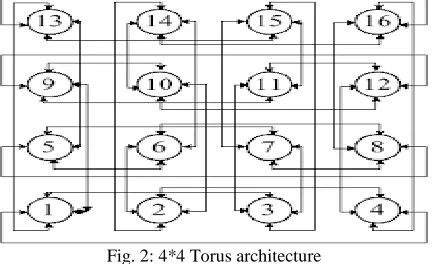
Torus network is the one type of topology which used to transfer the data from source to destination. In wireless mesh network the delay is high due to a hops needed for transmission is more. While in Torus network the minimum hops are required to data communication from source to destination. Topology refers to type of network. Torus networks are frequently used in large-scale supercomputers as a cost-efficient alternative to other topologies. In 4*4 torus topology if we want to send the data from node 1 to node 13 then data can be direct pass only single hop is required. The range of mesh network is less as compared to Torus network.
Fig. 2: 4*4 Torus architecture
The reminders of this paper are as follow in section II the research related to this work has been presented. In section III described the network model which is used for maximizing the throughput of decentralized users. In section IV described the performance evaluation. Then in section V result of this paper. Section VI concludes this paper.
II. RELATED WORK
Cognitive radio is the communication paradigam in which the wireless users are classified into two categories secondary users (unlicensed users) and primary users (licensed users). There is an extensive research activity is going on in the Cognitive radio (CRs) technology in the field on spectrum sharing. The author proposed the Cognitive Radio Wireless Mesh Network (CRWMN) this scheme was used for channel assignment between the users and respective mesh gateways [5]. Scheduling and spectrum allocation are tasks affecting the performance of cognitive radio wireless networks, where heterogeneity in channel availability limits the performance and poses a great challenge on protocol design. The author, present a distributed algorithm for scheduling and spectrum allocation with the objective of maximizing the network’s throughout subject to a delay constraint. During each time slot, the scheduling and spectrum allocation problems involve selecting a subset of links to be activated, and based on spectrum sensing outcomes allocate the available resources to these links.
III. NETWORK MODEL
In a typical cognitive radio scenario, users of a given frequency band are classified into primary users and secondary users. Primary users are licensed users of that frequency band. Secondary users, on the other hand, are unlicensed users that opportunistically access the spectrum when no primary users operating on that frequency band. The simulation interconnection architecture model consists of m × n mesh of switches. Switches consists a slot for a resource. Fig. 1 shows the architecture of Torus interconnection with 16 nodes. A 4 × 4 two-dimensional Torus topology was designed and simulated using network simulator NS2. This topology is easily scaled to different sizes. Switch, resource and link are three basic elements in the topology. Every node has a dedicated point to point link to every other node in the network. Bidirectional links are actually implemented by using a single wire.
IV. PERFORMANCE EVALUATION
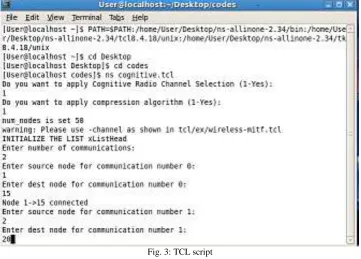
reduces the number of hops while sending packet between those nodes. Node (1) sends a packet to node (13) just by single hop. The additional challenge with larger networks is scalability; it means the ability to add nodes without affecting performance and reliability of the system. We have design the 50 nodes by using NS2. In that the even number of nodes i.e. 2, 4, 6, 8…..48 are primary users which are in red color in Cognitive radio. Similarly the odd nodes i.e. 1, 3, 5, 7…49 are secondary users nodes are in green color. For minimizing the delay we have proposed Compressive data sending protocol. For channel selection of secondary users we have use two technique Time threshold based technique and Packet threshold based Technique. In Time threshold based technique the Threshold time is 1 second when data transmit to primary users the time taken T1. If primary users are not available to accept the data then after 1 second the data send to the secondary users in time T2 and secondary user receive the data in time T3. Again T4 data send to primary users. Maximum primary threshold time is 1 second. In packet threshold technique the normal packet threshold value is 20. When normal packet value is greater than threshold value then it uses to secondary users.
Fig. 3: TCL script
For minimizing the delay we have propose Compressive data sending protocol. For compression data sending protocol threshold value is at least 2. If the data
Repeated or less than threshold value then it discard else pass the data to destination. Coding is in TCL and C++ for binding this code use the adhoc on demand multiple vector routing bind function which is also called constructor.
V. RESULT
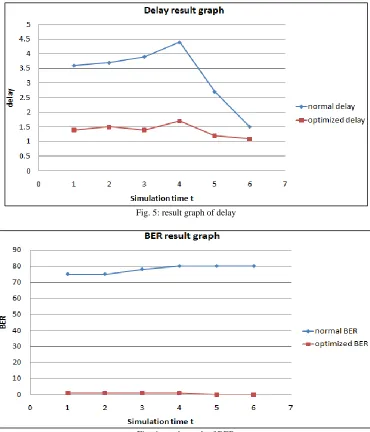
By using compression technique we have minimized the delay in cognitive radio. Here BER and Throughput are directly propotational to each other. By using compression data sending protocol we hane minimized the delay and BER, Hence Throughput of decentralized users are maximizing. When delay and Bit Error rate are minimized then the Throughput of decentralized users are automatically increses. In the result graph define the normal delay and optimized delay and normal BER and optimized BER. On the x-axis define simulation time t in both graph while y-axis in delay graph gives the delay (ms) while in BER graph y-axis define with BER.
Fig. 5: result graph of delay
Fig. 6: result graph of BER VI. CONCLUSION
REFERENCES
[1] Amr A. El-Sherif, Member, IEEEand Amr Mohamed, Member,IEEE “Decentralized Throughput Maximization in Cognitive Radio Wireless Mesh Network” Sep.2014.
[2] Chakrapani gadde, K.Chandrasekhar and I.Hemalatha” Throughput Improvement in Wireless Mesh Networks by Integrating with Optical Networks” May 2012.
[3] Hyang-Won Lee, Member, IEEE, Eytan Modiano, Senior Member, IEEE, Long Bao Le, Member, IEEE “Distributed Throughput Maximization in Wireless Networks via Random Power Allocation” Jun 2009.
[4] Tao Chen, Honggang Zhang, Gian Mario Maggio, and Imrich Chlamtac CREATE-NET via Solteri 38, Trento, 38100, Italy” CogMesh: A Cluster-based Cognitive Radio Network” 2008.
[5] Mohammad Siraj and Saleh Alshebeil “Performance Enhancement in multi Hop Cognitive Radio Mesh Networks” Feb 2013.
[6] J. Zhao, H. Zheng, and G.-H. Yang, “Distributed coordination in dynamic spectrum allocation networks,” in Proc. IEEE DySPAN, Baltimore, MD, USA, Nov. 2005.
[7] L. Cao and H. Zheng, “Distributed spectrum allocation via local bargaining,” in Proc. IEEE Conf. SECON, Santa Clara, CA, USA, Sep. 2005.
[8] Y. Wu and D. H. K. Tsang, “Distributed power allocation algorithm for spectrum sharing cognitive radio networks with QoS guarantee,” in Proc. IEEE INFOCOM, Rio de Janeiro, Brazil, Apr. 2009,
[9] R. Hincapie et al., “Efficient recovery algorithms for wireless mesh networks with cognitive radios,” in Proc. IEEE ICC, Dresden, Germany, Jun. 2009, [10] K. R. Chowdhury and I. F. Akyildiz, “Cognitive wireless mesh networks with dynamic spectrum access,” IEEE J. Sel. Areas Commun., vol. 26, no. 1, pp.
168–181, Jan. 2008