e-ISSN: 2278-067X, p-ISSN: 2278-800X, www.ijerd.com
Volume 14, Issue 2 (February Ver. I 2018), PP.21-26
Cloud Storage Optimization Approach Using Compressive
Sensing
M.Tanooj Kumar
1, Dr.M.Babu Reddy
21,2
Department of Computer Science, Krishna University, Machilipatnam
Corresponding Author: M.Tanooj Kumar
ABSTRACT:-Management of massive data or signals is one of the difficult problems in cloud storage. To handle this, most of the Cloud Storage Providers (CSP’s) incorporate data compression methods to utilize the storage space optimally. We present a compressed sensing based method that allows performing data or signal capturing, its compression and encryption at the same time. We also present techniques specially for reconstructing the signal or data and evaluate their performance.
KEY WORDS:-Cloud Storage, Compressive sensing, Sparsity, Basis Pursuit, Convex optimization.
--- ---
Date of Submission: 10-02-2018 Date of acceptance: 26-02-2018
---
---I.
Introduction
Cloud Storage is a remote, online, data storage service to store, access and share data over the internet. In accordance with the growing demand for cloud storage in an exceedingly safe and fast manner, researchers began to integrate cryptographic and compression techniques. The integration of these two methods may divide into three categories based on the sequence of these two processes. In the first category, cryptographic technique is applied after the compression method, which focuses more on security than the compression. In the second category, compression technique is applied after the cryptographic method, which has an advantage of choosing lossy, lossless or combination of both loss and lossless compression technique. In the third category, both compression and cryptographic techniques will be in a single process either partially or as compressive sensing (CS), which gives a very good data safety assurance with a low computational complexitythat it is qualified for upgrading the efficiency and security of data storage.
The reminder of this paper is as follows. Section II provides background and motivation of the work; Section III describes the design of proposed system; Section IV describes the implementation and experimental results; and, finally, we give concluding remarks in Section V.
II.
Background
A.Basic theory of compressive sensing
Compressive sensing (CS) is one of the alternatives to capture the attributes of a signal using very few measurements, which performs both sampling as well as compression, along with encryption of input data at a time [1, 2]. Compressive sensing was introduced by Candes et al [3] and David L.Donoho in 2004 [4]. It includes the random projection of the signal and reconstructing it from far fewer samples than traditionally required. It depends on two principles: sparsity and incoherence [5].
1)Sparsity:
A signal is called sparse if most of its components are zeros. For representing a signal in a sparse form, the signal should be projected onto a convenient basis (Discrete Cosine Transform, Discrete Fourier Transform etc.) Ψ = [Ψ1, Ψ2 …Ψn]. Using this basis, the signal can be represented as f = Ψ .x,wherex is the coefficient vector for f
under the basis Ψ :
f = 𝑛𝑖=1 (1)
A sparse approximation of a given signal means that the signal can be represented by k (k << n) non zero coefficients and the remaining, are close to or equal to zero, can be discarded without loss of signal quality. 2) Incoherence:
y = Φ .Ψ .x
y = θ .x , where θ = Φ.Ψ (3)
The largest correlation between any two elements of Φ and Ψ is computed by coherence and mathematically, the coherence between the sensing basis Φ and the representation basis Ψ is
µ(Φ,Ψ) = 𝑛. max1≤𝑘,𝑗 ≤𝑛| < 𝛷𝑘, 𝛹𝑗 > | (4)
3) Under-sampling and sparse recovery:
For sparse recovery, preference will be given to compute all the n coefficients of signal f, but subsets of these are usually observed and data is collected.
yk= <f,Φk> , k ∈ M (5)
Where, M is a subset, such that m < n. In general, we assume that x is sparse,that is, it is a linear combination of only k << n basis vectors. Solving the equation (3) for x is equivalent to solving for f as Ψ is a known pre-determined basis.The goal of the compressive sensing is to design measuement matrix Φ and a reconstruction algorithm.
4) Measurement / Sensing Matrix (Φ):
The measurement / sensing matrix (Φ) plays an important role in the process of recovering or reconstructing the original signal. This matrix can be random ones, which is typically Guassian random matrix in numerous CS applications, or can be predefined as per some knowledge about the statistical characteristics of the original signals. The measurement matrix should satisfy the condition called Restricted Isometry Property (RIP) and is givey by
1 - δK ≤
||θV||2
| 𝑉 |2 ≤ 1 + δK for some 0 < δ < 1 (6)
B. Optimization Techniques
At Receiver side, several reconstruction algorithms, either within the context of greedy approaches or convex optimization,, are used to recover or reconstruct the signal from a minimum number of measurements. Convex optimization can be formulated as follows [6]:
Min||x||psuch that y = Ψ. Φ. x = θ .x (7)
Where, θ = Reconstruction matrix and ||x||p is the p-norm given by[ 𝑁𝑛=1 (xn)p]1/p (8)
Various algorithms have been developed to solve this problem through linear programming. One solution is achieved by L0 – norm i.e. p = 0 in equation (7), but it is NP hard problem. L2 – norm or least squares
minimization problem i.e. p = 2 in equation (7) gives not sparse solution. L1 – norm i.e. p = 1 in equation (7)
gives sparse solution and good reconstruction probabilities. Most commonly used algorithms of convex optimization are Basis Pursuit (BP) [7], Basis Pursuit De-noising (BPDN) [7], e Least Angle Regression (LARS) [8], Least absolute shrinkage and selection operator (LASSO) [9]. A greedy approach solves this problem by finding the solution, step by step, in an iterative fashion. Most popular algorithms are Matching Pursuit (MP) [10] and its derivative (OMP) [11] due to their low implementation cost and high speed of recovery. However the Basis Pursuit performance seems good as compared to OMP and its derivatives from minimum measurements perspective [12, 13]. A smaller measurement rate implies less sampling and communication cost at the transmitter side.
III.
Proposedmethod
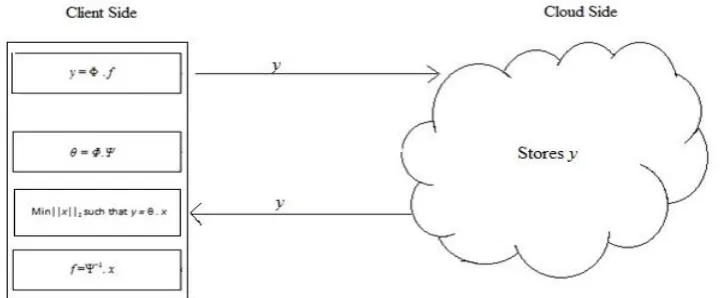
Fig.I Block diagram of proposed method, including both Client and Cloud side, with recovery task
IV.
Experimental Results
Experimental results of the proposed method were as follows.
A. Text Message
Let assume that the message of the text file is THIS IS A SECRET MESSAGE FOR BOB
T H I S I S
01010100 01001000 01001001 01010011 01000000 01001001 01010011 01000000
A S E C R E T
01000001 01000000 01010011 01000101 01000011 01010010 01000101 01010100
M E S S A G E
01000000 01001101 01000101 01010011 01010011 01000001 01000111 01000101
F O R B O B
01000000 01000110 01001111 01010010 01000000 01000010 01001111 01000010
After assigning the Extended ASCII code to each character in the message, the binary code forms a vector of length 256; 90 vector elements are non-zero so this vector has relative sparsity 0.35. It was checked experimentally that measurement matrix (generated with secret key) must have at least compression ratio 0:8 (i. e. matrix size 205 x 256) for successful reconstruction of message. Basis Pursuit algorithm is used for the reconstruction of the message and successfully reconstructed the message.
B. Images
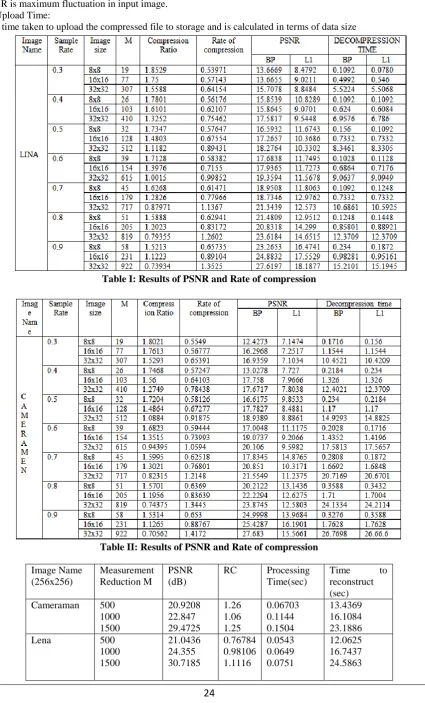
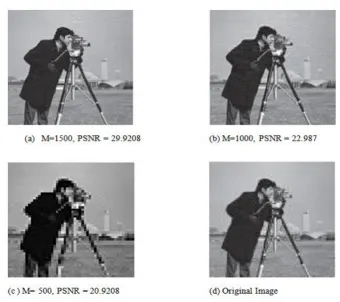
In this section, the experimental (simulation) results for image compression using compressive sensing are presented. These algorithms are applied on Cameraman (Figure 1) and Lena(Figure 2) images, one each, and their performance is evaluated using Compression Rate, Compression Processing Time, PSNR and upload time. Table I, II &III shows the results of PSNR and rate of compression for Cameramen and Lena standard images of different sizes. The parameters are defined as follows:
1) Rate of compression (RC):
Compression Ratio is defined as the ratio between the uncompressed file sizes in bits to compressed file size in bits. Rate of compression is defined as the reciprocal of compression ratio.
Compression rate = 1/ compression ratio 2) Compression processing time:
It is the time taken for compressing the file. 3) Peak Signal to noise Ratio (PSNR):
and R is maximum fluctuation in input image. 4) Upload Time:
It is time taken to upload the compressed file to storage and is calculated in terms of data size
Table I: Results of PSNR and Rate of compression
Table II: Results of PSNR and Rate of compression
Image Name (256x256)
Measurement Reduction M
PSNR (dB)
RC Processing Time(sec)
Time to reconstruct (sec) Cameraman 500
1000 1500
20.9208 22.847 29.4725
1.26 1.06 1.25
0.06703 0.1144 0.1504
13.4369 16.1084 23.1886 Lena 500
1000 1500
21.0436 24.355 30.7185
0.76784 0.98106 1.1116
0.0543 0.0649 0.0751
Table III: Results of PSNR and Rate of compression
V.
CONCLUSIONS
In this paper, we presented the implementation of Compressive sensing (CS) in cloud storage environment. After testing CS on different files of different sizes, it shows significant storage savings and a large M means that a lot of coefficients are captured; this results the high compression rate and high quality of reconstruction of data. We used both Basis Pursuit (BP) and L1-reularised least squares optimizer to perform the optimization step in CS and it is observed that BP gave better performance with respect to both PSNR and the time taken. We can conclude that compressive sensing can be used in the cloud environment to compress the data during storage so that the data transfer time and storage reduced subsequently. We presented an analysis with practical results for text and image files.
References
[1]. M. Elad, ―Optimized Projections for Compressed Sensing‖, IEEE Transactions on Signal Processing,
Vol. 52, (2007).
[2]. Shuhui Bu, Zhenbao Liu, Tsuyoshi Shiina, Kazuhiko Fukutani, Matrix Compression and Compressed Sensing Reconstruction for Photoacoustic Tomography, Elektronikairelektrotechnika, Vol 18, No 9 (2012)
[3]. E. Candes, J. Romberg, and T. Tao, “Robust Uncertainty Principles: Exact Signal Reconstruction from Highly Incomplete Frequency Information,” IEEE Transaction on Information Theory, vol. 52, pp. 489– 509, (2006).
[4]. D.L. Donoho, "Compressed Sensing," IEEE Transactions on Information Theory, vol. 52, pp.1289-1306, (2006).
[5]. E. Candes and J. Romberg , “Practical Signal Recovery from Random Projections,” Processing SPIE International Symposium Electronic Imaging, pp. 76–86, vol. 5674, (2005).
[6]. Baraniuk, R.: Compressive Sensing [Lecture Notes]. IEEE Signal Processing Magazine 24(4), 118-121,(2007).
[7]. Chen, S.S., Donoho, D.L., Saunders, M.A.: Atomic Decomposition by Basis Pursuit. SIAM Rev.43(1),129-159, (2001)
[8]. Tibshirani, R.: Regression Shrinkage and Selection Via the Lasso. Journal of the Royal Statistical Society, Series B 58, 267-288 (1996).
[9]. Efron, B., Hastie, T., Johnstone, I., Tibshirani, R., Ishwaran, H., Knight, K.,Loubes, J.M., Massart, P., Madigan, D., Ridgeway, G., Rosset, S., Zhu, J.I.,Stine, R.a., Turlach, B.a., Weisberg, S., Hastie, T., Johnstone, I., Tibshirani, R.: Least angle regression. Annals of Statistics 32(2), 407-499, (2004).
[10]. Mallat, S.G., Zhang, Z.: Matching pursuits with time-frequency dictionaries. IEEE Transactions on Signal Processing 41(12), 3397-3415, (1993).
[11]. Tropp, J.A., Gilbert, A.C.: Signal Recovery From Random Measurements Via Orthogonal Matching Pursuit. IEEE Transactions on Information Theory 53(12), 4655-4666, (2007).
[12]. Dai, W., Milenkovic, O.: Subspace pursuit for compressive sensing signal reconstruction. IEEE Transactions on Information Theory 55(5), 2230 -2249, (2009).
[13]. Donoho, D.L., Tsaig, Y., Drori, I., Starck, J.L.: Sparse solution of underdetermined systems of linear equations by stagewise orthogonal matching pursuit. IEEE Transactions on Information Theory 58(2), 1094-1121, (2012).