Duke Law Journal
VOLUME 68 APRIL 2019 NUMBER 7
CLAUSE CONSTRUCTION: A GLIMPSE INTO
JUDICIAL AND ARBITRAL
DECISION-MAKING
DAVID HORTON†
ABSTRACT
For decades, the U.S. Supreme Court has insisted that forcing a plaintiff to arbitrate—rather than allowing her to litigate—does not af-fect the outcome of a dispute. Recently, the Court has invoked this “par-ity assumption” to expand arbitral jurisdiction. Reasoning that it does not matter whether an arbitrator or a judge resolves a particular issue, the Justices have allowed arbitrators to decide important questions about the arbitral proceeding itself.
The parity assumption has proven impossible to test. First, cases that are arbitrated differ from those that end up in the judicial system, com-plicating efforts to compare outcomes from each sphere. Second, arbi-tral awards are rarely published and thus remain shrouded in mystery.
However, one important topic defies these limitations. Jurisdictions are divided over whether courts or arbitrators should perform a task known as “clause construction”—determining whether an arbitration clause that does not mention class actions permits such procedures. As a result, both judges and arbitrators have been weighing in on the same question. Moreover, because class members are entitled to notice of rul-ings that impact their rights, the American Arbitration Association re-quires arbitral clause-construction awards to be available to the public.
Copyright © David Horton 2019.
For once, then, it is possible to assess how the two kinds of deci-sionmakers resolve the same issue.
This Article capitalizes on this opportunity by analyzing a dataset of 150 recent judicial and arbitral clause-construction decisions. Its logit regression analysis concludes that arbitrators are nearly 64 times more likely than judges to allow class actions. This Article then uses its findings to propose a solution to the circuit split over clause construc-tion and to inform the broader debate over the boundaries between ju-dicial and arbitral power.
TABLE OF CONTENTS
Introduction ... 1324
I. Clause Construction ... 1332
A. Arbitration About Arbitration ... 1332
B. Arbitration About Class Actions ... 1346
II. Empirically Assessing Clause Construction ... 1358
A. Methodology and Caveats ... 1358
B. Results ... 1362
III. Policy Implications ... 1368
A. Who Should Interpret Silent Arbitration Clauses?... 1368
B. “Ghost” Delegation Clauses ... 1377
Conclusion ... 1381
INTRODUCTION
In 2015, a prison service provider called JPay faced two similar class actions.1
One accused the company of overcharging inmates and their loved ones for electronic money transfers.2 The other alleged that JPay’s “video visitation” sessions—a kind of Skype for the incarcer-ated—were shorter than advertised.3 Yet, like countless other busi-nesses, JPay had tried to protect itself from lawsuits by placing an ar-bitration clause in its contract with customers.4 Thus, in each case, the
1. See Defendants’ Notice of Removal at 1–2, JPay, Inc. v. Kobel, No. 1:16-cv-20121-DPG (S.D. Fla. Jan. 8, 2016) [hereinafter Kobel Complaint]; Defendant’s Notice of Removal at 1–4, JPay, Inc. v. Salim, No. 1:16-cv-20107-DLG (S.D. Fla. Jan. 7, 2016) [hereinafter Salim Complaint]. 2. See Kobel Complaint, supra note 1, at 1.
3. See Salim Complaint, supra note 1, at 1–2.
first clash between the parties centered on whether the plaintiffs could go to court or instead needed to arbitrate.
However, what happened next was like a chess game in reverse. Bucking the conventional wisdom, both groups of plaintiffs invoked JPay’s arbitration provision.5
Although arbitration has acquired a rep-utation as “the place lawsuits go to die,”6 the consumers filed their class actions in the private forum.7
JPay responded by doing something equally unexpected; it tried to stopthe arbitrations and remove the dis-putes to court.8
In turn, this prompted the plaintiffs to file motions in court to compel arbitration of their own claims.9
These backward-seeming tactics are the product of a doctrinal anomaly. In the last decade, the U.S. Supreme Court has expanded the Federal Arbitration Act (“FAA”)10 in two major ways. The first relates to class actions. Starting with 2011’s AT&T Mobility LLC v. Concep-cion,11 the Court has instructed lower courts to uphold class-arbitration waivers in almost all circumstances, placing the burden on individuals to pursue low-value claims in numerous two-party arbitrations.12 The second strand of the Court’s recent FAA jurisprudence revolves around the mind-bending issue of arbitration about arbitration.13 Tra-ditionally, judges have decided matters of “substantive arbitrability”— that is, whether a dispute should be sent to arbitration because it falls within the scope of a valid arbitration clause.14
However, in a line of
5. See Kobel Order, supra note 4, at *1; Order, JPay, Inc. v. Salim, No. 16-20107-CV-1434l-DLG, 2016 WL 9735069, at 2 (May 24, 2016) [hereinafter Salim Order].
6. Hawkins v. Region’s, 944 F. Supp. 2d 528, 532 (N.D. Miss. 2013). 7. See Kobel Order, supra note 4, at *1; Salim Order, supra note 5, at *3–4.
8. See Kobel Order, supra note 4, at *1; Salim Order, supra note 5, at *3–4. 9. See Kobel Order, supra note 4, at *1; Salim Order, supra note 5, at *3–4.
10. Federal Arbitration Act, Pub. L. No. 68-401, 43 Stat. 883 (1925) (codified at 9 U.S.C. §§ 1–16 (2012)).
11. AT&T Mobility LLC v. Concepcion, 563 U.S. 333 (2011).
12. See Epic Sys. Corp. v. Lewis, 138 S. Ct. 1612, 1619 (2018) (“In the Federal Arbitration Act, Congress has instructed federal courts to enforce arbitration agreements according to their terms—including terms providing for individualized proceedings.”); DIRECTV, Inc. v. Imburgia, 136 S. Ct. 463, 471 (2015) (holding that the FAA preempts a California appellate court’s conclu-sion that a class arbitration waiver did not apply to a particular dispute); Am. Express Co. v. Italian Colors Rest., 570 U.S. 228, 238 (2013) (extending Concepcion to cases involving federal statutory claims); Concepcion, 563 U.S. at 344 (prohibiting courts from deeming class-arbitration waivers to be unconscionable).
13. I address this phenomenon in David Horton, Arbitration About Arbitration, 70 STAN.L. REV. 363 (2018). In that piece, I flag, but do not analyze, the jurisdictional split over clause con-struction. See id. at 376 n.93.
cases about arbitrating arbitrability, the Court has opened the door for arbitrators to resolve any conflict about the arbitration.15
As counter-intuitive as it seems, the Court has held that “parties can agree to arbi-trate ‘gateway’ questions[,] . . . such as whether the[y] have agreed to arbitrate” a particular claim.16
These Supreme Court opinions are widely seen as a brutal one-two punch to the plaintiffs’ bar. According to conventional wisdom,
Concepcion and its progeny have sounded “the death knell for
con-sumer and employment class actions.”17
As scores of policymakers, scholars, and journalists have noted, few individuals spend the time and money necessary to arbitrate small grievances.18
Likewise, the Court’s
[substantive] arbitrability’ for a court to decide.”). Unfortunately, the Court sometimes refers to issues of “substantive arbitrability” simply as issues “arbitrability,” and matters of “procedural arbitrability” as not involving “arbitrability.” See, e.g., id. at 83–84.
15. The Court announced that parties could empower the arbitrator to decide whether a dispute falls within the scope of an arbitration clause in the collective bargaining context. See
United Steelworkers of Am. v. Warrior & Gulf Navigation Co., 363 U.S. 574, 583 n.7 (1960) (ex-plaining that the party claiming arbitrability is “excluded from court determination” and “must bear the burden of a clear demonstration of that purpose”). Eventually, the Justices extended this principle to other settings. See Rent-a-Center, W., Inc. v. Jackson, 561 U.S. 63, 66 (2010) (enforc-ing a provision in a freestand(enforc-ing arbitration agreement between an employer and an employee that delegated to the arbitrator exclusive authority “to resolve any dispute relating to the inter-pretation, applicability, enforceability or formation of this Agreement”);First Options of Chi., Inc. v. Kaplan, 514 U.S. 938, 946 (1995) (observing that parties to a commercial contract can “clearly agree[] to have the arbitrators decide (i.e., to arbitrate) the question of arbitrability”).
16. Rent-A-Center, 561 U.S.at 68–69.
17. Maureen A. Weston, The Clash: Squaring Mandatory Arbitration with Administrative Agency and Representative Recourse, 89 S.CAL.L.REV. 103, 116 (2015); see Aaron Blumenthal, Comment, Circumventing Concepcion: Conceptualizing Innovative Strategies to Ensure the En-forcement of Consumer Protection Laws in the Age of the Inviolable Class Action Waiver, 103 CALIF.L.REV. 699, 701 (2015) (“The death knell of the consumer class action has sounded.”); Myriam Gilles & Gary Friedman, After Class: Aggregate Litigation in the Wake of AT&T Mobility v. Concepcion, 79 U.CHI.L.REV. 623, 627 (2012) (“All of the doctrinal developments of recent years circumscribing the reach of class actions pale in import next to the game-changing edict that companies . . . may simply opt out of potential liability by incorporating class action waiver lan-guage in their standard form contracts . . . .”); J. Maria Glover, Disappearing Claims and the Ero-sion of Substantive Law, 124 YALE L.J. 3052, 3054 (2015) (“A private entity, through contractual arbitration provisions, can now significantly reduce or even remove its substantive legal obliga-tions by eliminating claiming.”); David Horton, Federal Arbitration Act Preemption, Purposivism, and State Public Policy, 101 GEO.L.J. 1217, 1222 (2013) (“[C]iting Concepcion, judges are com-pelling arbitration of claims that are destined to fail.”); see also Judith Resnik, Comment, Fairness in Numbers: A Comment on AT&T v. Concepcion, Wal-Mart v. Dukes, and Turner v. Rogers, 125 HARV.L.REV. 78, 118–33 (2011) (critiquing Concepcion).
arbitrating-arbitrability decisions supposedly shield corporations from liability by permitting arbitrators to decide whether the plaintiff must arbitrate her complaint. After all, arbitrators bill by the hour, and they have a pecuniary interest in catering to the repeat-playing businesses that might choose them again.19 Thus, critics speculate that arbitrators are unlikely to exempt matters from arbitration.20
However, on one vital issue, the two prongs of the Court’s case law collide. Although Concepcion mandates that courts enforce ex-press class-arbitration waivers, it does not govern arbitration clauses that neither allow nor prohibit aggregate proceedings.21 In this com-mon situation—when a provision is “silent” on the topic—somebody needs to engage in “clause construction” and decide whether class ac-tions are permissible.22
And here the Justices’ disdain for class actions crashes headlong into their aggrandizement of arbitrators. Under the arbitrating-arbitrability opinions, there is a colorable argument that ar-bitratorsenjoythe right to interpret the arbitration clause.23 Moreover, when it comes to clause construction, arbitrators have financial incen-tives that favor plaintiffs. If an arbitrator reads a silent arbitration pro-vision to bar class actions, she is left with a single, small-dollar claim that will likely be abandoned. But if she goes the other way, she chris-tens a lucrative multiparty dispute.24
C.F.R. pt. 1040). Yet, in October 2017, the Senate voted 51 to 50—with Vice President Pence breaking the tie—to repeal the CFPB’s rule. See Jessica Silver-Greenberg, Consumer Bureau Loses Fight to Allow More Class Action Suits, N.Y. TIMES (Oct. 24, 2017), https://www.ny-times.com/2017/10/24/business/senate-vote-wall-street-regulation.html?_r=0. [https://perma.cc/ H4AV-FSJL].
19. See, e.g., AM. ARB. ASS’N, EMPLOYMENT ARBITRATION RULES AND MEDIATION PROCEDURES r. 13, at 21, r. 44, at 30 (2009), https://www.adr.org/sites/default/files/Employment %20Rules.pdf [https://perma.cc/JS5G-6AYF] (outlining arbitrator selection and compensation); Jean R. Sternlight, Panacea or Corporate Tool?: Debunking the Supreme Court’s Preference for Binding Arbitration, 74 WASH.U.L.Q. 637, 685 (1996) (“An arbitrator who issues a large punitive damages award against a company may not get chosen again by that company or others who hear of the award.”).
20. See David S. Schwartz, Claim-Suppressing Arbitration: The New Rules, 87 IND.L.J. 239, 246 (2012) (“If the arbitrator decides that the arbitration agreement is unenforceable, he loses income.”); cf. Prima Paint Corp. v. Flood & Conklin Mfg. Co., 388 U.S. 395, 416 (1967) (Black, J., dissenting) (reasoning that arbitrators should not be allowed to decide whether arbitration is war-ranted because “[t]heir compensation corresponds to the volume of arbitration they perform”). 21. See, e.g.,Oregel v. PacPizza, LLC, 187 Cal. Rptr. 3d 436, 448 (Ct. App. 2015) (noting that “Concepcion [is] irrelevant” if an arbitration clause “[does] not contain a class action waiver”). 22. See, e.g.,Jock v. Sterling Jewelers Inc., 646 F.3d 113, 116 (2d Cir. 2011) (discussing the clause-construction process).
23. See infra Part I.A.
This dynamic explains the bizarre maneuvering in the class actions against JPay. Both sets of plaintiffs were desperately trying to obtain an arbitrator’s ruling on clause construction. Conversely, the defendant did everything in its power to obtain a decision from a judge on the matter. Ultimately, these intuitions were correct. In one lawsuit, a fed-eral court in Florida engaged in clause construction itself, holding that the agreement precluded class actions.25 Within a week, a different judge in the same Florida district passed the baton to the arbitrator,26 who concluded that the agreement authorized class procedures.27
These incongruous results are part of a larger trend. The legal sys-tem has been unable to clarify whether an arbitration clause that does not mention class actions allows such procedures.28 In fact, as the JPay cases illustrate, judges are now disagreeing about an even more ele-mentary question: Should courts or arbitrators perform clause con-struction?
This Article uses this split in authority as an opportunity. For dec-ades, there has been a raging debate about whether being forced to arbitrate affects the outcome of a dispute.29
As noted above, some
25. See JPay, Inc. v. Kobel, No. 16-20121-CIV-GAYLES/TURNOFF, 2016 WL 2853537, at *4 (S.D. Fla. May 16, 2016); Kobel Order, supra note 4, at *5. As this Article was being edited, the Eleventh Circuit reversed the district court’s decision. See JPay, Inc. v. Kobel, 904 F.3d 923, 931, 936 (11th Cir. 2018) (holding that “that the availability of class arbitration is . . . presump-tively for the courts to decide,” but that the parties had delegated the question to the arbitrator). 26. See Salim Order, supra note 5, at 4. But see Kobel Order, supra note 4, at *5 (“This Court respectfully disagrees with, and is not bound by, the Salim Ruling.”).
27. See Opinion, Order and Award on Clause Construction at 15–16, Salim v. JPay, Inc., Case No. 01-15-005-8277 (Am. Arb. Ass’n 2016) (Hochberg, Harding & Dreier, Arbs.).
28. In fact, as this Article was being edited, the Supreme Court granted certiorari in a case in which lower courts had determined that a silent arbitration clause permitted class actions. See
Varela v. Lamps Plus, Inc., 701 F. App’x 670, 673 (9th Cir. 2017), cert. granted, 138 S. Ct. 1697 (2018). I address Lamps Plus infra notes 280, 287.
servers believe that arbitration’s informal rules and paid decisionmak-ers tilt the scales of justice toward businesses.30
Yet, as a matter of Su-preme Court precedent, arbitration and litigation are equally hospita-ble forums for plaintiffs. Indeed, more than 30 years ago, the Court announced that “[b]y agreeing to arbitrate[,] . . . a party does not forgo [any] substantive rights.”31
This view, which I call the “parity assump-tion,” is a pillar of contemporary arbitration law.32 The Court has re-peated it like a mantra,33
and lower courts have cited it more than 600 times.34
The parity assumption is hard to disprove. For one, arbitration is
private dispute resolution—a “black box[,] . . . where the proceedings
are confidential and non-precedential.”35 Unlike judicial opinions, which are available to the public, arbitral awards do not have to be rea-soned or written.36 Thus, even if one could obtain arbitration results, one could only guess at how an arbitrator arrived at a particular hold-ing.37 Compounding this problem, it is not necessarily instructive to
30. See supra text accompanying notes 19–20.
31. Mitsubishi Motors Corp. v. Soler Chrysler-Plymouth, Inc., 473 U.S. 614, 628 (1985). 32. An earlier draft of this Article used the phrase “parity principle.” However, Professor Luke P. Norris then published a thought-provoking article entitled The Parity Principle, 93 N.Y.U.L.REV. 249 (2018). Norris’s “parity principle” is completely different than mine: it refers to his argument that section 1, which exempts certain contracts from the FAA, reveals that Con-gress did not intend the statute to apply “where wide economic power disparities exist between parties.” Id. at 253 (emphasis added). To minimize confusion, I changed “parity principle” to “parity assumption.”
33. 14 Penn Plaza LLC v. Pyett, 129 S. Ct. 1456, 1469 (2009); Preston v. Ferrer, 552 U.S. 346, 359 (2008); Circuit City Stores, Inc. v. Adams, 532 U.S. 105, 123–24 (2001); Gilmer v. Inter-state/Johnson Lane Corp., 500 U.S. 20, 26 (1991); Rodriguez de Quijas v. Shearson/Am. Express, Inc., 490 U.S. 477, 481 (1989); Shearson/Am. Express, Inc. v. McMahon, 482 U.S. 220, 229–30 (1987).
34. A Westlaw search in the “all cases” database on February 16, 2019, for “adv: arbitrat! /10 forgo /10 ‘substantive rights’” yielded 675 results.
35. Myriam Gilles, The Day Doctrine Died: Private Arbitration and the End of Law, 2016U. ILL.L.REV. 371, 409; see also Thomas J. Stipanowich, The Third Arbitration Trilogy: Stolt-Niel-sen, Rent-A-Center, Concepcion and the Future of American Arbitration, 22 AM.REV.INT’L ARB. 323, 422 (2011) (observing that it is notoriously difficult to “obtain[] sufficient reliable data on largely private arbitration processes”).
36. See, e.g., United Steelworkers of Am. v. Enter. Wheel & Car Corp., 363 U.S. 593, 598 (1960) (“Arbitrators have no obligation to the court to give their reasons for an award.”); Pat K. Chew, Arbitral and Judicial Proceedings: Indistinguishable Justice or Justice Denied?, 46 WAKE FOREST L.REV. 185, 200 (2011) (“[A]rbitrators do not always write opinions. They are not legally required to do so, and the parties may not want or need them.”). The AAA once discouraged arbitrators from memorializing awards in writing in order to insulate them from judicial review.
See Soia Mentschikoff, Commercial Arbitration, 61 COLUM.L.REV. 846, 857 (1961).
Prece-compare arbitration outcomes with those from the judicial system. Be-cause complaints that are arbitrated diverge from those that are liti-gated, any discrepancy in win rates might actually reflect variations in the strength of the underlying cases.38
For these reasons, “research into the fairness of mandatory arbitration ha[s] produced only a handful of empirical studies, and these have told us very little.”39
But clause construction is different. Because class members are entitled to notice of proceedings that impact their rights, the American Arbitration Association (“AAA”) treats clause-construction orders as sui generis. For one, the AAA requires arbitrators to memorialize their clause-construction reasoning in writing.40
Also, rather than shielding awards from disclosure, the AAA publishes all clause-construction rul-ings on its website.41
Moreover, these awards showcase how courts and
dent, 90 N.C.L.REV. 1091, 1093 (2012) (“[W]e know very little about how arbitrators be-have . . . .”).
38. See infra Part II.A.
39. David S. Schwartz, Mandatory Arbitration and Fairness, 84 NOTRE DAME L.REV.1247, 1283 (2009); see also David Sherwyn, Samuel Estreicher & Michael Heise, Assessing the Case for Employment Arbitration: A New Path for Empirical Research, 57 STAN.L.REV. 1557, 1559 (2005) (observing that both “critics and advocates” of arbitration make “assertions that [are] generally devoid of empirical support”). The empirical work that does exist falls into three camps. First, some articles compare arbitration results with other arbitration results. See, e.g., Andrea Cann Chandrasekher & David Horton, Arbitration Nation: Data from Four Providers, 107 CALIF.L. REV. 1, 9 (2019) (examining whether defendants and plaintiffs’ law firms that arbitrate multiple times outperform their one-shot counterparts); Alexander J. S. Colvin, An Empirical Study of Employment Arbitration: Case Outcomes and Processes, 8 J. EMPIRICAL LEGAL STUD. 1, 18 (2011) (same); David Horton & Andrea Cann Chandrasekher, After the Revolution: An Empirical Study of Consumer Arbitration, 104 GEO.L.J.57, 111 (2015) (same) [hereinafter Horton & Chan-drasekher, After the Revolution]; David Horton & Andrea Cann Chandrasekher, Employment Arbitration After the Revolution, 65 DEPAUL L.REV. 457 (2016) (same); cf. Stephen J. Choi, Jill E. Fisch & A.C. Pritchard, Attorneys as Arbitrators, 39J.LEGAL STUD. 109, 128–40 (2010) (ex-amining factors that influence awards in securities arbitration). Second, other scholars use awards to gain a better understanding of how arbitrators decide cases. See Weidemaier, supra note 37, at 1111–30 (surveying citation practices in three samples of arbitral rulings). Third, commentators have compared the results of psychological tests that were given to both judges and arbitrators.
See Susan D. Franck et al., Inside the Arbitrator’s Mind, 66EMORY L.J. 1115, 1166 (2017) (finding that “international arbitrators performed at least as well as, but never demonstrably worse than, judges”).
40. See AM.ARB.ASS’N,SUPPLEMENTARY RULES FOR CLASS ARBITRATIONS r. 3, at 3 (2003), https://www.adr.org/sites/default/files/Supplementary%20Rules%20for%20Class%20 Arbitrations.pdf [https://perma.cc/DW8R-YTGJ] (“[T]he arbitrator shall determine as a thresh-old matter, in a reasoned, partial final award on the construction of the arbitration clause, whether the applicable arbitration clause permits the arbitration to proceed on behalf of or against a class.”).
clause-arbitrators see the exact same issue. Indeed, as different jurisdictions— and different courts within the same jurisdiction—have splintered over
who should interpret the arbitration clause, the task of clause construc-tion has been, in effect, randomly dealt to judges and arbitrators across the country.
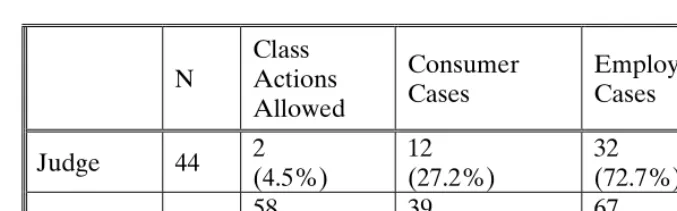
To capitalize on this rare window into the decision-making pro-cess, this Article studies 150 clause-construction orders issued by courts and arbitrators between June 1, 2010, and February 15, 2019. Its results are striking. For most judges, clause construction is simple to the point of being banal. If an arbitration clause does not explicitly permit class actions, it bans them. Indeed, just 2 of the 44 courts in my data (4.5 percent) interpreted a silent arbitration clause to authorize class claims. In sharp contrast, 58 of the 106 arbitrators (54.7 percent) smashed a champagne bottle across the hull of a class action, silent clause notwithstanding. Likewise, this Article’s logit regression analy-sis—which estimates the effect of several variables on clause-construc-tion rulings while holding other factors constant—reveals that the odds of class actions being allowed are 63.7 times higher simply because the issue is arbitrated.
This Article then uses this evidence to reexamine the line between judicial and arbitral power. The Court has used three factors to deter-mine which decisionmaker should resolve issues related to the arbitra-tion.42 At various times, the Justices have considered (1) the need to streamline dispute resolution, (2) the relative expertise of courts and arbitrators, and (3) the parties’ intent.43 Under the parity assumption, one factor that cannot affect the analysis is mere conjecture “that an arbitrator will . . . be driven by an ulterior interest in keeping the case
construction awards. See, e.g., Christopher R. Drahozal & Peter B. Rutledge, Contract and Pro-cedure, 94 MARQ.L.REV. 1103, 1154 (2011) (examining arbitrators’ reasoning in a random sam-ple of 24 clause-construction awards); Alyssa S. King, Too Much Power and Not Enough: Arbi-trators Face the Class Dilemma, 21 LEWIS &CLARK L.REV. 1031 (2017) (analyzing 64 clause-construction awards to track trends in outcomes over time); Weidemaier, supra note 37, at 1115, 1127–28 (analyzing arbitrator citation practices in a dataset that includes 97 clause-construction awards); Alan Scott Rau, “Gap Filling” by Arbitrators 62–63 (The Univ. of Tex. Sch. of Law Ctr. for Glob. Energy, Int’l Arbitration and Envtl. Law, Research Paper No. 2014-03, 2014), https:// repositories.lib.utexas.edu/bitstream/handle/2152/28755/2014_06_Gap-Filling-by-Arbitra-tors.pdf?sequence=2 [https://perma.cc/64E3-QZCF] (criticizing arbitrators’ logic in 22 clause-construction rulings).
in arbitration to generate fees.”44 Nevertheless, the studied clause-con-struction rulings suggest that arbitralbias is real, not just theoretical. Thus, this Article proposes that the arbitrability equation should also consider that certain issues create opportunities for arbitrators to warp their rulings in furtherance of their financial self-interest.
This Article contains three parts. Part I provides background about clause construction. It traces the issue to the expansion of arbi-tration about arbiarbi-tration and the Court’s use of the FAA to curtail class actions. Part II describes how I gathered and analyzed my data. It then establishes that, at least in the AAA, the only variable with a statisti-cally significant effect on the outcome of clause construction is whether a judge or an arbitrator decides the matter. Part III uses this data to draw descriptive and normative conclusions about arbitral power.
I. CLAUSE CONSTRUCTION
This Part describes the two hallmarks of the Supreme Court’s modern FAA jurisprudence. First, the Justices have allowed arbitra-tors to make pivotal decisions about the dispute-resolution process. Second, the Court has encouraged companies to use arbitration as a defense against class actions. This Part then examines clause construc-tion—the hotly contested intersection of these trends.
A. Arbitration About Arbitration
Suppose two parties have a dispute about arbitration. A plaintiff might contend that she never even assented to a contract that contains an arbitration provision. Alternatively, she might concede that she agreed to arbitrate some claims but assert that the arbitration clause is narrow and does not encompass this particular claim. Finally, the par-ties could disagree about whether the plaintiff’s complaint is timely or whether the defendant is barred from compelling arbitration under the doctrines of waiver, laches, or estoppel. These skirmishes raise the same vexing question: Should a court or an arbitrator resolve them? This Section explains that this issue, which is known as “arbitrability,” has long been unsettled. But although the precise contours of the black-letter law may be elusive, the general trend is not—the Court has gradually given arbitrators greater power to decide gateway questions about the arbitration itself.
The story begins in 1925, when Congress passed the FAA.45 Under the ancient ouster and revocability doctrines, courts refused to grant specific performance of an arbitration provision.46 The FAA elimi-nated these antiarbitration principles through its centerpiece, section 2, which makes agreements to arbitrate “valid, irrevocable, and en-forceable, save upon such grounds as exist at law or in equity for the revocation of any contract.”47 By doing so, the statute puts arbitration clauses “upon the same footing as other contracts.”48
In addition, the FAA allocates power between courts and arbitra-tors. On the front end, sections 3 and 4 task judges with ensuring that arbitration is warranted.49
They require a court to be “satisfied” that a lawsuit is “referable to arbitration”50 and that there is no conflict about “the making of the arbitration agreement.”51
On the back end, section 10 permits courts to overrule an arbitrator’s award for extreme de-fects.52
To preserve arbitration’s expediency, judges must confirm an arbitrator’s ruling unless it is tainted by “corruption,” “fraud,” or “par-tiality,”53
or the arbitrators “exceeded their powers” by addressing an issue that the parties did not submit to arbitration.54 This makes judicial review of arbitration awards “extremely deferential.”55
For decades, arbitration was seen as a pale substitute for litigation. Even the FAA’s draftsman, Julius Henry Cohen, cautioned that arbi-tration was “not the proper method for deciding points of law of major importance.”56 Likewise, in Wilko v. Swan, the Supreme Court held that Congress did not intend for plaintiffs to resolve federal statutory
45. Federal Arbitration Act, Pub. L. No. 68-401, 43 Stat. 883 (1925) (codified at 9 U.S.C. §§ 1–16 (2012)).
46. See Kill v. Hollister, (1746) 95 Eng. Rep. 532, 532 (K.B.); Vynior’s Case, (1609) 77 Eng. Rep. 595, 597 (K.B.).
47. 9 U.S.C. § 2.
48. H.R.REP.NO. 68-96, at 1 (1924). 49. See 9 U.S.C. §§ 3–4.
50. Id. § 3. 51. Id. § 4. 52. Id. § 10.
53. Id. § 10(a)(1)–(3). 54. Id. § 10(a)(4).
55. Dluhos v. Strasberg, 321 F.3d 365, 370 (3d Cir. 2003).
claims outside of the court system.57 The Court reached this conclusion, in part, by reasoning that judges are superior to arbitrators:
This case requires subjective findings on the purpose and knowledge of an alleged violator of the [Securities] Act [of 1933]. They must be not only determined but applied by the arbitrators without judicial instruction on the law. As their award may be made without explana-tion of their reasons and without a complete record of their proceed-ings, the arbitrators’ conception of the legal meaning of such statutory requirements as “burden of proof,” “reasonable care” or “material fact,” . . . cannot be examined.58
However, as the decades passed, the lines that Congress had drawn between judges and arbitrators began to blur. One recurring problem arose from the fact that contracts usually contain broad arbi-tration clauses, such as: “Any controversy or claim arising out of or relating to this [a]greement [must] be settled by arbitration . . . .”59 When the parties cast such a wide net, which decisionmaker has juris-diction to rule on arbitrability? That is, who should answer the gateway question of whether a claim is even subject to arbitration? On the one hand, these are controversies or claims that flow from the contract and fall squarely within the ambit of the arbitration provision. This suggests that the parties had agreed to arbitrate arbitrability. On the other hand, it seems perverse to allow arbitrators to decide the very question of whether arbitration is proper.60
57. Wilko v. Swan, 346 U.S. 427, 435–37 (1953), overruled by Rodriguez de Quijas v. Shear-son/Am. Express, Inc., 490 U.S. 477 (1989).
58. Id. at 435–36; see also Alexander v. Gardner-Denver Co., 415 U.S. 36, 57 (1974) (reason-ing that “the factfind(reason-ing process in arbitration usually is not equivalent to judicial factfind(reason-ing” and “[t]he record of the arbitration proceedings is not as complete [and] the usual rules of evidence do not apply”).
The Court has suggested various answers to the arbitrability puz-zle. It first tackled the issue in 1964, with John Wiley & Sons, Inc. v.
Livingston.61 A union entered into a collective bargaining agreement
(“CBA”) with Interscience, a publishing firm.62
The CBA gave em-ployees seniority and pension rights and also established a multistep dispute-resolution process in which the union could only initiate arbi-tration after it had tried to negotiate with the employer.63 John Wiley & Sons acquired Interscience and refused to provide the benefits that its predecessor had granted.64 The union protested by filing an arbitra-tion, but Wiley countered that it could not be compelled to arbitrate because (1) it had never signed the CBA, and (2) alternatively, the un-ion had failed to meet and confer before filing its grievance.65
Justice Harlan, writing for the majority, attempted to solve the problem by dividing arbitrability into two camps.66 First, he explained, there are matters of substantive arbitrability, which judges—not arbi-trators—must resolve.67 Substantive arbitrability arises when a party argues that it never manifested assent to an agreement that includes an arbitration clause.68 As Justice Harlan explained, because arbitration draws its legitimacy from the parties’ consent, permitting an arbitrator to determine whether a party had consented would be premature.69 Un-der this rubric, Wiley’s assertion that it had not agreed to the CBA raised a matter of substantive arbitrability.70 Indeed, the Court held, because “[t]he duty to arbitrate” is wholly “contractual,” a court must “determin[e] that the [CBA] does in fact create such a duty.”71
61. John Wiley & Sons, Inc. v. Livingston, 376 U.S. 543 (1964). Wiley did not involve the FAA; rather, it arose under section 301 of the National Labor Relations Act (“NLRA”), which governs collective bargaining agreements. See Labor Management Relations Act, Pub L. No. 80-101, § 301, 61 Stat. 136, 156 (1947) (codified at 29 U.S.C. § 185 (2012)).
62. Wiley,376 U.S. at 544–45. 63. Id. at 545, 556–57. 64. Id. at 545. 65. Id. at 545, 556–57. 66. Id. at 547–59.
67. Id. at 545–47. Lower courts had previously used this term loosely to signify “the question of arbitrability of the subject matter.” Brass & Copper Workers Fed. Labor Union No. 19322 v. Am. Brass Co., 172 F. Supp. 465, 467 (E.D. Wis. 1959), aff’d, 272 F.2d 849 (7th Cir. 1959). 68. See Wiley, 376 U.S. at 558.
Second, Justice Harlan explained that questions involving proce-dural arbitrability are for arbitrators.72
Justice Harlan applied this label to Wiley’s assertion that the union had failed to exhaust the steps nec-essary to arbitrate.73
Justice Harlan reached this result by noting that the evidence necessary to resolve the arbitrability issue overlapped with the evidence that pertained to the merits of the union’s complaint:
Questions concerning the procedural prerequisites to arbitration do not arise in a vacuum; they develop in the context of an actual dis-pute about the rights of the parties to the contract or those covered by it. In this case, for example, the Union argues that Wiley’s con-sistent refusal to recognize the [CBA] . . . made it “utterly futile—and a little bit ridiculous to follow the grievance steps as set forth in the contract.” . . . These arguments in response to Wiley’s “procedural” claim are meaningless unless set in the background of the merger and the negotiations surrounding it.74
Thus, Justice Harlan reasoned that it would be more economical to allow the arbitrator to entertain both claims.75 I refer to this view— which allocates power between judges and arbitrators with an eye to abbreviating the dispute-resolution process—as the efficiency theory of arbitrability.
Unfortunately, Wiley created more questions than it answered. The Court’s logic for assigning procedural arbitrability to arbitrators— that the same evidence pertained to the arbitrability of the grievance and to the actual grievance76—also applies to matters of substantive ar-bitrability. Wiley itself is a shining example of this phenomenon. The Court held that judges, not arbitrators, should assess whether the CBA’s arbitration clause had survived the merger and therefore gov-erned Wiley.77 But whether the CBA had survived the merger was also the fulcrum of the underlying complaint. Indeed, if Wiley was not
72. Id. at 555. The phrase “procedural arbitrability” was not new. See Carey v. Gen. Elec. Co., 213 F. Supp. 276, 283 (S.D.N.Y. 1962), modified, 315 F.2d 499 (2d Cir. 1963) (defining “pro-cedural arbitrability” to mean “objections to arbitration on the ground that the party seeking to compel it has failed to comply with the procedural requirements of the grievance and arbitration provisions”).
73. Wiley, 376 U.S. at 556–59. 74. Id. at 556–57.
75. See id. at 558 (claiming that failing to allow the arbitrator to decide the two claims would result in a delay that “may entirely eliminate the prospect of a speedy arbitrated settlement of the dispute, to the disadvantage of the parties . . . and contrary to the aims of national labor policy”). 76. See id. at 556–58.
bound by the CBA, then it did not need to honor the concessions that Interscience had made in the agreement. Accordingly, because sub-stantive and procedural arbitrability can bleed into the merits, the dis-tinction between the two remains unclear.
Commentators have tried to fill this gap. Some assert that the di-vision between judicial and arbitral authority should revolve around the parties’ wishes.78
Arguably, matters of substantive arbitrability— such as whether a party had manifested assent to the contract that in-cluded the arbitration clause—are crucial.79
To minimize the risk of er-ror, plaintiffs and defendants likely prefer to litigate these topics using traditional judicial procedures and appellate review.80
Conversely, the parties likely would not object to arbitrating mere procedural issues because the stakes are lower.81
I refer to the idea that issues should be assigned to judges or arbitrators “based on their importance to the par-ties” as the intent theory of arbitrability.82
Another proposal revolves around the fact that arbitrators are steeped in the norms of a particular industry.83 Thus, the argument pro-ceeds, specialist arbitrators are better than generalist judges at evalu-ating the interactions between the parties that underlie disputes about procedural arbitrability.84
Perhaps, then, Wiley’s rule “that procedural compliance was an issue for the arbitrator implicitly relied upon the presumed special competence of the arbitrator to make this type of de-cision.”85 I refer to this as the expertise theory of arbitrability.
78. See The Supreme Court, 1963 Term—Government Regulation, 78 HARV.L.REV. 266, 287 (1964) (noting that the most likely explanation for the division is that “various questions are arranged on a spectrum depending in large part on their importance to the parties”).
79. See id.
80. See id.
81. See id. (“The procedural issue can be assigned to an arbitrator because it would seem a less serious imposition . . . to arbitrate when procedural prerequisites have not been met than to compel arbitration of an issue that he asserts he never agreed to arbitrate at all.”).
82. See id.
83. See, e.g., Alan Schwartz, Comment, Procedural Arbitrability Under Section 301 of the LMRA, 73 YALE L.J. 1459, 1468–71 (1964).
84. See Phila. Dress Joint Bd. of the Int’l Ladies’ Garment Workers’ Union v. Sidele Fash-ions, Inc., 187 F. Supp. 97, 100 (E.D. Pa. 1960) (“[T]he grievance procedure concerns the everyday relationships of management and labor and is part of the contract which would benefit from in-terpretation by the arbitrator, who has specialized knowledge in the field.”).
The conflict between these views came to the fore with “scope ar-bitrability”—the question whether an arbitration clause is broad enough to cover a particular claim.86 At first blush, scope arbitrability seems to belong to the substantive arbitrability family. Indeed, there is little difference between objecting, “I never agreed to arbitrate any
cause of action,” and contending, “I never agreed to arbitrate this cause of action.”87 Yet, there are also powerful arguments that arbitrators should interpret the agreement to arbitrate. For one, Wiley’s efficiency theory suggests that disputes over the meaning of the arbitration clause are matters of procedural arbitrability because they usually overlap with the underlying merits. For example, in breach of contract cases, the parties’ negotiations shed light on the arbitrability of the merits and on the merits themselves.88 Similarly, the expertise rationale fits ques-tions of scope arbitrability like a glove. Arbitrators are nothing less than “the parties’ officially designated ‘reader’ of the contract.”89 One of their greatest assets is their “familiarity with the vocabulary and cus-toms of the industry”—skills that come to the fore when there is con-flict over the meaning of the agreement.90
Because scope arbitrability has a foot in both worlds, it is a hybrid. Like matters of substantive arbitrability, it is generally “an issue for judicial determination.”91
However, the Court cast a judge’s jurisdic-tion over these issues as a mere presumpjurisdic-tion that the parties could override by “clearly and unmistakably” permitting an arbitrator to
de-constituting the environment in which the collective agreement was drawn up, the arbitrator is better qualified to settle disputes arising under the agreement”).
86. Consol. Rail Corp. v. Metro. Transp. Auth., No. 95 Civ. 2142 (LAP), 1996 WL 137587, at *8 (S.D.N.Y. Mar. 22, 1996).
87. Cf. George Bermann & Alan Scott Rau, Gateway-Schmateway: An Exchange Between George Bermann and Alan Rau, 43 PEPP.L.REV. 469, 475 (2016) (“[I]t is one thing to say, ‘I never agreed to arbitrate,’ and it is another to say, ‘Well, I did agree to arbitrate, but I didn’t agree to arbitrate that.’”).
88. See Archibald Cox, Reflections Upon Labor Arbitration, 72 HARV.L.REV. 1482, 1509 (1959) (“The evidence bearing upon questions of arbitrability is often relevant to the merits.”).
89. Boise Cascade Corp. v. United Steelworkers of Am., Local Union No. 7001, 588 F.2d 127, 128 (5th Cir. 1979) (quoting Theodore J. St. Antoine, Judicial Review of Labor Arbitration Awards: A Second Look at Enterprise Wheel and Its Progeny, 75MICH.L.REV. 1137, 1140 (1977)).
90. Recent Case, Arbitration and Award—Arbitrators and Proceedings—By Considering Trade Usage Arbitrator Exceeded Authority to Interpret Contract Which Reviewing Court Finds Unambiguous, 63HARV.L.REV. 347, 348 (1949).
cide whether a lawsuit falls within the ambit of the agreement to arbi-trate.92
In the 1980s, the lack of guidance from the Court about arbitrabil-ity became a pressing problem. In a series of controversial opinions, the Court expanded the FAA.93
For example, the Court overruled
Wilko’s prohibition on the arbitration of federal statutory claimsand
began to order plaintiffs to vindicate important rights outside of the judicial system.94 In doing so, the Court announced the parity assump-tion, decreeing that the choice between arbitration and litigation does not affect the result of a case:
By agreeing to arbitrate a statutory claim, a party does not forgo the substantive rights afforded by the statute; it only submits to their res-olution in an arbitral, rather than a judicial, forum. It trades the pro-cedures and opportunity for review of the courtroom for the simplic-ity, informalsimplic-ity, and expedition of arbitration.95
The parity assumption operates as a force field around arbitration agreements. For example, in Gilmer v. Interstate/Johnson Lane Corp.,96 the plaintiff sued his former employer, a securities firm, for age dis-crimination.97
He argued that he could not receive a fair hearing be-cause a New York Stock Exchange rule required that any arbitrators used by the firm be affiliated with the securities industry.98
The Court
92. Id.; see also United Steelworkers of Am. v. Warrior & Gulf Navigation Co., 363 U.S. 574, 583 n.7 (1960) (“Where the assertion . . . is that the parties excluded from court determination not merely the decision of the merits of the grievance but also the question of its arbitrability, . . . the claimant must bear the burden of a clear demonstration of that purpose.”). In addition, lower courts carved out a unique exception to scope arbitrability. Even when the “clear and unmistak-able” test was met, some judges refused to allow arbitrators to exercise jurisdiction when a “claim of [scope] arbitrability [was] wholly groundless.” McCarroll v. L.A. Cty. Dist. Council of Carpen-ters, 315 P.2d 322, 333 (Cal. 1957). However, the Court recently held that the wholly groundless exception violates the FAA. See Henry Schein, Inc. v. Archer & White Sales, Inc., 139 S. Ct. 524, 528 (2019); see also infra notes 323, 339.
93. See Allied-Bruce Terminix Cos. v. Dobson, 513 U.S. 265, 277 (1995) (holding that the FAA applies to the maximum extent permissible under Congress’s Commerce Clause authority); Southland Corp. v. Keating, 465 U.S. 1, 11 (1984) (holding that the FAA governs in state court and preempts state law).
94. See Rodriguez de Quijas v. Shearson/Am. Express, Inc., 490 U.S. 477, 480 (1989) (“The Court’s characterization of the arbitration process in Wilko is pervaded by . . . ‘the old judicial hostility to arbitration.’” (quoting Kulukundis Shipping Co. v. Amtorg Trading Corp., 126 F.2d 978, 985 (2d Cir. 1942))).
95. Mitsubishi Motors Corp. v. Soler Chrysler-Plymouth, Inc., 473 U.S. 614, 628 (1985). 96. Gilmer v. Interstate/Johnson Lane Corp., 500 U.S. 20 (1991).
97. Id. at 23–24.
disagreed with the plaintiff, refusing to “presum[e] that the parties and arbitral body conducting a proceeding will be unable or unwilling to retain competent, conscientious and impartial arbitrators.”99 Similarly, the parity assumption led the Court to hold that the FAA preempts any state rule that operates from the logic that arbitration is inferior to litigation. For example, California exempted workers with wage dis-putes from arbitration,100 and Montana required arbitration clauses to be conspicuous.101
The FAA overrides these laws because they “singl[ed] out arbitration . . . for suspect status.”102
This alleged equivalence between arbitration and litigation has provoked fierce debate. Academics object that the Court made a bold empirical claim with no evidence to support it.103 Because “service as an arbitrator requires no legal training,”104
they speculate that “arbitra-tors may be ‘wholly unqualified to decide legal issues.’”105 Finally, they argue that arbitration is slanted toward the powerful enterprises that routinely use it. Unlike judges, arbitrators bill by the hour, which means that their livelihoods depend on appeasing the frequently arbi-trating businesses that might select or veto them in the future.106 But
that a discrimination claimant is not assured an unbiased hearing.”). 99. Gilmer, 500 U.S.at 30 (quoting Mitsubishi, 473 U.S. at 634).
100. See CAL.LAB.CODE § 229 (2018), invalidated by Perry v. Thomas, 482 U.S. 483, 492 (1987).
101. See MONT.CODE ANN. § 27-5-114(4) (2017), invalidated by Doctor’s Assocs., Inc. v. Casarotto, 517 U.S. 681 (1996).
102. Casarotto, 517 U.S. at 687.
103. See, e.g.,Sternlight, supra note 19, at 673 (“[T]he Court has not based th[is] assertion[] on any empirical data. Rather, the Court has simply announced its own opinion that arbitrators are as capable as judges and thereby shifted the burden to a party seeking to demonstrate the inferiority of arbitration.”).
104. Richard C. Reuben, First Options, Consent to Arbitration, and the Demise of Separability: Restoring Access to Justice for Contracts with Arbitration Provisions, 56 SMUL.REV. 819, 844 (2003).
105. Carrington & Haagen, supra note 29, at 344–45 (quoting Prima Paint Corp. v. Flood & Conklin Mfg. Co., 388 U.S. 395, 407 (1967) (Black, J. dissenting)).
arbitration’s proponents have counterpunched. They defend arbitra-tors, noting that they are often “retired judges or retired longstanding practitioners with a deep understanding of . . . [the] law.”107
Meanwhile, arbitration has spread throughout the economy, mak-ing the boundary between judges and arbitrators a kind of demilita-rized zone. Companies added arbitration clauses to contracts for goods, services, employment, and medical care.108
Some went further by slash-ing remedies109 and shifting costs to plaintiffs.110 Judges pushed back by repeatedly striking down one-sided arbitration clauses under the con-tract law defense of unconscionability.111 They were able to do so be-cause unconscionability—which centers on whether a party’s apparent “agreement” to fine print is authentic—is considered a matter of sub-stantive arbitrability.112
However, in 1995, the Court opened the door for companies to end-run this layer of judicial review in First Options of Chicago, Inc. v. Kaplan.113
Manuel Kaplan owned a firm called MKI.114
Manuel, along with his wife and MKI, entered into four contracts with First Options.115 Only one contract featured an arbitration clause, and it had been signed by MKI, but not by the Kaplans.116 First Options initiated arbi-tration against the Kaplans as individuals and against MKI.117
MKI
107. David Sherwyn, Because It Takes Two: Why Post-Dispute Voluntary Arbitration Pro-grams Will Fail to Fix the Problems Associated with Employment Discrimination Law Adjudica-tion, 24 BERKELEY J.EMP.&LAB. L. 1, 29 (2003); see also John R. Allison, Arbitration Agree-ments and Antitrust Claims: The Need for Enhanced Accommodation of Conflicting Public Policies, 64 N.C.L.REV. 219, 245 (1986) (“There is no good reason that lawyers with antitrust expertise, retired judges, industrial organization economists, or others with relevant back-grounds could not be used as arbitrators in cases involving antitrust claims.”).
108. See, e.g.,Aaron-Andrew P. Bruhl, The Unconscionability Game: Strategic Judging and the Evolution of Federal Arbitration Law, 83 N.Y.U.L.REV.1420, 1429 (2008) (noting that arbi-tration practices grew significantly in the 1980s).
109. See, e.g.,Stirlen v. Supercuts, Inc., 60 Cal. Rptr. 2d 138, 143 (Ct. App. 1997). 110. See, e.g., Faber v. Menard, Inc., 367 F.3d 1048, 1051 (8th Cir. 2004).
111. See, e.g., David Horton, Unconscionability Wars, 106 NW.U.L.REV. 387, 388 (2012). 112. See Puleo v. Chase Bank USA, N.A., 605 F.3d 172, 183 (3d Cir. 2010) (“This is a question of [substantive] arbitrability for the court to resolve . . . .”); Hooters of Am., Inc. v. Phillips, 39 F. Supp. 2d 582, 609, 613–14 (D.S.C. 1998), aff’d and remanded, 173 F.3d 933 (4th Cir. 1999); Wiley v. Advance Am., No. 3:07–3533–TLW–TER, 2008 WL 4179652, at *10 (D.S.C. Sept. 5, 2008) (“Whether the agreements to arbitrate are unconscionable . . . are issues of substantive arbitra-bility . . . .”).
113. First Options of Chi., Inc. v. Kaplan, 514 U.S. 938 (1995). 114. See id. at 940.
115. See id.
116. See id.
agreed to arbitrate, but the Kaplans argued to the arbitrators that they had never agreed to arbitrate any dispute with First Options.118
The ar-bitrators rejected the Kaplans’s objections to their jurisdiction and then found for First Options on the merits.119
The Court granted certiorari to clarify the standard that courts should apply when reviewing an arbitrator’s determination that a dis-pute is arbitrable.120
In a unanimous decision written by Justice Breyer, the Court held that the answer to this question hinges on the parties’ intent.121
If the parties “agree[d] to submit the arbitrability question it-self to arbitration,” then a judge should give the arbitrators’ resolution of that issue the same broad deference given to arbitral awards on the merits under section 10 of the FAA.122 Conversely, if “the parties did
not agree to submit the arbitrability question itself to arbitration, then the court should decide that question just as it would decide any other question that the parties did not submit to arbitration, namely, inde-pendently.”123
The Court then turned its attention to the next step in the analy-sis—how courts should decide whether the parties intended to arbitrate the very question of whether they have agreed to arbitrate the merits of a complaint.124
Citing its previous decisions about scope arbitrability, the Court announced that judges “should not assume that the parties agreed to arbitrate [substantive] arbitrability unless there is ‘clea[r] and unmistakabl[e]’ evidence that they did so.”125 The Court reasoned that this presumption against finding an intent to arbitrate matters about arbitration itself stems from the fact that arbitrating arbitrability “is ra-ther arcane.”126
Indeed, “[a] party often might not focus upon that question or upon the significance of having arbitrators decide the scope of their own powers.”127
Finally, the Court applied the clear-and-un-mistakable standard to the facts of the case. It held that First Options had not demonstrated that the Kaplans had unequivocally agreed to arbitrate the issue of whether they had agreed to arbitrate the merits
118. See id. at 941. 119. See id.
120. See id. at 942. 121. See id. at 943. 122. See id.
123. See id. (emphasis added). 124. See id. at 944.
125. Id. (emphasis added) (citation omitted). 126. Id. at 945.
of the lawsuit.128 Indeed, only MKI—not the Kaplans in their individual capacities—had even signed a contract that included an arbitration provision.129 Also, although the Kaplans had appeared in the arbitra-tion, they did so for one purpose only: to vigorously protest the arbi-trators’ assertion of power over them.130
First Options is notable for two reasons. For one, it retreated from
Wiley’s efficiency theory of arbitrability. Indeed, the Court did not ask
whether the arbitrability issue and the underlying complaint involved the same facts. Instead, conferring substantive arbitrability to courts was justified on the grounds that arbitrating whether a party agreed to arbitrate a claim would “force . . . [the party] to arbitrate a matter they reasonably would have thought a judge, not an arbitrator, would de-cide.”131
Thus, First Options suggests that the parties’ expectations should be paramount in distinguishing substantive and procedural ar-bitrability. As such, it embraced the intent theory of arar-bitrability.132
Even more importantly, First Options extended the clear-and-un-mistakable principle from the context of scope arbitrability to all ques-tionsof substantive arbitrability. The rule once only governed disputes about the coverage of the arbitration clause.133 But now, a carefully drafted contract could ask arbitrators to decide the very question of whether the parties had agreed to arbitrate the merits of the case.
Companies saw an opportunity after First Options to cut courts out of the loop. Fed up with what they saw as stifling judicial regulation, they began to use “delegation clauses” to allow arbitrators to resolve any dispute relating to the arbitration.134
Initially, most courts refused to permit arbitrators to decide whether the agreement to arbitrate the merits of the lawsuit was unconscionable. For example, in Ontiveros v.
DHL Express (USA), Inc.,135 the California Court of Appeals found
that the delegation clause itself is unconscionable under those
128. See id. at 946. 129. See id.
130. See id.
131. Id. at 945.
132. See supra text accompanying notes 78–82. 133. See supra text accompanying notes 86–92. 134. See Horton, supra note 13, at 393.
stances, reasoning that “the arbitrator has a unique self-interest in de-ciding that a dispute is arbitrable.”136
Likewise, a federal district court in Washington held that delegation clauses are “contrary to fundamen-tal notions of fairness and basic principles of contract formation.”137
However, in 2010, the Court threw its weight behind delegation clauses in Rent-A-Center, West, Inc. v. Jackson.138 Rent-A-Center, a rent-to-own company, required its employees to sign an arbitration agreement that gives an arbitrator the “exclusive authority to resolve any dispute relating to the interpretation, applicability, enforceability or formation of this [arbitration] Agreement including, but not limited to any claim that all or any part of this Agreement is void or voida-ble.”139 Antonio Jackson, a former Rent-A-Center employee, sued the business for race discrimination.140
When Rent-A-Center moved to compel arbitration, Jackson argued that the arbitration clause was un-conscionable.141
The Ninth Circuit held that Jackson could pursue his unconscionability theory in federal district court, rather than through arbitration, because any arbitration clause that might be unconsciona-ble cannot pass the clear-and-unmistakaunconsciona-ble test from First Options.142 According to the appellate panel, this was because an allegation of un-conscionability translates into a claim that a party “did not meaning-fully assent to the [a]greement.”143
The Supreme Court reversed.144
Justice Scalia’s majority opinion began by describing delegation clauses in a new way. Recall that sec-tion 2 of the FAA states that “[a] written provision . . . to settle by arbitration a controversy . . . shall be valid, irrevocable, and enforcea-ble.”145
The Court held that a delegation clause is its own “written [ar-bitration] provision” within the meaning of the statute:
The delegation provision is an agreement to arbitrate threshold issues concerning the arbitration agreement. . . . An agreement to arbitrate
136. Id. at 481.
137. Luna v. Household Fin. Corp. III, 236 F. Supp. 2d 1166, 1174 (W.D. Wash. 2002). 138. Rent-A-Center, W., Inc. v. Jackson, 561 U.S. 63 (2010).
139. Mutual Agreement to Arbitrate Claims at 2–3, Jackson v. Rent-A-Center, W., Inc., No. 3:07-cv-00050-LRH-RAM, 2007 WL 7140327 (D. Nev. Mar. 14, 2007).
140. Jackson v. Rent-A-Center, W., Inc., 581 F.3d 912, 914 (9th Cir. 2009).
141. Opposition to Motion to Compel Arbitration and for Attorney Fees, Jackson v. Rent-A-Center, W., Inc., No. CV07–00050 LRH (RAM), 2007 WL 7031087 (D. Nev. Mar. 20, 2007). 142. Rent-A-Center, 581 F.3d 912 at 917.
143. Id.
a gateway issue is simply an additional, antecedent agreement the party seeking arbitration asks the federal court to enforce, and the FAA operates on this additional arbitration agreement just as it does on any other.146
By deeming delegation clauses to be industrial-strength arbitra-tion clauses, Rent-A-Center extended the parity assumption from arbi-tration about the merits of a lawsuit to arbitration about arbitration.147 Under Rent-A-Center, no rule can be “based on the notion that arbi-tration is inferior to litigation in court”148
—even if it merely allocates jurisdiction between judges and arbitrators to decide whether arbitra-tion is warranted. For example, as noted, before Rent-A-Center, several courts did not allow arbitrators to decide unconscionability challenges because of their “self-interest in deciding that a dispute is arbitrable.”149 After Rent-A-Center, these same courts have reluctantly acknowledged that their previous rulings “discriminate[] against arbitration, putting agreements to arbitrate on a lesser footing than agreements to select any judicial forum for dispute resolution.”150
Thus, they have “re-ject[ed] the argument, however practical it may be, that an arbitrator will be unable to determine the question of arbitrability because he or she may potentially be driven by an ulterior interest in keeping the case in arbitration to generate fees.”151
In sum, although the test for distinguishing matters of substantive and procedural arbitrability has long been obscure, the Court has grad-ually given arbitrators more power. At the same time, arbitration clauses have become common in consumer and employment contracts, partially privatizing the civil justice system. Accordingly, as I discuss next, the tug of war between courts and arbitrators has now spread into one of the most divisive areas in American civil justice—the relation-ship between the FAA and class actions.
146. Rent-A-Center, 561 U.S.at 68–70 (citations omitted).
147. See Horton, supra note 13, at 373–76 (criticizing this maneuver).
148. THI of N.M. at Hobbs Ctr., LLC v. Patton, 741 F.3d 1162, 1165 (10th Cir. 2014). 149. Ontiveros v. DHL Express (USA), Inc., 79 Cal. Rptr. 3d 471, 481 (Ct. App. 2008), abro-gated by Tiri v. Lucky Chances, Inc., 171 Cal. Rptr. 3d 621 (Ct. App. 2014) and Malone v. Superior Court, 173 Cal. Rptr. 3d 241 (Ct. App. 2014); see also supra text accompanying notes 138–39. 150. Malone, 173 Cal. Rptr. at 255.
B. Arbitration About Class Actions
Recently, in AT&T Mobility LLC v. Concepcion,152
American
Ex-press Co. v. Italian Colors Restaurant,153 and Epic Systems Corp. v.
Lewis,154
the Court made class-arbitration waivers enforceable in al-most all circumstances. These opinions have inspired an ongoing policy debate.155
From a doctrinal perspective, though, their holdings are “both broad and clear”: no court can “impose class arbitration despite a contractual agreement for individualized arbitration.”156
Yet,
Con-cepcion, Italian Colors, and Epic Systems only govern express
class-ar-bitration waivers. In a closely related area—where an arclass-ar-bitration clause does not mention class actions—the law is a tangled mess. As this Section explains, jurisdictions disagree over whether judges or ar-bitrators should decide if a silent arbitration provision permits class ac-tions.
In the 1990s, most courts held that unless a contract affirmatively authorized class arbitration—which, of course, none did—plaintiffs needed to arbitrate on an individual basis.157
As the Seventh Circuit explained, the FAA mandates that judges enforce arbitration clauses “in accordance with the[ir] terms.”158
Thus, it “forbids . . . class arbitra-tion where the parties’ arbitraarbitra-tion agreement is silent on the matter.”159 But matters became far more complex in 2003, when the Court decided Green Tree Financial Corp. v. Bazzle.160
Green Tree’s loan agreement mandated that “[a]ll disputes, claims, or controversies aris-ing from or relataris-ing to this contract . . . shall be resolved by bindaris-ing arbitration by one arbitrator selected by us with consent of you.”161
152. AT&T Mobility LLC v. Concepcion, 563 U.S. 333, 352 (2011). 153. Am. Express Co. v. Italian Colors Rest., 133 S. Ct. 2304, 2312 (2013). 154. Epic Sys. Corp. v. Lewis, 138 S. Ct. 1612, 1632 (2018).
155. See supra text accompanying notes 17–18.
156. Litman v. Cellco P’ship, 655 F.3d 225, 231 (3d Cir. 2011).
157. See Champ v. Siegel Trading Co., 55 F.3d 269, 275 (7th Cir. 1995); Herrington v. Union Planters Bank, N.A., 113 F. Supp. 2d 1026, 1034 (S.D. Miss. 2000); Howard v. Klynveld Peat Mar-wick Goerdeler, 977 F. Supp. 654, 665 n.7 (S.D.N.Y. 1997); Gammaro v. Thorp Consumer Disc. Co., 828 F. Supp. 673, 674 (D. Minn. 1993); Med. Ctr. Cars, Inc. v. Smith, 727 So. 2d 9, 20 (Ala. 1998) (“[T]o require class-wide arbitration would alter the agreements of the parties, whose arbi-tration agreements do not provide for class-wide arbiarbi-tration.”). But see Blue Cross v. Superior Court, 78 Cal. Rptr. 2d 779, 790 (Ct. App. 1998) (allowing classwide arbitration); Dickler v. Shear-son Lehman Hutton, Inc. 596 A.2d 860, 866 (Pa. Super. Ct. 1991) (same).
158. Champ, 55 F.3d at 274 (quoting 9 U.S.C. § 4 (2012)). 159. Id. at 275.
Two groups of plaintiffs filed class actions against Green Tree for vio-lating a state consumer protection statute.162
An arbitrator awarded one class $10,935,000 and the other $9,200,000.163 Green Tree appealed, but the South Carolina Supreme Court held that class arbitration was permissible because the contracts did not expressly prohibit such pro-cedures.164
The Court granted certiorari to consider whether the FAA “prohibits class-action procedures from being superimposed onto an arbitration agreement that does not provide for class-action arbitra-tion.”165
The result was a highly fractured plurality opinion that did not break along classic ideological lines. Justice Breyer, joined by Justices Scalia, Souter, and Ginsburg, held that the arbitrator—not the state trial court—should decide whether class arbitration is authorized.166 Justice Breyer rested this conclusion entirely on the expertise theory of arbitrability, reasoning that arbitrators are well situated to interpret the arbitration clause:
The question here . . . . concerns neither the validity of the arbitration clause nor its applicability to the underlying dispute between the par-ties. . . . Rather the relevant question here is what kind of arbitration proceeding the parties agreed to. That question does not concern a state statute or judicial procedures. It concerns contract interpreta-tion and arbitrainterpreta-tion procedures. Arbitrators are well situated to an-swer that question.167
Because the arbitrator had never formally interpreted the arbitra-tion clause, Justice Breyer remanded the cases to allow the parties to “obtain[] the arbitration decision that their contracts foresee.”168
Justice Stevens joined the judgment but wrote separately.169 As he saw it, “[t]here is nothing in the [FAA] that precludes” a finding that a silent arbitration clause allows class actions.170 He conceded that “[a]rguably the interpretation of the parties’ agreement should have been made in the first instance by the arbitrator, rather than the
162. Id. at 448–49. 163. Id. at 449. 164. Id. at 450.
165. Brief of Petitioner at *i, Green Tree Fin. Corp. v. Bazzle, No. 02-634, 2003 WL 721716 (Feb. 24, 2003).
166. See Bazzle, 539 U.S.at 454.
167. Id. at 452–53 (emphasis and citation omitted). 168. Id. at 453.
court.”171 Nevertheless, “[b]ecause the decision to conduct a class-ac-tion arbitraclass-ac-tion was correct as a matter of law,” he would have pre-ferred to affirm the award rather than remand to the arbitrator.172
In dissent, Chief Justice Rehnquist, joined by Justices O’Connor and Kennedy, noted that the plurality had moved the goalposts.173 Chief Justice Rehnquist reasoned that First Options had established that the distinction between substantive and procedural arbitrability hinges on the significance of the disputed issue to the parties, not on the comparative competence of courts or arbitrators.174
Because he be-lieved that few issues are more consequential than whether a case can proceed as a class action, Chief Justice Rehnquist would have classified clause construction as a matter of substantive arbitrability for judges.175 Moreover, Chief Justice Rehnquist accused the South Carolina Su-preme Court of misunderstanding the contract.176 Noting that the agreements mentioned the use of “one arbitrator selected by us with the consent of you,”177 Chief Justice Rehnquist opined that class-wide arbitration denied Green Tree its “contractual right to choose an arbi-trator for each dispute with the other 3,734 individual class mem-bers.”178
Bazzle seemed to signal the dawn of the class-arbitration era. The
plurality and Justice Stevens only disagreed about whether to remand the case, not about the overarching law.179
As a result, there were five votes for two related propositions: (1) class arbitration is a viable method of dispute resolution, and (2) if an arbitration clause says noth-ing about class actions, its interpretation is a matter of procedural ar-bitrability for arbitrators.180
Thus, shortly after the case came down, the
171. Id. at 455. 172. Id.
173. See id. at 455–57 (Rehnquist, J., dissenting). 174. See id. at 456–57.
175. See id.
176. See id. at 455.
177. Id. at 458 (emphasis added) (citation omitted).
178. Id. at 459. Justice Thomas also dissented to reassert his longstanding view that the FAA does not apply in state courts. See id. at 460 (Thomas, J., dissenting).
179. See supra text accompanying notes 166–71.