A Query Verification Scheme for Dynamic
Outsourced Databases
Xiaoming Wang
Department of Computer Science, Guangzhou ,China Email: [email protected]
Duobao Yuan
Department of Computer Science, Guangzhou ,China Email: [email protected]
Abstract—Recently, Kyriakos et al. proposed a Partially Materialized Digest scheme (PMD). Their scheme uses separate indexes for the data and the verification information to realize the authenticity and completeness verification in outsourced database. In this paper, we analyze PMD and show the drawbacks in PMD such as the slow update, the collusion and forgery attacks, and no content access control etc. In order to overcome these defects, the idea of designated verifier signature is introduced into query verification, and a secure, efficient query verification scheme for dynamic outsourced databases is proposed based on PMD. The analysis of security and performance shows that the proposed scheme has not only the same advantages with PMD, but also prevents the collusion and forgery attacks as well as enforces content access control. Furthermore, the update speed of the proposed scheme is faster than PMD, the storage cast of the proposed is lower than PMD.
Index Terms—outsourced databases, query authentication, security, efficiency
I. INTRODUCTION
With rapid developments of Internet applications and network technology, the outsourcing service is emerging as an important new trend called the “application-as-a-service”. Outsourcing service is an operation mode that enterprises outsource their information systems or business processes to professional external agencies that can provide these services for much lower cost due to economies of scale. As a recent manifestation of this trend, there have been growing interests in outsourcing database services in both the commercial and the research community. In 2002, Hacigumus et al. first proposed database outsourcing in ICDE (International Conference on Data Engineering)[1]. The basic idea is that data owners delegate their database needs and functionalities to a third-party that provides services to the users of the database. Since a service provider is not always fully trusted, security and privacy of outsourced data are significant issues.These problems are referred to as data confidentiality, query verification, user privacy, and data privacy. Among them, the query verification takes a crucial role to the success of the outsourcing model. The database query verification enables users quickly and accurately to verify if the query results that the database
server returned are correct and complete, in order to avoid wrong decisions based on false or incomplete data.
In 2009, Kyriakos et al.[2] proposed a Partially Materialized Digest scheme(PMD). Their scheme uses a main index (MI) tree solely for storing and querying the data, and a separate digest index (DI) tree that contains the MHT-based verification information in a compressed form. Because the two processes of the search query result and the verification information can be concurrently executed, therefore their scheme is high efficient. PMD can support the completeness and correctness of the query verification, fit to deal with massive data and better support to update the outsourced databases.
This paper analyzes PMD and shows the drawbacks in PMD such as slow update, the collusion and forgery attacks, and no content access control etc. For dealing with these shortcomings, the idea of designated verifier signature is introduced into query verification, and a secure and efficient query verification scheme for dynamic outsourced databases is proposed based on PMD. The analysis of security and performance shows that the improved scheme has not only the same advantages with PMD, but also conceals the owner’s signatures during the query verification process, prevents collusion and forgery attacks, enforces a certain content access control, and reduces the storage overhead of the database server and improves the update speed etc. Therefore the proposed scheme can overcome the disadvantages of PMD.
II. PMD ANALYSIS
A. PMD[2]
Suppose there are N records in the database, and each record can be expressed in the form of <key, A1,…,Am>
where keyis an indexed attribute and Ai(i=1,2,…,m) is a
non-indexed attribute. PMD uses MI tree for storing and querying the data, and DI tree for verifying information in a compressed form. MI tree is a standardB+
external nodes. Where H(ri)=H(key|A1|…|Am),
) || ( i|j k|l
i H h h
H = ,
)) ( | ) ( (
|j i j
i H H r H r
h = , S(H1|2|3|4) is its signed root using ordinary signature scheme such as RSA. H(.) is a hash function.
In order to reduce the storage overhead at the server and the I/O costs for VO (verification object) computation,
PMDdoes not materialize the entire DI structure, that is, does not store the lower trees. Instead only when an external MI node is accessed during query processing and hash values is required from the corresponding lower tree of the DI in order to form the VO, the server computes them on the fly. Following the same principle, the server does not store the entire upper trees.
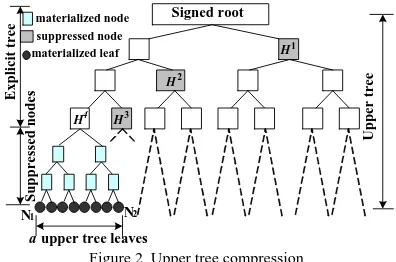
In particular, PMDdivides the n upper tree leaves (i.e., the n lower tree roots) into groups of α. For each group, PMD builds a binary MHT (suppressed tree). In the second step, PMDconstructs one binary MHT (explicit tree) on top of all the suppressed ones, as shows in Figure 2[2].
For every group (e.g., the group of αleaves shown in the Figure 2), PMD forms one DI page by inserting following messages (1) the signed DI root, and (2) itsαhashes (the solid circles), and (3) the sibling digests to its path in the explicit tree (hashes H1, H2, H3, shown as solid squares). In other words, the internal nodes of the suppressed tree (small rectangle) are not materialized, but they are computed on the fly (using theα leaves/solid circles) when needed. Overall, the DI contains n /αdisk pages. Thus,PMDcan compute VO for any range query
with at most 2 disk accesses, one for each boundary object. If both c left and right are covered by the same suppressed tree, then only one page access is needed for their common DI block.
The DI works like an ordinary MHT. PMD considers the paths that lead to the left and to the right boundary objects as left and right. The VO for a range query contains (1) the signed DI root, (2) all left sibling hashes to the path of left, and (3) all right sibling hashes to the path of right. Upon receipt of the query result, the user combines it with VO components (2) and (3), to reconstruct the (missing) part of the DI between the paths of left and right. Then, the user verifies with the owner’s public key whether the root of DI (i.e., component (1) of the VO) matches the locally computed root hash. If they match, the query results are deemed both complete and authentic; the collision-resistance of the hash function ensures that it is computationally infeasible for the server to tamper with the result and yet manage to produce hashes that match the original ones.
B. PMD analysis
Comparing with previous query verification scheme PMDhas the following advantages: (1) there is more flexible architecture. When the user does not need verification, then PMD is similar to an ordinary and non-authenticated index without any performance degradation due to verification structure. Moreover, existing database can be directly authenticated, without having to be modified and re-uploaded. Therefore, the construction cost is significant savings. Also, query answering and VO generation can be delegated to different servers, thus the server's performance is full used; (2) separating the query processing and the VO computation tasks, this provides that the search result and the verification process can be implemented in parallel, so response is faster.
However, we analyze PMD and discover that PMD has the following shortcomings:
1) There exists the forgery attack in PMD. PMD uses an ordinary signature scheme such as RSA to sign DI root. When PMD deals with a user query, server returns the query results and the authentication objects including the data owner's signature to the user, thus exposes the data owner's signature. The ordinary signature is self-proven and can be passed. Anyone can verify the correctness of the signature and data as long as access to the signature. If an attacker intercepts the data and verification information that are uploaded to the server by data owner, he can impersonate the server to provide services for users or distribute the data owner's data and signatures. If a user already obtains the data and the authentication objects including the data owner's signature, he can impersonate the server to provide services for users or distribute the data owner's data and signatures. It is not permitted in practical applications such as payment services through the server.
2) There exists a collusion attack inPMDand it cannot achieve the content access control. When PMD deals with a user query, the server directly gives query results and the authentication objects including the data owner's
H1|2
S(H1|2|3|4)
Up
p
er t
ree
L
o
we
r tr
ee
H1 H2
r1r2r3r4
h1|2 h3|4
r5r6 r7r8
h5|6 h7|8
H1|2
H3 H4
r9 r10r11r12
h9|10h11|12
r13r14r15r16
h13|14h15|16
E1 E2
External nodes of MI
Query range
E3 E4
External nodes of MI
Figure 1 DI Digest index example
H1
Signed root
H4 H3
H2
U
p
per tree
Explici
t t
ree
Suppr
ess
ed nodes
a upper tree leaves
suppressed node materialized node
materialized leaf
N2
N1
signature to a user, thus the users can make collusion attack together. For example, there are two legitimate users A and B, the data owner grants different privileges to A and B such as A can only query the index values in the range of α≤key b≤ and B can only query the index values in the range ofb key c≤ ≤ . After A and B obtain their data and the authentication objects through legitimate query, they can collude and impersonate the server to provide services for other users such as accessing the data in the range ofα≤key c≤ . However, A or B has no right to query the index values in the range ofα≤key c≤ .
3) PMDcan not well protect the privacy of data. When the user needs or only views some of these fields, the server must return all of these fields to the user in order to enable the user to verify the correctness and completeness of the data. Thus PMDleaks some unnecessary fields to the user and does not protect the privacy of data and implement the column-based access control, which is not allowed in many applications.
4) The update speed of PMD is slow. As long as the data is updated, the root node must be re-signed. Because each DI page stores a signed DI root, so each update (object insertion or deletion) requires modification of all DI pages, thus the cost of update is high. Although Kyriako et al.[2] proposed the dynamic PMD(dPMD) to resolve this problem, but dPMD still needs (2d-1) disk accesses (where d is the high of DI tree). When the database stores huge amounts of data such as2d−1>>2, dPMD needs to access the disk many times.
III. A NEW QUERY VERIFICATION SCHEME
In order to overcome the disadvantages in PMD, we improve PMD and propose a new query verification scheme for dynamic outsourced databases. We modify PMD as following:
1) Similar to PMD, our scheme uses MI tree for storing and querying the data, and DI tree for verifying information in a compressed form. But in order to improve the update speed, our scheme does not save the signed DI root in each DI page and stores the signed DI root in a separate disk block, which is different from PMD. When the owner inserts/deletes an object in the database, PMD requires to modify all DI pages and needs many I/O operations, however our scheme does not require to modify all DI pages, and needs the times of I/O operations much less than PMD. Therefore, the update speed of our scheme is fast than PMD.
Dealing with user query for the first time, server may read the signed DI root from the disk and save the signed DI root in memory until the signed DI root needs to be updated, thus our method guarantees the fact that server needs 3 disk accesses for only dealing with user query for the first time, and needs 2 disk accesses for each subsequent user queries, which just is the same as PMD. Therefore, the response speed of our scheme is as fast as PMD
Consider the examples in Figure 3 and Figure 4, let |S| is the size of the signed DI root, |H| is the size of hash
value. Assuming that a disk block fits 7 hashes (i.e. B=7|H), and |S|=3|H|.
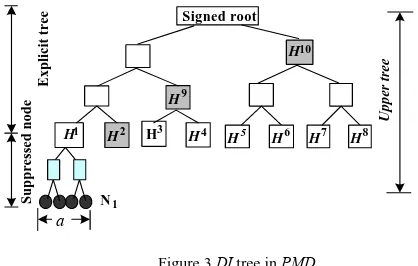
In PMD, a DI tree showed in Figure 3 can be divided into 8 suppressed trees (H1- H8), i.e. α=4, because a DI page contains 4 hashes (the solid circles), and the sibling digests to its path in the explicit tree such as hashes H2, H9
, H10(shown as solid squares), in other words, the server needs 8 disk blocks to store the DI tree.
c
If the owner inserts/deletes an object corresponding to the external leaf N1, the updated value of this leaf causes the digest changes that propagate upwards until the root of the DI tree. Because each DI page materializes the signed DI root, therefore, server needs to modify all DI blocks and 8 I/O operations to reflect the update.
However, in our scheme, a DI page does not materialize the signed DI root, and only contains corresponding hashes, the signed DI root alone is stored in another a disk block. A DI tree showed in Figure 4 can be divided into 4 suppressed trees (H1- H4), i.e.α=8, server needs 4 disk blocks to store the DI tree.
If the owner inserts/deletes an object corresponding to the leaf N1, the updated value of this leaf causes digest changes that propagate upwards until the root of the DI. Because each DI page does not materialize the signed DI root, and only 3 DI pages relate with H1hashes, therefore, server needs to modify 3 DI blocks and 3 I/O operations to reflect the update. Therefore, the update speed of our scheme is fast than PMD.
2) In PMD and some query verification technology [2~6,8~10], using ordinary signature such as RSA signs the root of DI tree, thus brought security issues such as forgery and collusion attacks as well as no content access
H10
Signed root
H1 H2
H9
H3 H4 H5 H6 H7 H8
N1 a
U
ppe
r t
ree
E
x
pl
ic
it t
r
ee
Sup
pressed nod
e
Figure 3 DI tree in PMD
Signed root
H1 H2
H5
U
ppe
r tr
ee
Exp
licit tree
S
upp
re
sse
d no
de
s
a
H4
N1 H3
control etc. For dealing with these problems, we construct a new signature scheme combining with the idea of designated verifier, and use the new signature scheme to sign the root of DI tree, and build new query verification scheme of outsourced databases. When server deals with user queries, the server does not disclose the data owner’s signature. Therefore, the new query verification scheme can prevent collusion and forgery attacks, and implement content access control.
New verification scheme is as following:
Let p1, p2,p1′,p2′and q be distinct large primes, and
1 2 1
1= qp′+
p ,p2=2qp2′ +1,n=p1p2, ϕ(n)=( p1-1)(p2-1) , g be the primitive element in GF(n). h(.) is a secure one-way hash function.
The data owner completes the following steps to sign root hroot.
1) The data owner computes two pair of secret keys (eo,
do) and (er,dr) using RSA algorithm, and sends (er,dr,g,n)
to server.
2) The data owner chooses a random numberσ∈Z*n, computes
n g
Y er
r= mod ,x=Yrσ modn, q e h h d
s=(σ o− ( root) o)mod and sends (s, x) to server.
User verifies the query results:
1) Upon receiving the user access request, server chooses a random integer β∈Zn* and computes
n r e
mod β
γ = , and sendsγ to the user.
2) The user chooses a random numberv∈Z*n , and sends v to server.
3) On receiving v, server computesY geo n
o = mod and n
g g
xdr =[( er)σ]dr = σmod ,z=β(gσ)vmodn
and sends (z, s) and the query results to the user.
4) The user verifies the results of query. According to the principle of MHT, the user can calculate the hash value of the root based on the query results and VO, thus the user can verify
n Y
g
zer =γ( s oh(hroot' ))eoνermod
If it holds, then the query results are authentic and complete. Because
n Y
g
g g g
z
r o root
r o o root r
r r
ve e h h o s
ve e e h h s ve e e
mod )
(
) (
) (
) (
) (
γ
γ
β σ
=
= =
In the above query verification process, the user must cooperate with server to complete the verification of query results. Therefore, even if a attacker steals data files from the server or intercepts all the information on the process of the data owner uploading the data and verify information to server, the attacker can not impersonate the server to provide services for users since the attacker does not know the server's private key dr and
can not calculate
xdr =[(ger)σ]dr =gσmodn
Therefore, our query verification scheme can resist the forgery attack existed in PMD. Moreover, because the server returned the different signature to the user each time, the user cannot use an existing signature to implement the collusion attack. So our scheme can also resist the collusion attack and achieve the content access control.
3) Aiming at the defect that PMD cannot realize the column-based access control, our scheme uses
H(ri)= H(key||H(A1)||…||H(Am))
to compute the message authentication code of the record ri. When a user queries some fields, the server only
returns the values of query fields and the hash values of other fields to the user, and does not return to the values of all fields, and hence does not leak unnecessary information to the user. Thus our scheme protects the privacy of data and implements the column-based access control. Therefore, our scheme can overcome the defect that PMD cannot implement the column-based access control.PERFORMANCE AND SECURITY ANALYSIS
Our scheme, which is similar to PMD, uses MI tree for storing and querying the data, and DI tree for verifying information in a compressed form. But our scheme is different from PMD. Our scheme does not save the signed DI root in each DI page and stores the signed DI root in a separate disk block, thus improves update speed. Moreover, our scheme reduces the server's storage overhead since a signed DI root is stored.
After start, server immediately reads the signed DI root from the disk and computes (Yo,gσ ), and then stored them in memory. In order to compute a VO, server needs 2 disk accesses for each user query, which just likes PMD. Therefore, the response speed of our scheme is as fast as PMD.
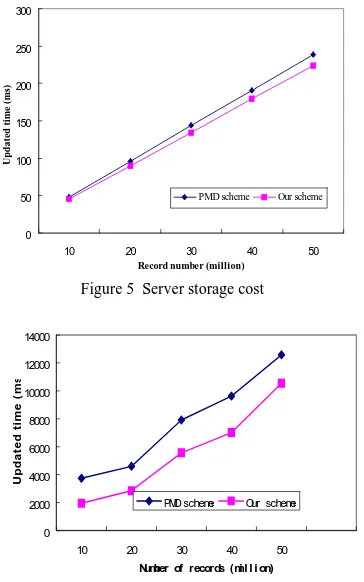
In order to verify the storage cost and update speed of our scheme, we perform experiments using Forest CoverType Data set that is provided by University of California, Irvine. Our experiments focus on compare between our scheme and PMD. The server storage cost simulation shows as Figure 5. The update speed simulation shows as Figure 6.
The experiments show that our scheme reduces the storage overhead of the database server and improves the update speed at the database server.
ordinary signature is self-proven and can be passed. Anyone can verify the signature as long as access to the signature. Therefore these schemes also exist above problems. We introduce the idea of designated verifier to the query verification technology of outsourced databases, and well resolve these security issues.
Because using H(ri)=H(key||H(A1)||…||H(Am)) to
compute the message authentication code of the record ri,
server only returns the values of query fields and the hash values of other fields to the user when a user queries some fields. Therefore, our scheme can better support the projection queries, implement the content access control, and protect private data by the greatest extent.
V. CONCLUSION
In this paper, we improve PMD, and propose a new query verification scheme. We modify the storage contents of the DI page in PMD in order to improve the update speed. We also construct a new signature scheme combining with the idea of designated verifier signature, and replace the signature scheme of PMD with the new signature scheme to sign DI root in order to resist collusion and forgery attacks. We use H(ri)=H(key||H(A1)
||…||H(Am)) to compute the message authentication code
of the record ri in order to protect the privacy of data and
implement the column-based access control. We perform experiments on our scheme, and focus on comparing our scheme with PMD. The result of the experiments shows that the update speed of our scheme is faster than PMD, the storage cast of our scheme is lower than PMD.
ACKNOWLEDGMENT
This work was supported in part by National Natural Science Foundation of China under Grant (61070164); Science and Technology Planning Project of Guangdong Province, China (S2011010001599); Natural Science Foundation of Guangdong Province, China (81510632010 0000 22).
REFERENCES
[1] H.,Hacigumus,S.Mehrotra,B.Iyer, et al. Providing database as a service. ICDE'02 Proceedings of the 18th International Conference on Data Engineering, IEEE Computer Society Washington, pp. 29-38.
[2] M.Kyriakos,S.Dimitris,P.HweeHwa. Partially Materialized Digest Scheme: An Efficient Verification Method for Outsourced Databases. The VLDB Journal,2009,18(1),pp. 363–381.
[3] P.Devanbu, M.Gertz, C.Martel, et al. Authentic third-party data publication. 14th IFIP 11.3 Working Conference in Database Security, The Netherland: Kluwer, 2000,pp.101-112.
[4] M.Charles, N.Glen, D.Premkumar, et al. A general model for authenticated data structures. Algorithmica.2004,39, pp.21-41.
[5] E.Mykletun, M.Narasimha, G.Tsudik. DSAC: integrity for outsourced databases with signature aggregation and chaining. ACM CIKM. New York, 2005,pp.235-236. [6] L.Feifei,H.Marios, K.George,et al. Dynamic Authenticated
Index Structures for Outsourced Database. Chicago, Illinois: ACM SIGMOD, 2006,pp.121-132.
[7] E. Mykletun, M.Narasimha, G.Tsudik. Authentication and Integrity in Outsourced Databases. ACM Transactions on Storage,2006,2(2), pp. 107-138.
[8] N.Maithili,T.Gene. Authenticated of Outsourced Databases Using Signature Aggregation and Chaining. Wuwongse: DASFAA. 2006, LNCS 3882,pp.:420-436.
[9] J.A.Mikhail,C.Y.Sun,K.Ashish. Efficient Data
Authentication in an Environment of Untrusted Third-Party Distributors. ICDE 2008,pp.696-704.
[10] T.G.Michael,T.Roberto,T.Nikos.Superefficient verification of dynamic outsourced databases. CT-RSA 2008, LNCS 4964,pp.407-424.
[11] L.Bouganim, F.D.Ngoc, P.Pucheral,et al. Chip-secured data access: Reconciling access rights with data encryption. Proc. of the 29th International Conference on Very Large Database. VLDB Endowment, 2003,pp.1133-1136.
[12] L. Bouganim, C.Cremarenco, F.D.Ngoc, et al. Safe data sharing and data dissemination on smart device. Proc. of the 2005 ACM SIGMOD International Conference on Management of Data. New York: ACM Press. 2005, pp.888-890.
[13] Q Zhu, J.H. Chen, J.J.Le. Digital watermark-based authentication of queries in outsourced database. Journal of Computer Applications. 2008, 28(3),pp.605-608.
Xiaoming Wang received her Ph.D Degree from the College of Mathematics, Nankai University, China, in 2003. Currently she is a professor in the Computer Science Department, Jinan University. Her research interests include database security, network security, cryptography, etc.
Duobao Yuan received his M.S. Degree from Department of Computer Science, Jinan University, China, in 2010. Currently he is a engineer in Commercial Bank of China. His research interests include database security, network security,etc.
0 50 100 150 200 250 300
10 20 30 40 50
Record number (million)
Updated time (ms)
PMD scheme Our scheme
Figure 5 Server storage cost
0 2000 4000 6000 8000 10000 12000 14000
10 20 30 40 50
Number of records (million)
U
p
dated time
(m
s
PMD scheme Our scheme