Comparison of Conventional and Construction
Stage Analysis of a RCC Building
Geethu Girija Das Dr. Praseeda K I
M. Tech. Student Assistant Professor
Department of Civil Engineering Department of Civil Engineering
FISAT, Kerala, India-683577 FISAT, Kerala, India-683577
Abstract
While analyzing a multistorey building frame, conventionally all the probable loads are applied after modeling the entire building frame. But in practice the frame is constructed in various stages. Accordingly, the stability of frame varies at every construction stage. Even during construction freshly placed concrete floor is supported by previously cast floor by formwork. Thus, the loads assumed in conventional analysis will vary in transient situation. Obviously, results obtained by the traditional analysis will be unsuitable. Therefore, the frame should be analyzed at every construction stage taking into account variation in loads. The phenomenon known as Construction Stage Analysis considers these uncertainties precisely. The present study provides a comparison of conventional analysis with construction stage analysis for a commercial building using ETABS v15. Keywords: Building, Conventional Analysis, Construction Stage Analysis
________________________________________________________________________________________________________
I. INTRODUCTION
The effect of the sequential application of dead load due to the sequential nature of construction is an important factor to be considered in the multistory frame analysis. Unfortunately, however, this effect has been ignored by many engineers in practice in the past. One of the ways to include this effect properly in the analysis is to carry out the analysis through step-by-step procedures in accordance with the sequential application of dead loads as the construction proceeds. For bridges and high rise buildings, time dependent effects make analyses even more complex. The effects develop at the early stages of the construction process and continue to evolve considerably after the structures are built. Depending on the construction method, the time dependent effects can appear and induce important stress redistribution in the structures like bridges. To obtain real behavior of concrete bridges and high rise buildings, segmentally construction stage analysis using time dependent material properties and geometric nonlinearity should be considered, because construction period continue along time and loads may change during this period and after.
In the structural analysis of multistory buildings, there are two important factors that have very significant effects on the accuracy of the analysis but are usually ignored in practice. They are: (1) the effect of sequential application of dead loads due to the sequential nature of construction as discussed above; and (2) differential column shortening due to the different tributary areas that the exterior and interior columns support.
The exterior column in a building is loaded with roughly one-half of the gravity load to which the interior column is subjected. In many design practices, however, there is a tendency to design the exterior columns so as to have cross-sectional areas nearly equal to the interior ones, since additional cross-sections are required in the exterior columns to resist the forces induced by overturning moments due to lateral loads such as winds and earthquakes. Therefore, there exists a substantial inequality between the ratio of the applied dead load to the cross-sectional area of an exterior column and that of an interior one. This inequality may cause a differential shortening between the exterior and interior columns in the frame. Moreover, this differential shortening is enlarged in RC frame structures since additional time-dependent deformations of concrete, which have a magnitude of more than two times the elastic deformation, are accompanied.
In this study construction stage analysis and conventional analysis is performed for a commercial building of 2B+G+6. A comparison of bending moment, displacement and shear force is done for both analysis. In conventional analysis dead loads, live loads, wind loads and seismic loads are applied simultaneously to the entire complete structure. In construction stage analysis, dead loads are applied in a sequential manner. Since the difference exists only in the application of dead load. So only dead load and dead load along with live load conditions are considered in this study.
II. LITERATURE REVIEW
variation in bending moment, shear force and displacement for conventional and construction stage analysis. A brief discussion pertaining to column shortening and related observations from the study is also presented.
III. CONSTRUCTION STAGE ANALYSIS OF A PRESENT STUDY
A commercial building located at Angamaly of 2B + G + 6 is identified to study the significance of construction stage analysis. It has a total plinth area of about 9493.27 sqm and land area of about 2756 sqm. Currently 2B + G + 3 floors are completed. The current stage of the project is shown in fig.1.
Fig. 1: Current stage of the project
IV. BUILDING IN ETABS
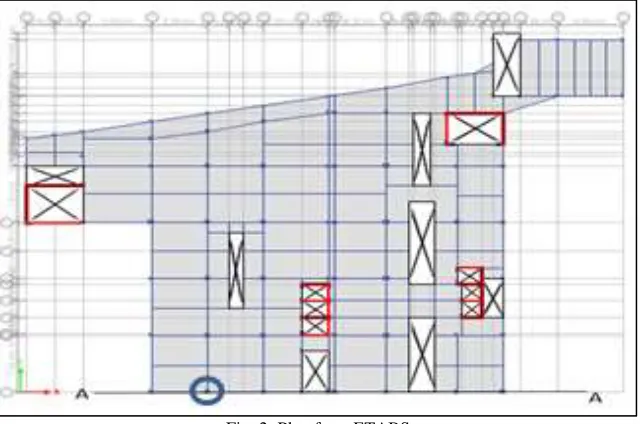
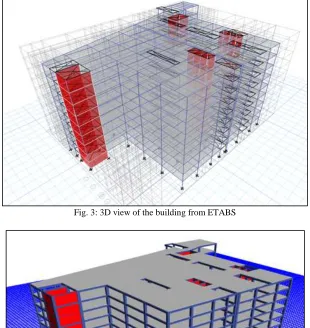
The case study building is modelled in ETABS for construction stage analysis. The deformation, bending moment and shear force are considered in the study for comparison between conventional analysis and construction stage analysis. The plan, 3D view and rendered view are shown in fig. 2, 3 and 4.
Fig. 3: 3D view of the building from ETABS
Fig. 4: Rendered view from ETABS
V. LOADS CONSIDERED IN THE STUDY
In conventional analysis dead loads, live loads, wind loads and seismic loads are applied to the entire structure after complete modeling. But in reality live load, wind load and seismic loads are applied at once to the entire complete structure whereas in case of dead loads, it is a type of sequential loading. Construction stage analysis deals with the stability of the structure on the sequential application of loads. Hence in this study only dead loads case and dead load along with live load cases are considered for analyzing the structure.
VI. SECTION DETAILS
Beams of concrete M25 and steel Fe415 and columns of concrete M35 and steel Fe500 are used in the structure. The different cross sections of beams and columns used are tabulated in table 1 and 2. The thickness of the slab used is 100 mm. M 25 concrete and Fe 500 steel is used for modeling the structure.
Table – 1 Section details of beams
Table – 2
Section details of columns Column Sizes IN mm
600 x 600 500 x 500 500 x 700 300 x 600 300 x 500 L Shape 900 x 550 x 250 L Shape 600 x 600 x 250 L Shape 600 x 600 x 200 T Shape 600 x 200 x 200
Fe 500, M 35 VII. ANALYSIS RESULTS
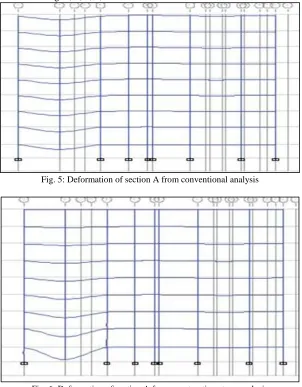
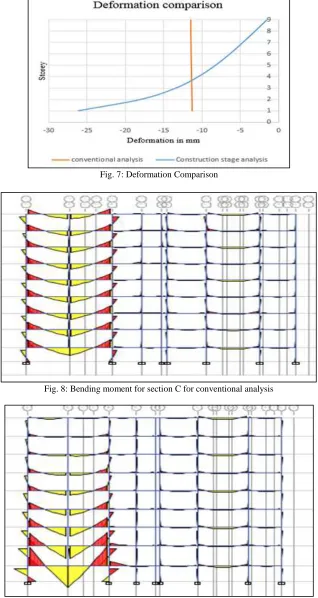
In order to study the effect of sequential application of loading, section A shown in fig. 2 is chosen and a column is removed from the basement 1 marked in fig. 2 to create a transfer girder. Transfer girders are vulnerable to construction sequence. This is because if construction sequence is ignored, the analysis assumes all loads are carried by the entire truss action. Deformation, bending moment and shear force are the parameters considered to compare conventional analysis with construction stage analysis. The deformation, bending moment and shear force diagram of section A for both conventional analysis and construction stage analysis is shown in fig. 5, 6, 8, 9,10 and 11.
Fig. 5: Deformation of section A from conventional analysis
Fig. 6: Deformation of section A from construction stage analysis
analysis. From the figure it is concluded that the deformation is more than double for the lower floors when we consider the construction stage analysis. This gives the actual response of the structure. If live load along with dead load condition is considered a similar pattern of deformation is obtained for conventional and construction stage analysis.
Fig. 7: Deformation Comparison
Fig. 8: Bending moment for section C for conventional analysis
Fig. 9: Bending moment for section C for conventional analysis
A for conventional and construction stage analysis for dead load case. From the figures it is found that for construction stage analysis the bending moment is more in the bottom floors and it is found to be decreased for the top floors. For dead load along with live load application a similar bending moment diagram is obtained for both the analysis.
Fig. 10: Shear force diagram for section C for conventional analysis
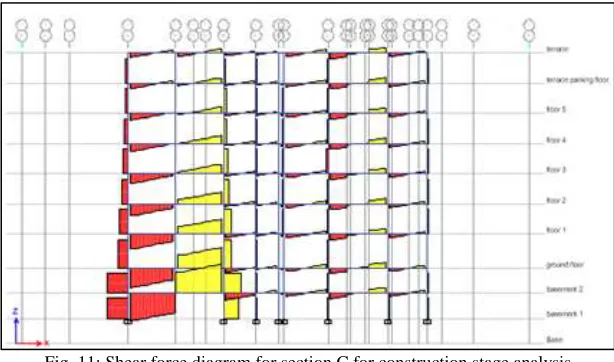
Fig. 11: Shear force diagram for section C for construction stage analysis
The shear force values of section A for all floors are compared for construction stage analysis and conventional analysis. From the figure it is found that for construction stage analysis, the shear force is more in the bottom floors and it is found to be decreased for the top floors.
VIII. COLUMN SHORTENING
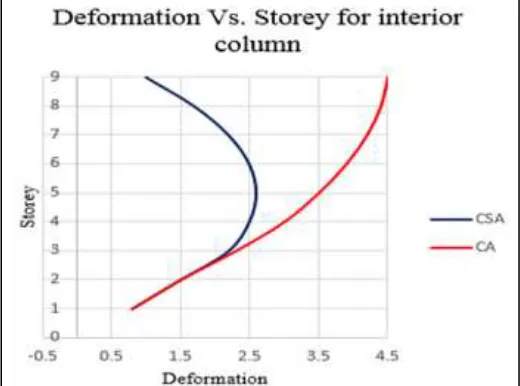
The effect of column shortening is a major consideration in the design and construction of tall buildings, especially in concrete and composite structural systems. Column shortening occurs due to various factors like elastic stresses due to gravity loads, creep caused by gravity loads, drying shrinkage and temperature variations of exposed columns. In this study the column shortening due to applied load is calculated.
Fig. 12: Section 9 of the commercial building
In fig. 12 a column is highlighted which is considered to find out the deformation in interior column. It can be seen that for bottom stories the column shortening is under estimated and for top floors the column shortening is over estimated.
Fig. 13: Deformation of exterior column for conventional analysis and construction stage analysis
Fig. 14: Deformation of interior column for conventional analysis and construction stage analysis
IX. CONCLUSIONS
actual case a building, bridge or any kind of structure is constructed in a sequence of stages. So the load applied on the structure will be different at each stage. The analysis considering these sequential nature of application of load is known as construction stage analysis. This type of analysis is essential to ensure the stability of the structure throughout the construction period.
An existing commercial building of 2B+G+6 storey is chosen to study the difference in construction stage analysis from conventional analysis. Deformation, bending moment and shear force is selected as the parameters to compare conventional analysis with construction stage analysis. From the comparison results it is found that for conventional analysis the deformation, bending moment and shear force are underestimated for the bottom floors and the same are over estimated in the upper floors when compared with construction stage analysis. The column shortening for exterior and interior columns for a particular section is also find out for conventional analysis and construction stage analysis. From the results it is found that the value of column shortening is over estimated for upper floors and under estimated for lower floors in case of conventional analysis. So for high-rise buildings in order to provide column shortening compensation, accurate values of column shortening can be find out from construction stage analysis.
REFERENCES
[1] Chang-KoonChoi, E-DooKim ; “Multistory frames under sequential gravity loads”; Journal of Structural Engineering 1985 (ASCE)
[2] Chang-KoonChoi, Hye-KyoChung, Dong-GuenLee, “Simplified building analysis with sequential deadloads—CFM” ; Journal of Structural Engineering 1992 (ASCE)
[3] P.J.S.Cruz , A.R.Mari , P.Roca; “Nonlinear time dependent analysis of segmentally constructed structures”; Journal of Structural Engineering1998 (ASCE) [4] Hyo-Gyoung Kwak, Jin-Kook Kim; “Time-dependent analysis of rc frame structures considering construction sequences”; Building and Environment ;
2006 (sciencedirect)
[5] O.A. Rosenboom, T.F. Paret, G.R. Searer , “ Chronological construction sequence, creep, shrinkage, and pushover analysis of an iconic 1960s reinforced concrete building”, WCEE 2012
[6] Yousuf Dinar, Muhammad Junaid Absar Chowdhury, Md. Abu Ashraf ,” Chronological construction sequence effects on reinforced concrete and steel buildings”, International Journal of Engg. & Science 2014
[7] W. Njomoa , Giray Ozay; “Sequential analysis coupled with optimized substructure technique modeled on 3d-frame construction process” ; Engineering Structures 2014 (sciencedirect)
[8] Taejun Cho, Tae Soo Kim; “Probabilistic risk assessment for the construction phases of a bridge construction based on finite element analysis”; finite element analysis and design; 2008
[9] Sevket Ates, “Numerical modelling of continuous concrete box girder bridges considering construction stages”, Applied Mathematical Modelling, 2011 [10] Suleyman Adanur, Murat Gunaydin, Ahmet Can Altunisik, Baris Sevim, ” Construction stage analysis of humber suspension bridge ”, Applied
Mathematical Modelling, 2012
[11] Barbaros Atmaca , Sevket Ates, “ Construction stage analysis of three-dimensional cable-stayed bridges ”, Steel Composite Structures , 2012
[12] Murat Günaydin, Süleyman Adanur “Construction stage analysis of fatih sultan mehmet suspension bridge”; Structural Engineering and Mechanics; 2012 [13] Ahmet Can Altunisik, Alemdar Bayraktar;“Construction stage analysis of komurhan highway bridge using time dependent material properties”; Journal of
wind Engg. and industrial aerodynamics 2013- sciencedirect
[14] Murat Günaydin ,SüleymanAdanur; “Determination of structural behavior of bosporus suspension bridge considering construction stages and different soil conditions ” ;Steel and Composite Structures 2014