Available online: https://edupediapublications.org/journals/index.php/IJR/ P a g e | 2417
A Review on Power System Stability by Using Different FACTS Devices
P.DHEERAJ KUMAR Assistant Professor
Abstract – Presently a day's energy request increments and generally extended in the power age and transmission and dispersion framework division. Yet, to keep up the strength and enduring state operation of energy framework causing from aggravation or swaying, shortcomings and all of a sudden changing of the heap, voltage precariousness, voltage hang, unsettling influence in recurrence, steadiness is the most essential factor with respect to
control framework. Because of unsteadiness,
distinctive issues approach in control framework, for example, vacillation in voltage and recurrence, which may cause harm or disappointment of energy framework. Adaptable AC Transmission System (FACTS) devices are utilized to tackle the Issues of current power framework (age and transmission framework) which leads in change and improvement of execution of the power framework. Different sorts of FACTS gadgets comprise of Static Synchronous Compensator (STATCOM), Thyristor Controlled
Series Compensator (TCSC), Static Series
Synchronous Compensator (SSSC), Static VAR Compensator (SVC), Unified Power Flow Controller (UPFC), Thyristor Controlled Series Reactor (TSSR), Thyristor Controlled Voltage Reactor (TCVR), Interline Power Flow Controller (IPFC) and another more gadgets. This paper portrays the execution of study and examination of different FATCS gadgets and their impact on control framework security improvement. Likewise, this paper surveys about various power framework stabilizer utilizing different FACTS devices.
Index Terms: - FACTS Devices, power system stabilizer (PSS), AVR
I.
INTRODUCTION
Current electric power framework is confronting numerous issues step by step developing in complex system and their operation and structure. In the power framework, flimsiness of the issues are arised fluctuate oftentimes. There are number of steadiness
issues that point of confinement the transmission
capacity in transient soundness, dynamic
dependability, unfaltering state strength, recurrence fall, voltage crumple. As of late electrical power request is consistently expanding or becoming
because of quick mechanical advancement
development. To take care of this demand, it is important to build the transmitted power alongside the current transmission offices. The requirement for the power stream control in electrical power frameworks is in this manner obvious. More prominent requests have been put on the transmission arrange, and these requests will keep on increasing in light of the expanding number of non-utility generators and more rivalry among utilities themselves. Expanded requests on transmission, nonappearance of long haul arranging, and the need to give open access to producing organizations and clients, all together have made propensities toward less security and lessened nature of supply. As a result, some transmission lines are intensely stacked and the power framework solidness turns into a power exchange restricting component. Adaptable
AC transmission frameworks (FACTS)
gadget/controllers have been essentially utilized for fathoming and developing development innovation to enhance the solidness of transmission and different power framework consistent state control issues. To
accomplish both dependable and advantage
financially, it has progressed toward becoming clearer that more proficient usage and control of the current transmission framework foundation is required. Enhanced usage of the current power framework is given through the use of cutting edge control innovations. Power gadgets has built up the adaptable AC transmission framework (FACTS) gadgets which are successful and equipped for expanding the power exchange capacity of a line and bolster the power framework to work with agreeable edges of soundness [2]-[3]. Certainties gadgets are use in transmission framework to control and use the adaptability and framework execution [5].
Available online: https://edupediapublications.org/journals/index.php/IJR/ P a g e | 2418
edge, and the damping of motions at different frequencies beneath the appraised recurrence. Actualities gadgets have expanded controllability and enhanced power exchange ability. The FACTS gadgets comprise of three gatherings, reliant on their exchanging innovation: mechanically exchanged, (for example, stage moving transformers), thyristor exchanged utilizing semiconductor gadget, while a few sorts of FACTS, for example, the stage moving transformer and the static VAR compensator are now notable and utilized as a part of energy frameworks. New improvements in control hardware and control have broadened the application scope of FACTS [6]. The gadgets are utilized as a part of transmission framework to control and use the adaptability and framework execution. To acquire this, the FACTS gadgets control the principle parameters to be specific voltage, stage edge and impedance, which are influencing air conditioning power transmission framework.
The power framework stabilizer (PSS) is for the most part associated with electromechanical wavering and enhances the power framework security with the assistance of its extra excitation framework. For keeping up the steady age and transmission of electric vitality, the electric power frameworks end up noticeably bigger and bigger, which covers a region and incorporate all transmission lines, synchronous generators, burdens and assortment of controllers in more efficient way. Power framework soundness can be enhanced by utilizing dynamic
controllers as excitation frameworks, control
framework stabilizers and FACTS gadgets,
controlled islanding and HVDC [4].
II.
LITERATURE REVIEW
Power system stability is a major challenge for engineers from many years. It is significantly noticed 1920s [2]. Where as it is tested for practical power system in 1926 [3]. Initially stability problems occurred in distant power plants feeding load hubs over expanded transmission lines which used slow
exciters and non-continuously acting voltage
controllers due to which power transfer capability was often restricted by steady-state as well as transient rotor angle variability due to inadequate synchronizing torque.
The power circle diagram and equal area criterion (EAC) methods are design to solve this problem and so models become superior and economical. The next significant test on the way of stability improvement was the development of network analyzer, which was proficient of power flow investigation of multi-machine power systems in 1930 [4]. This system has a drawback that the system dynamic had to explain by explaining the swing equation using step-by-step numerical integration.
After the invention of electronic analog computer in 1950 detailed modelling of the synchronous machine, excitation system and speed governor became easier. Later on with evolution in digital computers about 1956, the first digital program for power system stability investigation was return. In later decades various system for power stability were design in the Canada and United States. Now a day’s most of the industries concentred on transient stability [4].
In earlier days efforts were made for optimal linear regulator design of a multi-machine power system through a computational algorithm based on the matrix sign function theory, which can give solutions without the evaluation of the system eigen values (1972). A computer program has been design to incorporate the developed computational techniques, which are based on the matrix sign function theory and can obtain the optimal controllers and the dynamic responses of the power system [18].
Later on a technique for designing variable structure controllers (VSCs) to damp out multimodal oscillations in a multi machine power system along with an approach of incorporating nonlinearities in the system operation at the design stage is proposed. V. Samarasinghe and N. Pahalawaththa show the possibility of achieving a robust design using a simple linear model of power systems. The system demonstrate the effectiveness of the VSC through a number of experiments results in showing that a VSC performs better than a conventional power system stabiliser and both types of controllers on different units in the system co-operate in a positive manner in damping oscillations [19].
Available online: https://edupediapublications.org/journals/index.php/IJR/ P a g e | 2419
matrix inequalities with damping and control input constraints for fuzzy logic control design was proposed. The effectiveness of the control design method can be by simulation results on a single-machine infinite-bus model and compared to classical power system stabilizer [20].
In 2007 system was design for the study of dynamic behavior and transient stability of the single-machine infinite-bus (SMIB) with used eigenvalue analysis [21].
On more power, system stabilizers were added to excitation system to enhance the damping during low frequency oscillations with the help of fuzzy logic. To enhance the system stability, speed deviation (Δω) and acceleration (Δϖ) of the rotor of synchronous generator of Kota Thermal were taken as the input to the fuzzy logic controller. These variables take significant effects on damping of the generator shaft mechanical oscillations [22].
An alternative approach on designing PSS for a Single Machine and Infinite Bus (SMIB) system based on optimal control (OP) techniques was proposed in later days. The simulation technique were used for analyzation of the small signal stability characteristics of the system about the steady state operating condition following the loss of a transmission line. The focus of the system was on the control performance [23].
The Artificial Bee Colony algorithm was also used for achieving better stability of the power system as compared to the conventional techniques [24].
Research was done for designing power system stabilizer for interconnected power system. In this system, information available at the high voltage bus of the step-up transformer is used to set up a modified Heffron-Phillip’s model to decide the structure of the PSS compensator and tune its parameters at each machine in the multi-machine environment, using only those signals that are available at the generating station [25].
Power system stabilizer based on the Particle Swarm Optimization (PSO) algorithm was use for tuning dual input power system stabilizer parameters to optimize a suitable objective function, optimal values for PSS controlling parameters including lead-lag
compensator time constants as well as the controller gain calculation. The employed objective function is the error between the reference voltage and the signal produced from the terminal voltage (i.e. to minimize the overshoot of low-frequency oscillations). This algorithm is applied to a single machine power system and for various operating conditions [26].
Exact linearization approach of feedback
linearization was use to design the nonlinear observer when the power system is fully linearized. The excitation control law was derived for the exactly linearized power system model [27].
The method had been developed obtained simplified model of the system by using different reduction technique. One research team had used the differentiation method in time & frequency domain to preserve the stability and characteristic parameters of a single machine infinite bus system (SMIB) with power system stabilizer [28].
An attempt had been made to study the application of static synchronous series compensator (SSSC) equipped with a Hybrid Fuzzy Logic Damping Controller (HFLDC) to improve the small signal stability of Single Machine Infinite Bus (SMIB) power system. This is carried out with modified Heffron-Phillips model of a single machine infinite bus (SMIB) system integrated with SSSC. This enhanced the transient stability of the power system.[29]
III.
POWER SYSTEM STABILITY
(PSS)
Power framework soundness is the capacity of an electric power framework, for a given introductory working condition, to recover a condition of working balance in the wake of being subjected to a physical unsettling influence, with most framework factors limited so essentially the whole framework stays in place.
Available online: https://edupediapublications.org/journals/index.php/IJR/ P a g e | 2420
synchronous operation of a framework. This synchronous operation can be aggravated by any little or huge unsettling influence. For instance, there can be an all of a sudden changing or increment in the heap or loss of age. Another kind of unsettling influence is the changing out of a transmission line, which may happen because of over-burdening or a blame [7]. The aggravation can isolate into little and huge. Unsettling influences can be expansive or little relying upon their starting point. The little changes in the heap or age can be named as little aggravations. Transmission framework flaws, sudden load changes, loss of creating units, and line exchanging are cases of vast unsettling influences [7, 8].
Power framework security is predominantly
characterized into various phenomena's: wave,
electromagnetic, electromechanical, and
thermodynamic. Here electromechanical marvel just accept, which happens in the windings of a synchronous machine. An unsettling influence in the electrical framework will create control changes between the producing units and the electrical system
framework. What's more, because of
electromechanical wonder bother the dependability of the pivoting parts in the power framework [9]. Figure 1 demonstrates the practical piece graph of a run of the mill excitation control framework for a substantial synchronous generator [10].
The PSS is a feedback controller, part of the control system for a synchronous generator, which provides an additional signal that is added to the input summing point at the Automatic Voltage Regulator AVR. The PSS main function is to damp generator rotor oscillations due to electromechanical dynamics and is called electromechanical oscillations. Different input signals have been used to extract the rotor
oscillations. The most common input signals are the active power, the terminal frequency, and the shaft speed. To provide effective damping and ensure the stability of the system, the PSS should be carefully tuned.
Hence, stabilizing signal was needed and the Power System Stabilizer (PSS) developed.
3.1 Operating Principle of PSS-
The Power System Stabilizer (PSS) is a
supplementary excitation controller used to damp generator electro-mechanical oscillations in order to protect the shaft line and stabilize the grid. The general function of power system stabilizer (PSS) is to add damping to the generator rotor oscillations by controlling its excitation by using auxiliary external stabilizing signal. Based on the automatic voltage regulator (AVR) and using frequency deviation, power deviation or speed deviation as extra control signals, Power system stabilizer is designed to introduce an additional torque coaxial with the rotational speed deviation, so that it can increase low-frequency oscillation damping and increase the dynamic stability of the power system. The AVR regulates the generator terminal voltage by controlling the amount of current supplied to the generator field winding by the exciter.
IV.
CLASSIFICATION OF
INSTABILITY IN POWER
SYSTEM
Available online: https://edupediapublications.org/journals/index.php/IJR/ P a g e | 2421 4.1 Rotor angle stability
Due to electromechanical oscillation problems, rotor angle stability disturbs. When the problem was occurring, the power output of synchronous machine varies as the rotor angle changes. The interconnected synchronous machine maintains the synchronism with another machine by restoring force when one or more machine accelerate or decelerate. The rotor angle stability means the ability of synchronous machine of an interconnected power system network to persist in synchronism subsequently been subjected to an interruption. Under the steady state condition, there is maintain or restore the equilibrium between input the mechanical torque and output the electromagnetic torque of the synchronous machine in the system and the speed remains constant. If the system is disturb the synchronism is upset causing in acceleration or deceleration of the rotors of the machines. The instability of this case produces because of the increasing angular swing of the generators or the loss of synchronism with other generators [4]. The loss of synchronism in the system happens by the non-equilibrium state between the mechanical torque and electromagnetic torque and the speed difference between the generators.
4.2 Voltage stability
Voltage stability of power system means the ability of the power system to maintain constant voltage at all the transmission lines in the system after being affected by a disturbance from initial operating condition. This stability depends on to maintain or restore equilibrium between the load demand and supply from the power system [11, 12]. The effect of instability in this case is fall or rise of voltage of transmission lines. The reason for this instability in this loss of load is tripping of transmission lines or other elements and loss of synchronism and induces voltage fluctuation occurs. When load dynamic struggle to restore power consumption, apart from the capacity of the transmission network and connected generation [13, 14]. The main circumstances contributing to voltage drop because when the active and reactive power flow through inductive reactance of the system [15]. And this happens when the generators swing their field or armature current time-overload competence limits [16]. The voltage instabilities are like voltage collapse, voltage surge etc., this all can be decreased by maintaining the condition of generators and other devices [17].
4.3 Frequency stability
Frequency stability assign to ability of a power system to maintain steady frequency severe system disconcerted resulting in a significant imbalance between load and generator. The frequency stability depends on capability to restore between system generation and load. The fluctuations that may occur in power system it ensure that uninterrupted frequency swings well nown to trip of generating unit or load. Generally, frequency stability problems are associated with inadequacies in equipment responses, poor coordination of control and protection equipment, or insufficient generation reserve.
V.
CLASSIFICATIONS
There are various types of FACTS devices and classified as according to depend on their connection like as series connected controller, shunt connected controller and combination of shunt series connected controller. The main types of FACTS devices are describe below
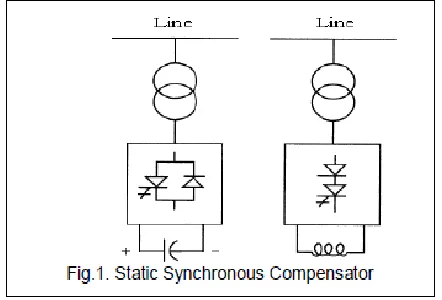
5.1 Static Synchronous Compensator (STATCOM)
A Static synchronous generator operated as a shunt-connected static var compensator whose capacitive or
inductive output current can be controlled
Available online: https://edupediapublications.org/journals/index.php/IJR/ P a g e | 2422
are however the most common use is for voltage stability.
5.2 Static VAR Compensator (SVC)
A shunt-connected static var generator or absorber whose output is adjusts to exchange capacitive or inductive current so as maintain or control specific parameters of the electrical power system. This is a general term for a controlled or thyristor-switched reactor, and/or thyristor-thyristor-switched capacitor or combination shown in fig. 2. SVC is based on thyristors without the gate turn-off capability. It includes separate equipment for leading and lagging vars; the thyristor-controlled or thyristor-switched reactor for absorbing reactive power and thyristor-switched capacitor for supplying the reactive power. A static VAR compensator is an electrical device for providing fast-acting reactive power on high-voltage electricity transmission networks. SVCs are part of the Flexible AC transmission system device family, regulating voltage and stabilizing the system. Some as a lower cost alternative to STATCOM consider SVC, although this may not be the case if the comparison is made based on the required performance and not just the MVA size.
Fig.2. Static VAR Compensator
5.3 Thyristor Controlled Series Capacitor (TCSC)
A capacitive reactance compensator which consists of a series capacitor bank shunted by a thyristor-controlled reactor in order to provide a smoothly variable series capacitive reactance. The TCSC shown in fig. 3 based on thyristors without the gate turn-off capability. It is a very important FACTS Controller. A variable reactor such as a Thyristor-Controlled Reactor (TCR) is connected across a series capacitor. The main disadvantage in TCSC is not giving high voltage profile when compare to other devices. The TCSC may be a single, large unit, or may consist of several equal or different-sized smaller capacitors in order to achieve a superior performance.
4.4 Unified Power Flow Controller (UPFC)
Available online: https://edupediapublications.org/journals/index.php/IJR/ P a g e | 2423
Fig. 4. Unified Power Flow Controller
5.5 Static Synchronous Series Compensator (SSSC)
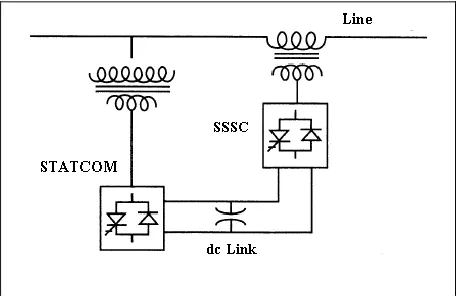
A static synchronous generator operated without an external electric energy source as a series compensator whose output voltage is in quadrature with, and controllable independently of, the line current for the purpose of increasing or decreasing the overall reactive voltage drop across the line and thereby controlling the transmitted electric power. The SSSC may include transiently rated energy storage or energy absorbing devices to enhance the dynamic behavior of the power system by additional temporary real power compensation, to increase or decrease momentarily, the overall real (resistive) voltage drop across the line. SSSC is one the most important FACTS Controllers. It is like a STATCOM, except that the output ac voltage is in series with the line. It can be based on a voltage sourced converter or current-sourced converter. It has a DC-AC converter and it is connected to a transmission line by series connection through a transformer. Fig. 5 shows SSSS.
5.6 Interline Power Flow Controller (IPFC)
The IPFC is a recently introduced Controller. A possible definition is the combination of two or more Static Synchronous Series Compensators which are coupled via a common dc link to facilitate bi-directional flow of real power between the ac terminals of the SSSCs, and are controlled to provide
independent reactive compensation for the
adjustment of real power flow in each line and maintain the desired distribution of reactive power flow among the lines. The IPFC may also include a STATCOM, coupled to the IFFC's common dc link, to provide shunt reactive compensation and supply or absorb the overall real power deficit of the combined SSSCs.
5.7 Thyristor-Controlled Series Reactor (TCSR)
An inductive reactance compensator, which consists of a series reactor shunted by a thyristor, controlled reactor in order to provide a smoothly variable series inductive reactance. The TCSR fig. 6 shown below.
4.7 Thyristor-Contolled Voltage Regalator (TCVR)
Available online: https://edupediapublications.org/journals/index.php/IJR/ P a g e | 2424
Voltage converter for injection of variable ac voltage of the same phase in series with the line in fig. 7b. This is low cost controller can be very effective in controlling the flow of reactive power between two ac systems.
Advantage of FACTS devices
The advantage of utilizing FACTS devices in electrical transmission systems as follows.
1. Better utilization of existing transmission system assets.
2. Increased quality of supply for sensitive industries.
3. Environmental benefits better and Provide greater flexibility in sitting new generation.
4. Reduce reactive power flows, thus allowing the lines to carry more power that is active.
5. Improved the power system stability.
6. Increased dynamic and transient grid stability and reduce loop flows
7. Increased transmission system reliability and availability.
8. Increase the system security through raising the transient stability limit, limiting short-circuit currents and overloads, managing cascading blackouts and damping electromechanical oscillations of power systems and machines.
VI.
CONCLUSIONS
This paper concentrates on FACTS gadgets utilized as a part of transmission lines. Power framework stabilizer (PSS) or outside excitation control framework is to apply a flag through the excitation framework to deliver extra damping torque of the generator in a power framework at all working and framework conditions. This paper presumes that so as to give quicker reactions over an extensive variety of energy framework operation and enhance the power framework solidness by utilizing FACTS gadgets with PSS and to give the ideal power stream control systems. The FACTS are monetarily and effectively operation in transmission and age framework's and due utilization of FACTS gadgets to keep the continuous power supply give to age, transmission and dispersion framework. The power framework stabilizer implies utilizing outside excitation (AVR)
controller likewise avert irritate yield energy of age framework causing different reasons.
REFERENCE
[1] R. M Piedra and A. Frish, “Digital Signal Processing Comes of Age,” IEEE Spectrum, Vol. 33, No. 5, May 1996.
[2] Steinmetz, C.P., “Power Control and Stability of Electric Generating Stations,” AIEE Trans., Vol. XXXIX, no.2, pp.1215-1287, July 1920. [3] Wikins, R., “Practical Aspects of System
Stability,” IEEE Trans., pp. 41-50, 1926. [4] P. K. Kundur, “Power System Stability and
Control, McGraw-Hill, Inc., New York, 1994. [5] Ranjit Kumar Bindal, “A Review of Benefits of
FACTS Devices in Power System”, International
Journal of Engineering and Advanced
Technology (IJEAT) ISSN: 2249 – 8958, Volume-3, Issue-4, April 2014. pp. -105-108. [6] Alok Kumar Mohanty, Amar Kumar Barik,
“Power system stability improvement using FACTS Devices”, International Journal of Modern Engineering Research (IJMER) Vol.1, Issue.2, pp-666-672 ISSN: 2249-6645.pp.-666-672.
[7] Narain G, Hingorani, Laszlo Gyugyi
,“Understanding FACTS: Concepts and
Technology of FACTS”, IEEE Power
Engineering Society.
[8] John J. Grainger & William D. Stevenson, “Power System Analysis”, McGraw-Hill. [9] J. Machowski, J. W. Bialek, and J. R. Bumby,
Power system dynamics: stability and control. Chichester: Wiley, 2008.
[10] Klein, M., Rogers G.J., Moorty S., and Kundur, P., “Analytical investigation of factors
influencing power system stabilizers
performance”, IEEE Transactions on Energy Conversion, Volume: 7 Issue: 3, Page(s): 382 -390, Sept. 1992.
[11] Y. Zou, M. H. Yin, and H. D. Chiang. 2003. Theoretical foundation of the controlling UEP method for direct transient-stability analysis of network preserving power system models. IEEE Trans. Circuits Syst. 50(10): 1324-1336.
[12] T. Van Cutsem and C. Vournas. 1998. Voltage Stability of Electric Power System. Norwell, MA: Kluwer.
Available online: https://edupediapublications.org/journals/index.php/IJR/ P a g e | 2425
[14] T. Van Cutsem and R. Mailhot. 1997. Validation of a fast voltage stability analysis method on the Hydro- Quebee System. IEEE Trans. Power System. 12: 282- 292.
[15] J. D. Ainsworth, A. Gavrilovic and H. L. Thanawala. 1980. Static and synchronous compensators for HVDC transmission convertors connected to weak AC system. 28th Session CIGRE, paper 31-01.
[16] 1992. CIGRE working Group 14.05 Report, Guide for planning DC Links Terminating at AC systems Location Having Low Short-Circuit Capacities Part1: AC/DC Interation Phenomena, CIGRE Guide No.95.
[17] 1997. CIGRE Working Group 14.05 Report, Interaction between HVDC convertors and nearby synchronous machine. CIGRE Brochure 119, Oct.
[18] Yu YN and Moussa HAM, “Optimal stabilization of a multi-machine system,” IEEE Transactions on Power Apparatus and Systems, vol. 91, no. 3, pp. 1174–1182, 1972.
[19] V. Samarasinghe and N. Pahalawaththa, “Damping of Multimodal Oscillations in Power Systems Using Variable Structure Control Techniques”, IEEE Proc. Genet. Transm. Distrib. Vol. 144, No. 3, pp. 323-331, Jan. 1997.
[20] N. S. D. Arrifano, V. A. Oliveira, R. A. Ramos, “Design and Application of Fuzzy PSS for Power Systems Subject to Random Abrupt Variations of the Load”, Proceeding of the
American Control Conference Boston,
Massachusetts June 30 - July 2, 2004.
[21] G. Shahgholian Ghfarokhi, M. Arezoomand, H. Mahmoodian, “Analysis and Simulation of the Single-Machine Infinite-Bus with Power System Stabilizer and Parameters Variation Effects”, IEEE, International Conference on Intelligent and Advanced Systems, pp. 167-171, 2007. [22] D. K. Sambariya, R. Gupta, A. K. Sharma,
“Fuzzy Applications to Single Machine Power System Stabilizers”, Journal of Theoretical and Applied Information Technology (JATIT), pp. 317-324, 2009.
[23] Muawia Abdel Kafi Magzoub, Dr. Magdi S. Mahmoud, “Power System Stabilizer (PSS) for Single Machine Connected to Infinite Bus (SMIB) Based on Optimal Control (OP) Techniques”, January 2010.
[24] V. Ravi, Dr. K. Duraiswamy, “Effective Optimization Technique for Power System
Stabilization using Artificial Bee Colony”,
International Conference on Computer
Communication and Informatics (ICCCI), pp. 1-6, January 2012.
[25] Vijay. M, Selvakumari S., “Design of Power System Stabilizer to Improve Small Signal
Stability,” International Journal of
Communications and Engineering, Volume 04, No. 4, Issue: 04 March 2012.
[26] M. Suguna, “Damping of Low- frequency Oscillations Using Swarm Optimized Controller for SMIB System”, International Journal of Engineering and Innovative Technology (IJEIT), Volume 1, Issue 4, April 2012.
[27] M. A. Mahmud, H. R. Pota, M.J. Hossain,
“Full-order nonlinear observer-based excitation
controller design for interconnected power systems via exact linearization approach”, ELSEVIER, Volume 41, Issue 1, Pages 54–62, October 2012.
[28] D. K. Sambariya, Rajendra Prasad,
“Differentiation method based Stable Reduced Model of Single Machine Infinite Bus System with Power System Stabilizer”, International Journal of Applied Engineering Research, ISSN 0973-4562, Vol. 7, No. 11, November 2012. [29] G. Jeelani Basha ,N. Narasimhulu, P.
Malleswara Reddy, “Improvement of Small Signal Stability of a Single Machine Infinite Bus Using SSSC Equipped With A Hybrid Fuzzy Logic Controller”,IJAREEIE, ISSN 2278 – 8875 Vol. 3, Issue 2, February 2014.pp.-7090-7099. [30] E.Kirankumar, Prof. V. C. Veera reddy, “A