Original Research Article
Continuous Epidural Analgesia in Labour Using 0.0625% Bupivacaine with
0.0002% Fentanyl and 0.125% Bupivacaine Alone: A Randomized Study
Rajkumar Mohapatra
1*, Manjubala Acharya
21*PG Student, 2Associate Professor, Department of Anaesthesia,
Hi-Tech Medical College & Hospital, Bhubaneswar, Odisha, India.
ABSTRACT
Aim: To evaluate the efficacy of Bupivacaine 0.0625% with Fentanyl 0.0002% and Bupivacaine 0.125%, in epidural analgesia for labour in relation to onset and duration of motor
blockade, duration of analgesia, hemodynamic parameters. Materials and Methods: After approval of our institutional
ethical committee and informed written consent from parturients, a randomized study was conducted. Over 60 parturients admitted to the labour room were selected to give epidural anaesthesia for labour pain included in the study. The study included 60 parturient patients, aged 18-35 years, in spontaneous 1st stage of labour with no obvious cephalopelvic disproportion, randomly distributed into two groups Group A (n=30)- Parturient in this group received 0.0625% bupivacaine with 0.0002% fentanyl for initiation and maintenance of lumbar epidural anaesthesia Group B (n=30) Parturient in this group received 0.125% bupivacaine for initiation and maintenance of lumbar epidural anaesthesia. Inclusion criteria were parturients with age above 18 years with ASA grade I & II. Exclusion criteria were patients not willing for epidural anesthesia, pre-existing neurological disorders, coagulopathies and infection at
the site of puncture, spinal abnormalities and grand multiparas. Results: The success rate of both groups were comparable in
relation to onset and duration of motor blockade, duration of analgesia & hemodynamic parameters. But the group B has higher incidence of motor paresis than group A.
Conclusion: 0.0625% bupivacaine with 2µg/ml fentanyl
emerged as a better than 0.125% bupivacaine alone.
Key words: Labour Analgesia, Fentanyl, Epidural
Anaesthesia, Bupivacaine.
*Correspondence to:
Dr. Rajkumar Mohapatra, PG Student,
Department of Anaesthesia, Hi-Tech Medical College & Hospital, Bhubaneswar, Odisha, India. Article History:
Received: 21-02-2017, Revised: 15-03-2017, Accepted: 27-03-2017
Access this article online Website:
www.ijmrp.com
Quick Response code
DOI:
10.21276/ijmrp.2017.3.2.044
INTRODUCTION
The international association for the study of pain defines pain as
“An unpleasant sensory and emotional experience associated with
actual or potential tissue damage, or described in terms of such damage.1 Child birth is associated with very severe pain for most women, often exceeding all expectations. The degree of pain experienced by women during labour is influenced by psychological preparations, emotional support during labour, past
experience, the patient’s expectation of the birthing process, and
augmentation of labour with oxytocin.2According to the ‘Macgill
pain questionnaire’ used by Melzack and colleagues in 1984,3
labour pain is one of the most intense pain that a women can experience, often worse than a toothache, backpain, non-terminal cancer pain, postherpetic neuralgia and pain associated with a deep laceration. Hypnosis, probably as old as civilization, was practiced by the ancient Egyptians and in ancient India. The concept of prepared childbirth by late Dr. Grantly Dick Read was
based on Pavlov’s conditioning reflex. He suggested antenatal
psychotherapy to break anxiety-pain-tension cycle. Ether was first
used by Professor James Young Simpson in 1847. He too suggested the use of chloroform. In 1853, John Snow administered choloroform to Queen Victoria during the birth of her 8th child, Prince Leopold (Lee et al, 1977). Morphine with its fetal depressant effect has gone out of favour.
motor blockade while producing good sensory block. Fentanyl or sufentanyl can reduce the local anaesthetic dose requirement by one half with minimal or uterine action and fetal or neonatal wellbeing. The addition of extradural fentanyl to extradural bupivacaine in laboring women has been claimed to hasten onset of analgesia, increase its duration, diminish perineal discomfort and reduce the amount of Bupivacaine required to achieve comfort without motor block (Cohen Se, Tan S., Albright G.A., Halpern J., 1987). It improves maternal satisfaction and may reduce the need for instrumental delivery. Addition of fentanyl did not improve the quality of labour analgesia when given with plain bupivacaine at concentration in excess of 0.2% w/v , but with weaker concentration of bupivacaine fentanyl becomes effective in clinical practice (Chestnut D.H., Laszewski L.J., Pollack K.L., Bates J.N., Manago N.K., Chei W.W., 1990).4 This has promoted the use of dilute solutions of extradural bupivacaine in combination with opioids to achieve satisfactory analgesia but with a reduction in unwanted local anaesthetic effects such as motor block.
METHODS
After ethical approval, a randomized study was conducted in Hi-tech Medical college and Hospital at Bhubaneswar. Informed consent was obtained and 60 parturients in spontaneous first stage of labour with no obvious cephalopelvic disproportion with following inclusion criteria, classified as ASA I on physical examination, labour should be spontaneous in onset, within 18-35 years of age, singleton term pregnancy (37-42weeks) with vertex presentation. Exclusion criteria were patients not willing for epidural anesthesia, pre-existing neurological disorders, coagulopathies, infection at the site of puncture and grand multipara. Selected patients were allotted to Group A (Parturient in
this group received 0.0625% bupivacaine with 0.0002% fentanyl for initiation and maintenance of lumbar epidural anaesthesia) or Group B (Parturients in this group received 0.125% bupivacaine for initiation and maintenance of lumbar epidural anaesthesia) by systemic randomization.
Each group had 30patients. Preoperative evaluation and routine investigations were done. All the patients were pre-loaded with
500 ml Ringer’s lactate and monitoring was done with ECG, heart
rate, noninvasive blood pressure and arterial oxygen saturation. Under all aseptic conditions, the subject was placed in the sitting position for placement of the epidural catheter. The second or third lumbar space was chosen and a wide area around it was cleaned with 5% povidone-iodine solution. The area was dried with sterile gauge and a skin nick was made with a size of 20G needle after infiltration of the skin with 2% lignocaine solution. Under these aseptic precautions an 18G Tuohy needle was inserted preferably in the L3-L4 interspace using the technique of loss of resistance. A 20G epidural catheter was inserted 3-4 cm cephalad and its position was checked by negative aspiration of blood or CSF. The catheter was thereafter sealed with gauze and fixed with adhesive tape to prevent dislocation. The subject was then made to lie down in left lateral position. After confirming that there was no misplacement, 12 ml of the test solution was injected through the catheter in an incremental fashion at the rate of 2-3 ml per min, with repeated negative aspiration and continuous monitoring for S1 motor block by checking for loss of planter flexion, bradycardia, hypotension, nausea, and other adverse effects. A continuous infusion of the test solution was started 10minutes after completion of the initial dose at the rate of 10 ml/hr (range 8-15 ml/hr) and the rate was increased or decreased as required to maintain analgesia up to dermatome level T10 bilaterally. The patients were followed for the results.
Table 1: Age distribution of parturients
AGE GROUPS(YRS) GROUP A GROUP B
NUMBER PERCENTAGE NUMBER PERCENTAGE
≤20 5 16.67 8 26.67
21-25 18 60 10 33.33
26-30 7 23.33 11 36.67
31-35 0 0 1 3.33
MEAN 23 24
S.D. ±3 ±3.9
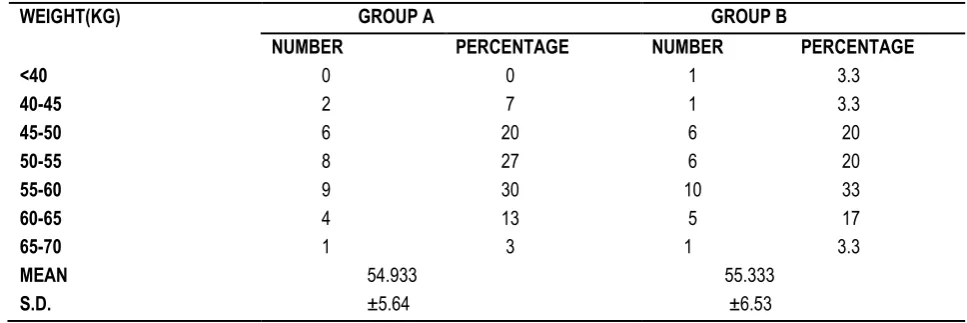
Table 2: Weight distribution of parturients
WEIGHT(KG) GROUP A GROUP B
NUMBER PERCENTAGE NUMBER PERCENTAGE
<40 0 0 1 3.3
40-45 2 7 1 3.3
45-50 6 20 6 20
50-55 8 27 6 20
55-60 9 30 10 33
60-65 4 13 5 17
65-70 1 3 1 3.3
MEAN 54.933 55.333
Table 3: Distribution of gravid and parity of the parturients
GROUP A (n=30) B (n=30)
No. of parturients Percentage of total No. of parturients Percentage of total
Primigravida 20 66.67 18 60
Multigravida 10 33.33 12 40
2nd gravid 8 26.67 9 30
3rd gravid 2 6.67 0 0
4th gravid 0 0 3 10
Nullipara 23 76.67 21 70
Multipara 7 23.33 9 30
Parity = 1 7 23.33 7 23.33
Parity = 2 0 0 2 6.67
RESULTS
Table 1 shows youngest parturients in both groups were 18 years old; while the oldest were 28 and 33 in groups A & B respectively. The mean age is similar in the two groups, 23±3 year in group A, 24±3.9 years in group B. In the combined age range 21-30 years, there are 83.33% of women in group A and 70% in group B. The two groups are thus comparable by age.
Table 2 shows the most common weight range in either group is 55-60 kgs. The mean weight is 54.93±5.64 kg in Group A and 55.33±6.53 kg in group B. The two groups are comparable by weight.
Table 3 shows the distribution of parturients in the two groups in terms of gravid and parity. It was found out that, the distribution of primigravida in group A 66%, 2nd gravid 27%, 3rd & 4th gravid 7%, while in group B, primigravida 60%, 2nd gravid 30% & 3rd gravid 10%. In both groups, there were more primigravida than multigravida, and the distribution is comparable. The distribution reflects the usual pattern of parturients who come to this hospital for delivery. If parity is considered, a majority of women in both groups were nulliparous, the distribution being similar in both. As there were some multigravidae with history of spontaneous
abortion/ MTP in both groups, there are more nulliparous women in either group in comparison with primigravidae.
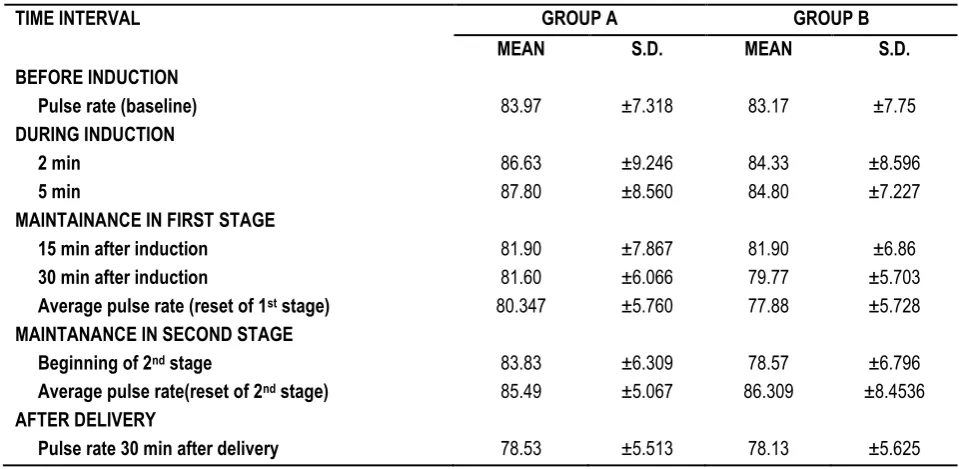
Table 4 shows the distribution of maternal pulse rate in the two groups during labour and after delivery. The baseline pulse rate taken before induction is similar in both groups. A slight increase in the mean rate compared to baseline is noted soon after induction, probably related to anxiety following the catheterization. No anxiolytics were used during the procedure to avoid foetal complications. There is no reason to suspect compensatory tachycardia, as the pharmacologic response usually came much Later, and sufficient preloading was done to pre-empt any fall in BP. A similar rise is noted in the second stage which is usually greater in parturients not receiving epidurals and is a normal physiologic response to labour.
Table 5 depicts the systolic blood pressure (SBP) in different stages of labour in the two groups in terms of mean and standard deviation. The table shows that the mean systolic blood pressure in the two groups was maintained close to baseline. In the second stage a slight rise above baseline is noted in both groups, which is expected to be much higher in those not receiving epidurals.
Table 4: Distribution of pulse rate in labour
TIME INTERVAL GROUP A GROUP B
MEAN S.D. MEAN S.D.
BEFORE INDUCTION
Pulse rate (baseline) 83.97 ±7.318 83.17 ±7.75
DURING INDUCTION
2 min 86.63 ±9.246 84.33 ±8.596
5 min 87.80 ±8.560 84.80 ±7.227
MAINTAINANCE IN FIRST STAGE
15 min after induction 81.90 ±7.867 81.90 ±6.86
30 min after induction 81.60 ±6.066 79.77 ±5.703
Average pulse rate (reset of 1st stage) 80.347 ±5.760 77.88 ±5.728
MAINTANANCE IN SECOND STAGE
Beginning of 2nd stage 83.83 ±6.309 78.57 ±6.796
Average pulse rate(reset of 2nd stage) 85.49 ±5.067 86.309 ±8.4536
AFTER DELIVERY
Table 5: Shows systolic blood pressure (SBP) distribution in labour
TIME INTERVAL GROUP A GROUP B
MEAN S.D. MEAN S.D.
BEFORE INDUCTION
SBP (baseline) 124.87 ±8.029 124.80 ±10.015
DURING INDUCTION
2 min 124.73 ±8.557 125.77 ±10.621
5 min 124.00 ±8.614 123.20 ±8.767
MAINTAINANCE IN FIRST STAGE
15 min after induction 118.93 ±8.481 122.87 ±9.751
30 min after induction 120.20 ±8.491 122.13 ±9.555
Average SBP (reset of 1st stage) 122.32 ±6.84 122.37 ±8.24
MAINTANANCE IN SECOND STAGE
Beginning of 2nd stage 126.47 ±6.981 125.93 ±9.105
Average SBP (reset of 2nd stage) 128.44 ±8.29 126.39 ±8.279
AFTER DELIVERY
SBP 30 min after delivery 124.60 ±7.933 122.67 ±10.189
Table 6: Shows diastolic blood pressure
TIME INTERVAL GROUP A GROUP B
MEAN S.D. MEAN S.D.
BEFORE INDUCTION
DBP (baseline) 79.53 ±5.746 77.67 ±6.082
DURING INDUCTION
2 min 78.73 ±6.898 77.53 ±5.625
5 min 78.53 ±5.655 76.93 ±5.426
MAINTAINANCE IN FIRST STAGE
15 min after induction 76.47 ±4.747 75.07 ±5.675
30 min after induction 76.13 ±4.637 74.13 ±5.631
Average DBP (reset of 1st stage) 77.51 ±3.553 74.18 ±5.189
MAINTANANCE IN SECOND STAGE
Beginning of 2nd stage 78.80 ±4.999 76.73 ±5.570
Average DBP (reset of 2nd stage) 79.60 ±3.895 76.74 ±5.714
AFTER DELIVERY
DBP 30 min after delivery 75.73 ±5.502 75.93 ±5.159
Table 6 shows the mean diastolic pressure (DBP) in the two groups before induction, in the first stage, in the second stage and after delivery, along with the standard deviation. A quick perusal of this table shows a slight falling trend in both groups in the maintenance phase.
Table 7 shows the mean duration to the first painless contraction as elicited by a verbal score of 1, along with the standard deviation. The time was calculated from the completion of the bolus dose. The mean duration was 15.67±2.771 min in group A whereas it was 18.33±4.73 min in group B. The time of onset in group A was shorter than group B, which is definitely significant (P<0.01).
The mean VAS score in mm in each group. Since the infusion was given continuously in both groups in the 1st stage and by bolus in the 2nd stage, no time adjustment were done and simple arithmetic means were taken. VAS scores were recorded before start of procedure and at pre-determined intervals irrespective of requests for higher dose in the 1st stage or bolus top-ups in the 2nd stage.
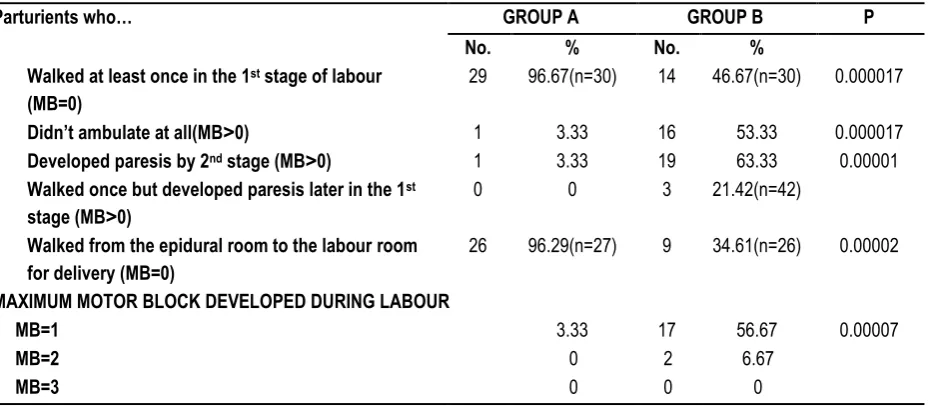
The values are found to be low after epidural analgesia was instituted. There is no significant difference (P>0.05) in VAS scores between the two groups as evidenced by the P values in the last column on the right. The scores shows that good analgesia is obtained by use of 0.0625% bupivacaine solution with 2µg/ml fentanyl which is comparable to that obtained with 0.125% bupivacaine solution. The effect of the test solutions on ambulation and also the maximum motor paresis developed eventually. Motor paresis was assessed using the Modified Bromage score. Those with a score of 0 were allowed to ambulate.
(96.29% compared to 34.61% in group B) walked to the delivery table in the 2nd stage from the adjacent epidural analgesia room. Only 3.33% parturients in group A developed a maximum motor paresis of grade 1 while in group B, 56.67% developed a maximum block of grade 1 and 6.67% developed a maximum block of grade 2, the differences being highly significant
(P<0.001). One woman in group B had unilateral paresis. 90% of mothers in group A and 93.33% in group B were satisfied with the procedure 24 hours after delivery. One woman in group A developed pruritus & was dissatisfied with the inability to perceive contractions. The high level of satisfaction is similar in the two groups.
Table 7: Shows the onset of analgesia as measured by the time to first painless contraction
GROUP A GROUP B P
MEAN S.D. MEAN S.D.
Time to 1st painless contraction (min) 15.67 ±2.771 18.33 ±4.73 0.007
Table 8: Shows the mean VAS scores (mm)
TIME PERIOD GROUP A GROUP B P
MEAN S.D. MEAN S.D.
Before epidural (baseline) 66.83 ±17.195 70.5 ±16.523 0.403
Epidural to full dilatation 13.36 ±3.914 12.44 ±3.535 0.340
2nd stage 11.229 ±4.665 10.453 ±5.799 0.057
Epidural to delivery 12297 ±3.528 11.446 ±3.230 0.334
Table 9: Shows effects on ambulation and degree of motor block
Parturients who… GROUP A GROUP B P
No. % No. %
▪ Walked at least once in the 1st stage of labour (MB=0)
29 96.67(n=30) 14 46.67(n=30) 0.000017
▪ Didn’t ambulate at all(MB˃0) 1 3.33 16 53.33 0.000017
▪ Developed paresis by 2nd stage (MB˃0) 1 3.33 19 63.33 0.00001
▪ Walked once but developed paresis later in the 1st
stage (MB˃0)
0 0 3 21.42(n=42)
▪ Walked from the epidural room to the labour room
for delivery (MB=0)
26 96.29(n=27) 9 34.61(n=26) 0.00002
MAXIMUM MOTOR BLOCK DEVELOPED DURING LABOUR
MB=1 1 3.33 17 56.67 0.00007
MB=2 0 0 2 6.67
MB=3 0 0 0 0
DISCUSSION
The mean age of parturients in the 0.0625% bupivacaine with fentanyl group was 23±3 years; while it was 24±3.9 years in the 0.125% bupivacaine group. The two groups were similarly matched by age, as almost 80% parturients in both groups were in the age range of 21 to 30 years. In a similar study on continuous infusion of bupivacaine and fentanyl for labour analgesia conducted by Elliot, R.D. in 1998, the mean age in the three groups studied were 26±5 years, 26±4 years and 27±4 years. The mean age in the present study in either group in lower in comparision reflecting the early age of marriage in our country. The mean weight in the 0.0625% bupivacaine with fentanyl group was around 54.93±5.64 Kgs and in the 0.125% bupivacaine group it was 55.33±6.53 Kgs, the range extending from 40 to 70 kgs. The two group were similarly matched by weight. The mean weight distribution in the study by Elliot, R.D., 1998 was 73±9 kgs, 78±10 kgs and 76±14 kgs respectively in the three groups studied. The mean weight was found to be lower in the present
study in comparison, as women in our country have a smaller built. The quality of analgesia was assessed using visual analogue scores (VAS) recorded on a 100 mm line. The mean VAS score in the 0.0625% bupivacaine with fentanyl group before institution of epidural analgesia was 66.83±17.195 while it was 70.5±16.523 in the 0.125% bupivacaine group, and the two groups were similarly matched (P>0.05). The baseline pain levels in the three groups studied by Elliot in 1991 had median and interquartile ranges (in brackets) as follows: 80 (70-89.5); 80 (72.5-95); 80 (75-100). The Comparative Obstetric Mobile Epidural Trial (COMET) Study Group UK in 2002 recorded initial median VAS scores of 75, 78 and 75 in the three groups they studied before epidural analgesia was started. The present study recorded similar values with respect to the degree of pain before initiation of epidural analgesia.
and B respectively. Corresponding values for the second stage were 11.229±4.665 for the 0.0625% bupivacaine with fentanyl group and 10.453±5.779 for the 0.125% bupivacaine group. Overall, the mean VAS score in labour was 12.297±3.528 for the 0.0625 % bupivacaine with fentanyl group and 11.446±3.230 for the 0.125% bupivacaine group.
Analgesia scores between the two groups were not significantly differently different (P>0.05). Likewise, in 2001, Femandez-Guisasola, J., Serrano, M.L., et al5 recorded scores of 1.04±1.63 on a verbal score of 1 to 10 for the group receiving 0.0625% bupivacaine with and 0.95±1.71 for the group receiving 0.1%ropivacaine with 1µg/ml fentanyl; the values were not significantly different (P>0.05).
REFERENCES
1. Merskey H, Bogduk N (editors). 1994. Classification of chronic Pain. Description of Chronic Pain Syndrome and Definitions of Pain Terms, 2nd ed. Seattle: IASP Press, International Association for the Study of Pain. 209-214.
2. Brinbach, D.J., Browne I.M. 2005. Anesthesia for Obstetrics.
Miller’s Anesthesia 6th Edition. Philadelphia: Elsevier Churchill
Livingstone.
3. Melzack R. The myth of painless childbirth (the John J. Bonica Lecture). Pain 1984; 19:321-337.
4. Chestnut, D.H., Laszewski, L.J., Pollack, K.L., Bates, J.N., Manage, N.K.,, Choi, W.W. Contineous Epidural Infusion of 0.0625% Bupivacaine- 0.0002% Fentanyl during the Second Stage of Labour. Anaesthesiology 1990; 72(4):613-618.
5. Fernandez- Guisasola, J., Serrano , M., Cobo, B., Munoz, L., Plaza, A., Trigo, C., Garcia del Valle, S. A Compromise of 0.0625% Bupivacaine with Fentanyl and 0.1% Ropivacaine with Fentanyl for Continuous Epidural Labour Analgesia. Anaesthesia & Analgesia 2001; 92(5): 1261-1265.
[
Source of Support: Nil. Conflict of Interest: None Declared. Copyright: © the author(s) and publisher. IJMRP is an official publication of Ibn Sina Academy of Medieval Medicine & Sciences, registered in 2001 under Indian Trusts Act, 1882. This is an open access article distributed under the terms of the Creative Commons Attribution Non-commercial License, which permits unrestricted non-commercial use, distribution, and reproduction in any medium, provided the original work is properly cited.