©Center for Promoting Education and Research
www.cpernet.org
Information technology in holography
KRASKEVICH Valeriy Evgenovych Ph.D. Professor
Head of the Department of Computer Science Kyiv National University of Trade and Economics
TYSCHENKO Ihor Anatoliiovych Postgraduate Student
Department of Computer Science
Kyiv National University of Trade and Economics PYLYPENKO Iryna Dmytrivna
English teacher of the highest degree, senior teacher Abstract
Creating a holographic image is a complex process that requires knowledge in the field of informatics, physics, geometry, and design. To achieve results, a large number of specific equipment and information technology is used. That is why holographic projectors are rather a luxury item than a productive component of advertising or education. The use of 3D technology will greatly enhance the capabilities of the hologram and reduce the cost of devices. The information technology software used in the construction and reproduction of holograms is based on web design, video editing, and 3D modeling.
Keywords:3D, 2D, information technologies, software, holography.
Introduction
Improving gadgets, increasing productivity and reducing their size is a vector of modern information technology development. Holographic prisms and holographic showcases, and finally, holography as a whole, became the new direction of multimedia presentations. The information technologies used in these devices are based on the presentation of images on special projection surfaces that are transparent or translucent, enabling users to see the image in space. To achieve the 3D image effect, 3D technology and 3D image playback software are used.
To transform the 3D image into the holographic one, special devices such as holographic 3D screenshots are used. Due to the use of several screens (usually 3) and a glass surface with a back projection film, located at an angle of 45 degrees, the effect of the "hologram" is achieved. Due to the use of the laws of geometric optics and the laws of refraction of light, the effect of positioning the image in space [1, p.135 -185] is achieved.
The 3D image is in the coordinate plane X, Y and Z, which allows you to go beyond the usual 2D plane X and Y, and maximize the "animation" of the image. 3D images include shadow, refraction of light, change of viewing angle with the use of special glasses or virtual rooms. 3D image is a bulk image that, due to its structure, completely mimics an object from any angle. Typically, there are 6 images in the cube that reproduce the object on each side. It allows the user to change the view angle of the image.
The systematization of the laws of optics and combining them with information technologies and systems make it possible to create an optical illusion that transforms the usual 3D image into a holographic one.
Preparing a 3D image for a holographic prism is different from creating a 3D bulk image. Stages of image preparation:
©Center for Promoting Education and Research
www.cpernet.org
2. Use of the background is inadmissible. The holographic image should be a clear model in the space that is in the environment where the design takes place. There should only be a black background that will serve as a void and will provide volume.
3.It is not allowed to use shades or colors close to black or white. They serve as void (black) and "glare" on glass (white). The vivid colors do not have enough force to pass through the light filter glass and will be invisible on the prism.
4. The use of too small details is not allowed since the glass consists of at least 2 layers, which will create the effect of "duality of the image".
5. It is not allowed to use the "shadow" effect for any image or line of images. The precise lines of the object separate the image projected from the environment where it is projected.
6. Most holographic 3D images are blue or green. These colors have enough contrast for viewing in any lighting.
The main advantage of using information technology in the hologram is the ability to simulate any object, regardless of complexity and size. This solution helps to recreate an object and place it in the right environment. The scope of 3D technology is not limited. One of the solutions where 3D technology is used is a holographic 3D showcase «uScreener».
Why is it exactly 3-D and what is the difference in the application of 2-D and 3-D images?
The principle of using information technology in holography is based on the interaction between a minimum of auxiliary devices. That is why the important element in holograms is the use of a three-dimensional 3D image, which completely replaces the use of multiple screens, mirrors and glass surfaces [2, p.217-221].
Rules for constructing a holographic image using a 2D image:
1. The image from the monitor is applied to the mirror surface, which is parallel to the screen.
2. The inverse image from the mirror surface is transferred to a glass surface, which is located at an angle of 45 degrees relative to the mirror surface. Thus it creates a bulk image, due to the double display of the screen on the glass and the screen in the mirror.
3. The surface in the holographic window should be white. It is this color that allows you to avoid unnecessary items that are on the screen.
4. Using a reverse projection film will avoid unwanted illumination of the image and provide color detail. 5. The light in the holographic display case helps to illuminate the element and position the image relative to the space in the middle of the show-window.
The conclusion regarding the use of 2D images is an overloaded showcase component, which should work in specific conditions, where each component will not be exposed to external factors and mechanical damage, which is difficult to achieve in conferences, exhibitions, presentations. The information technologies used in 2D image projection differ in complicated system code, compared with the software used in 3D image projection.
Rules for constructing a holographic image using a 3D image:
1. The image from the monitor is applied to the glass surface. A back-projection film is applied on the glass surface.
2. A glass surface image is transmitted to the back of the projector, which in its turn helps to avoid any dark and bright beams. Thus, only colored rays come into the surface.
3. The inner part is made in black. It helps to provide internal volume.
©Center for Promoting Education and Research
www.cpernet.org
5. Using a 3D image avoids the use of additional mirrors, and due to the dark background create a volume in the middle of the window.
As for the appropriateness of using a 3D image, 3 elements are enough to create a holographic effect: a monitor, a glass with a reverse projection film and spotlight. A combination of these 3 elements will allow you to create a hologram of any size.
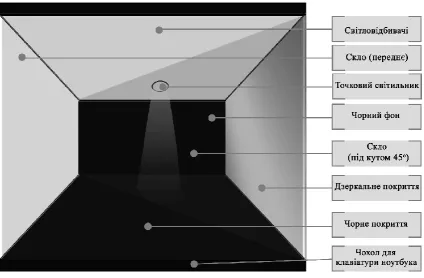
Full 3D hologram playback is provided by equipment called "holographic 3D showcase". The device converts light streams from the LED (Light-emitting diode) of the monitor and reproduces the image on the wall of the light, which is a "projection screen". Model of holographic 3D showcase «uScreener» (Fig. 1).
Fig. 1. 2D model of holographic 3D showcase
The device depicted in Fig. 1 is portable and can work in any lighting that gives functional advantages compared with conventional holographic prisms. The picture should be in contrast. For the image to be reproduced brightly in any light one of the three types of the light-filtration glass is used:
1. Transparent glass.
Transparent glass is used in rooms with low light, where bright beams of light will not get on the device.
2. Gray glass.
Gray glass is used with medium light. The purpose of using this glass is to create a complete picture or "complemented reality" around the subject.
3. Dark glass.
Dark glass is a universal solution for any type of lighting, as it is protected from falling of bright beams on the device and can work in any lighting around the holographic 3D display.
Light in the middle of the device should be evenly distributed and not have too bright or dark areas. This guarantees the effect of the full presence of the subject and at a 1-meter distance from the device simulates the presence of the real object in the device, rather than the 3D image.
©Center for Promoting Education and Research
www.cpernet.org
In the case of plants or insects, the hologram completely replaces their presence, allowing them to display rare instances of insects or plants.
Replacing items on holographic objects will significantly reduce the cost of security and reduce the risk of harm to the environment.
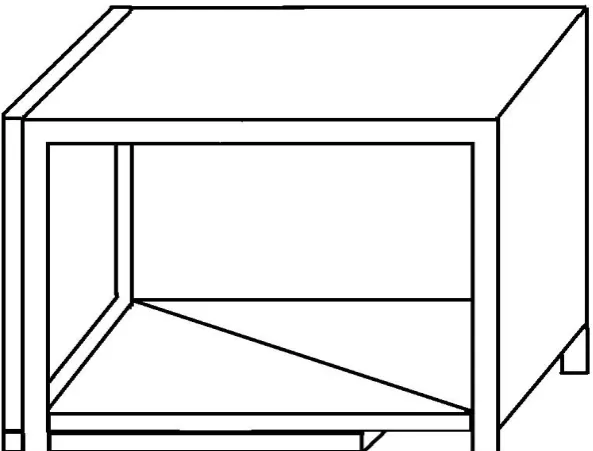
Fig. 2. Scheme of the holographic 3D showcase
The diagram depicts the main components of the holographic 3D display:
1-screen; 2-mirror surface; 3-light wall; 4-light-correction glass; 5-coloured streams of light; 6-computer; 7-a tablet.
The model depicts the construction of a holographic 3D display (Fig.3). Changing the display angle significantly reduces the size of the device, which allows you to display objects much larger in the same location, compared with holographic prisms. It greatly simplifies the logistics of using locations and allows you to provide more detailed information to the viewer.
The advantages of this design are the ability to display holograms of people at full height, using a space no more than 1m2. It is impossible to achieve such results using holographic prisms.
©Center for Promoting Education and Research
www.cpernet.org
The features of the functioning of the holographic 3D display are as follows: the device interacts using the software on the tablet and the computer. The tablet controls the images and the functioning of the computer and also adjusts the device and controls the light wall. There are mdi-media playback files and a video web application on your computer Due to the information technology software it is possible to control the hologram on-line.
One of the important areas of hologram application is environmental safety. Most of the museums, exhibitions, presentations demonstrate materials that can harm the environment or vice versa, these materials can be destroyed by the environment. In most cases, these items are replaced by static holographic images or displayed on monitors.
One of the technologies used in modern museums is holograms. These holograms are created with the help of glass, photoresists and laser beams, which, by scattering, fall into the object behind the glass, and when reflected from the subject, the light waves fall on the glass, creating the image of the object. This technology allows you to create static models.
The use of a dynamic 3D hologram allows you not to stick to glass, and you can display any image that is of sufficient size on one stand. Due to this technology, it is possible to demonstrate not only objects but also installations of the past, the placement of objects in the right environment, which makes it possible to create the effect of complemented reality. It is also possible to install large sizes and reproduce historical facts or fantastic events.
The scope of holographic 3D projectors is limited only by the imagination of the designer. The use of a holographic 3D image is possible in any environment without the need to create a special microclimate in the middle of the exhibition space. Due to this technology, it is possible to transfer the viewer to any environment, without risk to the health of viewers and the risk of harming objects of antiquity or living creatures that must be in a particular environment.
Conclusions
The use of 3D technology in the field of holography opens up new opportunities in creating models in space. Modern information technology software significantly accelerates the process of creating holograms and improves the result. 3D technology helps to reduce the size of devices to reproduce holograms and increase their productivity. The disadvantage is that to model and reproduces holograms with a 3D image, computers with greater productivity than for 2D should be used, but the use of productive devices is a necessary step for the transition to the era of holography and the replacement of conventional projectors and showcases with modern and more productive ones. Information technology software for reproducing 3D images must be multipurpose and work on any device. It will create a fundamentally new situation in presentations and advertising.
References
Pedrini G., Zhang F., Osten W. Digital holographic microscopy in the deepultraviolet. Applied Optics, 2007. V.46, №32. P.135–185.