Improvement in Power Quality of IGBT based
Front-End Converter using MATLAB
Binita Tailor Ayaz Pathan
UG Student UG Student
Department of Electrical Engineering Department of Electrical Engineering Shroff S.R. Rotary Institute of Chemical Technology, Vataria
India
Shroff S.R. Rotary Institute of Chemical Technology, Vataria India
Harsh Patel Ritesh Khushwaha
UG Student UG Student
Department of Electrical Engineering Department of Electrical Engineering Shroff S.R. Rotary Institute of Chemical Technology, Vataria
India
Shroff S.R. Rotary Institute of Chemical Technology, Vataria India
Mr. Jignesh Joshi Assistant Professor
Department of Electrical Engineering
Shroff S.R. Rotary Institute of Chemical Technology, Vataria India
Abstract
The paper presents the modeling, simulation and analysis of an IGBT based front-end converter. It provides a suitable control algorithm for a pulse width modulation rectifier, which reduces ripple from the DC output side as well as shapes the input current as input voltage. The basic objective of IGBT based front-end converter is to regulate the DC output voltage and also ensure a sinusoidal input current and unity power factor operation. This is implemented by high speed IGBT switches connected in H-Bridge. The output voltage is controlled by switching of IGBTS and higher order ripples at the output can be easily eliminated with the help of passive filter. Lower order harmonics are eliminated using PWM technique. The control subsystem generates gating pulse to the universal bridge by passing the output voltage through a network consisting of comparator, discrete PI controller and discrete PWM generator. The output of this generator is the gating pulses to be applied to the universal bridge. By this control method, we have tried to reduce the input current harmonic distortion and bring the input current and voltage in same phase as well as make it sinusoidal.
Keywords: Improvement of Power Quality, IGBT based Front-End Converter, Eliminate Line Current Distortion, MATLAB Simulation, Reduce Input Current %THD
________________________________________________________________________________________________________
I. INTRODUCTION
A switching power rectifier in the power system converts one level of electrical energy into another level of electrical energy. Converters in the AC to DC conversion field are the most widespread and the operation of a converter can be explained in terms of the input quantities, output quantities and the switching pattern used to obtain the preferred output.
Types of semiconductor devices used in the rectifier are as follows: Uncontrolled rectifiers - Diodes as switches
Phase-controlled rectifiers - SCR (silicon controlled rectifiers)
Pulse-width modulation rectifiers - IGBTs (insulated gate bipolar transistors) or power MOSFETs (metal oxide field-effect transistors)
The ability to control the system to obtain unity power factor operation of a boost rectifier is an important feature of the rectifier topology. The power factor (PF) is defined as the ratio of working power to apparent power. The power quality problems, such as large values of harmonics, poor power factor and high total harmonic distortion, are usually associated with operations of AC to DC converters. An increase in the current harmonics and a decrease in the displacement power factor in AC power lines produced by diode and thyristors are serious problems.
current will be developed by using MATLAB/Simulink for elimination of the harmonics of current and to obtain a sinusoidal current of the line.
II. PROBLEM IDENTIFICATION
From the study in this paper, there are a large number of switching converter topologies and composite switching converters are possible. The power quality problems, such as large values of harmonics, poor power factor and high total harmonic distortion, are usually associated with operation of AC/DC converters. The other important problem is that the input current and voltage waveforms are not in phase due to the distortions. There have been many approaches to mitigate the harmonics and other problems in the rectifier system. [1]
III. OBJECTIVE OF THE PAPER
The objective of this Project is to design, simulate and implement of diode based rectifier and IGBT based front-end converter which more efficient and able to solve the nonlinear problem with optimum way.
1. To reduce the Input current THD (Total Harmonic Distortion)
2. Input voltage and current should be in the same phase i.e. unity power factor. 3. The input current should be sinusoidal.
IV. IGBT BASED FRONT END CONVERTER
In this paper boost rectifier using IGBT for operating at higher frequency is reported. Sinusoidal Pulse width modulation technique is used for switching of IGBTs is explained. This converter providing the desirable dc output voltage with unity power factor and less %THD. The power circuit for this rectifier with closed loop using PI controller is simulated in MATLAB.
V. DESIGN CALCULATION
Input Voltage
Vm=√2×230 =325 V
Line filter Inducter
L=0.03 Vs 2πf Is
Output filter Capacitor
= Vr Is
ΔV 2Vdc 4πf
Output DC Voltage
=2 Vm π
Switching Frequency
Time period T=1 f
VI. DESIGN CONSIDERATION AND RESULTS
Design Specification:
Input voltage: 325V Frequency: 50Hz
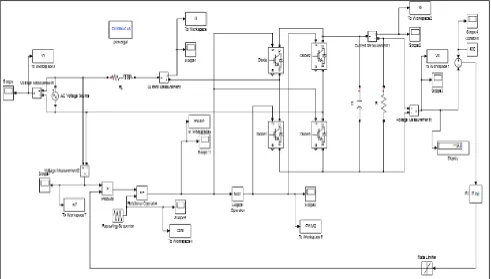
Fig. 5: Simulation of IGBT based front end converter In this paper IGBT based front end converter for operating at high frequency is reported.
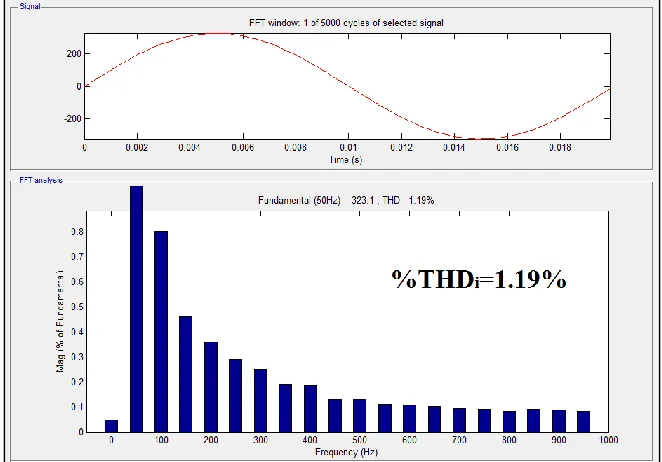
Simulation of IGBT based front end converter is as shown in Simulink model. In this there is H-Bridge rectifier circuit with gate controlled switches i.e. IGBT.s. For triggering the IGBTs we have generated gate pulses using closed loop arrangement. By comparing output voltage of PWM rectifier and reference Dc voltage given to the PI controller. Output of PI controller is to be multiply with supply voltage. The multiplier output voltage is compared with carrier signal (triangular wave). This will generate gate pulses for triggering the IGBT. By varying the values of output side filter capacitor and resistive load values. We can gate the DC output voltage with minimum of ripple. By this simulation we also reduce the input current %THD to 8.59% also input current same phase with input voltage i.e. unity power factor.
VII. RESULTS OF THIS SIMULATION
Input Current
Output Voltage
Output voltage [Scale: X axis:10 s/div , Y axis:50 V/div] Fig. 7: Waveform of output voltage
VIII. CONCLUSION
It provides suitable control algorithm for a pulse width modulation rectifier, which reduces ripple from the DC output side as well as shapes the input current as input voltage.
ACKNOWLEDGEMENT
We are grateful to Mr. Jignesh Joshi, Assistant Professor in the Department of Electrical Engineering, SRICT. We are extremely thankful and indebted to him for sharing expertise, and sincere and valuable guidance and encouragement extended to us and thankful to Mr. Praful P. Chudasama, Head of Department of Electrical Engineering, SRICT for giving us valuable support.
We take this opportunity to express gratitude to all of the Department faculty members for their help and support. We also thanks our parents for the unceasing encouragement, support and attention.
REFERANCES
[1] Mahasweta Bhattacharya ECE “Improvement of Power Quality Using PWM Rectifiers” Future Institute of Engineering & Management ,Kolkata International Journal of Scientific and Research Publications, Volume 4, Issue 7, July 2014 ISSN 2250-3153
[2] Prof. P. N. kapil Assi. Professor Electrical Department “Simulation of Closed Loop AC-DC Converter for Power Quality Improvement” International Journal of Engineering Research & Technology (IJERT) Nirma University Ahmedabad, India Vol. 4 Issue 03, March-2015, ISSN: 2278-0181
[3] Maulik J. Shah, Hirenkumar D. Patel and Niravkumar D .Patel Student, Dept. of Electrical Engineering, “Simulation of PWM Control Scheme Designed for 1-phaseUnity Power Factor Active Rectifier” Nirma University, Ahmedabad ,Gujarat, India Designed for 1- Conference Paper December 2010 [4] Renju Mathew, Neha Agarwal, Manisha Shah, and P. N. Tekwani “Design, modelling and simulation of three-phase front-end converter for unity power
factor and reduced harmonics in line current”2013 Nirma University International Conference on Engineering (NUiCONE)
[5] Maulik J. Shah, U.A. Patel, Rameshvar P. Sadhu, Mitesh N. Priyadarshi “Design and Simulation of 1kW Active Rectifier” institute of technology, nirma university Ahmedabad – 382481, 9-11 December, 2010 Conference Paper
[6] Deepakkumar Varu, Nitin H. Adroja, Narendrasinh Rana Department of Active Electrical Engineering, “Power Factor Improvement in Single Phase System Using Front End Converter” Atmiya Institute of Technology & Science, Rajkot, Gujarat, India Conference Paper April 2016