DEMOGRAPHIC RESEARCH
VOLUME 30, ARTICLE 43, PAGES 1245
−
1276
PUBLISHED 23 APRIL 2014
http://www.demographic-research.org/Volumes/Vol30/43/ DOI: 10.4054/DemRes.2014.30.43
Research Article
White-Hispanic differences in meeting lifetime
fertility intentions in the U.S.
Caroline Sten Hartnett
© 2014 Caroline Sten Hartnett.
This open-access work is published under the terms of the Creative Commons Attribution NonCommercial License 2.0 Germany, which permits use, reproduction & distribution in any medium for non-commercial purposes, provided the original author(s) and source are given credit.
1 Introduction 1246
2 Background 1247
2.1 Fertility intentions 1247
2.2 Race-ethnicity and gender 1248
2.3 Mediating factors 1249
2.4 Goals of the study 1251
3 Data and methods 1252
3.1 Key variables 1253
3.2 Analytic approach 1254
4 Results 1255
4.1 Racial-ethnic differences in fertility intentions and the correspondence between intentions and outcomes
1255 4.2 Decomposition of racial-ethnic differences in fertility levels 1259 4.3 Explaining White-Hispanic differences in intended parity 1260 4.4 Explaining White-Hispanic differences in overshooting intended
parity
1262
4.5 Post-Hoc tests 1264
5 Discussion 1265
6 Acknowledgements 1268
References 1269
White-Hispanic differences in meeting lifetime fertility intentions
in the U.S.
Caroline Sten Hartnett1
Abstract
BACKGROUND
Hispanics in the U.S. have higher fertility than non-Hispanic Whites but it is not clear why this difference exists nor whether fertility levels reflect the preferences of individuals in these groups. Understanding racial-ethnic differences in fertility is important for understanding American fertility more broadly since the majority of births in the U.S. are to non-White women.
OBJECTIVE
This paper examines the correspondence between fertility intentions and outcomes for Hispanic and White women and men in the U.S.
METHODS
Panel data from the National Longitudinal Survey of Youth are used to describe intended family size (recorded at age 22), completed family size (recorded at age 42 and above), and the likelihood that these numbers match, for Hispanic and White women and men. Regression analyses are used to understand why the correspondence between intentions and outcomes varies across groups.
RESULTS
Although Hispanics come closer to achieving parity intentions in the aggregate (Hispanic women fall short by a quarter of a birth, compared to more than two-fifths for Whites), at the individual level they are not more likely to meet their intentions (33% of Hispanic women achieve their desired parity, compared with 38% of Whites). Hispanics have higher fertility than Whites both because they intend more children at the start of their reproductive lives and because they are more likely to exceed these intentions.
CONCLUSIONS
Higher fertility among Hispanics compared with Whites in the U.S. is due to a combination of wanted and unwanted fertility. In addition, despite relatively high completed fertility, a large proportion of Hispanic women and men fall short of early life intentions.
1. Introduction
Differences in fertility rates across ethnic groups in the U.S. are well documented, with Hispanic women bearing more children than non-Hispanic White and Black women, but the reasons for these differences remain unclear (Bean and Tienda 1987; Martin et al. 2009). The country’s Hispanic population is growing dramatically and most of this growth currently comes from fertility rather than migration (Pew 2011). Understanding racial-ethnic differences in fertility is important for understanding American fertility more broadly, since race-ethnicity is one of the primary axes along which fertility behaviors vary. It was recently announced that births to non-White women now exceed births to White women for the first time (United States Census Bureau 2012). The presence of higher fertility subgroups – particularly Hispanics – is one reason cited for the fact that the U.S. is able to maintain replacement-level fertility while other developed countries fall short (Kohler et al. 2006; Preston and Hartnett 2010). Here, I focus on non-Hispanic Whites (hereafter “Whites”) and Hispanics specifically and explore whether differences in fertility levels across groups reflect the preferences of individuals in those groups. I also show how ethnic differences in fertility levels can be explained by differences in fertility intentions and the likelihood of meeting those intentions.
childbearing goals. It is an open question whether ethnic differences in fertility levels are the result of differing preferences or whether some groups are systematically disadvantaged in trying to carry out their childbearing intentions.
The ability to meet intentions is important from a well-being perspective. One component of meeting childbearing intentions – unintended pregnancy – is acknowledged as part of Healthy People 2020 (U.S. Department of Health and Human Services 2010). This policy document cites the reduction of unintended pregnancy as a U.S. public health goal, due to the fact that unintended pregnancy is associated with poorer health outcomes for children and health risks and psychological distress for parents (Sable and Wilkinson 2000; Singh et al. 2003; Barber and East 2011; Baydar et al. 1997a; Baydar et al.; 1997b; Brown and Eisenberg 1995; Maximova and Quesnel-Vallée. 2009). There has been relatively little research on the prevalence and consequences of the converse situation – unmet desire for children – but in cases where the individual continues to want children, infertility has been linked with a variety of negative outcomes, including stress and poorer marital quality (Andrews et al. 1991; Greil, Slauson-Blevins, and McQuillan 2010).
In this paper I focus on “fertility intentions” (or “intended parity”) expressed in early life (meaning the total number of children that young women and men say they eventually want to have) and the likelihood of ultimately meeting these intentions. Fertility intentions are considered the key determinant of fertility in low fertility settings where the means of controlling fertility are accessible (Barber 2001; Bongaarts 2001, 1992; Rindfuss, Morgan, and Swicegood 1988; Schoen et al. 1999; Westoff and Ryder 1977; Remez 2000).
2. Background
2.1 Fertility intentions
several factors that can cause individuals to either exceed intentions or fall short of them, such as unwanted births or the lack of an acceptable partner.
Prior research on meeting fertility intentions finds very different patterns at the individual level compared with the aggregate level. It is common in low fertility populations for women to fall somewhat short of intentions in the aggregate, as Berrington (2004) found in the U.K., but other studies in various countries have found a high level of correspondence between fertility intentions and achieved fertility at the aggregate level, with intended and achieved fertility both hovering around two children (Monnier 1989; Van de Giessen 1992, Quesnel-Vallee and Morgan 2003; O’Connell and Rogers 1983). However, this correspondence at the aggregate level does not generally seem to be due to the overwhelming achievement of fertility intentions at the individual level. On the contrary, it seems that a high frequency of both positive and negative ‘errors’ at the individual level balance one another out. For example, research by Morgan and Rackin (2010) found that a high proportion of Americans (57% of women and 64% of men) either exceed their long-term fertility goals or fall short of them. Throughout this paper, the term “overshooting” intentions is used to refer to the situation of having more births than one intended in early adulthood and the term “undershooting” intentions refers to having fewer births than one intended in early adulthood.
The fact that a large fraction of individuals either undershoot or overshoot their early life fertility intentions can be linked, in part, to changes in preferences over the life course. Fertility intentions depend on expectations of future circumstances (related to partnership situation, economic resources, and other factors) and intentions change over time, so the measurement and meaning of intentions is complex. Nevertheless, it seems that people do have underlying preferences that persist: intentions are powerful predictors of fertility behavior at the individual level, compared with other variables, and this seems to be the case even when intentions apply to a long time frame (Remez 2000; Rindfuss, Morgan, and Swicegood 1988; Thomson, et al. 1990; Thomson 1997; Trent and Crowder 1997; Schoen et al. 1999; Westoff and Ryder 1977; Wilson and Bumpass 1973). Further, having a gap between intended and completed parity is often considered a negative outcome for well-being, as is the case for many European countries where average intended parity exceeds average completed parity.
2.2 Race-ethnicity and gender
no research in this area has focused on Hispanics. However, prior research does point to White-Hispanic differences in unintended pregnancies and births, which can lead to overshooting intentions. A higher proportion of pregnancies to Hispanic women are unintended, compared with White women (54% and 40%, respectively, in 2001), and for both groups about half of these pregnancies are carried to term (Finer and Henshaw 2006, Martin et al. 2009). In addition, Hayford (2009) found that Hispanic women were more likely than non-Hispanic White women to reduce their fertility intentions over the life course. To my knowledge there is no existing research on the correspondence between fertility intentions and completed fertility for Hispanics in the U.S.
It is important to bear in mind that Hispanics are a heterogeneous group, both in terms of country of origin and immigrant generation, and these differing characteristics have implications for behavior (Glick 2010). First, the childbearing preferences and expectations of immigrants may be influenced by the prevailing norms in home countries (Alba and Nee 2003). Moreover, the migration event itself can also be disruptive to childbearing trajectories, either directly or indirectly by affecting partnerships or labor market engagement (Stephen and Bean 1992; Parrado 2011). The dataset used in this analysis minimizes immigration effects on fertility since the sample only includes those who were in the U.S. before peak childbearing ages.
In addition to addressing ethnic differences in fertility intentions and outcomes, this paper contributes to existing literature by examining men as well as women. Most studies of fertility intentions are limited to women and prior research shows that female partners’ intentions have a larger impact on fertility outcomes (Beckman et al. 1983). However, men’s intentions also impact a couple’s achieved parity (Thomson 1997; Schoen et al. 1999; Thomson et al. 1990). The intentions of male partners could play a particularly important role among Hispanics since men in this group might have more control over fertility decision-making than their White counterparts (Sable et al. 2009; Hirsch 2003).
2.3 Mediating factors
I explore several sets of factors that might explain differences between Whites and Hispanics in terms of their fertility intentions and their likelihood of meeting intentions. While no clear theoretical framework exists for selecting potential explanatory factors, prior research has identified factors that are likely to influence intentions and the likelihood of meeting intentions, and differ between Whites and Hispanics.
childbearing decisions, arguing that women who have more children simply have less to lose by having each additional child (Becker 1991). White women might choose to have fewer children because they have higher earning potential on average, and therefore bear a greater cost from shifting time from market work to childcare work. And, although couples with greater economic resources might theoretically be able to afford more children, wealthier couples spend substantially more money raising each child compared to couples with fewer means (Lino 2007). In addition to having higher intended parity, socioeconomically disadvantaged individuals (who comprise a higher proportion of the Hispanic group than the White group) might be more likely to overshoot their intentions, because prior research has shown they are more likely to have unintended births (Finer and Zolna 2011). Alternatively (or in addition), they may have early births which lead them to invest more in home life rather than education and work life, and decide to have more children than they originally anticipated.
Differences between Whites and Hispanics in religious upbringing might also lead to differences in fertility intentions and the likelihood of meeting intentions. Religious participation may increase fertility intentions through the dissemination of a pronatalist message, more ‘family-oriented’ values, and more sex role segregation, all of which might increase the desire for children (Goldscheider and Goldscheider 1988; Thornton and Camburn 1989; Thornton 1985). Moreover, affiliation with Catholicism – which is more common among Hispanics – might be associated with overshooting intended parity due to messages that discourage contraceptive use.
A more proximate determinant – the timing of births – is also likely to influence whether individuals achieve childbearing intentions (Morgan and Rackin 2010). Among couples that delay childbearing, some proportion will have fewer births than they intended due to subfecundity, which occurs at a range of ages and generally cannot be anticipated in advance (Hendershot, Mosher, and Pratt 1982). Conversely, the earlier individuals achieve their desired parity, the longer the period of exposure during which they are at risk of having an additional birth that would cause them to exceed their original intentions. Such births could be the result of unintended pregnancies that are carried to term or of revising intentions upwards over the life course. Ethnic differences in the age pattern of childbearing are well established, with Hispanic women having children at younger ages, on average, compared with White women (Ventura et al. 2008; see also Burton 1990).
2.4 Goals of the study
This study addresses three research aims:
1) To describe racial-ethnic differences in fertility intentions and the correspondence between intentions and outcomes
2) To decompose racial-ethnic differences in fertility levels into three components: fertility intentions, likelihood of overshooting intentions, and likelihood of undershooting intentions
3. Data and methods
The data for this paper came from the 1979 National Longitudinal Survey of Youth (NLSY79), a large, nationally representative sample of the 1957−64 U.S. birth cohort. This cohort was interviewed starting in 1979 when they were ages 15−21, and re-interviewed every year or two through their childbearing years and beyond (Zagorsky and White 1999). The NLSY is particularly useful for looking at the correspondence between intentions and outcomes since the same respondents were followed through time and were asked for their fertility intentions 16 different times between 1979 and 2008. No other nationally representative survey contains as detailed information about fertility intentions and births throughout the reproductive life course.
Women and men from the 1979 cohort were divided into two ethnic groups: Hispanics and non-Hispanic Whites (referred to as “Whites” throughout). In order to simplify the analysis the sample was limited to these two groups – respondents who were non-Hispanic Black, or non-Hispanic and of another race were dropped.2 Almost one-quarter of Hispanic respondents were foreign-born. Since respondents were in the U.S. before most childbearing occurred (most respondents were in their late teens at the first survey), and to maintain sample size, Hispanic immigrants were not separated from non-immigrants in the main analysis. The relevance of immigrant status was examined using regressions, however. Analyses were not conducted by country of origin, since data on national origin was only available for those who were foreign-born (a minority of the Hispanic sample). Most foreign-born Hispanic respondents were from Mexico (61%).
The analyses are based on a subsample of the 1979 cohort of Hispanic and White respondents, specifically those who were followed until 2008. Of the original 9,333 respondents in these racial-ethnic groups, 26% were excluded from the analyses because they were part of subsamples that were dropped from the NLSY after the initial waves. Of the remaining 6,922 respondents in these racial-ethnic groups, another 1,674 (24%) were dropped from the analysis due to missing data on key variables (either early life fertility intentions, completed parity above age 42, or independent variables). In other words, of the Hispanic and White respondents who were eligible to have been followed through to 2008, 76% were included in the analytic sample, with retention rates varying from 72% for Hispanic men to 80% for White women. Despite attrition and the loss of subsamples, the analytic sample appeared quite similar to the original
sample based on a comparison of background characteristics and intended parity (data available from the author).
3.1 Key variables
Early life parity intentions were based on the question, “Altogether, how many (more) children do you expect to have?” This number was added to any existing children to equal the total lifetime intended parity, for a respondent at a given age. The variable for early life intentions was equal to intentions expressed at age 22, or as close as possible to age 22, within the range of 19 to 25 (for 98% of respondents this information was collected between ages 21 and 23). Following prior research, I chose an age that was old enough that respondents could offer an intended parity that was realistic and based on personal preferences (rather than societal norms) but was young enough that most respondents had not yet completed childbearing (Quesnel-Vallee and Morgan 2003; Morgan and Rackin 2010).
Completed parity was based on the fertility history taken at the last wave the respondent participated in. The variable for completed parity was equal to the number of children ever born to the respondent, as long as the data were available at age 42 or older. For most respondents (64% of women and 62% of men) completed parity was collected above age 45. As a result, the “completed parity” variable missed a small number of births. According to vital registration data, women over 40 contribute only a small fraction of the Total Fertility Rate (1%−2%) and the percentage would be substantially lower above age 42 (Quesnel-Vallee and Morgan 2003). Actual completed parity for men is likely to have been only slightly higher than that reported here, based on the convergence between intended and achieved parity observed among respondents. The education levels of the respondent’s parents were used as indicators of childhood socioeconomic status. Mother’s and father’s education each consisted of four categories: less than high school, high school or equivalent, some college, and bachelor’s degree or higher. Because information on father’s education was not available for a high proportion of respondents (14%) and missing data is likely to be correlated with father absence rather than being random, the analysis includes a separate category for “father education level not available”.
The religion the respondent was raised in consisted of four categories: no religion, Protestant, Catholic, and other religion.
school, and more than high school. Second, poverty status in early adulthood is equal to 1 if the respondent was classified as being under the poverty line in any of the first three survey waves (1979, 1980, and 1982, during which respondents were in their late teens and early twenties).
Finally, there were three variables capturing the timing of childbearing: whether the respondent had his or her first child before age 23, between 23 and 26, or between 27 and 30. The reference category was respondents who did not have a birth by age 30.
Basic descriptive statistics for these independent variables appear in Appendix A. Compared with White respondents, Hispanics were less likely to have highly educated mothers and fathers. They were more likely to have been raised Catholic, and less likely to have been raised Protestant or another religion. In early adulthood Hispanics had lower levels of education and were more likely to be in poverty. In addition, Hispanic women and men had earlier first births compared with Whites. Among Hispanics, just over half were born in the U.S. and raised in non-English-speaking households, nearly a quarter were born in the U.S. and raised in English-speaking households, and nearly a quarter were foreign-born.
3.2 Analytic approach
Throughout the analysis I compared White women to Hispanic women, and White men to Hispanic men. Sampling weights were applied to adjust for differential nonresponse, the oversampling of certain subgroups, and the use of data from multiple waves (U.S. Bureau of Labor Statistics 2005).
The first part of the analysis examined group-level differences in fertility intentions and the likelihood of meeting intentions. I present average intended parity around age 22 and average completed parity at age 42 and above for the four groups. I also examined ethnic differences in the likelihood of individuals to meet intentions, that is, what proportion of White and Hispanic women and men met intentions, exceeded intentions, and fell short of intentions, and by how much. In addition, I present descriptive statistics for two factors that contribute to overshooting intentions: having an unwanted birth and revising intentions upwards.
In the second part of the analysis decomposition was used to examine how differences in completed parity between Whites and Hispanics were explained by three factors: differences in intended parity, differences in undershooting intentions, and differences in overshooting intentions.
several steps. The first step included only the ethnicity variables, separated by immigration and language status. Specifically, the Hispanic group was sub-divided into three categories: those who were born in the U.S. and grew up in English-speaking households, those who were born in the U.S. and grew up in non-English-speaking households, and those who were foreign-born (the reference group was non-Hispanic Whites). The second step of the model added parents’ education in order to see whether differences in socioeconomic background mediated the relationship between ethnicity and the dependent variables. The third step of the model added variables for the religion the respondent was raised, and the fourth step added measures capturing the respondent’s socioeconomic status in early adulthood (education level at age 22 and poverty status). Finally, for the set of models predicting whether the respondent overshot his or her intentions, there is a fifth model which adds variables for the timing of first birth. The first of the dependent variables to be examined – intended parity – was treated as a continuous variable and Ordinary Least Squares (OLS) regressions were used for these models. Logistic regressions were used for models where the dependent variable was whether the respondent overshot parity intentions. The variable for overshooting intentions was a dummy variable coded 1 if the respondent’s completed parity was higher than his or her intended parity as expressed at age 22 (0 if not). Models were estimated separately for women and men. All models controlled for age at the baseline survey.
4. Results
4.1 Racial-ethnic differences in fertility intentions and the correspondence between intentions and outcomes
Table 1: Mean intended and achieved parity, by race-ethnicity and gender, U.S. NLSY79 (Weighted)
Women Men
White Hispanic White Hispanic
Intended parity around age 22 (mean) 2.29 2.45* 2.24 2.43*
Last recorded achieved parity (age 42+) (mean) 1.87 2.22* 1.72 2.09*
Difference (achieved – intended) -0.42 -0.23 -0.52 -0.34
N = 5,310 1,940 782 1,864 724
* White-Hispanic difference significant at p<0.05
Figure 1 shows how average intended parity and achieved parity evolved with age, for White and Hispanic women and men. With age, intended parity converged with achieved parity, since individuals ultimately adjusted their expectations to fit reality. Although average intended parity at the youngest ages was similar for White and Hispanic women, White women fell further and further behind their Hispanic peers in achieved births. As a result, the White-Hispanic gaps in both achieved parity and intended parity widened with age for women. Among men, Hispanics had higher parity intentions than their White counterparts in early life, and the Hispanic-White gap in intentions continued to grow as White men fell behind in achieved parity.
Figure 1: Intended and achieved parity by age, race-ethnicity, and gender, U.S. NLSY79
Note: Data points are 5-year moving averages. “CEB” = Children ever born. “Intended” = Intended parity.
0.0 0.5 1.0 1.5 2.0 2.5 3.0
18 23 28 33 38 43 48
N
umb
er o
f c
hi
ld
re
n
Age Women
White CEB
White Intended Hispanic CEB
Hispanic Intended
0.0 0.5 1.0 1.5 2.0 2.5 3.0
18 23 28 33 38 43 48
N
umb
er o
f c
hi
ld
re
n
Age Men
White CEB
White Intended Hispanic CEB
Table 2: Proportion of individuals who met early life parity intentions, by race-ethnicity and gender, U.S. NLSY79 (Weighted)
Women Men
White Hispanic White Hispanic
Undershot intentions (%) 41.7 38.5 46.5 42.5
Achieved intentions (%) 37.5 33.4 31.8 30.3
Overshot intentions (%) 20.8 28.1* 21.6 27.1*
100.0 100.0 100.0 100.0
Average number of births undershot1 0.72 0.69 0.85 0.82
Average number of births overshot1 0.30 0.47* 0.33 0.48*
N = 5,310 1,940 782 1,864 724
* White-Hispanic differences significant at p<0.05
1
Respondents who did not undershoot (or overshoot) are given values of zero
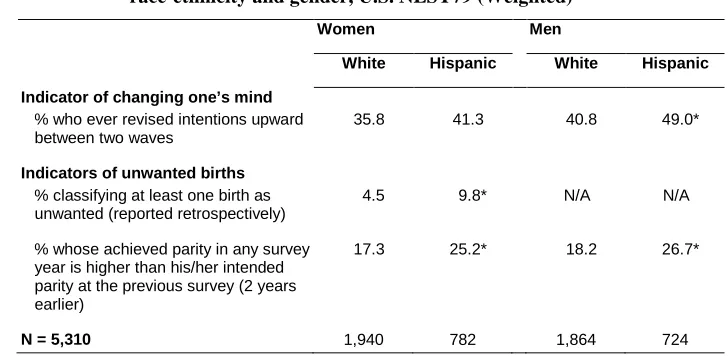
Were Hispanic women and men more likely to overshoot intentions because they were more likely to change their minds (i.e., revising intention upwards after age 22) or because they were more likely to have an unwanted birth? Table 3 shows that Hispanic women and men were more likely to experience both of these situations. 41% of Hispanic women and 49% of Hispanic men revised their intended parity upwards between two waves at least once, compared with 36% of White women and 41% of White men. These estimates only include upward revisions that were not ‘forced’ upward by a birth or a current pregnancy.
Table 3: Overshooting intended parity: wanted versus unwanted births, by race-ethnicity and gender, U.S. NLSY79 (Weighted)
Women Men
White Hispanic White Hispanic
Indicator of changing one’s mind
% who ever revised intentions upward between two waves
35.8 41.3 40.8 49.0*
Indicators of unwanted births
% classifying at least one birth as unwanted (reported retrospectively)
4.5 9.8* N/A N/A
% whose achieved parity in any survey year is higher than his/her intended parity at the previous survey (2 years earlier)
17.3 25.2* 18.2 26.7*
N = 5,310 1,940 782 1,864 724
* White-Hispanic differences significant at p<0.05
A second method of estimating unwanted births is to infer them, based on whether achieved parity in a given wave was higher than intended parity reported by the respondent in the previous wave, two years earlier. Some of these births might have been intended – i.e., the respondent decided to have an additional birth, conceived a pregnancy, and had a birth, all within a two-year span – but it is likely that many of these births were the result of unplanned pregnancies. These estimates of unwanted births are therefore considered upper bounds. Hispanics were more likely than Whites to be in this situation: 25% of Hispanic women and 27% of Hispanic men had an increase in achieved parity between two waves that was not predicted by intended parity at the prior wave, compared with 17% of White women and 18% of White men.
4.2 Decomposition of racial-ethnic differences in fertility levels
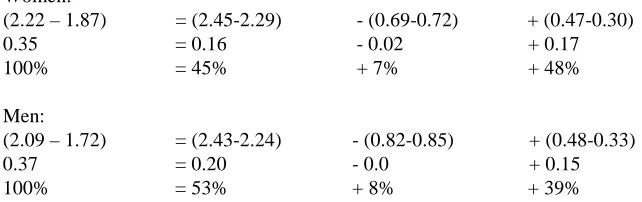
H-Wmean completed fertility = H-Wmean intended parity - H-Wmean births undershot + H-Wmean births overshot
Women:
(2.22 – 1.87) = (2.45-2.29) - (0.69-0.72) + (0.47-0.30)
0.35 = 0.16 - 0.02 + 0.17
100% = 45% + 7% + 48%
Men:
(2.09 – 1.72) = (2.43-2.24) - (0.82-0.85) + (0.48-0.33)
0.37 = 0.20 - 0.0 + 0.15
100% = 53% + 8% + 39%
Differences in completed parity between Whites and Hispanics seemed to be largely explained by differences in two factors: intended parity and the likelihood of overshooting intentions. 45% of the difference in completed parity between White and Hispanic women was due to higher intentions among Hispanic women, 48% was due to the fact that Hispanic women are more likely to overshoot intentions, and only 7% was due to the fact that Hispanic women are less likely to undershoot intentions. Among men, a larger fraction of the difference in completed parity between Whites and Hispanics was due to higher intentions (53%), while 39% was due to the fact that Hispanic men were more likely to overshoot intentions, and 8% was due to the fact that Hispanic men were less likely to undershoot intentions. In the next section I focus on these two important factors – intended parity and likelihood of overshooting – and explore reasons for racial-ethnic differences in these factors.
4.3 Explaining White-Hispanic differences in intended parity
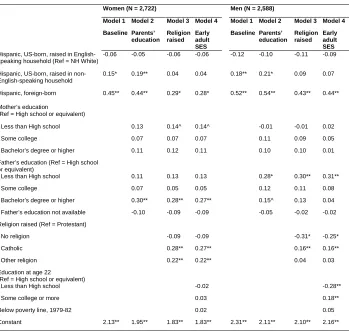
Catholic. Finally, controlling for socioeconomic variables in young adulthood in Model 4 did not further attenuate the White-Hispanic differences in intentions. Results were generally consistent across gender.
Table 4: Coefficients from OLS regressions predicting intended parity at age 22, by gender, U.S. NLSY79
Women (N = 2,722) Men (N = 2,588)
Model 1 Model 2 Model 3 Model 4 Model 1 Model 2 Model 3 Model 4
Baseline Parents’ education Religion raised Early adult SES
Baseline Parents’ education Religion raised Early adult SES
Hispanic, US-born, raised in English-speaking household (Ref = NH White)
-0.06 -0.05 -0.06 -0.06 -0.12 -0.10 -0.11 -0.09
Hispanic, US-born, raised in
non-English-speaking household
0.15* 0.19** 0.04 0.04 0.18** 0.21* 0.09 0.07
Hispanic, foreign-born 0.45** 0.44** 0.29* 0.28* 0.52** 0.54** 0.43** 0.44**
Mother’s education
(Ref = High school or equivalent)
Less than High school 0.13 0.14^ 0.14^ -0.01 -0.01 0.02
Some college 0.07 0.07 0.07 0.11 0.09 0.05
Bachelor’s degree or higher 0.11 0.12 0.11 0.10 0.10 0.01
Father’s education (Ref = High school
or equivalent)
Less than High school 0.11 0.13 0.13 0.28* 0.30** 0.31**
Some college 0.07 0.05 0.05 0.12 0.11 0.08
Bachelor’s degree or higher 0.30** 0.28** 0.27** 0.15^ 0.13 0.04
Father’s education not available -0.10 -0.09 -0.09 -0.05 -0.02 -0.02
Religion raised (Ref = Protestant)
No religion -0.09 -0.09 -0.31* -0.25*
Catholic 0.28** 0.27** 0.16** 0.16**
Other religion 0.22** 0.22** 0.04 0.03
Education at age 22
(Ref = High school or equivalent)
Less than High school -0.02 -0.28**
Some college or more 0.03 0.18**
Below poverty line, 1979-82 0.02 0.05
Constant 2.13** 1.95** 1.83** 1.83** 2.31** 2.11** 2.10** 2.16**
^ p<0.10, * p<0.05, ** p<0.01
4.4 Explaining White-Hispanic differences in overshooting intended parity
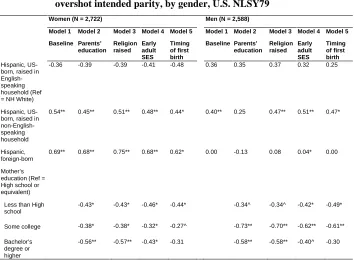
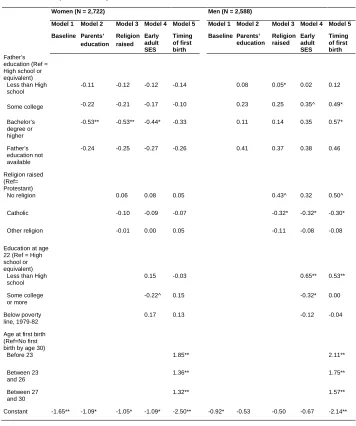
Reasons for White-Hispanic differences in overshooting intentions were also explored. Table 5 presents coefficients from logistic regression models predicting whether women and men overshot their early life intentions. Model 1 for women shows that there is no statistically significant difference in the likelihood of overshooting intentions between Whites and Hispanics who were raised in English-speaking households. However, U.S.-born Hispanic women raised in non-English-speaking households were more likely to overshoot intentions than their White counterparts, and the difference between foreign-born Hispanic women and White women was even larger. The pattern among men was similar, with the exception that foreign-born Hispanic men were not more likely than White men to exceed intended parity. This may be related to the fact that foreign-born Hispanic men had the highest fertility intentions.
Table 5: Coefficients from logistic regressions predicting whether respondent overshot intended parity, by gender, U.S. NLSY79
Women (N = 2,722) Men (N = 2,588)
Model 1 Model 2 Model 3 Model 4 Model 5 Model 1 Model 2 Model 3 Model 4 Model 5
Baseline Parents’ education Religion raised Early adult SES Timing of first birth
Baseline Parents’ education Religion raised Early adult SES Timing of first birth Hispanic, US-born, raised in English-speaking household (Ref = NH White)
-0.36 -0.39 -0.39 -0.41 -0.48 0.36 0.35 0.37 0.32 0.25
Hispanic,
US-born, raised in non-English-speaking household
0.54** 0.45** 0.51** 0.48** 0.44* 0.40** 0.25 0.47** 0.51** 0.47*
Hispanic,
foreign-born
0.69** 0.68** 0.75** 0.68** 0.62* 0.00 -0.13 0.08 0.04* 0.00
Mother’s
education (Ref = High school or equivalent)
Less than High school
-0.43* -0.43* -0.46* -0.44* -0.34^ -0.34^ -0.42* -0.49*
Some college -0.38* -0.38* -0.32* -0.27^ -0.73** -0.70** -0.62** -0.61**
Bachelor’s degree or higher
Table 5: (Continued)
Women (N = 2,722) Men (N = 2,588)
Model 1 Model 2 Model 3 Model 4 Model 5 Model 1 Model 2 Model 3 Model 4 Model 5
Baseline Parents’ education Religion raised Early adult SES Timing of first birth
Baseline Parents’ education Religion raised Early adult SES Timing of first birth Father’s education (Ref = High school or equivalent) Less than High school
-0.11 -0.12 -0.12 -0.14 0.08 0.05* 0.02 0.12
Some college -0.22 -0.21 -0.17 -0.10 0.23 0.25 0.35^ 0.49*
Bachelor’s
degree or higher
-0.53** -0.53** -0.44* -0.33 0.11 0.14 0.35 0.57*
Father’s
education not available
-0.24 -0.25 -0.27 -0.26 0.41 0.37 0.38 0.46
Religion raised
(Ref= Protestant)
No religion 0.06 0.08 0.05 0.43^ 0.32 0.50^
Catholic -0.10 -0.09 -0.07 -0.32* -0.32* -0.30*
Other religion -0.01 0.00 0.05 -0.11 -0.08 -0.08
Education at age
22 (Ref = High school or equivalent)
Less than High school
0.15 -0.03 0.65** 0.53**
Some college or more
-0.22^ 0.15 -0.32* 0.00
Below poverty line, 1979-82
0.17 0.13 -0.12 -0.04
Age at first birth (Ref=No first birth by age 30)
Before 23 1.85** 2.11**
Between 23 and 26
1.36** 1.75**
Between 27 and 30
1.32** 1.57**
Constant -1.65** -1.09* -1.05* -1.09* -2.50** -0.92* -0.53 -0.50 -0.67 -2.14**
^ p<0.10, * p<0.05, ** p<0.01
Model 2 included parents’ education as an independent variable. For both women and men, controlling for parents’ education slightly reduced the magnitude of the coefficient for U.S.-born Hispanics raised in non-English-speaking households. Controlling for religion raised in Model 3 did not attenuate the coefficients for the Hispanic subgroups. Model 4 accounts for socioeconomic status in early adulthood, which – for women – slightly attenuates the coefficients for the two less acculturated Hispanic subgroups. Finally, Model 5 examines the role of first birth timing. We see that differences in the timing of first birth partially explain the greater likelihood of overshooting among the less acculturated Hispanic subgroups, even after controlling for differences in socioeconomic status and religious upbringing. Overall, the higher likelihood of some Hispanic subgroups to overshoot is partially mediated by differences in parents’ education, individuals’ own socioeconomic status in early adulthood, and the timing of first birth. However, differences in the likelihood of overshooting intentions between Whites and two of the Hispanic subgroups (U.S.-born raised in non-English-speaking households and foreign-born Hispanics) remained even after controlling for a range of possible mediators.
4.5 Post-Hoc tests
but this factor did not explain White-Hispanic differences in the likelihood of overshooting. Likewise, respondents with Rotter scores indicating a high internal locus of control were less likely to report an unwanted birth, but controlling for this factor did not explain White-Hispanic differences in the likelihood of overshooting intentions. Finally, age at first sex and attitudes regarding gender roles were both tested as mediating variables, but neither helped explain White-Hispanic differences in fertility outcomes.
5. Discussion
Hispanics have higher fertility than Whites but prior research had not explored whether this difference reflects the preferences of individuals, nor how differences in fertility levels are related to the process of exceeding or falling short of intentions over the life course. Although Hispanics came closer to achieving early-life parity intentions in the aggregate, at the individual level they were not more likely to have the number of children they said they wanted in early life. Decomposition revealed that Hispanics had higher completed fertility than Whites mainly because their intended parity was slightly higher and they were more likely to overshoot intended parity. Overall, Hispanic-White differences in intended parity and the likelihood of overshooting intentions seemed to result mainly from the presence of less assimilated women and men in the Hispanic group, as well as differences in religious upbringing (in the case of fertility intentions) and differences in socioeconomic status and the timing of first birth (in the case of overshooting intentions).
The socioeconomic variables included in the regression models only partially explained the difference between Whites and Hispanics in the likelihood of overshooting intentions, and did not explain any of the White-Hispanic difference in fertility intentions. Although it was somewhat surprising, the finding that socioeconomic status was not sufficient to explain White-Hispanic differences in fertility behaviors fits with recent work by Musick et al. (2009), which found that variation in opportunity costs was not strongly related to variation in births.
acting through fertility intentions developed in early life, rather than affecting the likelihood of overshooting those intentions.
The regression analysis suggested that differences between Whites and Hispanics were due, in part, to a subgroup of Hispanics – those who are immigrants or were raised in non-English-speaking households. Based on the regression analyses, it appeared that immigration and language variables were acting as proxies for socioeconomic status to some extent; however, the coefficients for the less acculturated Hispanic subgroups generally remained significant even after controlling for socioeconomic measures. One explanation is that for those born outside the U.S. the migration experience itself could be affecting fertility outcomes. Migration can affect fertility by separating partners from one another, separating parents from children who remain in this home country, or changing participation in the labor market, for example. Disruption is unlikely to be a central mechanism in this case, however, because respondents were in the United States by the time they entered the survey in their late teen years.
Falling short of intentions was a surprisingly common outcome among Hispanic women and men. This is counterintuitive, considering the emphasis in the literature on Hispanics’ higher fertility and higher rates of unintended pregnancies and births. We might assume that it is only groups with low fertility that have fewer children than they would like, but this had not been examined empirically (Bongaarts 2001; McDonald 2002). In fact, I found that Hispanic women and men were very likely to undershoot intentions – 39% of women and 43% of men fell short of intentions expressed around age 22 – and they were more likely to undershoot intentions than to either meet intentions or exceed them. Hispanic women and men were only slightly less likely to undershoot intentions than were Whites, and the differences were not statistically significant.
We should use caution in drawing conclusions about well-being from these results. For many individuals, not meeting their early life fertility intentions will be a neutral or even positive outcome, since it is common (and reasonable) to simply change one’s mind about the number of children one wants. If the data were to show that White or Hispanic women or men were overwhelmingly exceeding intended parity or overwhelmingly falling short of intended parity – as we see in many European countries – there would be reason to infer that individuals face powerful structural barriers to achieving their preferences. However, the data show a mix of outcomes, with high proportions in each subgroup meeting intentions, falling short of intentions, and exceeding intentions, which is reassuring.
they were also the group most likely to overshoot intentions, and these women balanced out those who fell short.
A central limitation of this study was the inability to identify country of origin for the three-quarters of Hispanic respondents who were born in the U.S. Prior research has established that the Hispanic category is heterogeneous, and these differences have implications for behavior (Oropesa and Landale 2004). However, other studies with more complete information on national origin lack the longitudinal measures of intentions and births available in the NLSY that were necessary for this analysis.
A second limitation of this study is that it followed an older cohort – those who were 18−21 in 1979 – and the Hispanic population in the U.S. has changed in the intervening decades. Hispanics now comprise a larger fraction of the population and are more likely to be foreign-born compared with the 1980s (U.S. Census Bureau 1993; Pew 2012). As a result, Hispanic women and men who are currently in their peak childbearing years might fare differently in meeting their intentions. This is an inherent drawback to analyzing fertility at the cohort level as opposed to the period level: cohort fertility levels can only be assessed once couples have finished (or nearly finished) childbearing, which occurs at least fifteen years after the peak childbearing years. Nevertheless, a cohort approach is necessary to evaluate whether individuals meet their childbearing intentions. It is reassuring that separate analyses of repeated cross-sectional data from the National Survey of Family Growth demonstrated that fertility intentions of both Whites and Hispanics have been fairly stable over time (author’s tabulations; see also Hagewen and Morgan 2005). Despite the drawbacks of examining fertility from a cohort perspective, cohort measures (those that rely on “children ever born”) are likely more reliable for estimating fertility among Hispanics compared with period measures (those that rely on vital statistics and census counts) for various reasons, including the fact that Hispanics may be undercounted in population estimates (Parrado 2011; Preston and Hartnett 2010).
6. Acknowledgements
References
Ajzen, I. and Fishbein, M. (2005). The influence of attitudes on behavior. In: Albarracín, D., Johnson, B.T., and Zanna, M.P. (eds.). The handbook of attitudes. Mahwah, NJ: Lawrence Erlbaum Associates Publishers: 173−221.
Alba, R.D. and Nee, V. (2003). Remaking the American mainstream: Assimilation and contemporary immigration. Cambridge, MA: Harvard University Press.
Andrews, F.M., Abbey, A., and Halman, L.J. (1991). Stress from infertility, marriage factors, and subjective well-being of wives and husbands. Journal of Health and Social Behavior 32(3): 238−253. doi:10.2307/2136806.
Barber, J.S. (2001). Ideational influences on the transition to parenthood: Attitudes toward childbearing and competing alternatives. Social Psychology Quarterly
64: 101−127. doi:10.2307/3090128.
Barber, J.S. and East, P.L. (2011). Children’s experiences after the unintended birth of a sibling. Demography 48(1): 1−25. doi:10.1007/s13524-010-0011-2.
Baydar, N., Greek, A., and Brooks-Gunn, J. (1997a). A longitudinal study of the effects of birth of a sibling during the first 6 years of life. Journal of Marriage and the Family 59: 939−956. doi:10.2307/353795.
Baydar, N., Hyle, P., and Brooks-Gunn, J. (1997b). A longitudinal study of the effects of the birth of a sibling during preschool and early grade school years. Journal of Marriage and the Family 59: 957−965. doi:10.2307/353795.
Bean, F.D. and Swicegood, G. (1985). Mexican American fertility patterns. Austin: University of Texas Press.
Bean, F.D. and Tienda, M. (1987). The Hispanic population of the United States. New York: Russell Sage Foundation.
Becker, G.S. (1991). A Treatise on the Family. Cambridge, MA: Harvard University Press.
Becker, G.S. and Barro, R.J. (1988). A reformulation of the economic theory of fertility. Quarterly Journal of Economics 103(1): 1−25. doi:10.2307/1882640.
Beckman, L.J., Aizenberg, R., Forsythe, A.B., and Day, T. (1983). A Theoretical Analysis of Antecedents of Young Couples’ Fertility Decisions and Outcomes.
Berrington, A. (2004). Perpetual postponers? Women's, men's and couples' fertility intentions and subsequent fertility behaviour. Population Trends 117: 9−19.
Berry, J.W. (1997). Immigration, acculturation, and adaptation. Applied Psychology
46(1): 5−34. doi:10.1080/026999497378467.
Bongaarts, J. (1992). Do Reproductive Intentions Matter? International Family Planning Perspectives 18(3): 102−108. doi:10.2307/2133409.
Bongaarts, J. (2001). Fertility and Reproductive Preferences in Post-Transitional Societies. Population and Development Review 27: 260−281.
Brown, S.S. and Eisenberg, L. (1995). Demography of unintended childbearing. In: Brown, S.S. and Eisenberg, L. (eds.). The best intentions: Unintended childbearing and the well-being of children and families. Washington, DC: National Academy Press: 21−49.
Burton, L.M. (1990). Teenage Childbearing as an Alternative Life-Course Strategy in Multigeneration Black Families. Human Nature 1(2): 123−143. doi:10.1007/ BF02692149.
Finer, L.B. and Henshaw, S.K. (2006). Disparities in rates of unintended pregnancy in the United States, 1994 and 2001. Perspectives on Sexual and Reproductive Health 38: 90−96. doi:10.1363/3809006.
Finer, L.B. and Zolna, M.R. (2011). Unintended Pregnancy in the United States: Incidence and Disparities, 2006. Contraception 84(5): 478−485. doi:10.1016/j. contraception.2011.07.013.
Fishbein, M. and Ajzen, I. (1975). Belief, attitude, intention, and behavior: An introduction to theory and research. Reading, MA: Addison-Wesley.
Ford, K. (1990). Duration of Residence in the United States and the Fertility of US Immigrants. International Migration Review 24(1): 34−68. doi:10.2307/ 2546671.
Glick, J.E. (2010). Connecting complex processes: A decade of research on immigrant families. Journal of Marriage and Family 72(3): 498−515. doi:10.1111/ j.1741-3737.2010.00715.x.
Gordon, M.M. (1964). Assimilation in American life: The role of race, religion, and national origins. New York: Oxford University Press.
Greil, A.L., Slauson-Blevins, K., and McQuillan, J. (2010). The Experience of Infertility: a Review of Recent Literature. Sociology of Health and Illness 32(1): 140−162. doi:10.1111/j.1467-9566.2009.01213.x.
Hagewen, K.J. and Morgan, S.P. (2005). Intended and ideal family size in the United States, 1970–2002. Population and Development Review 31(3): 507−527.
doi:10.1111/j.1728-4457.2005.00081.x.
Hartnett, C.S. and Parrado, E.A. (2012). Hispanic Familism Reconsidered. Sociological Quarterly 53(4): 636−653. doi:10.1111/j.1533-8525.2012.01252.x.
Hayford, S.R. (2009). The Evolution of Fertility Expectations Over the Life Course.
Demography 46(4): 765−783. doi:10.1353/dem.0.0073.
Hendershot, G.E., Mosher, W.D., and Pratt, W.F. (1982). Infertility and Age: An Unresolved Issue. Family Planning Perspectives 14(5): 287−289. doi:10.2307/ 2134890.
Hirsch, J.S. (2003). A courtship after marriage: Sexuality and love in Mexican transnational families. Berkley: University of California Press.
Kohler, H.P., Billari, F.C., and Ortega, J.A. (2006). Low Fertility in Europe: Causes, Implications, and Policy Options. In: Harris, F.R. (ed.). The baby bust: Who will do the work? Who will pay the taxes?. Lanham, MD: Rowman: 48−109.
Koropeckyj-Cox, T. and Pendell, G. (2007). The Gender Gap in Attitudes About Childlessness in the United States. Journal of Marriage and Family 69: 899−915. doi:10.1111/j.1741-3737.2007.00420.x.
Landale, N.S. and Oropesa, R.S. (2007). Hispanic families: Stability and change.
Annual Review of Sociology 33: 381−405. doi:10.1146/annurev.soc.
33.040406.131655.
Lino, M. (2007). Expenditures on children by families, 2006. Washington, DC: US Department of Agriculture, Center for Nutrition Policy and Promotion.
Maximova, K. and Quesnel-Vallée, A. (2009). Mental Health Consequences of Unintended Childlessness and Unplanned Births: Gender Differences and Life Course Dynamics. Social Science and Medicine 68(5): 850−857.
doi:10.1016/j.socscimed.2008.11.012.
McDonald, P. (2002). Low fertility: unifying the theory and the demography. Atlanta, GA: Population Association of America.
Minnis, A.M. and Padian, N.S. (2001). Reproductive health differences among Latin American-and US-born young women. Journal of Urban Health 78(4): 627−637. doi:10.1093/jurban/78.4.627.
Molina, C.W. and Aguirre-Molina, M. (1994). Latino health in the US: A growing challenge. American Public Health Association.
Monnier, A. (1989). Fertility Intentions and Actual Behaviour. A Longitudinal Study: 1974, 1976, 1979. Population: An English Selection 44(1): 237−259.
Morgan, S.P. (2003). Is low fertility a twenty-first-century demographic crisis?
Demography 40(4): 589−603. doi:10.1353/dem.2003.0037.
Morgan, S.P. and Rackin, H. (2010). The Correspondence of Fertility Intentions and Behavior in the U.S. Population and Development Review 36(1): 91−118.
Musick, K., England, P., Edgington, S., and Kangas, N. (2009). Education differences in intended and unintended fertility. Social Forces 88: 543−572.
doi:10.1353/sof.0.0278.
Oropesa, R.S. and Gorman, B.K. (2000). Ethnicity, immigration, and beliefs about marriage as a ‘tie that binds’. In: Waite, L.J. (ed.) The ties that bind: Perspectives on marriage and cohabitation. New York: Aldine de Gruyter: 188−211.
Oropesa, R.S. and Landale, N.S. (2004). The Future of Marriage and Hispanics.
Journal of Marriage and Family 66: 901−920. doi:10.1111/j.0022-2445.2004. 00061.x.
O’Connell, M. and Rogers, C.C. (1983). Assesssing Cohort Birth Expectations Data from the Current Population Survey, 1971–1981. Demography 20(3): 369−384.
doi:10.2307/2061248.
Pew, Hispanic Center (2011). The Mexican-American boom: Births overtake immigration. Washington, D.C.: Pew.
Pew, Hispanic Center (2012). Statistical Portrait of Hispanics in the United States. Washington, D.C.: Pew.
Preston, S. and Hartnett, C.S. (2010). The Future of American Fertility. In: Shoven, J. (ed.) Demography and the Economy. Chicago: Chicago University Press.
doi:10.7208/chicago/9780226754758.003.0002.
Quesnel-Vallée, A. and Morgan, S.P. (2003). Missing the target? Correspondence of fertility intentions and behavior in the US. Population Research and Policy Review 22(5): 497−525. doi:10.1023/B:POPU.0000021074.33415.c1.
Remez, L. (2000). Degree of certainty about plans to have children strongly predicts whether individuals will do so. Family Planning Perspectives 32: 46−47.
doi:10.2307/2648148.
Rindfuss, R.R., Morgan, S.P and Swicegood, G. (1988). First births in America: Changes in the timing of parenthood. Berkeley: University of California Press. Sable, M.R., Havig, K., Schwartz, L.R., and Shaw, A. (2009). Hispanic immigrant
women talk about family planning. Affilia 24(2): 137. doi:10.1177/088610 9909331693.
Sable, M.R. and Wilkinson, D.S. (2000). Impact of perceived stress, major life events and pregnancy attitudes on low birth weight. Family Planning Perspectives
32(6): 288−294. doi:10.2307/2648197.
Sabogal, F., Marín, G., Otero-Sabogal, R., Marín, B.V., and Perez-Stable, E.J. (1987). Hispanic familism and acculturation: What changes and what doesn't? Hispanic Journal of Behavioral Sciences 9: 397. doi:10.1177/07399863870094003. Schoen, R., Astone, N.M., Kim, Y.J., Nathanson, C.A., and Fields, J. (1999). Do
Fertility Intentions Affect Fertility Behavior? Journal of Marriage and Family
61: 790−799. doi:10.2307/353578.
Singh, S., Darroch, J.E., Vlassof, M., and Nadeau, J. (2003). Adding it up: The benefits of investing in sexual and reproductive health care. New York: The Alan Guttmacher Institute.
Stephen, E.H. and Bean, F.D. (1992). Assimilation, Disruption and the Fertility of Mexican-Origin Women in the United States. International Migration Review
26(1): 67−88. doi:10.2307/2546937.
Thomson, E. (1997). Couple Childbearing Desires, Intentions, and Births. Demography
34: 343−354. doi:10.2307/3038288.
Thomson, E., McDonald, E., and Bumpass, L. (1990). Fertility Desires and Fertility: Hers, His, and Theirs. Demography 27: 579−588. doi:10.2307/2061571.
Thornton, A. (1985). Reciprocal influences of family and religion in a changing world.
Journal of Marriage and Family 47(2): 381−394. doi:10.2307/352138.
Thornton, A. and Camburn, D. (1989). Religious participation and adolescent sexual behavior and attitudes. Journal of Marriage and Family 51(3): 641−653.
doi:10.2307/352164.
Trent, K. and South, S.J. (1992). Sociodemographic Status, Parental Background, Childhood Family Structure, and Attitudes toward Family Formation. Journal of Marriage and Family 54(2): 427−439. doi:10.2307/353074.
Trent, K. and Crowder, K. (1997). Adolescent birth intentions, social disadvantage, and behavioral outcomes. Journal of Marriage and the Family 59: 523−535.
doi:10.2307/353943.
U.S. Bureau, of Labor Statistics (2005). The NLSY79. In: U.S. Bureau of Labor Statistics (ed.). The NLS Handbook. http://www.bls.gov/nls/handbook/2005/ nlshc3.pdf.
U.S. Census, Bureau (1993). We the American-Hispanics. Washington, D.C.: GPO. U.S. Census, Bureau (2012). Most Children Younger Than Age 1 are Minorities.
Census Bureau Reports. http://www.census.gov/newsroom/releases/archives/ population/cb12-90.html.
U.S. Department, of Health and Human Services (2010). Healthy People 2020. Washington, D.C.: U.S. Department of Health and Human Services.
Van de Giessen, H. (1992). Using birth expectation information in national population forecasts. In: Keilman, N. (ed.) National Population Forecasting in Industrialized Countries. Amsterdam: Swets & Zeitlinger.
Ventura, S.J., Abma, J.C., Mosher, W.D., and Henshaw, S.K. (2008). Estimated Pregnancy Rates by Outcome for the United States, 1990-2004. National Vital Statistics Reports 56(15): 1−25.
Westoff, C.F. and Ryder, N.B. (1977). The Predictive Validity of Reproductive Intentions. Demography 14: 431−453. doi:10.2307/2060589.
Wilson, E.K. (2009). Differences in contraceptive use across generations of migration among women of Mexican origin. Maternal and Child Health Journal 13(5): 641−651. doi:10.1007/s10995-008-0382-9.
Wilson, F.D. and Bumpass, L. (1973). The Prediction of Fertility Among Catholics: A Longitudinal Analysis. Demography 10: 591−597. doi:10.2307/2060885. Zagorsky, J.L. and White, L. (1999). NLSY79 User’s Guide 1999. Ohio: U.S.
Appendix
Table A1: Women’s and men’s characteristics: Descriptive statistics, U.S. NLSY79 (Weighted)
Women Men
White Hispanic White Hispanic
Mother’s education (%) (%) (%) (%)
Less than High school 11.5 51.7* 10.9 49.0*
High school or equivalent 15.2 14.2 12.1 9.3
Some college 49.0 24.2* 53.1 27.3*
Bachelor’s degree or higher 24.2 9.9* 23.9 14.4*
Father’s education
Less than High school 17.1 41.3* 15.9 40.5*
High school or equivalent 10.7 9.4 10.3 8.0
Some college 37.2 21.4* 34.4 20.6*
Bachelor’s degree or higher 30.0 14.1* 35.3 17.3*
Father’s education not available 5.0 13.7* 4.2 13.6*
Religion raised
No religion 3.5 2.1 4.3 2.1*
Protestant 51.7 17.4* 49.7 15.3*
Catholic 32.3 73.4* 33.8 75.3*
Other religion 12.6 7.1* 12.1 7.3*
Education at age 22
Less than High school 9.5 24.3* 12.2 27.3*
High school or equivalent 47.1 44.3 45.3 43.1
Some college or more 43.4 31.4* 42.6 29.6*
Below poverty line, 1979-82 17.8 46.5* 17.7 39.6*
Age at first birth
Before 23 30.7 47.4* 16.0 30.2*
Between 23 and 26 19.7 21.3 19.5 20.3
Between 27 and 30 16.8 8.6* 20.5 13.1*
No first birth by age 30 32.8 22.7* 44.0 36.4*
Immigration and language characteristics (Hispanics only)
U.S.-born, raised in English-speaking household N/A 23.4 N/A 22.5
U.S.-born, raised in non-English-speaking household N/A 56.7 N/A 52.8
Born outside the U.S. N/A 20.0 N/A 24.6
N = 5,310 1,940 782 1,864 724