VOLUME 3, ISSUE 4, Apr.-2017
169 | P a g e
EFFECT OF SIZE REDUCTION ON OSMOTIC DEHYDRATION OF GUAVA
INDRAYANI V TARTEDepartment of Food Technology, Laxminarayan Institute of Technology,R.T.M.N.U Nagpur, India, Email: [email protected]
DR. S V KARADBHAJNE
Department of Food Technology, Laxminarayan Institute of Technology, R.T.M.N.U,Nagpur, India Email:[email protected]
ABSTRACT:
The effect of parameters such as varying time duration of osmosis and sugar syrup concentration at the time of osmotic dehydration of raw guava slices(5 mm thick) and cubes on mass transfer data such as water loss,solid gain and mass reduction were studied. Sucrose solution of 700B and 800B was employed as per osmotic dehydration process. After completion of osmotic dehydration process, the water loss from guava cubes and guava slicesof 700B is found as 28.45 to 44.41 and 23.49 to 36.14 per sent resp. and of 800B is found as 30.90 to 49.6 and 30.5 to 47.61per cent resp. Similarly,sugar gain and mass reduction was calculated for guava slices and guava cubes. It was observed that the mass reduction, water loss and sugar gain increases with increase in sugar syrup concentration and duration of osmosis.
KEYWORDS: Osmotic dehydration, size reduction, water loss, mass reduction, sugar gain, duration of osmosis
I. INTRODUCTION:
The Guava, botanically known as Psidiumguajava belonged to the family of Myrtaceae. Guava (PsidiumGuajava), is also called as the “poor man’s fruit” or“apple of the tropics”[1]. It was a popular tree fruit of the tropical and subtropical climates and was native to the tropical America stretching from Mexico to Peru. It had been adopted in India so well that it appeared to be an almost Indian fruit.Guava was considered to be one of the most exquisite and nutritionally valuable remunerative crops. The guava fruit and its juice are mostly consumed for its taste, nutritional values and flavor. In India after mango, banana and citrus, guava is the fourth most important commercial fruit for production. Guava was a fruitwhich was grown all over the country and also in kitchen gardening and near the wells and tube wellspremises and also grown on a commercial scale.For the production of guava fruit, nearly 0.15 million ha of land occupies with production of 1.80 million tons and productivity 12t/ha fruit per year in India. In India, guava is grown in Bihar, Andhra
Pradesh, Uttar Pradesh, Gujarat, Maharashtra and Karnataka on large scale [2].
According to various shapes, sizes and other characteristics, the guava fruit of the different Varieties are extremely variable. The various varieties of guavafound as rounded, globular, ovoidor pear in shaped. The size of guava fruit is from 3 to 15 cm in length and has 4 or 5 sepal at the apex. The color of the guava fruit may be found asshades of green, yellow, or pink. The flesh may be of color white, pink, yellow, or red are observed. The small or hard seeds are present inside the flesh and outer layer of flesh is a finely granular pulp. Guava varieties have a taste from sweet to tart, all with musky flavor and odor. Guava fruits vary in the thickness of the fleshymesocarp, but in some varieties is extremely thin. Varieties differ widely in flavor and seediness, some are seedless. After ripening of guava, it becomes soft and juicy[3].
VOLUME 3, ISSUE 4, Apr.-2017
170 | P a g e Therefore, guava fruit said as an ideal fruit for the
nutritional fact[5].
Fruits and vegetables drying may cause the changes in flavor and nutritional components if exposed to high temperatures. The reduction of aroma and volatiles, pigments and vitamins oxidation, and case-hardening and woody texture, slow or incomplete rehydration and considerable shrinkage during drying occurs. The drying process should consume less fossil fuels and electricity, and it should be also maintained the quality of product. The process of osmotic dehydration has been motivated as economic factor and have an applications for the improvement of quality, color, taste, etc. This process gives wide application in food industry. In recent years as a pretreatment for the removal of water gives attention towards osmotic dehydration process which reduces energy consumption and heat damage[6][7][8][9].
Osmotic dehydration process has an important complementary treatment and food preservation technique in the processing of dehydrated foods [10]. In this dynamic process, water and acid are removed fast at start and then move slowly, while sugar mass penetration is very slight at start but increases with the duration of osmosis. Therefore, the characteristics of the product can be increases by increasing sugar syrup concentration, concentration of osmosis solution, duration of osmosis, etc. to make osmotic dehydration process faster [11]. Although osmotic dehydration process will not give a product of completely low moisture content after this process product needs to be further dried, through air, vacuum or freeze drying [12].
II. MATERIALS AND METHOD: A. PREPARATION OF SAMPLE:
Raw guava was thoroughly washed by using water and the surface moisture was removed using blotting paper. Then blanched this raw guava by using boiled water for a 5 min of duration and peeled it. They were sliced (5±0.5mm thick) and cut into cubes manually using knife of stainless steel and deep in 0.5 % citric acid solution for 2 min. Sucrose solution used as an osmosis agent, the sugar solution of concentration 700 Brix and 800Brixwas
prepared by adding the required quantity of sugar in drinking water. Osmotic dehydration of sliced/cube guavas were conducted with two different sugar syrup concentrations 700 Brix and 800Brix. Cut slices/cubes
immersed into required brix sugar syrup for osmotic dehydration.Take out the slices/cubes after 1hr each for initial 6 hrs. and then after 24hrs, 48hrs, 72hrs and measure weight and brix of slices and cubes.
Raw Guava
Washing
Blanching
(In boiled water for 5 min of duration)
Peeling
Deep into citric acid solution (0.5%)
Cut into slices and cubes
Slices Cubes
Weight of the sample Weight of the sample
Immersed into the 70 Immersed into the 70 and 800B sugar syrup and 800B Sugar syrup
concentration for concentration for osmotic dehydration osmotic dehydration
Take out the slices/cubes after 1hr each for initial12hrs and then after 24hrs, 48hrs, 72hrs
Measure Weight and Brix of Slices/Cubes
Drying
B. OSMOTIC DEHYDRATION:
Osmotic dehydration, also called a “dewatering impregnation soaking process” is a water removal process that includes the soaking of food sample in hypertonic salt or sugar syrup or in a combined solution, to reduce the water content while increasing the soluble solid content [13]. The sample of raw food material is placed in concentrated solutions such as salt solution or sugar syrup solution of soluble solids with higher osmotic pressure and water activity is lower. This results in three different types of counter mass transport phenomenon in osmotic dehydration process.
1. At the start, water diffuses out product to the solution with faster rate initially and then slows down.
VOLUME 3, ISSUE 4, Apr.-2017
171 | P a g e or nutritional interest, or a sensory quality
improvement of the product.
3. Leaving out of products own solutes (sugar, organic acids, minerals, vitamins, etc.), which is negligibly small when compares with the other two types of transfer [14].
C. CALCULATION FOR WATER LOSS, SUGAR GAIN AND MASS REDUCTION:
In the process of osmotic dehydration, calculations of water loss, sugar gain and mass reduction was carried out which is shown in following equations respectively [15].
WATER LOSS (WL):
The water loss is defined as the ratio of the net water loss of the guava fruit to the initial weight of guava fruit which is calculated as,
WL = WiXi − WθXθ
Wi
SUGAR GAIN (SG):
Sugar gain is defined as the ratio of the net uptake of sugar by the slices or cubes tothe initial weight of the guava which is calculated as,
SL = Wθ 1−Xθ −Wi (1−Xi)
Wi × 100
MASS REDUCTION (MR):
Mass reduction (MR) is defined as the ratio of the net mass reduction of the guava fruit to the initial weight of guava. It is also defined as the difference between water loss and solid gain which is calculated as,
MR = Wi − Wθ
Wi
Where,
WL = Water loss from guava slices/cubes in g per 100 g mass guava slices/cubes.
SG = Solid gain by guava slices/cubes in g per 100 g mass of guava slices/cubes. MR=Mass reduction of guava slices/cubes in g per 100 g mass of guava slices/cubes.Wi = Initial mass of guava slices/cubes in g.Wθ= Weight of guava slices/cubes in g at time θ.Xθ= water content present as a function of guava siles/cubes at time θ.Xi= Initial water content present as a function of guava slices/cubes
III. RESULTS AND DISCUSION:
A. EFFECT ON WATER LOSS BY VARYING SUGAR SYRUP CONCENTRATIONS:
The effect of concentration of sugar syrup on water loss has been illustrated in Fig. The water loss was found as of 28.45 to 44.41 per cent from cubes and 23.49 to 36.14 per cent from slices for 70ºB, respectively when duration of osmotic dehydration varies from 0 to 72 hrs. Also for 80ºB, the water loss was found as 31 to 49.6 per cent from cubes, respectively 30 to 47.61 per cent from slices. It was obtained that a lower sugar concentration condition (70ºB) resulted in a lower water loss and a highersugar concentration condition (80ºB) resulted in a higher water loss.The result found that the higher percentage of water loss from osmotic dehydrated guava cubes for 80ºB. This shows that the water loss can be increased by increasing the sugar syrup concentration. That means, water loss increases with increase in sugar syrup concentration and differ in different sizes of guava due to increased osmotic pressure in the sugar syrup at high concentrations, which increased the driving force available for water transport.
Figure1-Effect on water loss by varyingsugar syrup concentrations with Cubes.
Figure 2.-Effect on water loss by varying sugar syrup concentrations with Slices.
B. EFFECT ON SUGAR GAINBY VARYING SUGAR SYRUP CONCENTRATIONS:
VOLUME 3, ISSUE 4, Apr.-2017
172 | P a g e dehydration varies from 0 to 72hrs. Also for 80ºBrix, the
sugar gain was found to be 8.21 to 49 per cent from cubes and 7.91 to 34.01 per cent from slices. It was obtained that a lower concentration condition (70ºB) resulted in a lower sugar gain and a higher concentration condition (80ºB) resulted in a higher sugar gain. This shows that sugar gain in raw guava which is increases by increasing the sugar syrup concentration.
Figure 3-Effect on sugar gain by varying sugar syrup concentration with Cubes.
Figure 4- Effect on sugar gain by varying sugar syrup concentrations with slices.
C. EFFECT ON MASS REDUCTION BYVARYING SUGAR SYRUP CONCENTRATION:
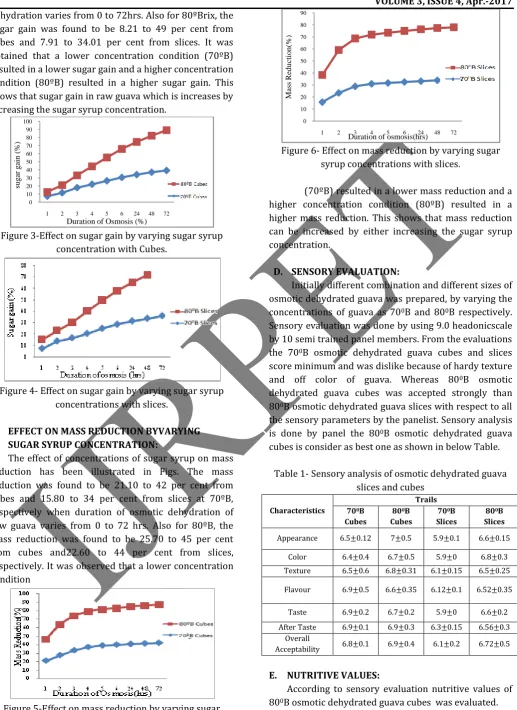
The effect of concentrations of sugar syrup on mass reduction has been illustrated in Figs. The mass reduction was found to be 21.10 to 42 per cent from cubes and 15.80 to 34 per cent from slices at 70ºB, respectively when duration of osmotic dehydration of raw guava varies from 0 to 72 hrs. Also for 80ºB, the mass reduction was found to be 25.70 to 45 per cent from cubes and22.60 to 44 per cent from slices, respectively. It was observed that a lower concentration condition
Figure 5-Effect on mass reduction by varying sugar syrup concentrations with cubes.
Figure 6- Effect on mass reduction by varying sugar syrup concentrations with slices.
(70ºB) resulted in a lower mass reduction and a higher concentration condition (80ºB) resulted in a higher mass reduction. This shows that mass reduction can be increased by either increasing the sugar syrup concentration.
D. SENSORY EVALUATION:
Initially different combination and different sizes of osmotic dehydrated guava was prepared, by varying the concentrations of guava as 700B and 800B respectively.
Sensory evaluation was done by using 9.0 headonicscale by 10 semi trained panel members. From the evaluations the 700B osmotic dehydrated guava cubes and slices
score minimum and was dislike because of hardy texture and off color of guava. Whereas 800B osmotic
dehydrated guava cubes was accepted strongly than 800B osmotic dehydrated guava slices with respect to all
the sensory parameters by the panelist. Sensory analysis is done by panel the 800B osmotic dehydrated guava
cubes is consider as best one as shown in below Table.
Table 1- Sensory analysis of osmotic dehydrated guava slices and cubes
Characteristics
Trails
700B
Cubes
800B
Cubes
700B
Slices
800B
Slices
Appearance 6.5±0.12 7±0.5 5.9±0.1 6.6±0.15
Color 6.4±0.4 6.7±0.5 5.9±0 6.8±0.3
Texture 6.5±0.6 6.8±0.31 6.1±0.15 6.5±0.25
Flavour 6.9±0.5 6.6±0.35 6.12±0.1 6.52±0.35
Taste 6.9±0.2 6.7±0.2 5.9±0 6.6±0.2
After Taste 6.9±0.1 6.9±0.3 6.3±0.15 6.56±0.3
Overall
Acceptability 6.8±0.1 6.9±0.4 6.1±0.2 6.72±0.5
E. NUTRITIVE VALUES:
According to sensory evaluation nutritive values of 800B osmotic dehydrated guava cubes was evaluated.
0 10 20 30 40 50 60 70 80 90 100
1 2 3 4 5 6 24 48 72
su
g
ar
g
ai
n
(
%)
Duration of Osmosis (%)
0 10 20 30 40 50 60 70 80 90
1 2 3 4 5 6 24 48 72
M
ass
R
ed
u
ct
io
n
(%)
Duration of osmosis(hrs)
VOLUME 3, ISSUE 4, Apr.-2017
173 | P a g e Table 2- Nutritive values
Constituents 800B guava cubes(per 100
g)
Moisture 7.8 %
Ash 0.2 %
Ascorbic Acid 10.8 mg
Fat 0.26 %
Crude Fiber 3 %
Phosphorus 0.1 mg
Iron 0.175 mg
Calcium 2.24 mg
CONCLUSION:
The effect of parameters such as varying time durationof osmosis and sugar syrup concentration at the time ofosmotic dehydration of raw guava slices (5mm thick) and cubes on mass transfer data such as water loss, solid gain and mass reduction were studied. Sucrose solution of 700B and 800B was employed as per
osmotic dehydration process. It was observed that the mass reduction, water loss and sugar gain increased with increase of sugar syrup concentration and duration of osmosis. The results obtained that an osmotic dehydration process is faster in guava cubes as compare to guava slices with sucrose concentration. Furthermore, according to sensory evaluation, after the osmotic dehydration process guava samples of having higher sugar syrup concentration which is more softer than lower sugar syrup concentration. By varying sugar syrup concentration and duration of osmosis causes softer tissue of osmotic dehydrated product compared with the fresh raw guava.
REFERENCES:
1) Optimization of guava juice and powder production. C.A. Chopda, D.M. Barrett. s.l. : Journal of Food Processing and Preservation, 2007, Vol. 25, pp. 411- 430.
2) Guava production and improvement in India: an overview. S.K. Mitra, M.R. Gurung, P.K. Pathak. s.l. : Acta Horticulture, 2007, Vol. 787, pp. 59-68.
3) JF, Morton. Guava, in Fruits of Warm Climates. Department of Horticulture and Landscape Architecture, Purdue University, West Lafayette, Indiana. 1987. pp. 356-363.
4) T.K. Lim, K.C. Khoo. Guava in Malaysia: production, pests and diseases. s.l. : Tropical press, Kuala Lumpur, Malaysia, 1990.
5) Effect of Process Parameters on Osmotic Dehydration of Guava Slices. M.D. Gaikwad, S.K. Jain , P.D. Jawake, L.K. Murdia, H.K. Jain, S.S. Lakhawat. 7, s.l. : Journal of Environmental Science, Toxicology and Food Technology, 2016, Vol. 10, pp. 117-123.
6) Rehydration kinetics of dehydrated products. M. K. Krokida, D. Marinos-Kouris. s.l. : Journal of Food Engineering, 2003, Vol. 57, pp. 1-7.
7) Dehydration in Food Processing Technology. Fellows,
P. s.l. : Ellis Harwood Ltd., Chichester, England, 1988, pp. 281-311.
8) Drying of Fruits. In: Processing Fruits: Science and Technology-Biology, Principles, and Applications. C. Ratti, A.S. Mujumdar. s.l. : Technomic Publication. Lancaster, 1996, Vol. 522.
9) Dehydration of sapota flakes. T. Padmini, G.S.V. Raghavan, T. Thangaraj. s.l. : Proceedings of 4th Asia-Pacific Drying Conference; Kolkata, India, 2005, pp. 1161-1165.
10) Osmotic dehydration of fruits and vegetables: a review. Ashok Kumar Yadav, Satya Vir Singh. 2014, Journal of food science and technology, Vol. 51, pp. 1654–1673.
11) Osmotic dehydration kinetics of guavas in maltose solutions with calcium salt. Sabrina Di Salvo MASTRANTONIO, Leila Mendes PEREIRA, Míriam Dupas HUBINGER. s.l. : Alim. Nutr., Araraquara, 2005, Vol. 16.
12) Mass exchange during osmotic pretreatment of vegetables. H. Kowalska, A. Lenart. s.l. : J. Food Engg, 2001, Vol. 49, pp. 137-140.
13) A Review on Osmotic Dehydration of Fruits and Vegetables: An Integrated Approach. V.Ramya, N.K.Jain. s.l. : Journal of food processing engineering, 2016.
14) Osmotic dehydration technique for fruits preservation-A review. Khan, Moazzam Rafiq. s.l. : PAK. J. FOOD SCI, 2012, Vol. 22, pp. 71-85.
15) Mass Transfer during Osmotic Dehydration of Banana.