Socio-Cultural and Technical Issues in Non-Expert Dubbing:
A Case Study
Christiane Nord
1a, Masood Khoshsaligheh
2b, Saeed Ameri
3bAbstract
Advances in computer sciences and the emergence of innovative technologies have entered numerous new elements of change in translation industry, such as the inseparable usage of software programs in audiovisual translation. Initiated by the expanding reality of fandubbing in Iran, the present article aimed at illuminating this practice into Persian in the Iranian context to partly address the line of inquiries about fandubbing which still is an uncharted territory on the margins of Translation Studies. Considering the scarce research in this area, the paper aimed to provide data to attract more attention to the notion of fandubbing by providing real-world examples from a community with a language of limited diffusion. An exploratory review of a large and diverse sample of openly accessed dubbed products into Persian, ranging from short-formed clips to feature movies, such dubbing practice was further classified into fundubbing, fandubbing, and quasi-professional dubbing. Based on the results, the study attempted to describe the cultural aspects and technical features of each type.
© 2015 IJSCL. All rights reserved.
1 Professor, Email: [email protected]
2 Assistant Professor, Email: [email protected] (Corresponding Author)
Tel: +98-915-501-2669
3 MA Student, Email: [email protected] a University of the Free State, South Africa b Ferdowsi University of Mashhad, Iran
ARTICLE HISTORY:
Received November 2014
Received in revised form February 2015 Accepted February 2015
Available online February 2015
KEYWORDS:
Non-expert dubbing Fundubbing Fandubbing
1. Introduction
lthough Translation Studies (TS) is becoming more divergent academically, and is tapping into more uncharted territories, translation by fans or amateurs, in words of Olohan (2014) and Pérez-González and Susam-Saraeva (2012), is still a scarce and unexplored notion. Gentzler (2014, p. 23) states that “translation today knows no institutional boundaries, and it is time for scholars to catch up to the practice”. Similarly, Nergaard and Arduini (2011) propose that “the inauguration of a trans-disciplinary research field with translation as an interpretive as well as operative tool…where translation is viewed as fundamentally trans-disciplinary, mobile, and open ended” (p. 8).
Dubbing and subtitling alongside voice-over as the frequent modes of audiovisual translation (AVT) (Diaz-Cintas, 2013) are also undertaken by fans and amateurs every so often. However, these expanding unprofessional activities have only been mentioned in the TS literatures by a few scholars. Fansubbing has been noted by Pérez-González (2007a, 2007b, 2012a, 2012b, 2012c), and fandubbing has been occasionally addressed by Chaume (2007, 2012, 2013a, 2013b, 2013c). However, quite a few other scholars have mentioned the notion in their publications, which clearly indicates to the dearth of research into fan-generated audiovisual renditions and this line of inquiry is awaiting further study. As Diaz-Cintas and Orero (2010) assert, “little attention has been devoted to the collaborative practice of fandubbing, which consists in the free distribution over the Internet of audiovisual programs, most commonly Japanese anime, which have been dubbed by fans for fans” (p. 444). Chaume (2013a), however, considers fandubbing/fundubbing as a new genre in AVT, which needs to be further explored.
This study aims at providing context-specific insights into the practice of fan-produced, dubbed audiovisual materials into Persian in the Iranian context across the three subcategories of fundubbing, fandubbing, and quasi-professional dubbing. On a more general level, this paper aims to provide a basis for further detailed investigations into the marginal yet expanding issue of fandubbing in
the Iranian context in specific and in other similar locales and other languages in general.
2. Theoretical Framework
The first signs of translation by fans were spotted in subtitling of Japanese anime tracing back to the 1980s (O'Hagan, 2009), mainly due to technological advancement such as easy availability of software programs (Diaz-Cintas & Muñoz Sánchez, 2006), but nowadays renditions by fans can be seen in every type of translation. According to Cronin (2012) and Gambier (2014), rendering by fans and non-experts has been very conspicuously originated by crowdsourcing of websites like Facebook or LinkedIn. Accordingly, Cronin (2012) highlights that such translations are “personalized, user-driven, and integrated into dynamic systems of ubiquitous delivery” (p. 475). Both fanned translation and amateur translation share the same idea of unpaid translations by non-experts, even though it cannot be denied that a few of these translators might be professionals in the field of translation and interpreting (Izwaini, 2014). While the markets of professional translators as well as their identity have been gravely threatened by non-professionals (Pérez-González & Susam-Saraeva, 2012), fans have played a crucial role in exchanging economic and cultural assets among nations throughout history (Pym, 2000).
The body of research produced and the richness of related debates show that AVT is one of the increasingly expanding extensions of TS. It is a special class of translation since AV material differs from written texts in that the acoustic and visual channels intricately work together (Chiaro, 2013). “Dubbing is a process which uses the acoustic channel for translational purposes, while subtitling is visual and involves a written translation that is superimposed on to the screen” (Chiaro, 2009, pp. 141-142). Information on the origin of fandubbing is scarce, but it seems that the practice of fandubbing dates back to the early 2000s and is presumed to be related to translation of Japanese anime or manga which were not dubbed officially (Chaume, 2007; Diaz-Cintas & Orero, 2010). As mentioned in Wikipedia (July 2014):
A fandub … is a fan-made dub or redub of a live-action or animated production … [and] the dialogue can range from being a close translation to a completely altered version of the original script's story and plots, as well as the personalities of protagonists. (par. 1)
Fandubbing might be for the aim of satire and there might not even be an intention of an overt relation between the original and the dubbed script. It is described in Wikipedia (July 2014) that “the story line, character personalities, and content are dramatically altered, typically in a humorous manner” (par. 1). Fandubbing at times is also called fundubbing because of “the witty and humorous nature of this type of home-grown dubbing” (Chaume, 2013c, p. 111). Nevertheless, unlike other fan-produced translations, subtitling by fans (or fansubs), fandubbing has not received substantial popularity on the Internet. Chaume (2013b) believes that fandubbing is currently in a flux and is gaining ground in practice and might influence the market of professional translators like fansubtitling.
Izwaini (2014) extensively discusses various kinds of fan translations in the Arabic world and proposes a special kind of amateur AVT (in subtitling – not to be confused with fansubbing) to be characterized as “fake translation” (p. 3).
Some translations are fake and done for fun; they are humorous translations in regional dialects and may be totally different from the ST. In some cases exaggerated offensive language is used when the Arabic is a fabricated text rather than a translation. (p. 14)
Nornes (2007) calls such translational products in dubbing ‘parodic’ rather than fake, clarifying it as simply “[rewriting] the script for laughs and dub[ing] a new sound track” (p. 195); a parodic dubbing requires changing of characters’ names, producing creative translations, or even creating imaginative narrations.
In Iran, the first cases of fandubbing (referred to as fundubbing, here) appeared in 2003 and were produced by fans from Kerman, the
capital city of Kerman Province in central Iran; they were quickly distributed, shooting their creators to a national fame. They were home-made dubbings of short-formed clips from Hollywood movies, recorded at home by easily accessible software programs like Movie Maker on Microsoft Windows, using a simple microphone. At this point in time in Iran, fandubbers have progressed as they have gained more experience and presently dub full-length feature movies with adequate quality in translation, by even preserving the original sound effects. However, the performance of the voice-actors is a noticeable drawback.
At the same time, there are certain cases of Persian dubbed editions of feature movies which can hardly be regarded as instances of fandubbing even though they are distributed on the Internet free of charge. Typically, they are professional dubbings which have not received authorization for distribution in the official Iranian market. This could be due to a number of reasons: either the exclusive right of dubbing was granted to another company, or the movie does not meet the cultural or ideological requirements. In such cases, the dubbing company which did not obtain the distribution permission would sell the dubbed version for a minimal price to some illegal websites or even make it available on the Internet for free downloads themselves. This is why such products can hardly be classified as fandubbing, and they were not included in the current study.
3. Methodology
episodes and seasons, animations, and full-length featured movies and trailers. The mainly web-based data and materials were collected from a variety of sources such as youtube.com, facebook.com, and apart.com, in addition to the websites of non-expert dubbing groups like Iranfilm and Baranfilm.
Overall, the study attempts to achieve as clear a picture as possible by obtaining information from multiple sources. Although this may complicate the analysis and the conclusions, it provides a first-time glimpse on web-based fan-produced dubbing into Persian.
4. Presentation and Analysis of the Data
Following a priori justifications, in addition to an initial analysis of the data, the practices of dubbings by fans were categorized into three types: a) fundubbing, b) fandubbing, and c) quasi-professional dubbing. Accordingly, the findings of the study are presented and discussed in these three categories. In each section, the relevant research method is described and the results are discussed.
4.1. Fundubbing
The analysis of the data reveals a number of extensively shared characteristics which are presented and discussed in the following paragraphs.
4.1.1. Length of Clips
All the dubbed clips in the sample were short-formed, ranging between one and no longer than six minutes, which is most probably due to the complex, costly and time-consuming nature of dubbing of any kind (O’Connell, 2007).
4.1.2. Language Use
In the sample, a very causal and colloquial language is used. This corresponds to the findings of Izwaini (2014, p. 3) referring to the Arab world. Izwaini states that fundubbings – in his words, “fake translations” – are typically “in a colloquial form of the target language (TL). To achieve the humorous effect, local color is added. Situational discourse of the TL and its culture are used to achieve the goal of amusement”.
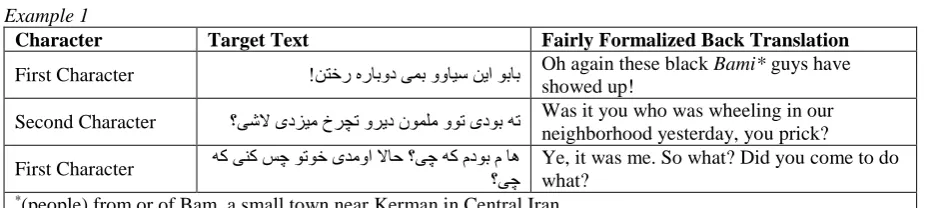
In all the clips dubbed into Persian, the local dialect of Kerman was used, which is heavily colloquial both in lexicon and sentence structure, at a level which perhaps only people from Kerman would fully understand. In fact, it was this local flavor and curious regional color juxtaposed onto clips from Hollywood feature movies that made the fundubbings witty and hilariously funny.
Table 1
Example 1
Character Target Text Fairly Formalized Back Translation
First Character !نتخر هرابود یمب ووایس نیا وباب Oh again these black Bami* guys have showed up!
Second Character ؟یشلا یدزیم خرچت ورید نوملم ووت یدوبهت Was it you who was wheeling in our neighborhood yesterday, you prick?
First Character هک ینک سچ وتوخ یدموا لااح ؟یچ هک مدوب م اه ؟یچ
Ye, it was me. So what? Did you come to do what?
*(people) from or of Bam, a small town near Kerman in Central Iran.
The colloquial expressions used in this sample are peculiar to the idioms of the dialect of Kerman. The humor boldly lies in the dialectal expressions and idioms as well as the use of local references, like black Bami (people from Bam are typically dark skinned), in the phrase
these black Bami guys (Table 1). Another
Table 2
Example 2
Character Target Text Back Translation
First Character شکاج ،یزاب ثوید ،هدش نیگنس یلیخ تمرج .منز یم فرح تاحاب یتقو نک هاگن نم !یزاب رخ هکدرم !
Your crime is grave, ye know, being a cuckold, hanging out with bitches! Look at me when I'm talking to ye. Moron. Second Character .مدروخن ور اگ نیا زا مودکچه نم اباب ه Look I’ve never pulled these bullshits. First Character هکدرم ،ثوید هکدرم مسانشم روت لاثما نم
لاقشر هکدرم ،قاسمرق !
I know such dirt bags like ye, cuckold, prick, asshole!
As discussed earlier, the typical goal of such dubbings is to entertain viewers in a variety of possible ways, including playing with the names of people and cities or swear words. In numerous cases, the characters are given special traditional Iranian names pronounced in the traditional accent of Kerman like /Alu/
and /Mamedu/ for the names Ali and Mohammad.
4.1.3. Dubbing Practice Features
Accurate synchrony is the most important point for the quality of dubbing. From a translational perspective, Chaume (2004, 2012) identifies three kinds of synchrony: lip synchrony, kinetic synchrony, and isochrony. Isochrony is the synchronization of duration of
a translation with characters’ utterances. In other words, translation must fit the moment the characters open their mouth and in the moment they close their mouth (Chaume, 2004, 2012).
The analysis revealed that lip synchrony was hardly ever preserved, but even in professional dubbings strict lip synchrony is not always achieved either. However, kinetic synchrony and isochrony were preserved in most cases not perfectly but acceptable. In one of the clips in the sample, a scene from the movie Dumb and Dumber (1994), a young lady is using hand movements to give directions (see Figure 1) whereas in the dubbed version the gesture is verbalized (see Table 3).
Figure 1
Example 3: Screen Shot from Dumb and Dumber (1994)
Table 3
Example 4: Scene from Dumb and Dumber (1994)
Character Source Text Target Text Back Translation
Lloyd
Excuse me, can you tell me how to get to the medical school?
هچوک یا !دیشخبب مناخ جاح ؟نریم فرط ودک ا هاگراتشک
Excuse me, senior madam, where is the slaughter house alley?
A Young Lady
Go straight ahead and make a left over the bridge.
نوبایخ ووت یریم وطمه امش یپیم ،اش چ رودو ییونودیم درگ ی
کیرباف هکلف .
Moreover, in all the dubbed clips, the original sound tracks with the original voice of actors, ambient noises, and any other sound effects are removed and replaced with the target sound track. Therefore, the dubbed version includes only the voice of the actors, which
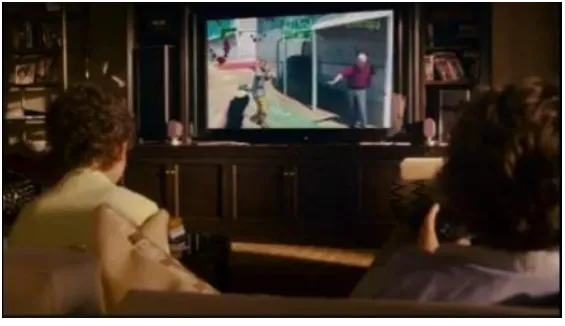
shows that the dubbing was done by non-experts. However, in order to compensate for the loss, the voice-actors produce the relevant sounds themselves, as is shown in example 5 (Figure 2).
Figure 2
Example 5: Scene with Boys Playing a Video Game
In this clip (Example 5), two boys are playing a video game, and the voice-actors attempt to reproduce the sound of gun shots. This makes the clip sound more realistic. Moreover, the scene becomes funny as the awkward sounds produced are witty in many ways. The voices used is another issue since all the voice actors are male, while some imitate female voices when there are female characters in the movie, which often happens. The imitation is easily recognized, and it is evident anyway, as the credits only list male Iranian names as voice-actors.
4.1.4. Translation or Not?
The results of the analysis of the sample
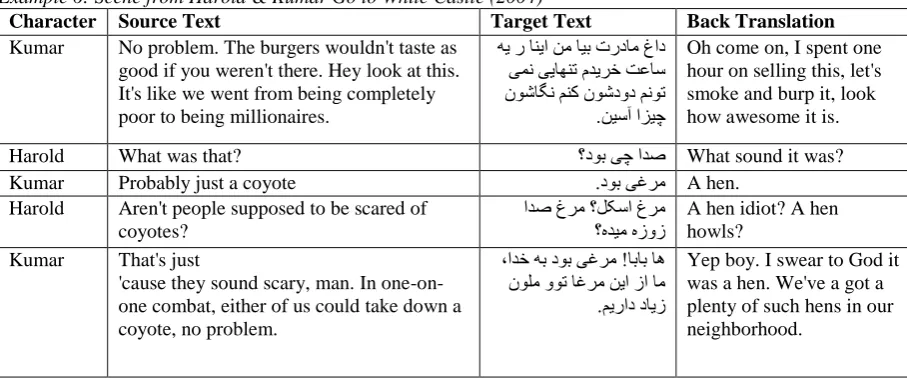
Table 4
Example 6: Scene from Harold & Kumar Go to White Castle (2004)
Character Source Text Target Text Back Translation
Kumar No problem. The burgers wouldn't taste as good if you weren't there. Hey look at this. It's like we went from being completely poor to being millionaires.
هی ر انیا نم ایب تردام غاد یمن ییاهنت مدیرخ تعاس نوشاگن منک نوشدود منوت نیسآ ازیچ .
Oh come on, I spent one hour on selling this, let's smoke and burp it, look how awesome it is.
Harold What was that? ؟دوب یچ ادص What sound it was?
Kumar Probably just a coyote .دوب یغرم A hen. Harold Aren't people supposed to be scared of
coyotes?
ادص غرم ؟لکسا غرم ؟هدیم هزوز
A hen idiot? A hen howls?
Kumar That's just
'cause they sound scary, man. In one-on-one combat, either of us could take down a coyote, no problem.
،ادخ هب دوب یغرم !اباب اه نولم ووت اغرم نیا زا ام میراد دایز .
Yep boy. I swear to God it was a hen. We've a got a plenty of such hens in our neighborhood.
Although the dubbed versions barely maintain any kind of fidelity to the original textual message, they cannot be regarded as pseudotranslations. Pseudotranslations, which are sometimes found in literary translation, are non- translation because they do not relate to any identifiable source text (O’Sullivan, 2011; Rambelli, 2009). However, where audiovisual materials are concerned, the visuals can be considered as a source of information to which the fundubbed versions correspond meaningfully to various extents. Gambier (2013) asserts that in the production of meaning in screen products the semiotic codes are very significant because they interact with the verbal code.
Given the fact that fundubbings in the sample had no overt relations with their source texts, it can be concluded that the translators did not work with verbal acoustic channels (dialogues) or did not consider the verbal elements (subtitles), because such dubbings did not aim to produce translations in the narrow sense of the term. Nonetheless, they carried out the task of translation as they rendered visual non-verbal signs like film codes, kinetic codes, and proxemic codes in particular. In other words, while in AVT the two sides of acoustic and visual channels are involved, in dubbing the audience cannot access the original acoustic channels, but they can only see the visuals; thus, there must be a synchrony between the translation and visual channels, known as “content synchrony” (Mayoral, Kelly, & Gallardo, 1998, p. 359). Since in fundubbings
there is always a visible relation between the translation and what is happening on the screen. This particular type of translation can be regarded as intersemiotic translation or transmutation which is “an interpretation of verbal signs by means of signs of nonverbal sign system” (Jakobson, 2012, p. 127), which is in line with Izwaini (2014), who points out that “in fake translation there is a visual element that is used by the translator to create the TT, and thus is a very important component of the translation product” (p. 3).
4.2. Fandubbing
The analysis of the data to explore the nature of Persian fandubbing in the context of Iran reveals a number of extensively shared descriptive characteristics which are presented and discussed in the following paragraphs.
4.2.1. Length of Clips
The clips dubbed by fans were short-formed clips from Hollywood feature movies, animations, and movie and game trailers. The duration of most clips ranged between 25 seconds up to 7 minutes. In addition, there were a few longer renditions. A non-expert group had dubbed the first three episodes of an American fairy tale drama series Once Upon a Time, creating some exceptional cases which were 40 minutes long.
4.2.2. Software Programs
The analysis of the cases, including the notes and commentaries of the fandubbers, showed that they used various software programs, such as Windows Movie Maker, Video Show Pro Video Editor, Wonder Share among others. Nevertheless, one of the more technically advanced groups stated that they had made use of Sony Vegas for recording voice-actors. Nuendo for creating and mixing sound effects, and Crystal Video Dubber, which are advanced software programs. Chaume (2007, 2013c) also asserts that fandubbers typically make use of software programs like Virtual Dub, Adobe Premiere or Windows Movie Maker.
4.2.3. Dubbing Practice Features
The typical producers of fandubbing in particular can be classified into two groups, the amateurs and the more technically advanced groups. The amateurs mainly dubbed short clips from animated movies and just for enjoying the experience, for an offer of an opportunity for professional dubbing and voice-acting, and showing off their ability in voice-acting. They enjoy the comments of other users on their dubbed clips and feel encouraged to pursue professional dubbing and voice-acting. They usually work in small groups of two or three or alone, and they are
very young people like high school and college students.
On the other hand, the technically more advanced groups in Iran, like Compliant Dub,
Avaye Novin, Idea Dub Group, Step Up, and
Mega Game Dub, are teams including a
translator, a dub director, and a number of voice-actors. By and large, these groups deliver a different quality especially regarding the technical aspect, as they manage to preserve the sound effects as much as possible, even though the performance of the voice-actors is far from professional.
As for synchrony in dubbing, while neither the technically more advanced groups nor the amateur groups preserved lip-synchrony in the target version, both the amateurs and quasi-professionals managed to preserve isochrony to a certain extent, although the technically more advanced groups were considerably more successful.
Occasionally, groups of fandubbers collaborate. For example, the two Iranian groups Step Up and Avaye Novin collaborated in dubbing the trailer of the movie Edge of
Tomorrow (2014). However, despite this
attempt to join forces, the quality was only fairly acceptable. The main challenge as usual is technical and refers to the sound effects. Since they often use downloaded, pirated versions, the dubbers do not have access to the various separate sound layers without which the recreation of the sound effects is technically difficult.
4.2.4. Translation
Generally, unlike the fundubbers, in this group (fandubbing) the target text is closely coherent with the original script, and no aim for added
laughter is observed in that; the aim of this group is to practice dubbing and voice-acting.
Table 5
Example 7: A scene from Frozen (2013)
Translation by an Official Dubbing Studio (Avazhe Dubbing)
Back-translation Translation by
amateurs
Back-translation
هکلم هکنیا مروظنم !اسلا :انآ
،منم
هب مهاوخ یم هزاجا .منم هرابود سسنرپ ،منک یفرعم نوتروضح یبونج ریازج زا سناه
ایلوا
ترضح نوتزا میتساوخ یم ام جاودزا میهاوخ یم هک میریگب هزاجا
.مینک .مدش جیگ مکی دیشخبب ؟جاودزا :اسلا
Anna: Elsa! I mean the queen, it’s me, me again. May I introduce Prince Hans from Southern Isles before you? Your majesty- We want to get the permission that we want to marry. Elsa: Marriage? Excuse me I'm a bit confused.
هکلم مروظنم دیشخبب !اسلا :انآ
رد مهاوخ یم هزاجا .منم هرابود سنرپ ،منک یفرعم نوتروضح یبونج ریازج زا سناه
یوناب
نم رد میتساوخ یم ام ام .میگب یزیچ هی نوتروضح
م .مینک جاودزا میهاوخ ی مکی نم دیشخبب ؟جاودزا :اسلا
.مدش جیگ
Anna: Elsa! Excuse me, I mean the queen. May I introduce Prince Hans from Southern Isles before you? My lady- We want to tell you
something before you. We want to marry. Elsa: Marriage? Excuse me I'm a bit confused.
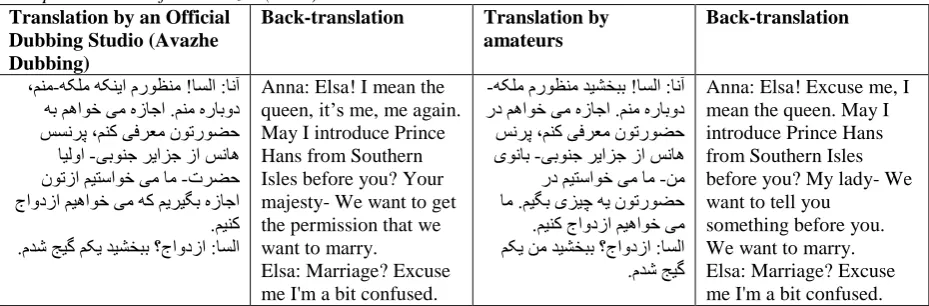
As the seventh example in the table 5 shows, the translations are close to the official dubbed version, which indicates that the group did not actually translate the original text and used the translation made available by the officially dubbed version.
As foreign movie trailers are not typically
dubbed officially in Iranian public access television or by home distribution networks, it can be strongly assumed that the fan groups have translated the original language of the trailers into Persian. In table 6, we present the dubbed version of the movie trailer of The
Amazing Spider-Man 2 (2014) by Step Up, a
technically fairly advanced dubbing group.
Table 6
Example 8: Scene from the Trailer of Amazing Spider Man 2 (2014)
Source Text Target Text Back-translation
Every day, I wake up knowing that the more people I try to save, the more enemies I will try to make and it’s just a matter of time until I face those with more power than I can overcome.
هک منود یم موش یم رادیب هک یزور ره یم یعس هک دنتسه مدرم زا یدایز ادعت یم ادیپ یرتشیب نانمشد و مدب تاجن منک ییایورو نم نیب هک هنامز طقف منک ینانمشد ،هتخادنا هلصاف رت یوق نانمشد .مهدب تسکش مناوت یمن هک
Every day, I wake up, I know that there are so many people that I try to save, and I find more enemies. It is only time that has kept me away from facing more powerful enemies, enemies whom I cannot defeat.
As can be seen in example 8 (see Table 6), the translation is strictly literal and source-oriented. The translation suffers from occasional incorrect rendition of the original content.
The clips dubbed by the group Megagame
Table 7
Example 9: Scene from the Trailer of Uncharted 4: A Thief's End (2015)
Source Text Target Text Back-translation
So, what do you think?
It’s a lot to take in kid. Where do I even start? You’ve been out of the game for a long time, or maybe I need to remind you the kind of people we’d be crossing here. Sully, I know the risks, but come on, it’s a sure fire plan.
؟ینک یم رکف یچ بخ شعورش ؟هچب یدب همادا یهاوخ یم زونه نیا ووت هتقو یلیخ وت و نم ؟دایم تدای رورم ور تارطاخ دیاب دیاش میتسه یزاب .نیگ یم یچ شدروم رد مدرم ینیبب و ینک نیا ایب سپ هکسیر هی نیا منود یم یلاس .مینک مامت ار یزاب شتآ
So, what do you think?
Are you gonna go ahead kid? Do you remember the very beginning? You and I have been involved in this game for a long time. Maybe, you should try to remember the memories, seeing what people speak about them. Sully, I know it is a risk, so let’s finish up this firework.
4.3. Quasi-Professional Dubbing
The analysis of the data to explore the nature of Persian quasi-professional dubbing in the context of Iran reveals a number of extensively shared descriptive characteristics which are presented and discussed in the following paragraphs. Primarily, this category can be distinguished from the first two categories in terms of the following features.
a) The most distinctive feature of this form of dubbing is the length of dubs, which sometimes even include a full length feature movie or the entire season of a TV series.
b) Unofficial dubbers who identify themselves in groups are referred to as quasi-professional dubbers since their work most often shows high-quality sound-effect mixing as well as high-standard voice-acting performances, although they are far from achieving the high standards of the dubbings by official studios.
c) Despite the high technical quality, their products are not planned for sale. Users can easily access the dubbed versions for download on the Internet mostly free of charge or for a very low fee.
d) All groups explicitly state that they do not work with any official dubbing studios. e) Fandubbers are usually not paid, or if they
are, they do not get much. They enjoy the experience and prospective opportunities in professional voice-acting.
4.3.1. Short History of Fandubbing in Iran
One of the very first cases of such quasi-professional dubbing appeared in January 2011 when the dubbing group Haft Simorgh
(The Seven Phoenixes), released a dubbed
trailer of the first season of the American series The Walking Dead (2010) announcing that they would dub the entire season of the series. However, their dubbed trailer had a low technical quality, including poor sound effects and voice-acting. Users critically commented on the poor technical quality; thus the group cancelled the project. In December 2011, another group, Haft Eghlim (the Seven Realms), announced that they would provide uncensored Persian dubbed versions of popular feature movies. They released the dubbed trailer of a movie, Man on a Ledge
(2012), and those of two TV series, Alcatraz
(2012) and Touch (2012). However, they only managed to dub the first episode of Alcatraz
(2012), which was not accepted by the users and criticized for low visual and auditory quality. Consequently, all their projects were cancelled. In March 2013, the Paradaiz
dubbing group released the dubbed version of the first episode of the American animated series Dream Works Dragons: Riders of Berk
(2012); in the following three months, they dubbed another four episodes, but later announced that they would not continue dubbing the series because an official dubbing studio would soon release an official dubbed version of the entire series. The group later also dubbed the Japanese anime Rurouni
Kenshin: New Kyoto Arc (2011) into Persian.
Then they removed the links for downloading their work, even though the dubbings can be found on other websites. Except for the voice performances, the dubbed anime was of good quality. So far, the group has not dubbed any other audiovisual material.
In May 2013, the group Baranfilm released a Persian dub of the trailer of the movie The
Hunger Games (2012), before releasing the
dubbed version was made available for download for a small fee. The group is active to date and has dubbed a number of other animated movie clips later in 2014. They also announced that they accept applications from users to join the group by sending a sample of their recoded sounds.
The dubbing group Iranfilm in March 2013, released their first project, the Persian dubbed version of the American movie Premium Rush
(2012). During the Iranian New Year Holidays in 2013, they released one of their biggest projects, the first dubbed version of the complete American TV series Pan Am (2011). The review of their work in addition to the user comments and testimonies posted on their website clearly reflect their success. Their dubbing is quite acceptable both with regard to the translations and to sound-effects mixing. Their latest dubbing project was released in August 2014, and they have announced that they would soon release the dubbed version of the American movie The Lone Ranger (2013). Since their first dubbing project, in 16 months, they have dubbed one entire season of an American series (14 episodes), two English documentaries, and 38 other American movies to date. They announce that they continue their dubbing projects and allow charge-free downloads.
4.3.2. Dubbing Practice Features
To get insights into the features of the practice of quasi-professional dubbers, a selection of works by two of the most successful groups,
Iranfilm and Baranfilm, was analyzed. The
sample included Premium Rush (2012) and the first episode of Pan Am (2011) by Iranfilm, and a short-form animation by Baranfilm. The sample was analyzed for dubbing quality, voice-acting performance, and the invisibility of translators and dub directors. The main features of the dubbed items in the sample can be listed as follow:
a) The dubbed versions were available for free access on the Internet.
b) The products do not involve any visual censorship and only minor content censorship.
c) The copyright of the originals are not
bought, and pirated versions are obtained mainly through Internet-based peer-to-peer file sharing systems (e.g., BitTorrent) to access the original AVT material.
d) Dubbings are of acceptable quality, as the positive testimonies of users show.
e) Redubbings of the audiovisual material are attempted and provided despite the availability of a prior official dubbed version.
f) The dubbing team members are not credited, and names are not revealed except for occasional first names or nicknames. g) They follow the operational norms of
professional dubbings, like aiming at synchrony, sound effects mixing, etc. h) Voice-acting performance is the least
quality in comparison with other features. i) The products are visited and/or downloaded
by 3000 to 50000 users.
j) The translations maintain coherence with the original and are acceptable for the audience.
Additionally, although the dubbing team members in this category are volunteers, there is at least one professional among them especially for the sound engineering, which is considerably specialized. One of the most important features of such quasi-professional dubbing is the lack of censorship. Iranfilm
stated that they slightly censor certain scenes in compliance with the Iranian families’ expectancy norms, but they barely censor visuals, and they mainly do not dub the socially unacceptable scenes. For example, in the movie Pompeii (2014), a segment was not dubbed but subtitled into Persian, as a female character was fairly scantily dressed.
Table 8
Example 10: Scene from Premium Rush (2012)
Source Text Quasi-professional Dubbing Official Dubbing
You got a real name? A girlfriend?
؟یراد یعقاو مسا ؟رتخد تسود
؟یراد یعقاو مسا ؟هچب و نز Back translation Have you got a real name? A
girlfriend?
Have you got a real name? A wife or kids?
As the tenth example in Table 8 shows, the original version contains a taboo word (i.e., girlfriend, according to the Iranian context). The official dubbing replaced the word
girlfriend with a non-taboo expression, but the
quasi-professional dubbers kept it as
girlfriend. In another example from the same
movie the official dubbing has edited out a scene simply because it happened in a bar with explicit show of alcoholic drinks, dancing, with a couple kissing in the background, but the quasi-professional groups kept and dubbed the same scene, however, edited out the kissing. Generally, the quasi-professionals follow the norms of the society at a less strict level; therefore, they mainly censor scenes which have socially very inappropriate visuals like showing affection or other provocative behavior.
Having reviewed users’ comments on these groups’ websites, there were numerous testimonies which indicated that the users approved these quasi-professional dubbings. As to the series Pan Am (2011), a user posted, in Persian, “Thanks, it was excellent” (April 22, 2014 - 8.02 am). Another user commented “Hello, and well done! Your work was excellentˮ (June 14, 2014 - 1.03 am). Some other users had different ideas. For example, one wrote, “why isn’t it dubbed well? In one scene with the airplane taking off, the voice-actor's voice is not clearly heardˮ (April 11, 2013 - 1.01 am).
4.3.3. Dubbing Practice Process
As to the process of fandubbing, according to Chaume (2007) fandubbers first watch the screen product (e.g., cartoons); then after translating and writing the dialogue, they produce the dubbed version at home, using free software programs. In order to identify the process of dubbing by fans, a quasi-professional dubber who directs dubbing projects was interviewed. The data show the following steps:
a) After the dub director selects a screen product (e.g., documentaries, animations, movies), the appropriate voice-actors are selected and invited to participate.
b) Since the original movies are not used, the sound layers are not accessed separately. Therefore, it is necessary to create the sound effects and have them added to the dubbed version later.
c) Once the movie is translated, the dub director writes the lines for each of the actors. A challenge is here to produce a synchronized version of the target text by considering lip-synchrony, kinetic synchrony and isochrony.
d) Then the dub director chooses from among the volunteers who will speak for which character.
e) Later, the translated script is emailed to each volunteer. As there is no studio to work in, they do the job at home.
f) After doing their job, volunteer actors send the recording to the dub director for review and approval. If the recording needs revision or changes, the volunteers are asked to redo the process often as the dub director considers necessary.
g) Finally, the recorded dialogues are added to the visual of the dubbed movie by the technical engineer.
h) The dubbed movie is usually made available on the Internet at short notice.
5. Concluding Remarks
However, recently, fandubbing is also creating an issue which has scarcely been the focus of
AVT research so far.
Figure 3
Illustration of Current Types of Dubbing in Iran
Due to the specific characteristics of non-expert dubbing in the Iranian context, we made a distinction between fundubbing, fandubbing, and quasi-professional dubbing (see Figure 3). In the first category, the results of the analysis showed that the aim of this type of dubbing by non-experts was mainly to entertain the audience by producing creative yet remotely matching narratives in dubbed short clips. The second category, fandubbing, was further classified into two sub-groups: amateurs and technically more advanced groups. Both sub-groups aimed at practicing dubbing and voice-acting through game trailers, short clips of animated or feature movies. Their translations were flawed with mistakes, since the dubbers neither copied any official dubbings nor did they translate the original literally. The third type, quasi-professional dubbing, included full-length movies, TV series or animations with rather high standards regarding the quality of dubbing and translation, yet low quality of voice-acting.
The results seem to confirm Chaume (2007), who believes that dubbings produced by fans
are no commercial threat to the industry of dubbing, and that official dubbing and fandubbing can certainly coexist, even though “the quality of fandubs varies from poor microphone sound conditions with no sound effects and amateur actors, to professional voice talents who freely give their time and energy using professional sound equipment and sound effects” (Chaume, 2013b, p. 297). In fact, despite standard quality, such fandubbings do not have long-term effects on the market, as fan groups rarely have adequate financial support for their projects; in addition
paradoxically, the ever-increasing standards and release speed that anime fans demand of fansubbers has the effect that many of them get tired very quickly and decide sooner rather than later to quit the fansubbing scene after having worked for a while. (Diaz-Cintas & Muñoz Sánchez, 2006, pp. 50-51)
their subtitled products on the web, more people may prefer subtitling to dubbing, which creates more market space for the subtitling companies. However, the official market of AVT in Iran orbits around dubbing and voice-over, and there is no official subtitling, thus, there is no competition between dubbing and subtitling, and voice-over is only used for non-fictional genres like documentaries, news or interviews, hence, voice-over cannot be the challenge for dubbing. Consequently, dubbing does not have any competitor in the Iranian AVT market. Therefore, fandubbing cannot have such a positive effect discussed by Pérez-González (2007a) since Iran is a dubbing country traditionally. In addition, fansubbing is another active issue in Iran which is much stronger than fandubbing, and more young people are interested in fansubtitling. But fandubbing can create a competitive market for dubbing, as the dubbing company do their best to distribute their own dubbed products very quickly and reduce the delay, and also enhance the quality of their dubbing practice.
Ferrer Simó (2005, cited in Pérez-González, 2007a) believes that the translational activities by fansubs would be a risk and danger for the professional translators. But Kayahara (2005) believes the works and activities by fansubs can lead to “raising the visibility of subtitling (p. 69). We agree with Kayahara as dubbings produced by fandubbers can raise the visibility of dubbing as a practice in Iran. Nonetheless, it is uncertain if these non-expert dubbings, in particular the quasi-professional dubbings, will endanger the market and the profession of AVT in Iran, as no special effect of these groups on the market has been reported yet simply because this practice has begun quite recently, and it is too soon to predict anything.
Reviewing the scarce literature of fandubbing, this report presented a qualitative, insight-driven study into issues of non-expert dubbing in contemporary Iran. Further studies into dubbing by fans can bring more insights into AVT and TS in the Iranian context and internationally. To this end, fundubbing, fandubbing and quasi-professional dubbings can be investigated in other language pairs and locales, using a variety of other methods. Quantitative wide-scope surveys can provide generalizable conclusions by considering and controlling more relevant variables.
Corpus-based investigations can provide deeper insights into the features and characteristics of the TL. Process-oriented case studies, employing eye-tracking, screencast, keystroke logging, or think-aloud protocols, can help determine the cognitive and mental processes of the practitioners. Longitudinal studies can help in discovering the length and maturation of these non-expert AVT practices, as well as their effects on the market and profession of AVT. It is also recommended to investigate the motivating and ideological factors behind fandubbings. Moreover, reception studies can also elicit the attitudes of users regarding such dubbed products. In conclusion, we hope that this paper could be a catalyst, provide a basic framework, and pave the way for future studies on non-expert dubbing issues and its incidental effect on the profession of AVT.
Acknowledgment
Our heartfelt thanks go to Frederic Chaume, professor of Audiovisual Translation at the Universitat Jaume I, Spain, who supported us with considerable encouragement and expert advice. Any errors are, of course, our own.
References
Chaume, F. (2004). Synchronization in dubbing: A translational approach. In P. Orero (Ed.), Topics in audiovisual
translation (pp. 35-52). Amsterdam, The
Netherlands: John Benjamins.
Chaume, F. (2007). Dubbing practices in Europe: Localisation beats globalisation.
Linguistica Antverpiensia, 6, 203-217 .
Chaume, F. (2012). Audiovisual translation:
Dubbing. Manchester, England: St.
Jerome.
Chaume, F. (2013a). Plenary lecture:
Translation for dubbing: Expanding
borders. Paper presented at the Media For
All 5 ,Dubrovnik, Croatia.
Chaume, F. (2013b). Research path in audiovisual translation: The case of dubbing. In C. Millán & F. Bartrina (Eds.), The routledge handbook of
translation studies (pp. 288-302).
Abingdon, England: Routledge.
Chiaro, D. (2009). Issues in audiovisual translation. In J. Munday (Ed.), The
routledge companion to translation
studies (pp. 141-165). Abingdon, England:
Routledge.
Chiaro, D. (2013). Audiovisual translation. In C. A. Chapelle (Ed.), The encyclopedia of
applied linguistics. Oxford, England:
Wiley-Blackwell.
Cronin, M. (2012). The translation age: Translation, technology, and the new instrumentalism. In L. Venuti (Ed.), The
translation studies reader (3rd ed., pp.
469-482). Abingdon, England: Routledge. Diaz-Cintas, J. (2013). Subtitling: Theory,
practice and reserach. In C. Millán & F. Bartrina (Eds.), The routledge handbook
of translation studies (pp. 273-287).
Abingdon, England: Routledge.
Diaz-Cintas, J., & Muñoz Sánchez, P. (2006). Fansubs: Audiovisual translation in an amateur environment. Jostrans: The
Journal of Specialised Translation, 6,
37-52 .
Diaz-Cintas, J., & Orero, P. (2010). Voiceover and dubbing. In Y. Gambier & L. van Doorslaer (Eds.), Handbook of translation
studies (Vol. 1, pp. 441-445). Amsterdam,
The Netherlands: John Benjamins.
Dörnyei, Z. (2007). Research methods in
applied linguistics. Oxford, England:
Oxford University Press.
Gambier, Y. (2013). The position of audiovisual translation studies. In C. Millán & F. Bartrina (Eds.), The routledge handbook of translation studies
(pp. 45-59). Abingdon, England: Routledge. Gambier, Y. (2014). Changing landscape in
translation. International Journal of
Society, Culture & Language, 2(2), 1-12 .
Gentzler, E. (2014). Translation studies: Pre-discipline, Pre-discipline, interPre-discipline, and post-discipline. International Journal of
Society, Culture & Language, 2(2),
13-24 .
Izwaini, S. (2014). Amateur translation in Arabic-speaking cyberspace. Perspectives:
Studies in Translatology, 22(1), 96-112.
Jakobson, R. (2012). On linguistic aspects of translation. In L. Venuti (Ed.), The
translation studies reader (3rd ed., pp.
126-131). Abingdon, England: Routledge. Kayahara, M. (2005). The digital revolution:
DVD technology and the possibilities for audiovisual translation studies. The
Journal of Specialised Translation, 3,
64-74 .
Khoshsaligheh, M., & Ameri, S. (2014). Translation of taboos in dubbed American crime movies into Persian. T&I Review, 4, 25-50 .
Mayoral, R., Kelly, D., & Gallardo, N. (1988). Concept of constrained translation. Non-linguistic perspectives of translation. Meta,
33(3), 356-367.
Nergaard, S., & Arduini, S. (2011). Translation: A new paradigm. Translation:
An Interdisciplinary Journal (Inaugural
Issue), 8-17.
Nornes, A. M. (2007). Cinema babel:
translating global cinema. Minneapolis,
MP: University of Minnesota Press. O’Hagan, M. (2009). Evolution of
user-generated translation: Fansubs, translation hacking and crowdsourcing. The Journal of Internationalisation and Localisation, 1(1), 94-121 .
O’Connell, E. (2007). Screen translation. In P. Kuhiwczak & K. Littau (Eds.), A
companion to translation studies (pp.
120-133). Clevedon, England: Multilingual Matters.
O’Sullivan, C. (2011). Pseudotranslation. In Y. Gambier & L. van Doorslaer (Eds.),
Handbook of translation atudies (Vol. 2,
pp. 123-125). Amsterdam, The Netherlands: John Benjamins.
Olohan, M. (2014). Why do you translate? Motivation to volunteer and TED translation. Translation Studies, 7(1), 17-33.
Pérez-González, L. (2007a). Fansubbing anime: Insights into the butterfly effect of globalisation on audiovisual translation.
Perspectives: Studies in Translatology, 14(4), 260-277.
Pérez-González, L. (2007b). Intervention in new amateur subtitling cultures: A multimodal account. Linguistica
Antverpiensia, 6, 67-80 .
Pérez-González, L. (2012a). Amateur subtitling and the pragmatics of spectatorial subjectivity. Language and Intercultural
Communication, 12(4), 335-352.
Pérez-González, L. (2012b). Amateur subtitling as immaterial labour in digital media culture: An emerging paradigm of civic engagement. Convergence: The International Journal of Research into
Pérez-González, L. (2012c). Co-creational subtitling in the digital media: Transformative and authorial practices.
International Journal of Cultural Studies, 16(1), 3-21.
Pérez-González, L., & Susam-Saraeva, Ş. (2012). Non-professionals translatingand interpreting: Participatory and engaged perspectives. The Translator, 18(2), 149-165.
Pym, A. (2000). Negotiating the frontiers: Translators and intercultures in hispanic
history. Manchester, England: St. Jerome.
Rambelli, P. (2009). Pseudotranslation. In M. Baker & G. Saldanha (Eds.), Encyclopedia
of translation studies (2nd ed., pp.
208-211). London, England: Routledge. Saldanha, G., & O'Brien, S. (2013). Research
methodologies in translation studies.
Manchester, England: St. Jerome.
Wikipedia (July 2014). Fandub. Retrieved July 7, 2014.
Filmography
Bell, A. (Director). (2012). Dream works dragons: Riders of berk.
Buck, C., & Lee, J. (Directors). (2013). Frozen. Cannon, D. (Director). (2012). Alcatraz. Darabont, F. (Director). (2010). The walking
dead.
Farrelly, P., & Farrelly, B. (Directors). (1994). Dumb and dumber.
Furuhashi, K. (Director). (2011). Rurouni kenshin: New kyoto arc.
Kitsis, E., Horowitz, A., & Tigelaar, L. (Directors). (2011). Once upon a time. Koepp, D. (Director). (2012). Premium rush. Lawrence, F. (Director). (2012). Touch. Leiner, D. (Director). (2004). Harold & Kumar
go to White Castle.
Leth, A. (Director). (2012). Man on a ledge. Liman, D. (Director). (2014). Edge of Tomorrow. Ross, G. (Director). (2012). The hunger games. Schlamme, T. (Director). (2011). Pan Am. Straley, B., & Druckmann, N. (Directors).
(2015). Uncharted 4: A thief's end. Verbinski, G. (Director). (2013). The lone ranger. Webb, M. (Director). (2014). The amazing