Association Rules Mining on Heart Failure
Differential Treatment Based on the Improved
Firefly Algorithm
Feng Yuan
School of Information Science and Engineering of Shandong Normal University, Jinan, China
Shandong Provincial Key Laboratory for Distributed Computer Software Novel Technology of Shandong Normal University, Jinan, China
School of Information Engineering of Shandong Management University, Jinan, China Email:[email protected]
Shouqiang Chen
Center of Hear of the Second Affiliated Hospital of Shandong University of Traditional Chinese Medicine, Jinan, China Email: [email protected]
Hong Liu*
School of Information Science and Engineering of Shandong Normal University, Jinan, China
Shandong Provincial Key Laboratory for Distributed Computer Software Novel Technology of Shandong Normal University, Jinan, China
Email: [email protected]
Abstract—Research the heart failure medical cases of TCM (traditional Chinese medicine) to effectively mine the association rules of differential diagnosis and treatment. TCM medical cases are of vast amounts of data and strong relatedness, and a new and improved firefly algorithm based on the guide of normative knowledge has been proposed to overcome the shortcomings of traditional association rules mining algorithms with the handling of TCM medical cases data such as low efficiency, slow convergence rate and rules underreporting, etc. The algorithm sets the support degree threshold through the penalty function, adaptively adjusts the hunting zone by normative knowledge to improve the convergence rate and exploration ability of the algorithm; it uses the way of random disturbance to conduct disturbance operation so as to increase the population diversity and effectively avoid algorithm prematurity. Confirmatory experiment of TCM medical cases for the treatment of heart failure has been conducted, the experimental results show that this method has achieved a great improvement on individual diversity and the efficiency of effective rules extraction compared with traditional association rules mining algorithms, and the mining results are of a certain reference value for TCM clinical diagnosis and treatment of heart failure.
Index Terms—association rules, firefly algorithm, normative knowledge, heart failure
I. INTRODUCTION
Heart failure is also known as congestive heart failure or cardiac insufficiency. It refers to that the cardiac output can’t satisfy the need of organs and tissue metabolism due to heart illness, overwork and output decrease, the main symptoms of which include dyspnea, cough, expectoration and edema, etc. Heart failure is a clinical syndrome, and the final stage of a variety of organic heart diseases; it is of high incidence rate and poor prognosis, seriously affecting people's quality of life. Currently, western medicine treatment on heart failure has achieved good curative effect. However, long-term normative application of the medicines can hardly be achieved due to many restrictions of western medicine such as untoward effect and limited economic conditions, etc. The patient tends to judge the treatment result according to the symptom improvement and can’t get systematic and effective treatment eventually. In recent years, Traditional Chinese Medicine has made great progress in the diagnosis and treatment of heart failure because of its good efficacy, fewer side effects and reasonable price[1]. Traditional Chinese Medicine specialists have accumulated large number of medical cases in clinical practice of heart failure diagnosis and treatment. The extraction of information implied in the accumulated TCM medical cases by data mining techniques is helpful for the analysis of TCM clinical diagnosis and treatment laws of heart failure to achieve the objective of differential treatment.
Some researchers have realized the importance of data mining in the field of TCM application. The swarm intelligence optimization algorithm, which started in the 1990s, quickly became the new technical research focus for the research of association rules mining for its advantages such as independence between the evolutionary process and initial value, fast search speed etc. The relatively mature algorithms include the following ones: Ant Colony Optimization Algorithm (ACO) [2] proposed by Dorgo and others, Particle Swarm Optimization Algorithm (PSO)[3-5] proposed by Kennedy and others, Gene Expression Programming Algorithm (GEP)[6-7] proposed by Ferreira, Artificial Bee Colony Algorithm (ABC)[8] proposed by Karabogal, and Firefly Algorithm (FA)[9-12] proposed by Yang.
Because it is a relatively short period of time since Firefly Algorithm was proposed, only few scholars have conducted improvement on it. Lukasik and others [13] conducted researches on the parameters of Firefly Algorithm and improved its solution accuracy. Apostolopoulos and others [14] successfully applied Firefly Algorithm to solve the economic emission load dispatch among multi-objective optimization problems. Yang conducted confirmatory experiment on the multi-objective optimization problem of Firefly Algorithm. Based on this, the paper proposes an improved firefly algorithm (FACA) guided by normative knowledge, which adaptively adjusts the hunting zone of the algorithm by normative knowledge; at the same time, it adopts the way of random disturbance to conduct disturbance operation, and conducts variation and update to the population space initiatively, which effectively avoids shortcomings of the algorithm such as prematurity and low population diversity, and improves the convergence rate and exploration ability of the algorithm. Association rules mining experiment has been conducted on TCM medical cases of heart failure treatment collected from October 2009 to October 2012. The results show that this method is much better than traditional association rules mining algorithm on individual diversity and the efficiency of effective rules extraction.
II. RELEVANT CONCEPT AND DESCRIPTION
A. Firefl Algorithm [15]
Firefly Algorithm is a stochastic optimization algorithm based on groupization and constructed through simulating the luminescence behavior of fireflies in the nature, and its optimization principle is described as follows:
Assuming that the number of fireflies in a population is
N, among which the position of the ith (i=1, 2,...,N) firefly
in D-dimensional space is
( , ,...,
1 2 D)
i i i i
x x x
x
. Thebrightness of the firefly reflects the superior and inferior position of the firefly. Its relative fluorescent brightness is:
0
ij r
I
=
I e−λ (1)Where, I0 means the fluorescent brightness of position of the firefly, which is the objective function value; the superior the objective function value is, the
brighter it will be. λ means the luminous intensity absorption coefficient, which is generally set to a constant;
ij
r
means the spatial distance between firefly i andfirefly j. Its definition is as follows:
2 1
|| || D ( k k)
k
ij i j i j
r = X −X = ∑ = x −x
(2) Attraction degree determines the movement distance of the firefly, and it is defined as follows:
2
0 ij
r
e λ
β β= − (3) Where,β0 means the maximum value of attraction
degree, which is generally set to a constant i.e. 1; the meanings of
λ
andr
ij are the same as above.If firefly i moves towards firefly j , the position
update due to movement is subject to formula (4):
( ) ( 1 / 2)
xi =xi +β xj −xi +α rand−
(4) Where,
x
i andx
j respectively represent the spatial position of firefly i and firefly j; α is the step lengthfactor, which is generally defined as a constant; rand is a
random factor obeying uniform distribution.
B. Normative Knowledge
In cultural algorithm[16], knowledge of reliability space is generally divided into state knowledge, normative knowledge, topology knowledge, domain knowledge and historical knowledge[17]. Normative knowledge is used to describe the feasible solution space[18] of the problem, and the update is reflected as the change of the searching space of feasible solution. In allusion to the optimization of D-dimensional variables,
its structure can be described as <W W1, 2, ...,WD > ; where Wi =| ( ,lk uk), (L Uk, k) |,k ≤D ,
u
k andl
krespectively represent the upper limit and lower limit of the i -dimensional variable,
U
k andL
k respectively represent the adaptive value of the upper limit and lower limit of the variable hereof.As the evolutionary process continues, the individual shall search in the region with comparative advantage. Therefore, according to the characteristics of evolution strategies of Firefly Algorithm, the update mode to amend the normative knowledge (take the maximum value optimization as an example) is as follows:
( ),
( 1) ( ) ( ) ( ( )) ( )
( ),
k j
k
j k j k
k
x t
lk t if x t l t and f x t L t
l t else
+ = < >
⎧
⎪⎪
⎨
⎪
⎪⎩
( ( )),
( 1) ( ) ( ) ( ( )) ( )
( ),
j k
k j k j k
k
f x t
L t if x t l t and f x t L t
L t else
+ = < >
( ),
( 1) ( ) ( ) ( ( )) ( ))
( ),
k j
k
k j k j k
k
x t
u t if x t u t and f x t U t
u t else
+ = > >
⎧
⎪
⎪
⎨
⎪
⎪
⎩
( ( )),
( 1) ( ) ( ) ( ( )) ( )
( ),
j k
k j k j k
k
f x t
U t if x t u t and f x t U t
U t else
+ = > >
⎧
⎪⎪
⎨
⎪
⎪⎩
(5) Where,
x t
j( )
means the jth firefly individual in the
tth
iteration,
f x t
( ( ))
j means the corresponding function adaptive value of individualx t
j( )
.III. IMPROVED FIREFLY ALGORITHM (FACA)
A. Fitness Function Design
Fitness function design has a direct impact on the performance of the algorithm; if the fitness function design is improper, on the one hand, it will generate some supernormal individuals in general during the early evolution of the algorithm, the selection process will be controlled by these abnormal individuals due to their prominent competitiveness, which will make the algorithm premature; on the other hand, during the later evolution as the algorithm is close to convergence, the algorithm evolution can hardly continue due to the little fitness difference of individuals in the population, which will make the algorithm come into a standstill[19]. During association rules mining, the support degree and confidence coefficient are two important standards for the measurement of association rules; formula (6) is adopted as the fitness function to solve the foregoing problems. The fitness function
f i
( )
is defined as follows:spt i( )−t l( ) min_× spt+ (cnf i( ) min_− cnf),
( )
f i
=
i
f (spt i( ) min_− spt) 0>and (cnf i( ) min_− cnf)>0 0, else (6)
Where t l( ) is the penalty coefficient, its interest on item set increases with the increase of the item set length during association rules mining, so the penalty coefficient shall be set for the threshold value of the minimum support degree i.e. ( ) 1
2l
l
t l = − , where l means the length
of the item set; spt i( ) and cnf i( ) respectively represent the support degree and confidence coefficient of the ith
rule formed by optimizing operation; min_spt and min_cnf respectively represents the minimum support
degree threshold value and the minimum confidence coefficient threshold value which are set beforehand.
B. Mining Strong Association Rules Obtained by Firefly Algorithm
Assuming that I={ , ,..., }i i1 2 im is a set consisting of m
different items, then the association rule can be expressed as R X: ⇒Y , where X ⊂I,Y ⊂IandX∩ = ∅Y ; the rule meeting the minimum support degree threshold value min_spt and the minimum confidence coefficient threshold value min_cnf is named as strong association rule[20]. The process of strong association rule mining is exactly the attracting and moving process of individual fireflies. The bionics principle is: use the points in the searching space to simulate the fireflies in the nature; the fitness function values measure the superior and inferior position of fireflies; and the process of survival of the fittest of fireflies is simulated as the iteration process of better feasible solution replacing poor feasible solution during the searching and optimization process. The corresponding relationship between Strong Association Rule mining and firefly optimization is shown in Table 1.
TABLE 1
THE CORRESPONDING RELATIONSHIP BETWEEN MINING STRONG ASSOCIATION RULE MINING AND FIREFLY BEHAVIORS
Firefly behavior strong association rule mining Spatial position of firefly
individuals Individual
Firefly brightness Individual fitness function value Speed of finding the brightest
firefly Speed of mining strong association rule Brighter firefly Strong association rule The process of strong association rule mining by FA algorithm is designed as follows:
Step 1: determine the item set and transactional database, input the parameters;
Step 2: generate the initial individuals randomly, and calculate the individual fitness function value;
Step 3: update the spatial position of fireflies according to formula (4), and exert random disturbance to the individual in the optimum position;
Step 4: calculate the individual fitness function value according to the updated position of the firefly;
Step 5: turn to Step 6 when the searching precision or the maximum number of searching times is reached; otherwise, increase the number of searching times by 1, turn to Step 3 and enter into the next search;
Step 6: output the Strong Association Rule. The time complexity of the algorithm is O ( N2 ), N2 is the number of fireflies.
C. Disturbance Strategy Guided by Normative Knowledge
local optimum. In order to solve this problem, this paper proposes a disturbance strategy with small probability guided by normative knowledge; the specific expression is as follows:
(
)
k
i k k k
x
= +
l
rand u
−
l
(7)In the iterative process, when the random number meets a small probability
ψ
, choose an individual randomly for disturbance to enhance the ability of the algorithm to escape from local optimum; the specific process is as follows:If rand<ψ
k k ( k k) ( 1 / 2)
i i j i
x =x +β x −x +α rand−
Else
( )
k
i k k k
x = +l rand u −l
Where, disturbance is a small probability event, so
ψ
is generally set to a value larger than 0.9.D. FACA Algorithm Process Design
Firefly Algorithm is characteristic of simple operation and rapid convergence rate, but it is easy to fall into local optimum [21] during rapid convergence due to its evolution mode and selection strategies. In order to solve this problem, this paper uses normative knowledge to guide the region of search and adopts random disturbance to conduct disturbance operation. It adaptively adjusts the hunting zone of the algorithm, and better solves the problem of traditional FA algorithm which will fall into local optimum untimely during evolution. Its process design is as follows:
Step 1: initialize the population; calculate the corresponding function adaptive value.
Step 2: if t i.e. the number of iteration of the present
algorithm is larger than a certain threshold value, select the firefly with the optimal adaptive value to apply to the update operation of normative knowledge.
Step 3: calculate the relative brightness I and attraction
degree B of the firefly by formula (1) and (3), determine
the movement direction of fireflies according to the relative brightness;
Step 4: implement the disturbance strategies guided by normative knowledge.
Step 5: calculate the function adaptive value according to the updated position of the firefly.
Step 6: turn to Step 7 when the searching precision or the maximum number of searching times is reached; otherwise, increase the number of searching times by 1, turn to Step 2 for the next search;
Step7: output the strong association rule.
E. Evaluation Indicator Design
The diversified quantitative analysis function of the evaluation rule set is defined as follows:
2 ,
1 1
(
N N) /
pop m n
m n
DIV
d
N
= =
=
∑ ∑
(8) Where, N means the population size,
d
m n, represents the Hamming distance between individual m andindividual n.
IV. ALGORITHM VERIFICATION AND RESULT DISCUSSION
A. Data Analysis
This paper collects 612 recipe cases for heart failure treatment conducted by distinguished veteran doctors of TCM including Deng Tietao, Chen Keji, Xu Xinru and Li Jieming, etc., There are 346 male cases and 266 female cases and 208 patients. The ages range from 11 to 84 years old; the clinic times range from 1 to 7, and there are totally 554 effective recipe cases. These recipe cases include 8 syndrome types i.e. qi deficiency, yang deficiency, retained morbid fluid, blood stasis, yin deficiency, phlegm and fluid, heat-toxicity and phlegm-heat, among which the type of qi deficiency is the most frequent one with the times of occurrence of 308 and the frequency of 50.33%; and the type of phlegm-heat is the least frequent one with the times of occurrence of 28 and the frequency of 4.58%. The syndrome differentiation frequency sees Table 2, and the overall differentiation frequency sees Table 3.
TABLE 2.
SYNDROME DIFFERENTIATION FREQUENCY TABLE
Syndrome differentiati on Times of occurr ence Freque ncy (%) Syndrome differentiat ion Times of occurrenc e Frequ ency (%) Qi
deficiency 308 50.33% deficiency Yang 200 32.68% Retained
morbid fluid 178
29.08 %
Blood
stasis 164
26.80 % Yin
deficiency 102
16.67 %
Phlegm
and fluid 84
13.73 %
Heat-toxicity 52 8.49% Phlegm-heat 28 4.58%
TABLE 3.
OVERALL DIFFERENTIATION FREQUENCY
Interval y (%) Frequency number Frequency (%) Cumulative frequency (%) y<10 2 25% 25%
10≤y<20 2 25% 50%
20≤y<30 2 25% 75%
30≤y<40 1 12.5% 87.5%
40≤y<50 0 0% 87.5%
50≤y<60 1 12.5% 100%
60≤y<100 0 0.0% 100%
Figure1. Medication frequency
TABLE 4.
OVERALL MEDICATION FREQUENCY
Interval y (%) Frequency number Frequency (%) frequency (%) Cumulative
y<10 296 89.4% 89.4%
10≤y<20 18 5.4% 94.8%
20≤y<30 7 2.1% 96.9%
30≤y<40 7 2.1% 99.0%
40≤y<50 1 0.3% 99.3%
50≤y<60 2 0.7% 100%
60≤y<100 0 0.0% 100%
B. Initialization Code
According to the analysis, there are totally 35 kinds of traditional Chinese medicines with the medication
frequency no less than 10%. SAS statistical software is applied for Logistic regression analysis with these 35 kinds of traditional Chinese medicines as the independent variable and heart failure as the dependent variable. Upon the verification by Likelihood Ratio, Score and Wald, the P value is less than 0.0001 and these 35 kinds of traditional Chinese medicines are of statistical significance. 35 kinds of traditional Chinese medicines with statistical significance and the medication frequency no less than 10% are used to construct the item set in the association rules mining of heart failure i.e. arrange these 35 kinds of traditional Chinese medicines into a sequence, initialize all the gene locus into 0, select a kind of traditional Chinese medicine from the sequence randomly and set its gene locus to 1 accordingly, repeat that operation until the initial solution space is generated.
C. Strong Association Rule
FACA algorithm shall be adopted for experiment. The maximum attraction degree β0
=
1
; the luminous intensity absorption coefficientλ
=
1
; the number of population individuals is 100; the maximum cycle-index is 1000;min_
spt
=0.1 andmin_
cnf
=0.6. The results of part of Strong A、association rule experiments of heart failure TCM medical cases made by FACA algorithm are shown in Table 5.TABLE 5.
PART OF STRONG ASSOCIATION RULE EXPERIMENTS OF HEART FAILURE TCM MEDICAL CASES
Strong association rule
Qi deficiency type of heart failure
⇒
(Milkvetch Root, Rhizoma Ligustici Chuanxiong, Polyporus Umbellatus, Radix Pseudostellariae, Rhizoma Polygonati Odorati)Retained morbid fluid type of heart failure
⇒
(Poria, Rhizoma Alismatis, Pepperweed Seed, Rhizoma Imperatae)Phlegm and fluid type of heart failure
⇒
(Lignum Sappan, Fructus Perillae, Orange Fibers)Yang deficiency type of heart failure
⇒
(Processed Radix Aconiti Carmichaeli)Blood stasis type of heart failure
⇒
(Radix Paeoniae Rubra,Rhizoma Ligustici Chuanxiong, Motherwort Herb, Rehmannia Glutinosa Libosch, Adenophora Stricta, Lignum Sappan, Fructus Amomi, Chinese Taxillus Twing)Yin deficiency type of heart failure
⇒
(Adenophora Stricta)D. Result Analysis
Analysis of differentiation medications can reflect the commonly used traditional Chinese medicine by the distinguished veteran doctors of TCM during the treatment of heart failure. For qi deficiency type of heart failure, distinguished veteran doctors of TCM generally use Milkvetch Root for the nourishing of vital energy and yang qi, invigorating defensive energy for consolidating superficies, and inducing diuresis for removing edema, supplemented with the following TCM: Rhizoma Ligustici Chuanxiong for promoting blood and qi circulation; Polyporus Umbellatus for inducing diuresis for removing edema; Radix Pseudostellariae for strengthening spleen to nourish qi; Rhizoma Polygonati Odorati for nourishing heart yin and clearing heart heat. For patients of retained morbid fluid type of heart failure, distinguished veteran doctors of TCM generally use Poria
well as clearing heat and detoxication; Rehmannia Glutinosa Libosch for clearing heat and cooling blood as well as nourishing yin and generating body fluid; Adenophora Stricta for clearing heat and nourishing yin as well as moistening lung and arresting cough; Lignum Sappan for promoting blood circulation and removing blood stasis as well as detumescence and relieving pain; Fructus Amomi for dampness dispersing and promoting qi circulation as well as warming spleen and appetizing. It is generally supplemented with a balanced amount of Chinese taxillus twig for nourishing liver and kidney, strengthening the bones and muscles, and expelling wind-damp. For the patients of yang deficiency type of heart failure, distinguished veteran doctors of TCM generally use processed radix aconiti carmichaeli. For yin deficiency type of heart failure, distinguished veteran doctors of TCM generally use Adenophora Stricta for clearing heat and nourishing yin.
Modern pharmacological research results show that Milkvetch Root, Rhizoma Ligustici Chuanxiong, Radix Pseudostellariae, Rhizoma Polygonati Odorati, Adenophora Stricta and others are all of a certain cardiac effect; active constituents contained in Rhizoma Alismatis can lower the heart output, heart rate and left ventricle pressure; Pepperweed Seed both has the function of cardiac effect and diuresis, increasing the heart output and lowering the venous pressure [22-25]. The above analysis results are consistent with the clinical practice, and can be selected and used flexibly for different syndromes so as to improve the treatment result of heart failure.
E. Comparison of FACA Algorithm with Other Algorithms
Apriori association rules mining algorithm, FA algorithm and FACA algorithm shall be adopted for comparative experiment, and all experiments shall operate independently for 100 times. Results of the comparative experiment are shown in Table 6, Figure 4 and Figure 5.
TABLE 6.
OPERATION RESULTS OF ASSOCIATION RULES MINING OF HEART FAILURE MEDICAL CASES
Algorithm Running time /s
Effective association rules
/ article
Average fitness % Apriori 210 352 55.3
FA 106 236 48.6 FACA 88 378 56.5 It can be seen from the comprehensive comparison that FACA algorithm is much better than FA algorithm and Apriori algorithm not only in running time and the number of effective association rules mining, but also in the average fitness.
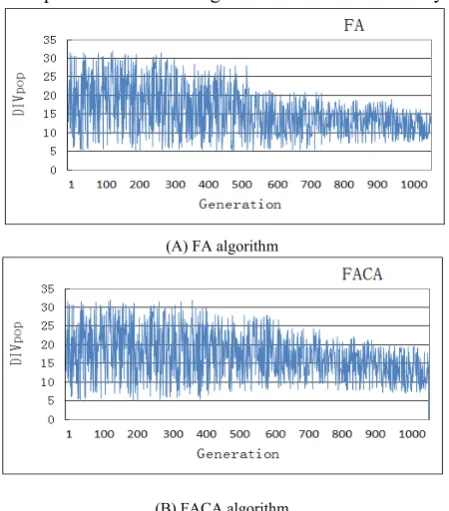
Figure 2 is the diversity comparison between evolutionary process of FA algorithm and FACA algorithm. It can be seen from the comparison that the diversity of FACA algorithm is superior to that of FA algorithm. The diversity of FACA algorithm is still well maintained after being updated to the 500th generation.
Generally, the diversity decreases with the continuation
of evolution, but it still maintains a relatively high diversity, providing the condition for avoiding falling into local optimum and obtaining new solutions continuously.
(A) FA algorithm
(B) FACA algorithm
Figure 2. Individual diversity comparison between FA algorithm and FACA algorithm
Figure 3 is the average fitness comparison of evolutionary process of FA algorithm and FACA algorithm. It can be seen after comparison that the average fitness all increases with the continuation of evolution, and tends to be stable after being updated for many generations; the average fitness of FACA algorithm is 56.5%, which is higher than that of FA algorithm i.e. 50.6%.
(A) FA
(B) FACA algorithm
V. CONCLUSION
TCM medical cases are featured by high correlation and mass data, which determines the difficulty of efficient association rules mining. This paper makes use of normative knowledge in reliability space and information about historical optimal solution to improve the way of searching new position of fireflies, update the normative knowledge with the evolution process, and adaptively adjust the hunting zone of the algorithm as well as improve the ability of local search. Verified by experiment, this composition model is much better than traditional association rules mining algorithms on running time, the number of effective association rules mining and the average fitness.
As the medical cases are collected continuously and the parameter settings become more and more reasonable as well as the intelligibility and degree of interest and other factors are also taken into consideration in addition to support degree and confidence coefficient when setting the fitness function, this composition model will be of more reference value for TCM clinical diagnosis and treatment of heart failure.
ACKNOWLEDGEMENTS
This paper is financed by the National Natural Science Foundation of China (60743010 and 60970004) as well as Natural Science Foundation of Shandong Province (ZR2012HW052).
REFERENCES
[1] Sun Zhenqiu, “People's Medical Publishing House”, Medical Statistics, 333-341,2007. ( in Chinese)
[2] KENNEDY J, EBETHART R., “Particle swarm optimization”, Proceeding of IEEE International Conference on Neural Networks. Piscataway, NJ:IEEE Computer Society,1942-1948,1995.
[3] H. Gandomi, G. J. Yun, X. S. Yang, S. Talatahari, “Chaos-enhanced accelerated particle swarm optimization”, Communications in Nonlinear Science and Numerical Simulation, 18(2),327-340,2013.
[4] Lin W, Gu X, Lian Z, et al. A Self-Government Particle Swarm Optimization Algorithm and Its Application in Texaco Gasification[J]. Journal of Software, 2013, 8(2): 472-479.
[5] Pan J, Mao G, Dong J. A Web-Based Platform for Intelligent Instrument Design Using Improved Genetic Algorithm[J]. Journal of Software, 7(10), 2333-2340,2012. [6] Ferreira C. “Gene expression programming: a new
adaptive algorithm for solving problems”, Complex Systems,13(2),173-178,2001.
[7] Hu W, Fu L, Zhang H. BP Network for Diagnosing Rotor Broken Fault Based on a New PSO[J]. Journal of Software, 8(8), 1960-1967, 2013.
[8] Karaboga D.,”A idea based on bee swarm for numerical optimization”, Erciyes University, Engineering Faculty, Computer Engineering Department,2005.
[9] Yang, X.S., “Firefly algorithms for multimodal optimization” ,SAGA'09: Proceedings of the 5th International Conference on Stochastic Algorithms, Foundations and Applications. Berlin:Springer-Verlag,169-178,2009.
[10] Yang, X. S., “Firefly Algorithm Stochastic Test Functions
and Design Optimization”, Int. J. Bio-Inspired Computation,2(2),78-84,2010.
[11] Yang, X. S., “Firefly Algorithm, Levy Flights and Global Optimization”, Research and Development in Intelligent Systems XXVI (Eds M. Bramer, R. Ellis, M. Petridis), Springer London,209-218,2010.
[12] H. Gandomi, X. S. Yang, S. Talatahari, A. H. Alavi, “Firefly algorithm with chaos”, Communications in Nonlinear Science and Numerical Simulation,18(1), 89-98,2013.
[13] Lukasik S,Zak S., “Firefly algorithm for continuous constrained optimization tasks”, In proceeding of Springer,169-178,2009.
[14] Apostolopoulos T, Vlachos A., “Application of the firefly algorithm for solving the economic emissions load dispatch problem”, International Journal of Combinatorics, Article ID 523806,2011.
[15] Yang, X.S., “Multiobjective firefly algorithm for continuous optimization”, Engineering with Computers, 29(2),175-184,2013.
[16] Reynolds R G,Sverdlik W., ”Problem Solving Using Cultural Algorithms”, Proc of the 1st IEEE Conference on Evolutionary Computation, Orlando, 645-650,1994. [17] Guo Yinan,Wang Hui,”Overview of Cultural
Algorithm”,Computer Engineering and Applications,45( 9), 41-46,2009. ( in Chinese)
[18] Chung C J., “Knowledge-Based Approaches to Self-Adaptation in Cultural Algorithms”, Detroit, USA: Wayne State University Press,1997.
[19] Ngai E W T, Li X, Chau D C K, “Application of data mining techniques in customer relationship management: a literature review and classification”, Expert Systems with Applications,36(2),2592-2602,2009.
[20] Venkatadri M, Lokanatha C R.,”A review on data mining from past to the future”, International Journal of Computer Applications,15(7):19-22,2011.
[21] Yang, X. S., “Engineering optimization: an introduction with metaheuristic applications”, John Wiley & Sons, 2010. [22] Zhai Hongqi, Xu Yanxiang , Hong Yan, ”Clinical
Observation of Heart Failure Treatment by Using Ligustrazine”, Central Plains Medical Journal, 27 (10), 45-46,2000. ( in Chinese)
[23] Wu Meiping, Xiong Xudong, Dong Yaorong, “Experimental Study on the Acute Blood Hemodynamics Effect of Nourishing Yin Medicine -- Rhizoma Polygonati Odorati Conducted on SD Rat with Heart Failure”,The Practical Journal of Chinese and Western Medicine,15(22),1233-1235,2009. ( in Chinese)
[24] Zhang Qiao,Wu Qinan, “Modern Research Prospects of TCM Rhizoma Alismatis”, Primary Journal of Chinese Materia Medica, 16 (5), 52-54,2002. ( in Chinese)
[25] Yang Mengkao,”23 Medical Cases of Stubborn Heart Failure Treatment by Pepperweed Seed Alone”, Chinese Community Doctors, 18 (20),40-41,2002. ( in Chinese)
Feng Yuan (1972- ), female, lives in Jinan City, Shandong
Shouqiang Chen(1972- ), male, lives in Tai’an City, Shandong
Province. He received his doctorate from Shandong University of Traditional Chinese Medicine in 2008. He is Associate Professor of the Second Hospital Affiliated to Shandong University of Traditional Chinese Medicine. His major research areas include TCM informatization and data mining.
Hong Liu (1955- ), female, lives in Jinan, Shandong Province.