Comparative Study of Seismic Behavior of
Honeycomb Structure with Conventional
Structure by using Staad Pro
Ankita Rode Dr P. Y. Pawade
M. Tech. Student HOD
Department of Civil Management Department of Civil Engineering
GHRCE Nagpur GHRCE Nagpur
Abstract
Paper presents a comparative study of newly developed hexagrid system for buildings. The largest forces that act on any structure are the natural lateral forces earthquake forces and wind forces in any orthogonal direction about the Cartesian axis. The purpose of this project is to compare the efficiency of the structure in case of these main forces mentioned above. Many tall structures are prone to such type of heavy forces and cause losses to the environment and society in every means.
Keywords: Honey Comb Structure, Innovation, Strength
________________________________________________________________________________________________________
I.
I
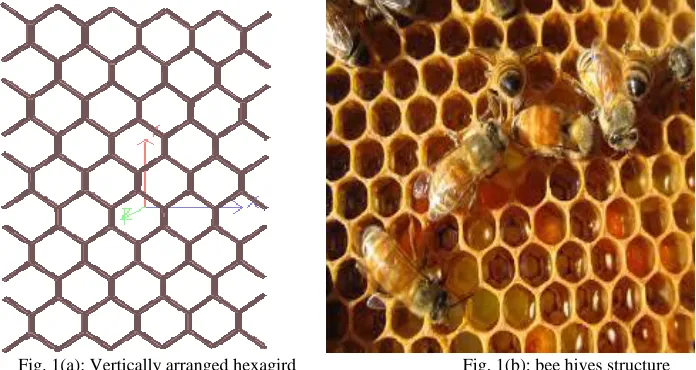
NTRODUCTIONThe newly developed innovated system is basically dependent on the prevailing structural system in tall buildings construction that is facade system. The facade system buildings are very prone to earthquake as per the studies .But the facade system now can be built and in arrange in such a way with such a structure that it will increase the efficiency of the building. The hexagrid structure is basically a biomemitic structure which is inspired by bee hives. The environment and our surrounding is full of miracles of god, Which is an inspiration to the human being because of the efficient utility of the environment without any damage to it. Fig 1.1 (a) and Fig 1.1 (b) demonstrates the arrangement similar to the beehives structure used as a structural member. The gird can be made in any pattern which may consist of horizontally arranged hexagrid or vertically arranged type. It can also be a square, triangle of rectangular type. This is a recently evolved structural system in china. There are many different types of biomimic structural which are constructed in different parts of the world. The driving force behind the evolution of these type of the structures is the attraction and interest of architects towards the new type of challenges over the aesthetic appearance and its combination of structural strengths.
Fig. 1(a): Vertically arranged hexagird Fig. 1(b): bee hives structure Fig. 1: Shows the hexagrid structure which is arranges as the beehives
II.
O
BJECTIVEearthquake forces The objective of this project is to efficiently use the environment and provide proper ventilation to the structure so that minimum energy losses can be done and energy is rather saved.
III.
S
COPEThe scope of the honey comb structure or any biomemitic structure is that it efficiently uses land. The conventional structures are very heavy structures made up of bricks, concrete and steel. The weight of the structure is very large. Heavier is the structure greater is the damaged cause by earthquake. Steel structures and specifically honey comb structures are made up of steel exoskeleton which is a shear solid surface. This makes the structure resistant to lateral loads and the vertical loads due to inertia is less as the self-weight will be less, less moment is developed. During earthquakes it has been seen that tall structures are very vulnerable to earthquakes. The increase in the construction and demand of tall structures has raised lot of questions on the environmental safety. It is seen that many tall structures are not as good in strength as they are aesthetically good. This damage to the environmental system can be minimized if the structure is properly designed and proper ductile and damping to the structure is given. The new honey comb structures can be energy efficient and earthquake resistant to great extent.
IV.
M
ETHODOLOGYIn this project seismic analysis will be carried out on conventional type framed structure building and then honey comb structured building. The plan of a building is chosen as a plan of an existing building.
The effectiveness of the honey comb structural system will be studies and compared with conventional structure by using STAAD pro software of analysis and design.
Both the type of structure will be analyzed using this software. The structure will be studied for following: The different loading condition are taken as per IS1893-2002 part 1
The loading combination will be changed and for every different loading condition both conventional type and honey combed structure will be analyzed.
The support reaction will be studied.
Axial forces in columns of each structure will be studied and compared. The displacement of floors in each structure will be studied
About The Structure
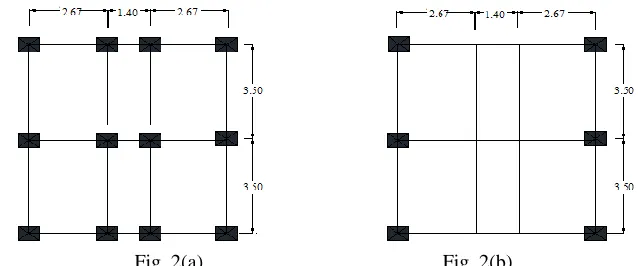
Fig. 2(a) Fig. 2(b)
Fig. 2: shows a. column orientation and plan of conventional type structure and b. Column orientation and plan of honey comb structure
Details of the Structures:
Conventional structure:
The column sizes are 500 X 250 mm The beam sizes are:
1.b1=400 x230 mm
b2=450x230mm
b3=500x230mm
The plate thickness are taken as per the plan
s1=125 mm
s2=115 mm
Honey comb (hexagrid) structure
The hexagrid is made up of hollow circular pipes as per Indian specification PIP1270m steel with outer diameter 127mm
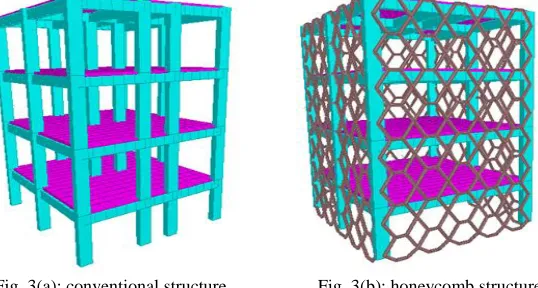
The following figure shows the elevation and 3d view of structural system of honey comb structre which is modelled in STAADpro
Fig. 3(a): conventional structure Fig. 3(b): honeycomb structure Fig. 3: 3D view of both the types of structures used in analysis
Load Transfer Mechanism
The load is transferred centrally in case of biomemitic hexagrid structure. Through the hexagrid these loads are transferred to the earth as the energy is transferred to through the molecules. So the load is transferred from an element of the hexagrid to another element within the hexagrid and then passed on to the other grid. The mechanism of load transferee in conventional structure is form beam to column to the earth.
The different load cases used for analysis are as per Indian Code:
1) EQRX
2) EQRZ
3) DL
4) LL
5) 1.5 XDL+ 1.5XLL 6) 1.2X DL+ 1.2 XLL
7) 1.2XDL+ 1.2XLL + 1.2 XEQRX 8) 1.2XDL+ 1.2 XLL+ 1.2 EQRZ 9) 1.2 XDL+1.2XLL -1.2XEQRX 10) 1.2XDL+ 1.2XLL -1.2 XEQRZ 11) 1.5 XDL
12) 1.5XDL + 1.5X EQRX 13) 1.5XDL+ 1.5 XEQRZ 14) 1.5XDL -1.5 XEQRX 15) 1.5XDL -1.5 XERQZ 16) 0.9 XDL+1.5 XEQRX 17) 0.9XDL +1.5 XEQRZ 18) 0.9XDL 1 -1.5 XEQRX 19) 0.9 XDL+ -1.5XEQRZ
Where, EQRX stands for earthquake load in x direction EQRZ stands for earthquake load in z direction
DL= Dead load of the structure = -3 kn/m as per IS 875 part 1 LL= live load of the structure= -2.5 kn/m as per IS 875 part 2 RL= Roof live load= 1.5 kn/m (access provided)
Earthquake load is as per IS:1983 part IS 1983:2002 part 1 EQRX is earthquake force taken in -x direction Z=Zone is taken as IV
R=Response reduction factor is taken as 5 I =Importance factor is taken as 1
V.
R
ESULTThe results obtained from the analysis are as follows:
Static Check Results
Fig. 4: shows the difference in forces of the structure when subjected to earthquake force in negative x direction,
Where, Fx is the base shear and My and Mz is bending moment and moment along z direction of the structure
Fig. 5: Shows the different in forces due to the dead load of structure
Where, Fy is the vertical reaction and Mx and Mz is torsion and moment along z direction of the structure
Results of Analysis in Structural Members
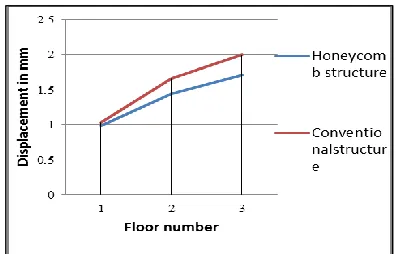
Fig. 6: shows the difference in maximum absolute displacement of the structures at each floor when subjected to earthquake force in negative x direction
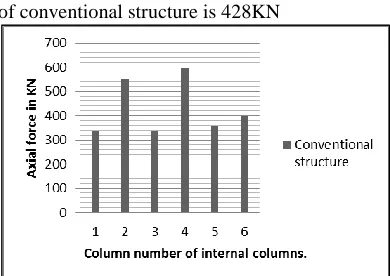
The average sum of axial forces in case of honey comb structure is 415 KN The average sum of axial forces in case of conventional structure is 428KN
Fig. 8: shows the maximum axial forces at internal columns of ground floor conventional structures
The sum of axial forces is 2582.267 KN
Fig. 9: Shows the difference in maximum vertical deflection in beam at 2nd floor in both the type of structures.
VI.
C
ONCLUSION1) From the observations it is found that the axial forces on external columns are reduced by 13KN in external columns. 2) The horizontal displacements in case of conventional structure are higher than in case of honey comb structure. 3) The inner column in case of conventional structure takes axial forces 2582.267 KN.
4) The deflection of beam in both the type of structure is within permissible limit as per IS 456:2000
5) The hexagrid that are used takes axial forces in the structure which reduce the quantity of concrete as no of columns are reduced.
6) The base shear in honey comb structure is found very less than in case of conventional structure. 7) The time period for both the structures is found to be nearly same.
8) Therefore, Cost effective structural systems such as honey comb structure can be used for construction of tall buildings which will save the cost.
9) As the dead weight of the honeycomb structure is reduced the moments as a result are reduced to a greater extent
10) The lighter is the structure the lighter is the earthquake force action on the structure and hence the honey comb structure is very effective method.
11) It also increases the aesthetic affect of the building.
12) The disasters due to major earthquakes can be reduced to a great extent.
13) Many structures are now a day’s mimicry of biological environment. Which are constructed across the world are very effective structural systems in every aspect. These should be adopted. And strengths should be given the outmost importance.
R
EFERENCES[1] Xue Yi Fu “Structural Design Of Sino Steel International Plaza”,2012.
[2] P. Askarinejad, “Beehive hexagrid new innovative structural system for tall structure”,2011 [3] M.Ali,” Structural Developments in Tall Buildings: Current Trends and Future Prospects”2007 [4] Ritesh A. Khire, “Study of a Honeycomb-Type Rigidified Inflatable Structure for Housing”2006 [5] Vivian Loftness “The Triple Bottom Line Benefits of Climate-Responsive Dynamic Facades”2014 [6] Tomohiko Yamashi “Innovative structural system of Japan” 2015