A trust‑aware task allocation method
using deep q‑learning for uncertain mobile
crowdsourcing
Yong Sun
1,2*and Wenan Tan
3Introduction
With the advancing technology of mobile devices with numerous built-in sensors, mobile crowdsourcing has recently emerged as a new collaboration paradigm in numerous intelligent mobile information systems [1]. The existing mobile crowd-sourcing has applications in numerous domains including urban planning, traffic monitoring, ride sharing, environmental monitoring and intelligent disaster response [2]. Mobile crowdsourcing is a combination of spatial crowdsourcing and smart phone technology that employs mobile workers to perform certain tasks in a specific
Abstract
Mobile crowdsourcing has emerged as a promising collaboration paradigm in which each spatial task requires a set of mobile workers in near vicinity to the target location. Considering the desired privacy of the participating mobile devices, trust is considered to be an important factor to enable effective collaboration in mobile crowdsourc-ing. The main impediment to the success of mobile crowdsourcing is the allocation of trustworthy mobile workers to nearby spatial tasks for collaboration. This process becomes substantially more challenging for large-scale online spatial task allocations in uncertain mobile crowdsourcing systems. The uncertainty can mislead the task allocation, resulting in performance degradation. Moreover, the large-scale nature of real-world crowdsourcing poses a considerable challenge to spatial task allocation in uncertain environments. To address the aforementioned challenges, first, an optimiza-tion problem of mobile crowdsourcing task allocaoptimiza-tion is formulated to maximize the trustworthiness of workers and minimize movement distance costs. Second, for the uncertain crowdsourcing scenario, a Markov decision process-based mobile crowd-sourcing model (MCMDP) is formulated to illustrate the dynamic trust-aware task allocation problem. Third, to solve large-scale MCMDP problems in a stable manner, this study proposes an improved deep Q-learning-based trust-aware task allocation (ImprovedDQL-TTA) algorithm that combines trust-aware task allocation and deep Q-learning as an improvement over the uncertain mobile crowdsourcing systems. Finally, experimental results illustrate that the ImprovedDQL-TTA algorithm can stably converge in a number of training iterations. Compared with the reference algorithm, our proposed algorithm achieves effective solutions on the experimental data sets. Keywords: Collaborative computing, Mobile crowdsourcing, Dynamic task allocation, Collaborative partners selection, Trust optimization
Open Access
© The Author(s) 2019. This article is distributed under the terms of the Creative Commons Attribution 4.0 International License (http://creat iveco mmons .org/licen ses/by/4.0/), which permits unrestricted use, distribution, and reproduction in any medium, provided you give appropriate credit to the original author(s) and the source, provide a link to the Creative Commons license, and indicate if changes were made.
RESEARCH
*Correspondence: [email protected]; [email protected] 1 Anhui Center
for Collaborative Innovation in Geographical Information Integration and Application, Chuzhou University, Chuzhou 239000, Anhui, China
location [3]. For example, in a disaster search and rescue scenario, the requester urgently needs to collect images and videos of search areas from different locations in a country [4]. The requester submits a query to a mobile crowdsourcing server. Then, the server allocates the spatial tasks to the available workers in the vicinity of the dis-aster location.
Geographic information plays a key factor in many aspects of mobile activities [5]. The goal of typical mobile crowdsourcing is to allocate multiple tasks to a team of suitable workers located within their time zone [6]. The required tasks of mobile crowdsourcing are considered with strong spatial proximity optimization [2]. For the above instance, it is important to rapidly respond to emergencies or disasters [3]. Mobile crowdsourcing systems must assign emergency tasks to workers who are in the vicinity to the target location. Most tasks must be accomplished within a set time, making it impossible for mobile workers to travel long distances to accomplish the required tasks [4].
Moreover, the success of mobile crowdsourcing relies heavily on the quality of location-related workers [7]. The existing crowdsourcing systems are dependent on mainly mobile workers to allocate tasks to themselves when logging on to the systems [8], and many spatial tasks may not be allocated to suitable workers [9]. The execu-tion quality of the crowdsourcing tasks suffers because the workers may be malicious participants [10–13]. The trustworthiness of mobile workers must be considered in the mobile crowdsourcing setting [12]. In this context, mobile crowdsourcing should consider both the trustworthiness and location of mobile workers. This paper focuses on the trust-aware task allocation (TTA) optimization problem of mobile crowd-sourcing systems.
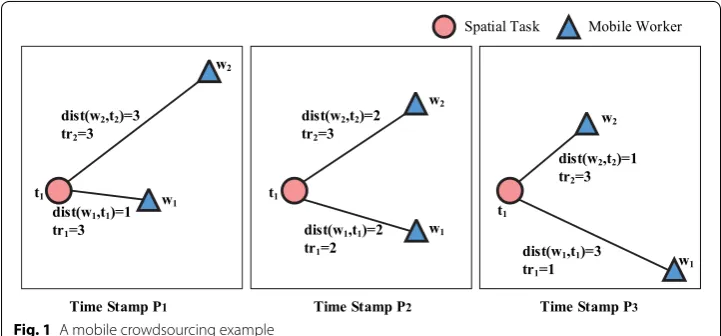
The objective of optimizing TTA is to maximize the trust score and minimize the distance cost of mobile crowdsourcing. In the real world, mobile crowdsourcing sys-tems are inherently dynamic, and the trust scores of mobile workers are unknown. The mobile crowdsourcing scenario in Fig. 1 has a location-based task ti(i=1) , shown in red circles, and two crowd workers wi(1≤i≤2) , shown as blue triangles. At the time stamp Pi(1≤i≤3) , worker wi and location-based tasks ti join the mobile crowd-sourcing system. Assume that spatial tasks t1) can be accomplished by w1 and w2 who
have some compensation traveling distance dist(wi,tj) and trust score tri , as described as Table 1. Based on our observation, at time stamp P1 , mobile worker w1 can be
rec-ommended to do the spatial tasks t1 because of the high trust scores and low travel
cost; by contrast, at time stamp P2 and P3 , mobile worker w2 may be selected for task t1.
As mentioned above, mobile workers frequently move to different locations, and trust scores for performing the required tasks are unstable in mobile crowdsourc-ing systems. Mobile crowdsourccrowdsourc-ing systems require optimization to be dynamic and adaptive to address this uncertainty [2]. However, mobile crowdsourcing emerged very recently and is typically considered to be a static environment in most exist-ing research [3–5]. Most of the current crowdsourcexist-ing approaches have vital draw-backs. Mathematical optimization algorithms, in which the evaluation parameters are considered to be certain and fully known in advance, are used to solve the allocation problems of static crowdsourcing systems [2, 6].
The advantage of mobile crowdsourcing is to enable a crowd of mobile workers to offer collaboration services, which enhances the efficiency of performing cooperative tasks while reducing the cost. Unfortunately, static approaches may fail when deal-ing with task allocations in uncertain mobile crowdsourcdeal-ing. TTA optimization algo-rithms should adapt to frequent changes in crowdsourcing systems. The inherently dynamic changes in mobile crowdsourcing systems are difficult to handle. An attempt has been made to design an adaptive learning algorithm to solve this uncertain prob-lem. In [6], Q-learning is employed for the dynamic task allocation of crowdsourcing systems. However, Q-learning has mainly been limited in applicability in address-ing only medium-sized optimization problems [14–16]. The majority of real-world TTA problems are fundamentally large-scale, and the crowdsourcing state space is extremely large because massive spatial tasks and mobile workers exist on mobile crowdsourcing systems. It is a considerable challenge to solve large-scale task alloca-tion in uncertain scenarios, which further highlights the need for designing innovative and highly effective learning algorithms to optimize the real-world TTA problems.
In summary, a dynamic TTA algorithm is needed to enhance the model perfor-mance by fully exploiting the potential advantage in uncertain mobile crowdsourc-ing systems. The difficulty lies in accurately modelcrowdsourc-ing the dynamic characteristic of task allocations and making better crowdsourcing decisions, with the aim of maxi-mizing the model performance over a long period of time. Specifically, the dynamic TTA optimization can be formulated as a Markov decision process (MDP) problem. The emerging deep Q-learning (DQL) algorithm shows distinct advantages for large-scale MDP problems and has been widely used in dynamic sequential decision mak-ing problems [17–20]. By combinmak-ing the advantages of both deep neural networks Table 1 A mobile crowdsourcing example
Time Crowdsourcing pair Trust Dist Crowdsourcing pair Trust Dist
P1 (w1,t1) 3 1 (w2,t1) 1 3
P2 (w1,t1) 2 2 (w2,t1) 2 2
and Q-learning, DQL is able to predict the next state and action in large-scale crowd-sourcing environments.
This paper investigates a practical and important problem, namely dynamic trust-aware task allocation, which aims to maximize the trust score and minimize the travel distance cost in uncertain crowdsourcing environments. This paper mainly focuses on addressing the uncertain large-scale task allocation in location-based mobile crowd-sourcing. Our proposed DQL-TTA algorithm can be directly extended to the scenario of large-scale task allocation in real-world mobile crowdsourcing. The principal contribu-tions of our work can be summarized as below:
• TTA optimization is formally defined in mobile crowdsourcing systems. For an uncertain scenario, dynamic TTA optimization is formalized as an MDP-based mobile crowdsourcing model (MCMDP). MCMDP comprises four core elements, including the crowdsourcing state, allocation action and immediate reward.
• We first study a Q-learning algorithm to optimize the dynamic allocations in mobile crowdsourcing. In addition, deep Q-learning-based trust-aware task allo-cation (DQL-TTA) is proposed to handle large-scale MCMDP optimization prob-lems, which are intractable in traditional Q-learning. Tabular Q-Learning is further advanced by deep neural networks to estimate the Q-value of the next crowdsourc-ing state in a practical manner. The DQL-TTA algorithm extends the TTA problems to dynamic optimization by combining the advantage of both deep Q-network and bi-objective trust optimization.
• To improve the overall performance DQL-TTA, this paper proposes an improved DQL-TTA (ImprovedDQL-TTA) algorithm to handle the large-scale MCMDP problems much more stably in real-world crowdsourcing scenarios. The novel deep neural network architecture with an action advantage function is integrated in ImprovedDQL-TTA, which performs better than the DQL-TTA algorithm in mobile crowdsourcing. The pivotal idea of ImprovedDQL-TTA is to design two estimators to separately learn the state value and action advantage functions with two streams of fully connected neural network layers. Additionally, the mini-batch stochastic gra-dient descent with advanced training mechanisms and an Epsilon-decreasing greedy policy are integrated into ImprovedDQL-TTA. In this context, ImprovedDQL-TTA can maintain good stability to solve large-scale trust-aware allocation problems in uncertain mobile crowdsourcing. Theoretical analysis is conducted to demonstrate the applicability of ImprovedDQL-TTA.
• The experimental results illustrate that the proposed ImprovedDQL-TTA algorithm can achieve greater effectiveness and stability in uncertain scenarios of large-scale mobile crowdsourcing systems.
proposed algorithm is discussed in "Experimental results and analysis" section, followed by conclusions.
Related work
Crowdsourcing is a newly emerging field that enables organizations or companies to make their requests on numerous intelligent web platforms [21], such as Amazon MTurk, Upwork, and Crowdflower [22]. Crowdsourcing has been widely applied to annotations [23], graph searching [24], data analysis [25], query processing [26], and
social-aware collaborations [27, 28]. In such applications, the required tasks can be
accomplished by online workers on basis of crowdsourcing techniques. However, these workers do not have to travel to the target locations to accomplish the required tasks. Unlike general crowdsourcing, location-based mobile crowdsourcing systems usually require mobile workers to move to the specified location to perform tasks.
Task allocation in location‑based mobile crowdsourcing
Mobile crowdsourcing entails a novel mechanism for tasks performed by mobile work-ers. Task allocation in the location-based mobile crowdsourcing has gained increasing attention in recent years [29, 30]. Location-based mobile crowdsourcing is a subclass of spatial crowdsourcing that allocates available mobile workers to spatial tasks on a mobile crowdsourcing system [2]. A task allocation framework was formally presented for the location-based mobile crowdsourcing [3]. Kazemi and Shahabi proposed a task assign-ment problem for spatial crowdsourcing [12]. They proposed a network-flow-based algorithm for handling the allocation problem. The goal of this framework is to maxi-mize the number of tasks matched with workers [31]. To extended this spatial allocation problem to the maximum score assignment problem for skills-based crowdsourcing [3]. To handle the large-scale query problem, Li et al. proposed R-Tree-based approximation algorithms for task allocation in mobile crowdsourcing [5]. Recently, an optimal task allocation problem was presented to address the quality constraints [29].
Considering the private participating mobile devices [8], Tran and To et al. proposed a real-time algorithm for spatial task allocation in server-assigned crowdsourcing [5]. This framework can be employed to protect the real locations of mobile workers and to max-imize the crowdsourcing success rates [10, 11]. Unlike private location-based queries, this study focuses on trust-aware task allocation in mobile crowdsourcing. The workers in crowdsourcing processing are not always trusted [13]; thus, another work by Kazemi aimed to address the optimization of trust in task allocation [12]. The trustworthiness of mobile workers must be considered in the mobile crowdsourcing setting [12]. The goal is to optimize spatial proximity and trustworthiness management in task allocation. For participatory mobile systems, trust evaluation is an effective mechanism to promote mobile system performance by identifying the trustworthiness of potential participants [13]. This process can formally be defined as processing spatial tasks for a crowd of trust-worthy mobile workers close to the target location.
Uncertain mobile crowdsourcing and deep reinforcement learning
that is fully known in advance [2]. Crowdsourcing is defined as a static problem, and the multiple quality objectives are invariant [2]. By contrast, in uncertain crowdsourcing sys-tems, all parameter values may change spontaneously [6]. Thus, Cheng et al. proposed a prediction-based allocation strategy to estimate the location and quality distributions of future workers and tasks for global optimal task allocation [32]. In comparison, our pro-posed method aims to maximize the reward utility on the basis of deep Q-learning algo-rithms by adapting the dynamic trust-aware allocation strategy to the uncertain mobile crowdsourcing environment.
Q-learning algorithms have been found to be more suitable for uncertain problems of crowdsourcing [2, 6]. A Q-Learning agent learns how to address uncertain decision-making problems with dynamic environments [14]. Since tabular-Q learning requires iterative updating to converge, an optimal policy is difficult to find in limited time [14–16]. To solve this problem, deep Q-networks algorithm was proposed by combin-ing Q-learncombin-ing with deep neural networks [17–20]. Van Hasselt, Guez and Silver pro-posed double DQN to address the overestimation of Q-learning [17]. Schaulman et al. designed a prioritized experience replay mechanism to enhance the efficiency of train-ing data [33]. Wang et al. proposed dueltrain-ing DQN to further improve the convergence speed [34]. The dueling DQN algorithm represents both the state value function and the related advantage function [35].
A Q-learning algorithm was adopted in our previous work to obtain the optimal allo-cation policy in uncertain crowdsourcing [6]. However, the Q-learning algorithm is limited by its slow convergence in the large crowdsourcing state and action space. To address this limitation, we propose a novel neural network with advanced deep Q-learn-ing algorithm. This algorithm extends the TTA optimization to dynamic crowdsourc-ing problems by means of a deep Q-learncrowdsourc-ing algorithm. Most importantly, we propose an improved adaptive optimization algorithm by combining TTA optimization and advanced deep Q-learning, which maintains great efficiency in solving large-scale TTA problems in uncertain mobile crowdsourcing.
Preliminaries and problem formulation
In this section, a trust-aware task allocation scenario is formally introduced to deal address challenges in unreliable mobile crowdsourcing environments.
Mobile crowdsourcing preliminaries
The basic concepts of mobile crowdsourcing systems [2, 3, 6] are formally defined as
follows.
Definition 1 (Spatial task) Denote a spatial task st as a tuple: st= �expir,loca,stype� . The textual property describes the task submitted by the requester. The location prop-erty loca denotes the location coordinates in relation to the required task. The expiry property expir is the specific time of task completion. The type property stype indicates the spatial task type.
time constraints, and the mobile workers must physically travel to the target location on time. Mobile workers are formulated as follows.
Definition 2 (Mobile worker) Denote a mobile worker as a tuple: cw= �hisinfo,exptype,loc� . The property hisinfo is a crowdsourcing data sequence that records the series of spatial tasks allocated to mobile worker cw. A mobile worker cwi has his own expertise exptype to be competent for a type stype of crowdsourcing task sti . The competence of worker cwt for task stt can be evaluated in terms of a quality score. The location loc represents the current location of the mobile worker.
A worker cwt is associated with the traveling cost dist(cwt,stj) , and dist(cwt,stj) is the traveling distance between cwt and stj . Accordingly, mobile workers cwt are recom-mended to perform spatial tasks stj if they are in the near vicinity of mobile worker cwt.
Definition 3 (Travel distance) Distance fdist(xij) specifies the travel cost in terms of the movement required to get from the location aloc of mobile worker cwj to the location bloc of spatial task sti . The distance may be computed on the basis of the Euclidean dis-tance metric.
where (alocx , alocy) and (blocx , blocy) are the coordinates of aloc and bloc.
In the optimization process, the algorithms wish to allocate workers cwt to spatial tasks tt with a minimum traveling cost so that the sum quality value of the allocation is maxi-mized and the total distance cost is minimaxi-mized [6]. However, in uncertain environments, numerous discrete events cause the execution failure of spatial tasks. Therefore, a trust-aware allocation optimization metric is required for solving the unreliable quality prob-lem of mobile crowdsourcing systems.
Trust assessment metric
The main impediment to the success of spatial task allocation is the issue of trust evalua-tion for mobile workers. To evaluate the trustworthiness of a mobile worker, we consider and evaluate two parameters: reputation and expertise. The calculation of each trust parameter is discussed first; then, the trust evaluation is explained in detail.
The reputation of a worker reflects the probability, calculated based on historical data, of completing a spatial task. In general, the reputation of mobile workers can be described with reference to their mobile worker IDs and trust parameters. The reputa-tion metric of a worker is formally represented by definireputa-tion 4.
Definition 4 (Worker reputation) The reputation of a mobile worker is denoted as wqos= �idcw,rep� , where idcw represents the mobile worker ID and rep is the reputa-tion value of the mobile worker. rept denotes the reputation attribute of the i-th mobile worker cw. The i-th mobile worker is determined by observation of whether the previous
(1) fdist(xij)=
interactions among mobile workers result in successful task execution. The observation is often described by two variables: ni , denoting the number of successful interactions, and Ni , denoting the total number of interactions for the i-th mobile worker. The trust value can be calculated as:
where the trust value of a service is initialized to 1/2.
Definition 5 (Worker expertise) Denote expertise as the knowledge estimation of a mobile worker, which is especially important for spatial tasks that require particular knowledge, such as geomatics skills and familiarity with geographical information sci-ence. Denote the matching between the i-th mobile worker’s skills and j-th task require-ments by Eij . Suppose that Ejta is the requirements for the i-th task and that Ecwi is the collection of expertise of mobile worker cwt ; then,
where the trust value of a service is initialized to 1/2.
All the trust parameters are combined into a single value for computing the trust score of the mobile worker.
where wrep and wexp are the weights of each crowdsourcing parameter, wrep+wexp=1.
In reality, task allocation is not a static decision process, as spatial tasks and mobile work-ers interact dynamically with the system. The allocation decision process is conducted iter-atively, and each iteration involves allocating spatial tasks to trustworthy mobile workers in uncertain scenarios.
Weighting TTA approach with normalization
TTA problems focus not only on trust management [36] but also spatial optimization. The aim of a crowdsourcing problem is to match tasks and mobile workers such that the trust score is maximized and the allocation distance is minimized. The objective func-tions of TTA are normalized between 0 and 1, and the bi-objective allocation optimiza-tion problem is formulated as follows:
(2) rept= ni+1
Ni+2
(3) Eij= |E
ta i ∩Ejcw|
|Etai |
(4)
ftr(xji)=wrep·rept+wexp·Eij
(5) minimize:
m
i=1 n
j=1 2
k=1
for 2
k=1wk =1,wt>0 . The minimum travel cost maximum trust-aware allocation optimization is changed to a weighted sum single objective problem with the max-min operator [36], where zkU is the minimum value of the k-th objective and zkN is the maxi-mum value of the k-th objective; and all objective function fk(x) and X=(x1,1, ...,xm,n) is the matrix of decision variables. To solve this problem, a trust-distance weighted func-tion is defined as an integrated optimizafunc-tion of trust scores and allocafunc-tion distance costs. Owing to the dynamic nature of uncertain crowdsourcing scenarios, the trust values of mobile workers and tasks cannot be known in advance. In addition, many workers may be unavailable on the mobile crowdsourcing system at run time.
Trust‑aware task allocation with deep Q‑learning
The majority of TTA optimization approaches require prior knowledge, but such approaches are not applicable in dynamic mobile crowdsourcing environments, where the availability of mobile workers is subject to frequent and unpredictable changes [2, 6]. Let us consider the submission of spatial tasks from requesters through a mobile crowdsourcing system, whereby spatial tasks are reached in an online manner. In such a scenario, the mobile crowdsourcing system possesses no prior information regard-ing spatial tasks and mobile workers.
The crowdsourcing TTA optimization problem is modeled as a Markov decision process-based mobile crowdsourcing (MCMDP) problem. Deep Q-learning is intro-duced to address the MCMDP problem. Furthermore, we propose an improved deep Q-learning-based trust-aware task allocation (ImprovedDQL-TTA) algorithm by combining trust crowdsourcing optimization and deep Q-learning, which enables the learning agent to solve large-scale MCMDP problems in an uncertain scenario.
MDP model for uncertain mobile crowdsourcing
To address the dynamic problems of uncertain crowdsourcing TTA, a Markov deci-sion process is adopted. The Markov decideci-sion process, a machine learning model, is a typical intelligence framework for modeling sequential decision-making problems under uncertainty [15]. In this paper, the MDP is applied to demonstrate the trust-aware task allocations and adaptation processes schematically in uncertain mobile crowdsourcing.
A mobile crowdsourcing MDP consists of a five-tuple = �S,A,P,R,O� , where S is a state space composed of a finite set of crowdsourcing states, A is a crowdsourcing action space composed of a finite set of actions, P is the transition function for reaching the
(6) subject to:
m
j=1
xji=1, i=1, ...,n
n
i=1
xji=1, j=1, ...,m
next crowdsourcing state s′ from state s when an action a∈A(s) is performed by a
crowdsourcing agent, R is a real crowdsourcing valued reward function, where the agent receives an immediate reward r=R(s′|s,a) , and O is the crowdsourcing observation
space in which the agent can fully observe the mobile crowdsourcing decision environ-ment. On this basis, the mobile crowdsourcing MDP can be defined as follows.
Definition 6 (Mobile Crowdsourcing MDP (MCMDP)) A MCMDP is formally defined as a seven-tuple: MCMDP= �Si,si0,sir,Ai,Pi,Ri,Oi� , where:
– Si is the set of tasks in the state space of a particular crowdsourcing partially observed by agent i.
– si0∈S is the initial task and any execution of the mobile crowdsourcing beginning from this task.
– si
r ∈S represents the terminal task. When arriving at the terminal task, an execution of mobile crowdsourcing is terminated.
– Ai is the set of mobile workers that can perform tasks s∈Si , and mobile worker cw
belongs to Ai only if the precondition is satisfied by s.
– P is a probability value, that is, a transition distribution P(s′|s,a) that determines the probability of reaching the next state s′ from state s if action a∈A(s) is fulfilled by a crowdsourcing agent. The probability distribution P(s′|s,a) can be defined as
– Ri is the reward function when mobile worker cw∈Ai is invoked, agent i transits from s to s′ , and the learning agent obtains an immediate reward ri . The expected value is Ri(s′|s,ws) . Consider selecting mobile worker cw with multiple quality crite-ria, where agent i receives the following quality vector as a reward:
where each fk(·) denotes a quality attribute of mobile worker cw.
– O is the crowdsourcing observation space in which the agent can fully observe the mobile crowdsourcing decision environment.
The MCMDP solution is a collection of TTA decision policies, each of which can be described as a procedure of trust-aware task allocation cw∈A by agent i in each state s. These policies, denoted as π , actually map spatial tasks to mobile workers, defined as
π=S→A . The MCMDP policy can be defined as a mobile crowdsourcing model. The
main idea is to identify the optimal policy for trust-aware allocation in uncertain mobile crowdsourcing.
Deep Q‑learning‑based trust‑aware task allocation algorithm
The above section analyzed the optimization problem of trust aware allocation by means of the MCMDP model. The optimization objective is to maximize the long-term rewards (7)
s′∈S
P(s′|s,a)=1,∀s∈S,∀a∈A.
of the MCMDP. The solution of the MCMDP can be denoted as a policy π that guides a learning agent to take the right action for the specific crowdsourcing state.
Dynamic task allocation with Q‑Learning
The uncertain mobile crowdsourcing problem can be formulated as an MCMDP model. However, the transition probabilities are not known, and we do not initially know the rewards of taking the allocation action. In this case, Q-learning is suggested for a crowdsourcing agent to determine the optimal policy. Q-learning is a temporal difference learning algorithm [14, 15] that takes into account the fact that the agent initially has only partial knowledge of the crowdsourcing MCMDP. In general, assume that an agent learns from experience to address uncertain mobile crowdsourcing. The agent can obtain a set of state-action rewards �s1,a1,r1,s2,a2,r2,· · · ,st,at,rt� , which indicates that the agent was in state st , selected action at , and obtained reward rt . Figure 2 illustrates the sequence of the crowdsourcing state and state-action reward pairs.
Temporal difference learning agents determine the increment to V(st) in each time
step. At time t, the agents immediately create an update by using discount rewards
and computing V(st) . Temporal difference learning [15] can defined as
The goal of temporal difference learning agents is to update V(st) by R(st)+γ ·V(st) in each step. Tabular Q-learning is a common approach in temporal difference learn-ing for maximizlearn-ing total rewards. For each state s and action a, the tabular Q-learning algorithm takes an action, observes a reward r, enters a next state s′ , and updates Q(s, a). The key of the Q-learning algorithm is a straightforward value Q(s, a) iteration update. Q(s, a) is accumulated for the current estimate of Qπ in each training iteration. The learning table values of Q(s, a) are revised by the following function:
The learning rate α∈ [0, 1] indicates the extent to which the existing estimation of
Qπ(s,a) contributes to the next estimation. The Q(s, a) values ultimately converge to the optimum value Q∗(s,a) [15]. Thus, the Q-learning-based allocation algorithm ultimately
discovers an optimal policy for any finite MCMDP [6]. The basic optimization involves incorporating both the travel distance and the trust score of mobile workers into the dynamic mobile crowdsourcing decisions. Thus, the reward function of Q Learning-based TTA is defined as in Definition 7.
(9)
V(st)=V(st−1)+α·rt+γ ·V(st)−V(st−1).
(10) Qπ(s,a)=(1−α)·Q(s,a)+α·r+γ ·max
a′ Q(s ′,
a′)
Definition 7 (Reward function) Suppose that a mobile worker completing a task can be estimated by a trust score ftr(xij)=tr(x
j
i) . Each mobile worker is required to move from location aloc to bloc when completing the spatial task, which incurs a distance cost fdist(xij) . The distance cost is evaluated in terms of the distance fdist(xji)=dist(aloc,bloc) between aloc and bloc. As a result, the reward function is determined with QoS vectors [ftr(xji),fdist(xji)] . Owing to the different scale of each QoS objective, the QoS value is mapped into the interval [0, 1]. With the min-max operator, the learning reward function adopts the linearly weighted sum approach to calculate the value of all QoS objectives:
In the training iterations, the learning agent estimates its optimal policy by maximizing the total of received crowdsourcing rewards in the uncertain scenario.
Dynamic task allocation with deep Q‑learning
Tabular Q-learning is not a feasible solution owing to the large-scale state and action spaces in uncertain mobile crowdsourcing systems. Moreover, a Q-learning table is environment-specific and not generalized. In large-scale uncertain systems, there are too many states and actions to store in machine memory, and learning the value of each state is a slow process. This section introduces a new and highly effective Q-Learning-based task allocation mechanism.
To adapt to changes in large-scale mobile crowdsourcing systems, we propose a deep Q-learning-based trust-aware task allocation (DQL-TTA) algorithm that is a combi-nation of advances in deep neural network and Q-learning techniques. Specifically, the dynamic TTA problem is formalized as a Markov decision process-based mobile crowdsourcing model. The experience of a crowdsourcing state transition is denoted as s,a,r,s′ , and a set of crowdsourcing states and allocation actions with a transition policy constitute an MCMDP. One episode of an MCMDP forms a limited sequence of crowd-sourcing states, allocation actions and rewards:
where st denotes the current state, at denotes the current action, rt denotes the reward after performing an action, and st+1 denotes the next state in the dynamic mobile crowd-sourcing system.
The DQL-TTA algorithm directly combines a deep neural network and Q-Learning to solve the dynamic trust-aware allocation problem. The DQL-TTA learning algo-rithm uses a value iteration approach, in which the crowdsourcing value function Q=Q(s,a;θ ) is a parameterized function with parameter θ that takes crowdsourcing state S and crowdsourcing action space A as inputs and returns a crowdsourcing Q value
for each action a∈A . Then, we can use a greedy approach to select a crowdsourcing
action:
(11) r=
2
k=1
wk·(fk(xji)−zkU)/(zkN−zkU)
(12)
s0,a0,r0,S1,a1,r1,s2, ...,st,at,st+1, ...,sn−1,an−1,rn−1,sn
DQL-TTA iteratively solves the mobile crowdsourcing MDP problem by learn-ing the weights of the deep neural network towards the optimization objec-tive. The DQL-TTA algorithm differs from Q-Learning in two ways. Traditional Q-Learning is based on the Bellman equation, and the Q value is iteratively updated: Qt+1(s,a)=E[r+γ ·maxa′Qt(s′,a′)|s,a] . Q-Learning algorithms with value iterations are impractical for large-scale crowdsourcing problems. Thus, it is practical to employ a dynamic crowdsourcing function approximation to assess the action value function Q(s,a;θ )≈Q∗(s,a) , which is a typical function approximation.
DQL-TTA is designed as a function approximation with weight θ for the mobile
crowdsourcing MDP problem. The parameters of the DQL-TTA function approxima-tion can be learned by minimizing loss funcapproxima-tion L(θt) , which is optimized at iteration i
where yt is the target value for iteration i and can be computed as
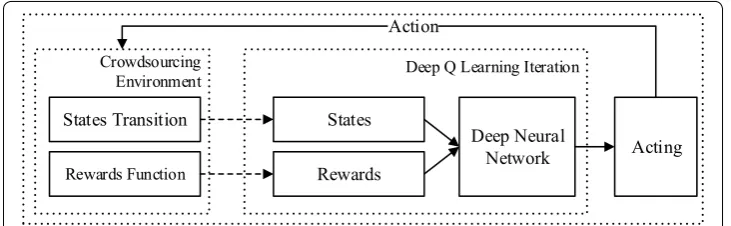
DQL-TTA considers the crowdsourcing states and allocation actions as the inputs of a deep Q-network and outputs the Q-value for dynamic allocations. Figure 3 illustrates the deep Q-learning-based trust-aware task allocation (DQL-TTA) algorithm framework.
Dynamic task allocation with improved deep Q‑learning
As discussed in [17, 33–35], the performance of deep Q-learning algorithms may not to be stable. To improve the overall performance of DQL-TTA, an improved DQL-TTA algorithm (ImprovedDQL-TTA) is further proposed to handle large-scale MCMDP prob-lems much more stably in uncertain mobile crowdsourcing environments. Our proposed ImprovedDQL-TTA algorithm has been improved with the following important nisms: (i) mini-batch stochastic gradient descent approach with advanced training mecha-nisms; (ii) Epsilon-decreasing greedy policy; iii) a novel deep neural network architecture with an action advantage function.
Mini-batch stochastic gradient descent The parameters of ImprovedDQL-TTA from an earlier training iteration θt−1 are fixed while optimizing the loss function L(θt) . Note that the targets rely on the ImprovedDQL-TTA weight parameters. A local minimum of the loss function by the gradient is obtained as follows,
(14) L(θt)=Eπ
yt−Q(s,a;θt)
2
(15) yt=
rt, if A(s′)=∅
rt+γ ·maxa′Q(s′,a′;θt−1), else
Instead of calculating the full expectation in the above gradient, the loss function of the ImprovedDQL-TTA is computationally optimized by stochastic gradient descent [17]. The weights of the ImprovedDQL-TTA approximation are trained using a gradient descent rule, and the parameter θ can be updated using stochastic gradient descent by
Stochastic gradient descent is simple and appealing for DQL-TTA; however, it is not sample efficient. In this paper, mini-batch stochastic gradient descent learning is there-fore proposed to discover the optimal fitting value function of ImprovedDQL-TTA by training on mini-batch crowdsourcing data. Instead of making decisions based solely on the current allocation experience, the allocation experience replay helps the ImprovedDQL-TTA network to learn from several mini-batches of crowdsourc-ing data. Each of these allocation experiences is stored as a four-dimensional vector of state,action,reward,nextstate . During training iteration t, allocation experience
et=(st,at,rt,st+1) is stored into a replay tuple D= {e1, ...,et} . The memory buffer of the allocation experience replay is fixed, and as new allocation experience are inserted, pre-vious experience are removed [19]. To train the ImprovedDQL-TTA neural networks, uniform mini-batches of experiences are extracted randomly from the allocation mem-ory buffer.
To obtain stable Q-values, a separate target network is used to estimate the loss function after every training iterations; another neural network, whose weights are changed gradually compared to the primary Q-network, is also used [35]. In this con-text, the ImprovedDQL-TTA algorithm learns to optimize two separate neural networks Q(s,a;θ ) and Q(s,a; ˆθ ) with current learning parameters θ and previous learning param-eters θˆ . θ are updated numerous times during the training iterations and are cloned to the previous parameters θˆ after NUMtraining iterations.
ImprovedDQL-TTA is refreshed with a batch of collected samples in the experience replay buffer by means of mini-batch stochastic gradient descent at each decision epoch.
Theorem 1 (The convergence analysis of mini-batch stochastic gradient descent) Assume that there are two constants A and B that satisfy E[�▽hb(θ )�2] ≤A and
E[�θ∗−θt�2] ≤B , wheretdenotes the gradient optimization iteration and
(16) ∆θt= −
1
2η·▽θ(L(θt))
=η·Eπ
r+γ ·maxa′Q(s′,a′;θt−1)−Q(s,a;θt)
·▽θQ(s,a;θt)
(17) ∆θt=η·
r+γ ·maxa′Q(s′,a′;θt−1)−Q(s,a;θt)·▽θQ(s,a;θt)
θt=θt−η·∆θt
(18) θt=θt−ηt·
1
b k+b
t=k
Let hmin(θ )=min{h(θ1),h(θ2),· · ·,h(θt)} and assume that
When the optimization of the mini-batch approach reaches t+1 iterations, then
According to the conditional expectation of mathematics, we can obtain
Taking the expectation of θt in Equation (22) yields
Accordingly,
Since E[�θt+1−θ∗�2] ≥0 , we obtain
Since E[�θt−θ∗�2] ≤
B , we obtain
and
Since ∞
t=0ηt= ∞ , it is clear that hmin(θ )→h(θ∗).
Therefore, it can be concluded that ImprovedDQL-TTA with mini-batch stochastic gradient descent converges to h(θ∗).
ǫ-decreasing greedy policy The ImprovedDQL-TTA algorithm selects the allocation action a with the maximum Q value by exploiting the knowledge found by the current (19)
▽hb(θ )= 1
b
k+b
t=k ∆θt
(20)
1> ηt>0, ∞
t=0
ηt2<∞,
∞
t=0
ηt= ∞
(21) �θt+1−θ∗�2= �θt−ηt·▽hb(θ )−θ∗�2
= �θt−θ∗�2−2ηt·▽hb(θ )·(θt−θ∗)+η2t · �▽hb(θ )�2
(22) E[�θt+1−θ∗�2|θt] =E[�θt−θ∗�2|θt] −2ηt·E[▽hb(θ )·(θt−θ∗)|θt]+
η2t ·E[�▽hb(θ )�2|θt]
≤ �θt−θ∗�2−2ηt·(h(θt)−h(θ∗))+η2t ·A
2
(23) E[�θt+1−θ∗�2] =E[�θt−θ∗�2] −2ηt·E[h(θt)−h(θ∗)] +ηt2·A
2
(24) E[�θt+1−θ∗�2] ≤E[�θt−θ∗�2] −2
t
ηt·E[h(θt)−h(θ∗)] +A2·
t
η2t
(25) E[�θt+1−θ∗�2] +A2
t
ηt2≥2
t
ηt·E[h(θt)−h(θ∗)]
≥2
t
ηt·E[hmin(θt)−h(θ∗)]
(26)
B+A2 t
η2t ≥2
t
ηt·E[hmin(θt)−h(θ∗)]
(27) E[hmin(θt)−h(θ∗)] ≤
B+A2 tηt2
2
s. To build a better estimate of the optimal ImprovedDQL-TTA function, the
algo-rithm should explore and select a different allocation action from the current best
allocation. In this paper, the ǫ-greedy policy is employed to select a random allocation action ǫ at one time ( 0≤ǫ≤1 ) and to select the optimal allocation action by
maxi-mizing its Q value at the other time [15]. By means of this strategy,
ImprovedDQL-TTA can achieve a trade off between exploration and exploitation in uncertain mobile crowdsourcing systems. The ǫ-greedy policy can be illustrated as follows
where actnum denotes the total number of available allocation actions.
Theorem 2 (ǫ-greedy policy improvement) For anyǫ-greedy policyπ , theǫ-greedy
pol-icyπ′with respect toqπis an improvement,vπ′(s)≥vπ(s).
Therefore, the ǫ-greedy policy is an improvement, vπ′(s)≥vπ(s).
To maintain a good balance of exploration and exploitation, a suitable learning parameter should be selected for the ǫ-greedy strategy. In the early training time, a more random policy should be used to encourage initial exploration, and as train-ing time progresses, a more greedy policy should be considered. The traintrain-ing
perfor-mance of ImprovedDQL-TTA can be improved by using an ǫ-greedy parameter that
changes during training, which is defined as following.
where ǫi is the initial value of ǫ , ǫf is the final value of ǫ , and explore is the total number of training steps.
Novel neural network architecture with action advantage function To further improve the convergence stability, a novel deep network architecture is integrated into ImprovedDQL-TTA for learning the crowdsourcing decision process with an action advantage function [33–35]. The key idea of this mechanism is to design a novel neural network with two sequences of fully connected layers. In this way, the state values and the action advantage are separately learned by the novel Improved-DQL-TTA neural network. Figure 4 illustrates the novel neural network architecture.
(28) π(a|s)=
ǫ
actnum+1−ǫ, if a∗=argmaxa∈AQ(s,a) ǫ
actnum, otherwise
(29)
qπ(s,π′(s))=
a∈A
π′(a|s)qπ(s,a)
= ǫ
actnum
a∈A
qπ(s,a)+(1−ǫ)maxa∈Aqπ(s,a)
≥ ǫ
actnum
a∈A
qπ(s,a)+(1−ǫ)
a∈A
π(a|s)−ǫ/actnum
1−ǫ qπ(s,a)
=
a∈A
π(a|s)qπ(s,a)
=vπ(s)
(30)
For a stochastic policy π , Qπ(s,a) and Vπ(s) can be formulated as
The action advantage function can be defined as
Note that E[Gπ(s,a)] =0 . Intuitively, the Vπ(s) function calculates the value of a par-ticular state s, and Qπ(s,a) evaluates the value of selection action a in state s and then combines the results to estimate the crowdsourcing action value. Based on this defini-tion, the evaluation of the relative importance of the each crowdsourcing action can be obtained from the action advantage function Gπ(s,a).
To estimate the values of V and G functions, ImprovedDQL-TTA is implemented
with a novel neural network, where two streams of fully connected layers output vec-tor V(a;β) and vector G(s,a;α) . ImprovedDQL-TTA combines Vπ(s) and Gπ(s,a) to obtain Qπ(s,a) , as follows
and
where α and β are parameters of the two sequences of novel neural network
lay-ers. The action advantage function has zero advantage in selecting an action. For a∗=argmaxa∈AQ(s,a;α,β)=argmaxa∈AG(s,a;α), the function obtains
(31) Qπ(s,a)=E[Rt|st=s,at=a,π]
Vπ(s)=Ea∼π(s)[Qπ(s,a)]
(32)
Gπ(s,a)=Qπ(s,a)−Vπ(s)
(33)
Q(s,a;θ,α,β)=V(s;θ,β)+G(s,a;θ,α)
(34)
Q(s,a;θ,α,β)=V(s;θ,β)+
G(s,a;θ,α)−maxG(s,a;θ,α)
Q(s,a∗;α,β)=V(s;β) . Furthermore, for better stability, an alternative module of ImprovedDQL-TTA replaces the max operator with an average operator
ImprovedDQL-TTA is an intelligent algorithm for addressing sequential decision-mak-ing problems of mobile crowdsourcdecision-mak-ing systems. ImprovedDQL-TTA is implemented with mini-batch stochastic gradient descent, ǫ-decreasing greedy policy, and a novel net-work architecture with an action advantage function. To intelligently develop an appro-priate strategy, ImprovedDQL-TTA is built with a multiple-layer network that takes the crowdsourcing state encoded in a [1×statenum] vector and learns the best action
(mobile workers), mapping all possible actions in a vector of length actnum. In
sum-mary, the pseudo code for improved deep Q-learning-based trust-aware task allocation is illustrated in Algorithm 1.
(35) Q(s,a;θ,α,β)=V(s;θ,β)+
G(s,a;θ,α)− 1 |A|
a
G(s,a;θ,α)
ImprovedDQL-TTA is able to effectively identify an optimal solution for the large-scale MCMDP. ImprovedDQL-TTA operates by learning to optimize the expected reward of selecting an action for a given state and discovering the optimal action-selec-tion policy to stably adapt to changes in a large-scale environment.
Experimental results and analysis
The prototype applications were programmed on the JetBrains PyCharm Commu-nity platform. All the algorithms were implemented in Python 3.5 programming lan-guage, and the experiments were run on 64 bit windows 10 with an Intel(R) Core(TM) i5-7300HQ@2, 50 GHz, 16 GB of RAM, and 500 GB disk storage. The performance of the proposed ImprovedDQL-TTA algorithm was compared to the reference algorithms. A series of experiments were performed on synthetic data from the real world. In this section, computer simulations are conducted to illustrate the performance of the pro-posed ImprovedDQL-TTA algorithm in mobile crowdsourcing systems. We first pre-sent the experimental setting; then, the performance under different scenarios simulated and analyzed. Finally, the convergence of the proposed ImprovedDQL-TTA algorithm is illustrated.
Experimental setting
Existing research has addressed spatial task allocation by simulating mobile crowdsourc-ing environments by means of experimental data sets. Data sets from location-based social networks have been used to evaluate dynamic crowdsourcing algorithms. A simi-lar approach is followed here to evaluate the performance of the proposed algorithm. The experimental data set is presented and evaluated in the following subsections.
The synthetic data set consists of real-world data obtained from Gowalla, a popular location-based social network. Gowalla was selected as our experimental data set for evaluating ImprovedDQL-TTA, and San Francisco was chosen as the experimental region, within the boundary [37.709, 37.839,−122.373,−122.503] . The Gowalla data set includes check-ins by a large number of users at numerous locations in San Fran-cisco. The data set comprises 1,083 persons, 38,333 locations, and 227,428 check-ins. For synthetic experimentation purposes, the task and worker locations were randomly ini-tialized with latitude∼µ(37.71, 37.83) and longitude∼µ(−122.37,−122.50) . Table 2 summarizes both data sets used for the data-driven initialization [6].
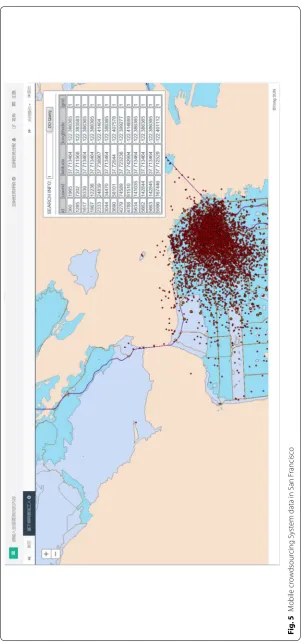
Figure 5 illustrates the geographical map and its data table for mobile crowdsourcing systems in San Francisco.
The synthetic data were used to study the proposed algorithm. Users in the Gowalla data set are regarded as mobile workers, and the locations and check-ins are initialized Table 2 Parameter settings for the synthetic data set
Synthetic data set Gowalla data set
Latitude∼µ(37.71, 37.83) , longitude∼µ(−122.37,−122.50) 38,333 task locations
1000 mobile workers 1083 users
Fig
. 5
M
obile cr
ow
dsour
cing Syst
em data in San F
in relation to the mobile users. Mobile crowdsourcing requesters are randomly gen-erated by sampling Gowalla check-ins [6]. To evaluate the scalability of our proposed ImprovedDQL-TTA, the mobile crowdsourcing parameters are set as in Table 3.
Furthermore, the trustworthiness of mobile workers is evaluated in terms of their trust value trj , sampled from the parameterized uniform distribution, that is,
trj∼µ(trmin,trmax) . For workers, the qualities of the tasks are also randomly generated from a uniform distribution, that is, swi,j ∼µ(trj, 0.1) . We set the mobile worker trust parameters as tr, and the trust score range is [0.5, 1], [1, 2], [2, 3], [3, 4], [4, 4.5). To sat-isfy the experimental requirements, we evaluate our proposed ImprovedDQL-TTA algo-rithm on synthetic and real-world data sets. The quality data for each mobile worker are simulated in the MCMDP model with a random vector. The parameters of the quality vector are obtained from a Gaussian distribution. Figure 6 illustrates the quality distri-bution of mobile workers.
Table 3 Mobile crowdsourcing settings for scalability evaluation
Setting content Setting values
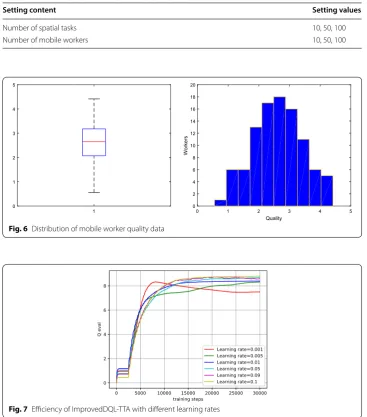
Number of spatial tasks 10, 50, 100
Number of mobile workers 10, 50, 100
Fig. 6 Distribution of mobile worker quality data
With the purpose of solving dynamic decision problems in uncertain mobile crowd-sourcing, the ImprovedDQL-TTA algorithm iteratively runs until convergence. As the trust score and travel distance of mobile workers are dynamic, the trust and distance values of 10% of the mobile workers are regenerated periodically every 30,000 episodes.
Algorithm parameter study
The parameters of the algorithm are defined for our experiments to ensure high-qual-ity crowdsourcing solutions, and the number of iterations is set to 30,000. This section
discusses two core parameters of ImprovedDQL-TTA: the learning rate α and ǫ-greedy
rate. The following experiments investigate the two learning parameters.
Experiment 1: ImprovedDQL-TTA learning rate evaluation. To improve the learn-ing efficiency of the proposed algorithm, a suitable learnlearn-ing rate must be seleted. This experiment varies the learning rate η to investigate the learning efficiency. As shown
in Fig. 7, when η=0.001 , the Q value continues its downward trend after
approxi-mately 20000 iterations, which indicates that the learning with this parameter set-ting is inefficient; when η=0.005 , the Q value are continue their upward trend after approximately 30,000 iterations, which indicates η=0.005 results in inefficient learn-ing; when η=0.09 , the Q values reach to a maximum after approximately 15,000 iter-ations, but the learning value is not stable; when alpha=0.1, the Q values rapidly reach to the maximum after around 15,000 iterations, and the final Q values with η=0.1 is higher than the that of the other η settings.
Experiment 2: ImprovedDQL-TTA ǫ-greedy rate evaluation. In this experiment, the number of spatial tasks is set to 50, the number of candidate mobile workers is set to 50, and the greedy rate ǫ is varied. To investigate the impact of the greedy rate on
the proposed ImprovedDQL-TTA algorithm, the final epsilon parameter of ǫ-greedy
Fig. 8 Efficiency of ImprovedDQL-TTA with different greedy rate
Table 4 Learning parameter settings
Setting content Setting parameter Setting value
Learning rate η 0.1
Initial epsilon value ǫi 0.9
is varied in [0.01, 0.05, 0.1, 0.5]. Figure 8 illustrates the average cumulative rewards
with different final ǫ values. From the results, we can make an observation that the
learning quality with ǫf =0.01 is higher than other ǫf settings.
In the ImprovedDQL-TTA algorithm, the learning rate η is defined as 0.1, the initial ǫ -greedy value is defined as 0.9, and the final ǫ-greedy value is defined as 0.01 as shown in Table 4.
ImprovedDQL‑TTA performance study
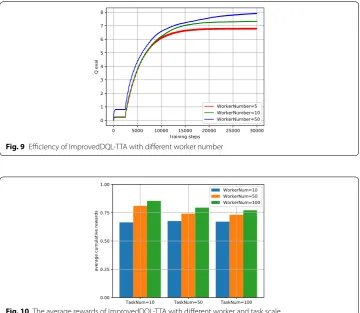
Experiment 3: Learning efficiency with different numbers of worker. As illustrated in Fig. 9, the Q value performance is evaluated with respect to the number of mobile workers. The number of mobile workers is varied in [5, 10, 50], and the spatial task num-ber is set to 50.
Figure 9 shows that the Q values increase with increasing number of mobile workers because a greater number of mobile workers increases the chances of selecting better workers.
Experiment 4: Average rewards with different worker and task scales. As illustrated in Fig. 10, the average cumulative reward performance is estimated with respect to the number of mobile workers. The number of mobile workers varies in [10, 50, 100], and the number of spatial tasks is varied in [10, 50, 100].
Fig. 9 Efficiency of ImprovedDQL-TTA with different worker number
Figure 10 illustrates that the average cumulative rewards increase with increasing number of candidate mobile workers because a greater number of workers increases the chances of selecting higher-quality workers by using ImprovedDQL-TTA.
Experiment 5: Comparison of DQL-TTA and ImprovedDQL-TTA. The mobile crowdsourcing scale is denoted by the number of spatial tasks. The experimental num-ber of mobile workers is set to 50, and the numnum-ber of required spatial tasks are set to [10, 50, 100]. The experiment creates 10×50 , 50×50 , and 100×50 task-and-worker pairs matrix for comparing the proposed algorithm ImprovedDQL-TTA and DQL-TTA. The x-axes indicates the training steps.
Evaluation of Q values: The proposed ImprovedDQL-TTA algorithm is run in this
setting and the Q values are compared with those of DQL-TTA. Figure 11 shows the
Q value results for the proposed ImprovedDQL-TTA algorithm with DQL-TTA
algo-rithm. The ImprovedDQL-TTA algorithm consistently produces higher Q values than
the DQL-TTA algorithm after approximately 15,000 iterations.
Evaluation of training loss cost: The proposed ImprovedDQL-TTA algorithm is run in this setting and the training lost costs are compared with those of DQL-TTA. Figure 12 illustrates the loss function cost results of the proposed ImprovedDQL-TTA algorithm and DQL-TTA algorithm. The two algorithms converge within the certain number of
Fig. 11 Learning Q value evaluation of ImprovedDQL-TTA and DQL-TTA
Fig. 12 Learning loss evaluation of ImprovedDQL-TTA and DQL-TTA
training steps. Therefore, the learning accuracies of ImprovedDQL-TTA gradually improves as training progresses.
Evaluation of the average accumulated reward: The proposed ImprovedDQL-TTA algorithm is run in the setting of experiment 5 and the average accumulated reward is
compared with that of DQL-TTA. Figure 13 illustrates the average accumulated award
results of the proposed ImprovedDQL-TTA algorithm and DQL-TTA algorithm. The ImprovedDQL-TTA algorithm consistently leads to higher rewards than the DQL-TTA algorithm during the training, which indicates the proposed ImprovedDQL-TTA algo-rithm produces a better allocating solution in uncertain mobile crowdsourcing systems.
Efficiency evaluation of ImprovedDQL-TTA: We compare our proposed Improved-DQL-TTA algorithm to Improved-DQL-TTA in terms of run-time performance. According to the experimental requirements, the number of spatial tasks is set to 50, and the number of available mobile workers is varied in [10, 50, 100]. The proposed ImprovedDQL-TTA algorithm is run in this setting. Figure 14 illustrates the run-time performance of the proposed ImprovedDQL-TTA algorithm in comparison to that of DQL-TTA when varying the number of mobile worker. The blue bar describes the average run-time of the ImprovedDQL-TTA with different mobile worker scales. As illustrated in the figure, ImprovedDQL-TTA is more efficient than the DQL-TTA algorithm in terms of calcula-tion time.
The above experiments illustrate the performance of the proposed
ImprovedDQL-TTA in terms of Q value, loss cost, average accumulated reward and run time. The
experimental results on the data sets of uncertain mobile crowdsourcing illustrated that ImprovedDQL-TTA algorithm outperformed DQL-TTA algorithm. Therefore, our proposed ImprovedDQL-TTA produces better solutions than DQL-TTA. Moreover, ImprovedDQL-TTA is much more stable when solving large-scale MCMDP problems of uncertain mobile crowdsourcing systems. Given enough iterations, the ImprovedDQL-TTA algorithm will converge to the optimal Q value. Therefore, ImprovedDQL-ImprovedDQL-TTA can learn to optimize its efforts to solve the dynamic trust-aware task allocation problems in an adaptive and effective manner.
Conclusion
Due to the advancing technology of smart phones with numerous built-in sensors, mobile crowdsourcing has recently promoted the combination of collective intelli-gence beyond geographical boundaries. Mobile workers need to collaborate with other
workers for accomplishing multiple tasks. Trustworthiness is considered as a key fac-tor in mobile crowdsourcing to enable effective collaboration. In this paper, a new and highly effective learning algorithm has been proposed to process dynamic Trust aware Task Allocations (TTA) in uncertain mobile crowdsourcing systems. Specifically, the TTA optimization problem, which aims at maximizing trust score and minimizing the travel distance cost, is formulated as Mobile Crowdsourcing Markov Decision Process (MCMDP). Furthermore, to solve the large-scale MCMDP problem, an Improved Deep Q-Learning-based Trust aware Task Allocation (ImprovedDQL-TTA) algorithm is pro-posed as an improvement over trust collaboration optimization modelling in uncer-tain crowdsourcing systems. The proposed algorithm combines both trust aware task allocation optimization and deep Q-Learning techniques. The theoretical analysis was conducted to prove the applicability of ImprovedDQL-TTA. Experimental simulations were carried out to establish the obvious advantage of our proposed algorithm through comparisons with the reference algorithm. The ImprovedDQL-TTA algorithm exhibits distinct advantages that make it effective to large-scale spatial collaboration problems in uncertain mobile crowdsourcing systems.
Acknowledgements
The authors thank the reviewers for their suggestions which helped in improving the quality of the paper. Authors’ contributions
Yong Sun contributed to the original idea, algorithm and the whole manuscript writing. Wenan Tan supervised the work and helped with revising and editing the manuscript. Both authors read and approved the final manuscript.
Funding
This work was supported in part by the National Natural Science Foundation of China under Grant No. 61272036, Anhui Provincial Natural Science Foundation under Grant No. 1908085MF191, and the University Natural Science Foundation of Jiangsu Province under Grant No. 18KJB520008.
Availability of data and materials Not applicable.
Competing interests
The authors declare that they have no competing interests. Author details
1 Anhui Center for Collaborative Innovation in Geographical Information Integration and Application, Chuzhou Univer-sity, Chuzhou 239000, Anhui, China. 2 Anhui Engineering Laboratory of Geoinformation Smart Sensing and Services, Chuzhou University, Chuzhou 239000, Anhui, China. 3 College of Computer Science and Technology, Nanjing University of Aeronautics and Astronautics, Nanjing 210016, Jiangsu, China.
Received: 23 January 2019 Accepted: 22 June 2019
References
1. Ju R, Zhang Y, Zhang K (2015) Exploiting mobile crowdsourcing for pervasive cloud services: challenges and solu-tions. IEEE Commun Mag 53(3):98–105
2. Hassan UU, Curry E (2016) Efficient task assignment for spatial crowdsourcing: a combinatorial fractional optimiza-tion approach with semi-bandit learning. Expert Syst Appl 58((C)):36–56
3. To H (2016) Task assignment in spatial crowdsourcing: challenges and approaches. In: Proceedings of the 3rd ACM SIGSPATIAL PhD symposium, San Francisco, CA, USA, 26 June–1 July 2016
4. Tran L, To H, Fan L (2018) A real-time framework for task assignment in hyperlocal spatial crowdsourcing. ACM Trans Intell Syst Technol 9(3):37:1–37:26
5. Li Y, Shin B (2017) Task-management method using R-tree spatial cloaking for large-scale crowdsourcing. Symmetry 9(12):311
6. Sun Y, Wang J, Tan W. Dynamic worker-and-task assignment on uncertain spatial crowdsourcing. In: IEEE CSCWD 20th international conference on computer supported cooperative work in design, 2018. pp 755–760
7. Guo B, Liu Y, Wang L (2018) Task allocation in spatial crowdsourcing: current state and future directions. IEEE Intern Things J 5(3):1749–1764
9. Zhao Y, Han Q (2016) Spatial crowdsourcing: current state and future directions. IEEE Commun Mag 54(7):102–107 10. Liu A, Wang W, Shang S (2018) Efficient task assignment in spatial crowdsourcing with worker and task privacy
protection. GeoInformatica 22(2):335–362
11. Chi Z, Wang Y, Huang Y (2018) The novel location privacy-preserving CKD for mobile crowdsourcing systems. IEEE Access 6:5678–5687
12. Kazemi L, Shahabi C, Chen L, et al. GeoTruCrowd:trustworthy query answering with spatial crowdsourcing. In: ACM Sigspatial international conference on advances in geographic information systems. ACM, 2013. pp 314–323 13. Hayam M, Sonia BM, Omar H (2015) Trust management and reputation systems in mobile participatory sensing
applications: a survey. Comput Netw 90:49–73
14. Watkins CJ (1989) Learning from delayed rewards. Ph.D. thesis. Cambridge University, Cambridge 15. Sutton RS, Barto AG (1988) Reinforcement learning: an introduction, vol 1. MIT Press, Cambridge
16. Azevedo CR, Von Zuben FJ (2015) Learning to anticipate flexible choices in multiple criteria decision-making under uncertainty. IEEE Trans Cybern 46(3):778–791
17. Mnih V et al (2015) Human-level control through deep reinforcement learning. Nature 518:529–533 18. Silver D et al (2017) Mastering the game of go without human knowledge. Nature 550(7676):354–359
19. Liu N, et al (2017) A hierarchical framework of cloud resource allocation and power management using deep rein-forcement learning. In: Proc. IEEE 37th Int. Conf. Distrib. Comput. Syst. (ICDCS), Atlanta, GA, USA, pp 372–382 20. Sun Y, Peng M, Mao S (2018) Deep reinforcement learning based mode selection and resource management for
green fog radio access networks. IEEE Intern Things J 99:1
21. Chittilappilly AI, Chen L, Ameryahia S (2016) A survey of general-purpose crowdsourcing techniques. IEEE Trans Knowl Data Eng 28(9):2246–2266
22. Doan A, Ramakrishnan R, Halevy AY (2011) Crowdsourcing systems on the World-Wide Web. ACM, New York 23. Whitehill J, Wu TF, Bergsma J, Movellan JR, Ruvolo PL (2009) Whose vote should count more: optimal integration of
labels from labelers of unknown expertise. In: Advances in neural information processing systems. pp 2035–2043 24. Parameswaran A, Sarma AD, Garcia-Molina H (2011) Human-assisted graph search: it’s okay to ask questions. Proc
Vldb Endow 4(5):267–278
25. Liu Xuan, Meiyu Lu, Ooi Beng Chin, Shen Yanyan, Sai Wu, Zhang Meihui (2012) CDAS: a crowdsourcing data analytics system. Proc VLDB Endow 5(10):1040–1051
26. Bulut MF, Yilmaz YS, Demirbas M. Crowdsourcing location-based queries. In: 2011 IEEE international conference on pervasive computing and communications workshops (PERCOM Workshops). IEEE, New York, pp 513–518 27. Sun Y, Tan W, Li LX (2016) A new method to identify collaborative partners in social service provider networks.
Inform Syst Front 18(3):565–578
28. Awal GK, Bharadwaj KK (2014) Team formation in social networks based on collective intelligence-an evolutionary approach. Appl Intell 41(2):627–648
29. Miao C, Yu H, Shen Z (2016) Balancing quality and budget considerations in mobile crowdsourcing. Decis Support Syst 90:56–64
30. Feng Z, Zhu Y, Zhang Q et al (2014) Trac: Truthful auction for location-aware collaborative sensing in mobile crowd-sourcing. In: Proceedings of the IEEE INFOCOM conference, pp 1231–1239
31. Kazemi L, Shahabi C (2012) GeoCrowd: enabling query answering with spatial crowdsourcing. In: Advances in geographic information systems. pp 189–198
32. Cheng P, Lian X, Chen L et al (2017) Prediction-based task assignment in spatial crowdsourcing. In: International conference on data engineering, pp 997–1008
33. Schaul T, Quan J, Antonoglou I, et al (2016) Prioritized experience replay. In: International conference on learning representations, ICLR
34. Wang Z, Schaul T, Hessel M, et al (2016) Dueling network architectures for deep reinforcement learning. In: Interna-tional conference on machine learning, pp. 1995–2003
35. Li Y (2017) Deep reinforcement learning: an overview
36. Tan W, Sun Y, Li L (2014) A trust service-oriented scheduling model for workflow applications in cloud computing. IEEE Syst J 8(3):868–878
Publisher’s Note