R E S E A R C H
Open Access
Lessons learned from applying social
network analysis on an industrial
Free/Libre/Open Source Software ecosystem
Jose Teixeira
1*, Gregorio Robles
2,3and Jesús M. González-Barahona
2,3Abstract
Many software projects are no longer done in-house by a single organization. Instead, we are in a new age where software is developed by a networked community of individuals and organizations, which base their relations to each other on mutual interest. Paradoxically, recent research suggests that software development can actually be
jointly-developed by rival firms. For instance, it is known that the mobile-device makers Apple and Samsung kept collaborating in open source projects while running expensive patent wars in the court. Taking a case study approach, we explore how rival firms collaborate in the open source arena by employing a multi-method approach that
combines qualitative analysis of archival data (QA) with mining software repositories (MSR) and Social Network Analysis (SNA). While exploring collaborative processes within the OpenStack ecosystem, our research contributes to Software Engineering research by exploring the role of groups, sub-communities and business models within a high-networked open source ecosystem. Surprising results point out that competition for the same revenue model (i.e., operating conflicting business models) does not necessary affect collaboration within the ecosystem. Moreover, while detecting the different sub-communities of the OpenStack community, we found out that the expected social tendency of developers to work with developers from same firm (i.e., homophily) did not hold within the OpenStack ecosystem. Furthermore, while addressing a novel, complex and unexplored open source case, this research also contributes to the management literature in coopetition strategy and high-tech entrepreneurship with a rich description on how heterogeneous actors within a high-networked ecosystem (involving individuals, startups, established firms and public organizations) joint-develop a complex infrastructure for big-data in the open source arena.
Keywords: Social network analysis; Open source; Open-coopetition; Software ecosystems; Business models; Homophily; Cloud computing; OpenStack
1 Introduction
Software is often no longer developed in-house, but in an open ecosystem, where employees of a company co-operate with “distributed collaborators” from other com-panies. If the software ecosystem is sufficiently open, the co-operation will include as well a community of volun-teers, developers employed by other partner companies, universities, and even competitors.
Such an inter-networked approach to software devel-opment also applies to Free/Libre/Open Source Software
*Correspondence: [email protected]
1School of Economics (TSE), University of Turku, Turku, Finland Full list of author information is available at the end of the article
(FLOSS) projects which have a strong industrial compo-nent. WebKit is an example of such a situation, where several dozen companies collaborate in the development of a web-layout software used in many web browsers. OpenStack, a cloud infrastructure developed together by over 200 companies and organizations, is another case of such an inter-networked software ecosystem.
In an environment of technological complexity and competitive turbulence, companies collaborate with other companies that compete in the same market [1, 2]. For instance, WebKit has been developed together by Google, Apple and Samsung, which were involved in a fierce com-petition on the smartphone and smartphone operating system markets. It is now well-known that Apple and
Samsung continued their collaboration in WebKit while running expensive patent-wars in the court worldwide [3]. This hybrid behavior comprising competition and coop-eration has been namedcoopetition. A number of man-agement scholars have emphasized the increasing impor-tance of coopetition both for today’s networked business and networked scientific investigation [4–7]. Neverthe-less, it remains undetermined whether such knowledge can contribute to Software Engineering research, which more recently embraced the ecosystem thinking [8].
In this research, we study coopetition in the open source arena by investigating the OpenStack ecosystem that jointly develops, promotes and exploits a complex cloud computing infrastructure. We take software ecosys-tems as they were early defined by Jansen et al. as “a set of businesses functioning as a unit and interacting with a shared market for software and services, together with the relationships among them” [9].
Within an exploratory case study [10], we employ a mixed methods approach which bridges qualitative analy-sis of archival data (QA) with mining software repositories (MSR) and Social Network Analysis (SNA) to assess how competition and collaboration among firms evolve over time. This blended methodological approach allowed us to exploit synergies among methods while minimizing single-source and single-method biases [11–13].
Taking a longitudinal design covering more than 4 years of the OpenStack development, we address a call from Basole [14] for the use of methods which take into con-sideration the time, pace and sequence in the study of an ecosystem. We are also addressing the novel and more specific term of “open-coopetition”, coined by Teixeira and Lin as “a portmanteau of cooperative competition in the open source arena, where R&D is jointly performed by competing firms in a open source way, giving-up authorship-granted intellectual property rights for maxi-mizing both the blueprints transparency and collaborative benefits” [3].
We assess how revenue models affect collaboration in OpenStack: contrary to expectations, firms competing for the same revenue model (i.e., where rivalry is expected) tend to collaborate more than firms which do not com-pete for the same revenue model; being the exception only those firms that provide public cloud services (in the case of OpenStack, these are HP, Rackspace and Canonical).
Our findings indicate that by combining QA methods with SNA visualizations, we can produce rich longitudi-nal descriptions and interpretations which enable a better understanding of competitive and collaborative issues in large and complex software ecosystems.
Finally, we also contribute to management and innova-tion studies with a rich descripinnova-tion of how heterogeneous actors within a high-networked ecosystem (involv-ing individuals, startups, established firms and public
organizations) joint-develop a complex infrastructure for big-data in the open source arena.
2 Coopetition and Free/Libre/Open Source software ecosystems
A number of management scholars [4–7] have empha-sized the increasing importance of coopetition both for today’s networked business and networked scientific investigation. According to Dagnino and Padula [1], the term “coopetition” was coined by Nadar, former CEO of Novell, and introduced into research by Brandenburger, first in an academic journal [15] and then in a more practice-oriented book [7].
The current coopetition body of knowledge argues that competitors can be involved in both cooperative and competitive relationships with each other simultaneously while benefiting from both in a symbiotic way. Coopeti-tive relationships are complex and hard to manage, as they consist of two diametrically opposed logics of interaction [16]. According to Bengtsson and Kock [2], firms tend to cooperate more frequently in activities carried out at a greater distance from buyers, and to compete in activi-ties closer to buyers. From a strategic point of view, this means that R&D activities, such as software development, are best suited to be developed in cooperation with a com-petitor, but when it comes to marketing a new product, competitors choose to distinguish the products from each other. A core driving force behind this behavior is the het-erogeneity of resources, as each competitor holds unique resources that are best utilized in combination with other competitors’ resources. Other driving forces are shorter product life cycles, convergence of multiple technologies and increasing R&D and capital expenditures [5]; rapidly changing consumer preferences; and the speed and mag-nitude of technological changes [17]; additionally, firms need to speed-up their innovation efforts [18] and to aim at setting up standards and platforms [19, 20].
a firm. Addressing the manufacturing of telecommunica-tion satellites, one of the most competitive segments of the space aircraft industry, Lopez-Fernandez et al. [23] pin-pointed that coopetition is filled with tension due to inher-ent contradictory and opposing forces. They contributed with a conceptual framework that increases the under-standing of tension in coopetition, and key approaches to cope with it. Using empirical data from the semicon-ductor industry Park et al. [24] examined coopetition and its effects on innovation performance. The authors conclude that competition and cooperation intensities have a non-monotonic positive relationship with firms’ coopetition-based innovation performance.
Since coopetition applies to inter-firm relationships, the phenomenon is to be observed in inter-organizational net-works, which many scholars more recently refer to by using the ecosystems metaphor [14, 25–27]. Following a trend from industry, there is an emergence of Software Engineering research with an interest in software ecosys-tems [28–30]. It is recognized that “ecosystem thinking” brought a radical shift in how Software Engineering is being carried out, influencing fundamental aspects such as control, collaboration, business models, and innovation [8, 31, 32].
Knowledge of business ecosystems, or even of natural ecosystems, can also be useful for understanding software ecosystems [28–30]. However, as pointed out by Hanssen and Dybå, the software business has radically different characteristics (e.g., short distance from design to use, the intangibility of software, the high innovation veloc-ity) [30]. Hence, it is not clear to what extent theories drawn from business and natural ecosystems apply in the Software Engineering world.
Even if coopetition is a phenomenon that has an impact on how R&D operations are conducted in an ecosystem setting, there are very few empirical studies addressing how rival software development teams simultaneously collaborate and compete [33]. In Software Engineering, empirical research exploring the inherent notions of com-petition and collaboration in software development teams is as well very scarce. Such scarcity is a principalraison d’êtrefor this research.
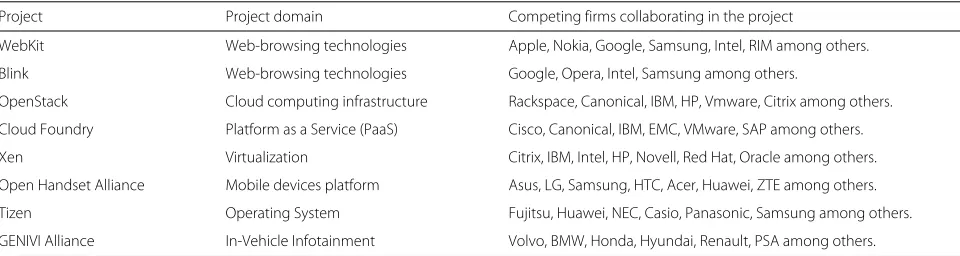
There are several known cases of open-coopetition (i.e., coopetition in the open source arena) as captured in Table 1. The phenomenon where competing firms jointly develop open source ecosystems has reached different R&D intensive sectors, following the development of the Internet, cloud computing, mobile-devices and automo-tive technologies among others.
A key concept which emerged in this research was the sociological concept of homophily - the tendency of individuals to associate and bond with similar oth-ers [34–37]. A vast array of network studies pointed out that humans tend to connect with humans sharing
similar attributes (e.g., age, gender, class, organizational role or company affiliation) [34, 35]. The same applies to the natural ecosystems where animal species tend to mate with similar ones [38]. Prior research dealing with inter-organizational networks, strongly suggests that homophily drives the formation of corporate strategic alliances [39, 40], the formation of entrepreneurial teams [41] or the selection of human resources [42, 43].
The concept of homophily was already addressed in technology related contexts. The concept was integrated in the ’diffusion of innovation’ theory [44], as acknowl-edged previously by Software Engineering scholars [45, 46], “one of the most distinctive problems in the dif-fusion of innovations is that the participants are usually quite heterophilous” [44]. Existing studies in Information Systems also suggest that homophily plays a very impor-tant role in the assimilation of technology [47]. However, the concept remains largely unexplored in studies tak-ing into account both the social and the technological perspectives.
3 Research questions
Our research questions focus on understanding the hybrid behaviors of collaboration and competition within the development of the OpenStack Nova open source project, an example of a high-tech industrial Free/Libre/Open Source software ecosystem involving competing firms that market similar products and services.
RQ1– What is the software development process used to develop the OpenStack high-networked open source cloud computing infrastructure?
RQ2– Are developers affiliated with different firms collaborating with each other in the project? How does the collaboration evolve over time? How is collaboration affected by exogenous events in the market?
RQ3– Is there a tendency towards sub-grouping in the project? Are there different sub-communities within the OpenStack ecosystem-community? Which ones? How do developers cluster into different groups? Do developer clusters correspond to firms?
RQ4– Do firms that compete in the same revenue model collaborate less in the ecosystem?
4 Case Study: OpenStack
Table 1Coopetition in the open source arena
Project Project domain Competing firms collaborating in the project
WebKit Web-browsing technologies Apple, Nokia, Google, Samsung, Intel, RIM among others.
Blink Web-browsing technologies Google, Opera, Intel, Samsung among others.
OpenStack Cloud computing infrastructure Rackspace, Canonical, IBM, HP, Vmware, Citrix among others.
Cloud Foundry Platform as a Service (PaaS) Cisco, Canonical, IBM, EMC, VMware, SAP among others.
Xen Virtualization Citrix, IBM, Intel, HP, Novell, Red Hat, Oracle among others.
Open Handset Alliance Mobile devices platform Asus, LG, Samsung, HTC, Acer, Huawei, ZTE among others.
Tizen Operating System Fujitsu, Huawei, NEC, Casio, Panasonic, Samsung among others.
GENIVI Alliance In-Vehicle Infotainment Volvo, BMW, Honda, Hyundai, Renault, PSA among others.
set of different open source projects governed by the OpenStack Foundation.
Both hardware and software developers affiliated with companies such as AT&T, AMD, Canonical, Cisco, Dell, EMC, Ericsson, HP, IBM, Intel, NEC, NASA and many others, work together with independent, non-affiliated developers in a scenario of pooled R&D in an open source fashion. We decided to address the OpenStack case due to its perceived novelty, its high inter-networked nature (i.e., an ecosystem involving many firms and individual con-tributors), its heterogeneity (i.e., an ecosystem involving both startups and high-tech corporate giants), its market-size ($1.7bn by 2016 as claimed by Al Sadowski 451 Research analyst in August of 2014 [48]), its complexity (i.e., involving different programming languages, differ-ent operating systems, differdiffer-ent hardware configurations) and its size (17,020 community members, 100,000 code reviews and 1,766,546 lines of code as recently reported by Jason Baker from Red Hat in June 2014 [49]).
The OpenStack Nova project, our unit of analysis, is a cloud computing fabric controller, the main part of an IaaS system. It is the largest and the most “core” project governed by the OpenStack Foundation.
Even if OpenStack emphasizes the joint develop-ment of a large and complex open source ecosystem, there are competing firms within its community. For instance, by October 2014, third-party software devel-opers could choose from three different firms offering OpenStack-based cloud computing public cloud services: HP, Canonical and Rackspace. All those three firms were fighting for revenues from OpenStack-based cloud com-puting services marketed under different brands: HP Helion Public Cloud,Ubuntu Cloud, Ubuntu BootStack, Rackspace Cloud ServersandRackspace Public Cloud. In other words, besides contributing to the same project, all the three mentioned firms competed for revenues from third-party actors “renting” public cloud services. Within the hardware business, many contributors to OpenStack such as IBM, HP and Nebula also compete in sales of specialized hardware for cloud-computing installations.
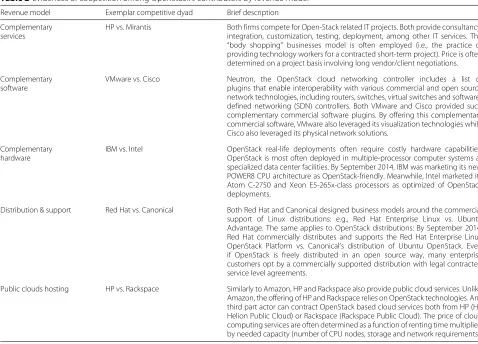
In order to provide evidences of competitive issues, we exemplify in Table 2 and Fig. 1 how OpenStack firms directly compete with each other for the same revenue streams. The network nodes in Fig. 1 represent the top firms contributing to the OpenStack ecosystem while the edges connect firms that compete for the same revenue stream.
5 Methodology
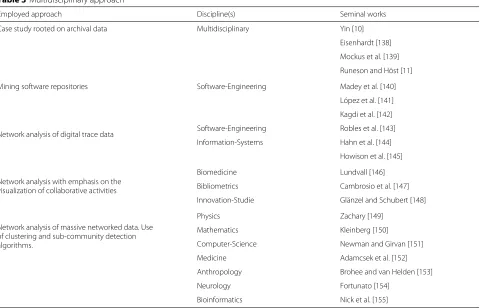
We have combined qualitative analysis of archival data (QA), mining software repositories (MSR) and Social Network Analysis (SNA) on publicly-available and naturally-occurring data from the OpenStack Nova repos-itory in order to re-construct and visualize the evolu-tion of collaboraevolu-tions in a sequence of networks. Table 3 presents a set of multidisciplinary methodological notes that guided our mixed methods research design.
We started in a qualitative way, by screening publicly available data such as company announcements, finan-cial reports and spefinan-cialized press reports, which allowed us to review an immense amount of on-line information pertaining to the competitive cloud computing industry. While taking into consideration established methodolog-ical notes that legitimate the use of archival data when studying a case [10, 11, 50–52, 138], we gained valu-able insights from the industrial context surrounding the OpenStack community. After attaining a better under-standing of the industrial collaborative and competitive dynamics, we extracted and analyzed the social net-work of the OpenStack Nova project by leveraging SNA [53–55]. By mining digital traces of code collaboration, and by uncovering the social structure of the OpenStack Nova project, the computerized SNA revealed key pre-liminary understandings of coopetition in the OpenStack ecosystem that were later re-investigated with comple-mentary qualitative data. The combination of methods was not only fundamental for the retrieval of social struc-tures, but also for explaining them.
Table 2Evidences of coopetition among OpenStack’s contributors by revenue model
Revenue model Exemplar competitive dyad Brief description
Complementary services
HP vs. Mirantis Both firms compete for Open-Stack related IT projects. Both provide consultancy, integration, customization, testing, deployment, among other IT services. The “body shopping” businesses model is often employed (i.e., the practice of providing technology workers for a contracted short-term project). Price is often determined on a project basis involving long vendor/client negotiations.
Complementary software
VMware vs. Cisco Neutron, the OpenStack cloud networking controller includes a list of plugins that enable interoperability with various commercial and open source network technologies, including routers, switches, virtual switches and software-defined networking (SDN) controllers. Both VMware and Cisco provided such complementary commercial software plugins. By offering this complementary commercial software, VMware also leveraged its visualization technologies while Cisco also leveraged its physical network solutions.
Complementary hardware
IBM vs. Intel OpenStack real-life deployments often require costly hardware capabilities. OpenStack is most often deployed in multiple-processor computer systems at specialized data center facilities. By September 2014, IBM was marketing its new POWER8 CPU architecture as OpenStack-friendly. Meanwhile, Intel marketed its Atom C-2750 and Xeon E5-265x-class processors as optimized of OpenStack deployments.
Distribution & support Red Hat vs. Canonical Both Red Hat and Canonical designed business models around the commercial support of Linux distributions: e.g., Red Hat Enterprise Linux vs. Ubuntu Advantage. The same applies to OpenStack distributions: By September 2014, Red Hat commercially distributes and supports the Red Hat Enterprise Linux OpenStack Platform vs. Canonical’s distribution of Ubuntu OpenStack. Even if OpenStack is freely distributed in an open source way, many enterprise customers opt by a commercially supported distribution with legal contracted service level agreements.
Public clouds hosting HP vs. Rackspace Similarly to Amazon, HP and Rackspace also provide public cloud services. Unlike Amazon, the offering of HP and Rackspace relies on OpenStack technologies. Any third part actor can contract OpenStack based cloud services both from HP (HP Helion Public Cloud) or Rackspace (Rackspace Public Cloud). The price of cloud computing services are often determined as a function of renting time multiplied by needed capacity (number of CPU nodes, storage and network requirements).
on the OpenStack Nova project changelog. As in prior multi-disciplinary studies [60, 146–148], our analysis emphasizes the visualization of the collaboration network, which evolves over time, to reveal dynamics among the OpenStack software developers. We then attempted to understand the visualized networks with our acquired understanding from the competitive cloud computing industry in general and OpenStack in particular. The visualization, together with a deeper understanding of the phenomenon under investigation, corresponds to the notion of figuration [61] as pointed out in several stud-ies [62, 63, 147]. Studstud-ies which take a SNA perspective for building social network visualizations are already becom-ing established in Software Engineerbecom-ing studies in general, and in FLOSS research in particular [64–67, 141]. Even so, very few Software Engineering studies exploit the potential of social network visualizations for exploratory research as suggested by [68].
5.1 Data collection
Our screening of public and naturally-occurring data available on the Internet followed established method-ological guidelines on case study research [10, 138] which
are consistent with more focal and discipline-oriented guidelines established in Software Engineering [11, 69], Information Systems [50, 51], Operations Research [52] and Management [70, 71].
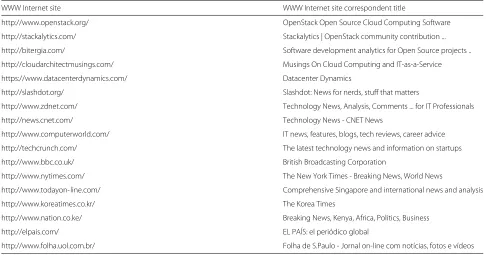
More especially, we have reviewed the most relevant public announcements of companies, publicly avail-able financial reports, publicly availavail-able documenta-tion supporting software development, news from both specialized and generalist press, discussions in forums, white-papers and blogs. The selection of sources took in consideration key guidelines on how to conduct quali-tative empirical research online [72, 73]. The Kozinets’ four criteria for selecting from on-line data sources [72] set the departure points from where we started collecting relevant empirical material.
Fig. 1OpenStack firms competing for the same revenue streams
Table 3Multidisciplinary approach
Employed approach Discipline(s) Seminal works
Case study rooted on archival data Multidisciplinary Yin [10]
Eisenhardt [138]
Mockus et al. [139]
Runeson and Höst [11]
Mining software repositories Software-Engineering Madey et al. [140]
López et al. [141]
Kagdi et al. [142]
Network analysis of digital trace data Software-Engineering Robles et al. [143] Information-Systems Hahn et al. [144]
Howison et al. [145]
Network analysis with emphasis on the visualization of collaborative activities
Biomedicine Lundvall [146]
Bibliometrics Cambrosio et al. [147]
Innovation-Studie Glänzel and Schubert [148]
Network analysis of massive networked data. Use of clustering and sub-community detection algorithms.
Physics Zachary [149]
Mathematics Kleinberg [150]
Computer-Science Newman and Girvan [151]
Medicine Adamcsek et al. [152]
Anthropology Brohee and van Helden [153]
Neurology Fortunato [154]
In Table 4 we point out our selected departure points for collecting relevant on-line archival data. From the initially selected sources, we followed many ‘links’ and end up visiting many other sites (e.g., corporate sites from com-panies involved in the development and commercializa-tion of OpenStack technologies or blogs from individual OpenStack contributors).
After the retrieval and qualitative analysis of the selected archival data, we also conducted SNA which allows us to depict overall pictures of the coopetitive dynamics among different developers in the project. Knowledge gained from earlier phases of this study (more qualitative) on OpenStack’s actors, events, processes and technology informed the subsequent SNA design.
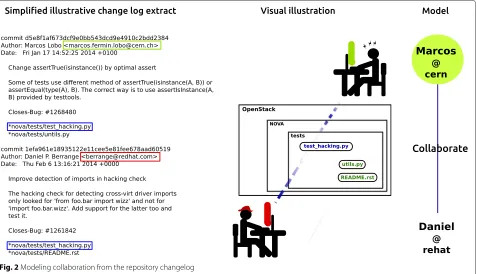
The input data of SNA is based on different source code release versions of the OpenStack project. The lat-est source code snapshot from the repository of the OpenStack Nova project was performed on 16 June of 2014, usinggit (v1.8.5.1). From the repository changelog documentation, we extracted basic information, includ-ing developer email addresses and the time stamp when changes to a specific file had been made (see Fig. 2). We then connect the developers who work on the same file, and construct a network of collaboration activities among the developers. With the visualization of the col-laboration network over time, we aim to understand the evolution of the code-based collaborations with a lens of social structure.
The process of associating the developer email address with code commits is one of the most challenging steps in this research. First, we developed a set of Python
scripts that validated and corrected repository commit data, for instance to deal with small mistakes performed by developers that submitted code with Unrecognized author (no email address), Unrecognized author (with email address) or with an invalid email. Second, we had to deal with the fact that some developers do not commit their changes with their corporate account (e.g., a
devel-oper commits code using [email protected] instead
of [email protected], while actually affiliated with HP). This problem was tackled by manually triangulating our automatically-retrieved affiliation results with data from the Foundation affiliation database using two external data sources [74, 75].
5.2 Data analysis
Our empirical materials span the time period from October 21st 2010 to April 17th 2014. After the Cactus release (April 15th 2011), OpenStack aban-doned the 3-month time-based release cycle for a coor-dinated 6-month release cycle with frequent development milestones [76–78]. Thus, we opted to take a longitudinal approach and to construct SNA visualizations that depict collaborative behaviors release after release. Table 5 lists the 9 releases of OpenStack addressed by this study.
The design choice was inferred by characteristics of the OpenStack project: 1) The cyclical nature of Open-Stack development where each release cycle encom-passes planning, discussion, implementation and fixing release-critical bugs in a sequential way [78]; and 2) The OpenStack scheduling policy, where developers are dis-couraged from implementing new features during the
Table 4Internet sources of naturally occurring material
WWW Internet site WWW Internet site correspondent title
http://www.openstack.org/ OpenStack Open Source Cloud Computing Software
http://stackalytics.com/ Stackalytics | OpenStack community contribution ...
http://bitergia.com/ Software development analytics for Open Source projects ..
http://cloudarchitectmusings.com/ Musings On Cloud Computing and IT-as-a-Service
https://www.datacenterdynamics.com/ Datacenter Dynamics
http://slashdot.org/ Slashdot: News for nerds, stuff that matters
http://www.zdnet.com/ Technology News, Analysis, Comments ... for IT Professionals
http://news.cnet.com/ Technology News - CNET News
http://www.computerworld.com/ IT news, features, blogs, tech reviews, career advice
http://techcrunch.com/ The latest technology news and information on startups
http://www.bbc.co.uk/ British Broadcasting Corporation
http://www.nytimes.com/ The New York Times - Breaking News, World News
http://www.todayon-line.com/ Comprehensive Singapore and international news and analysis
http://www.koreatimes.co.kr/ The Korea Times
http://www.nation.co.ke/ Breaking News, Kenya, Africa, Politics, Business
http://elpais.com/ EL PAÍS: el periódico global
Fig. 2Modeling collaboration from the repository changelog
last development milestone and concentrate efforts on bug-fixing for the coming release candidates [78–80]. As illustrated in Fig. 3, we narrow code-collaboration as a synchronous behavior happening within a release. It is important to remark that due to this design choice our research does not capture collaboration between two developers who contributed to the same file but in a different release cycle.
In line with existing guidelines on how to combine digital trace data with SNA [145], we constructed the collaboration network of developers for each partitioned time-slice (i.e., by software release date). In this way, we are able to assess how the collaboration network has evolved over time in response to the exogenous events in the industry.
Table 5Releases of the OpenStack community
Release date Release name
Oct 21st, 2010 Austin
Feb 3rd, 2011 Bexar
Apr 15th, 2011 Cactus
Sep 22nd, 2011 Diablo
Apr 5th, 2012 Essex
Sep 27th, 2012 Folsom
Apr 4th, 2013 Grizzly
Oct 17th, 2013 Havana
Apr 17th, 2014 Icehouse
During the planning phase of each release, the commu-nity gathers for a Design Summit to facilitate live devel-oper working sessions and to assemble the OpenStack roadmap. Documentation regarding the development sta-tus of the current release and decisions made at each Design Summit are publicly available [81].
From publicly available data [74, 75] and reports sup-porting decision-making in the OpenStack ecosystem [82], we observed an onion model, as addressed in the open source research literature [64, 83, 84], with a rela-tively dense core [82]. This indicates that a small set of developers (mostly affiliated to a company) account for most of the development activity. Therefore, in order to better understand collaboration in such a complex collab-orative network and to minimize the impact of outliers, we decided to focus our research on the developers affiliated with the top 10 contributing firms to the OpenStack Nova project during the complete period under study. These firms were selected using classical code metrics provided by Bitergia and Mirantis (i.e., number of commits, lines of code and number of completed blueprints).
The selected top 10 firms contributing to OpenStack Nova, briefly introduced in Table 6, can be formally defined as:
TOPTEN={Canonical,Citrix,Cloudscaling,HP,IBM,
Mirantis,Nebula,Rackspace,VMware,Red Hat}
Fig. 3Capturing code-collaboration between releases
The collaborative network during a certain time slice can be formally defined as:
Gt=(V,Av,E)
where:
• V is the set of nodes representing the developers
∈TOPTENcontributing to the OpenStack Nova open source software project. All other developers not affiliated with the top 10 contributing firms are not considered in this study.
• Avis the set of nodes-attributes, capturing the company affiliation of a developer.
• Eis the set of edges, identifying the connections between two developers if they have worked on the
same software source code file. An edge will existiff two developers have modified the same file during the release under study. Edges are both unweighted and undirected.
Various numeric network measures have been estab-lished in SNA: for example, eigenvector-centrality [85, 86], degree-centrality and betweenness-centrality [53]; all revealing the importance of a node in a network. Other aspects of a network can also be manifested with impor-tant measures such as network-density [54], cluster coef-ficients [87], strength of ties [88], etc.
However, as our SNA goes hand-in-hand with qualitative analysis of a very competitive and dynamic environment, we concentrated our efforts in visualizing
Table 6Top 10 firms contributing to OpenStack
Firm Firm description
Canonical The makers of Ubuntu. Provider of support services for Ubuntu deployments in the enterprise.
Citrix Multinational software company that provides virtualization, networking, software-as-a-service (SaaS), and cloud computing technologies.
Cloudscaling Services and open source products company selling custom cloud infrastructure for large service providers, chiefly telecom service providers.
HP Multinational IT company. Provides hardware, software and services to consumers, small- and medium-sized businesses (SMBs) and large enterprises.
IBM Multinational technology and consulting corporation.
Mirantis North California software company specialized on OpenStack.
Nebula North California hardware and software company specialized on cloud computing.
Rackspace Multinational IT hosting company.
VMware Software company that provides cloud and virtualization software and services.
the network graphs, which was sufficient to uncover some history line and to reveal the dynamics of coopeti-tion in an observacoopeti-tional way. Although the visualizacoopeti-tion of social networks has been widely utilized by scholars [60, 64, 141, 147, 148], few studies have explored the time dimension in order to observe how networks evolve lon-gitudinally [3, 89]. At a later stage, we also used another specialized software tool,Visone(v2.7.3) [90], to visualize a sequence of networks according to the established release cycle, and to interpret the network evolution with understanding generated from the collection of rich qualitative material capturing the network dynamics.
Given the high density of the collaborative networks during the last releases, and in order to better address
RQ3(who tends to collaborate with whom in the project), we also explored sub-community detection methods. Among a number of possible methods from Graph Theory [91, 92, 153, 154], we opted for a novel technique based on the extraction of Simmelian backbones [155], due to its efficiency to analyze complex networks with unweighted edges.
The obtained social network visualizations (key part of our data analysis) added rigor and comparative logic to the qualitative description (via triangulation of research methods) as suggested by Eisenhardt [93, 138]. However, it also added ‘pictures’ of the social structure, whichper seincreased the richness of the qualitative description as rejoindered by Dyer [94].
6 Results
6.1 A overview of the software development process
Directly addressingRQ1, we constructed a brief qualita-tive description of collaboraqualita-tive software development of OpenStack, as can be found in the software engineering literature for other projects [83, 139]. Such description directly derives from many sources of archival data which have been preserved throughout the history of Open-Stack [76–80]. The process data is naturally occurring (i.e., not provoked by the researchers), not created for research purposes but to guide and steers real software developers contributing to OpenStack. As our analysis covered more than 4 years of the OpenStack project lifes-pan, and as the process kept evolving, the description is based on the most recent releases of OpenStack (i.e. years 2014–2015).
OpenStack operates a time-based cyclical software development process where each release cycle encom-passes planning, discussion, implementation and fixing release-critical bugs (all in a sequential way). During our investigation we notice that during the earlier release phase, the ‘coding’ efforts are discussion and specification oriented, while in a later release phase (i.e., stabilization of release candidates) the development turns into bug-fixing
mode (as reported in other open source projects [95, 96]).
The ‘planning stage’ is at the start of a cycle, just after the previous release. This phase usually lasts 4 weeks and runs in parallel with the OpenStack Design Summit on the third week (in a mixture of virtual and face-to-face collaboration). The community discusses among peers gathering feedback and comments. In most cases, specifi-cation documents are proposed via a support system [97] that should precisely describe what should be done. Con-tributors may propose new specs at any moment in the cycle, not just during the planning stage. However doing so during the planning stage is preferred, so that con-tributors can benefit from the Design Summit discussion and the elected Project Team Leads (PTLs) can include those features into their cycle roadmap. Once a specifica-tion is approved by the corresponding project leadership, implementation is tracked in a blueprint [98], where a priority is set and a target milestone is defined, com-municating when in the cycle the feature is likely to go live.
The ’implementation stage’ is when contributors actu-ally write the code (or produce documentation, test cases among other software related artifacts) mapping the defined blueprints. This phase encompasses a number of milestone iterations (a characteristic of agile software development methods). Once developers perceive their work as ready to be proposed for merging into the master branch, it is pushed to OpenStack’s Gerrit review system for public review [99]. It is important to remark that in order to be reviewed in time for a milestone, the change should be proposed in the weeks before the targeted milestone publication date. An open source software col-laboration platform [100] is used to track blueprints in the ’implementation stage’. In an open source way, it is worth remarking that not all “features” have to go through the blueprints tracking: contributors are free to submit any ad hocpatch. Both specifications and blueprints are tools supporting the discussion, design and progress-tracking of the major features in a release. Even if thebigcorporate contributors are naturally more influential in the election of PTLs steering the tracking process, it should not pre-vent other contributors from pushing code and fixes into OpenStack. Development milestones are tagged directly on the master branch during a two-day window (typically between the Tuesday and the Thursday of a milestone week).
encouraged to turn most of their attention to testing the result of the development effort and fix release-critical bugs. Critical missing features, dubious features and bugs are documented, filed and prioritized. Contrib-utors are advised to turn their heads to the quality of the software and its documentation. The development becomes mainly bug-fixing oriented and a set of norms and tools guide this last product-stabilization phase [101, 102]. Any change proposed for the master branch should at least reference one bug on the bug-tracking sys-tem. Once all the release-critical bugs are fixed, Open-Stack produces the first release candidate for that project (named RC1).
The OpenStack release team is empowered during this last phase. It creates astable/*branch from the current state of themaster branchand introduces any new release-critical fix discovered until the release day. Between the RC1 and the final release, OpenStack looks for regres-sion and integration issues. RC1 may be used as is for the final release, unless new release-critical issues are found that warrant a RC respinning. If this happens, a new milestone will be open (RC2), with bugs attached to it. Those RC bug fixes need to be merged in the master branch before they are allowed to land in the stable/* branch. Once all release-critical bugs are fixed, the new RC is published. This process is repeated as many times as necessary before the final release. As it gets closer to the final release date, to avoid introducing last-minute regressions, the release team limits the number of changes and their impact: only extremely-critical and non-invasive bug fixes can get merged. All the other bugs are documented as known issues in the Release Notes instead.
On the release day, the last published Release Candi-date of each integrated project is collected and the result is published collectively as the OpenStack release for this cycle. OpenStack should by then be stable enough for real industrial deployments. But once the version is released, a new cycle will commence within OpenStack; themaster branchswitches to the next development cycle, new fea-tures can be freely merged again, and the process starts again.
6.2 Longitudinal description of collaborative and competitive issues
To answer RQ2 we will take a chronological approach. We will proceed by quoting the words of Jim Curry in one of the first announcements of the OpenStack project. The founding leader of the OpenStack community starts by advocating the freedom of open source software before stating the mission of the the OpenStack project. It is important to notice that Jim Curry emphasized the roles of NASA and Rackspace as initial contributors to the project; project did not start from zero.
“What is OpenStack? Well, our mission statement says this:
To produce the ubiquitous Open Source Cloud Computing platform that will meet the needs of public and private clouds regardless of size, by being simple to implement and massively scalable.
That is a big ambition. The good news is that OpenStack is starting with code contributions from two organizations that know how to build and run massively scalable clouds - Rackspace and NASA. Rackspace has been in the cloud business for 4 years and now serves tens of thousands of customers on its cloud platform. Likewise, NASA began building their Nebula cloud platform 2 years ago to meet the needs of their scientific community” — Jim Curry, OpenStack Lead, 19 July 2010 [103]
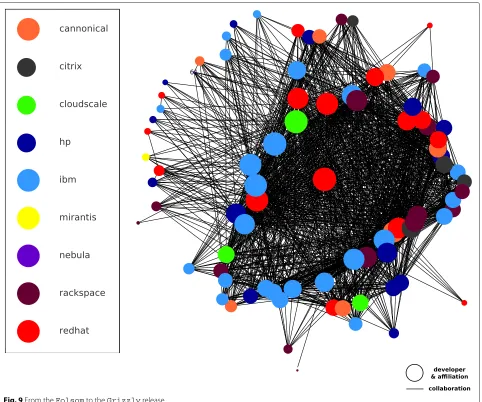
Visualizations in Figs. 4, 5, 6, 7, 8, 9, 10 and 11 provide an understanding of how key players in the cloud com-puting industry collaborate in a Free/Libre/Open Source software ecosystem. SNA visualizations are not just ‘pretty pictures’ as network studies are periodically criticized (counter-arguments to this criticism can be found in [104]), but exploit combinations of text, signs, color, size, location and shape to communicate several pieces of numerical information simultaneously [105]. Each net-work visualization aggregates both numbers, mathemati-cal formulae, and written text which have to be otherwise communicated sequentially [106].
In our visualizations, the size of a node is dependent on its degree-centrality; i.e., the larger the node, the more social connections the developer has. The value of degree-centrality depends on the number of adjacent nodes with which a node is connected. Therefore, the higher a devel-oper’s degree-centrality, the more likely he/she is collabo-rating with others.
Figure 4 captures collaboration in the OpenStack Nova project from theAustinto theBexarrelease, from October 21st 2010 to February 3rd 2011. From it, we can derive the collaboration between software developers affiliated with companies; so, Citrix had three developers working on the project together with Rackspace.
“OpenStack provides a solid foundation for promoting the emergence of cloud standards and interoperability.” .... “As a longtime technology partner with Rackspace, Citrix will collaborate closely with the community to provide full support for the XenServer platform and our other cloud-enabling products.” — Peter Levine, SVP and GM, Citrix, 19 July 2010 [107]
Fig. 4From theAustinto theBexarrelease
would be conveniently integrated with Rackspace plans for OpenStack.
“The project is exhibiting the key benefits that the industry derives from successful open source collaboration: rapid development, faster testing, feedback and project turn around, broader industry adoption and learning through implementation and de-facto standardization whilst avoiding the prospect of commoditization.
It has been rewarding to work with the OpenStack crew, and to have experienced first hand the dedication to an open, code-rules, community-first approach taken by the project leaders. OpenStack has shown that it is possible to rally the community around the development of “management” software - as opposed to the Linux kernel or Xen - and it is definitely the case that OpenStack is breaking new ground for the industry at large. With the release behind us, our team will head in force to San Antonio for the next Design Summit.” — Simon Crosby, CTO, Citrix 21 October 2010 [108]
Our second visualization with degree-centrality, in Fig. 5, captures collaboration from theBexar to the Cactus release (from February 3rd 2011 to April 15th
2011). From this visualization we can observe a new node, a developer affiliated with Cloudscaling. Cloudscaling was founded in 2006 by the cloud architect and open source software advocate Randy Bias, and the co-founder Adam Waters. It started as a professional services com-pany selling custom cloud infrastructure for large service providers, chiefly telecom service providers. They had KT (formerly Korea Telecom) as an early customer, for which the company in 2010 designed and deployed the first OpenStack-based storage cloud outside Rackspace.
“Earlier this week, one of our clients, a Tier 1 ISP, launched an object storage cloud based on OpenStack, an open source compute and storage framework created by Rackspace and NASA. The new storage cloud is the first commercial OpenStack-based storage offering in the market after Rackspace itself, which is based on the same technology.
Cloudscaling assisted in developing
Fig. 5From theBexartoCactusrelease
Fig. 7From theDiabloto theEssexrelease
Fig. 9From theFolsomto theGrizzlyrelease
Our visualization in Fig. 6 captures collaboration from theCactusto theDiablorelease (from April 15th 2011 to September 22nd 2011). HP (a well-known IT multi-national company), Mirantis (an OpenStack startup), and Red Hat (the company behind the Red Hat Enterprise Linux and sponsor of the Fedora Linux distributions) joined the coopetitive software development efforts.
Mirantis was founded in January 2011 by Boris Renski Jr. and Alex Freedland. Also born in Northern California, this startup marketed itself as a “pure-play” OpenStack company and started working early with Red Hat. Dur-ing our qualitative analysis of on-line data on the Inter-net, we came across a conversation between engineers from Mirantis and an open source enthusiast contribut-ing occasionally to the Fedora project. Such conversation provided qualitative digital trace data evidencing collabo-ration between Mirantis and Red Hat [110].
“Our internal infrastructure is running on Fedora, instead of migrating the full infrastructure to Ubuntu, we decided to make OpenStack Fedora-friendly.” – Maxim Lvov, Senior deployment engineer, Mirantis, 18 of May 2011 [110]
“Are you aware of the upstream effort to create packages for Fedora?” ... “would you be willing to contribute your specs if you really build your rpms from the sources?” – Fabian Deutsch, Contributor to the Fedora project, 20 of May 2011 [110]
Fig. 10From theGrizzlyto theHavanarelease
Meanwhile, HP started marketing their cloud comput-ing services based on OpenStack. HP markets itself as the leading corporation behind the project, emphasiz-ing that OpenStack is the only cloud computemphasiz-ing solution without a single-vendor lock-in, but with an extensive ecosystem behind it [111]. Another key startup to Open-Stack was born in those days, Nebula. Nebula was founded also in Northern California in Spring 2011 by Chris C. Kemp, a former NASA Chief Technology Officer, his long-time colleague Devin Carlen, and the entrepreneur Steve O’Hara. The company absorbed much of the original NASA team which coded the first bits of OpenStack [112]. Figure 7 depicts collaborations from theDiabloto the Essexrelease (from September 22nd 2011 to April 5th 2012). Although the graph becomes more dense, we can visualize new nodes representing early contributions of Intel (interested in making OpenStack deployments work well on Intel micro-processors) and IBM. IBM has a long history of working with open standards and open source
initiatives such as in the Apache and Eclipse projects, and has been able to sell complementary solutions (i.e., hard-ware, software and services) from open source projects. It expects the same business model to work well with OpenStack.
Fig. 11From theHavanato theIcehouserelease
I wrote back in April, I highlighted three initial focus areas for IBM: 1) Establish the OpenStack Foundation, 2) Support and expand the OpenStack Ecosystem and 3) Contribute to the OpenStack Development.” – Angel Diaz, Vice President of Open Standards, IBM, 19 of September 2012 [113]
Figure 8 shows collaborations between theEssexand the Folsomrelease (from April 5th 2012 to September 27th 2012). We can observe that the network becomes more dense, as there are more developers working with each other. Even if some of their developers continued contributing to the project, Citrix had by then aban-doned its Olympus OpenStack distribution in order to focus instead on the competing CloudStack cloud com-puting FLOSS ecosystem. Citrix decided to contribute to the competing CloudStack software ecosystem under the umbrella of the Apache Software Foundation, with a code-base resulting from the acquisition of Cloud.com in July
2011. This turn of strategy from Citrix is related with the OpenStack lack of integration with the Amazon’s APIs (Application Programming Interfaces). Amazon is cur-rently the leader of cloud services, and the migration costs to another cloud computing infrastructure are very high, specially if the APIs do not resemble each other.
“Amazon has in many ways invented and created this market, and with what is projected to be $1 billion in ecosystem and customer revenue attached to Amazon cloud, we believe the winning cloud platform will have to have a high degree of interoperability with Amazon” – Sameer Dholakia, GM Cloud Platforms Group, Citrix, 3 of April 2012 [114]
investing increasingly in the development of OpenStack, interested in keeping its Linux DistributionUbuntuas the leading Linux distribution for OpenStack clouds [115].
VMware, a Northern Californian firm with exper-tise in virtualization technologies, made substantial contributions (evidenced by the number of commits) during this between-releases period [116]. The acqui-sition of the networking virtualization startup Nicira in July 2012 reshaped the VMware cloud comput-ing strategy. As a sign of commitment to OpenStack, VMware and Canonical issued a joint statement on their intentions to work together to improve the integra-tion VMware technologies with Canonical’s OpenStack distribution.
“(OpenStack Summit) Canonical and VMware, Inc. (NYSE: VMW), the global leader in virtualization and cloud infrastructure, today announced a collaboration that will enable organizations to deploy VMware technologies, including VMware vSphere and Nicira NVP, with Canonical’s OpenStack distribution. Canonical’s Ubuntu Cloud Infrastructure, the most widely used OpenStack distribution, will now include the plugins required to use OpenStack with vSphere and NVP. Canonical will provide commercial support for OpenStack and will collaborate with VMware on issues related to vSphere or NVP running with OpenStack. In addition, VMware reaffirms its support of Ubuntu as a fully supported guest operating system (OS) on vSphere. This agreement will enable
customers the flexibility to deploy and reliably run OpenStack clouds with Ubuntu Cloud Infrastructure on VMware vSphere while receiving commercial support.” – Joint press release from VMware and Canonical, Acquire Media, 16 of April 2013 [116]
Figure 10 captures collaboration in the project in a more recent phase, from the Grizzlyto theHavana release (from April 4th 2013 to October 17th 2013). We can see that VMware took its commitment to OpenStack seriously, as six new developers engaged in developing with other OpenStack developers affiliated withTOPTEN firms. Mirantis, in yellow on the right of Fig. 10, invested heavily in collaborative activities with IBM, Rackspace and Red Hat. Mirantis counted on financial support from Dell Ventures and Intel Capital (representing the interests of hardware manufacturers betting on OpenStack) [117] and additional investment by Ericsson, Red Hat, and SAP Ventures [118], turning it into one of the biggest code con-tributors to the OpenStack software ecosystem in just a few months as reported by Bitergia [82]; the number of developers from Mirantis increased from 1 to 17 in this time period.
Figure 11 captures collaborations in the latest period studied, from theHavanato theIcehouserelease (from October 17th 2013 to April 17th 2014). In this visualiza-tion, the number of network nodes (i.e., software devel-opers affiliated with TOPTEN firms in the OpenStack Nova) decreased, while retaining a similar density. This fact must be interpreted carefully, as it does not mean that the number of software developers contributing to the OpenStack Nova is now lower. There were currently 313 developers contributing with code, and 483 develop-ers reviewing code during this period. The community contributing to the OpenStack Nova project increased sig-nificantly, while the role of theTOPTENfirms decreased. As of this release, Intel, NEC, Huawei and the rest of the non-affiliated developers grouped together would belong to the TOP 10 contributors of the Icehouse release – although considering the whole lifespan of OpenStack the project, we have considered them to be out of the TOP 10.
By this time the role of NASA on OpenStack had dimin-ished. The first developments of OpenStack were in the service of science, supporting NASA’s research activi-ties. NASA’s prestige and participation has been a selling point for advocates of OpenStack technologies. NASA lost much of its IT staff working on its Nebula cloud computing project. Software developers and IT architects headed to startups and high-tech giants within the Open-Stack ecosystem. Moreover, a cost-driven IT reform led to disinvestment in OpenStack by NASA. Today, scientists at NASA depend on Amazon EC2 and Microsoft Azure cloud computing infrastructures [119]. While much of the scientific data Meanwhile, on the other side of the Atlantic, the European Organization for Nuclear Research (CERN) decided on an OpenStack based strategy in 2012. In January 2014, OpenStack was already running collision reconstructions at the Large Hadron Collider (LHC) [120].
6.3 Ecosystem and its sub-communities
In order to carefully address RQ3 we employed
Fig. 12Evolution of the size of the community, collaborative relationships and cohesion of the community over time
As a result of the extraction of Simmelian backbones from the collaborative network of the last OpenStack releases, the emergent sub-communities in Fig. 13 reveal, contrary to what the authors expected, a low degree of homophily in code collaboration, meaning that develop-ers do not tend to work with developdevelop-ers from their own company.
Instead of visualizing the complex “raw” collaborative network (see Fig. 13a), by using the sub-community detec-tion technique, we can depict three ecosystem-groups
(a)
(b)
Fig. 13Sub-community structure extraction
6.4 Exploring the relationship between revenue-models and collaboration
For addressingRQ4, we can also exploit network analysis to explore how competition for a revenue stream affects collaboration in the OpenStack Nova case. This can be done (as displayed in Table 7) by calculating the density of the two collaborative networks: collaboration among firmscompetingfor a specific revenue stream vs. collab-oration among firms that do not compete for a specific revenue stream. It should be noted that density is a mea-sure of cohesion, collaboration and learning. Alternatively, but less precisely, it can be also be done by zooming and visualizing side by side collaboration among firms com-peting vs. collaboration among firms that do not compete (see Fig. 14).
Either by the calculated network densities or by the visualizations, we can conclude the following:
• Companies providing complementary software collaboratemorethan companies not providing complementary software.
• Companies providing complementary hardware collaboratemorethan companies not providing complementary hardware.
• Companies providing distribution and support collaboratemorethan companies not providing complementary distribution and support.
• Companies providing public clouds collaborateless
than companies not providing public clouds.
Table 7Community cohesion across firms competing for the same revenue stream
Competing revenue stream Revenue stream description Competing firms
DO
n(αi) den(αi)
DO NOT
n(βi) den(βi)
Complementary services Firms providing specialized support,maintenance, integration, customization, testing, consulting, etc.
ALL TOPTEN 1361 UND0
Complementary software Firms providing software embeddingOpenStack or complementary drivers and plug-ins.
IBM, VMware, Nebula, Cloudscaling, Red Hat, Citrix, Canonical
76
0.472 0.36265
Complementary hardware Firms providing hardware targetingOpenStack installations. IBM, HP, Nebula
69
0.459 0.43467
Distribution and support Firms distributing OpenStack withenterprise support (for a fee). Red Hat, IBM, HP,VMware, Canonical
91
0.460 0.42545
Public cloud services Firms providing OpenStack basedpublic cloud services such as hosting. HP, Rackspace, Canonical
41
0.3200
95
(a)
(b)
(c)
(d)
(e)
(f)
(g)
(h)
Fig. 14Visualizing the impact of competition for the same revenue revenue model
These results suggest that the open competition strategy is working well for the firms involved in the development of the OpenStack Nova. Even if they are competitors for the same revenue stream they do not collaborate less, with the exception of HP, Rackspace and Canonical, who are providers of public cloud computing services.
During our investigation we observed that collabora-tion increased when a firm from the OpenStack ecosystem was deploying (i.e., installing or delivering) OpenStack. It
7 Discussion, including further research
7.1 Homophily
The visualizations of degree-centrality Figs. 4, 5, 6, 7, 8, 9, 10 and 11 ascertained the hyper-collaborative nature of the OpenStack as its developers often collaborate with developers affiliated with competing firms. In a more pos-itivist way, the sub-community detection process revealed a small degree of homophily in code collaboration. As visible from Fig. 13, sub-communities within the Open-Stack Nova project are highly heterogeneous as they tend to include developers from many different firms. These results contradict with prior sociological studies report-ing the tendency of individuals to associate and bond with similar others [34–37].
Surprisingly, the low level of homophily in code collab-oration contradicts an expected social behavior. Why do not developers tend to collaborate with colleagues that should represent the same business interests within the ecosystem? What drives homophily? Is this because of the openness of FLOSS projects? Is it due to the increasing virtualization of work practices as developers collaborate with reduced face-to-face interactions? Future research should assert if the observed low level of homophily is a characteristic only of OpenStack, or more generally of FLOSS and/or other coopetitive projects.
7.2 Coopetition theories and business models
Our case study integrates with the established literature on coopetition. We confirm that the need for external resources is a main driving force behind the establishment of long-term cooperative relationships [121]. Additionally, through cooperation, two companies can gain access to each other’s unique resources or share the cost of develop-ing new unique resources [2, 122]. Within an open source scenario, it is an open to and networked community that fulfills the need for external resources. Moreover, accord-ing to Bengtsson and Kock, individuals within a firm can only act in accordance with one of the two logics of inter-action at a time, i.e., either compete or collaborate [2]. Hence, the two logics either have to be divided between individuals within the firm or need to be controlled and regulated by an intermediate organization such as a col-lective association. Again, within an open source scenario, it is the project community that plays the role of such an intermediate organization. Developers must identify themselves with the project community in order to be able to collaborate with rivals in the same community. In our case, developers must identify themselves with the open source community, the OpenStack Foundation or the OpenStack community to engage in coopetitive behaviors.
Our research however finds discrepancies with prior lit-erature on R&D coopetitive networks, which addresses alliances in a form of either joint-ventures, consortia
or other arrangements where access is granted only to a few selected partners [1, 4]. In the OpenStack case, everyone is welcome to contribute to the project, and everyone is allowed to copy, sell and distribute outcomes from the project. Prior coopetition research, derived from the Nordic milk industry, proposed that coopetition activities take place far from the customer – “competi-tors cooperate with activities far from the customer and compete in activities close to the customer” [2]. How-ever, as we observed code-contributions from many dif-ferent end users (such as AT&T, NASA and CERN), we illustrate that in the open source arena, coopeti-tion can also occur very close to the market and the customers.
We have assessed how revenue models affect collabora-tion in OpenStack: Contrary to expectacollabora-tions, and visible in Fig. 14 and Table 7, and with the exception of a few firms providing public cloud services (HP, Rackspace and Canonical), firms competing for the same revenue model (i.e., where rivalry is expected) tend to collaborate more than firms that do not compete for the same revenue model.
7.3 Understanding the dynamics of industrial FLOSS projects
We believe that the Software Engineering discipline can benefit from developing code-collaboration metrics and visualizations based on developers attributes (e.g., affil-iation) as a valuable complement to established soft-ware development metrics emphasizing code size, code quality and productivity. The information that can be obtained by this means can lead to better decision mak-ing by stakeholders and investors, as well as to point out possible technical and organizational problems in the project [123].
In the case of projects with an ample number of indus-trial corporations, having the possibility of a transparent development process is of key importance. Nonethe-less, companies are reluctant to invest significant capital and/or resources on a coopetitive project in perceived disadvantage to its competitors (i.e., fear of exploitation or other non-cooperative behaviors). Thus, this type of analysis facilitates the generation of trust and confidence among stakeholders, resulting in a win-win cooperative relationship.
what afairdevelopment process is, incorporating process metrics that conveniently address this issue.
Also, an analysis like the one carried out enables super-visor agents, as is the case with the OpenStack Foundation in our case study, to identify possible malfunctions in the community. This can be the case of companies that do not want to be integrated into the community or to coop-erate with other companies. Our idea hence expands the notion of community metrics [124, 125] from the indi-vidual developer to organizations by including affiliation information.
Practitioners from the high-tech sector can further explore the potential of using our socio-structural visual-izations for better communicating the importance of their contributions to particular open source software projects. High-tech firms are already active in claiming their contri-butions to the open source community [126–128]; the use of the implemented visual approach can be used for com-municating the social importance of a firm in a project. The same socio-structural visualizations are more valu-able when complemented with rich textual descriptions of what was contributed [126] or in combination with measurable quantities of contributed source code [129].
Future research efforts from a software engineering point of view could be focused on obtaining better com-munity cohesion metrics and the development of code collaboration metrics. They might not make sense in a small development team, but they are definitely relevant in a high-networked ecosystem where ‘who works with who’ is not obvious. Other ways of measuring collabora-tion (i.e., at the funccollabora-tion level instead of at the file level) or other types of collaboration (i.e., reviews, bug fixing, etc.) would help understanding these type of communities better. The inclusion of weighted edges would add more tangible information on the frequency and importance of the collaboration among stakeholders.
7.4 Mixed method approach
Our findings suggest that by methodologically combining more ethnographic qualitative methods with social net-work visualizations, we can produce longitudinal and rich descriptions that enable a better understanding of com-petitive and collaborative issues simultaneously present and interconnected in large and complex software ecosys-tems. As a methodological note, and as in prior research employing similar research designs [33], we also warn that repository-driven social network measures (i.e., central-ity, eigenvector centrality) or related visualizations must be interpreted carefully.
For instance from theGrizzlyto theHavanarelease, either by summing the centrality measures of the devel-opers affiliated to Mirantis or by interpreting Fig. 10, we could easily make wrong judgments about the impor-tance or influence of Mirantis within the OpenStack Nova
project. Thanks to complementary ethnographic knowl-edge we know that Mirantis has been in contractual sup-ply relationships with AT&T, Cisco, Red Hat and NASA. Moreover, other companies contributing to the project (e. g., Intel, Ericsson, Red Hat and SAP) have equity par-ticipation within Mirantis. Hence, pure repository-driven quantitative judgments about the centrality, importance or influence of actors within a software ecosystem setting must be interpreted very carefully.
8 Threats to validity
8.1 Threats to construct validity
These threats consider the relationship between theory and observation, in case the measured variables do not provide a good measure of the actual factors. A main simplification in our modeling of reality has been how we identify collaboration in our case study. So, collabo-ration was narrowed to working on the same code files; other software development activities (testing, bug-fixing, translation, code-review, specification, testing, design) should be included. In addition, only modifications to the same file during a software release have accounted for collaboration, artificially limiting its scope and dimension. Some choices regarding the SNA can also be improved. So far, we only used density as a community cohesion metric, other network-based measures for the same con-struct (e.g., transitivity, compactness, connectedness and distance-weighted fragmentation among others) should be considered for enhancing the rigor of this research. In addition, our method is still supported mainly by visualizing the resulting SNA graph and its attributes, although other means might be more suitable (i.e., a matrix based solution). Efforts should be also invested in exploring regressions of SNA topological properties with other measures such as activity or quality, that for the sake of parsimony have not been included in this manuscript.
8.2 Threats to external validity
These type of threats consider the problematic of gener-alizing our findings. In our research, we show evidence based on a single case study; our understanding is that it is representative of other industrial FLOSS projects, with volunteer and affiliated developers developing together a software. However, further research should replicate our method on other projects to explore other open-coopetition scenarios and to find out if our findings hold there too.