Pharmacophore
ISSN-2229-5402
Journal home page: http://www.pharmacophorejournal.com
Corresponding Author: Fouzia. Mesli, Department of Chemistry, Aboubekr Belkaid University of Tlemcen,13000, Algeria E-mail: meslifouzia 2018 @ gmail.com
PREDICTION OF STRUCTURAL AND THERMODYNAMIC
PROPERTIES OF CHROMEN USING NUMERICAL METHODS
3 , 2
, Salim Bouchentouf
, * 3 , 1
Fouzia. Mesli
1. Department of Chemistry, Aboubekr Belkaid University of Tlemcen,13000, Algeria
2. Faculty of Technology, Doctor Tahar Moulay University of Saïda,20000, Algeria
3. Laboratory of Naturals Products and Bioactives- Lasnabio, Tlemcen,13000,
Algeria
A R T I C L E I N F O A B S T R A C T
Received: 21th Mar 2018
Received in revised form: 10th Aug 2018
Accepted: 16th Aug 2018
Available online: 28th Aug 2018
Keywords: Biological activity, Coumarin, Chromen, Molecular Dynamic
In this work, the spherical interaction study of three toxic products: 4-hydroxy-chromen-2-one, 5-7 dihydroxy -4- methyl coumarin, and 7-hydroxy 4- methyl coumarin; was elaborated using the Leap Frog algorithm. The authors calculated new values of the box cut-off through Lennard Jones potential parameters. This model was adapted to allow the determination of the characteristics for the SP1, SP2 and SP3 state points, and was applied to study the properties of the three products by molecular dynamics. This method affirmed the structure–activity relationship between these compounds. The thermodynamic and structural characteristics of both canonical NVT and isothermal–isobaric NPT ensembles of these products were assessed. The obtained numerical system results were compared with both experimental data, and recent theoretical investigations. The simulation model isobaric–isothermal system of this study provided accurate results in comparison with the canonical system. This model accorded very well with the experimental data. The aim of this investigation was to demonstrate that the classical approach with a low statistical uncertainty for liquid toxic leads to data which is in a very good agreement with experiments or
other types of calculations. The researchers hoped that this model with a lower threshold to 2.5 σ
and the diameter of collision intermediary 0.5nm ≤ σ≤ 1nm could be an effectively starting material
to study the properties of complex systems in order to predict the transport phenomenon in the fluids.
Copyright © 2013 - All Rights Reserved - Pharmacophore To Cite This Article: Fouzia. Mesli1,3,*, Salim Bouchentouf, (2018), “Prediction of structural and thermodynamic properties of chromen using numerical methods”, Pharmacophore, 9(4), 14-20.
Introduction
Nowadays, the molecular dynamics simulation MD is an essential complement with the experimental method for the study and the comprehension of the transport phenomenon [1]. Several researchers have investigated the study of these products. For this, the researchers in this study have simulated the behavior of very dangerous molecules that have harmful effects on human health and the environment. This work, based on the appraisal of the statistical uncertainties of computed data, was compared to experimental or theoretical data, it was the 4-hydroxy-chromen-2-one, 5-7 dihydroxy -4- methyl coumarin, and 7-hydroxy 4- methyl coumarin. In the current study, the applications of molecular modelling derivative system dynamics of chromenes by [2], were taken into consideration. An algorithmic implementation was developed to study the coumarin, at different proportions.
describe the system best especially on these molecules which were the object of this study, because the latter had different attractive effects on donors. Indeed, it was possible to confirm which of the two approximations better describes the system. The researchers simulated the interaction of spherical toxic mixtures numerically and observed the evolution of the systems over time. In other words, this study was performed for both simulations of NVT canonical and isothermal–isobaric (NPT) systems to evaluate the thermodynamic and structural properties.
In this work, the new parameters of the Lennard Jones potential were calculated using an iterative algorithm with a mean square method. The LJ model was preferred because it took the interactions between spherical molecules into account. The spherical interactions for the toxic products were numerically simulated to visualise the evolution of the systems in time. The results obtained were compared with those in the literature, particularly with [2 , 3]. The results demonstrated the reliability of the numerical model and the potential accuracy of the chosen model. In the remainder of this paper, the technique to use in this type of simulation was included, and the pattern of use that would optimize the behavior of these systems was explained. The collision diameter was deduced from the cleavage of the MD box that was chosen as an intermediary between 0.5 nm ≤ σ ≤ 1nm. Remote interactions were represented by the LJ using the program Cerius (Molecular Simulation Inc. San Diego, CA, USA). The DFR were described to 4-hydroxy-chromen-2-one, 5-7 dihydroxy -4- methyl coumarin, and 7-hydroxy 4- methyl coumarin. Subsequently, the evolution of radial distribution function was traced. Various thermodynamic properties for two units NVT and NPT were studied, and then the conclusion of this study was presented.
Numerical model
In this work, the coumarins which are consisted of N (64, 256 and 1000) molecules in freely rotating state were studied. The new parameters of the LJ Eq. 1 were calculated using an iterative algorithm with a mean square method, until the total minimization of potential occurred (Table 1).
( )
−
=
6 12
4
r
r
r
U
LJσ
σ
ε
Eq.1
The parameters for iterative calculation which were utilized were: length-unit of 1.0E-10, time- unit of 1.0E-13, the strain- mask of 238, and the set time - unit was 4.8888213 E-14. The overall runtime was 100 ps with an equilibration period of 50 ps, and the data production period reaching up to 50 ps. The parameters used for fixing the pressure Hoover were calculated, the incorporate Parinnello–Raman integration scheme " mass of piston " was calculated by
i
m
w
=
2Σ
4
3
π
Eq.2
The thermodynamic functions (temperature and density) were calculated in the reduced units from the related references [4]. All the results have been given in Table 1.
Table1. Thermodynamic state points calculated in reduced units: Temperature ε
B
K T T* =
, Density
3
*
ρσ
ρ
=
,* *
i iX
∑
= ρ
ρ
, Molar fraction
∑
Xi =1, and Thermostats parameters
2 *
*
τ
T
NK
Q
=
B of three products.Physical properties
Potential parameters state point
LJ W* T* Xi* TTmax TRmax
Density (g/cm3)
1.303(a)
1.2570(a)
1.2473(a)
T f°C
215(b)
183(b)
282(b)
Cutof
7.854 9.254 6.152
Cutoff Radius
Cutoff≤2.5σ
1.25 1.75 2.50 Fourier space cutoff
0.75 1.25 1.74
SP1
SP2
3
SP 0.105
0.235 0.0259 2.0652 4.0846
0.0357 2.3455 4.1585
2.1549 1.0475 2.4526
0.3194 0.4850 0.7580
0.7565 0.5250 0.5240
0.7524 0.3540 0.2540
9.24540 12.2403 15.2403
08.524 07.425 06.425
12.245 10.403 09.543
9.24540 12.2403 15.2403
10.2457 05.5450 07.356
07.5550 09.2563 12.545
(a) Ref [2].(b) Ref [3] .(c) Ref [5,6]. SP1: 4-hydroxy -chroméne-2-one C9H6O3, SP2:, 7-hydroxy 4 - methyl coumarin C10H8O3, SP3: 5-7 dihydroxy -4 - methyl coumarin C10H8O4.
Results and discussion
Structural properties
The radial atomic distribution function gave the probability of finding a pair of atoms separated by distance r, reducing the probability to hope the same uniform probability density distribution [7].
( )
( )
α αβ
αβ
π
ρ
dr
r
r
dn
r
g
24
=
with α
α
ρ
N
V
=
=
N
c
αV
×
Eq.3
1,50x10⁻¹
3,00x10⁻¹
4,50x10⁻¹
6,00x10⁻¹ -2,50x10⁻¹
0,00 2,50x10⁻¹ 5,00x10⁻¹ 7,50x10⁻¹ 1,00x100 1,25x100 1,50x100 1,75x100 2,00x100 2,25x100
4-hydroxy-chromen-2-one 7-hydroxy 4- methyl coumarine 5-7 dihydroxy -4- methyl coumarine
Radi
al D
istr
ibut
ion F
unc
tion g(
r)
r( distance in reduce unit)
Figure 1. Radial distribution functions of spherical interaction in NVT system of SP1 point: 4-hydroxy-chromen-2-one
C9H6O3, 5-7dihydroxy-4-methyl coumarin C10H8O4, 7-hydroxy 4- methyl coumarin C10H8O3.
Thermodynamic properties
Using the MD simulation approach, the evolution thermodynamic properties of coumarin was studied in NVT and NPT ensemble.
( )
(
)
∑
∑
∑
∑ ∑
+ +
= ij
i i
iv I w U r
m N
ET
2 2
1 2 2
Eq.4
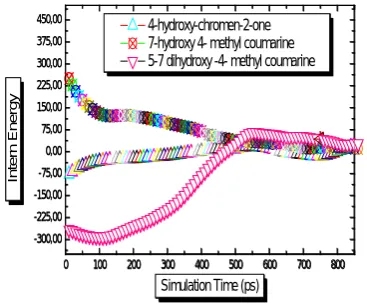
It could be concluded that energy was much more important within the framework where the molecule was substituted by C10H8O4. The value of internal energy decreased according to the nature of the groupings substitute by C10H8O3 was less outstanding by the contribution of C9H6O3. As more drifts of the chromen were substituted, more molecules were less stable, thus their energy was important (Figure 2).
0 100 200 300 400 500 600 700 800 -300,00
-225,00 -150,00 -75,00 0,00 75,00 150,00 225,00 300,00 375,00
450,00 4-hydroxy-chromen-2-one
7-hydroxy 4- methyl coumarine 5-7 dihydroxy -4- methyl coumarine
Int
er
n E
ner
gy
Simulation Time (ps)
0 100 200 300 400 500 600 700 800 -300,00
-225,00 -150,00 -75,00 0,00 75,00 150,00 225,00 300,00 375,00
450,00 4-hydroxy-chromen-2-one
7-hydroxy 4- methyl coumarine 5-7 dihydroxy -4- methyl coumarine
Int
er
n E
ner
gy
Simulation Time (ps)
0,00 5,50E0 1,10E1 1,65E1 -2,4x10⁻¹⁸
-2,2x10⁻¹⁸
-2,0x10⁻¹⁸
-1,8x10⁻¹⁸
-1,6x10⁻¹⁸
-1,4x10⁻¹⁸
-1,2x10⁻¹⁸
-1,0x10⁻¹⁸
-8,0x10⁻¹⁹
-6,0x10⁻¹⁹
-4,0x10⁻¹⁹
-2,0x100,0-19
2,0x10⁻¹⁹
4,0x10⁻¹⁹
6,0x10⁻¹⁹
8,0x10⁻¹⁹
1,0x10⁻¹⁸
4-hydroxy-chromen-2-one 7-hydroxy 4- methyl coumarine 5-7 dihydroxy -4- methyl coumarine
H
am
il
toni
en of
s
y
s
tem
Simulation time(ps)
0,00 5,50E0 1,10E1 1,65E1 -2,4x10⁻¹⁸
-2,2x10⁻¹⁸
-2,0x10⁻¹⁸
-1,8x10⁻¹⁸
-1,6x10⁻¹⁸
-1,4x10⁻¹⁸
-1,2x10⁻¹⁸
-1,0x10⁻¹⁸
-8,0x10⁻¹⁹
-6,0x10⁻¹⁹
-4,0x10⁻¹⁹
-2,0x10⁻¹⁹
0,0 2,0x10⁻¹⁹
4,0x10⁻¹⁹
6,0x10⁻¹⁹
8,0x10⁻¹⁹
1,0x10⁻¹⁸
4-hydroxy-chromen-2-one 7-hydroxy 4- methyl coumarine 5-7 dihydroxy -4- methyl coumarine
H
am
il
toni
en of
s
y
s
tem
Simulation time(ps)
Figure 2. Evolution of the intern energy in NPT unit. : Figure 3. Evolution of the Hamiltonian in NPT unit.
A) 4-hydroxy-chromen-2-one, B) 5-7 dihydroxy -4- methyl A) 4-hydroxy-chromen-2-one, B) 5-7 dihydroxy -4- methyl
3,00k 4,50k 6,00k 7,50k 9,00k -100,0
-50,0 0,0 50,0 100,0 150,0 200,0 250,0
4-hydroxy-chromen-2-one 7-hydroxy 4- methyl coumarine 5-7 dihydroxy -4- methyl coumarine
Pr
es
sur
e/
(K
ba
r)
Simulation time (ps)
Figure 4. Evolution of the pressure in NVT unit:
A) 4-hydroxy-chromen-2-one, B) 5-7 dihydroxy -4- methyl coumarin and C) 7-hydroxy 4- methyl coumarin
In this study, the two states were considered: a) Variation of particles number at cut off ≤ 2.5σ, and b) Variation of cohesion diameter at cut off ≤ 2.5σ with 0.5 nm ≤ σ ≤ 1nm. The thermodynamic properties (P*, U*, H*) were calculated in reduced units based on the related references [8]. All the results have been given in table2.a.b.
Variation of particles number
Table 2a. Thermodynamic properties calculated in reduced units. Pressure P* = P σ-3/ε, Energy of configuration U* = U/Nε,
translation Kinetic Energy EKT* = EKT/Nε., rotational Kinetic Energy EKR* = EKR/Nε.,and Enthalpy H* = H/Nε. CI: cut-off of the box ≤ 2.5σ.
State
point Method N P* EKT* EKR* ET* U* H*
SP1
NVT C9H6O3CI NPT C9H6O3CI 64
0.104±0.102 0.151±0.105
1.750±0.105 1.745±01035
2.805±0.250 2.517±0.200
-5.105±0.054
-5.317±0.050 -6.105±0.050 -6.052±0.045
-7.206±0.055 -7.075±0.205
NVT C9H6O3CI NPT C9H6O3CI 265
0.170±0.152 0.145±0.125
1.025±0.206 1.505±0.105
2.504±0.205 2.503±0.011
-5.502±0.070
-6.410±0.010 -6.0652±0.020 -6.0712±0.035
-6.402±0.316 -7.200±0.350
NVT C9H6O3CI NPT C9H6O3CI 1000
0.241±0.125 0.254±0.25
1.071±0.205 1.502±0.200
2.256±0.275
2.065±0.205 -6.415±0.020 -6.225±0.030
-6.052±0.025 -5.091±0.015
-6.305±0.204 -6.106±0.360
SP2
NVT C10H8O3 CI NPT C10H8O3CI 64
0.255±0.205 0.241±0.207
1.256±0.203 1.573±0.105
1.376±0.207 1.245±0.120
-4.316±0.040
-4.231±0.041 -5.405±0.000 -5.430±0.040
-5.270±0200 -5.250±0.200
NVT C10H8O3rCI NPT C10H8O3CI 265
0.2046±0.205 0.254± 0.201
2.055±0.203 2.102±0.105
2.525±0.221 2.325±0.200
-4.2515±0.040 -4.165±0.040
-5.302±0.020 -5.203±0.015
-5.1715±0.155 -5.295±0.100
NVT C10H8O3CI NPT C10H8O3CI
1000
0.441±0.214 0.425±0.240
2.507±0.107 2.068±0.1045
2.604±0.211 2.715±0.145
-3.709±0.032 -3.462±0.042
-5.305±0.026 -5.208±0.050
SP3
NVT C10H8O4 CI NPT C10H8O4 CI 64
0.351±0.440 0.522±0.284
3.055±0.105 3.066±0.105
0.8055±0.214 0.9045±0.257
-3.705±0.030 -3.605±0.032
-5.707±0.057 -4.605±0.041
-3.425±0.155 -3.704±0.120
NVT C10H8O4 CI NPT C10H8O4CI
265
0.250±0.341 0.2484±0.245
2.500±0.158 3.509±0.100
1.602±0.420 1.554±0.410
-3.924±0.042 -4.566±0.050
-4.606±0.036 -4.500±0.010
-4.300±0.140 -5.2602±0.151
NVT C10H8O4 CI NPT C10H8O4CI
1000
0.369±0.450 0.450±0.325
3.507±0.157 3.605±0.100
2.106±0.240 2.602±0.10
-4.509±0.0402 -4.401±0.041
-4.502±0.035 -4.400±0.010
-4.406±0.150 -5.303±0.127
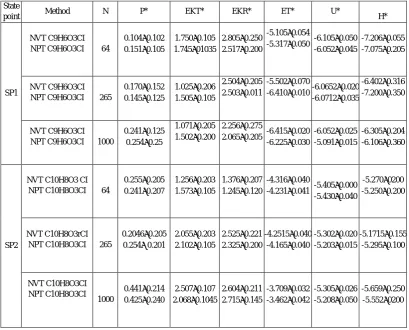
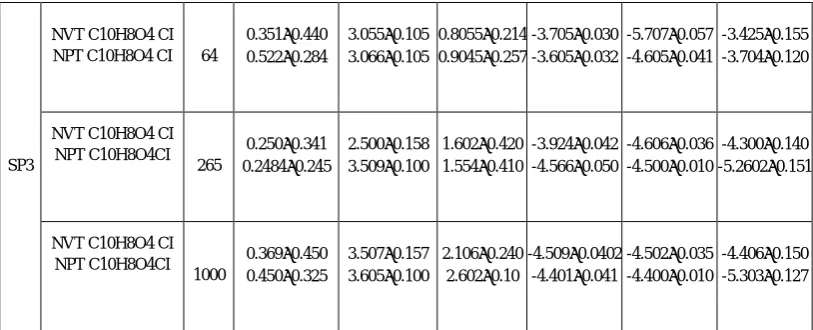
From Table 2a, the molecule that trisubstituted C10H8O4 had very important energy. This coincided well with [9-11]. Unlike the two other systems, i.e, C9H6O3 and C10H8O3 that their obtained energies were low by intake system trisubstitued coumarins. Moreover, it can be noted that the mean values of the energies of translation as well as the rotations of all the systems varied in the same order. This means that the cut of box molecular dynamics at a distance ≤2. 5 σ gave a better discription of the system. Fluctuations of energy for the molecule trisubstituted 5-7 dihydroxy-4-methyl coumarin C10H8O4 were low for a cutoff ≤ 2.5 σ which were respectively for a canonical and the isothermal- isobaric ensembling 0.035 - 0.010. The values obtained for N number of atoms = 1000. However, these fluctuations for N= 50 were important which explained that the significant error varied between 0.057-0.041. In addition, the equations of motion were solved with a constant of integration step Δt = 5E-15. Regarding the variation in the average temperature of translation, the rotation was fixed at the outset of isochors- isotherms ensemble NVT. It could be noted that increasing the number of particles did not affect the system properties mainly for the intern energy and the Hamiltonien system (table 2.a).
b) Influence of cohesion diameter.
Table 2b. Thermodynamic properties calculated in reduced units. Pressure P* = P σ-3/ε, Energy of configuration U* = U/Nε,
translation Kinetic Energy EKT* = EKT/Nε., rotational Kinetic Energy EKR* = EKR/Nε.,and Enthalpy H* = H/Nε.
CI1: cut-off of the box ≤ 2.5σ with σ =0.5nm, CI2: cut-off of the box ≤ 2.5σ with σ =0.7nm, CI3: cut-off of the box ≤ 2.5σ with σ =1 nm
State
point Method Xi % P* EKT* EKR* ET* U* H*
SP1
SP2
NVT C9H6O3 CI1 NPT C9H6O3 CI1 NPT C9H6O3 CI2 NPT C9H6O3 CI3
0.3194
1. 2054±0.04 0.2154±0.050 0.304±0.050 0.364±0.050
3.256±0.41 2.5223±0.10
2.502±0125 2.508±0123
3.589±0355 2.565±0.23 2.475±0.24 2.355±0.24
-6.190±0.124 -6.150±0.105 -6.14±0.410 -6.120±0.125
-7.570±0.050 -6.140±0.050 -6.550±0.054 -6.465±0.040
-6.569±0.205 -6.05±0.204 -6.105±0.25 6.20±0.204
NVT C9H6O3 CI1 NPT C9H6O3 CI1 NPT C9H6O3 CI2 NPT C9H6O3 CI3
0.4850
0.347±0.041 1.540±0270 1.450±0270 1.754±0250
3.575±0.240 2.578±0.155 2.752±0.140 2.648±0.130
3.550±0.250 2.648±0.550 2.040 ±0.152 2.440±0.155
-6.599±0.070 -6.501±0.055 -6.501±0.055 -6.271±0.045
-7.700±0.060 -7.255±0.055 -7.511±0.035 -7.300±0.030
-6.550±0.350 -6.170±0.250 -6.205±0.250 -6.275±0.255
NVT C9H6O3CI1 NPT C9H6O3 CI1 NPT C9H6O3 CI2 NPT C9H6O3 CI3
0.7580
1.554±0.057 0.335±0.222 0.405±0.225 0.305±0.02
3.809±0.240 2.475±0.140 3.570±0.10 2.840±0.140
3.704±0720 3.500±0.500 3.400±0.520 3.120±0.250
-6.757±0.056 -6.607±0.030 -6.554±0.030 -6.544±0.025
-7.575±0.055 -6.460±0.055 -6.800±0.055 -6.700±0.055
-6.755±0.550 -6.257±0.250 -6.254±0.255 -6.150±0.250
NVT C10H8O3 CI1 NPT C10H8O3 CI1 NPT C10H8O3 CI2 NPT C10H8O3 CI3
0.7565
1.525±0.752 1.230±0.050 1.033±0.050 1.214±0.030
3.565±0.50 2.750±0.10 2.472±0.20 2.452±0.10
2.745±0.750 2.541±0550 2.431±0450 2.341±0550
-5.758±0.055 -5.547±0.040 -5.444±0.040 -5.365±0.045
-6.77±0.055 -6.15±0.055 -6.50±0.054 -6.30±0.050
SP3
NVT C10H8O3 CI1 NPT C10H8O3CI1 NPT C10H8O3 CI2 NPT C10H8O3 CI3
0.5250
1.5005±0.04 1.105±0.005 0.205±0.005 0.175±0.005
4.025±0.24 3.515±0.210 3.045±0.150 3.065±0.150
3.658±0.550 2.705±0.220 2.555±0.220 2.405±0.240
-5.154±0.050 4.520±0.052 4.630±0.052 4.220±0.055
-6.404±0.070 -5.255±0.065 -5.472±0.065 -5.62±0.055
-5.255±0.540 -4.750±0.250 4.650±0.255 -4.570±0.250
NVT C10H8O3 CI1 NPTC10H8O3CI1 NPT C10H8O3 CI2 NPT C10H8O3 CI3
0.5240
1.184±0.075 0.154±0.0064 0.175±0.0064 0.122±0.0064
3.805±0.520 3.507±0.250 3.703±0.250 3.605±0.120
2.784±0.550 2.54±0.250 2.305±0.250 2.325±0.250
-3.856±0.040 -3.554±0.025 -3.454±0.045 -3.74±0.042
-4.702±0.052 -4.55±0.030 -4.265±0.042 -4.275±0.030
-3.66±0.250 -3.412±0220 -3.14±0210 -3.10±0220
NVT C10H8O4 CI1 NPT C10H8O4 CI1 NPT C10H8O4 CI2 NPT C10H8O4 CI3
0.7524
0.455±0.032 1.250±0.045 1.370±0.042 1.350±0.045
2.755±0.55 2.455±025 2.35±025 2.275±025
1.575±0.255 1.550±0.255 1.425±0.250 1.320±0.25
-3.755±0.045 -3.255±0.020 -3.325±0.025 -3.425±0.025
-4.750±0.055 -4.525±0.035 -4.535±0.035 -4.145±0.025
-3.552±0.20 -3.241±0.50 -3.154±0.15 -3.105±0.15
NVT C10H8O3 CI1 NPT C10H8O4CI1 NPT C10H8O4 CI2 NPT C10H8O4 CI3
0.3540
0.400±0.040 1.586±0.045 0.150±0.045 0.126±0.045
3.572±0.550 2.754±0.250 2.504±0.150 2.354±0.150
2.570±0.550 1.704±0.200 1.554±0.200 1.404±0.200
-2.708±0.055 -2.705±0.035 -2.554±0.04 -2.534±0.025
-3.750±0.055 -4.500±0.03 -4.450±0.025 -4.020±0.045
-2.405±0.550 -2.501±0.450 -2.041±0.150 -2.301±0.350
NVT C10H8O4 CI1 NPTC10H8O4CI1 NPT C10H8O4 CI2 NPT C10H8O4 CI3
0.2540
0.359±0.075 0.204±0.055 0.270±0.050 0.300±0.055
3.805±0.550 2.562±0.255 2.402±0.155 2.632±0.555
2.544±0.250 2.355±00255 2.452±0.055 2.400±0.225
2.855±0.045 -2.51±0.025 -2.401±0.025 -2.351±0.025
-3.75±0.05 -3.850±0.040 -3.740±0.040 -3.044±0.040
-2.777±0.755 -2.373±0.062 -2.323±0.045 -2.205±0.035
In table 2b, an increase can be seen in the energies of the translation EKT, and the rotation EKR. When the diameter of cohesion equaled 1 nm, the molecule trisubstituted was stable, that was proved by its weak internal energy. When the same molecule was simulated by the same composition by maintaining the diameter equal to 0.5 nm, the latter was unstable or obtained an important energy. On the other hand, in case of the molecules bisubstitued 4-hydroxy-chromen-2-one C9H6O3 and 7-hydroxy 4 - methyl coumarin C10H8O3 with a high composition, these molecules were stable when the system was simulated by a diameter equal to 0.5 nm. It could be concluded from this research that at high proportion and in cases of cutoff ≤ 2.5σ, the evolution of the energies was regular and with low fluctuations, in contrast to the behavior of the system which was substituted. The molecule was substituted by the attractive effects of C10H8O4 on shielding, and the steric gene was stable with a limiting diameter with limps of DM. On the other hand, the best results were obtained for the system of 4-hydroxy-chromen-2-one C9H6O3 and 7-hydroxy 4 - methyl coumarin C10H8O3 where the latter was close to the central molecule (table2b).
Conclusion
In this work, an adapted Lennard-Jones potential model was performed to study many properties of toxic system by molecular dynamics. The MD method was chosen to predict the toxic characteristics much better. Some numerical results for the three toxic products were presented. The spherical performed potential model gave an acceptable description of the thermodynamic and structural properties. Therefore, a good prediction on thermodynamic for the cut-off ≤ 2.5σ was obtained, and the diameter of collision σ was smaller than the possible order of 0.5 nm. So, the important fluctuation for cut-off ≤ 2.5 σ was obtained when the diameter was equal to 1 nm. From the calculated thermodynamic and structural values, it was confirmed that toxic system was in liquid state.
a threshold cut-off of 2.5. There was a high energy, and hence, a destabilization of the system and the fluctuations of this simulated model fitted very well with the experimental data.
This work presented the opportunity to obtain thermodynamic and structural properties with high accuracy which allowed the elucidation of chemical processes in the liquid state. The simulated model in NPT system gave precise results and fitted the experimental data very well. It was hoped that this model at cut-off <2.5 could be an effective model to study the properties of complex systems. The research has been expanded to determine the dynamic viscosity, and the rate of explosion of these products in the liquid state in the air; in the near future, it would be important to see the inhibitory effects on these toxic systems.
References
1. G. P. Morriss, P. J. Daivis, D. J. Evans, Computer simulation study of the comparative rheology of branched and linear alkanes . J. Chem. Phys., 94, 7420-7433 (1991)
2. F. Mesli, R. Mahboub, “Evolution of thermodynamic and structural properties of coumarins by molecular dynamics simulation. J. Pharm. Biol. Chem. Sci. 1, 83 (2010)
3. M. Maladenovié, N. Vukovié, N. Niciforovié, S. Sukdolak, S. Solujié, “Synthesis and molecular descriptor characterization of novel 4-hydroxyl-chromene-2-one derivatives as antimicrobial agents. Molecules 14, 1495– 1512 (2009)
4. T. Uehara, Y. Minowa, Y. Morikawa, C. Kondo, T. Maruyama, I. Kato, N. Nakatsu, Y. Igarashi, A. Ono, H. Hayashi, “Prediction model of potential hepatic carcinogenicity of rat hepatic carcinogens using a large-scale toxic genomics database. Toxicol. Appl. Pharm. 255, 297–306 (2011)
5. Mahboub R. Mahboub M (2012) Effects of Force Fields on the Equilibrium State of 5,7-Dihydroxy-4-MethylCoumarin Comparative Study of Molecular and Langevin Dynamic Simulations. Modern Applied Science 5 :100-110.
6. Kihara T (1963) Convex molecules in gaseous and crystalline states Advances in Chemical Physics. 5:147-188.
7. Lennard-Jones JE (1924) On the determination of molecular fields. Proc. Soc. R. Soc. Lond. A 106:463–477.
8. Belkacem F, Krallafa A (2005) Thermodynamic, structural and transport properties of liquid methane, an extensive molecular dynamics simulation study. J. Soc. Alger. Chem. 15:35-42.
9. Shadman M, Yeganegi S, Ziaie F (2009) Ab initio interaction potential of methane and nitrogen Chem. Phys. Lett. 467: 237–242
10. Evens DJ, Morriss GP (1984) Non-Newtonian molecular dynamics Comput. Phys. Rep. 1: 297 343.