An Assessment of the Safe Delivery Incentive
Program at a Tertiary Level Hospital in Nepal
Background: Maternity incentive program of Nepal known as Safe Delivery Incentive Program (SDIP) was
introduced nationwide in 2005 with the intention of increasing utilization of professional care at childbirth. The
program provided both childbirth service as well as ‘cash’ to women giving birth in a health facility in addition to
incentives to health provider for each delivery attended, either at home or the facility. Due to a lack of uniformity in
its implementation and administrative delays, the program was reformed and even extended to many not-for-profit
health institutions in early 2007, and implemented as a ‘Safer Mother Program’ popularly known as
“Aama-Suraksha-Karyakram” since January 2009.
Methods: This is a system research with observational and analytical components. Plausibility design is selected to
evaluate the performance-based funding (PBF) as a system level intervention of maternity care using two instruments:
Pay-For-Performance and Conditional-Cash-Transfer. It uses interrupted time-series to control for the natural trend.
Research tools used are interviews, the focus group discussions and literature review. Numerical data are presented
in simple graphs. While online random number generator was used partly, the purposive sampling was used for
qualitative data.
Results: There is a gross discrepancy in non-targeted service delivery at the tertiary level health facility.
Overflooding of maternity cases has hampered gynecological admission and surgical management delaying
subspecialty care and junior physicians’ training. With the same number and quality of physical facility and human
resource, the additional program has put more strains to service providers and administrators.
Conclusions: There should be adequate planning and preparation at all levels of health facilities; implementing a
new program should not adversely affect another existing service delivery system. For the optional implementation,
hospital organogram should be revised; and physical facilities and the low-risk birthing-centers with referral linkages
should be expanded.
Keywords: impact; incentive; maternity; safe-delivery; system research
Baral G
11Paropakar Maternity and Women’s Hospital and National Academy of Medical Sciences, Kathmandu, Nepal.
Correspondence:
Gehanath Baral, Paropakar Maternity and Women’s Hospital
and National Academy of Medical Sciences, Kathmandu, Nepal. Email:
[email protected],
ABSTRACT
INTRODUCTION
Health system research according to the WHO “Framework for Action” comprises of six building blocks, which are used in this study to understand functioning of the system They are: effective, safe and quality service delivery; adequate and efficient health workforce; regular health information practice; safe, cost effective
and quality medical technologies; adequacy of health financing; and efficient leadership and governance. Research tools have been designed based on these parameters.1,2
Nepal's Safe Delivery Incentives Program (SDIP), formerly known as the Maternity Incentives Scheme, was launched
J Nepal Health Res Counc 2012 Jan;10(20):118-24
Original
in 2005, with the aim of raising the coverage of skilled birth attendance. It marked a departure from the past government policy that tended to focus predominantly on service delivery without any serious concern for demand side barriers. The establishment of the SDIP was a response to mounting evidence of the high cost faced by the households trying to access care at childbirth and the low coverage of skilled birth attendance (20%).3 The success of the conditional cash transfer programs in Latin America has led to an enthusiastic response in Nepal.4 To overcome administrative delays and non-uniform implementation, this program was reformed in early 2007 and implemented as a ‘Safer Mother Program’ since January 2009. This program is running successfully all over the country so much that it has been extended to many semi-private/private teaching hospitals. DFID, a British co-operation, is funding the program excepting neonatal and gynecological services. Such incentive-driven program was in place since 2005 with strict criteria before making universal in January 2009.5-22
By the principle of Performance-based Funding (PBF) as a system-level intervention, and using a paying-for-performance and cash transfer instrument, the current program has been interpreted as a demand-side incentive that promotes institutional safe delivery services. The intervention, however, is not as successful to promote supply-side incentive and the health system as a whole.1,4
Paropakar Maternity and Women’s Hospital (PMWH) is the only government hospital in Kathmandu exclusively providing gynecological and obstetrics services with 415 beds. Every reproductive health program will be launched from this hospital by government. This is the training site for all of reproductive health packages including maternal and neonatal health in the country. The hospital not only provides specialty services and serves as a posting site for the residents of Anesthesiology and Pediatrics, but offers the academic programs like postgraduate diploma and masters in obstetrics and gynecology as well.23
The hospital earlier had both paying and non-paying beds. But in order to promote institutional deliveries in line with MDGs 4 and 5, government has been providing all services for childbirth and pregnancy and postpartum complications free of cost for the last two years. The program also covers transportation costs for patients after childbirth. This program was implemented even at this tertiary level referral center ignoring rest of the health facilities including gynecological services, human resources, organogram and infrastructure.
Work load at health facilities is increasing while the infrastructure and the number of service providers
METHODS
This is a non-interventional study carried out atPMWH, a public hospital for maternity and women’s health care. Institutional review committee (IRC) of the hospital has approved the study and the respondents were adequately informed of the objectives and purposes before obtaining verbal consents.
It is a qualitative research with interrupted time series, which is a type of plausibility design. Both observational and analytical components are incorporated to evaluate the system of funding (PBF).1,2 Plausibility design, as an optional evaluation design for the pay-for-performance (P4P) intervention, is characterized by interrupted time-series which allows evaluator to control for the natural trend that would have occurred anyway. A conceptual framework was formulated based on the ‘system thinking approach’ to study three aspects of services: target services (maternity care), non-target services (gynecological care) and sub-system equilibrium (hospital support system) (Chart 1).1
Flow Chart 1. Chart showing conceptual framework1
clients’ satisfaction level. The study was carried out from May to October 2011 and all data were collected in nearly all conditions since 2003 to see a general trend. Service delivery parameters in the last two years (2009/10) were compared to the period prior to the initiation of the program (2007/8).
To compare clinical information records in 30 case files in each group, a three-step randomization was done to select particular month, week and file by using a random number generation online tool available at http://www. randomizer.org/form.htm. Data have been projected in the simple diagram using in-built tools of Microsoft Office. Responses received on qualitative information from purposive sampling have been quantified and used for discussions.
RESULTS
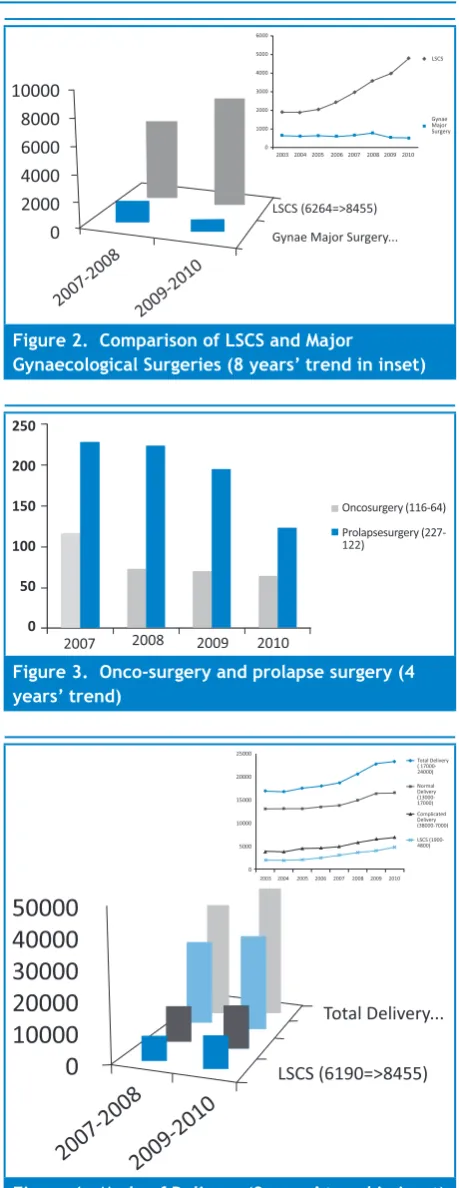
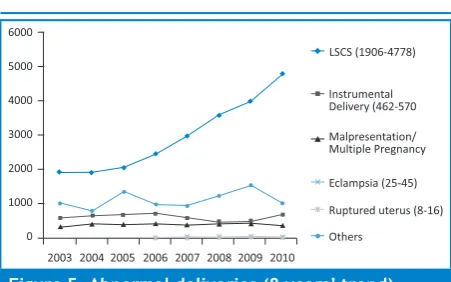
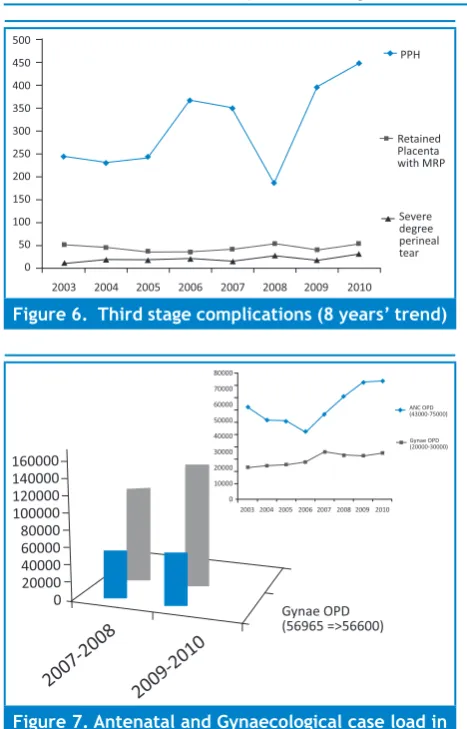
Safer Mother Program has both positive and negative impacts on all aspects of existing service delivery system in the hospital. The program’s target is achieved on the following parameters. There are significant increases in total hospital delivery (17.8%) and complicated deliveries (26.4%) with 35% increase in Cesarean Section physically (Figure 1-5). Though the number of third stage complications are increased in number, their proportion has remained the same (PPH = 1-2%, MRP = 0.1-0.2%, Severe degree perineal tear = 0.06-0.12% of abnormal deliveries) for the last 8 years (Figure 6). There is no change in the rate of NND, SBR, PNR and MMR. Antenatal attendants and obstetrics admissions are increased by 29.2% and 16.6% respectively.
Figure 1. Obstetrics and Gynecological admissions (4 years’ trend)
Figure 2. Comparison of LSCS and Major
Gynaecological Surgeries (8 years’ trend in inset)
Figure 3. Onco-surgery and prolapse surgery (4 years’ trend)
Figure 5. Abnormal deliveries (8 years’ trend)
There are noteworthy unwanted effects as well. Waiting time is long in emergency room for laboring patients due to shortage of beds (40% had to wait for >4 hours). Forty percent had inadequate record of FHR monitoring. Doctors were found to be physical and mentally exhausted during their duty/call days with minimal time to monitor apparently low risk cases. Essential patient care was compromised due to inadequate infrastructure, beds, and the number of doctors and nurses for several years.
Towards non-obstetric services, which are not the primary program targets, even though the hospital has made genital prolapse and cancer surgeries free of cost the shortage of operation rooms has not allowed to accommodate all patients. Gynecological admissions and surgeries have decreased by 9% and 17% respectively (Figure 3). Gynecological OPD cases have decreased a little as there is no space to expand subspecialty services further (Figure 7). Trainees were lacking adequate gynecological exposure and long waiting periods for poor patients needing surgery was evident.
The program has mixed effects in the hospital dynamics as a whole. The hospital has become a good training center since it is the only government hospital with maternity and women’s health services where new reproductive programs are introduced and implemented attracting a large number of clients. Despite these positive impacts there are certain shortcomings: a high volume of low-risk births does not normally allow specialist care to high-risk cases, the non-obstetric (gynecological sub specialty) service could not be maximized and a need-based personnel management system in the hospital was lacking.
DISCUSSION
Both positive and negative perceptions were recorded
were not carried out in absence of governing local authority for hospital management for years. It had to accept and execute the program before putting proper arrangements in place.23
Although accounting and financial issues were dealt on a daily basis, exact account of the free service could not be recorded in the absence of a credit-billing system. The financial rule requiring the purchase of medicines from the lowest bidder had resulted in low quality and untimely supplies. Wards, where medicines were often sent, were not keeping updated inventories leading to loss, duplications, or, in some circumstances, the stocks even ended up being recycled.
Over 75 obstetrics admissions and indoor requisition of emergency testing round the clock compromised quality report at times. Obstetricians/Gynaecologists had expressed dissatisfaction over the disproportionately changing service delivery pattern. Existing operating rooms shared by obstetrics and gynaecology had been reversed from 1:2 to 2:1 due to the increasing number of operative deliveries (8-20 Caesarean Section daily). The number of major gynaecological surgeries was reduced by half. The hospital figures also showed that the number of obstetrics and gynaecological admissions had changed towards opposite directions each other as there was a clear 17% increment in obstetrics cases compared to 9% reduction in gynaecological cases. Likewise, Caesarean Section (CS) was increased by 36.6% whereas gynaecological surgeries decreased by 17%. Annual onco-surgery and genital prolapse surgeries were decreased from 116 to 64 and 227 to 122 respectively from 2007 to 2010. CS was in increasing trend since 2006 when the incentive scheme was started with strict criteria, then continued in a linear path after the program became universal in 2009 (Figure 1-3) Complicated deliveries almost doubled (from 14.7 to 26.4% to) than normal deliveries leading to 36.6% increase in the number of operative interventions. Though the third stage complication rate has not changed, number of PPH rose steeply up requiring more time and resources for the intervention (Figure 4-6).
Figure 6. Third stage complications (8 years’ trend)
Figure 7. Antenatal and Gynaecological case load in OPD (8 years’ trend in inset)
Likewise, neonatologists often faced problems dealing with neonatal morbidity due to high expectation of clients to be treated free-of-costs in all cases. Maternal mortality ratio has not changed; perinatal (18.6-11.9‰) and neonatal mortality (16.8-21.2‰) were in decreasing trends since 2008 with a slightly increased still birth rate (Figure 8). Asphyxia/Respiratory Distress Syndrome, LBW/prematurity and sepsis were the major causes of NICU admissions. Likewise, birth asphyxia, prematurity and infections were the top three causes of NNDs.
Junior physicians who were working in the hospital and getting specialty training hade mixed remarks on the program. They preferred to learn obstetrics management from normal delivery than caesarean section because of increased cases in the hospital. At the same time, they were unhappy about the limited exposure to gynaecological surgical management due to compromised states of the service. The need to discharge the normally delivered patients early, two-three times a day, had resulted in inadequate postnatal care and counselling.
NB. Horizontal label represents initial of each month,
LBW=low birth weight, IUFD=intrauterine foetal
death, SB=stillbirth
Figure 8. Four years trend of birth from Jan 2007-2010 Dec
Comparison of 60 randomly selected in-patient charts with those of the past two years revealed inadequate documentation [χ2 (df =1) =0.406=0.05<p<0.10]. While seven had normal delivery immediately after admission and were discharged the same day in the study period, there were only four such cases two years earlier. It had become more difficult to trace patient attendants when needed, as they were not allowed to stay inside owing to space constraints. There was also no visitors' waiting room in the hospital. Similar responses were obtained from emergency room medical officers and on-duty registrars. Due to overflowing patients and limited number of beds, shortening of emergency waiting time was proving difficult. The data shows that 40% of patients had >4 hours of waiting time in emergency room against 20% [χ2 (df =1) =2.1454=0.05<p<0.10] and 40% had inadequate FHR monitoring against 25% two years earlier [ χ2 (df =1) =1.4818=0.05<p<0.10].
The cases referred from outside Kathmandu valley were also coming to the hospital, which included women with complicated pregnancies without regular ANC visits, and with regular ANC visits in private hospital but indicated for Caesarean Section. It had added extra burden to already overloaded hospital services. Complicated delivery had increased by 26.4% and Caesarean Section by 36.6%. There was no system to refer patients to another facility once they entered the hospital. Once entered, the patients were often unresponsive even to counselling to leave the premise. Obstetrics case admission had increased by 16.6% in two years. Half of the cases were under the low risk category, but the rest needing close monitoring had been diluted.
was observed that SES was inversely proportional to patients’ satisfaction level irrespective of degree of complications. Satisfaction level was measured in three scales only: low, middle and high. Two women - one with Caesarean Section and another with normal delivery- with low SES had satisfaction level higher than expected for they received free of cost services. Three patients at middle SES had mid-level of satisfaction: they complained of longer waiting time, overcrowded wards, less frequent monitoring and inadequate infrastructure, but showed confidence in the specialists. They also thought medicines supplied were of low costs and meant for poor people. This remark is very much valid as there is no discrimination from the supply side. Another woman with a good SES showed mid-level satisfaction as she had to wait for her planned Caesarean Section. The facility was overloaded with emergency cases and there was hardly enough time to prepare operating table for subsequent surgeries.
Of the four antenatal patients outdoor, three had low-level and one had high-low-level satisfactions. The latter had pregnancy complications and was promptly undergone surgery. The former three had to wait for hours but got only few minutes (<5 min) of check-up; only one with senior doctor and they had to wait for a week to show their test report as the respective unit has ANC outdoor consultation schedule only once a week. It shows that apparent pregnancy complication was dealt promptly but chances of missing in crowd are plenty.
Amongst four gynaecological cases, one had low satisfaction level as she did not get an earlier date for cancer surgery and went elsewhere; two had mid-level satisfaction for non-cancer surgeries. They had waited for one-two months and faced difficulties for coming without their guardians; and one had high-level satisfaction as she obtained the date the same day - for someone else did not turn up.
CONCLUSIONS
Safer Mother Program has been received well as demonstrated by ever increasing institutional deliveries, but the system equilibrium is found to be disturbed. Existing components of service delivery-except maternity care- had been ignored at the time of intervention. This study provides certain recommendations to bridge the gaps in the system. There is a need of separate birthing center for low risk cases and referral linkages in
unavailability of beds will not be injustice for the care seekers. Financial documentation in the form of credit bill will be of help for cost analysis.
ACKNOWLEDGEMENTS
I acknowledge residents, colleagues, account section, library unit, medical record section and patients helping me to collect data; hospital IRC for allowing me to carry out the study and the Professors Lotta Mellander (Gothenberg University), Stefan Peterson (Karolinska
Institute) and Uwe Ewald (Uppsala University) from International Training Program of Swedish International Development Agency for their mentorship.
FINANCIAL SUPPORT
None.
CONFLICT OF INTEREST
None declared.
REFERENCES
1. World Health Organization. Systems thinking for health systems strengthening. France; 2009
2. Gonzalez-Block MA. Health policy and systems research agendas in developing countries. Health Res Policy Syst. 2004 Aug 5;2(1):6.
3. Powell-Jackson T, Morrison J, Tiwari S, Neupane BD, Costello AM. The experiences of districts in implementing a national incentive programme to promote safe delivery in Nepal. BMC Health Serv Res. 2009;9:97.
4. Glassman A, Todd J, Garder M. Performance-Based Incentives for Health: Conditional Cash Transfer Programs in Latin America and the Caribbean. Washington DC: Center for Global Development; 2007
5. Safer Mother Programme Working Guideline-2065/2009. Kathmandu: Family Health Division, Department of Health Services, Ministry of Health & Population, Government of Nepal; 2009
6. National Safe Motherhood and Newborn Health Long Term Plan (2006-2017). Family Health Division, Department of Health Services, Ministry of Health and Population; 2006.
11. Five -Year Operational Plan for In-service Training of Skilled Birth Attendants. Kathmandu: National Health Training Center, Ministry of Health and Population, Government of Nepal; 2009 12. Powell-Jackson T, Neupane BD, Tiwari S, Morrison J, Costello
AM. Evaluation of the Safe Delivery Incentive Programme: Final Report of the Evaluation. Kathmandu: Support to Safe Motherhood Programme, Nepal; 2008.
13. Increasing Access to Essential Obstetric Care: A Review of Progress and Process. UK aid for Department for International Development (DFID); 2004
14. Quality of Care Assessment Study for Nepal Safer Motherhood Project and Family Health Division. Kathmandu: Ministry of Health and Population; 2004.
15. Operational Guidelines on Incentives for Safe Delivery Services 2062. Kathmandu: Family Health Division, Department of Health Services, Ministry of Health & Population, Government of Nepal; 2005.
16. Ministry of Health and Population, New ERA, Macro International Inc. Nepal demographic and health survey 2006. 2007.
17. Sharma SK, Sawangdee Y, Sirirassamee B. Access to health: women's status and utilization of maternal health services in Nepal. J Biosoc Sci. 2007 Sep; 39(5):671-92.
18. Barker CE, Bird CE, Pradhan A, Shakya G. Support to the Safe Motherhood Programme in Nepal: an integrated approach. Reprod Health Matters. 2007 Nov; 15(30):81-90.
19. McPherson RA, Khadka N, Moore JM, Sharma M. Are birth preparedness programmes effective? Results from a field trial in Siraha district, Nepal. J Health Popul Nutr. 2006 Dec; 24(4):479-88.
20. Gupta I, Joe W, Shalini R. Demand Side Financing in Health: How far can it address the issue of low utilization in developing countries? World Health Report (2010) Background Paper, No 27. World Health Organization; 2010
21. Timothy PJ, Joanna M, Suresh T, Neupane BD, Costello AM. The experiences of districts in implementing a national incentive programme to promote safe delivery in Nepal. BMC Health Services Research 2009; 9:97
22. ‘SMARIKA’ (Annual hospital publication). Kathmandu: Paropakar Maternity and Women’s Hospital; cited since 2003 to 2010. 23. Powell-Jackson T, Tiwari S, Neupane BD, and Dangol M. Early