e-ISSN: 2250-3021, p-ISSN: 2278-8719
Vol. 3, Issue 10 (October. 2013), ||V3|| PP 32-36
Experimental Technique with a Pyramidal Indenter
Demonstrating The Development of Pyramidal-Shaped Crevice
Corrosion In Inconel 600
Aezeden Mohamed
Faculty of Engineering and Applied Science, Memorial University, St. John's, NL, A1B 3X5, Canada
Abstract: - Inconel alloy 600 is widely used in applications requiring its excellent crevice corrosion resistance, e.g. with corrosive solutions. Cyclic polarization tests were carried out on Inconel work pieces immersed in a 5.5% NaCl solution at a temperature of 35±5oC. One group of work pieces workpiece incorporated diamond pyramid hardness indentations while the other group of the workpieces did not. Hysteresis loops obtained from cyclic polarization test scans indicated passive film breakdown and non-passive film breakdown in work pieces with and without hardness test indentations, respectively.
Microstructural observations indicated that all workpieces with the hardness test indentations developed crevice corrosion in the pyramidal indentations. Furthermore, microstructural observations revealed clearly developed dendritic structures in both indented and non-indented workpieces.
Keywords: - Crevice, corrosion, dendrites, Inconel, work piece.
I. INTRODUCTION
Inconel alloys belong to a family of austenitic nickel-chromium based super alloys. They are widely used in highly corrosive environments because of their excellent corrosion resistance [1-3].
1.1 Crevice Formation
Even though these alloys have excellent crevice corrosion resistance, in some applications Inconel alloy has been shown to be subject to crevice corrosion. This type of corrosion occurs when there are crevice environments in the workpiece such as a joint, and pits formed by any types of indentation due to hardness testing. Prevention or amelioration of such conditions defects will reduce crevice resistance. No matter how minor the surface crevice, the resulting corrosion result can lead to failure even in work pieces of Inconel [4-8]. Diamond pyramid hardness indentation can be an excellent test method for the evaluation of the potential for surface crevice corrosion from exposure to corrosive solutions. The diamond pyramid hardness indentation is chosen because it has a shallower depth and smaller size indenter than others indenters like Rockwell hardness [9-12]. Furthermore, it has a unique pyramidal shape which cannot be confused with any other type of surface defects like pores or voids.
1.2 Dendritic Formation
The effect of microstructure on metallic alloy corrosion behavior and hence on the mechanical properties has been reported in different studies, especially the relation between dendritic structures and corrosion behavior [13-15].
It is well known in cast alloys that the cooling rate during solidification influences the formation of dendritic structures which can affect the corrosion behavior of alloys [14, 15]. From the literature it is reported that the microstructural characteristics of dendritic structures can be observed during corrosion tests [14–19]. Most of the materials studied and reported in the literature found dendritic structure in casting alloys.
The current study introduces an experimental technique with a pyramidal indenter for the assessing the potential for the formation of crevice patterns on workpieces with diamond hardness test indentations in a corrosive solution. Comparisons of the observations are made for workpieces with or without hardness indentations. In addition to the study of these “defects” which was the main objective, dendritic structures were also observed on both types of work pieces (i.e. with and without hardness indentations), which is not a common observation in wrought alloys.
II. MATERIAL AND EXPERIMENTAL PROTOCOL
with acetone in an ultrasonic bath for at least 15 minutes before immersion in a 5.5% sodium chloride solution (NaCl) at a temperature of 35±5oC.
Cyclic polarization measurements were performed using a conventional three electrode cell with a platinum plate as an auxiliary electrode and a saturated calomel electrode (SCE) as a reference electrode [20]. The exposed area of the working electrode to the 5.5 % NaCl solution was 1.27cm2.The work pieces were then cleaned in distilled water before placing them into the work piece holders. Placement was such that the Luggin capillary of the reference electrode was close to and facing the working electrode. The same set up was used for all work pieces.
III. RESULTS AND DISCUSSION
3.1 Cyclic Polarization Plots
Figure 1 show cyclic polarization test plots of the Inconel alloy work pieces. A comparison was made of crevice corrosion in the two different work pieces, i.e. with and without indentations. Distinct differences were noted. As can be observed from the hysteresis loop of the work piece with indentations there is a passive region during the initial stage followed by passive film breakdown, whereas, for the work piece without indentations, the hysteresis loop exhibited a straight passive region without breakdown.
It was also found that the larger hysteresis loop was associated with the work pieces with indentations. The larger hysteresis loop indicates that the indented work piece is susceptible to surface crevice corrosion.
As is indicated from Figure 1, the workpiece or component made of Inconel alloy experienced accelerated crevice corrosion in a corrosive environment when the metal surface is indented, scratched, or contained pores. Generally, the electrolytes penetrate the indentations or other defects such as pores and micro cracks. Therefore, in order to have the remarkable corrosion resistance of Inconel alloy surfaces, they must be free of pores and micro cracks.
100 101 102 103 104 105 106
-0.4 -0.2 0.0 0.2 0.4
Po
te
n
tia
l (Vo
lts)
Current density (NA/cm
2)
Workpiece with hardness indentation
Workpiece without hardness indentation
Figure 1 Cyclic polarization plots of Inconel work pieces, (a) work pieces with diamond pyramid hardness indentations, showing passive film breakdown and larger hysteresis loop, (b) work pieces without diamond
pyramid hardness indentations, showing no passive film breakdown and smaller hysteresis loop.
3.2 Microscopic Observations
From these observations, it was again demonstrated that the work piece or component made of Inconel alloy experienced accelerated crevice corrosion where it was indented, scratched, or contained pores. It was also observed that the localized surface crevice corrosion mirrored the pyramidal geometry of the initial indentation. These microscope observations again showed that in order to have perform with high corrosion resistance, the surface of the Inconel alloy must be free of pores, microvoids, and hardness indentations.
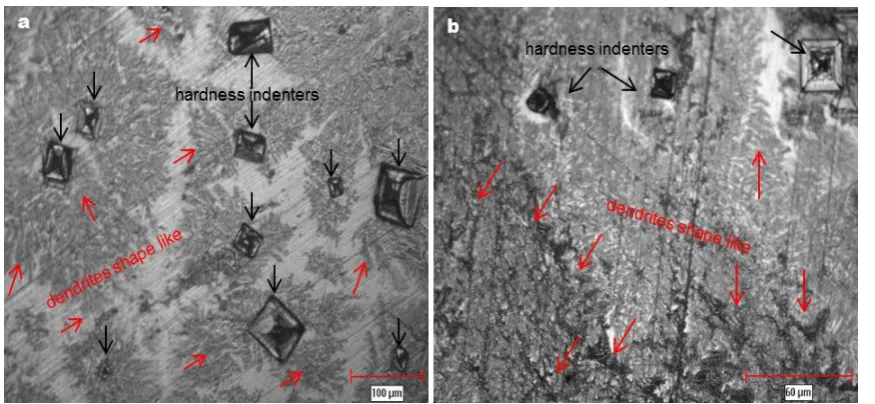
Dendritic structures were also observed on the surfaces of work pieces prepared with indentations (Figure 2 (a)). They are often observed as dark areas and typically initiate along grain boundaries.
Figure 2 Micrographs of Inconel workpieces with diamond hardness indentation after corrosion test at (a) low magnification and (b) high magnification.
The formation of the surface morphologies of the dendritic patterns (Figure 3 and Figure 4) may due to dissolved alumina (Al2O3) and chromium (Cr2O3) on the surface of the work pieces during interaction between the electrolyte and work piece.
It has been reported that the extent of dendritic structures decreases drastically during ladle metallurgy in steel as the morphology not only depends on the activity of oxygen and aluminum which form alumina (Al2O3), but also on the relative content of reaction elements [21]. For alloy steel, deoxidization of alloy steel increases alumina oxide activity and hence leads to rapidly decreasing oxygen activity with the formation of dendritic structures of aluminum oxide.
Though the phenomenon of dendrites is already well known in steel, dendrites of alumina (Al2O3) and chromium (Cr2O3) in Inconel alloys have not been studied in detail.
Figure 3 Micrographs of Inconel work pieces after corrosion test, (a, c) showing dendritic structure and pyramidal shaped surface crevice corrosion in indentations at low magnification, (b, d) work pieces showing
surface crevice corrosion pattern in indentations at high magnification.
Figure 4 showing work pieces without the hardness indentations, reveals no surface crevice corrosion. However, dendrite structures were formed on the surface. These dendrites initiated and grew along grain boundaries as shown in Figure 4 (a), 4 (b).
Figure 4 (a, b) are micrographs of Inconel work pieces without diamond hardness indentations showing dendritic structures developed along grain boundaries at (a) low magnification, (b) high magnification.
Further studies on dendritic structures in alloy steel have been reported [22-25], from which it has been concluded that the formation of dendritic structures is due to iron-manganese oxides, which are present prior to deoxidization with aluminum, when they become more aluminum rich and transform into inclusions after deoxidization. These inclusions depend on the amount of manganese alloying added to the steel. Researchers have also found that increasing the amount of aluminum alloying added to the steel can produce further deoxidization and hence the formation of more aluminum oxide (Al2O3) which precipitates in the form of inclusions [22-25].
IV. CONCLUSION
REFERENCES
[1] H. Shah Hosseini, M. Shamanian, and A. Kermanpur, Characterization of microstructures and mechanical properties of Inconel 617/310 stainless steel dissimilar welds, Material Characterization, 62, 2011, 425– 431.
[2] F. Jalilian, M. Jahazi, and R. Drew, Microstructural evolution during transient liquid phase bonding of Inconel 617 using Ni–Si–B filler metal. Material Science Engineering A, 423, 2006, 281–269.
[3] A. K. Roy, and V. Marthandam, Mechanism of yield strength of Inconel 617. Material Science Engineering A, 517, 2009, 276–280.
[4] Y.I. Kim, H.S. Chung, W.W. Kim, J.S. Kim, and W.J. Lee, A study on pitting corrosion of TiN-coated Inconel 600 by immersion test in high temperature chloride solutions. Surface and Coatings Technology, 80, 1996, pp. 113–116.
[5] C. Cibert, H. Hidalgo, C. Champeaux, P. Tristant, C. Tixier, J. Desmaison, and A. Catherinot, Properties of aluminum oxide thin films deposited by pulsed laser deposition and plasma enhanced chemical vapor deposition, Thin Solid Films, 516, 2008, 1290 1296.
[6] M. Zaytouni, and J.P. Rivière, Wear reduction of TA6V produced by SiC coatings deposited by dynamic ion mixing, Wear, 197, 1996, 56-62.
[7] Y. Li, J. Yao, and Y. Liu, Synthesis and cladding of Al2O3 ceramic coatings on steel substrates by a laser controlled thermite reaction, Surface and Coating Technology, 172, 2003, 57-64.
[8] T.J. Zhu, L. Lu, and M. O. Lai, Pulsed laser deposition of lead-zirconate-titanate thin films and multilayered heterostructures, Applied Physics,A, 81, 2005, 701-714.
[9] V.S. Sastri. Corrosion inhibitors–principles and applications. (John Willy and Sons, Chichester, 1998). [10] S.W. Dean, Electrochemical techniques for corrosion. R. Baboian, Ed., National Association of
Corrosion Engineers, Houston, TX, USA, 1977, 52–60.
[11] J. Tauc, F. Abels Ed., Optical Properties of Solids (North-Holland, Amsterdam, 1972).
[12] ASTM G3., Standard recommended practice for conventions applicable to electrochemical measurements in corrosion tests, 1989.
[13] J.M.V. Quaresma, C.A, Santos, and A. Garcia, Correlations between unsteady-state solidification conditions, dendrite spacing, and mechanical properties of Al-Cu alloys. Metallurgical Material Transaction A31, 2000, 3167–3178.
[14] W. R. Osório, C. M., Freire, and A., Garcia, The effect of the dendritic microstructure on the corrosion resistance of Zn–Al alloys. Journal of Alloys Compound, 397, 2005, 179–191.
[15] W. R. Osório, J. E. Spinelli, N. Cheung, and A. Garcia, Secondary dendrite arm spacing and solute redistribution effects on the corrosion resistance of Al-10wt%Sn and Al-20wt%Zn alloys, Material Science Engineering A420, 2006, 179–186.
[16] W. R. Osório, C. M. Freire, and A. Garcia, Effects of the longitudinal and transversal structural grain morphologies upon the corrosion resistance of Zn and Al specimens, Review Metal, Madrid, 2005, pp.176–180.
[17] G. Song, A. Atrens, and M. Dargusch, Influence of microstructure on the corrosion of die cast AZ91D, Corrosion Science, 41, 1999, 249–273.
[18] G. Song, A. L. Bowles, and D. H. St John, Corrosion resistance of aged die cast magnesium alloy AZ91D, Material Science Engineering A, 366, 2004, 74–86.
[19] P. R. Goulart, W. R. Osório, J. E. Spinelli, and A. Garcia, Dendritic microstructure affecting mechanical properties and corrosion resistance of an Al-9 wt% Si Alloy, Materials and Manufacturing Processes, 22, 2007, 328–332.
[20] C. Sujaya, H. D. Shashikala, G. Umesh, and A. C. Hegde, Hardness and electrochemical behavior of ceramic coatings on Inconel, Journal of Electrochemical Science Engineering 2, 2012, 19-31.
[21] Rob Dekkers, Non-metallic inclusions in steel, Chapter 2, Ph.D., Thesis, Katholieke Universiteit Leuven, Leuven, Belgium, 2002.
[22] V.G. Gavriljuk, H. Hanninen, A.S. Tereshchenko, and K. Ullakko, Effects of nitrogen on hydrogen-induced phase transformations in stable austenitic steel. Scripta Metallurgica et Materialia, 28(2), 1993, 247–252.
[23] S.W. Robinson, I.W. Martin and F.B. Pickering, Formation of alumina in steel and its dissemination during mechanical working. Metals Technology, 6, 1979, 157-169.