INTRODUCTION
Traditional gold mining (TGM) was a prac-tice in Sudan since the old times in Merowe and Nubian kingdoms in the third century BC. The practice of gold mining was also found in the eastern Sudan by the Bijah and some Arab im-migrants as well as in the Red Sea Mountains (Sudanow Magazine 2016). The campaigns or-ganized by foreign countries such as Egypt and Britten were the main cause for their invasion on
the Sudan. The gold mining practices were very much limited in the past until Sudan was divided into the North Sudan and South Sudan in 2011. Prior to secession, Sudan discovered the pres-ence of petroleum and its revenue was directed to finance the country’s budget. The contributions of petroleum helped in gross national product of both North and South when Sudan was one coun-try. As a result of the secession, the North Sudan lost over 50% of the petroleum revenue and since then experienced serious economic crises which Accepted: 2018.11.06 Available online: 2018.12.10
Volume 20, Issue 2, February 2019, pages 106–115
https://doi.org/10.12911/22998993/96275
Consequences of Mercury Used by Artisanal and Small-Scale Gold
Mining Processes a Case of River Nile State Sudan
Ali M.A. Ahmed
1, 2*, Purwanto Purwanto
1, 3, Henna Rya Sunoko
1, 41 Doctorate Program of Environmental Science, School of Postgraduate Studies, Diponegoro University,
Semarang, Indonesia
2 Department of Applied Chemistry and Chemical Technology, Faculty of Engineering and Technology,
University of Gezira, Wad Medani Sudan
3 Department of Chemical Engineering, Faculty of Engineering, Diponegoro University, Semarang, Indonesia
4 Department of Pharmacy, Faculty of Medicine, Diponegoro University, Semarang, Indonesia
* Corresponding author’s e-mail: [email protected]
ABSTRACT
On the discovery of gold reserves in 14 states in Sudan, traditional gold mining suddenly started to flourish and
hundreds of thousands of laymen became engaged in gold extraction. The new source of revenue generation added much to the empty treasury and the loss in petroleum revenue due to cessation of the south in 2011 could thus be
compensated. Since gold extraction by artisanal and small-scale gold mining does not require much finance or
advanced technology, it suited unskilled workers and many young people found their way into the new business. Although gold extraction generates high revenues, the use of mercury in gold extraction poses much threat to the
environment and general health of miners and the surrounding areas. The research tries to investigate the effects of
traditional gold mining in Alebedia area, Berber Locality in the River Nile State. The investigation includes A/ the
effects of extraction methods on the environment and general health. B/ the level of education and its distribution within the miners and how it affected the awareness of the miners about the dangers of mining activities. C/ the pe -riod of stay that miners spend in the mining area its contribution on the awareness about the dangers and diseases
in-flicted on the miners, D/ the effects of traditional gold mining activities on natural environmental impacts and E/ the effects of the meteorological and topographical factors, the distribution and concentration of mercury in the area and their effects on the environment and general health. The research adopted the techniques of using random sampling and quantitative qualitative in addition to the analytical techniques. The research finally concluded that traditional gold mining has positive effects on the economic side and negative effects on the environment and general health.
affected the country economic and social stabili-zation. This was aggravated by the sanctions en-forced on the country by the USA. Many sectors in the country, especially agriculture and industry, were affected and the country was at the edge of economic collapse but suddenly new hopes ap-peared by the discovery of gold at everywhere in Sudan. Traditional gold mining has flourished and hundreds of thousands of people, most of whom were laymen, were engaged in gold extrac-tion. The economy witnessed migration from in-side and outin-side Sudan into the new open source of income. The new source of revenue added to the treasury as much as the loss in the petroleum revenue (Sudanow Magazine, 2014), (African Mining Brief, 2014). Gold extraction does not require much finance or advanced technology (Massaro & Theije 2018). Therefore, it suited the unskilled workers to reap high levels of income (Betancur-corredor et al. 2018). Gold extraction processing had hazardous effects on the human health and environment through its use of mer-cury (Rava & Ramirez 2018). The present paper investigates the effect of the mercury use in the extraction of gold by traditional gold mining on human health and natural environment in Alebe-dia area, Berber Locality in the River Nile State.
Traditional gold extraction is often informal-ly practiced by individual groups of communi-ties and in developing countries. Frequently, the use of mercury in their attempt to recover gold is difficult and practiced under hazardous condi-tions, especially in the absence of regulations and hygienic standards (Vangsnes 2018). The mer-cury may be released into the environment pos-ing health risk to the miners, their families and to the surrounding communities (Guo et al. 2018). The mining activities are referred to as artisanal and small scale gold mining and they are often conducted by hand and primitive tools. Mer-cury is used to amalgamate gold and separate it from other undesired minerals. ASGM is one of the most significant sources of mercury released into the environment in the developing countries (Santos-Francés, F. 2011). The use of mercury in the extraction of gold has negative effects on the environment and human health (Drace et al. 2012). Health records of Abu Hamad’s Central Hospital, which is one of the main hospitals close to the study area , received 107 cases of undiag-nosed fever from gold mining areas, in addition to some cases of cancer and respiratory diseases, Cancer that was diagnosed in the hospital is due
to the use of mercury and cyanide for gold extrac-tion by these gold miners (Ibrahim et al. 2015). The extent of mercury contamination depended on the duration and intensity of mining activities (Wilopo et al. 2013).
The ambience is the circumference in which pollutants are released and scattered. Once emit-ted into the ambience, contaminants move away from the source and are dispersed into a large amount of air, while concentrations decrease. The ability of the ambience to dissipate pollu-tion geographically varies from site to site, and temporally, as a function of time. Sometimes the ambience consolidates dispersion of pollut-ants, and in such cases the pollution concentra-tion is commonly reduced. But at other times, the ambience may block dispersion, and as a result pollution will stack near the source and concen-trations will elevate. Information about how the air behaves helps to recognize the locomotion of pollutants and thus define concentrations in spe-cific side. The vertical stability of pollutants con-trols the stability of the ambience; the horizontal movement of pollutants depends on the speed and direction of the wind; the chemical transfer of pollutants in the ambience is governed mainly by solar radiation and humidity; finally, the removal of pollutants from the atmosphere depends on precipitation (NILU 2003).
The main objective of this paper is to investi-gate the impact of traditional gold mining on the natural environment and general health of occu-pationally exposed workers and residents in sur-rounding communities in the Alebedia area, Ber-ber Locality in the River Nile State. This involves the methods of traditional gold mining extraction the effects of these methods in the environment and general health, how meteorological and topo-graphical factors affect the distribution and trans-port of mercury from study area to neighboring places and determination of the mercury concen-tration in the surface soil and surface water.
MATERIAL AND METHODS
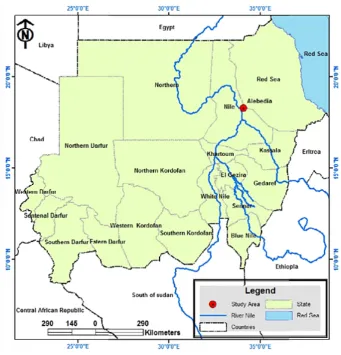
dif-ferent domestic purposes such as cooking, drink-ing, washing and agriculture craft. In addition the Central Hospital of Abu Hamad’s, which is one of the main hospitals close to the study area records, received 107 cases of undiagnosed fever from gold mining areas, in addition to some cases of cancer and respiratory diseases, Cancer that was diagnosed in the hospital is due to the use of mer-cury for gold extraction by these gold miners. It covers an area of more than 122 thousand square kilometer and population size in 2006 amounted to one million. The most prominent topographic feature of the area is the fifth cataract of the River Nile. The deposits which appear east of the Nile between Khartoum and Barber represent a type of lacustrine deposition during Oligocene. It is cov-ered by Nubian gravel, which is in turn covcov-ered by basalt resulting from more recent volcanic ac-tivity. The study area is spotted with rooky desert hells which are crossed by Atmour valley as part of Red Sea Hills. All this geologic information has witnessed gold excavation in the past. The temperature in this area rises up to (50oC) during
the hot summer followed by as low as (5oC) in the
winter season (Ibrahim et al. 2015). Many people suffer from the mercury coming from traditional gold mining. Therefore, it is considered impor-tant to investigate this problem and this research will serve as a good example to AGM activities in other areas in the rest of Sudan.
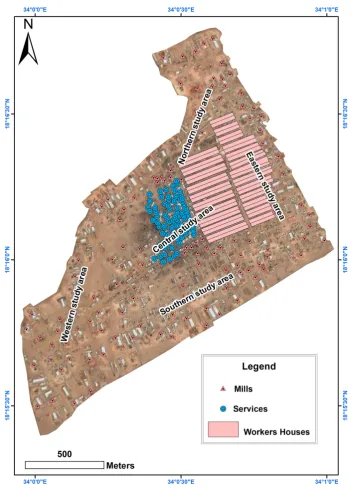
The area of study is characterized by the pres-ence of some services which are used by the tradi-tional gold mining workers (figure 2). These ser-vices include grinding mills located at five sites. These grinding mill are located within four direc-tions in addition to the centre of the gold min-ing site. There are 128 grindmin-ing mills located as follows to facilitate the crushing of rocks bearing gold coming from distant areas. In addition to the crushing mills, there are other premises located in the Centre and in the North of the area of study. They include gold trading centers, retail shops, restaurants, watch clubs and coffee shops, in ad-dition to security and health services.
The research was conducted in March 2018 in Alebedia area, Berber Locality in the River Nile State. The methodology applied in carrying out this study includes quantitative and qualitative as
well as laboratory analysis for the environment samples of surface soil and surface water to deter-mine the distribution of mercury concentration. The data used include primary and secondary sources. The primary data is obtained by the use of questionnaires and the result from the labora-tory for concentration of mercury in the surface soil and surface water. The secondary data were collected from different sources of published and unpublished information, books, relevant articles from journals and reports of studies conducted on the effect of mining operations on workers and residents in surrounding communities.
The population investigated in this research includes the WOE and RSC who are not engaged. The sample design is stratified according to age group (20–50) years old, respondents staying in the study area for at least three years, direc-tions from the mine and perception towards min-ing activities and its effects on the environment and health in general. Two hundred respondents were randomly selected, this size of the samples was governed by the researcher limited financial ability and time. Four communities were chosen based on their relative proximity and direction to the mine site. Fifty respondents from each
munity were sampled and each community rep-resents a different direction but having the same distance of about one kilometer away from the mine site. This reflected the various responses concerning the mining effects for each local-ity with regard to wind direction speed, ground slope (meteorological and topographical factors features), surface roughness, buildings and other obstructions from the mine. The WOE as well as the RSC were interviewed for the information re-lating to their health conditions.
The sample design for the environment in-cluded the design for surface soil and the de-sign for surface water, Three random samples of surface water were collected for each direction about one km in the mercury polluted area from different directions (Northern, Southern, East-ern, Western and Central). The date and time of sampling as well as location were obtained with Global Positioning System (GPS) and by means of a map sheet, 15 sampling sites in and around Alebedia area, three sample each were selected for each site and direction, Sites 1–3 were col-lected in the Northern part of the area; Sites 4–6 were collected in the Southern part of the area, Sites 7–9 were collected in the Eastern part of the area, Sites 10–12 were collected in the Western part of the area; and site 13–15 were located in the Central area. Additionally, Three sampling sites were collected for grinding mills, sample 16 was collected from water supply coming from the River Nile and sample (17a) was collected from grinding process while sample (17b) was collect-ed from panning. Four random samples of surface soil were taken for each about one km in mercury polluted area each at a different direction (North-ern, South(North-ern, East(North-ern, Western and Central). Date and time of sampling and location were ob-tained with Global Positioning System (GPS) and by means of a map sheet. There were 20 sampling sites in and around Alebedia area, Sites 18–21 were collected in the Northern side of the area; Sites 22–25 were collected in the Southern side of the area, Sites 26–29 were collected in the East-ern side of the area, Sites 30–33 were collected in the Western side of the area; and site 34–37 were located in the Central area. For each sample, the collected soil was taken between the soil surface and 50 cm below the surface soil. After collect-ing the soil samples, most of the foreign objects (pebbles, roots, etc.) were removed from each sample and homogenized mix and a quarter was randomly selected from the homogenized
com-posite, then a few selected samples were mixed and divided into equal weights to obtain a final composite sample.
The data obtained from WOE and other RSC was analyzed using SPSS and Ms. Ex-cel to find quantity and quality of the effects of TGM activates on the environment and gen-eral health. The methods of TGM extraction which have been employed by the ASGM in MS have been acknowledged.
The samples of surface water and surface soil had been analyzed to determine the mercury con-centration contained in each of the samples using Inductively Coupled Plasma Mass Spectrometry (ICP-MS) ICPE-9000 SHIMADZU which be-longs to Sudanese Forensic laboratories, Ministry of Interior, Presidency of the police forces. This compares with the international techniques ap-proved by the USPA organization.
RESULTS AND DISCUSSION
In recent years, Sudan suffered from some economic problems which were manifested in serious macroeconomic features exhibited in its balance of payment, rise in the levels of unem-ployment and general prices, in addition to the depreciation of the national currency. The mea-sures adopted by the government were ineffec-tive and a large sector of the population lived under the poverty line. Many parts of the coun-try had mounting unemployment and numerous young people were willing to migrate to where employment was available. The advent of tradi-tional gold mining had no problem in finding the people ready to work in spite of the harsh living conditions and low earnings which characterized the mining activities. Labor from all educational levels competed for the available jobs and occu-pations. The list of job seekers varied from uni-versity graduates to basic dropouts from other educational levels. It is worth noting that over one million miners participated in gold mining extrac-tion which supported over four million people in more than 14 states.
en-vironment and general health using quantitative and qualitative, in addition to the analytical tech-niques. The factors which were tested included: the level of education attained by the miners and its significance. The research noted that the num-ber of miners decreases as the level of education increases indicating that the nature of mining is labor extensive. The research investigated the period of miners staying in the mining site, and found that the longer the period of miners stay-ing in the site, the higher their awareness about the diseases inflicted in the area and their causes. These diseases include respiratory tract, can-cer, fever, skin diseases and kidney dysfunction. The awareness of the respiratory tract infection was the highest. Also the research noticed that, the (TGM) activities associated with natural en-vironmental impacts are strongly and positively associated at significant level of (0.00) which is the maximum degree of statistical significance. i.e. with more gold mining activities there will be more water pollution (40%), air pollution (25%), noise pollution (20%) and land degrada-tion (15%). This increase cannot be attributed only to the chance (probability), others evidance that the workers whome in the grinding activity in the (TGM) are more influential than others on the degradation of land and noise pollution be-cause of the continuous vibrations and noise from the mill machines. The percentages were (100%) and (100%) respectively. The workers whome in the panning activity in the (TGM) are more in-fluential than others on water pollution and air pollution because of inefficient separation of the amalgam in washing or excess mercury use. This excess mercury often makes its way into sur-rounding waterways when mine tailings are dis-posed. The percentages were as follows (75 %) and (12 %) respectively. Workers whome in the burning activity in the (TGM) are more influen-tial than others on air pollution and water pollu-tion because they heate the separated amalgam, which vaporizes the mercury, leaving behind the gold and then Spread through the air, Where the percentages were (88%) and (25%) respectively.
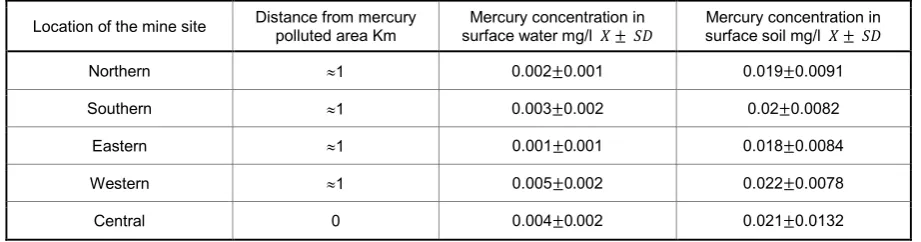
Other parameters being investigated were the distribution of mercury concentration in sur-face water and sursur-face soil of the study area, the average mercury concentration found in the surface water and surface soil are varied (0.001- 0.005 mg L-1) and (0.018- 0.02 mg L-1)
respectively, the highest average mercury con-centration was found in the western area (0.005
mg L-1) because of the largest number of grinding
mills among all the unit. It was followed by the average concentration in the central area (0.004 mg L-1) . The next one is in southern area (0.003
mg L-1) and followed by northern area (0.002 mg
L-1). The lowest mercury concentration was found
in the eastern part of study area (0.001 mg L-1).
This area contains the lowest number of grinding mills (9.4%). The above concentration exceeded the WHO water quality guideline for total mer-cury (0.001 mg L-1) except for the mercury
con-centration in the Eastern side.
For the comparison, Our research shows that the mercury concentration at Murung Raya Dis-trict, Central Kalimantan Province, Indonesia is extremely high, compared to Kim, 2015 and low, compared with Wilopo, 2013. Research conduct-ed in in this study area found that the concentra-tion of mercury (Hg) reached 0.3 mg/L, in sur-face water (Wilopo et al. 2013) and in Poznań, Poland, mercury was found as (range 8*10–6 – 4*10–5 mgL-1) in surface waters (Kim et al. 2015).
Respectively, for the distribution of average mercury concentration on surface soil, the highest is in the western area ( 0.022 mg L-1) which
con-tains the largest number of grinding mills (28.1 %). Then, It was followed by the mercury con-centration in the central area (0.021 mg L-1). The
next one is southern area (0.019 mg L-1) and
fol-lowed by northern area (0.019 mg L-1). The
east-ern area was found to have the lowest mercury concentration (0.018 mg L-1) because of its lowest
number of grinding mills (9.4%). All these values exceeded the WHO soil quality guideline for the total mercury 0.01 mg/l.
For the comparison purpose, some research on mercury concentration on surface soil is also presentend. One of them is Santos-Francés, F. (2011) who conducted a research that found the total Hg in regionally distributed soils are 2.17 mg/L.(Santos-Francés, F. 2011). The other research work was carried out in selogiri area, central java, indonesia and found that the mercury concentrations in soil collected during dry season was ranged from (0.01 to 481 mg/l). Some of the mercury concentration levels in soil layers around the globe, shown as high levels of Hg (range: 15–119 μg g-1), were found in soil near mercury
mining and smelting in Wanshan, China (M.L. Søvik. 2008, Kim et al. 2015). Mercury concen-trations in the Poznań, Poland were found to be 0.75–8.84 μg g-1 and from the city area 0.72–3.03
The research noted that the average mer-cury concentration in the surface water and sur-face soil are influenced by the gold mining ac-tivities by means number of grinding mills in different locations.
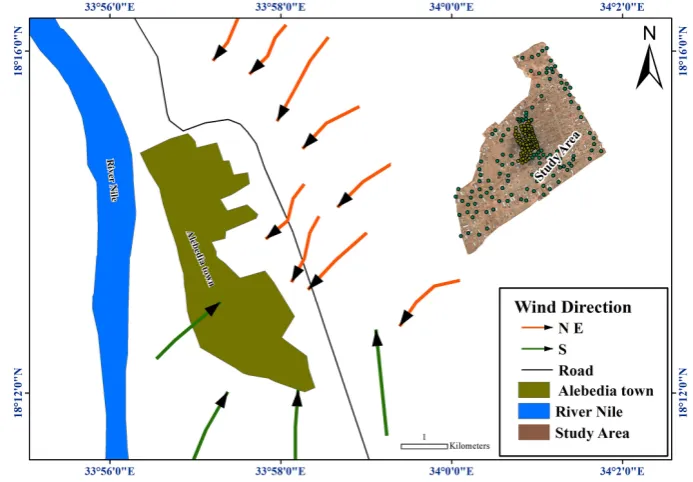
Other parameters being investigated were the meteorological and topographical factors. The re-sult of meteorological factors on the dispersion and concentration of mercury. The study noted that the location of the mining site was affected by the meteorological factors associated with it. The location has positively contributed to the concentration of mercury and its disposal in the area. These meteorological factors included the wind directions, the wind speed at surface and above ground. (Figure 3). According to the sta-tistical data issued by the Sudan Meteorological Administration in 2018 about the study area, the direction of the wind during the first ten years came from the Northern and Eastern direction during the first ten months of the year, but during July and August the wind direction came from the South. Additionally, the statistical data showed that the average wind speed is 7.4–13 km/h but the maximum was recorded in January and
Febru-ary (13 km/h), whereas in March to December the wind speed was 11.1 km/h, in April, May, June, August and October wind speed was 9.3 km/h and 7.4 km/h in the rest of the months, (table 1).
Those two meteorological elements affect the transport of pollutants from the highest to the lower boundary layers. Research conducted in a Palu city, Central Sulawesi, Indonesia mining area revealed that an air mass containing a high concentration of Hg(0) may cover Palu city all the time, and city residents may therefore always be at risk for exposure to high Hg (0) concentrations via inhalation. The research found that the 24-h average concentration, wind speed, and wind di-rection data show that the ambient air in both the gold-processing area and the city was always cov-ered by high concentration of mercury vapor, The wind blows from the mountains to the estuary, the Hg(0)-containing plume of air emitted from the Poboya gold-processing area is alternately blown toward and away from the city in the estuary., (Nakazawa et al. 2016).
The level of temperature during the year also contributes to the level of dispersion of mercu-ry in the area. The area is characterized by high
Figure 3. Direction of the wind during the year comes from the Northern and Eastern direction
Table 1. The monthly wind direction and wind speed (in km/h) in Alebedia and meteorological stations for the year 2017–2018
Month Dec Nov Oct Sep Aug July June May Apr Mar. Feb Jan.
Wind direction N N NE NE S S N NE NE NE NE NE N
temperatures during most of year for ten months (50°C) and low temperatures during winter months to (5°C). Mercury starts to evaporate at the temperature exceeding (25°C). Hence, the areas of higher temperatures are subjected to higher mercury concentration than other areas of low temperatures. Research conducted in Shanxi, China (2009) on mercury released from gold ex-traction by Amalgamation revealed that mercury concentrations were the highest in summer and the lowest in winter (Tian Li 2009).
In addition, the study area is located at a height of 372 meters above sea level, and the River Nile to the west is located at an altitude of 340 meters, (figure 4) the regression rate is 4 meters, indicat-ing the height is less than 4 meters towards the River Nile West of 1 km. Topographically, con-tour lines retreat towards in the River Nile, which means that the surface run-off water will flow to-wards the River Nile because of the natural slope of the area. However, a portion of the Western area slopes towards the residents within the
rounding communities. The topographical factors of the area include ground slope, surface rough-ness and building and other obstruction. The fol-lowing table summarizes the effects the level of concentration of mercury in the study area.
Last but not least, the study acknowledges the diseases that worker occupationally exposed usu-ally suffer on contacting with (TGM) activities at various degrees of intensity.
The research also acknowledges the high con-tribution of gold in the economy; nevertheless, the negative environmental and health effects which bear huge financial costs as well have received less attention by the authorities who claim that some measures have already been taken to mitigate the effects of traditional gold mining activities.
Acknowledgements
I would like to express my sincere gratitude and thanks to: UNDIP, Sudan Government, Min-istry of Minerals, geological research authority of the Sudan, Sudan Chamber and Ministry of High-er Education and Scientific Research to pursue a Doctorate Program of Environmental Science. Special thanks and sincere appreciation are ex-tended to my supervisors Prof. Dr. Ir. Purwanto, DEA, second supervisor Dr.Henna Rya Sunoko, Apt, MES and Dr. Hartuti Purnaweni. MPA, for their continued help and guidance during the prepara-tion of this research.
REFERENCES
1. African Mining Brief, 2014. Sudan announces a 64 tons increase in gold production. Available at: http://www.ambriefonline.com/2014/11/sudan-an-nounces-64-tons-increase-gold-production. 2. Betancur-corredor, B. et al., 2018. Gold mining as
a potential driver of development in Colombia : Challenges and opportunities. Journal of Cleaner
Production, 199, pp.538–553. Available at: https:// doi.org/10.1016/j.jclepro.2018.07.142.
3. Cordy, P. et al., 2013. Characterization, mapping, and mitigation of mercury vapour emissions from artisanal mining gold shops. Environmental Re-search, 125, pp.82–91. Available at: http://dx.doi. org/10.1016/j.envres.2012.10.015.
4. Drace, K. et al., 2012. Mercury-free, small-scale
artisanal gold mining in Mozambique: Utilization of magnets to isolate gold at clean tech mine. Jour-nal of Cleaner Production, 32, pp.88–95.
5. Guo, S. et al., 2018. Mercury release character-istics during pyrolysis of eight bituminous coals. Fuel, 222(November 2017), pp.250–257. Available at: https://doi.org/10.1016/j.fuel.2018.02.134. 6. Ibrahim, E. et al., 2015. Socioeconomic and
Envi-ronmental Implications of Traditional Gold Mining in Sudan. American Based Research Journal, 4(7), pp.1–11. Available at: http://www.abrj.org.
7. Kim, K.-H., Kabir, E. & Jahan, S.A., 2015. A re-view on the distribution of Hg in the environment and its human health impacts. Journal of Hazard-ous Materials. Available at: http://www.sciencedi-rect.com/science/article/pii/S0304389415302314. 8. Massaro, L. & Theije, M. De, 2018. Understand
-ing small-scale gold min-ing practices: an anthro-pological study on technological innovation in the Vale do Rio Peixoto (Mato Grosso, Brazil). Journal of Cleaner Production.
9. Nakazawa, K. et al., 2016. Human health risk as-sessment of mercury vapor around artisanal small-scale gold mining area, Palu city, Central Sulawesi, Indonesia. Ecotoxicology and Environmental Safe-ty, 124, pp.155–162. Available at: http://linkinghub. elsevier.com/retrieve/pii/S0147651315301172. 10. NILU, 2003. Department of Environmental Affairs
and Tourism Environmental Quality and Protection
Chief Directorate : Air Quality Management & Cli -mate Change NATIONAL air quality management programme phase ii transition project publication series B: Book 7 Air Pollut, New York. Available at: TR3/2003, Q-303.
11. Rava, T. & Ramirez, D., 2018. Science of the Total
Environment A systematic review on the
manage-Table 2. Summary of the effects of the mercury concentration levels in the study area
Location of the mine site Distance from mercury polluted area Km surface water mg/l Mercury concentration in 𝑋𝑋 ± 𝑆𝑆𝑆𝑆 surface soil mg/l Mercury concentration in 𝑋𝑋 ± 𝑆𝑆𝑆𝑆
Northern 1 0.002±0.001 0.019±0.0091
Southern 1 0.003±0.002 0.02±0.0082
Eastern 1 0.001±0.001 0.018±0.0084
Western 1 0.005±0.002 0.022±0.0078
ment and treatment of mercury in artisanal gold mining. Science of the Total Environment, 633, pp.816–824. Available at: https://doi.org/10.1016/j. scitotenv.2018.03.241.
12. Santos-Francés, F., A.G.-S., 2011. Distribution and
mobility of mercury in soils of a gold mining re-gion, Cuyuni river basin, Venezuela. Journal of En-vironmental Management, 92(4), pp.1268–1276. Available at: http://dx.doi.org/10.1016/j.jenv-man.2010.12.003.
13. Sudanow Magazine, 2016. Traditional Mining Poverty Alleviation vs. -Environment Pollution. Sudanow, p.6. Available at: http://sudanow.info.sd/ traditional-mining-poverty-alleviation-vs-environ-ment-pollution/6.September.2016.
14. Sudanow Magazine, 2014. Traditional Mining Poverty Alleviation vs. -Environment Pollution. Available at:
http://sudanow.info.sd/traditional- mining-poverty-alleviation-vs-environment-pollu-tion/6.September.2016.
15. Tian Li, L.Æ.H.F.G.Æ.A.G.Æ.X.T.L.Æ.Q.Y.,
2009. Effects of Mercury Released from Gold Ex -traction by Amalgamation on Renal Function and Environment in Shanxi , China. Bull Environ Con-tam Toxicol, 83, pp.71–74.
16. Vangsnes, G.F., 2018. The Extractive Industries and Society The meanings of mining : A perspec-tive on the regulation of artisanal and small-scale gold mining in southern Ecuador. The Extractive Industries and Society, 5(2), pp.317–326. Available at: https://doi.org/10.1016/j.exis.2018.01.003. 17. Wilopo, W., Resili, R. & Putra, D.P.E., 2013. Effect
of traditional gold mining to surface water
qual-ity in Murung Raya District , Central Kalimantan Province. J Ournal Of D Egraded And M Ining L