1466
Fire Recognition From Sensor Node And Features
Of Video Smoke
S.R.Vijayalakshmi, S.MuruganandAbstract : Gaussian mixed model, LK optical flow method and background subtraction from foreground method are used to extract the fire and smoke region in foreground of video image. Multi feature of fire characteristics are used to extract the information. Colour feature of suspected region are extracted according to the colour model RGB and HSI spaces. Background blur feature is extracted using two dimensional discrete wavelet transform. If smoke appears in scene, the contour edge of the background would become blurry. The motion direction feature is extracted using LK optical flow method and gaussion mixed model. The DHT 11 digital temperature - humidity sensor in sensor node is used to extract temperature and humidity values for measurement and TIMSP430 microcontroller for processing the information. The video node and sensor node extracted information are combined to detect the possibility of fire in the area during worst season conditions. By this method, the accuracy of fire a nd smoke detection is improved even in the worst environmental condition such as rainy weather. From the simulated and experimental results, the proposed method improves the accuracy and detection rate. Combination of sensor output and video output give excellent value in finding smoke or fire from videos. They reduces false detection rate of detecting smoke from non-smoke videos. It can be used in outdoor large environment.
Index Terms : background subtraction; Lucas-Kanade optical flow; video processing; embedded vision; Fire smoke detection; Sensor node; Gaussian mixed model;
————————————————————
1.
INTRODUCTION
Sensor node with temperature humidity sensor DHT 11 is designed to measure temperature and humidity value of the suspected region during worst weather conditions. It displays the measured value after processing by MSP 430 processor. Smoke probably first appears at the early stage of fire instead of visible fire flame. Therefore smoke recognition has a high importance of early fire alarm. If smoke appears in scene, the contour edge of the background would become blurry. It means that high frequency energy decreases in frequency domain. Hence smoke can be recognized according to the decrease of image edge information of the background. First colour feature of smoke pixel is extracted by colour model. The smoke features such as colour, background blur, contour irregularity and main motion direction are integrated for detection of early fire along with the temperature humidity measurement of sensor node by the sensor DHT11.
1.1 Related Work
There has been numerous research studies in finding the fire and controlling it before spread. But this proposed system is integrated with Sensor node to find and detect fire event before it occurs. The video node information about finding smoke and sensing fire using sensor node both are combined and are available in real-time.
Andrey Makeenkov et al. [1] dealt about the flammable gases and vapors of flammable liquids and monitoring with infrared sensor node. They analyzed about the reasons for fire because of flammable gases and monitoring fire using infrared sensor node. A.Somov et al. [2] analyzed about the combustible gases and early fire detection; an autonomous system for wireless sensor networks. They discussed wireless sensor network for early fire detection. Wen-hui Dong et al. [3] discussed about the design of wireless automatic fire alarm system. ZHANG Ying-cong and YU Jing [4] discussed about the study on the fire IOT development strategy. They analyzed how internet of things can be implemented with fire industries and fire monitoring system. Sheng an Duan et al. [5] analyzed about the wireless intelligent fire fighting system software platform. Wei Chen [6] discussed about application of Internet of Things for electric fire control. They discussed about the application of IoT for fire. Liu Longshen et al. [7] discussed about the embedded forest fire monitoring and positioning system based on machine vision. They discussed about the forest fire monitoring. C.W.Chiu et al. [8] dealt about the performance assessment of video-based fire detection system in tunnel environment. S.Vertokt et al. [9] analysed about the multi modal video analysis approach for car park fire detection. They discussed about the fire detection in the car parking location. Pasquale Foggia et al.[10] discussed about the real time fire detection for video surveillance applications using a combination of experts based on colour, shape and motion. Mueller et al. [11] discussed about the optical flow estimation for flame detection in videos. They discussed how flame could be detected from videos using optical flow estimation. Li.W et al. [12] analyzed about the video smoke detection algorithm based on wavelet energy and optical flow Eigen-values. They discussed wavelet and optical flow for smoke detection. Konstantinos Liolis et. al [13] analyzed about an automated fire detection and alerting application based on satellite and wireless Communications. They compared satellite IP technology and displayed fire alarm in the event grid of user interface application. Wei Chen [14] analyzed about the application of Internet of Things for electric fire control. Deng Tian et. al [15] discuseed about
____________________
Department of Electronics and Instrumentation,
Bharathiar University,
Coimbatore-641046,
Tamilnadu, India.
Email: [email protected] *( corresponding author), [email protected]
fire monitoring system based on Ethernet. Most of the research discussed about sensor network for monitoring and image extraction from video node using image processing separately and independently. This work supports the combined output of the both video and sensor nodes. This paper is arranged in the manner as follows. Section 2 provides extraction of suspected region and features of smoke from video node and sensor node. Section 3 explains about experimental and simulated results and analysis. Section 4 finally discusses about the conclusion and further work.
2.
EXTRACTION OF SUSPECTED REGION
AND FEATURES OF SMOKE FROM VIDEO
NODE
The background subtraction method along with optical flow is used to extract the suspected region of smoke. Gaussian mixed model and LK optical flow is used to for motion and accumulation of smoke.
2.1 Colour feature
Grayish white is the early fire smoke colour due to low temperature. Along with RGB values of the pixel in RGB space, colour brightness I value also distributed in HSI space. The colour feature of smoke can be determined by the difference threshold of the maximum and minimum values in smoke pixel R,G, and B components and the distribution range threshold of the colour brightness I value. Accordingly, expressions (1) and (2) are used to determine the colour features of smoke.
(1)
(2)
Pixels of smoke colour are detected when T1 met with the given following value. Itis the difference threshold of the maximum value x max and minimum value y min in R, G and B components and its value is between 0.275 and 108. TIL and TIH are the distribution range threshold of the colour brightness I with the value of TIL = 80 and TIH =200.
2.2 Background blur
Smoke partially wipes out other objects leading to blurry texture and contour of video. The smoke attenuates high-frequency information in high-frequency domain of the video image. Therefore, the ratio between high frequency energy of the smoke region to the corresponding background can be used as blur feature of smoke. A video image is breakup into two sub-images using filtering such as one image with low frequency (LL) contents and three sub-images (LH, HL, HH) with high frequency contents. The low frequency component LL sub image never play significant role in finding smoke. The high frequency component (LH, HL, HH) includes smoke texture information. After filtering, the smoke in video attenuates high frequency components. ER is a composite Image undergone frequency domain decomposition by using horizontal-HL, vertical-LH, and diagonal-HH coefficient of 2-Dimensional Discrete Wavelet Transform wavelet filtering technique represented by equation 3.
∑| | | | | |
Suppose Ei represents total high frequency energy values of the pixel (x,y) in the image of foreground and Eib represents total high frequency energy values of the pixel (x,y) in the image of background for the corresponding foreground image. It can be obtained using the expression 4.
Where, is the feature value of background blur. As high frequency energy in smoke background would attenuate, is in the range of [0,1].
2.3 Contour irregularity
Smoke tends to spreads around airflow direction and its contour appears irregular. Therefore the ratio of the area of the suspected region to the area of its minimum enclosing rectangle can be seemed as a contour feature value to determine smoke.
where As is the total amount of pixels in the suspected smoke region; AMR is the area of minimum rectangle of the suspected region. is the contour feature value of the smoke irregularity. If the suspected region is rectangle,
2.4 Smoke motion direction feature
Due to differences of temperature and pressure in the environment, fire smoke presents motion. It moves upwards and sideways in the video frame series. The motion direction can be used as feature to determine early smoke. Optical flow algorithm is used to track the region. The image constraint equation can be given as for the pixels at location a b with respect time t:
where it is for dimensional case, a pixel at location with gray value moves between two frames of image, and after movement, the gray value of that pixel is . If the gray values of those two pixels regard as constant. The displacement of image between two nearby instants is small and perform first order expansion to above equation:
Due to in small movement,
1468 Let
and
represent the optical flow of in direction, and
represent the image derivatives at in the corresponding a b directions. Then the optical flow constraint expression modified as,
Assumption is made in Lucas-Kanade (LK) optical flow algorithm such that the flow of motion object is essentially constant within a local area and given by,
∑ or [
] [ ] [
]
LK optical flow algorithm considers the matrix of pixels or group of pixels for motion. Hence, it best suits to find the smoke in the image.
2.5 Flow rate or growth rate analysis of smoke
The LK optical flow algorithm can extract motion velocity of the smoke from each feature point of the pixels. The computation results of the optical flow of feature pixel points are done as like distance between two points equation as given below. Let a denotes the beginning point of the smoke feature pixel point and b denotes the ending point of smoke feature pixel point. i.e.,
[ ] [ ]
The average flow rate of the optical flow analysis for smoke is calculate as follows:
∑ √( )
m refers to the number of feature points of smoke pixels. Where Fa denotes the average flow rate of the smoke for optical flow analysis. It is growth rate of the smoke.
2.6 Gaussian mixed model
Let a variable represent the colour value of a certain pixel point at time . K three dimensional Gaussian models defined to represent the different states of the pixel in a certain time. The probability of the pixel value can be expressed by equation:
∑
( )
( )
| |
To find smoke, here, k number of Gaussian model chosen as 3. µi,t is the mean and Σi,t is the covariance matrix of the Gaussian. is the weight at time t for and
∑ . ( ) is the Gaussian density. d is the dimensional data vector or features of Xt.
2.7
Segmentation of suspected moving smoke region
After background image frame established, each pixel of image in current video frame should be compared with corresponding background reference frame of pixel image value to extract the suspected moving region. If current pixel value Xt is matched to the corresponding pixel belongs to background image at same location and 0 is marked in foreground binary image. Otherwise, the pixel belongs to the foreground moving region and 1 is marked in foreground binary image.{ | |
In this, the foreground images of moving smoke is extracted.
2.8 Feature extraction and Sensor node output
By investigating the feasibility of video smoke feature extraction and the effectiveness of feature recognition, the colour, background blur, contour irregularity and main motion direction are selected as the criteria of early fire smoke. During worst environmental condition such as rainy weather, fog, mist and light intensity variations the video output is combined with sensor node output for best results. The DHT11 sensor is used to measure temperature and humidity in digital form without need of ADC conversion. In worst conditions the temperature and humidity output is checked for fire risk. The temperature measured at two time intervals s and s-1 are used to detect fire conditions. The difference of these two temperature is compared with the threshold temperature set by the user based on environmental condition such as fog as given by below equation.
( )
represents the sensor output also taken into consideration when the environmental condition is unpredictable and worst. and are the two different temperature value measured at time s and 1 second ago s respectively. If their difference is greater than threshold temperature value more than three (set by user based on environment condition) times and have to consider video output for risk of fire and for smoke alarm state.
3.
EXPERIMENTAL RESULTS AND
DISCUSSION
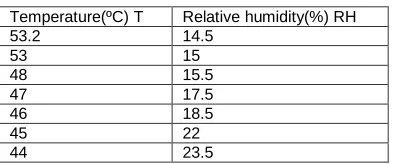
Table 3.1 T and RH relationship on worst environment during fire
Temperature(ºC) T Relative humidity(%) RH
53.2 14.5
53 15
48 15.5
47 17.5
46 18.5
45 22
44 23.5
The table 3.1 shows the temperature T and relative humidity RH measured by sensor node during experiments for fire under worst environment such as fog, mist. When the difference of temperature at time s and s-1 exceeds the set tempthreshold = 2ºC, verifies for video output. The threshold is fixed based on environment such as fog, season such as rainy and climate condition. The figure 3.1 shows sensor node and video node used for experiment. The figure 3.2 shows the graph of temperature measured during different time interval by DHT11 sensor. The figure 3.3 compares output from sensor node, video node and combined output of both nodes. The detection accuracy, efficiency of fire detection output are improved and false detection rate is reduced.
Figure 3.1. Sensor node and Video node
Figure 3.2. TempVs. Time graph
Figure 3.3. Comparison of sensor node, video node and combined outputs.
The background frame is shown in figure 3.4.The grayish white smoke colour is identified from the image frame which is shown in figure 3.5.
Figure 3.4. Background frame to extract suspected region
Figure 3.5. Grayish white smoke in image frame
1470 Figure 3.6 Background blur high frequency components
using 2D-DWT filtering (horizontal)
Figure 3.6. Background blur high frequency components using 2D-DWT filtering (vertical and diagonal)
Figure 3.7. LK optical flow method for motion detect
\
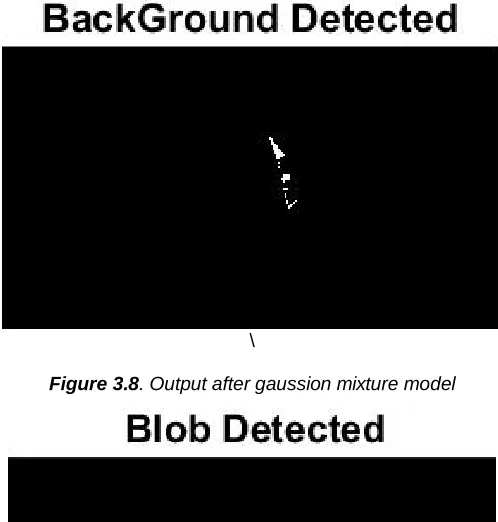
Figure 3.8. Output after gaussion mixture model
Figure 3.9. Final output after applying LK algorithms.
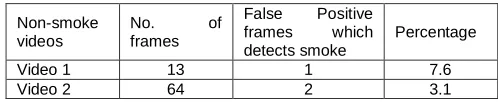
The accuracy of detecting smoke from smoke videos for true positive values at different types of environment condition is checked and from table 3.2 it show that detection rate of 94.9% and 91.5%. Detecting smoke for non smoke videos is known as false detection positive value which is 3.1% from table 3.3. The figure 3.10 shows program output in MATLAB for Gaussian mixed model.
TABLE 3.2. The smoke videos detection results
Sl. No. No. of frames
True Positive frames contains smoke
Percentage
Smoke Video 1
(inside) 79 75 94.9
Video
movie 2 200 189 94.5
Video
3(outside) 165 151 91.5
TABLE 3.3. The non-smoke videos false positive detection results
Non-smoke videos
No. of frames
False Positive frames which detects smoke
Percentage
Video 1 13 1 7.6
Video 2 64 2 3.1
Experimental results show that, in the conditions of strong outside light radiation intensity and multiple disturbances, the proposed method can effectively enhance the recognition rate of early smoke, as well as reduce missing alarm rate of fire event and false alarm rate of event fire.
4.
CONCLUSION AND FURTHER WORK
This is based on video image obtained from video node along with sensor node processing for early fire detection. Both chromatic colour and dynamic features of smoke are used to extract a real smoke from video frame of video node output. The four feature values of smoke such as colour, background blur, contour irregularity and smoke motion direction for early fire smoke in the suspected region are extracted. The suspected region is extracted by means of mixed Gaussian model background subtraction method and optical flow algorithms. Experimental results show that, in the conditions of strong outside light radiation intensity and multiple disturbances, the proposed algorithm can effectively recognize early fire smoke and reduce alarm for non-smoke and missing alarm for smoke. In the conditions of weak light intensity such as rainy weather and specific scenes, the possibility of misjudgment is reduced when it is combined with sensor node output. Experimental results show that this method of combining video node and sensor node can differentiate smoke event videos from non-smoke event videos and combining output of sensor node gives a excellent accuracy in detecting the smoke events. The accuracy of detecting smoke from smoke videos for true positive values at different types of environment condition is excellent and it show that detection rate of 94.9% and 91.5%. Detecting smoke for non smoke videos is known as false detection positive value which is 3.1%. Hence when combine with sensor output the detection rate is improved and false detection positive value is reduced. Positive detection rate of sensor node output is 68 % and video node output is 59%. But when combining both sensor output with the video node output it increase to 95 %. The false detection rate of sensor output is 10% and video node output is 15%. But the combined output of both video and sensor is reduced to 3%. Sensor and video node combination gives alarm as soon as the fire alarm condition is raised.
In future, neural network will be applied along with image processing technique for increasing detection rate and efficiency of fire-alarming. The combination of sensor network, embedded vision system and neural network will raise the true event find efficiency even better.
ACKNOWLEDGMENT
The University Grants Commission, Government of India supports this project.
REFERENCES
[1] Andrey Makeenkov, Igor Lapitskiy, Andrey Somov, Alexander Baranov, "Flammable gases and vapors of flammable liquids: Monitoring with infrared sensor node", Sensors and Actuators B , 2015, No.209, pp.1102-1107.
[2] A.Somov, D.Spirjakin, M.Ivanov, I.Khromushin, R.Passerone, A.Baranov, A.Savkin, "Combustible gases and early fire detection: an autonomous system for wireless sensor networks", Proceeding of e-Energy, 2010, pp.85-93.
[3] Wen-hui Dong, Li Wang, Guang-zhi Yu, Zhi-bhi Mei, "Design of wireless automatic fire alarm system ", Science direct, Procedia Engineering, 2016, No.135, pp.412-416.
[4] Zhang Ying-cong, YU Jing, "A study on the fire IOT development Strategy", Procedia Engineering, 2013, No.52, pp.314-319.
[5] Sheng an Duan, Kaitao Cheng, Quanbo Ge, Chenglin Wen, "wireless intelligent fire fighting system software platform R & D", 2011 IEEE International conferences on Internet of Things, and Cyber, Physical and social computing, pp. 94 - 99.
[6] Wei Chen, " Application of Internet of Things for electric fire control", 2011 International Conference on Electrical and Control Engineering (ICECE), pp.4741 4743.
[7] Liu Longshen, Shen Mingxia, Zhao Xianlin, Sun Yuwen, Lu Mingzhou, Xiong Yingjun, " Embedded forest fire monitoring and positioning system based on machine vision", International conference on electronic & mechanical engineering and information technology, 2011,pp.631-635.
[8] C.W.Chiu, T.Lu, H.T.Chao, and C.M.Shu, " Performance assessment of video-based fire detection system in tunnel environment," Tunnelling and Underground space technology, Feb. 2014, No.40, pp.16-21.
[9] S.Verstokt, S.Van Hoecke, T.Beji, B.Gouvemeur, A.E.Cetin, " A multi modal video analysis approach for car park fire detection", Fire safety journal, 2013, no.57, pp.44-57.
[10] Pasquale Foggia, Alessia Saggese, and Mario Vento, " Real time fire detection for video surveillance applications using a combination of experts based on colour, shape and motion", IEEE Transactions on circuits and systems for video technology, september 2015, vol.25, No.9 , pp.1545-1556.
1472 [12] Li.W, Fu B, Xiao L, "A video smoke detection algorithm
based on wavelet energy and optical flow Eigen-values", Journal of software,2013, pp.63-70.
[13] Konstantinos Liolis, Spiros Pantazis, Vassilis Gennatos, Socrates Costicoglou, Ilias Andrikopoulos, "An Automated Fire Detection and Alerting Application based on Satellite and Wireless Communications" , 2010 5th Advanced Satellite Multimedia Systems Conference and the 11th Signal Processing for Space Communications Workshop, pp.270 -277.
[14] Wei Chen, "Application of Internet of Things for electric fire control", 2011 IEEE International Conference on Electrical and Control Engineering (ICECE), pp. 4741 - 4743.
[15] Deng Tian, Huang Fei, Lu Yingchun, Liu Shixing, "A Complex Fire Monitoring System Based on Ethernet", 7th International conference on Wireless Communications Networking and Mobile Computing (WiCOM), 2011, pp.1 - 4.
Biographies:
S.R.Vijayalakshmi* is a UGC-PDF in Bharathiar University, Department of Electronics and Instrumentation. She had experience in field of teaching for 15 years and doing research in the field of electronics more than 5 years. She completed her Ph.D from Department of Science Technology, WOS-A Scheme funded by Government of India.