Helix: A Scalable and Fair Consensus Algorithm
Resistant to Ordering Manipulation
Avi Asayag, Gad Cohen, Ido Grayevsky, Maya Leshkowitz,
Ori Rottenstreich, Ronen Tamari and David Yakira
Orbs Research (
orbs.com
)
Abstract—We present Helix, a Byzantine fault tolerant and scalable consensus algorithm for fair ordering of transactions among nodes in a distributed network. In Helix, one among the network nodes proposes a potential set of successive transactions (block). The known PBFT protocol is then run within a bounded-size committee in order to achieve agreement and commit the block to the blockchain indefinitely. In Helix, transactions are encrypted via a threshold encryption scheme in order to hide information from the ordering nodes, limiting censorship and front-running. The encryption is further used to realize a verifiable source of randomness, which in turn is used to elect the committees in an unpredictable way, as well as to introduce a correlated sampling scheme of transactions included in a proposed block. The correlated sampling scheme restricts nodes from promoting their own transactions over those of others. Nodes are elected to participate in committees in proportion to their relative reputation. Reputation, attributed to each node, serves as a measure of obedience to the protocol’s instructions. Committees are thus chosen in a way that is beneficial to the protocol.
I. INTRODUCTION
As the blockchain space matures, different variants of the technology emerge, each with its different strengths and weaknesses. The Nakamoto consensus [1] was first to realize a permissionless membership model, mitigating Sybil attacks and reducing communication complexity by integrating the ingenious Proof-of-Work [2] (PoW) mechanism. While the incentive structure of PoW-based blockchains proved suc-cessful in bringing many competitors to the mining game, thereby increasing the security and resilience of the system, it created a paradigm that is extremely slow and expensive. Its exceptionally open nature coincides with its ability to facilitate a large number of miners, but restricts its transaction throughput. Transaction confirmation is slow and finality is asymptotically approached but never really obtained. More-over, miners’ interests are only partially aligned with those of the users—they first and foremost wish to solve PoW puzzles rather than execute and validate smart contracts [3].
Variants of the original PoW-based blockchain protocol try to improve certain aspects of it, while maintaining PoW as a key factor. Byzcoin [4] offers finality in a PoW-based blockchain by introducing a PBFT [5] layer among a com-mittee of recent block finders. Technologies based on block-DAGs are good examples for recently suggested solutions to some scalability and speed issues with PoW. These include
GHOST [6], which offers an alternative to the longest chain rule whose resilience does not deteriorate when the block rate is high; and SPECTRE [7], which gives up the concept of a chain of blocks altogether and suggests a virtual voting algorithm to determine the order of blocks in a block-DAG.
Parallel to Nakamoto consensus variants, we see prolif-eration of additional protocols and blockchains, inspired by ideas from the domain of distributed systems. These try to mitigate some of the fundamental problems with PoW, and develop cheap and fast consensus without the excess work associated with the latter. An interesting protocol in this regard is Algorand [8], which cleverly introduces a cheap way to incorporate common randomness and use it to select a block leader, emulating the native randomness incorporated in PoW. Another protocol that alternates block leaders is Tender-mint [9], which introduces a procedure for continuous primary rotation over a PBFT [5] variant. Other attempts to design consensus protocols for a business-oriented environment focus on assuring a degree of fairness among the participating nodes by being resilient to transaction censorship. A good example is HoneyBadgerBFT [10], where initially encrypted transactions are included in blocks, and only after their order is finalized, the transactions are revealed.
Helix borrows from these ideas to achieve a fast, scalable, and fair consensus protocol that is highly suited to the business requirements of modern applications. Helix relies on PBFT for Byzantine fault tolerance. In fact, Helix can be interpreted as a blockchain construction on top of PBFT, based on randomly-elected committees, which enables it to run many individual instances of PBFT sequentially, each responsible for a single value (block). It inherits PBFT’s finality, eliminating the possibility of natural forks in the blockchain. And it restricts the agreement process to a bounded-size committee, selected from the larger set of all consensus nodes, in order to mitigate PBFT’s inherent difficulty to scale to large net-works. The committee size is determined according to some conservative upper bound on the number of faulty nodes,f. In PBFT, whenever the number of participating nodesnsatisfies
unpredictable.
Helix explicitly defines the interests driving its consensus nodes and emphasizes fairness among them in regard to these definitions. Specifically, it focuses on ensuring fair distribution of power among the nodes and on guaranteeing that the order of transactions on the blockchain cannot be manipulated by a single node (or a small coalition). Helix also takes into account the end-users of the protocol and aims to protect them from being censored.
Helix concentrates on the orderingof transactions. It does not attribute semantics to the transactions it arranges and is completely unaware of state changes these transactions may invoke1. It is therefore possible to use threshold encryption to obfuscate the transactions from the nodes. Once the position of a transaction becomes final, its content is revealed.
The threshold encryption scheme is further used to produce verifiable randomness within the protocol. Helix realizes a randomness beacon without requiring additional rounds of communication2. It then makes use of the randomness in two respects: first, to elect leaders (and committees, which are used to address scalability concerns, as PBFT does not scale adequately to large networks) in an unpredictable and non-manipulable manner; and second, to realize correlated sampling [13], which is used to force nodes to randomly sample their pool of pending transactions when constructing blocks. The correlated sampling scheme enables new fee mod-els (e.g., constant fees) that differ from traditional approaches and prevent the emergence of undesired fee markets.
Helix assumes a known list of consensus nodes respon-sible for constructing and validating blocks. Such a list can be defined and modified frequently with various governance schemes—permissioned, based on an authority that explicitly determines the composition of the list; or permissionless, based on stake in the system, PoW or other criteria. For simplicity, through the course of this paper we assume that a set of consensus nodes is given. The fact that consensus nodes are identified allows Helix to introduce a reputation measure, which estimates a node’s compatibility with the protocol’s instructions. The reputation measure is used to compensate or punish a node, incentivizing correct behavior.
We explicitly mention our three main contributions. First, Helix achieves consensus over afairordering of transactions, where each block includes an unbiased set of transactions. Put differently, a node cannot prioritize transactions she fa-vors and include them in the block she constructs. Such a restriction enables scenarios where transactions fees cover only the processing costs of a transaction but bare no revenue. In such scenarios nodes prioritize transactions according to
1The execution and validation of transactions is beyond the scope of
this paper. We mention though, that under the abstraction of a well-defined order (obtained by Helix), invalid transactions can simply be skipped by the execution service.
2We note that the problem of using multi-party computation to produce
verifiable randomness has a long history both in and apart from the context of blockchains [11], [8], [12].
other criteria3 and such type of fairness becomes relevant. Second, in Helix end-users, which do not take active part in the consensus protocol, enjoy protection from being censored or discriminated against by the nodes that connect them to the network. This is achieved by having the users encrypt their transactions prior to transferring them to their nodes. Finally, while many consensus protocols rely on a stable leader to progress rapidly and suffer great latencies from leader substitution, Helix, under normal flow, efficiently rotates leaders (and committee members). The leader rotation comes only with negligible communication overhead and, unlike other protocols that use a round-robin scheme, is unpredictable and can be weighted non-equally between the nodes.
The remainder of the paper is organized as follows. We begin with some short background in Sec. II, covering basic concepts in distributed systems and a few cryptography prim-itives used by Helix. Then, in Sec.IIIwe describe our system model. In Sec.IVwe give a detailed description of the Helix protocol. Sec.V is dedicated to prove basic properties Helix satisfies. In Sec.VIwe focus on epochs with high transaction rates and suggest a sampling scheme to construct blocks in a fair manner. Finally, in Sec. VII we propose a method to synchronize nodes rapidly.
II. BACKGROUND
A. Distributed systems
In a distributed system independent entities run local com-putations and exchange information in order to complete a global task. A fundamental problem in the field is reaching agreement on a common output value. In this problem we considern entities, each associated with an input value, and the goal is to design a protocol, executed locally by each entity, which ensures all entities output the same value. Ex-isting agreement protocol are designed with various execution environments in mind, or possible behaviors by entities, and result in different performance characteristics.
The properties of a distributed protocol are affected by the quality of the underlying network communication. A few types of synchronous environments we refer to throughout the paper, taken from [14] are given hereafter:
Definition 1 (Strong synchronous network) A network is said to be strongly synchronous if there exists a known fixed bound,
δ, such that every message delays at most δ time when sent from one point in the network to another.
Definition 2 (Partial synchronous network) A network is said to be partially synchronous if there exists a fixed bound,δ, on a message’s traversal delay and one of the following holds:
1) δalways holds, but is unknown.
2) δis known, but only holds starting at some unknown time.
3For example, we can think of nodes as application developers that prioritize
A particular execution environment, considered to be general and least constraining with regards to the communication synchrony is the asynchronous network.
Definition 3 (Asynchronous network) A network is said to be asynchronous if there is no upper bound on a message’s traversal delay.
In the settings presented above, network links can either be reliableorunreliable. Reliable links are guaranteed to deliver all sent messages, while with unreliable links, messages may be lost in route. In both cases, and in all the environments described above, dispatched messages can be delivered out of order.
We formulate a primitive that captures the essence of agreement by the three following requirements:
Definition 4 (Non-triviality) If a correct entity outputs a value
v then some entity proposed v.
Definition 5 (Agreement) If a correct entity outputs a value
v then all correct entities output the valuev.
Definition 6 (Liveness) If all correct entities initiated the protocol then, eventually, all correct entities output some value.
An early protocol to propose a solution to the agreement problem was Paxos [15]. In Paxos, entities either follow the protocol’s prescriptions, or have crashed and thus do not par-ticipate at all. Paxos is non-trivial and maintains the agreement property under all circumstances, but is guaranteed to be live only when the network is synchronous and less than half of the entities have crashed. Raft [16], a modern Paxos variant, explicitly defines a timeout scheme that achieves liveness when communication is synchronous and reliable.
Fischer, Lynch and Paterson [17] showed that a deter-ministic agreement protocol in an asynchronous network can not guarantee liveness if one entity may crash, even when links are assumed to be reliable4. A key idea there is that in an asynchronous system one cannot distinguish between a crashed node and a correct one. Hence, deciding the full network’s state and deducing from it an agreed-upon output is impossible.
A variant of the agreement problem assumes a more in-volved failure model, where nodes may act maliciously in addition to crashing. A Byzantine entity does not follow the protocol’s instructions and behaves arbitrarily. This problem is often called Byzantine agreement(BA) and was introduced by Lamport, Shostak and Pease [19]. A well known result in the field of distributed systems is that in an asynchronous network, agreement cannot be reached unless less than1/3of the participants are Byzantine.
A natural extension of the single-value agreement problem is to agree on a set of values. In agreement on a sequence (log) of values, the agreement needs to cover both, the output values
4When links are unreliable reaching an agreement is impossible even
in a strongly synchronous network, a result known as the two generals problem [18].
and their order. Given a solution for a single-value agreement, it can be used as a black box to achieve agreement on a sequence of values. However, a version of Paxos (sometimes called Multi-Paxos or multi-decree Paxos) optimizes it by dividing the consensus protocol to a fast “normal mode” and a slow “recovery mode”. The recovery mode (which is also run initially when the protocol starts) selects a leader with a unique (monotonically increasing) ballot number. In the normal mode, the leader coordinates agreement on a sequence of values using an expedited protocol. If the leader fails or is suspected to have failed, the slow recovery mode is run to elect a new one. Similarly, Castro and Liskov proposed Practical Byzantine Fault Tolerance (PBFT) [5] which was the first efficient protocol to implement agreement on a sequence of values in the presence of (less than a third) Byzantine entities, employing similar type of optimization.
We further formulate a primitive that satisfiesagreement on a sequence of values written to a log, through the previous requirements, together with an additional requirement. In agreement on a sequence of values, values are written to a specific slot or index in the log.
Definition 7 (Strong consistency) For any pair of correct entities i, j with corresponding logs (vi
0, v1i, . . . , vli) and (v0j, vj1, . . . , vlj0)wherel ≤l0, it holds thatvki =v
j
k for every
k≤l.
A protocol that satisfies strong consistency is said to be safe. Intuitively, this means that for every position in the log, or index, only one value can be agreed upon and once a value was agreed upon in a certain position, it will stay there indefinitely. A different approach to reach agreement on a sequence of values is referred to as Nakamoto consensus [1]. The fundamental data structure that underlies the consensus is the famousblockchain. A blockchain, similarly to a linked list, is a sequential data structure composed of blocks, each pointing to the previous one by storing its hash. This yields a very strong property where any modification to the data included in a block utterly changes the output of its hash. Hence, modification of one block in the blockchain causes any succeeding block to change. Therefore, securing the hash of the current block guarantees that any previous block was not tampered and consensus on the history can be kept.
Reaching consensus on the current block remains the main problem. The Nakamoto consensus allows multiple values (blocks) to exist in the same index (height), resulting in a data structure that is better interpreted as a tree of blocks rather than a chain. Of the branches within this tree an entity is aware of, she selects the longest one as the valid chain (more accurately, she selects the branch that admits to the most amount of accumulative work according to the PoW principle [2], which we do not explain in this paper). Over time, this rule yields a single prefix-chain that is agreed upon by all. Nakamoto consensus is thus said to satisfy eventual consistency, rather than strong consistency orfinality.
new blocks propagate to the network in negligible time relative to the average block creation rate [20]. In case this assumption does not hold, the resilience of the longest chain rule may become fragile, facilitating an attacker to successfully re-organize the valid chain5.
B. Cryptographic primitives
Threshold Cryptography
Threshold cryptography [21] refers broadly to techniques for allowing onlyjoint groupsof parties to use a cryptosystem, be it to compute signatures, or to decrypt data. In particular, a (t, n)-threshold encryption cryptosystem is executed by
n entities, any of which can encrypt messages, while the cooperation of t+ 1 for some fixedt ∈ {1, . . . , n−1}
is necessary in order to decrypt messages successfully. Threshold security guarantees that any attempt by up tot of the entities to decrypt a ciphertext is bound to fail. The (t, n)-threshold cryptosystem we refer to in this paper consists of the following components:
1) A distributed key generation scheme executed once to set up a common public key P K, secret keysS0, . . . , Sn−1
and verification keysV0, . . . , Vn−1.
2) A non-malleable encryption scheme6 [22] which uses
P K for encryption.
3) A threshold decryption scheme which consists of two parts. In the first part, individual (and secret) key shares obtained by each entity are used in order to produce decrypted shares (from the ciphertext). The second part allows joiningt+ 1decrypted shares in order to retrieve the original message. A non-malleable threshold encryp-tion scheme must include two local verificaencryp-tion steps. First, to validate the ciphertext before producing a share, and second, to validate the shares before joining them.
We note that one appropriate choice for a such a threshold encryption cryptosystem is [23].
Hash Functions
We rely on an efficiently computable cryptographic hash function,H, that maps arbitrarily long strings to binary strings of fixed length. One property we will explicitly assume our hash function admits to iscollision-resistance:
Definition 8 A hash functionH is said to becollision resistant if it is infeasible to find two different stringsxandysuch that
H(x) =H(y).
Additionally, we modelH as a random oracle [24] as is often assumed in the literature.
5The GHOST [6] protocol suggests the “heaviest subtree” rule to determine
the valid chain, partially mitigating this problem.
6A non-malleable encryption scheme guarantees that it is impossible to
transform a given ciphertext, of a plaintextm, into another ciphertext which decrypts to a related plaintext,f(m)(for a known functionf).
Digital Signatures
Digital signature schemes enable authenticating a message by verifying it was created by a certain entity. Digital signa-tures usually require a secret key, denoted by ski, used by entity i for signing a message, and a public key, denoted by
pki, used for verifying the signature of entity i. To prevent anyone else from signing on her behalf, an entity should not share her secret key. Any entity with knowledge of the public key can verify the signature. A digital signature scheme typically consists of three algorithms: a key generation algorithm, a signing algorithm, and a verification algorithm. In order to produce a new pair of keys,skandpk, the generation algorithm is used. The binary stringσi(m)is referred to as the digital signature of entityiover a messagemand is produced using the signing algorithm andski.
The main properties required from a digital signature scheme are:
1) Legitimate signatures pass verification. σi(m) passes the verification algorithm under i’s public key and the messagem.
2) Digital signatures are secure. Without knowledge of ski it is infeasible to find a string that passes the verification algorithm, for a message m that was never signed by i
beforehand, even to an adversary that is allowed to view signatures underski (for other messages).
We denote byhmiσi the signature message which contains the
message m, the identity of the signer pki and the signature
σi(m).
III. MODEL
In this section we introduce the model assumptions that the Helix protocol relies on to achieve safety, liveness and fairness. We assume a strongly synchronous distributed system where participants are connected by a network over which they exchange messages in order to achieve consensus. The partici-pants are presented first, then the network topology and finally the adversarial model. We also mention two communication schemes used in our protocol.
A. Participants
In Helix there are two types of participants—users and nodes. Both locally generate cryptographic key pairs which serve as unique identifiers and help to ensure message authen-ticity (as described in Sec.II-B).
digital signatures or finding hash collisions. We further assume that each node owns an internal clock, and that all clocks tick at the same speed; we do not, however, require that the clocks be synchronized across nodes.
Users. Users form an open set of public keys and can join or leave the network as they please. They do not actively engage in the consensus process and can be seen as a virtual fragment of the node they are connected to.
B. Network topology
There are two types of network connections:node-node con-nections anduser-node connections. A node-node connection exists between each pair of nodes, such that the nodes are characterized by a clique topology. User-node connections are organized differently, where each user is connected to exactly one node. We assume there are many more users than nodes. Node-node connections are assumed to be strongly syn-chronous7, i.e., messages transmitted over them, are guaran-teed to be delivered within a known time period δ. This is a reasonable assumption under our circumstances, where the protocol assures limited-sized messages, and node participa-tion is condiparticipa-tioned. In the design of our protocol, we would like both connection types to consume a limited amount of bandwidth8.
C. Adversary
We distinguish betweencorrectnodes, defined as nodes that follow the protocol’s instructions precisely, and faultynodes, which do not. Among the faulty nodes, we further distinguish between Byzantine faulty nodes, defined as nodes that act arbitrarily, and benign faulty (or sleepy) nodes, which are unresponsive due to a crash or lack of information. We denote the total number of nodes in the network as n, the number of Byzantine nodes among them as fByz, and the number of sleepy nodes as fSlp. Thus, the number of faulty nodes is
f =fByz+fSlp. We restrict the adversary to control at mostf faulty nodes, where9 3f+ 1≤n. Note that to achieve safety, it is enough to bound fByz rather thanf =fByz+fSlp.
We assume a single powerful adversary that determines which nodes are correct and which nodes are faulty. Generally speaking, the protocol is divided into terms, where in each term a single block is added to the blockchain. The adversary isstaticin the sense that she must pre-determine which nodes will be faulty during a given term r, before the term starts. The adversary is adaptivein the sense that in different terms
7We emphasize that if our network violates the synchrony assumption, i.e.,
it is asynchronous, our protocol nonetheless satisfies the safety property as shown in Sec.V-A.
8While many existing BFT protocols assume to be run over a LAN
(local-area network) where bandwidth is not the bottleneck, we consider a WAN (wide-area network) where bandwidth constraints are more strict.
9We further limit the adversary in the amount of resources she controls,
which in our protocol is attributed to reputation. We assume the adversary controls at most f /n of the accumulative reputation of all nodes. This assumption is analogous to the common restriction of Byzantine hash power in PoW chains or stake in PoS chains.
she can choose different faulty nodes. In a specific term, the adversary is restricted to sign only on behalf of the nodes she controls in that term10. The adversary controls all the faulty nodes and coordinates their behavior. In addition, she delivers messages between the faulty nodes instantaneously. Hence, the adversary may perfectly coordinate attacks she wishes using all the corrupted nodes.
We maintain that in the context of our environment, as-suming network synchronization and a small number of faulty nodes is realistic. First, strong synchronization can be justified by constructing a highly connected network and requiring nodes to obtain high speed connections11. Second, a reputation mechanism maintained in our system incentivizes correct participation and increases nodes reliability (see Sec.IV-Dfor details). The assumed bound on the number of faulty nodes is implied by the chances of each node to be faulty. We note that Helix’s performance increases as this bound can be tuned smaller.
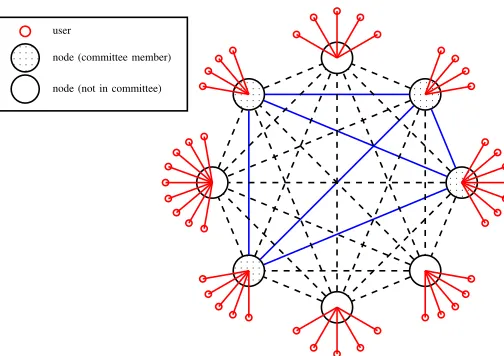
Fig.1shows an example of a fully-connected Helix network with eight nodes (illustrated by black large circles), serving various numbers of users (appearing as small red circles).
D. Communication schemes
The protocol uses two high level approaches for communi-cation. The first aims to reduce message dissemination time while the second aims to maximize originator anonymity. In both approaches, nodes’ bandwidth consumption is limited, i.e., a node is restricted in the number of nodes she sends messages to.
The fast broadcast scheme is deterministic (namely, not using random gossip), implying a fixed bound for the time a message is propagated in the network. The scheme is resilient tof Byzantine nodes that do not follow the scheme and may act arbitrarily. Letδbe the maximal time it takes for point-to-point messages to arrive at their destinations and let∆be the maximal time it takes a message that a correct node broadcasts, to reach all correct nodes. By the scheme a node multicasts a message to 2(f + 1)neighbors and a message is propagated to the whole network withinζ=O(log(n/f))hops such that ∆ =ζ·δ.
When anonymity is of interest, a second approach is used. Theanonymous broadcast, generalizes a simple ring topology and uses different heuristics to reach destined nodes while not revealing much information on the identity of the source node.
10One practical way to achieve such a restriction is to utilize ephemeral
keys for signing messages. In general, a node creates a pairwise ephemeral key for each term, composed of a secret key and a corresponding public key, which is uniquely associated both to the identity of the node and to some term number. The node publishes in advance (e.g., for the next thousand rounds) a commitment for these exclusive keys (one way of creating such a commitment is by using a Merkle tree and publishing the root). Every term the node signs messages with the term’s ephemeral secret key and destroys it when the term ends. Hence, if the adversary takes control over the node in a subsequent term, she cannot sign messages from an earlier term.
11Centralized relay services such as Bitcoin’s FIBRE network (see:http:
user
node (not in committee) node (committee member)
Figure 1: Illustration of a Helix fully mesh network withn= 8 nodes, serving various numbers of users. Among the nodes,
m= 4nodes (filled with dots) participate in the committee of some term r.
IV. THEHELIX PROTOCOL
This section is dedicated to a high-level description of the Helix protocol—we first illustrate the main data types used in Helix and then describe its operation.
In Helix, users issueEncrypted-transactions(etxs), which they send to the node they are connected to via a user-node connection. We refer to the receiving node as theowner node of the etx. etxs are stored locally by every node in her Epool, pool of Encrypted-transactions. The protocol’s goal is to order the etxs, such that the order is agreed upon by all correct nodes. The etxs are grouped into Eblocks, blocks of Encrypted-transactions, which will ultimately be incorporated into the blockchain. The protocol progresses in iterations, or terms, where in each term exactly one Eblock is appended to the blockchain.
Agreement on the next Eblock in the blockchain is achieved using a Byzantine agreement protocol, run within acommittee comprising a subset of the nodes (see Fig. 1). A special feature of Helix is that the committee members constructing an Eblock do not know the content of the transactions or their owner nodes. This property is achieved by encrypting transactions using a(t, n)-threshold encryption scheme among the nodes, where t=f, and broadcasting them anonymously. After a committee reaches an agreement on a new Eblock, a proof for this agreement, referred to as a Block-proof, is constructed and broadcasted to all nodes. Only then is the Eblock decrypted, in a process where, first each individual node produces her own Shares-block, and later t+ 1 (for a further explanation see Sec. IV-C) different Shares-blocks are later combined to reveal the Dblock, block of decryptedetxs (corresponding to the Eblock).
Each node incorporates a so-called Encrypted-secret into the Shares-block that she generates. When the Dblock is revealed (i.e., decrypted from the corresponding Eblock), the
Encrypted-secrets are also decrypted, and combined together to generate an unpredictable random seed. This random seed is used, together with the reputations of the nodes, to determine the new committee members responsible for appending a new Eblock to the blockchain in the next term. Intuitively, the reputation is a measure of node’s behavior in the protocol.
A. The Helix data types
Transaction(tx) andEncrypted-transaction(etx). Transac-tions are the atomic pieces of information12 that Helix com-municates and orders. Users issue transactions and sign them to prove their system-identities. They then employ a threshold encryption scheme13, where only t+ 1 or more cooperating nodes can decrypt. By ordering encrypted transactions prior to their disclosure, Helix enhances the fairness of the system (as discussed in Sec. V-C).
Secret(se) andEncrypted-secret(ese). A Secret is a fixed-length bit string sampled uniformly at random periodically by each node, and used to implement Helix’s randomness beacon. As their name suggests, the Encrypted-secrets are the cipher-texts corresponding to the secrets14. Each ese is propagated along the network after being associated with a term number
rand signed by its issuer i, denoted hese, riσi =ese
r i.
Epool. The Epool is a collection of etxs stored and main-tained locally by each node. The etxs contained in a given node’s Epool may have been issued by the node’s users, or forwarded from other nodes (we emphasize that the encryption scheme together with the anonymous communication scheme obfuscate the issuing user and his owner node). Once an etx
is included in a committed Eblock (i.e., an Eblock that is appended to the blockchain) it is removed from all Epools it appears in.
Committee-map(Cmapr). A Committee-map is an ordered list of the nodes in the system and their respective reputations, corresponding to a specific term. The firstm= 3f+ 1nodes in Cmapr form the committee of term r (with the first node serving as primary), which determines EBr. A Committee-map for term r is generated after the committed Eblock for the previous term EBr−1 is decrypted. The calculation of
Cmapr is done locally and deterministically by each node, and depends on the random seed RSr−1 and the nodes’
reputations.
Eblock (EBr). The Helix blockchain is made up of Eblocks, each comprising two parts: payload and header. The payload contains a Merkle tree of etxs and a list of t+ 1 signed (and distinct)esers these come from thet+ 1 Shares-blocks that were used in order to decryptEBr−1
. The header
12In many cases it is useful to think of transactions as inputs to some
transition function that updates a state. However, for the sake of generality, in this article we avoid attributing any particular semantics or functionality to transactions.
13Note that the encryption scheme should be CCA secure [25] as the
protocol could be interpreted as a decryption oracle.
14Note that the encryption scheme should be non-malleable to prevent
EB
DB BP
t+ 1SBs
Blockr−1
EB
DB BP
t+ 1SBs
Blockr
EB
DB BP
t+ 1SBs
Blockr+i
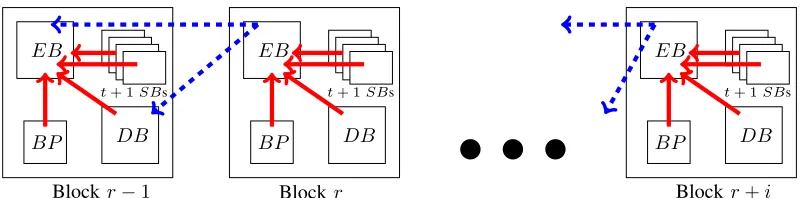
Figure 2: Illustration of the Helix blockchain. Hash pointers are used to point within blocks (in solid red) or over blocks (in dashed blue).
contains the following metadata:
• Term number, r.
• Current Committee-map15, Cmapr.
• Hash of the previous Eblock’s header, H(EBr−1). • Hash of the previous Dblock’s header,H(DBr−1).
• Merkle root for the payload’s Merkle tree.
• Hash of t+ 1concatenated esers.
• Composer. The composer is the node that originally constructed the current EBlockEBrfrom her Epool. The composer’s identity is taken into account for reputation updates.
• View. The view in which EBr was committed (see Sec.IV-Cfor details). The view is also taken into account for reputation updates.
We note that the header contains a digest of the payload and that Eblocks hash-point their predecessors. To support the inherent tamper-resistance of blockchains such a cryptographic dependency structure is required. We assume that EBs are limited in capacity16. In Helix we denote by b the maximal number of etxs in an Eblock.
Block-proof (BPr).BPris a list of messages and signa-tures, generated by the committee of termr, that acts as proof that EBr has successfully undergone all the phases of the Helix base agreement protocol (see Sec. IV-C). It manifests that EBris valid and safe to append to the blockchain. BPr
metadata includes H(EBr)and the term number r. There is a slight abuse of notation here as there could be many valid different Block-proofs in term r, and different nodes might store different ones. The exact content of a Block-proof is described in Sec.IV-C.
Shares-block(SBr
i).SBir consists of a list of decryption-shares, produced by a single node i for term r; the list comprises one decryption-share per etx and ese in EBr. According to the threshold encryption scheme, each node is capable of producing exactly one Shares-block per term. A node that received (any) t+ 1distinct Shares-blocks for term
r can verify each one’s authenticity and then decrypt EBr.
15The motivation behind including Cmap in Eblocks is to allow joining
nodes to sync quickly (see further details in Sec.VII).
16Capacity can be defined in many ways: space (such as in Bitcoin, where
blocks are limited to some predetermined memory size) or “gas” (such as in Ethereum [26], where blocks are limited according to the amount of computation and storage usage they invoke).
The metadata ofSBir includesH(EBr), the term numberr, a legally-generatedeseri+1 and nodei’s signature.
Dblock (DBr). DBr is the decrypted version of EBr. Similarly to an Eblock, the Dblock contains two parts: header and payload. The payload contains a Merkle tree of txs (decrypted transactions) and a list of ses (decrypted eses), whose order is dictated by their order in EBr. The header includes:
• Term number, r.
• H(EBr).
• Merkle root of the (decrypted) transaction tree.
• New random seed, calculated as follows: RSr =ser
0⊕
· · · ⊕ser
t. The choice of t+ 1 ses is dictated by the assumption on the number of Byzantine nodes (f =t). In Sec.V-Cwe formally prove the unpredictability of the random seed and explain the choice of the XOR operator. Fig.2 illustrates the Helix blockchain. Each block is com-posed of an EB, a BP, a DB, and t+ 1 SBs. A block includes internal hash pointers between components of the block as well as hash pointers to components in the previous block. Notice the Helix hash chaining structure—only unique elements (i.e., Eblocks and Dblocks) are referenced, while non-unique elements, that may differ from node to node, reference unique elements.
B. Happy flow: An overview of Helix’s normal operation
We describe the normal flow of the protocol on a high level. Node i ∈ {0, . . . , n−1} reveals the Dblock of the previous term DBr−1 and obtains the new random seed RSr−1. she
then calculates forj∈ {0, . . . , n−1} the values
vjr= H RS
r−1, r, pk
j
repr j
Here, repr
j is the reputation of node j in term r. Cmapr is ordered according to {vr
i} n−1
i=0, where the m nodes with the
minimal values are considered the committee for termr and the first node among them is the primary.
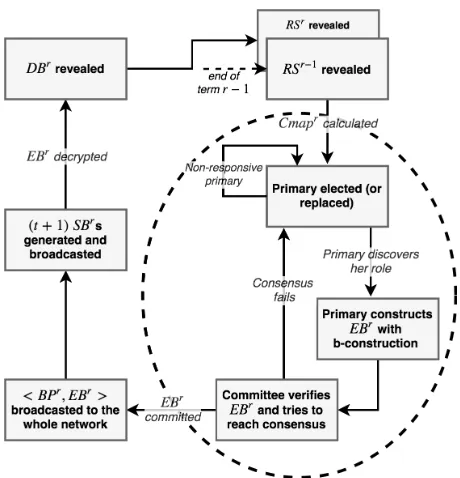
Figure 3: A high-level, system-view of the dynamics of a Helix term. Segment four and the intra-committee communication related to the base agreement protocol lies in the dotted ellipse.
probability (w.o.p.) she succeeds in committing it (see analysis in Sec. V-B) and a Block-proof for it is created. Committee members that complete assembling BPr, then add EBr to their blockchain and broadcast the pair hEBr,BPri to all nodes (in particular to non-committee members). Now, the decryption process begins. Nodes that do not hear of t+ 1 corresponding Shares-blocks SBs prior to receiving the pair
hEBr,BPri, produce their version of SBr and broadcast it to all nodes. Upon receiving t+ 1 Shares-blocks,EBr is decrypted and DBr is revealed. Finally, a new term begins. Fig.3 illustrates a high-level flow of a helix term.
C. The segments of the Helix protocol
For clarity of presentation, we divide Helix’s operation into four distinct segments, where each segment is responsible for a specific logic within the protocol. The first handles an initial setup phase; the second is responsible foretxpropagation; the third handles dissemination of information on the consensus result to all nodes, with the purpose of concluding the current term and initiating the following one; and the fourth handles reaching consensus among committee members. Helix consists of several processes that run concurrently and invoke each other frequently. We proceed to present the different segments of the protocol and pseudo-codes for the various processes.
Segment 1—Initial setup
Since Helix relies on a threshold cryptosystem, an initial interactive step for key generation is required. A distributed key generation (DKG) protocol among the nodes would be
used (e.g., [23], [27], [28]).
Threshold encryption. We use the DKG to generate a common public key (P K), secret keys (S0, ..., Sn−1) and
verification keys (V0, ..., Vn−1). The P K is known to all
entities in the system and is used to encrypt transactions. The secret and verification keys are kept privately by the nodes and are used to decryptetxs. In this article we assume static membership of nodes17.
Random seed. In every term, a random seed is generated as part of the decryption of the committed Eblock. The initial random seed RS0 is hard-coded into the genesis block. The
initial seed will be used to determine the first Cmap and in particular the first committee. Instead of using a dealer, a (Public)-VSS Coin Tossing scheme can be used to generate
RS0 [11].
Segment 2—etxetxetxpropagation
Transactions are issued by users; each user signs and then encrypts each transaction that he issues18. Each user’s unique
sk is used for signing, whereas the commonP K is used for encryption. Theskis generated locally by each user, whereas theP K is hard-coded into the genesis block19. After signing and encrypting is complete, the user sends theetxto his owner node.
Communicating Encrypted-transactions. As described pre-viously, each etx is sent by the issuing user to his owner node. The owner node then forwards theetxto all the nodes in the network. A key objective of the forwarding scheme is to reduce the ability of other nodes to identify the original sender node (a node should only certify whichetxs she owns but will not publicize this until after the Eblock containing her
etxis committed). This is crucial for maintaining fairness (as described in Sec.V-C). Each node maintains her own Epool by adding newetxs she receives and by removing committedetxs (i.e.,etxs included in committed Eblocks). We emphasize that the progress of segment 2 is independent of the advancement of the blockchain as described in segments 3 and 4.
Segment 3—Spreading consensus
The main purpose of this segment is to update all non-committee members as to the consensus result from the previous term and to kick-start the next one.
17An interesting topic for future investigation is removing the need to redo
the setup process every time a node joins or leaves. A possible approach is to generate extra key pairs and distribute them among the nodes according to some secret sharing scheme. When a new node joins she collects enough shares to construct her key pair, in the spirit of [28]. Supporting removal of nodes can be more tricky.
18The choice to have users sign and then encrypt transactions favors
user’s anonymity, but exposes the network to spam attacks. Under our model assumptions, these attacks are mitigated by the nodes, where each node is responsible for her users. As a matter of fact, the bare minimum required is a mechanism that reveals the owner nodes of committed transactions. If this cannot be achieved in a real deployment system, user anonymity can be given up.
19To address cases in which theP Kchanges due to a reconfiguration of
Process User
Letskbe the user’s secret key andP K the network’s public key.
// Issuing transaction and casting it
1: tx←IssueNewTransaction
2: σ←SignTransaction tx, sk
3: etx←EncryptTransaction htxiσ, P K
4: Unicast etx .to owner node
Eblocks and Block-proofs. In a certain termr, once the con-sensus procedure forEBrhas concluded and some committee member has built a valid BPr, the pairhEBr, BPrishould be propagated to the whole network as rapidly as possible. Once a non-committee member receives the pairhEBr, BPri, she performs a brief-validation and appends EBr to her blockchain. A brief-validation of a pairhEBr, BPriincludes the following checks:
1) The Cmap appearing in EBr’s header matches the one calculated locally by the node. In particular, a correct node would refuse to appendhEBr, BPriunless she had already appended the previous Eblock and can calculate the current Cmap and the current committee’s composi-tion. As a matter of fact, this step can be dropped as we explain in Sec. VII.
2) BPr serves as a valid proof that the base agreement protocol has been carried out successfully (as described in segment four) by the rightful committee (i.e., all signers appearing inBPr appear in Cmapr[0, . . . , m−1]). Shares-blocks and decryption. As briefly noted above, Shares-blocks are constructed by nodes that have committed an Eblock and have not yet receivedt+1Shares-blocks for that Eblock (this condition is set to reduce the number of Shares-blocks propagating in the network). Normally, committee members would be first to hear of new committed Eblocks and would thus be the ones producing Shares-blocks (this however strongly depends on message propagation in the network). After a node assembles a Shares-block, she broadcasts the Shares-block to all nodes through the fast forwarding scheme. Once a node obtains t+ 1 Shares-blocks for a committed Eblock, the Eblock is decrypted and the Dblock is revealed. We note that from the nature of the threshold encryption scheme, any valid t + 1 Shares-blocks would produce the same Dblock. The choice t = f minimizes the time from committing an Eblock to decrypting it, while maintaining Helix’s resilience tof Byzantine (and cooperating) nodes.
Segment 4—Base agreement protocol
Generally speaking, the base agreement protocol is a single-value variant of PBFT, instantiated every term, and re-sponsible for intra-committee consensus regarding the current term’s Eblock. The ellipse in Fig. 3 illustrates segment four within the Helix protocol. PBFT, as a Byzantine agreement protocol, enables Helix to reach finality, i.e., no two correct nodes ever commit different Eblocks in the same term, as long
Process Node(for nodei)
Letr be the term number andCmapr the Cmap of termr.
1: Upon receiving a briefly validated hEBr,BPriand t+ 1SBrs
2: DBr ←DecryptEblock EBr,SBr[0, . . . , t]
3: AppendToBlockchain
EBr,SBr[0, . . . , t],BPr,DBr
4: Cmapr+1←UpdateCmap DBr,Cmapr 5: r←r+ 1
6: Broadcast hEBr,BPri
7: Ifi∈Cmapr[0, . . . , m−1]
8: Trigger Process PBFT
as the boundf on the number of Byzantine nodes holds (see proof in Sec.V-A). To emphasize this, Helix inherits PBFT’s robust safety guarantees—safety is kept even during times the communication network is asynchronous or unreliable. We split the segment’s description into two parts. First, we describe segment four as an ideal agreement protocol that achieves certain properties. Then, we explain how PBFT is used to implement it.
Ideal agreement protocol. The ideal agreement protocol run betweenmnodesu0, . . . , um−1shall implement the following
primitive.
Definition 9 (ideal agreement protocol) An agreement protocol is said to implement the ideal agreement protocol for Helix’s segment four if it satisfies the following properties:
• Validity. If a correct node commits a value αthen some node proposedα.
• Liveness. If all correct nodes initiated the protocol then all correct nodes commit a value.
• Safety. If a correct node commits a value α then every correct node commitsα.
• Verifiability. If a correct node commits a valueα, then she can produce a proofpα, such that anyone can efficiently verify thatαwas agreed upon by themnodes.
A typical Byzantine agreement (BA) protocol satisfies the first three items. Nodes that have not participated actively in the BA and wish to commit the agreed-upon value after the fact can do so (safely and efficiently) using the verifiability proof. Helix’s base agreement protocol implements the ideal agreement protocol, whereEBr is the value agreed upon and
BPrserves as a proof that it was indeed agreed upon by nodes
u0, . . . , um−1. The question remains though—which nodes are
the rightful committee members in term r? In order to avoid forks (i.e., inconsistencies), Helix must figure out a way for all the participating nodes to come to an agreement as to a single committee. This is done usingEBr−1which contains a
commitment to the seed that determines ther-term committee. Using an inductive argument, if there are no forks in term
r−1, then only a single committee is possible in term rand accordingly there can neither be forks in termr. Finally, since the first committee is hard-coded into the genesis block and agreed upon by all nodes, Helix enjoys no forks.
the ideal agreement protocol is implemented using a simplified version of PBFT [5] that reaches agreement over a single value. We assume a familiarity with PBFT’s logic and ter-minology and describe Helix’s adjustments and modifications to PBFT20.
Accepting an Eblock. In PBFT, a nodeacceptsa pre-prepare message (and the value she proposes) by broadcasting a corresponding prepare message after validating the following:
1) The view in the pre-prepare message matches her internal view number.
2) The pre-prepare message is signed by the rightful primary in that view.
3) She has not accepted a pre-prepare message in the same view containing a different Eblock.
In Helix, when acceptingEBr, a correct committee member further validates that:
1) EBr’s header contains Cmapr as locally computed with
DBr−1 andEBr−1. We emphasize that a correct
com-mittee member does not depend onEBr’s header in order to figure out whether she is in the committee or not. This implies that in order to participate in a committee a correct node must obtainDBr−1 andEBr−1.
2) EBr’s header contains a valid hash pointer toEBr−1.
3) EBr’s header contains a valid hash pointer toDBr−1.
4) EBr’s header contains a valid hash of concatenated
eses, i.e., H(eser
i0, . . . , ese r
it), properly signed by the
different nodesi0, . . . , it (taken from thet+ 1SBr−1s the composer node used in order to decrypt EBr−1).
5) EBr’s header contains the correct composer and view (this can be validated with the new-view messages, if exist).
6) EBr’s payload contains at mostb etxs.
View-change mechanism. In PBFT, when timeouts expire (e.g., due to a faulty primary or an unexpected network slowdown) view-change messages are broadcasted with the aim of replacing the primary. In order to ensure safety is maintained cross-views, proofs of previously committed values are submitted within the view-change mechanism. To avoid rerunning all the committed values from the beginning of time, a checkpoint mechanism is introduced where proofs are sent only for values that were committed after the last stable checkpoint. Helix’s blockchain construction enables invoking a new instance of a value PBFT for each term (this single-value PBFT implements the ideal agreement protocol). Thus, the checkpoint and truncating mechanism can be given up altogether (while primaries keep being replaced seamlessly). In addition, new-view messages contain only one pre-prepare message which never contains the null digest, dnull. Only in case a new Eblock is proposed, the Eblock itself is passed as regularly done with pre-prepare messages.
20To keep our presentation concise, we leave PBFT’s original
point-to-point communication intact and do not adopt a more bandwidth-economical protocol such as CoSi [29] as proposed in Byzcoin [4] or Zilliqa [30]. In Helix, optimizations to PBFT’s bandwidth consumption can be relieved as we assumemn, wheremis the size of the committee running PBFT.
Verifying consensus. The verifiability property of the ideal agreement protocol (see definition9) is obtained by the Block-proof that stores a signed pre-prepare message, 2f corre-sponding signed prepare messages and2f+ 1corresponding signed commit messages21. On its own, a Block-proof is not enough as a node needs to know the composition of the term’s committee and make sure all the signers are indeed committee members. As mentioned before, this can be deduced from the previous term’s block. We show in Sec. V-A that BPr indeed serves as an unforgeable proof aEBrwas committed-locally by some correct committee member in term r. Thus, the pair hEBr, BPri (after validation) is safe to append to one’s blockchain.
Timeout mechanism. We consider two timeout mechanisms for Helix. In PBFT’s original approach, timeouts are determin-istic and double every time the view increases, i.e., the timer in viewv is set to be2v−1x, for some positive value x. This
ensures that in a timely network, all backups will eventually converge to a specific view (that of the current most advanced backup or one view later), even if the network performs unreliably for a restricted amount of time. This technique, although it works in theory, is very problematic (see [32]) as timeouts must keep growing and cannot be adjusted to be shorter22.
We suggest a different possible timeout mechanism, in which timeouts remain constant and thus highly relies on the network being reliable and predictable in latency. Every time an instance of PBFT is initiated, or when a view-change message is sent, a node’s timer is reset to the same value,
x= max{2∆, ∆ + 3δ}. In a nutshell, this value is set so that it expires only after a committee member is certain a correct primary had enough time to get her Eblock committed. In the next section, we prove formally that Helix is indeed live under the condition any piece of information a node broadcasts (according to the fast forwarding scheme) is received by all correct nodes within a known bound∆.
D. Incentive mechanism in Helix
Processing a transaction in Helix costs money as it con-sumes resources such as bandwidth, storage and computa-tion. Each node is responsible for the processing costs of transactions issued by her own users23. However, the cost for processing transactions for other nodes’ users may be considerable, and thus requires in-protocol compensation from those nodes. If all nodes produce the same amount of trans-actions, compensation is settled trivially as costs balance. Though if nodes produce different amounts of transactions,
21We note that in order to reduce the size of such a proof, aggregation of
signatures or a threshold signature scheme may be deployed, as in [31].
22As a matter of fact, once a backup commits-locally a value in PBFT, she
could potentially start over with timer set toxin the next view, leaving in previous views at mostf backups. These would eventually be synced with the checkpoint mechanism.
23The way a node covers the costs of her users depends on her business
Process PBFT(for committee memberi)
Letrbe the term’s number, Cmapr the Cmap of termr,v∈Nthe view, andCEB a candidate Eblock. Letj∈Cmapr[ 0, . . . , m−1] be a committee member andpv=Cmapr[v mod m] be v’s primary.
Init: v←0,CEB←null,prepared←f alse,committed locally←f alse, Pr
i ←null. Timer: Set timer tox0=xand start countdown.
// First primary 1: Ifi=p0,
2: CEB←ConstructEblockFromEpool
3: Multicastcommittee
hPRE-PREPARE,0,r, H(CEB)iσp0,CEB
// Normal flow
4: Upon receiving ahPRE-PREPARE,v,r, H(EB)iσpv,EB
message
5: ValidateEblock EB
.see Sec.IV-C
6: CEB←EB
7: Multicastcommittee hPREPARE,v,r, H(CEB),pkiiσi
8: Upon receiving2f hPREPARE,v,r, H(CEB),pkiiσj messages andCEB6=null
9: prepared←true
10: Multicastcommittee hCOMMIT,v,r, H(CEB),pkiiσi
11: Upon receiving2f+ 1hCOMMIT,v,r, H(CEB),pkiiσj messages andprepared=true
12: committed locally←true
13: BP ←ConstructBP
14: PropagateEB CEB,BP
// Timeout: primary change proposal
15: Upon timer expiry, reset timer toxv+1= 2v+1x0
16: Pir=null
17: Ifprepared=truethen,
18: Pir= (
Pr
i.EB←CEB
Pr
i.msgsv←2f+ 1PREPARE messages with viewv, received forCEB
19: Unicastpv+1 hVIEW-CHANGE,v+ 1, r,P
r i,pkiiσi
20: v←v+ 1
// Primary change takeover, forp˜v
21: Upon receiving2f+ 1hVIEW-CHANGE,ev,r,Pjr,pkjiσj messages, denote them byV
22: If there exists ajs.t.Pr
j 6=nullthen,
23: j←the node with the maximalvamongPr
j.msgsv 24: CEB← Pr
j.EB
25: Otherwise,
26: CEB←ConstructEblockFromEpool
27: O ←hPRE-PREPARE,
e
v,r,H(CEB)iσi,CEB
28: Multicastcommittee hNEW-VIEW,ev,r,V,Oi
.NEW-VIEW messages, after validated, are treated as
.PRE-PREPARE messages by recipients
a fee mechanism that offsets costs among nodes is required. Fees would basically be paid by nodes with a high transaction rate to those with a low transaction rate24.
Fees, in addition to balancing costs, serve as means to incentivize nodes to follow the protocol’s instructions and allow the protocol to reach optimal performance. This is achieved by a reputation score that is attributed to each node and is updated frequently. The reputation strives to serve as a reliable measure to a node’s quality of service. A node’s
24At this point we do not elaborate as to the implementation of Helix’s fee
mechanism, but assume that the fee is proportional to a node’s transaction rate.
reputation is taken into account when calculating her fee tariffs, where nodes with low reputation can charge lower fees for their services than their peers, possibly resulting in losses. For this reason, it is important that both the measurement of the resource usage and of the quality of service are accurate.
reputation measure may be enhanced to mitigate new found vulnerabilities in the protocol or to encourage new desired behaviors. The discussion above makes clear that nodes are incentivized to increase their reputation, but also wish to include their own etxs in Eblocks as fast as possible. These two distinct preferences may be conflicting, requiring nodes to prioritize.
We shall now illustrate a naive reputation measure. It is updated frequently (e.g., every 1000 blocks or every month), locally and deterministically by each node, according to the blockchain. A few concrete examples:
• In order to make sure that nodes maintain high uptime and stay available, every node is evaluated according to the average view number of committed Eblocks when she was a committee member. The higher the average view, the lower the reputation should be.
• In order to make sure that nodes maintain the recent
blockchain history, if an Eblock consists of a previously included etx, its composer should be punished by reduc-ing hers reputation.
• In order to make sure that nodes select etxs randomly (see Sec. VI for more details), adjacent Eblocks should represent similar distributions (in terms of the owner nodes of the etxs they include). If a specific node is found to construct Eblocks that significantly deviate from the Eblocks in their surrounding, she should be penalized by reducing her reputation.
• In order to encourage nodes to stay up-to-date with protocol changes, a node that constructs an Eblock with a decommissioned protocol version should be penalized by reducing her reputation.
We emphasize that the reputation update rules that do not depend on Dblocks may be used as validation checks in the agreement protocol. On the contrary, some of the validation checks in Sec.IV-Cmay be relaxed and become a part of the reputation mechanism. An interesting possibility is to relate reputation to a node’s stake in the system. We also note that the reputation measure is shared across other services in the system such as the execution service.
V. BASIC PROPERTIES AND PROOFS
Helix achieves three desired properties: safety, liveness and fairness. First and foremost, Helix issafe. As long as the bound
f on the number of Byzantine (rather than sleepy) nodes holds, even without any assumptions on network synchrony, forks cannot happen (i.e., there will not be a situation in which different nodes commit different blocks in the same term). Second, Helix is live. We refer to two types of liveness. First, under a weakly synchronous network Helix achieves (eventual) liveness, meaning that new blocks are (eventually) added to the blockchain in some finite time. Second, we show that under a strongly synchronous network Helix achieves a stronger property referred to asstrong liveness, in which new blocks are added within a known bounded period of time. Finally, Helix is fair with regard to three types of fairness. The first two
refer to fairness among nodes: election fairness (of committee members) and selection fairness (of transactions in Eblocks). The third type refers to fairness towards users. In this section, we elaborate on each of these three properties and prove that the Helix protocol fulfills them.
A. Safety
Helix is designed to provide safety even in the case of a slow and unreliable communication network. Safety implies finality, meaning that once an Eblock has been appended to the blockchain in the eyes of any (even one) correct node, then no correct node ever appends a different Eblock for that term. The safety of Helix relies on the safety of its underlying protocol, PBFT [5].
Claim 10 (Helix is safe) Let0, . . . , n−1be the nodes running Helix. In term r, let EBir and EBjr be Eblocks appended by correct nodes i, j ∈ [n−1], respectively, to their local blockchains. Then, EBr
i =EBjr.
Proof. For PBFT’s proof to be applicable here, we need to show that the committee in term r is a well-defined and agreed-upon set ofmnodes. Put differently, we need to show that no correct node can be “tricked” into believing she is a committee member when she is actually not, submitting signatures for invalid Eblocks. This is easily prevented by relying on the previous term’s Eblock (or more accurately Dblock) to determine the next term’s committee. A simple inductive argument can convince that there can be only a single version of DBr−1 and thus the composition of ther -term committee is well defined. Since all nodes compute the
r-term committee from theirr-term Dblock, all correct nodes will agree as to its composition. This concludes the proof using PBFT’s safety proof.
B. Liveness
In its most general sense, liveness guarantees that new blocks are added to the blockchain in some finite time. We consider two types of liveness which correspond to different synchrony assumptions and timeout mechanisms.
General liveness
For Helix to be live in the general sense, we need each PBFT instance to be live and for each member of the subsequent committee to (eventually) realize that she has been assigned to this role. For this to hold, we need the same synchrony assumptions as in PBFT, namely, a weakly synchronous net-work, where message delay is arbitrary up to a certain point but is eventually bounded by some unknown bound.
Proof. The proof follows from PBFT’s liveness and the fact that committee members eventually become aware of their committee membership. Assume that the last Eblock to be committed by a correct node was in term r−1. We identify three possible system states:
• State 1: At least 2f+ 1 correct nodes are aware of their participation in term r’s PBFT instance concurrently. In this case, by the liveness property in PBFT, in a finite time, at least one of them will append a valid Eblock to her blockchain.
• State 2: Fewer than 2f + 1correct committee members are aware of their committee membership, but at least one correct node knows the identities of the committee members for term r. This node has the ability (and duty, so to speak) to update all the committee members for term
r(safety guarantees that this will not contradict any other correct node’s view of term r’s committee members) by sending them EBr, BPr and t+ 1 SBrs. A simple syncing and feedback protocol25 run between the nodes ensures that this information is eventually propagated to all correct nodes. Accordingly, after a finite period of time state 1 takes place.
• State 3: No correct node is aware of the composition of termr’s committee. According to the protocol, the correct node that appended(r−1)’s Eblock to her blockchain is in the process of decrypting it (again, safety guarantees no forks in the term r −1). The decryption process duration depends only on the time of message dispersal, i.e., propagation of the committed Eblock, its Block-proof andt+ 1Shares-blocks. Thus, the process of decrypting term (r−1)’s Eblock is finite. Once at least one correct node decrypts the committed Eblock, we are back in state 2, which concludes the proof.
Strong liveness
In Helix, we wish to obtain a stronger notion of liveness that relies on two additional requirements. First, we require a time frame in which new blocks are committed. Second, we aim for a correct primary to succeed in committing her Eblock before a new primary is appointed. The first of these requirements is driven by the need for practical liveness (with a guaranteed bound on progress time), whereas the second requirement is related to fairness (discussed in Sec. V-C). We refer to this stricter notion of liveness as strong liveness. For strong liveness to hold in Helix we require the network to be strongly synchronous, namely, message delay is assumed to be bounded by some known constant (as explained in detail in Sec.III). To obtain strong liveness in Helix we use the constant timeout mechanism, in which x= max{2∆, ∆ + 3δ} is set as the timeout, as mentioned in Sec. IV-C.
Definition 12 (Strong liveness) A blockchain protocol (that enjoys finality), run between n participants is said to be
25We do not get into the details of this protocol, but it is clear that as long
as messages are eventually delivered, this information will propagate.
strongly live if it satisfies the following properties:
1) A primary that proposes a valid block, immediately after its construction, gets it committed.
2) A correct node that appended the (r−1)-term block, appends the r-term block within some known bounded period of time.
Before proceeding, recall the network model assumptions: ∆ is the maximal time it takes for a message that a correct node broadcasts, according to the fast forwarding scheme, to reach all correct nodes; and δ is the maximal time it takes for point-to-point messages to arrive at their destinations. The relationship betweenδand∆depends on the communication protocol26 as discussed in Sec. III.
We now prove that Helix (with the constant timeout mech-anism) is strongly live if the network is strongly synchronous. We distinguish between two cases based on the status of the first primary. First, we denote by ur the first correct node to revealDBr at timeτ
r, and with it, Cmapr+1.
Lemma 13 (Term with a correct first primary) If the first primary Cmapr[0] is correct, she will get EBr committed prior to any correct member’s timeout expiring.
Proof. In termr,ur−1’s initial timeout will be the first among
the correct nodes to expire (at time τr−1+x). Since ur−1
follows the communication protocol, she has propagated each piece of information she has heard or produced so far (in particularEBr−1,BPr−1and somet+ 1SBr−1s) and thus
necessarily all nodes reveal DBr−1 (and Cmapr) by time
τr−1+ ∆. In particular, the first committee’s primary (since
assumed to be correct) would realize her role by timeτr−1+∆
and would multicast a pre-prepared message withEBr to all committee members of termr. This message would reach all correct committee members by time τr−1 + ∆ +δ
(intra-committee communication is done point-to-point). Then, by time τr−1+ ∆ + 2δ all correct committee members should
receive enough prepare messages and by timeτr−1+ ∆ + 3δ, EBr should be committed-locally by all correct committee members. Since all correct nodes’ timers expire later than
τr−1+ ∆ + 3δ, no timeouts expire before EBris
committed-locally by all as required.
Lemma 14 (Term with a faulty first primary) Assume Cmapr[0],. . .,Cmapr[i−1]are all faulty nodes and Cmapr[i] is a correct node, where i ∈ {1, . . . , f}. Then, EBr will be committed-locally by all correct committee members in a view
v∈ {1, . . . , i}.
Proof. IfEBr is committed-locally, by even a single correct member, in view j < i, we are done because a correct committed-locally member would propagate hEBr, BPri to all correct nodes within∆time. This ensures that any correct
26In general gossip communication, where nodes send a new piece of