408
Changing Professionalism Tutor With TPACK
Model Based On Interactive Learning Simulation
(ILS) Of Greenhouse Concept
Suherman SuhermanAbstract: Experiment research aimed to find out how changing professionalism tutor with TPACK (Technological, Pedagogical, Content Knowledge) model based on Interactive Learning Simulation (ILS) of concept Greenhouse of the 21st century is the research subject tutor activity of the Teaching and Learning Centre (CLC), tutors were selected randomly as much as 7 out of every CLC. The Tutor after the implementation of this model shows that the model TPACK has a positive impact on the quality of the learning process. In detail the impact of the implementation of the model TPACK it is (1) increased knowledge of the subject matter better; (2) Tutor-Tutor is able to plan the learning process to encourage participants to be more active Tutor; (3) Tutor skill in conducting the learning process CLC changed for the better; (4) Tutor efficacy in performing the learning process increases CLC better.
Keywords: Model TPACK, Interactive Learning Simulation (ILS), Professionalism Tutor Science, Community Learning Centre (CLC). ————————————————————
1
I
NTRODUCTIONThe ASEAN Economic Community (AEC) represents one of the pillars of the dream of the ASEAN Community another pillar of Society ASEAN Security or ASEAN Security Community and Socio-Cultural Society ASEAN or ASEAN Socio-Cultural Community (ASCC) which is stipulated in the agreement Bali Concord II. ASEAN hopes to form a single market and base production (Linda, 2018). A single market and production base is essentially an area which is entirely seen by ASEAN member countries, rather than merely a market and resources that are within national boundaries and only involve the perpetrators economy at the national level. This means a member state will treat goods and services originating from anywhere in ASEAN equally as treatment them on their national goods. This will give privileges and access the same to ASEAN investors as well as their national investors, laborers‘ skilled and professionals will be free to do their work anywhere in ASEAN. Since reforms, its normative appeal has been enhanced by its hosting of a raucous but functioning democracy, an active civil society, and a vibrant cultural scene. But Indonesia is not new to the role of disseminator and aggregator of ideas (Camroux, 2015).See the era of MEA currently facing the Indonesian nation and educational goals national Indonesia, it's time for education in Indonesia to improve the Indonesian nation can compete with other nations. The basic improvement in education is related to the quality and competence of Indonesian teachers (Pantića, & Wubbelsb, 2010). Forget for a moment the debate on the 2013 curriculum, Indonesian teachers should be aware of their position in the era MEA and continue to improve their quality and competence in order to realize the purpose of Indonesian national education. As is known, a person can be a doctor, workers, architects, accountants, and various other professions is thanks to a teacher's upbringing (Loughran, 2014). While in this era of MEA various professions must compete in multinational ASEAN region. Therefore, the role of teachers is important in this era of MEA. Expose is a bit much indicate the vital position of a teacher in this era of MEA, so Indonesian teachers need to look at how the quality has been achieved and how catch
up, so that the Indonesian Nation is parallel to other nations and ready to compete in the face of the MEA. The presence of the development of science and technology can be one way to improve the quality of learning done by a teacher. To be able realizing that, a teacher needs to understand of Technological Pedagogical Content Knowledge (TPACK) (Graham, 2011) and Jang, & Tsai, 2012). In addition to the use of technology as a learning medium, in the TPACK framework, pedagogy is an important aspect that needs to be addressed in learning activities (Kabakci, et al., 2017). Pedagogy is not only how to develop the arts in teaching, or to design the completeness of the processes and assessment instruments in learning, but also to understand students psychologically and non-formal education. In this pedagogical thinking there is finally an emphasis, that a successful teacher is not a teacher who can only make his students smart like him, but more than that is successfully helping students find themselves (Yeh, et al., 2014). The interest, talent and character of the learner must ultimately be understood by a teacher. Learning achievement is the result of learning achieved after going through the process of teaching and learning activities. Learning achievement can be demonstrated through the value provided by a Tutor of the number of subject areas that the Tutor Participants have learned (Franziska & Anke, 2019). In the process of achievement, learning achievement is strongly influenced by various factors. One of the main factors that is very influential in the success of learning is the existence of Tutor. Tutors are agents of change (Allan, & Duckworth, 2018) the term Tutors are agents of change (Ab Kadir, 2018). Tutors as change agents have multiple meals, and each interpretation may be related to a particular perspective Tutor professional development (Kyriaki, et al., 2018 and Fischer, et al., 2018).
Given the existence of Tutor in the process of teaching and learning activities are very influential, then it should be the quality of the Tutor should be considered. As noted above, that in an effort to improve the quality of education, the main aspect that is determined is the quality of the Tutor. For that, the initial effort made in improving the quality of education is the quality of the Tutor. The Tutor's educational qualifications correspond to the minimum requirements set by the requirements of a professional Tutor. Professional Tutor is a qualified Tutor, competence, and Tutor desired to bring learning achievement and able to influence the teaching and learning process Participants Tutor which will result in good learning Practice Participants Tutor (Kyriaki, 2018). ————————————————
Department Non-Formal Education, Universitas Sultan Ageng Tirtayasa, Indonesia
409 Tutors or educators are true leaders, wise counsellors and
directors, sculptors and leaders of the human. The Tutor does understand according to Law no. Law is a professional educator with the main task of educating, teaching, guiding, directing, training, assessing, and evaluating the Participants of the Tutor in the following chapters. Primary and secondary education. Professional Tutor defines that: A professional tutor is a person who has the ability and special expertise in the field Tutor so he is able to perform tasks and functions as a Tutor with maximum ability. Conceptually, the Tutor's performance according to namely; (A) professional ability, (b) Social skills, and (c) personal abilities. But looking at the reality that exists, the existence of professional Tutor is very far from what is aspired. The proliferation of CLC. The low quality community gives a hint that the professional Tutor is just a discourse that has not been realized evenly in all education in Indonesia. This raises a concern that not only comes from academics, but even laypeople comment on the irregularities of education and teaching staff. The fact inspires the academics, so they formulate to improve the qualification of Tutor through empowerment and professional enhancement Tutor from training to instruction to have a minimum education qualification of Bachelor. The new problem is, Tutor only understands the instructions only as a formality to meet the demands of an administrative needs. So the competence of Tutor professional in terms of learning the maximum. Though this Tutor Participant is the target of education. Which is formed through guidance, exemplary, help, practice, maximal knowledge, skills, skills, values, good attitude of a Tutor (Kara, & Can, 2019). So only with a professional Tutor it can be realized in full, so it will create conditions that generate awareness and seriousness in the process of teaching and learning activities. Thus, what a Tutor says will affect the learning outcomes. Conversely, if the above is not realized well, it will result in dissatisfaction of Tutor Participants in the process of teaching and learning activities. The incompetence of a Tutor in the delivery of teaching materials indirectly will affect the outcome of learning. Because the learning process can not only be achieved by courage, but the main factor is the competence that is in the person of a Tutor. Limitations of the Tutor's knowledge in the delivery of the material, whether in terms of methods or other basic learning support will affect the learning? Attempts to improve the quality of Tutor include: Learning to love Tutor's work. This means learning to look for things that are positive from the Tutor's work, and then to be grateful for it. Loving work can happen, among other things, if we feel close to the work done and appreciate the work that is being done. Therefore learn to love work Tutor other learn familiar with the work of Tutor and learn to gain meaning in doing such work. Learning through work. In working, we can learn at once. The experiences of doing the Tutor work teach us what is right and right to do and what is not or is not right or right done. From there we can learn which work techniques should be established and which work techniques still need to undergo change, adjustment or replacement. Higher-level business operations will further intensify pre-service educations and Community Learning Centres (CLC) and their management agencies. Based on the above problems, we proposed Model-Based TPACK (Technological, Pedagogical, and Content Knowledge) model based on Interactive Learning Simulation (ILS) with Interactive Learning Simulation (ILS) to develop the professionalism of tutor‘s science. Looking at the above
discourse, it is very apparent that Tutor professionalism can have an effect on learning achievement. On the basis of existing discourse in the field, the authors want to prove whether the perception that exist in the community about the problem of professionalism Tutor is true or vice versa, by doing a research. According to the authors based on facts in the field, generally the condition of Community Learning Activities Centre that there is still a Tutor who is not professional. The Tutor Competencies in the Centre for Community Learning Activities have not fully met the criteria as required by the requirements of the Professional Tutor. Therefore, the government conducts certification programs to the Court by requiring teachers to have a minimum education qualification S1 in accordance with their respective fields. Based on the background of the above problems, the authors are interested in conducting research how changing professionalism tutor with TPACK (Technological, Pedagogical, Content Knowledge) model based on Interactive Learning Simulation (ILS) the 21st century in Teaching and Learning Centre (CLC) in Serang city, Banten, Indonesia.
2
M
ATERIALS ANDM
ETHODSThis research uses Quasi Experiment method with research design using The Randomized Post-test-Only Control Group Design (Cresswell, 2016). The timing of the research is planned 10 months from the proposal submission to the reporting. The research location is CLC Serang city, academic year 2016/2017.
Group Random Treatment Post Test
Experiment R O X1
Figure 1. Research Design the Randomized Post-test-Only Control Group Design
Information:
R : Selection of class at random O: Provision of the TPACK model based ILS Model of Greenhouse in experimental class. X1 : Final test with TPACK model Questionnaire in the experimental class.
Research subject in this research is CLC class level teacher in Serang City, Indonesia. With a random sample technique taken 7 Tutors from the total of all Tutors in proven Banten as an experiment. The steps taken in this research include 5 steps, namely: preliminary study, literature study, instrument design, instrument trial, implementation, and ending with result analysis and drawing the full conclusion can be seen in the flow of research picture.
3
R
ESULTS ANDD
ISCUSSION3.1INTERACTIVE LECTURE SIMULATION OF GREENHOUSE
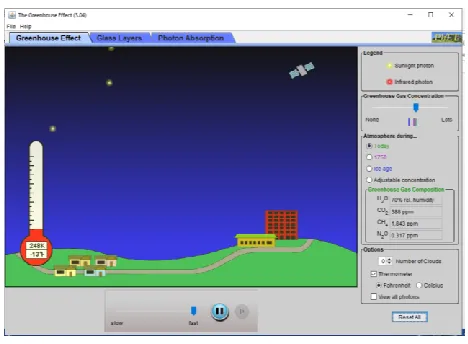
410 greenhouse is to capture sunlight, because the heat from the
sunlight is trapped inside the building.
Figure 2: ILS of greenhouse
(Source: https://phet.colorado.edu/in/simulation/legacy/greenhouse)
Based on Figure 2. The information of the greenhouse effect is based on sunlight which has been reflected by various objects on earth. This reflected sunlight can damage the ozone layer. With the main function is to inhibit sunlight in the atmosphere. If the ozone layer in the Earth's atmosphere decreases, the temperature of the earth will rise continuously. If the temperature on earth rises, the earth will turn cold. This condition will get worse, because carbon dioxide is on earth. Because it can resist the reflection of sunlight so that the temperature on earth will also increase. To avoid the damaged ozone layer in the earth's atmosphere, we must reduce the use of various tools or materials that can produce CO2 or carbon dioxide. It can even cause damage to other ozone layers. The process of the greenhouse effect starts from the sun which will emit its light in the form of ultraviolet radiation to the earth, which will be received by the earth and then reflected back in the form of infrared radiation. Sunlight will enter the earth as heat, then then some of the light will be reflected into the sky by the surface of the earth. So during the day the temperature in the greenhouse will get warmer, on the contrary if at night the temperature will remain warm not affected by the weather outside the home. The greenhouse effect is often regarded as the cause of the ozone layer getting bigger, so the earth gets very hot especially when summer arrives.
Figure 3. ILS of Greenhouse Adjustable Concentration (Source: https://phet.colorado.edu/in/simulation/legacy/greenhouse)
Based on Figure 3. The information of the adjustable concentration of greenhouse carbon dioxide is a greenhouse gas with the biggest contribution to global warming. Its natural concentration is small so it can only be absorbed as much as 0.3% in this atmosphere, and can be absorbed by plants with the help of natural sunlight. Described to form plant tissue known as photosynthesis. Methan is produced when certain bacteria break down organic matter, in conditions without air. In addition this gas is also a flammable one and will produce carbon dioxide, as a by-product. Man-made methan comes from industry, and agriculture and biomass burning. This one compound has the longest life span, which is around 150 years in the atmosphere. So that small increases in emissions can lead to increased concentration. The use of fossil fuels, and nitrogen fertilizers will contribute to the occurrence of air pollution resulting in emission buildup. The use of CFCs that are excessive and also sustainable in various uses such as air conditioning, dry cleaning, and the electronics industry will increase the level of air pollution which results in accumulation in the atmosphere.
3.2 Professionalism Tutor of TPACK model after Learning with ILS
The research is CLC class level teacher in Serang City, Banten, Indonesia. With a random sample technique taken 5 Tutors from the total of all Tutors as an experiment. The steps taken in this research include 5 steps, namely: preliminary study, literature study, instrument design, instrument trial, implementation, and ending with result analysis and drawing the full conclusion can be seen in the flow of research picture. The documentation by taking three lesson plan for each teacher. The data of this research is the non-formal education teacher's TPACK ability in compiling lesson plan in the form of CK, PK, PCK, TK, TCK, TPK, and TPACK. The data already collected then tabulated and described. The data in this research is data of TPACK ability of non-formal education teacher class X State Senior High School (SHS) i in academic year 2016/2017 in the preparation of the lesson plan has implemented the 2013 curriculum.
TABLE 1.
TPACKCAPABILITY RECAPITULATION NON FORMAL TEACHER
EDUCATION CLASS XHIGH SCHOOL IN ATTACK TOWN IN LESSON
PLAN PREPARATION FOR ACADEMIC YEAR 2016/2017
No Aspect
Senior High School
(SHS) ∑ (%) C A B C
1 Introduction 25 68 30 80 27 NG
2 Core activities
Cover 75 75 50 200 67 G
3 Closing 25 33 25 83 28 NG
Number 125 133 10
5 362 121
Average 42 44 35 121 40 P
411 Based on Table 1, information is obtained that the teacher's
TPACK capability non formal education class X in Indonesia preparation of lesson plan for academic year 2016/2017 with average (40% / P), where teacher A (27%) come in in criterion less good is higher than teacher B (67%) and teacher C (68%) is not included in the criteria. This is due to the teacher A has the lowest percentage (25%) included in the criteria was not good in the closing activity, while the teacher B (35%) and C had the lowest percentage (25%) entered the criteria not good at preliminary activities. The ability of introduction with a mean (27% / NG), where teacher A (26%) included in the criterion is not good higher than teacher B (68%) and C (30%) fall under the criterion is not good, because the teacher just listed material to be discussed, while teacher B and C are caused by the teacher yet there are apperception and motivation activities with the help of technology and include learning objectives. Ability of core activity with average (67% / C), where teacher A (75%) were included in the criteria both higher than teacher B (75%) and teacher C (60%) goes in the criteria less well, because teacher A is able involving students looking for information using technology, involving students actively use content, technology, approaches over time learning, and able to formulate learning (observing, asking, collect information, associate, and communicate), while teachers B and C have not been able to provide leadership in helping interaction between students in coordinating the use of content, technology, and approaches during learning and have not been able to engage students seek information using technology. Closing capability was obtained with mean (25% / NG), where teacher B (33%) included in the criterion is not good higher than teachers A and C (25%) entered in the criterion is not good, because teacher B only able to give feedback activities using technology, while teachers A and C have not able to involve students in making reflections, oral and written tests using technology and follow-up activities for the next material Facilitated technology, such as homework, summarizes printed material out. When viewed from all aspects above, the percentage of the teacher's TPACK ability non formal education of class X in the preparation of lesson plan was obtained (31.44% / TB). This matter in contrast to Chai, et al. 2010 and Kabakci et al. 2012. The research results obtained TPACK teachers non formal education State High School is in good criteria. Teachers have been able to apply TPACK well, while the Biology teacher class X High School in Serang City in learning activities has not been clearly attached to the activities in the learning process. The ability to develop RPP in TPACK is important so that a teacher has a picture and plan done in the classroom. Based on the description, it is very clear that the implementation of TPACK is in RPP preparation is needed to achieve learning objectives and is needed there is more training on the TPACK framework that is focused on the basic knowledge of the "T" element of technology. The results of observation on the learning practices conducted by the CLC Tutor at the time before the implementation of CLC model were identified by not paying much attention to the variation of the Participants' needs and conditions during the learning process. This is demonstrated by some facts that prior to the implementation of the CLC model (1) Tutors often do not design activities intended to prepare the Physician and mentally the Tutor Participants to start learning; (2) learning activities are often inadequate with learning objectives, Tutor Participants' needs, changing situation, and environment; (3) the learning
process has not used a lot of learning aids (media) in accordance with the purpose, condition of the Tutor Participants, and the demands of situation and environment ILS (learning context); And (4) the variation of learning activities has not been much emphasized based on individual, group or classical activities that need to be done to meet individual differences of the Tutor Participants and or form the impact of companion in the form of life skills. Furthermore, it was also identified that the level of efficacy of Tutor-Tutor is also still relatively low. Some characteristics of the low level of efficacy of this Tutor are often criticized Tutor Participants as less creative, stupid, lazy, and rowdy-making individuals; Likes to control excessively the learners behaviour of Tutor Participants that result in the creativity of Participant Tutor as if open; Often neglecting Participant Tutor who has slow learning ability; And likes to punish Participant Tutor. Empirical facts as described above have resulted in the learning process cannot develop well and ultimately the achievement of predetermined learning objectives is also not optimal. Different conditions are shown after the implementation of CLC model. By participating in the implementation of this CLC model, participants CLC Tutors are able to (1) implement a collaborative work mentality in an effort to improve the learning process conducted on a daily basis; (2) become more sensitive to the learning process problems faced by the Tutor Participants; And (3) able to anticipate various learning problems that may appear and faced by Tutor Participant, so that Tutor can prepare and determine anticipative solution that will be given. In addition there are changes in the behaviour of CLC Tutors, the Tutors are encouraged to want to talk about various issues of learning CLC intensively with fellow CLC Tutor. Another impact of the implementation of this CLC model is the change in the effectiveness of CLC Tutors for the better. After the developed CLC model was piloted in the field, it was found that some technical constraints resulting the modelling are sometimes difficult to achieve. The technical constraints refer to the model implementation procedure. The revised model, in addition to the four domain sequences and mechanisms that are the "triggers" of an activity on a domain within the model, as well as revisions intended to improve the model implementation procedure. The final product is a model of professional development of CLC Tutor (CLC model). The final product of this CLC model consists of five main domains, in contrast to the initial drafts of only four domains. The five domains are (1) Domain Requirement Analysis of CLC Teachers (English Teachers' Need Assessment / TNA); (2) Domain In-service Activity (IA); (3) Domain on service Activity (OA); (4) Climate Domains and Working Conditions in CLC; And (5) Domain Enhancement Professionalism of CLC Tutor (Outcomes). The relationship of these five domains does not show a rigid sequential relationship, but the relationship of the five domains is more interactive and cyclical. The form of activity and destination of each domain are described in the following sections.
4
C
ONCLUSION412 encourage participants to be more active Tutor; (3) Tutor skill in
conducting the learning process CLC changed for the better; (4) Tutor efficacy in performing the learning process increases CLC better. Model TPACK that requires the inquiry process, joint study, observation, reflection, discussion and collaboration among CLC actors conducted following the philosophy of this lesson study has led to the increased professionalism of CLC Tutor. Implementation of this TPACK model in the future can be utilized by the local government in order to improve the quality of education in the region. Implementation of this model requires a partnership between CLC Tutors, Tutor guides, and lecturers from high per post as a resource that many master the materials and learning methods. This partnership process of course requires adequate financial support. Thus, the support of local governments in providing financial assistance for the implementation of this model in the future is necessary. In accordance with the principle of regional autonomy, this support is one form of public service from local government in order to improve the performance of the organization of CLC through improving the quality and professionalism of the Tutor. It is also in line with the spirit of regional autonomy that local governments need to improve public services in all areas of life, including quality education services in educational units at the CLC. One of the limitations of this TPACK model is that this model has not looked at the impact of the model on improving the learners' learning outcomes. The reason, to see the impact of the implementation of this model on improving learners' learning outcomes required observation in a relatively long time. Therefore, there needs to be further development of this model in the future. The development of this model needs to be done not only to examine the impact of model implementation on improving the professionalism of the Tutor, but furthermore it is also necessary to observe the impact of the model implementation on improving the learners' learning outcomes.
R
EFERENCES[1] Ab Kadir, M. A. (2018). Singapore‘s educational policy through the prism of student voice: recasting students as co-agents of educational change and ―disrupting‖ the status quo? Journal of Education Policy, 1–30. doi:10.1080/02680939.2018.1474387
[2] Allan, D., & Duckworth, V. (2018). Voices of disaffection: disengaged and disruptive youths or agents of change and self-empowerment? British Journal of Special Education, 45(1), 43–60. doi:10.1111/1467-8578.12201 [3] Kabakci Yurdakul, I. (2017). Modeling the relationship
between pre-service teachers‘ TPACK and digital nativity. Educational Technology Research and Development, 66(2), 267–281.
[4] Yeh, Y. F., Hsu, Y. S., Wu, H. K., Hwang, F. K., & Lin, T. C. (2014). Developing and validatingtechnological pedagogical content knowledge-practical (TPACK-practical) through the Delphi surveytechnique.British Journal of Educational Technology, 45(4), 707–722 [5] Camroux, D. (2015). Indonesia: Doing ‘Normative Power‘
Differently? Paper presented at the ISA Second Global South Conference, Singapore. Retrieved from http://web.isanet.org/Web/Conferences/
GSCIS%20Singapore%202015/Archive/80 d19277–25a6– 4fc4–8097-1c55d62c1744.pdf
[6] Fischer, C., Fishman, B., Dede, C., Eisenkraft, A., Frumin, K., Foster, B., … McCoy, A. (2018). Investigating relationships between school context, teacher professional
development, teaching practices, and student achievement in response to a nationwide science reform. Teaching and Teacher Education, 72, 107–121.
[7] Chai, C. S., Koh, J. H. L. & Tsai, C. C. (2010). Facilitating preservice teachers‘ development of technological, pedagogical, and content knowledge (TPACK). Educational Technology & Society, 13, 4, 63–73.
[8] Cresswell, J. (2016). Research Design: Qualitative, Quantitative and Mixed methods Approach. London: Sage publication, lnc.
[9] Franziska Lautenbach & Anke Heyder (2019) Changing attitudes to inclusion in preservice teacher education: a systematic review, Educational Research, DOI: 10.1080/00131881.2019.1596035
[10]Graham, C. R. (2011). Theoretical considerations for understanding technological pedagogical knowledge (TPACK). Computers & Education, 57, 3, 1953–1960. [11]Jang, S.-J. & Tsai, M.-F. (2012). Exploring the TPACK of
Taiwanese elementary mathematics and science teachers with respect to use of interactive whiteboards. Computers & Education, 59, 2, 327–338.
[12]Kabakci Yurdakul, I., Odabasi, H. F., Kilicer, K., Coklar, A. N., Birinci, G. & Kurt, A. A. (2012). The development, validity and reliability of TPACK-deep: a technological pedagogical content knowledge scale. Computers & Education, 58, 3, 964–977.
[13]Kara, M., & Can, G. (2019). Master‘s Students‘ Perceptions and Expectations of Good Tutors and Advisors in Distance Education. The International Review of Research in Open and Distributed Learning, 20(2). https://doi.org/10.19173/irrodl.v20i2.3674
[14]Kyriaki Makopoulou (2018) An investigation into the complex process of facilitating effective professional learning: CPD tutors‘ practices under the microscope, Physical Education and Sport Pedagogy, 23:3, 250-266, DOI: 10.1080/17408989.2017.1406463
[15]Linda Quayle (2018) Indonesia, the ASEAN Socio-Cultural Community, and the contingent profile of regional ‗great-power management‘, The Pacific Review, 31:2, 131-150, DOI: 10.1080/09512748.2017.1327450
[16]Loughran, J. (2014). Professionally Developing as a Teacher Educator. Journal of Teacher Education. 28 (4), (pp. 1-14).
[17]Opfera D. V. and Pedder D., (2011). The lost promise of teacher professional development in England. European Journal of Teacher Education. 34 (1), (pp. 3-24).
[18]Pantića, N., and Wubbelsb, T., (2010). Teacher competencies as a basis for teacher education – Views of Serbian teachers and teacher educators. Teaching and Teacher Education, 26 (3), (pp. 694-703).