Copyright by author(s); CC-BY 317 The Clute Institute
CEO Pay For Long-Run Performance:
A Dynamic View
Ji-Young Ahn, Ph.D. Ewha Womans University, South KoreaABSTRACT
This study examines multi-year dynamic response of CEO compensation to firm performance. Multi-period agency theories posit that the CEO's current performance can be compensated both today and tomorrow. This study investigates the dynamic view of CEO pay and firm performance by using partial adjustment models of CEO pay. We find that target pay levels are set on “long-run” past firm performance and that the deviation of the actual pay level causes near-complete convergence to the target in one year. Overall, the findings here indicate that a pay-for-contemporaneous-only-performance relationship significantly understates the incentive effects of CEO pay.
Keywords: Pay For Performance; CEO Compensation, Long-Term Performance, Dynamic Agency View
INTRODUCTION
ow should CEO incentives be aligned with firm performance? In the traditional static agency view, a CEO should be paid on the basis of firm performance (e.g., Holmstrom, 1979; Jensen and Murphy, 1990). Prior empirical studies have been exclusively restricted to estimating the short-term pay-performance relationship. They suggest that the contemporaneous link between pay and performance is too weak to provide proper incentives to the CEO or to support the theoretical predictions from the agency perspective (Jensen and Murphy, 1990; Murphy, 1999; Hall and Liebman, 1998).
This article empirically investigates an alternative explanation for a weak relationship between firm performance and CEO pay. Unlike static agency theories, multi-period dynamic agency theories posit that optimal CEO compensation levels can be persistent over time regardless of short-term volatility in firm performance (Boschen & Smith, 1995; Wang, 1997). Under a multi-period performance based pay structure, current CEO performance can be optimally rewarded both today and tomorrow. Linking current pay to multiple periods of performance enhances firm efficiency by mitigating effects of incomplete information about the executives’ actions and efforts (Wang, 1997; Holmstrom, 1999). As noted by Boschen and Smith (1995), top executives are actually involved in multi-year relationships with their firms, and one should look at the long-term, dynamic relationship of compensation and performance to find the complete pay-performance link.
Despite these distinct predictions from multi-period dynamic agency theories, there have been only a handful of attempts made to test the existence of multi-period compensation structures explicitly (Joskow and Rose, 1994; Boschen and Smith, 1995; Wang, 1997). The lack of comprehensive evidence on the dynamic relation between CEO pay and firm performance arises mainly from the following grounds. First and most importantly, relatively short periods of available data make it prohibitively difficult to investigate empirically the dynamic characteristics of CEO compensation. For example, the typical tenure of CEOs in the U.S. economy is less than seven years, exacerbating the difficulty of examining the multi-year relationship between pay and performance. Second, a widely-used specification for pay-for-performance sensitivity is potentially biased against finding the dynamic links between CEO pay and long-term firm performance. The first-differenced compensation model, an approach mostly used by compensation researchers, typically assumes that the previous period’s annual pay level has a permanent effect on the next period’s pay level, focusing on the contemporaneous effect of shareholders' wealth changes on changes of annual compensation (Antle and Smith, 1986; Gibbons and Murphy, 1992;
Janakiraman et al 1992; Jensen and Murphy, 1990). This strong assumption may make it difficult to observe a dynamic response of CEO compensation to a firm’s series of past performance (Boschen and Smith, 1995).
In order to circumvent these difficulties, we estimate dynamic panel fixed-effect regression models whose dependent variable is total pay level, and one-year lagged total pay level is included as an explanatory variable. It is worth noting that we do not presume that past pay level has a permanent effect on current pay level. Instead, we directly estimate the significance and the size of the effect of previous pay level, thereby avoiding the potential downward bias against finding the effects of past firm performance. Although this specification allows us to investigate the dynamic characteristics of CEO compensation with short-term time-series data, it can also generate a potential statistical bias due to the correlation between unobserved CEO heterogeneity and the lagged total pay level. Thus, we attempt to minimize the statistical bias by using dynamic panel regression models introduced by Arellano and Bond (1991). Overall, the empirical model in this study provides a useful method to test these alternative views in a nested specification. We particularly explore (1) whether there is indeed an optimal target compensation level that depends on both current and past long-run firm performance drawing upon the dynamic agency perspective; and (2) whether there is substantial deviation from the target and, if so, how persistent the deviation is.
BACKGROUND AND HYPOTHESES
Dynamic Theory Of CEO Pay And Firm Performance
The relationship between CEO pay and firm performance has been one of the most widely studied questions in executive compensation literature (e.g. Jensen and Murphy, 1990b; Baker, Gibbons, and Murphy, 1994; Hall and Murphy, 2002). The firm’s outcomes are assumed to depend on the executive’s talent, managerial efforts or actions, and other factors, all of which are imperfectly known to a firm’s shareholders. Given incomplete information, shareholders are interested in correctly assessing the executive’s talent (or effort) level and in providing incentives for the manager to avoid shirking or any other hidden actions that would adversely affect firm performance. To implement desired actions, a compensation arrangement must be structured to provide the CEO appropriate incentives. A large number of theoretical literature develops optimal CEO compensation contracts that link pay to variations in firm performance as a means of aligning the incentives of CEOs with the interests of shareholders (Holmstrom, 1979; Holmstrom and Milgrom, 1990; Baker, 1992). This theoretical notion of “pay-performance relationship (or pay “pay-performance sensitivity)” has become widely accepted for both practitioners and researchers and has generated numerous empirical studies testing the presence and the strength of the relationship between CEO compensation and firm performance.
In empirical literature, a variety of different functional forms has been used, representing different assumptions about the persistence of firm performance effects on CEO pay. At one extreme are models that assume no memory in the compensation process (Boschen and Smith, 1995). The conventional agency models focus on a two-period economy where the unobservable efforts or actions today directly influence the outcome today. Current compensation is influenced by only current performance; past firm performance has no impact on current compensation (Joskow and Rose, 1994). For example, a widely used empirical specification of pay-performance sensitivity, the model of regressing change in compensation on change in shareholder wealth, indicates that the relationship between compensation and performance is contemporaneous only. That is, a one-time shock to return yields higher compensation only in the current period. A simple extension of this model into a multi-period repeated setting implies that in each period, effort only affects the current outcomes, and the relationship is simply repeated in each period. In this case, there is no significant difference between simple static and multi-period optimal pay structures.
In contrast to this simplified static agency model, some scholars and practitioners either implicitly or explicitly take the dynamic view concerning CEO compensation and firm performance for the following reasons. First, there is significant evidence that firms and their CEOs maintain relationships that extend over a number of years.1 Second, prior empirical evidence exhibits weak pay-performance sensitivity. For instance, Jensen and Murphy’s (1990) estimation of the pay-performance relationship shows that CEO pay changes little in response to a
Copyright by author(s); CC-BY 319 The Clute Institute change in shareholder wealth. The estimated static pay-performance sensitivity, defined as the dollar change in the CEOs’ compensation associated with a dollar change in shareholder wealth, is 0.00325.2 Third and most importantly, recent dynamic agency theories clearly show that the pay-performance relationship has a long-run component, indicating that the contemporaneous-only pay-performance relationship is an inadequate characterization (Boschen and Smith, 1995; Wang 1997).
The key idea behind the dynamic response of CEO pay to firm performance is straightforward. In a dynamic agency model, CEO compensation can be characterized as the sum of a base level of compensation plus the rewards associated with current and past outcomes. That is, the optimal CEO compensation contract has “memory” in the process, and in multiyear periods, the firm provides the CEO an incentive system composed of current performance-based pay and a series of future expected compensations that depend on a history of firm’s past performance. Put differently, if a CEO performs well (or poorly) today, he can be rewarded (or punished) both today and tomorrow. In an extreme case, contemporaneous pay for performance sensitivity can be completely replaced by expected future pay for performance and therefore the CEO’s current compensation may not be dependent of the firm’s contemporaneous performance, implying there can be no (or weak) contemporaneous-only pay-performance links (e.g., Wang, 1997). In other words, a good (or bad) firm performance today only raises (or reduces) the CEO’s pay from tomorrow on. Similarly, Wang (1997) shows that under the dynamic agency theory, rigidity in compensation level is endogenously produced by optimal compensation contracts.
The dynamic response of pay to performance operates as an effective mechanism such that in multiyear relationships, both shareholders and CEOs benefit from tying compensation to past performance. By linking compensation paid in period t to output produced over multiple periods, the principals are able to reduce the moral hazard problem associated with not being able to observe the executive’s actions (Lambert, 1983) by averaging out the random noise in the CEO’s measured performance (Wang, 1997; Holmstrom, 1999). Moreover, from executives’ viewpoints, a CEO desires “compensation rigidity” in Wang’s terminology (1997) produced by multi-period contracts as a mechanism for smoothing income (and, therefore, consumption) across multi-periods.
To bring the theoretical predictions closer to the empirical work, the dynamic agency theory predicts that multi-year CEO compensation contracts depend on both current and past firm performance (Rogerson, 1985; Lambert, 1983). Mukoyama and Sahin (2005) show the similar prediction when firm performance depends not only on current effort but also on accumulated efforts exerted for long periods of time. Additionally, they argue that the persistency of pay levels can be particularly pronounced when firm performance hinges on persistent effort accumulated over a long time horizon (Mukoyama and Sahin, 2005). Since future pay levels are contingent on previous firm performance, including today's performance, total incentives from inter-temporal compensation today come from current and future pay-for-performance. Put differently, a good (or poor) performance today increases (or decreases) both the CEO's actual pay today and the firm's committed compensation tomorrow. In this setting, we expect that realized future CEO pay levels should be affected by current and future performance. Extending this recursively indicates that compensation depends on contemporaneous and past firm performance.
The long-run dynamics of CEO pay and performance have been limited to being either missing or permanent in prior empirical literature (Joskow and Rose, 1994). As noted, the emphasis of existing empirical studies has been on estimating the contemporaneous pay-performance relationship. On one hand are studies that use a functional form that allows only a contemporaneous pay-performance relation (e.g., Antle and Smith, 1986). Studies at the other extreme use empirical models of differenced compensation (Lambert and Larcker, 1987; Janakiraman et al 1992; Jensen and Murphy, 1990) that assume a permanent change in the level of compensation in response to a performance shock. Only a few studies have attempted to explore the existence of multi-period dynamic compensation structures. For instance, Jensen and Murphy (1990) initially examine the dependence of CEO pay increaseon past shareholder wealth increase. They find that current and one-year lagged wealth increases are positively associated with CEO pay increases, but the magnitude of the impact of the past performance is quite minimal. Similarly, by using a data set including 16 firms that have complete time series from 1948 to 1990, Boschen and Smith (1995) test the idea of whether a high performance shock today increases contemporaneous and long-term future CEO compensation levelsby investigating the link between realized pay level and current and past
firm performance. They show that CEO pay level increases with both current and past stock price performance and that the performance-driven pay rise gradually dies out in four to five years. Despite their intriguing results, the sample of 16 firms is too small to draw a definitive conclusion. In sum, although the theoretical literature clearly points to the existence of dynamic model of CEO pay and performance, the evidence for the link between CEO compensation and past firm performance is at best mixed and calls for conducting a more comprehensive test to confirm the dynamics of pay and performance (Boschen and Smith, 1995). Following previous literature, we offer the following hypothesis:
H1: CEO pay level depends on past as well as current stock price performance.
Convergence Toward The Target Compensation Level
Greater efforts have been devoted to examining alternative explanations for the efficiency of observed contracting arrangements between firms and their CEOs. On the one hand, as discussed in Demsetz and Lehn (1985), all organizations are optimizing with regard to executive contract level in a way that maximizes the net expected economic value to shareholders. For instance, Fama (1980) posits that labor market discipline decreases agency problems with CEOs, who know that any opportunistic behavior will be punished by a downward revision of the human capital value.
In contrast to this optimal contracting view, a number of scholars and practitioners take the view that contracting arrangements are generally inefficient and are far from optimal (e.g., Bebchuck and Fried, 2003; Morck, Shleifer, and Vishny, 1988; Crystal, 1991; Jensen, 1993). For instance, as discussed in Bebchuck and Fried (2002), CEO pay level is mainly decided by compensation committee members who are under the control of a powerful CEO. If this managerial opportunism is dominant in the economy, CEO pay will be largely insensitive to firm performance. There is considerable evidence for inefficiency of CEO contracts resulting from managerial opportunism. For example, Bebchuck and Fried (2004) argue that CEOs have been able to essentially set their own pay through a captured board and compensation committee and that CEO compensation contracts as optimal incentive have little basis in reality. Bertrand and Mullainathan (2001) found that pay increases with “luck,” defined as the factor leading to increase firm performance beyond a CEO’s control. Similarly, Garvey and Milbourn (2006) claim that there exist asymmetric performance benchmarks in setting CEO compensation: market-wide positive news (or performance shock) increases CEO pay levels on average, whereas negative shocks do not decrease the level of CEO pay. Hallock and Oyer (1999) examine whether executives especially focus on performance measures during the time periods that they are being evaluated. They provide evidence that executives can game their pay system, although the effect is relatively small to overall compensation. These results imply that in many cases shareholders do not perceive significant effects of CEO incentive compensation on firm value and, therefore, make no efforts to restore the optimal level. This view predicts that there will be no optimal target pay level either; namely, there will be resistance to downward revision to the optimal target pay level.
Copyright by author(s); CC-BY 321 The Clute Institute The empirical model to test these theories accounts for the dynamic nature of a firm’s CEO total compensation structure. As noted above, in the dynamic agency model, the optimal target CEO depends on both current and past firm performance (Rogerson, 1985; Lambert, 1983). Moreover, the speed at which firms reverse deviations from their target level depends on the cost of adjusting total compensation level (Flannery and Rangan 2006). For instance, O’Byrne (1995) argues that the optimal trade-off between CEO dismissal and shareholder value depends on the difficulty of replacing the top management team and the shareholder’s willingness to accept retention risk to restrict the cost of CEO compensation level. With zero adjustment costs, the optimal contracting theory expects that firms should never deviate from their optimal target compensation level. At the other extreme, if transaction costs are substantial (i.e., managerial power), there is no convergence toward a target. Thus, the main goal of this study is to test whether there is indeed a CEO total compensation target, specified in the form following the dynamic agency model and, if so, what the adjustment speed is with which a firm moves toward its target. Building on the previous literature, it is expected that if there exists a target total compensation level, we should find that firms adjust toward the target over time. That is, under the combined view, these deviations from the target level are not necessarily offset quickly and are likely to be reduced over time. This leads to the following hypothesis:
H2: CEO pay levels will converge toward their long-run target over time.
METHODS
Sample
To test these hypotheses, we constructed a sample from all CEOs included in the Executive Compustat (ExecuComp) and merged the sample with firm characteristics from the Compustat Industrial Annual tapes for the time period of 1992 to 2003. The ExecuComp data typically includes information on the compensation for the executives of all the firms in the S&P 500, S&P Midcap 400, and S&P SmallCap 600 as disclosed in the proxy statements. Included is information on cash compensation such as bonus and salary, the value of granted stock options, and restricted stocks in the current year. We exclude financial firms and utilities (SIC 6000-6999, SIC 4900-4999), since corporate governance of these regulated industries may reflect special factors (Murphy, 1999). Scholars have argued that in regulated industries, managerial discretion decreases as does the sensitivity of firm value to the quality of managerial decisions (Kole and Lehn, 1997). Additionally, because the regression model includes lagged variables, we must also exclude any firm with fewer than two consecutive years of data. These exclusions result in complete information for 7,193 observations, which include 1,980 CEOs.
Measures
Dependent Variable
The Total Direct Compensation (hereafter, TDC) for the CEO is a dependent variable in all hypotheses. Total direct compensation is the total compensation for the individual year, comprised of the following: salary, bonus, total value of restricted stock granted, total value of stock options granted, long-term incentive payouts, and other miscellaneous items (TDC1 from ExecuComp). The value of stock options was determined using the procedure employed by Standard & Poor’s ExecuComp (2001), defined as the modified Black-Scholes model.
Independent Variables
Control Variables
We include a set of variables that prior research has found important for controlling movements in compensation and firm performance. The control variables include the characteristics of the firm, such as size (Baker, Jensen, and Murphy, 1988) and growth opportunity (Smith and Watts, 1992; Harvey and Shrieve, 2001) and risk (Aggarwal and Samwick, 1999). They hypothesize that firms that are larger and riskier with greater growth opportunities provide higher pay to their executives, lending some evidence consistent with their claim. The primary measure of firm size is sales. For a robustness check, we also use market capitalization as a size proxy. We include market-to-book ratio to control for growth opportunities market, measured by the market value of assets divided by the book value of the assets. CEO tenure is controlled for any effect it might have on the total compensation and past five-year volatility of monthly stock returns to control for risk. In addition to these usual determinants of CEO compensation, we include CEO dummies to control for CEOs’ unobserved heterogeneity. Finally, we include Year Effects by creating a set of year dummies over the entire span of the data in order to control for any temporal year effects that might influence the results.
Empirical Specification
One of the methodological challenges that this study faces is figuring out an empirical specification that allows us to test convergence of the target and to incorporate the dynamic relation between pay and firm performance. Put differently, the regression specification used to test for dynamic dependence of CEO pay on past performance must permit each inter-temporal CEO pay target to vary with time and must acknowledge that deviations from target compensation levels are not necessarily offset rapidly. These requirements are met in a model with partial adjustment toward a target compensation level that depends on firm performance and other firm characteristics (Flannery and Rangan 2006).
Optimal Target CEO Compensation Level
As noted above, the primary CEO target compensation measure is total direct compensation that is the sum of salary, bonus, other annual compensations, the total value of restricted stock granted, the total value of stock options granted (using the Black-Scholes formula), long-term incentive payouts, and all other total compensations. The model incorporates the possibility that target compensation levels might differ across firms or over time by specifying a target CEO pay level of the form
TDC
*i,t
=
b
1R
i,t+
b
2R
i,t-1+
...
+
b
pR
i,t-p+1+
b
cX
c i,t=
b
X
i,t (1)where *
, TDC
i t is a desired total direct compensation level for CEOiat t, Ri t,j
j = 1, …, p is j year lagged firm performance, X c
i,t is a vector of firm characteristics related to optimal CEO pay
level, where
b
={b
1b
2 ...b
pb
c}is a coefficient vector and Xi t, {Ri t, Ri t,1 ... Ri t p, 1 Xci t, }'. Under thehypothesis 1, we expect that coefficient vector
b
is not significantly different from zero.Adjustment To Target CEO Pay Level
Copyright by author(s); CC-BY 323 The Clute Institute 0 1 .0 e -0 4 2 .0 e -0 4 3 .0 e -0 4 4 .0 e -0 4 5 .0 e -0 4 D e n s it y
0 10000 20000 30000 40000
Total Compensation (in $1000s)
Compensation Distribution
TDC
i,t-
TDC
i,t-1=
a
(
TDC
i*,t-
TDC
i,t-1)
+
d
i,t(2)
where TDC i t, is realized total direct compensation level for CEOi at t and
includes CEO dummy variables andyear dummy variables. The alpha indicates adjustment speed toward the target level, representing how long the deviation does take to converge to the target. For instance, if
=1 then firm closed the gap between where it is and where it is desired to be, thereby creating no deviation.3 On the other hand, with
=0 the firm never closes the gap between its desired level of CEO pay and the realized CEO pay level, indicating no convergence toward the target.4 Each year, a firm closes a proportion
of the gap between its actual and its desired CEO pay levels. Substituting (1) into (2) and rearranging gives the following estimable model (3).TDC
i,t=
(
ab
)
X
i,t+
(1
-a
)
TDC
i,t-1+
d
i,t(3)
Equation (3) says that a firm sets CEO pay level or closes the gap between where it is (TDCi t, ) and where it
is desired to be (Xi t, ). The specification further indicates that (1) the firm's actual CEO pay level eventually
converges to its target pay level, (
X
i t, ) and (2) the long-run impact of Xi t, on CEO pay level is given by itsestimated coefficient, divided by
.The partial adjustment in equation (3) may not capture the full spectrum of an individual firm’s actual adjustments. A possible alternative model would allow small deviations from the target to persist. This is because, for example, strong managerial power of CEOs outweighs the gains from eliminating small deviations between the actual and the target CEO pay levels.
EMPIRICAL RESULTS
Dynamic Response of CEO Pay and Convergence toward the Target CEO Pay
Descriptive statistics and correlation coefficients for all variables are reported in Table 1.
Table 1: Descriptive Statistics
Variables Mean STD 1 2 3 4 5 6
1. Total Direct Compensationa 4,098 12,100 2. Current Performancea (Change in
Shareholder Wealth t)
505 7,478 0.042
3. Cumulative Past 2-year Performancea 844 9,358 0.133 -0.081
4. CEO Tenure (years) 7.75 7.60 -0.014 -0.005 -0.008
5. Firm Sizea 3,841 11,295 0.163 0.139 0.175 -0.063
6. Risk (Stock return volatility) 0.45 0.24 0.046 -0.061 -0.086 -0.058 -0.165
7. Market to Book Ratio 2.51 12.11 -0.008 0.038 -0.004 -0.013 -0.040 0.056
Note. n= 7,193 (sometimes fewer because of missing observations). a The variable is measured in $1,000 units. All correlations above |.03| are
significant at the .05 level.
Figure 1 shows that there exists reversion of CEO total direct compensation to long-run mean. In Figure 1(a), we assign observations to one of four groups based on their rankings of the increases in TDC. For each group, we calculate the mean and median of changes in TDC during the following years. Interestingly, CEOs whose pay increases (or decreases) this year tend to show a significant decreases (or increases) in the subsequent year. Consistent with Figure 1(a), Figure 1(b) also shows that there exists reversion of CEO total pay toward long-run
3 in equation (2), TDC
i,t=TDC
*
i,t+di,t
4 in equation (2), TDC
mean. In sum, these figures suggest that we need to use empirical specification that formally tests the degree of convergence speed and also incorporates the inter-temporal structure of CEO pay.
Figure 1: Partial Adjustment of CEO Total Direct Compensation
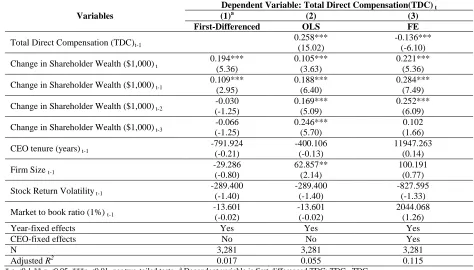
Table 2 presents the regression results that estimate the general dynamic performance specification, based on equation (1). Column (1) presents the pay-performance sensitivity using first-differenced model of compensation, following Jensen and Murphy (1990) and reports results that include current and one-, two-, and three-year lags for change in shareholder wealth as performance proxies.5 This result provides a benchmark for the remaining analyses. Most of the lagged stock performance measures are not statistically and economically significant except the first lagged shareholder wealth change. The effect of current performance on compensation is twice as much as the effect of one-year past performance, consistent with the results from Jensen and Murphy (1990). The model of differenced compensation implicitly assumes that the previous pay level has a permanent effect on current CEO pay level.6
Copyright by author(s); CC-BY 325 The Clute Institute 0 1 .0 e -0 4 2 .0 e -0 4 3 .0 e -0 4 4 .0 e -0 4 5 .0 e -0 4 D e n s it y
0 10000 20000 30000 40000
Total Compensation (in $1000s)
Compensation Distribution
Table 2: Estimate Of Pay-For Performance Relationship (T-Statistics In Parentheses)
Variables
Dependent Variable: Total Direct Compensation(TDC) t
(1)a (2) (3)
First-Differenced OLS FE
Total Direct Compensation (TDC)t-1
0.258*** (15.02)
-0.136*** (-6.10)
Change in Shareholder Wealth ($1,000) t
0.194*** (5.36) 0.105*** (3.63) 0.221*** (5.36)
Change in Shareholder Wealth ($1,000) t-1
0.109*** (2.95) 0.188*** (6.40) 0.284*** (7.49)
Change in Shareholder Wealth ($1,000) t-2
-0.030 (-1.25) 0.169*** (5.09) 0.252*** (6.09)
Change in Shareholder Wealth ($1,000) t-3
-0.066 (-1.25) 0.246*** (5.70) 0.102 (1.66)
CEO tenure (years) t-1
-791.924 (-0.21) -400.106 (-0.13) 11947.263 (0.14)
Firm Size t-1
-29.286 (-0.80) 62.857** (2.14) 100.191 (0.77)
Stock Return Volatility t-1
-289.400 (-1.40) -289.400 (-1.40) -827.595 (-1.33)
Market to book ratio (1%) t-1
-13.601 (-0.02) -13.601 (-0.02) 2044.068 (1.26)
Year-fixed effects Yes Yes Yes
CEO-fixed effects No No Yes
N 3,281 3,281 3,281
Adjusted R2 0.017 0.055 0.115
* p <0.1 ** p <0.05, ***p <0.01, per two-tailed tests. a Dependent variable is first-differenced TDC; TDC t- TDCt-1
The second and third columns of Table 2 report the estimates of Equation (3) without and with fixed effects. We estimate a CEO fixed-effect regression in order to control for a potential bias due to unobserved heterogeneity, such as CEO ability, in column (3). Two things can be noted about these results. First, the coefficients on lagged CEO total compensation shown in columns (2) and (3) indicate that these models of compensation level strongly reject Jensen and Murphy’s simple model of pay-for-performance dynamics.7 In column (2), the coefficient on lagged CEO total direct compensation (TDCt-1) is 0.258. This implies that, on average, there is about 74.2% (=1-0.258) deviation of the actual CEO pay level from long-run target pay level closings in one year, rejecting the previous assumption imposed on the estimates in column (1). This suggests that we should use levels rather than first differences in empirical modeling, consistent with the argument by Joskow and Rose (1994).
Secondly, the last two columns of Table 2 present regression coefficients that are biased estimates of the lagged dependent variable’s coefficient. The OLS estimate (0.258) in column (2) is biased upwards, while the panel estimate (-0.136) in column (3) is biased downwards. These findings square well with the symptoms of bias in dynamic panel regressions suggested by Bond (2002). When a panel regression analysis includes its dependent variables as explanatory variables and the fixed effects are improperly controlled, the OLS-estimated coefficient on the variable, here TDCt-1, becomes biased upwards (Anderson and Hsiao, 1981; Bond, 2002), and the estimate from
fixed effect OLS regressions tends to be biased downwards. As Bond (200) points out, the true coefficient on lagged dependent variables must lie between -0.136 and 0.258 (Bond, 2002). Surprisingly, without parametric restriction on the coefficient for lagged CEO pay level, the effects of lagged shareholder wealth changes become substantially stronger than the effect of current shareholder wealth. The findings, however, may result from well-known statistical bias in dynamic panel regression. Arellano and Bond (1991) provide an appropriate procedure to control for the bias in fixed-effect dynamic panel.
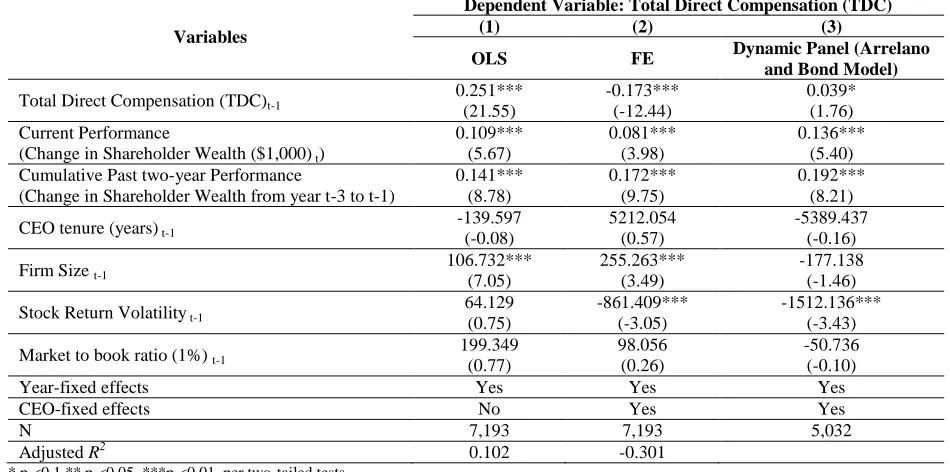
Thus, we estimate Equation (3) following Arellano and Bond (1991) in Table 3 in order to control for the bias in fixed-effect dynamic panel. Appendix A discusses the econometric issues related to estimating the dynamic panel regression. We replace three lagged shareholder wealth changes with cumulative past two-year firm
Copyright by author(s); CC-BY 326 The Clute Institute 0 1 .0 e -0 4 2 .0 e -0 4 3 .0 e -0 4 4 .0 e -0 4 5 .0 e -0 4 D e n s it y
0 10000 20000 30000 40000
Compensation Distribution
performance by calculating two-year holding period shareholder wealth change from the year t-3 to t-1 to examine a cumulative long-run performance effect on compensation. The first and second columns of Table 3 are OLS-estimates without and with CEO-fixed effects respectively. The coefficient on lagged CEO pay level is 0.251 from OLS regression without CEO-fixed effects, and -0.173 from regression with CEO-fixed effects.
Table 3: Estimate Of Pay-For-Performance Relationship Using Partial Adjustment Models (T-Statistics In Parentheses)
Variables
Dependent Variable: Total Direct Compensation (TDC)
(1) (2) (3)
OLS FE Dynamic Panel (Arrelano and Bond Model)
Total Direct Compensation (TDC)t-1
0.251*** (21.55) -0.173*** (-12.44) 0.039* (1.76) Current Performance
(Change in Shareholder Wealth ($1,000) t)
0.109*** (5.67) 0.081*** (3.98) 0.136*** (5.40) Cumulative Past two-year Performance
(Change in Shareholder Wealth from year t-3 to t-1)
0.141*** (8.78) 0.172*** (9.75) 0.192*** (8.21)
CEO tenure (years) t-1
-139.597 (-0.08) 5212.054 (0.57) -5389.437 (-0.16)
Firm Size t-1
106.732*** (7.05) 255.263*** (3.49) -177.138 (-1.46)
Stock Return Volatility t-1
64.129 (0.75) -861.409*** (-3.05) -1512.136*** (-3.43)
Market to book ratio (1%) t-1
199.349 (0.77) 98.056 (0.26) -50.736 (-0.10)
Year-fixed effects Yes Yes Yes
CEO-fixed effects No Yes Yes
N 7,193 7,193 5,032
Adjusted R2 0.102 -0.301
* p <0.1 ** p <0.05, ***p <0.01, per two-tailed tests
To investigate whether the effects of past shareholder wealth changes are driven by the bias in dynamic panel regression models, we estimate the coefficients following Arellano and Bond (1991) and report the results in the column (3).8 The estimated coefficient on lagged CEO pay level is 0.039, which is significant at the confidence level of ten percent and lies in the interval of (-0.173, 0.251), consistent with Bond (2002). This result suggests that the implied speed of convergence of CEO pay level toward target pay level is 0.961 (=1- 0.039). Put differently, the diversion of the actual CEO pay closes about 96% of the gap in one year. Consistent with the results in Appendix A as well as with the results in column (1) and (2) in Table 3, past two-year cumulative performance is significantly positively associated with the current CEO pay level. The effect of past two-year firm performance is even larger than the contemporaneous performance effect by about 40 percent.
The findings indicate that, although there can be a deviation of CEO pay level from target CEO pay structure, the deviation disappears shortly thereafter, supporting hypothesis 2. Thus, these results also reject the prediction from the managerial power view that managerial opportunism may result in permanent deviation from the “long-run” performance-based incentive. Furthermore, the link between target CEO pay level and past firm stock performance is significant and even stronger then the link between target CEO pay level and current firm stock performance, supporting hypothesis 1. Overall, the findings here strongly support the main prediction from multi-period agency theories. CEO pay incentives of average firms hinge on long-run and current firm performance, and the deviation of actual pay level from the target structure leads to near complete convergence to the target in the following year.
8 The unreported Sargan test cannot reject the null hypothesis that the model fit the data well and first and second order autocorrelation of errors
Copyright by author(s); CC-BY 327 The Clute Institute CONCLUSIONS
Prior studies show that CEO total pay is largely insensitive to current stock performance (Jensen and Murphy, 1990) and thus the incentive effects of CEO pay may be unimportant (Hall and Liebman, 1998). In addition, some scholars have argued that low-powered CEO incentives seem to indicate evidence for suboptimal arrangements of managerial incentive resulting from a powerful CEO’s influence on the design of compensation arrangement (Bebchuk and Fried, 2003). This paper attempts to suggest an alternative explanation for the rigidity in CEO total pay.
The results of this study show that long-term components are an important part of performance-based compensation arrangements. Put another way, the future compensation due to good performance today is as important as the contemporaneous pay-performance relationship. Hence, the contemporaneous-only pay for performance can be low, but the expected future compensation for today's performance provides substantial incentives today. This conclusion is consistent with the theoretical prediction that the multi-period compensation structure allows future expected compensations to replace current performance-based pay, providing consumption smoothing across periods and averaging out the random noise in a CEO's measured performance (Wang, 1997; Holmstrom, 1999). This implies that neglecting the dynamic effects may distort the interpretation of the pay-performance relationship because the bulk of the compensation responds in the years after the pay-performance event. Thus, perhaps, recent efforts to strengthen the pay-performance sensitivity that focus only on the contemporaneous relation may be ineffective since the market has apparently preferred longer-term reward structures.
This paper presents the first comprehensive evidence on the existence of a dynamic performance-pay relationship for CEOs. First, the results show that the impact of the past two-year performance is twice as great as the impact of the current stock performance. Second, evidence indicates that firms do target a long-run CEO compensation structure that is based on both current and past firm performance. Moreover, the typical firm converges toward its long-run target compensation profiles at a rate of nearly 100% in a year. This is consistent with the claim that organizations take positive steps to offset deviation from their optimal CEO pay.
AUTHOR INFORMATION
Ji-Young Ahn, Ph.D., is an Assistant Professor of School of Business, Ewha Womans University, 52 Ewhayeodae-gil, Seodaemun-gu, Seoul 120-750, South Korea. E-mail: [email protected]
REFERENCES
1. Aggarwal, R., & Samwick, A. (1999). The other side of the trade-off: the impact of risk on executive compensation. Journal of Political Economy, 107, 65-105.
2. Anderson, T., & Hsiao, C. (1981). Estimation of dynamic models with error components. Journal of the American Statistical Association, 76, 598-606.
3. Antle, R., & Smith, A. (1985). Measuring executive compensation methods and an application. Journal of Accounting Research, 23 (Spring), 296-325.
4. Arellano, M., & Bond, S. (1991). Some tests of specification in panel data: Monte Carlo evidence and an application to employment equations. Review of Economic Studies, 58, 227-297.
5. Baker, G., Jensen, M., & Murphy, K. (1988). Compensation and incentives: Practice vs. theory. Journal of Finance, 43, 593-616.
6. Bebchuk, L., & Fried, J. (2003). Executive compensation as an agency problem. Journal of Economic Perspective, 17, 71-92.
7. Bertrand, M., & Mullainathan, S. (2001). Are CEOs rewarded for luck? The ones without principals are. Quarterly Journal of Economics, 116(3), 901-932.
8. Bond, S. (2002). Dynamic panel data models: a guide to micro data methods and practice, Working paper, Centre for Microdata Methods and Practice, Institute for Fiscal Studies.
10. Core, J., & Guay, W. (2001). Stock option plans for nonexecutive employees. Journal of Financial Economics, 61, 253-87.
11. Demsetz, H., & Lehn, K. (1985). The Structure of Corporate Ownership: Causes and Consequences. Journal of Political Economy, 93 (6), 1155-1177.
12. Fama, E. (1980). Agency Problems and the Theory of the Firm. Journal of Political Economy, 88, 288-307.
13. Flannery, M., & Rangan, K. (2006). Partial adjustment toward target capital structures. Journal of Financial Economics, 79, 469-506.
14. Garvey, G., & Milbourn , T. (2006). Asymmetric benchmarking in compensation: Executives are rewarded for good luck but not penalized for bad. Journal of FinancialEconomics, 82, 197-225.
15. Gibbons, R., & Murphy, K. (1992). Optimal incentive contracts in the presence of career concerns: Theory and Practice. Journal of Political Economy, 100, 468-505.
16. Hall, B., & Liebman, J. (1998). Are CEOs really paid like bureaucrats? Quarterly Journal of Economics, 113, 653-691.
17. Hall, B. & Murphy, K. (2002). Stock options for undiversified executives. Journal of Accounting and Economics, 33, 3-42.
18. Hallock, K., & Oyer, P. (1999). The timeliness of performance information in determining executive compensation. Journal of Corporate Finance, 5(4), 303-321.
19. Harvey, K., & Shrieve, R., (2001). Executive compensation structure and corporate governance choice. Journal of Financial Research, 24, 495-512.
20. Holmstrom, B. (1979). Moral hazard and observability. Bell Journal of Economics 10, 74-91. 21. Holmstrom, B. & Milgrom, P. (1991). Multitask principal-agent analyses: Incentive contracts, asset
ownership, and job design. Journal of Law, Economics, and Organization, 7, 24-52.
22. Holmstrom, B. (1999). Managerial Incentives Problems: A Dynamic Perspective. Review of Economic Studies, 66, 169-182.
23. Ittner, C., Larcker, D., & Rajan, M. (1997). The choice of performance measures in annual bonus contracts. Accounting Review, 72(2), 231-55.
24. Janakiraman, S., Lambert, R., & Larcker, D. (1992). An empirical investigation of the relative performance evaluation hypothesis. Journal of Accounting Research, 30, 53-69.
25. Jensen, M., & Murphy, K. (1990). Performance pay and top-management incentives. Journal of Political Economy, 98, 225-64.
26. Joskow, P., & Rose, N. (1994). CEO pay and Firm Performance: Dynamics, Asymmetries, and Alternative Performance Measures. NBER Working Paper W.4976. Cambridge, MA.
27. Kole, S., & Lehn K. (1997). Deregulation, the evolution of corporate governance structure, and survival. American Economic Review, 87, 421-425.
28. Lambert, R. (1983). Long-term contracts and moral hazard. The Bell Journal of Economics, 14, 441-452. 29. Lambert, R., Larcker, D., & Weigelt, K. (1993). The structure of organizational incentives. Administrative
Science Quarterly, 38: 438-461.
30. Mukoyama, T., & Sahin, A. (2005). Repeated moral hazard with persistence. Economic Theory, 25, 831-854.
31. Murphy, K. (1999). Executive Compensation. In O. Ashenfelter & D.Card (ed.), Handbook of Labor Economics, vol.3. Amsterdam: North Holland.
32. O’Byrne, S. (1995). Total Compensation Strategy. Journal of Applied Corporate Finance, 8(2), 77-86. 33. Rogerson, W. (1985). Repeated moral hazard. Econometrica, 53, 69-76.
34. Shleifer, A., & Vishny, R. (1997). A survey of corporate governance. Journal of Finance, 52 (2), 737-84. 35. Smith, M., & Watts, R. (1992). The investment opportunity set and corporate financing, dividend, and
financing policies. Journal of Financial Economics, 32, 262-292.
36. Wang, C. (1997). Incentives, CEO compensation, and shareholder wealth: a dynamic agency model. Journal of Economic Theory, 76, 72-105.
37. Wooldridge, J. (2002). Econometric Analysis of Cross Section and Panel Data. The MIT Press, Cambridge.
Copyright by author(s); CC-BY 329 The Clute Institute APPENDIX A: Estimating the Dynamic Panel Model
Consider a dynamic panel model of this specification:
TDC
i,t=
a
TDC
i,t-1+
m
+
e
i,t(1)
where i indexes firms and t indicates the time. The error term in (1) has two components, i an unobserved,
time-invariant, CEO-specific effect, and
i t, , the residual. Because the residual component of TDCi t,1 is correlated withthe unobserved effect in the error term, an OLS-estimated coefficient on TDCi t,1will be biased upwards (Anderson
and Hsiao, 1981).
A common approach to estimate panel data models with unobserved effects is to perform a “within” transform of (1) and then estimate using OLS. A within transformation expresses all variables as deviations from their firm-specific time-series means (Green, 2003). This will eliminate i from the regression as it is time invariant and thus provides consistent estimates. However, in the presence of a lagged dependent variable, the within transform introduces correlation of the transformed lagged dependent variable with transformed error term by construction (Wooldridge, 2002). To see this, note that the within transforms of the lagged dependent variable and error term are
TDCi,t-1- TDCi,t-1/Ti
t=1 Ti
å
æ
è
çç öø÷÷ and
e
i,t-e
i,t/Tit=1 Ti
å
æ
è
çç öø÷÷
respectively, where Tiis the number of available observations from CEO i. Since TDCi,2is correlated withi,2,
,3
i