EVALUATION OF INVITRO FREE RADICAL SCAVENGING
POTENTIAL OF VARIOUS EXTRACTS OF WHOLE PLANT OF
Mucuna pruriens (Linn)
D.Satheesh kumar, A.Kottai Muthu*, A.Anton Smith and R.Manavalan
Department of pharmacy, Annamalai University, Annamalai Nagar-608 002, India.
*Corresponding author
E-mail: [email protected]
Summary
The antioxidant activity of various extracts of whole plant of Mucuna pruriens (Linn) was investigated in various in-vitro methods. The antioxidant activity was evaluated by Total antioxidant activity (Phosphomolybdic acid method), FRAP assay with reference standard Ascorbate and total flavonoids content respectively. The methanolic extract of Mucuna pruriens
was found to more effective in the total antioxidant activity. The IC50 values of the methanolic
extract of Mucuna pruriens and ascorbate were found to be 100µg/ml and 410µg/ml respectively. The methanolic extract of Mucuna pruriens was found more effective in FRAP assay than that of petroleum ether and ethyl acetate extracts. But when compare to the all the three extracts with ascorbate (standard), the methanolic extract of the Mucuna pruriens showed the better result. The methanolic extract of Mucuna pruriens contains high amount of flavonoids than that of other two extracts. Moreover, the results were observed in a concentration dependent manner. All the above in vitro studies clearly indicate that the methanolic extract of Mucuna pruriens has a better antioxidant activity. These in vitro assays indicate that this plant extracts is a better source of natural antioxidant, which might be helpful in preventing the progress of various oxidative stresses.
Key words: Whole plant of Mucuna pruriens, Invitro antioxidant, Total antioxidant activity, FRAP assay, Total flavonoids.
Introduction
Antioxidants are important in the prevention of human diseases. Naturally occurring antioxidants in leaf vegetables and seeds, such as ascorbic acid, vitamin E and phenolic compounds, possess the ability to reduce the oxidative damage associated with many diseases, including cancer, cardiovascular disease, cataracts, atherosclerosis, diabetes, arthritis, immune deficiency diseases and ageing5, 6, 7. Recent reports indicate that there is an inverse relationship between the dietary intake of antioxidant-rich foods and the incidence of human diseases8. So, many researchers have focused on natural antioxidants and in the plant kingdom numerous crude extracts and pure natural compounds were previously reported to have antioxidant properties.
Mucuna pruriens Linn.is belongs to the family fabaceae, commonly known as cowhage plant or kapikacho or kevach in Hindi, is the most popular drug in Ayurvedic system of medicine9. Traditionally, in India, the seeds of Mucuna pruriens are used as a tonic and aphrodisiac for male virility. It has been reported to be antidiabetic10. Its different preparations (from seeds) are used for the management of several free radical-mediated diseases such as ageing, rheumatoid arthritis, diabetes, atherosclerosis, male infertility and nervous disorders. It is also used as an aphrodisiac and in the management of Parkinsonism, as it is good source of L-dopa11. The anti-epileptic and anti-neoplastic activity of methanol extract of Mucuna pruriens
has been reported12. It had been reported analgesic and anti-inflammatory activities13. It also used as a fertility agent in men14.
However, no data are available in the literature on the antioxidant activity of whole plant of Mucuna pruriens. Therefore we undertook the present investigation to examine the antioxidant activities of various extract of whole plant of Mucuna pruriens through various in vitro models.
Materials and Methods
Collection and Identification of Plant materials
The whole plant of Mucuna pruriens (Linn), were collected form Neiyur dam, Kanyakumari District of Tamil Nadu, India. Taxonomic identification was made from Botanical Survey of Medical Plants Unit Siddha, Government of India. Palayamkottai. The whole plant of
Mucuna pruriens (Linn), were dried under shade, segregated, pulverized by a mechanical grinder and passed through a 40 mesh sieve.
Preparation of Extracts
The above powered materials were successively extracted with Petroleum ether (40-600C) by hot continuous percolation method in Soxhlet apparatus15 for 24 hrs. Then the mark was subjected to Ethyl acetate (76-780C) for 24 hrs and then mark was subjected to Methanol for 24 hrs. The extracts were concentrated by using a rotary evaporator and subjected to freeze drying in a lyophilizer till dry powder was obtained.
Evaluation of Antioxidant activity by in vitro Techniques:
Total antioxidant activity (Phosphomolybdic acid method) 16
After the samples had cooled to room temperature, the absorbance of the mixture was measured at 695 nm against a blank. The antioxidant activity was expresses relative to that of ascorbic acid.
FRAP assay17
A modified method of Benzie and Strain (1996)17 was adopted for the FRAP assay. The stock solutions included 300 mM acetate buffer, pH 3.6, 10 mM TPTZ (2, 4, 6-tripyridyl-S-triazine) solution in 40 mM HCl and 20 mM Fecl3. 6H2O. The fresh working solution was
prepared by mixing 25 ml acetate buffer, 2.5 ml TPTZ and 2.5 ml Fecl3 .6H2O. The temperature
of the solution was raised to 370 C before using. Plant extracts (0.15 ml) were allowed to react with 2.85 ml of FRAP solution for 30 min in the dark condition. Readings of the colored product (Ferrous tripyridyltriazine complex) were taken at 593 nm. The standard curve was linear between 200 and 1000 µM Feso4. Results are expressed in µM (Fe (II) /g dry mass and compared with that
of ascorbic acid.
Total flavonoids18
0.2g of the plant material was ground with ethanol-water in 2 different ratios namely 9:1 and 1:1 respectively. The homogenate was filtered and these 2 ratios were combined. This was evaporated to dryness until most of the ethanol has removed. The resultant aqueous extract was extracted in a separating funnel with hexane or chloroform. The solvent extracted aqueous layer was concentrated 0.5 ml of aliquot of extract was pipette-out in a test tube. 4 ml of the vanillin reagent (1% vanillin in 70% conc. H2SO4) was added and kept in a boiling water bath for 15
mins. The absorbance was read at 360 nm. A standard was run by using catechol (110 µg/ml).
Results and Discussion
Antioxidant compounds may function as free radical scavengers, initiator of the complexes of pro-oxidant metals, reducing agents and quenchers of singlet oxygen formation19. Phenolic compounds and flavonoids are major constituents of most of the plants reported to possess antioxidant and free radical scavenging activity20. Therefore, the importance of search for natural antioxidants has increased in the recent years so many researchers focused the same21.
Total antioxidant activity (Phosphomolybdic acid method)
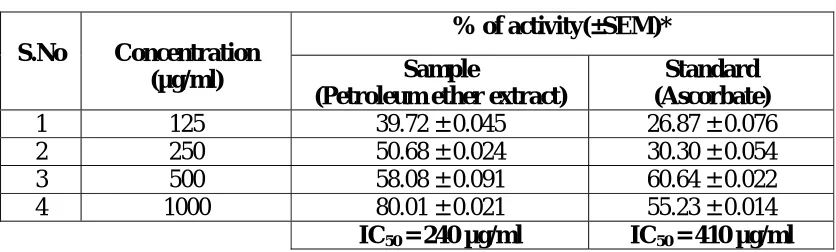
The percentage of total antioxidant activity of petroleum ether extract of Mucuna pruriens
presented in Table 1. The petroleum ether extract of Mucuna pruriens exhibited a maximum total antioxidant activity of 80.01 % at 1000 µg/ml whereas for ascorbate (standard) was found to be 55.23 % at 1000 µg/ml. The IC50 values of the petroleum ether extract of Mucuna pruriens and
Table 1: Total antioxidant activity of Petroleum ether extract of Mucuna Pruriens
% of activity(±SEM)* S.No Concentration
(µg/ml) Sample
(Petroleum ether extract)
Standard (Ascorbate) 1 125 39.72 ± 0.045 26.87 ± 0.076 2 250 50.68 ± 0.024 30.30 ± 0.054 3 500 58.08 ± 0.091 60.64 ± 0.022 4 1000 80.01 ± 0.021 55.23 ± 0.014 IC50 = 240 µg/ml IC50 = 410 µg/ml
*All values are expressed as mean ± SEM for three determinations
The percentage of total antioxidant activity of ethyl acetate extract of Mucuna pruriens
presented in Table 2. The ethyl acetate extract of Mucuna pruriens exhibited a maximum total antioxidant activity of 85.75 % at 1000 µg/ml whereas for ascorbate (standard) was found to be 55.23 % at 1000 µg/ml. The IC50 values of the ethyl acetate extract of Mucuna pruriens and
ascorbate were found to be 160µg/ml and 410µg/ml respectively.
Table 2: Total antioxidant activity of Ethyl acetate extract of Mucuna Pruriens
% of activity(±SEM)* S.No Concentration
(µg/ml) Sample
(Ethyl acetate extract)
Standard (Ascorbate) 1 125 41.91 ± 0.021 26.87 ± 0.076 2 250 79.17 ± 0.047 30.30 ± 0.054 3 500 85.47 ± 0.072 60.64 ± 0.022 4 1000 85.75 ± 0.039 55.23 ± 0.014
IC50 = 160 µg/ml IC50 = 410 µg/ml
*All values are expressed as mean ± SEM for three determinations
The percentage of total antioxidant activity of methanolic extract of Mucuna pruriens
presented in Table 3. The methanolic extract of Mucuna pruriens exhibited a maximum total antioxidant activity of 87.12 % at 1000 µg/ml whereas for ascorbate (standard) was found to be 55.23 % at 1000 µg/ml. The IC50 of the methanolic extract of Mucuna pruriens and ascorbate
Table 3: Total antioxidant activity of Methanolic extract of Mucuna Pruriens
% of activity(±SEM)* S.No Concentration
(µg/ml) Sample
(Methanolic extract)
Standard (Ascorbate) 1 125 51.50 ± 0.012 26.87 ± 0.076 2 250 76.98 ± 0.049 30.30 ± 0.054 3 500 86.02 ± 0.036 60.64 ± 0.022 4 1000 87.12 ± 0.024 55.23 ± 0.014 IC50 = 100 µg/ml IC50 = 410 µg/ml
*All values are expressed as mean ± SEM for three determinations
Based on the result clearly indicated the methanolic extract of Mucuna pruriens was found to more effective than petroleum ether and ethyl acetate extract. But when compare all the extracts with standard the methanolic extract of Mucuna pruriens was found strong antioxidant activity. The IC50 of the methanolic extract of Mucuna pruriens and Ascorbate were found to be
100µg/ml and 410µg/ml respectively.
FRAP assay
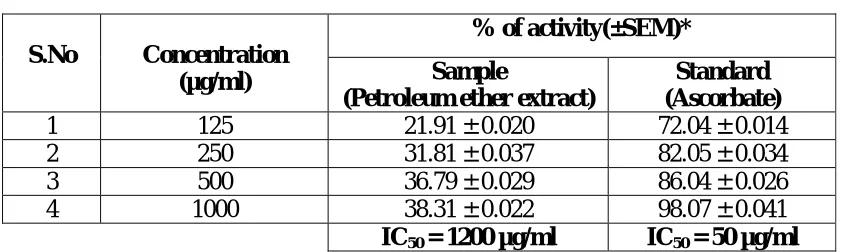
The antioxidant potential of Mucuna pruriens was ascertained from FRAP assay based on their ability to reduce TPTZ-Fe (III) complex to TPTZ-Fe (II). The reducing ability of the petroleum ether extract of Mucuna pruriens and ascorbate at various concentrations (125, 250, 500, 1000 µg/ml) were examined and the values were presented in Table 4. The maximum reducing ability at 1000µg/ml for petroleum ether extract and ascorbate were found to be 38.31% and 98.07% respectively. The IC50 values of petroleum ether extract and ascorbate were recorded
as 1200µg/ml and 50µg/ml respectively.
Table 4: FRAP assay of Pet. ether extract of Mucuna pruriens
% of activity(±SEM)* S.No Concentration
(µg/ml) Sample
(Petroleum ether extract)
Standard (Ascorbate) 1 125 21.91 ± 0.020 72.04 ± 0.014 2 250 31.81 ± 0.037 82.05 ± 0.034 3 500 36.79 ± 0.029 86.04 ± 0.026 4 1000 38.31 ± 0.022 98.07 ± 0.041 IC50 = 1200 µg/ml IC50 = 50 µg/ml
*All values are expressed as mean ± SEM for three determinations
The reducing ability of the ethyl acetate extract of Mucuna pruriens and ascorbate at various concentrations (125, 250, 500, 1000 µg/ml) were examined and the values were presented in Table 5. The maximum reducing ability at 1000µg/ml for ethyl acetate extract and ascorbate were found to be 59.80% and 98.07% respectively. The IC50 values of ethyl acetate
Table 5: FRAP assay of Ethyl acetate extract of Mucuna pruriens
% of activity(±SEM)* S.No Concentration
(µg/ml) Sample
(Ethyl acetate extract)
Standard (Ascorbate) 1 125 19.77 ± 0.016 72.04 ± 0.014 2 250 23.46 ± 0.011 82.05 ± 0.034 3 500 37.14 ± 0.029 86.04 ± 0.026 4 1000 59.80 ± 0.021 98.07 ± 0.041 IC50 = 780 µg/ml IC50 = 50 µg/ml
*All values are expressed as mean ± SEM for three determinations
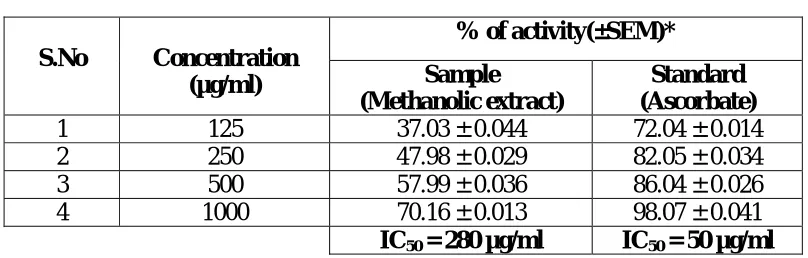
The reducing ability of the methanolic extract of Mucuna pruriens and ascorbate at various concentrations (125, 250, 500, 1000 µg/ml) were examined and the values were presented in Table 6. The maximum reducing ability at 1000µg/ml for methanolic extract and ascorbate were found to be 70.16% and 98.07% respectively. The IC50 values of methanolic
extract and ascorbate were recorded as 280µg/ml and 50µg/ml respectively.
Table 6: FRAP assay of Methanolic extract of Mucuna Pruriens
% of activity(±SEM)* S.No Concentration
(µg/ml) Sample
(Methanolic extract)
Standard (Ascorbate) 1 125 37.03 ± 0.044 72.04 ± 0.014 2 250 47.98 ± 0.029 82.05 ± 0.034 3 500 57.99 ± 0.036 86.04 ± 0.026 4 1000 70.16 ± 0.013 98.07 ± 0.041 IC50 = 280 µg/ml IC50 = 50 µg/ml
*All values are expressed as mean ± SEM for three determinations
Based on the above results indicated, the methanolic extract of Mucuna pruriens was found to most effective than that of petroleum ether & ethyl acetate extract. . But when compare to the all the three extracts with ascorbate (standard), the methanolic extract of the Mucuna pruriens showed the moderate result.
Total flavonoids
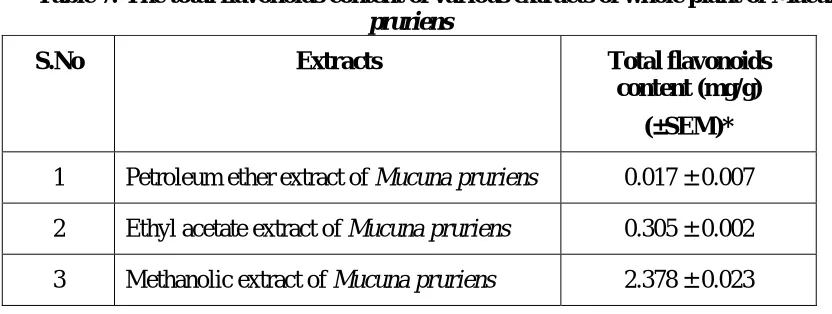
Table 7: The total flavonoids content of various extracts of whole plant of Mucuna
pruriens
S.No Extracts Total flavonoids
content (mg/g)
(±SEM)*
1 Petroleum ether extract of Mucuna pruriens 0.017 ± 0.007
2 Ethyl acetate extract of Mucuna pruriens 0.305 ± 0.002
3 Methanolic extract of Mucuna pruriens 2.378 ± 0.023
*All values are expressed as mean ± SEM for three determinations
Based on the result the methanolic extract of Mucuna pruriens was found higher content of flavonoids than that of petroleum ether and ethyl acetate extract of Mucuna pruriens.
Conclusion
The present study was clearly indicated the methanolic extract of Mucuna pruriens
showed strong antioxidant activity by total antioxidant activity and FRAP assay when compared with standard Ascorbate. But the ethyl acetate extract showed moderate activity when compared with standard Ascorbate. In addition, the methanolic extract of Mucuna pruriens was found to contain a noticeable amount of flavonoids, which play a major role in controlling antioxidants. Therefore, further investigations need to be carried out to isolate and identify the antioxidant compounds present in the plant extract.
Acknowledgments
The authors would like to thank University Grants Commission (UGC), New Delhi, India, for providing financial support for this investigation.
References
1. Nakayama T, Kimura T, Kadama T, Nagata C. Generation of hydrogen peroxide and superoxide anion from active metabolites of napthylamines and amino-azodyes.
Carcinogenesis 1983; 4: 765-9.
2. Imlay JA, Linn S. DNA damage and oxygen radical toxicity. Science 1988;240: 1302-9.
4. Halliwell B, Gutteridge JMC. Role of free radicals and catalytic metal ions in human disease. Methods Enzymol 1990;186:1-85.
5. Pietta P, Simonetti P and Mauri P, Antioxidant activity of selected medicinal plants, J Agric Food Chem, 1998, 46, 4487-4490.
6. Lee KG, Mitchell AE and Shibamoto T, Determination of antioxidant properties of aroma extracts from various beans, J Agric Food Chem, 2000, 48, 4817-4820.
7. Middleton E, Kandaswamy C and Theoharides TC, The effects of plant flavonoids on mammalian cells: implications for inflammation, heart disease and cancer, Pharmacol Rev, 2000, 52, 673-751.
8. Halliwell, B., (1997). Advances in pharmacology, vol.38, Academic Press,pp.3-17.
9. Chopra, R.N., Nayar, S.L. and Chopra, I.C., Glossary ofIndian Medicinal plants, CSIR, New Delhi, 1956.
10. Dhawan BN, Dubey MP, Mehrotra BN, Rastogi RP, Tandon JS. Screening of Indian plants for biological activity. Part 9. Ind J Expt Biol 1980;18:594-06.
11. Vaidya RA, Allorkar SD, Seth AR, Panday SK. Activity of bromoergocryptine, Mucuna pruriens and L-Dopa in the control of hyperprolactenaemia. Neurology.1978;26:179-86.
12. Gupta M, Mazumder UK, Chakraborti S, Rath N, Bhawal SR. Antiepileptic and
anticancer activity of some indigenous plants. Indian J Physiol Allied Sci 1997; 51 (2): 53-6.
13. Hishika R, Shastry S, Shinde S, Guptal SS (1981). Prliminary, Phytochemical and Anti-inflammatory Activity of seeds of Mucuna pruriens. Indian J. Pharmacol. 13(1):97-98.
14. Buckles D (1995). Velvet bean: a ‘new’ plant with a history: Econ. Bot.40:13-25.
15. Harborne J.B.(1984) Phytochemical methods 11 Edn.In Chapman &, Hall.New York: 4-5.
16. Prieto, P., Pineda, M., Aguilar, M (1999). Spectrophotometric quantitation of antioxidant capacity through the formation of a Phosphomolybdenum Complex: Specific application to the determination of vitamin E. Anal. Biochem, 269, 337-341.
17. Benzie IEF and Strain JJ (1996). The ferric reducing ability of plasma (FRAP) as a measure of “antioxidant power”: the FRAP assay. Anal Biochem.239,70-76.
19. Andlauer, W. and Furst, P., (1998).Antioxidative power of phytochemicals with special reference to cereals. Cereal Foods World, 43, 356-359
20. Christensen Lars P, (1999). Tuliposides from Tulipa sylvestris and T. turkestanica,
Phytochemistry, 51 (8), 969-974.
21. Jayaprakasha, G.K., Selvi, T. and Sakariah, K.K.,(2003).Antibacterial and antioxidant activities of grape (Vitis vinifera) seed extract. Food Res. Int., 36,117-122.
22. Salah N, Miller NJ, Paganga G, Tijburg L, Bolwell GP and Rice Evans C, Polyphenolic flavonoids as scavengers of aqueous phase radicals and as chain-breaking antioxidants,
Arch Biochem Biophys, 1995, 322(2), 339-346.
23. Van Acker SABE, Van den Vijgh WJF and Bast F, Stuctural aspects of antioxidant activity of flavonoids, Free Rad Bio Med, 1996, 20(3), 331-342.