TEACHING OF READING
by
LUIZ PAULO DA MOITA LOPES
VOLUME I
A Thesis submitted to the University of London for the Degree of PhD
1986
ABSTRAcr
This thesis has two main concerns. one is with the design of an EFL syllabus for Brazilian secondary schools of the public sector and the other with a preliminary evaluation of this syllabus in this context. To design the syllabus, this thesis takes into account two types of conditions: extrinsic and intrinsic conditions. The extrinsic conditions have to do with the actual characteristics of the "learning milieu" and of the general social context where this "milieu" is found. The study of these conditions point out that for a FL syllabus to be feasible and socially justifiable in this environment it must centre on the provision of reading skills. The intrinsic conditions relate to theoretical issues in applied linguistics which bear upon the internal organisation of a syllabus designed to meet this provision. These issues essentially involve research in the areas of discourse analysis, schema theories of reading comprehension, FL learning and , FL syllabus design theories. The design of the syllabus then comprises
a mediating process between these two types of conditions, which results in an interactive schema theoretic reading syllabus model.
The inquiry into the operation of the syllabus in the classroom involves the use of a quasi-experimental research paradigm which is complemented by non-experimental research procedures. The findings of this empirical work indicate that it is worth putting the syllabus
to the test of practice through its actual realisation in the classrooms so that it can be continually evaluated and improved by teachers.
ACKNOWLEDGEMENTS
Several colleagues and friends have helped me with this thesis. In particular, I would like to thank Professor H.G. Widdowson, my supervisor, for his patience in clarifying my thoughts and for his kindness in sharing his knowledge and ideas with me. I also want to express my thanks to four other people at the University of London Institubeof Education: Dr. P. Skehan of the ESOL Department and Dr. M. Yaegger of the Psychology Department, who helped me with the empirical part of this research, Professor C.J. Brumfit - now at Southampton University - with whom I first discussed some of the issues involved in this thesis, and Ms. E. Oliveira, a research student in the Arts and Design Department, for having illustrated the materials used in the empirical research. I am also grateful to Dr. B.S. Pinheiro of the Federal University of Rio (UFRJ) and Professor M.A.A. Celani of the Catholic University of Sao Paulo
(PUC-SP) for their constant support of my work, to Mr E. Hubner of the Research Methodology Department of the Faculty of Education of the Federal University of Rio (UFRJ) for helping me with the computational analysis of data, and to the other members of this department for their advice on different aspects of the empirical part of this research.
I am also indebted to the four teachers of the school system of Rio de Janeiro who took part in the experiment carried out in this thesis for their generosity in co-operating with my work: Ms. S.L. Bedran, Ms. R.P. Valle, Ms. M.B. Nunes and Mr S.P. Silva. Without their great sense of professionalism, I would not have been able to carry out my research. I also want to express my gratitude to colleagues from different Brazilian Universities who mailed me
material on ELT policy: Mr D.M. Costa (PUC-SP), Ms. H. Boxwell (UPPE), Ms. M.H. Souza (UFGO), Ms. V. Oliveira (UFRN), Ms. R.N. Silva (UFMG), and Ms. A. Dilamar (UFPI).
throughout my research. And I am grateful to my colleagues at the Department of English and German of the Federal University of Rio
(UFRJ), who had to teach extra hours while I was away.
~ Finally, I want to thank Sergio Pontes da Silva (amigo-mais-que-irmao) and John A. Thorburn, without whose companionship and moral support,
ABBREVIATIONS
CA
=
Contrastive AnalysisEAP
=
English for Academic purposes EFL=
English as a Foreign Language EL=
English LanguageELT
=
English Language Teaching ESP=
English for Specific Purposes ESI'=
English for Science and Technology FL=
Foreign LanguageFLT
=
Foreign Language TeachingISTR comprehension model
=
Interactive Schema Theoretic Reading comprehension model L1=
Native LanguageL2
=
Second or Foreign Language LSP=
Language for Specific Purposes LTM=
Long Term MemoryTRI
=
TOpic - Restriction - IllustrationBrazilian states:
GO
=
Golas . ~MG
=
Minas GeraisPE
=
Pernambuco PI=
PiaulCONTENTS
Abstract
Acknowledgements
Abbreviations
Chapter 1: Some Background Issues: An Introduction 1.1 The nature of the problem and of the inquiry 1.2 FLT and ELT in Brazil: a critical view
1.3 An alternative to the existing situation: a reading syllabus
1.4 Freire'S view of education and the social concern of the thesis
1.5 The content and organisation of the thesis: from and back to the classroom
Notes
Chapter 2: Determining the Extrinsic Conditions on Design 2.1 Introduction
2.1.1 Types of extrinsic conditions
2.2 Description of ELT in Brazilian secondary schools: extrinsic conditions for the syllabus model
2.2.1 Socio-political conditions
2.2.2 Logistico-adrninistrative conditions 2.2.2.1 The classroom setting
2.2.2.2 Mode of instruction and timetable 2.2.2.3 Administrative support to the teacher 2.2.3 The learner's language learning experience and
mother tongue
2.2.4 EFL teaching tradition
2.2.4.1 Type of syllabus, methodology, formal exams and textbooks
2.2.4.2 Teachers' academic qualifications 2.2.5 Socio-pyschological conditions
2.2.5.1 Social context and ELT
2.2.5.2 Brazilian teachers' and pupils' attitudes Page 2 3 5 14 14 15 19 21 23 27 28 28 31 32 34 41 41 42 42 43 44 44 46 48 48
to EFL. 50
2.2.5.3 Type of motivation to EFL in Brazil 53 2.3 Conclusion
2.4 Summary Notes
Page Chapter 3: Determining the Intrinsic Conditions on Design:
a Reading Comprehension Model 3.1 Introduction
3.2 The decoding, the psycholinguistic and the schema theoretic models of reading
3.2.1 The decoding model of reading
3.2.2 The psycholinguistic model of reading
3.2.2.1 Criticism of the psycholinguistic model 3.2.3 The schema theoretic model of reading
3.2.3.1 Schema theories
64 64 65 65 67
70
71 72 3.2.3.2 Complementing the schema theoretic model 74 3.3 An interactive schema theoretic model of reading 75
comprehension
3.3.1 Textual competence: linguistic competence and
discourse competence 75
3.3.2 Content schematic knowledge 78
3.3.3 Formal schematic knowledge 79
3.3.3.1 Local formal schemata 80
3.3.3.1.1 Types of local formal schemata 80 3.3.3.1.2 An interpreter's perspective
of discourse structure 81 3.3.3.2 Global formal schemata
3.3.3.2.1 Discourse macro-patterns 3.3.3.3 The patterning of formal schemata 3.3.4 Procedures of interpretation
3.3.4.1 The given-new contract 3.3.4.2 Problem-solving heuristics 3.3.4.3 Text-openendedness
3.4 Empirical evidence for the interactive schema theoretic
83 85 87 89 91 92 93
model of reading comprehension 94
3.4.1 Evidence in L1 reading comprehension 94 3.4.1.1 The psychological reality of schemata in
reading comprehension 95
3.4.1.1.1 The use of content schemata 95 3.4.1.1.2 The use of formal schemata 96 3.4.1.2 Performance level in reading comprehension
and schema use 97
3.4.1.3 Effects of teaching schematic knowledge
on reading comprehension 98
3.4.2 EVidence in L2 reading comprehension 99 3.4.2.1 The psychological reality of schemata in
3.5 Summary Notes
3.4.2.2 3.4.2.3 3.4.2.4
Page 3.4.2.1.1 The use of formal schemata 100 3.4.2.1.2 The use of content schemata 100 The difference in terms of text processing between Ll and L2 reading comprehension The universality of content and formal schemata
Effects of teaching schematic knowledge on L2 reading comprehension
102 105 106 107 110
Chapter 4: Determining the Intrinsic Conditions on Design: FL Syllabus Models and FL Learning Theories 119
4.1 Introduction 119
4.2 The concept of syllabus
4.3 Syllabus models and FL learning theories 4.3.1 Goal-oriented syllabuses
4.3.1.1 The structural syllabus 4.3.1.2 The situational syllabus 4.3.1.3 The notional syllabus 4.3.1.4 The relational syllabus 4.3.2 Process-oriented syllabuses
4.3.2.1 The procedural syllabus
119 122 123 124 126 128 132 136 137 4.3.2.2 The place of negotiation in syllabus design 141 4.4 Conclusion: Theoretical principles for the EFL reading
syllabus model 144
4.5 summary 147
Notes 148
Chapter 5: The ISTR Syllabus Model 151
5.1 Introduction 151
5.2 An interactive schema theoretic EFL reading syllabus model 152
5.2.1 The components of the syllabus 152
5.2.2 The grading of the units 153
5.2.3 The schematic component 157
5.2.3.1 Content schematic units 158
5.2.3.2 Global formal schematic units 159 5.2.3.3 Local formal schematic units 160
5.2.4 The systemic component 161
5.2.4.1 Lexico-semantic units 163
5.2.5 The methodological component 5.2.5.1 Pre-reading phase A 5.2.5.2 Reading phase A 5.2.5.3 Pre-reading phase B 5.2.5.4 Reading phase B
5.3 Summary Notes
5.2.5.5 Comprehension testing phase 5.2.5.6 Post-reading phase
Chapter 6: The Rationale for the Empirical Research 6.1 Introduction
6.2 Rationale for the type of research paradigm employed 6.3 The research design of the syllabus evaluation
6.3.1 Experimental research procedures
6.3.1.1 A quasi-experimental research design 6.3.1.2 The internal validity of the
page 166 167 170 172 174 178 179 181 182 185 185 187 195 195 195
experiment: eliminating extraneous
variables 196
6.3.1.3 Description of the pre-test
6.3.1.4 The external validity of the experiment 6.3.1.5 A factorial design: independent and
dependent variables
6.3.1.6 Description of the post-tests: the dependent variable
6.3.1.6.1 Pilot study and reliability of post-tests
6.3.1.6.2 validity of post-tests 6.3.1.7 Research hypothesis
200 201 202 205 206 207 209 6.3.2 Non-experimental research procedures 209
6.3.2.1 Pupils' questionnaires 210
6.3.2.1.1 Design of the questionnaires 211 6.3.2.1.2 The pilot study of the
questionnaires and the validity
and reliability of the scales 212 6.3.2.1.3 statistical treatment of the
questionnaires 213
6.3.2.2 Teachers' diaries
6.3.2.3 Teachers' final evaluation reports 6.4 Summary
Chapter 7: The Findings of the Empirical Research 7.1 Introduction
7.2 Experimental research findings: product-oriented data 7.2.1 Description of the experiment
7.2.1.1 Duration
7.2.1.2 The context of the research: schools and teachers
7.2.1.3 Population 7.2.2 The pre-test
7.2.2.1 Statistical treatment of the pre-test 7.2.3 Internal validity of the experiment
7.2.4 Factorial design of the experiment
7.2.4.1 Statistical analysis of the post-test scores
7.2.4.1.1 Statistical analysis of the COOPT scores
7.2.4.1.2 Statistical analysis of the EXPT scores
7.2.5 Interpretation and analysis of the experimental research results
7.2.5.1 Interpretation of the experimental results
7.2.5.2 Analysis of the experimental results 7.3 Non-experimental research findings: qualitative and
Page 222 222 222 222 222 223 224 229 229 231 231 232 233 235 237 237 240
process-oriented data 243
7.3.1 Pupils' questionnaires 244
7.3.1.1 The attitude and belief scales (Part II of
the questionnaires) 245
7.3.1.2 Open-ended questions (Part III of the
questionnaires) 248
7.3.2 Teachers' diaries and final evaluation reports 253
7.3.2.1 Teachers' diaries 256
7.3.2.2
7.3.2.1.1 Group 1 teacher's diaries 256 7.3.2.1.2 Group 2 teacher's diaries 257 7.3.2.1.3 Group 3 teacher's diaries 260 7.3.2.1.4 Teachers' 7.3.2.2.1 7.3.2.2.2 7.3.2.2.3 7.3.2.2.4
Group 4 teacher's diaries final evaluation reports
Group 1 teacher's report Group 2 teacher's report Group 3 teacher'S report Group 4 teacher's report
7.3.2.3 Summary of the data provided by teachers' diaries and final evaluation reports 7.4 Relating experimental and non-experimental findings
7.4.1 External and internal validity of the experiment 7.4.2 The experimental treatment and group 2 teacher's
expectations
7.4.3 The attitude scales and open-ended items of the questionnaires
7.5 Conclusion 7.6 Summary Notes
Chapter 8: Retrospect and Prospect 8.1 Introduction
8.2 Reflecting upon this inquiry
8.2.1 Connections with the classroom: the main points
Page
272 274 275 279 279 281 285 286
288 288 288
of the thesis 288
8.2.2 The empirical research in hindsight 293 8.3 Investigating the syllabus in the classroom: action-research296
8.3.1 A research methodology for teacher's work BIBLIOGRAPHY
Figures
Figure 2.1 Syllabus design procedure: a projection of the
298 304
thesis 33
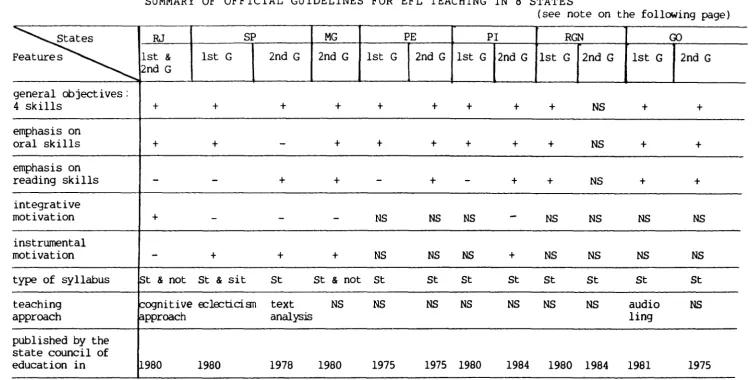
Figure 2.2 Summary of official guidelines for EFL teaching
in eight states 37
Figure 2.3 Summary of the extrinsic conditions in the Brazilian
EFL secondary school classroom 55
Figure 3.1 An interactive schema theoretic model of reading
comprehension 108
Figure 5.1 An interactive schema theoretic reading syllabus
model 154
Figure 5.2 Syllabus progression 162
Figure 5.3 Methodological component 167
Figure 5.4 Traditional syllabuses and the ISTR syllabus 171 Figure 6.1 Combination of the independent variables:
treatment and expectations 204
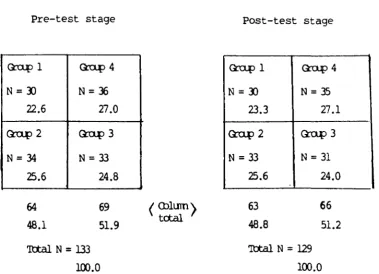
Figure 6.2 Factorial design of treexperiment 205 Figure 7.1 Distribution of the pre-test scores 230 Figure 7.2 Combination of independent variables 232
Figure 7.3 Means on the CONPT 233
Figure 7.4 Main effects and interaction effect (CONPT means) 234
Figure 7.6 Main effects and interaction effect (EXPT means) Figure 8.1 Action-research methodology for the implementation TABLES of the ISTR syllabus model
Table 7.1 Breakdown of the population by group Table 7.2 Crosstabulation of age by group Table 7.3 Crosstabulation: sex by group
Table 7.4 Crosstabulation: previous EFL instruction by group
Table 7.5 Crosstabulation: language school attendance by group
Table 7.6 Crosstabulation: interest in reading in Portuguese by group
Table 7.7 Crosstabulation: subjects who read a book in the past year by group Table 7.8 Descriptive statistics of the pre-test mean
scores
Table 7.9 ANOVA for the 4 groups' pre-test mean scores Table 7.10 Breakdown statistics of the CONPT scores
Table 7.11 ANOVA for the means of the groups on the CONPT Table 7.12 Breakdown statistics of the EXPT scores
Table 7.13 AN0\7A for the means of the groups on the EXPT Table 7.14 Item 52 What did you enjoy the most about the
reading course and materials?
Table 7.15 Item 53 What did you enjoy the least about the reading course and materials?
Table 7.16 Item 54 Is there anything else you would like say about the reading lessons and materials?
VOWME II APPENDICES
to
Appendix ~ The Actualisation of the ISTR syllabus in the Form of Materials
1. Rationale for the design of the experimental materials
2. The experimental materials Notes
Appendix ~ Rationale for the Control Group Treatment and
Page 237 302 224 225 226 226 227 228 228 229 230 233 234 235 236 250 251 252 4 4 17 73 its Actualisation in the Form of Materials 74 1. Rationale for the control group treatment 74 2. Rationale for the actualisation of the
control group treatment into materials 79
3. The control materials 80
Appendix f Teachers' First Materials Evaluation Questionnaire
Appendix
Q
Subjects' Parental OccupationAppendix ~ List of MateriaECovered by Groups before the Experiment Started
Appendix f Pre-test Appendix Q Post-tests
Appendix g Pupils'Questionnaires
1. Pupils'Questionnaires (English version) 2. Pupils'Questionnaires (Portuguese version) Appendix! Diary Format
1. English version 2. Portuguese version Appendix ~ Teachers' Diaries
Group 1 Diary Group 2 Diary Group 3 Diary Group 4 Diary
Appendix ~ Teachers' Final Evaluation Reports Group 1 Final Evaluation Report Group 2 Final Evaluation Report Group 3 Final Evaluation Report Group 4 Final Evaluation Report Appendix ~ Teachers' Diaries (in Portuguese)
Group 1 Diary Group 2 Diary Group 3 Diary Group 4 Diary
Appendix ~ Teachers' Final Evaluation Reports (in Portuguese) Group 1 Final Evaluation Report
Group 2 Final Evaluation Report Group 3 Final Evaluation Report
Group 4 Final Evaluation Report Appendix ~ Homework Exercises
Appendix Q Breakdown Statistics and ANOVAs of the Attitude Scales A, Band E
(Part II of the Questionnaires)
CHAPTER 1
SG1E BACKGROOND ISSUES: AN INTROOUCI'IOO
This introduction provides a general setting for the thesis.
It clarifies the nature of the problem to be investigated, the kind of inquiry to be pursued and how it is to be tackled in the different chapters of this work.
1.1 The nature of the problem and of the inquiry
For the last few years FL teaching in general and ELT in particular in Brazilian secondary schools of the public sector have reached very low standards. Although a FL is virtually taught in every secondary school in the country, FL education is nothing more than a formality. It is included in the curriculum, but pupils' performance in any FL skill at the end of the secondary school course falls short of any adequate level of competence. As a consequence, the FL teacher in that context has very low prestige and a lot of uneasiness and
dissatisfaction in the ELT profession has been generated. This thesis represents an attempt to begin to solve this problem through the design of an EFL syllabus to be investigateu and developed by teachers in the classroom. This problem has, in the last few years, attracted the attention of several specialists in the country (Tilio, 1980; vereza, 1982: Ballalai, 1982; Moita Lopes, 1981 and 1982; inter alia) who
have in one way or another tried to tackle it. Also, national conferences of EL lecturers have included sessions dealing with the existing
difficulties in EFL in the secondary schools of the public sector; and presently a national project for the development of FL education in that context is in elaboration. In other words, there has been a growing concern with this issue in Brazilian academic circles.
It is my contention that this situation has been mainly caused by negligence on the part of the Brazilian EFL specialists to think out alternatives for FL teaching which take into consideration the nature of the Brazilian context (including here both the general social context and the "learning milieu") so that adequate suggestions for objectives, syllabuses, methodology etc. could be made. Normally, imported
of an alternative to FL teaching which is operative and productive. What I am arguing for therefore is a position for the applied linguist
to FL teaching in which rather than working in abstraction (i~ solely in view of theoretical issues in applied linguistics), he should start his work fram an analysis of the "learning milieu" he is working with. This is a major issue in this thesis. FL teaching takes place in time and in a specific socio-political environment, involving particular individuals operating within certain conditions, therefore the consider-ation of these factors have to be made central if FL educconsider-ation is to have any relevance in the classroom and in general social terms.
The nature of the research to be undertaken here is therefore committed to a particular issue in Brazilian education, namely, FL education in secondary schools of the public sector and it aims at
initiating action in schools by putting forward an EFL syllabus for use and continual appraisal in the classroom. Thus, it does not intend to present a final solution to the existing problem of FL education in that context but to introduce a possible alternative that can be
investigated by teachers in the actual classroom through action-research so that in fact syllabus development is made possible and progress in the ELT profession can be generated. In Stenhouse's terms (1975:142), the syllabus to be proposed here "is not to be regarded as an unqualified recommendation but rather as a provisional specification claiming no more than to be worth putting to the test of practice" in the classroom. This research then has a clear pedagogic purpose in the sense that it has a concern with the reality of the classroom and with the education of both pupils and teachers.
In view of the pedagogic nature of this inquiry, it seems necessary that the issues to be studied here be seen in relation to how FLT in general and ELT in particular have been conceived in the
Brazilian educational context. This is the point to ~ dealt with in the next section.
1.2 FLT and ELT in Brazil: a critical view
Until 1961 FLs were compulsory in the curriculum of secondary schools. French, English, Spanish, Latin and sometimes Greek were taught in secondary schools. Students were normally required to take one FL during the seven years of secondary school and other FLs for shorter periods of time. However, because of the expansion
was a shortage of teachers who could take up FL posts. The imposition of a FL on the curriculum then became meaningless since there were not enough qualified teachers for so many new schools. Therefore, the Law of Directives and Bases of National Education (Law no. 4024, December 1961) transferred FLs from the set of common core disciplines to the set of additional subjects. It was then that FL teaching in the public sector began to deteriorate because less importance was given to the study of FLs in the curriculum.
A more recent law (Law no. 5692/71) confirmed the position of FLs outside the list of main disciplines and actually added that the
decision on the teaching of a FL is to be made by each State Council of Education. That is, FL learning may be part of the curriculum in one state but not in another. And according to this law what should determine the inclusion of a FL in the curriculum is the existence of the essential conditions for FL teaching, which surprisingly are not defined in the
law itsel f (cf 2.2. 1 l:Elcw). It should be indicated however that the
option of including a FL in the curriculum only applies to first grade schools (first four years of secondary education). The teaching of a FL is obligatory at 2nd grade schools (last three years of secondary education). Nevertheless, as far as I know, except for the state of E. Santo, a FL is normally included in the curriculum of secondary schools of the public sector in first grade schools. Ye~ as I have pointed out in 1.1 above, FLs are not adequately taught.
What is peculiar, I think, is that this de-emphasis on FLs in the official schools coincides with the opening of private FL schools all over the country. There are even chains of private FL schools with branches scattered throughout Brazil and not necessarily only in the state capitals. While the official educational system avoided the
responsibility of providing appropriate FL education, the private sector took over. As a result, FL education has been virtually reduced to those who can afford to attend private FL schools.
The situation is such that the idea that one must attend a private FL school in order to learn a FL is assumed to be self evident. It has also been argued that FLs should be totally removed from the curriculum of schools of the public sector because the social classes which attend these schools will never need to use a FL or because FL learning is hard for them (cf 6.3.11 below). This view, I think, is, to say the least, misconceived. FL education is part of the official educational system -albeit not in the main core of the curriculum - and it is the
so that FL education is made widely accessible in society. After all, as Ballalai (1982:4) remarks, while FLs are considered as superfluous
in the official educational system, they are nationally recognised as essential by the middle classes. Removing FLs from the school curriculum will only enlarge the gap between the education of the lower classes and of the middle classes since the latter have their access to FL education ensured by the private sector. A curriculum which excludes FLs from the public sector schools therefore would function as "the staple of an education designed for the underprivileged [and Whic~ reinforces their exclusion from the education and knowledge most valued and most valuable"
(Stenhouse, 1975:19-20) in SOCiety. What this thesis will essentially seek to do is to develop a means through which FL education becomes truly possible in the public sector.
In general terms the only FL normally included in the curriculum of Brazilian secondary schools nowadays is English. This, I think, re-presents a great cultural loss not to mention the danger of having all the foreign information filtered into the country through the means
1
of one FL (cf Ballalai, 1982:1).
In a few states however pupils can still choose between French and English, although they in general tend to prefer English if given the choice. The reasons for such preference are obviously connected with the undeniable importance of English as an international languag~which is due to the economic power of England and USA in the first and in the second half of this century, respectively, and to the penetration of English as the language of the new imperialist (ie, USA) in Brazil in this century~f25.1 below). In this sort of social context, it is not surpriSing that there is so much interest in EFL learning in the
country and that a knowledge of English has also become a symbol of social status since it provides access to the language and culture of the imperialist.
of ELT in Brazil:
In this regard, note the following accurate evaluation the need for English
"sterns, in part, from social and prestige values and also from a desire to emulate British and American cultural models. The knowledge of a foreign language is seen as almost synonymous with professional and social advancement, an elegant accomplishment and a sign of social status."
(The ELT Profile on Brazil, The British Council, 1976:2)
in the academic circles. The objectives of EFL learning normally pursued in secondary schools of the private and public sectors and in private language schools are very different, I think, from the actual role that EFL plays in the country. Traditionally, ELT has centred on the development of the four language skills with emphasis on oral skills (cf the review of the official guidelines in 2.2.1
below). And EFL specialists (cf Tilio, 1980: Vereza, 1982: Whitfield, 1982, inter alia) have generally claimed the role of English in Brazil as a resource for international oral communication on the grounds that Brazilians will need to use oral English in Brazil or abroad as a
lingua franca in their contact with foreigners. It seems to me however that these claims have been much more oriented by the long tradition of four language skill syllabuses with emphasis on oral skills than by an actual analysis of what most people need to learn English for in Brazil.
Only a very small minority of the population will ever have a chance of using English as a means of oral communication both inside and outside the country. Further, there are not enough jobs in the Brazilian market, for which oral skills in EFL are necessary (ie, interpreters, hotel
receptionists etc.), which could justify emphasis on oral skills in EFL syllabuses. I would argue that the only people who make use of oral English in Brazil are teachers, lecturers and students at the private language school "milieu" and in the English language and literature classroom at the university. Research has in fact shown that even Brazilian EFL secondary school teachers hardly ever have a chance of using oral English either inside or outside the classroom (cf Tilio, 1980:279 and 431). Therefore, to see the role of English in Brazil as a resource of oral communication seems to deny any social relevance to ELT. Even the middle classes who normally attend private language schools for 5/7 years usually lose whatever oral fluency competence they have in English after they leave those schools. Their great advantage over the pupils of the lower classes is the capacity of
reading in English they acquired in the language school and which they can easily keep since reading is the only EFL skill that can be used
in the Brazilian context. Besides, the only formal requirements in FLs demanded at undergraduate and postgraduate levels involve nothing but the corrmand of reading skills (cf 2.2.4.ltBlcw). The real necessity
learning in Brazil has to do with the use of English as a resource for reading. Reading is the only skill which is responsive to
educational needs and which the learner can use in his own environment. It is therefore the only skill which pupils can continue using auto-nomously once the language course is over. As Bruner (1977:17) points out, "Learning should not only take us somewhere, it should allow us later to go further more easily". This is one of the reasons why this thesis, as shown in the next section, argues for a reading syllabus for Brazilian secondary schools of the public sector.
1.3 An alternative to the existing situation: a reading syllabus
In view of my discussion of the ELT situation in Brazil in the previous section, it is clear that the traditional objectives of FL teaching in Brazil (ie, four language skills with emphasis on oral skills) have to be altered since these objectives have no social
justification in the Brazilian context, ie, they are inappropriate. And it seems to me that a school subject which is not socially account-able cannot show teachers, pupils and the community in general, the need of its presence in the curriculum. Therefore, it is not surprising that EFL teachers have a very low status in Brazilian secondary schools today.
Also, a school subject which has no accountability in social terms can only co-operate with a view of education which aims at making pupils conform to the "status quo". This is very different from the view of education which informs this thesis: education which gives learners means for acting upon the world so that they can transform it
(cf 1.4 below).
Furthermore, in the context of Brazilian secondary shools, as shown in 2.2.1 and 2.2.3 below, it is unrealistic to claim a four language skill syllabus due to the existing conditions in the "learning milieu". Thus, this thesis proposes a reading syllabus as an alternative.
This proposal is then derived from the social justification for ELT in the country and from the fact that a syllabus which centres on four language skills conceived as goals is unfeasible in the Brazilian school environment. Note therefore that there are two quite different considerations involved here. One is a matter of educational ideology and the other is related to feasibility. These are two fundamental points in this thesis which led me to criticise the existing situation
It should also be observed that the acquisition of the reading skill has been increasingly argued for in the academic circles as the objective of ELT in Brazilian secondary schools (cf Moita Lopes, 1981 and 1982; Ballalai, 1982: Menezes de Souza, 1983). Furthermore, Silva and Oliveira (1984:3) have indicated that the research they
coordinated (cf 2.2.2 below and specially note 13 in that section) involving a population of 1859 secondary school EFL teachers has shown that 67.9% of the teachers interviewed believe that the general goal of ELT in both the first and second grades should be the development of reading skills, coinciding therefore with the position taken in this thesis.
I would also like to make the point that using a reading syllabus to teach a FL may help the learner to develop better reading skills in his
own
native language. In this regard, note that Kleiman (1983) has presented evidence that the Brazilian secondary school pupil generally has a very limited reading competence level in his NL due to theinadequate approach to the teaching of reading utilised in schools. Further, cavalcanti (1984) has argued that in the Brazilian school there is no formal instruction on how to interpret texts and read critically, ie, reading instruction goes straight from the acquisition of lite~ skills to the evaluation of the acquired skills. I would think that the use of a FL syllabus which focuses on reading may also generate more interest in learning and teaching to read in the NL on the part of pupils and teachers, creating an atmosphere for reading instruction in schools from which both the NL and the FL teachers can profit and which by implication will have positive effects on learning to read. It should also be indicated, as will be shown in 5.2.5.6 below, that the FL reading syllabus to be put forward here, by drawing on pedagogic practices associated with other school subjects, will have a general educational value which goes beyond the task of learning a FL.
the FL in the general social context in which learners find themselves and of the conditions of learning in the school environment. That is, specificity is related to the state of affairs which represents the starting point for the learners rather than the state of affairs which
represen~target behaviour.
Furthe4 the reading syllabus does not have the short term remedial objectives of ESP courses normally associated with training in the use of a particular FL skill for specific needs. That is, in the reading syllabus FL learning is seen as part of the whole educational process of the learner.
ELT in this perspective does involve teaching one specific skill, but it has a general educational purpose. It comprises learning a FL
skill which is useful to learners, which they can continue to develop in their own enVironment, and which provides them with the possibilities of enlarging their conceptual boundaries since through reading in a FL they can be exposed to different views of the world, of their own culture, and of themselves as human beings. TWo different purposes are then
taken into consideration: a utilitarian and an educational purpose. In accounting for these two aims, the reading syllabus provides children of the public sector with the command of the only FL skill which, as seen in 1.2, makes a difference in the education of learners of private language schools. In so doing, the reading syllabus is making a socio-political point since it is helping to equip children of the public sector with the same opportunities available to children in the private sector so that social mobility is made possible.
Underlying the principles which led to the proposal of a reading syllabus for Brazilian secondary schools, there is therefore a particular conceptualization of the structure of society and of the role of
education in it, which,! think, need to be made explicit in this introduction.
1.4 Freire's view of education and the social concern of the thesis
The FL syllabus proposal to be advanced here is informed by Freire's (1974a, 1974b, 1982 and 1983) philosophy of education. Essentially, his position is characterised by the belief that the individual's ontological vocation is to act upon and transform the world in which he lives so that he has access to new opportunities of a better life.
Therefore, the world in his conception is not a static reality but a reality in process. The individual's role is then to take part in this process and,in so doing, he produces social reality and enters the historical process (cf Freire, 1974a:36). It is a view of the
individual as subject rather than as object of the historical process. Education accordingly in this perspective should be responsive to the individual's ontological mission so that the human condition can flourish. To deny people this role is to dehumanise them. In this sense, education should provide the means through which the individual can influence the transformation of society by dealing with reality critically. This process is what Freire (l974b:l5) has called
ftCONSCIENTIZA9AOft (the development of critical awareness) through which the individual is led to act upon the world and to take part in
the social process. In this way, the individual can consciously choose from the alternatives the world offers. This is what Freire calls education for liberation or education as the practice of freedom,which
ftconsists in acts of cognition, not transferrals of information"
(Freire, 1974a:67) in the sense that it stresses reflection rather than reception of information. If people become critical and learn to
question the existing social order, the chances that their rights will
be threatened by whatever forces will decrease. This view therefore sees education not as a conformist act but as a subversive force and as a source of power.
It implies, I think, a concept of education which, because it acknowledges that social reality is a process, sees the school as an environment which has to foster the individual's participation in this process by making use of means which involve adequate resources for instruction, which reflect the learning of skills socially justifiable and which stimulate critical awareness. The FL reading syllabus to be developed in this work tries to be responsive to these means. It is also due to this view of education that I have argued in 1.2 above ~ EFL education, which is so highly valued in the Brazilian context, has to be made accessible in the public sector so that the chances that the lower classes will have of participating in the historical process are augmented.
In this respect, I should like to draw attention to the fact that this thesis has a clear concern with the education of the less
It must directly or indirectly relate to problems in the social context. However, the nature of this relationship between research and social reality may vary. Research as a social act unavoidably expresses the socio-political leanings of the researcher. That is, research is never neutral. The reasons why and how one does research reveals particular convictions about the structure of society and, as a
consequence, the nature of the topics and approaches to be considered relevant. Simplifying the issue, some people do research that has a concern with the dominant classes, and some people do research that has a concern with the less favoured classes. EVen when not clearly stated, the socio-political bias is inevitably implied.
In the context of applied linguistics to FL teaching in Brazil, it is not that research has not had a bearing on social reality but that there seems to have been, I think, until quite recently, a preference for topics which have to do with the education of the middle classes. And when the topics have been related to FL education in contexts
where they could have a bearing on the education of the less privileged, they have been inadequately approached (cf 1.3 above). There is no reason why those who do research cannot be clearly concerned with the less favoured classes. It is a matter of choice for the researcher: "The fact that science is not found in a neutral form does not imply thdt all scientists have to be on the side of the dominant classes. They can be, if they so wish, on the side of the exploited classes".3
(Freitas, 1982:26).
In the last section of this introduction I discuss the contents and the organisation of the thesis with the intention of revealing how they derive from the issues I have raised in this introduction.
1.5 The content and organisation of the thesis: from and back to the classroom
As pointed out in 1.1 above, the inquiry to be pursued here focuses on the reality of Brazilian secondary schools by trying to solve an existing pedagogic problem: the design of an adequate EFL syllabus. With this purpose, this research is divided into two main parts. The first deals with the design of the syllabus itself and the second with a preliminary evaluation of this syllabus. The first part
comprises chapters 2, 3, 4 and 5 and the second chapters 6 and 7.
the general social context which characterise the language teaching situation he is concerned with, and only then should he move into theoretical issues in applied linguistics. The first part of his work will then determine the particular areas of research in applied linguistics he needs to focus on. Therefore, that is the sequence of the procedure to be used in the activity of syllabus design here
(cf 2.1.1 below), into which in fact this whole thesis is projected. It should also be noted that due to the pedagogic concern of this thesis, this inquiry starts in the FL classroom, moves into theoretical issues and goes back into the FL classroom in its last phases. The chapters of this thesis then represent the various stages in this route from and back to the classroom, which I now want to discuss.
Chapter 2 involves a critical appraisal of the Brazilian ELT classroom from perspectives which involve policy and pupil/teacher related variables. These will provide for what will be called the
extrinsic conditions on the design of the syllabus. This analysis makes use of: a) available existing research, which describes the Brazilian ELT secondary school classroom, undertaken by different researchers in various parts of the country; and b) the official guidelines for ELT published by the state councils of education. This study is then critically assessed in the light of the view of education taken in this thesis alid brings about the need of a reading syllabus for
Brazilian secondary schools, as advanced in this introduction. These extrinsic conditions in part define the sorts of theoretical issues to be examined in connection with the internal organisation of the syllabus in chapters 3 and 4. The next two chapters then focus on the intrinsic conditions on the design.
Chapter 3 puts together a model of the reading comprehension process which is informed by a particular theory of language use and heavily draws on research in the areas of discourse analysis and schema theories of reading comprehension. This reading comprehension model will
provide the backbone structure of the reading syllabus model. This chapter also presents illustrative empirical evidence for some aspects of the reading model and discusses the main is~ of research in the areas of L1 and L2 reading acquisition related to schema theories, some of which will be influential in the design of the syllabus model.
Having defined both the extrinsic and intrinsic conditions on the design, the thesis moves into the elaboration of the reading syllabus
itself in chapter 5, which is the central goal of the first part of this inquiry. A comprehensive view of syllabus is taken. In this
sense, the syllabus contains content specifications and a methodological component, which is responsible for its process-orientation.
The next two chapters constitute the second part of the thesis, which deals with the evaluation of the syllabus. This part then is
the empirical research: the focus of this inquiry returns to the classroom w~ it started. It is essential that the syllabus be seen in operation in the real FL classroom before anything can be said about its validity.
Chapter 6 then discusses the rationale for the empirical research, which involves the use of a (quasi-) experimental research paradigm
(quantitative/outcome-oriented data) complemented by non-experimental research procedures,which provide access to qualitative and process-oriented data. Due to the pedagogic concern of this thesis, it is important that the inquiry to be undertaken here into the effectiveness of the syllabus model in the classroom be approached from these two perspectives. While the quantitative/product-oriented data will offer access to the effects of the syllabus proposal in terms of pupils' performance, ie, a very narrow aspect of the evaluation is involved, the qualitative/process-oriented data will provide insights into more broader issues (the participants' affective perception of the innovation, the actual teaching/learning process etc.), which contextualise this research in the classroom. The findings of this inquiry then because of their dual perspectives on the classroom are useful in projecting this thesis into the future realisation of the syllabus in schools. This empirical research essentially comprises the design of a set of
teaching materials, which represent a possible realisation of the syllabus developed in this thesis, and their use in secondary schools of the public sector in the city of Rio de Janeiro for a limited period of time.
Chapter 7 contains the results of the evaluation. It describes and discusses the experimental and non-experimental findings of the
empirical research and relates both kinds of data to each other. In so dOing, this chapter shows how the non-experimental findings, by
NOTES
1 Christ (19Bl:42) and Schroder and Zapp (19Bl:109) discussing FL teaching policy in Europe have also drawn attention to the danger of having English as the only FL in the curriculum of schools: "If English is officially introduced as an international language in Europe, the vast European culture will be lost in the long run ... (Schroder and Zapp, 1981:109)
(cf my translation from French: "Si 1'ang1ais etait officiellement introduit comme langue internationa1e en Europe, ceci produirat'a long terme un vaste sabir Europeen, ... "
2 cf My translation from Portuguese: "Enquanto os animais se adaptam ao rnundo para sobreviver, os seres humanos o transformam de acordo com finalidades que se propoe," ... 3 cf My translation from Portuguese: "0 fato de a ci~ncia
CHAPTER 2
DETERMINING THE EXTRINSIC CONDITIONS ON DESIGN
2.1 Introduction
This chapter centres on a description of the Brazilian secondary school ELT classroom from a number of perspectives.l The study to be developed in this chapter together with the theoretical and empirical knowledge of the areas of discourse analysis and reading comprehension (cf chapter 3) and the areas of syllabus design and FL
learning (cf chapter 4) constitute the bodies of knowledge which provide grounds for the elaboration of the syllabus model put forward in chapter 5.
In Brumfit's terms (l980e and 1980g), this chapter provides for the extrinsic constraints on the syllabus, whereas chapters 3 and 4 account for the intrinsic c~ints on syllabus construction. In this thesis however instead of using the term constraint, the term commonly found in the literature, I will prefer the term condition. The term constraint is typical of an approach to syllabus design which this thesis will argue against. That is, this term implies an attitude to the syllabus design activity which sees the eXisting conditions in the classroom as inhibitlr'B factors to a syllabus designed in abstraction (ie, without reference to these conditions), rather than as factors which facilitate and inform certain decisions made by the syllabus designer in the very process of designing the syllabus (as with the approach to be used in this thesis). Further, the term constraint appears to imply that the syllabus designer is restricted by particular features of the classroom when in reality a new syllabus as an innovation may question some of the prevailing norms. In short, I will use the term condition because it better reflects the approach to syllabus design I will argue for here. Thus, in my terms this chapter ~ ftr the extrinsic conditions on the syllabus and the two next chapters for the intrinsic conditions.
The latter type of conditions concerns issues connected with the internal organisation of the syllabus and they are derived from a particular view of the nature of language use, of FL learning and of FL syllabus models (cf Figure 2.1 below).
syllabus elabzation as an activity which should take into consideration the local conditions under which the FL teacher operates, ie, a study of the "learning milieu" where the syllabus to be designed is to be
implemented. The underlying claim here is that syllabuses are
theoretically unsound if the context where it is going to be used is not taken into account in its design.
Hence, rather than elaborating a syllabus solely by considering its internal organisation (ie, in the light of theoretical aspects which define the intrinsic conditions on the syllabus) and looking into the extrinsic conditions in the phase of implementation in the classroom
(as in Munby, 1978:211, for example), syllabus design in this thesis considers both types of factors as determining conditions on design.
In this way, the analysis of the extrinsic conditions hets to define the kinds of intrinsic factors which are relevant in the design of the
syllabus. That is, the content items to be included in the syllabus, the skills or skill to be accounted for, the appropriateness of
methodological devices, etc. are up to a certain extent determined by the study of the extrinsic conditions on the syllabus.2 Thus, although the extrinsic conditions have to do with aspects which are external to the design of the syllabus itself, they are in fact an intrinsic issue in the syllabus design activity as here conceived.
Within this sort of framework of FL syllabus desiyn, theoretical models of FL syllabus (structural, notional etc.) have no direct and automatic application to the FL classroom since they have been
elaborated as theoretical principles which guide FL teaching, irrespecti\e of particular language teaching situations. FL syllabus design theories however inform the elaboration of specific FL syllabus models for
particular FL teaching situations (cf 4.3).
To my mind, the irresponsible interests and ethnocentric values of publishers and textbook writers have led to the elaboration of universal FL textbooks and courses and their importation to particular FL teaching contexts, without any concern for appropriateness. 3 Besides, even
textbook writers who have been concerned with specific national markets have often transferred theoretical syllabus models directly to the class-room no matter whether these models are adequate to the "learning
have argued that students in Egypt and China, respectively, are so much used to rote learning that it seems harmful to require a different type of learning strategy to acquire a FL. Nevertheless, as I have already pointed out, and will further discuss below, a syllabus as an innovation cannot simply conform to local conditions.
Therefore, syllabus construction here is not only an activity at the theoretical level, but also at the operational level since the syllabus designer is elaborating a syllabus for a particular ELT context: the syllabus operation is an integral part of the design. In Tongue and Gibbons' terms (1982:63 and 64), the syllabus model to be constructed
in this thesis in chapter 5 is an "applied syllabus" in opposition to a "theoretical syllabus".
One should bear in mind however that even the syllabus model to be advanced in this thesis, which takes particular local features into consideration, will require adaptations to handle the idiosyncrasies of specific language teaching classrooms. Or, as Breen (1984:50) puts it, "every teacher inevitably interprets and reconstructs that syllabus so that it becomes possible to implement it in his or her classroom". However, to my mind, this fact does not invalidate the design of a
syllabus model in the form of general guidelines which give teachers and materials designers bearings for their activities and allow for
modifications teachers will unavoidably have to make in the implementatkn of the syllabus.
In this regard, it should be noted that the analysis of the extrinsic conditions on the syllabus to be carried out here, albeit based on data derived from empirical research undertaken in different parts of the country and official publications, does not imply that all sorts of local
features operating in the ELT classroom m the context of the Brazilian secondary school have been considered. That is, accounting for the varieties of the Brazilian ELT secondary school classroom is beyond the scope of this thesis, and, for that matter, of any description. The existing differences across the geographical regions in a country of the size of Brazil are certainly reflected in the classroom and are never too well emphasised. Actually, in my study of the extrinsic conditions on the syllabus in 2.2 below, some of these differences will become apparent. However, the description here involves idealisation to a considerable extent so that this research can be operationalised. NeVertheless, while acknowledging the existing regional differences in Brazil, I would think that the fact that the study reported in
Brazilian secondary schools of the public sector) makes this analysis fairly generalisable across the country. In fact, Tilio (1980:509) points out that the results of her research about pupils' and teachers' attitudes to ELT in a specific region of a southern Brazilian state can, with a few restrictions, be generalisable to the country as a whole.
It should also be made clear from the start that while I argue in this thesis for a type of syllabus design practice which is informed by local features of the "learning milieu" in the very design procedure, it will be seen in the development of this chapter that sometimes certain decisions taken in the design will actually require changes in the existing conditions. As already pointed out above, a syllabus as an
'1' 4
innovation will inevitably imply modifications in the preval lng norms. Here these alterations will be made necessary whenever the
view of the educational process which orients this thesis is contradicted by the existing norms. This fact will be particularly noted when socio-political and socio-psychological conditions (cf 2.2.1. and 2.2.5 below) are discussed. While on the one hand I argue that the existing local conditions are determining features on the design, on the other I acknowledge that changes in some of these conditions will be needed because of the particular socio-political stand reflected in the view of education followed in this thesis (cf 1.4 above). Therefore, my approach to syllabus design also involves a dialectical process which
implies accommodation of the existing local conditiao to certain innovative aspects.
2.1.1 Types of extrinsic conditions
The kinds of extrinsic conditions operating in the FL classroom as listed by. different applied linguists (cf Howatt, 1974: Munby, 1978: and Brumfit, 1980e) are nearly the same. Following Brumfit (1980e: 130-132), I want to divide these conditions into two groups: pol icy-related variables and pupil/teacher variables.
The policy-related variables are derived from decisions which are normally beyond the teachers and pupils' immediate control ie decisions
5 ' ,
1.2 above where aspects connected with general FL teaching policy in Brazil were discussed, namely, issues connected with the objective of FL learning in Brazil, the reason why English is the major FL etc.
and are further investigated in 2.2.1 below. Local situational variables are related to specific features of the classroom situation which reflect decisions made at the level of national variables. In Munby's terms
(1978:217), these are logistical and administrative factors. They address issues which involve the amount of time allotted to EFL in the school curriculum, size of classes, resources available,etc. and are
analysed in 2.2.2 below.
The pupil/teacher variabl$ are derived from conditions imposed on the EFL classroom by pupils and teachers. They roughly correspond to what MUnby (1978:217) defines as psycho-pedagogical and methodological factors. In this thesis these conditions involve specifically aspects related to the nature of the learners' mother tongue, their language learning experience, the nature of the FL teaching tradition, and socio-Psychological factors affecting both pupils and teachers. These conditions are discussed in 2.2.3, 2.2.4 and 2.2.5 below.
In view of my argument in 2.1 above, it is clear that the practice of syllabus design here follows an order of precedence (cf Figure 2.1 below) in the way these intrinsic and extrinsic conditions are accounted for in the design. TrnS order is very different from the traditional practice, ie, deSign the syllabus and look into the extrinsic conditions in the implementation phase. Here, the procedure to be employed, into which in fact the whole thesis is projected, determines that at the first stage the extrinsic conditions should be examined (cf chapter 2). These in their turn will inform certain decisions at the 2nd stage or the stage of the intrinsic conditions (chapters 3 and 4) which will then lead into the design of the syllabus in stage 3 (cf chapter 5) and its subsequent implementation and evaluation in stage 4 (cf chapters 6 and 7).
2.2 Description of ELT in Brazilian secondary schools: extrinsic conditions for the syllabus model
FIGURE 2.1
syllabus Design Procedure: a projection of the thesis
STAGE 1 STAGE 2 STAGE 3
Intrinsic conditionsl ~ SYLLABUS MODEL
policy-related
V7\
s::cio-{Olitical lOjistiro-~ crlni.ni.stIatilOjistiro-~
~
le:u:rers'
m-tg
em
19
learni.nJ
e>q:Erien:::e
s:cio-~ ~
view of the
nature of language use
' - ~ ~ L ____ y
-chapter 2 chapter 3
x
FL FL
learning syllabus theory models
"---- _
-..--
J \ Jchapter 4 chapter 5
STAGE 4
Implementation and EValuation
\. J
2.2.1 Socio-po1itica1 conditions
A FL syllabus as a reflection of decisions made at curriculum level
is also accountable in socio-political terms. That is, a FL syllabus like any other syllabus in the school curriculum is elaborated within a certain socio-po1itical framework: "There is no such thing as a
neutral educational process" (R. Shaull in a foreword to Freire 1974a:14). Accordingly, my analysis of the existing socio-political conditions also reflects a particular socio-political bias towards the educational process, which informs the syllabus to be designed here and,as will be seen, does
not coincide with the existing official policy. It is in this way that the view of the educational process which orients this thesis implies changes in the existing socio-political conditions (cf 2.1 above).
As discussed in 1.4 above, the syllabus to be introduced in this thesis is essentially oriented by Freire'S concept of libertarian education, ie, education that provides means for learners to act upon reality. ELT in this sort of perspective should cooperate with the learner's entire educational process by emphasising education for critical consciousness. 7 It is in the light of this view of the educational process that I will examine the existing socio-polincal conditions.
In Brazil, as mentioned in 1.2 above, since Law 5692/71 was passed, there has been no national FL teaching policy. That is, decisions on which FL to teach, through which sort of syllabus and how to implement
it are made by each individual state. Each state council of education provides for the guidelines to be followed in that particular state.
Therefore, the examination of the relevant socio-political conditions on the ELT classroom requires a study of the guidelines provided in individual states. This is carried out below with a study of these conditions in eight different states (RJ = Rio de Janeiro; SP
=
Sao ~ Paulo: MG=
Minas Gerais: PE=
Pernambuco; PI=
piau!; RGN=
Rio Grande do Norte; and GO=
Goi[s) in four different geographical regions of the country (south, east, centre and northeast).It should be remarked however that by not providing for a national policy of FL education, the Federal Council of Education are not
excluding FL teaching from the school curriculum. In fact, in opinion no. 54/75 of that Council, Professor N. Sucupira, a member of the Council, has made clear that "Nowadays no nation can independently of
Nevertheless, what has oriented their decision for not establishing a national policy is the fact that the existing regional teaching
conditions in their view are so varied that they deemed it more appropriate for the decision of the inclusion of a FL in the curriculum to be made at the state level, depending on whether
individual states offer the essential conditions for teaching a FL. Although these conditions are an important issue in the above
mentioned law, they are nowhere defined. It seems however that they are the conditions which make the use of a four language skill syllabus possible, ie, the conditions found in a private language school (an adequate number of classes per week, a limited number of pupils per classroom, audio-visual equipment etc.) since the existing official guidelines can only be realised under these conditions. In other words,
if this law were really followed, a FL would not be taught in any
school of the public sector, for these conditions are not found in that context. What this law seems to ignore is that the essential teaching conditions for FL learning are dependent on the objectives of the course,
ie, they are relative to the goals of the course rather than absolute. If the objectives are changed, the essential teaching conditions are necessarily no longer the same. It is the contention of this thesis that the aims of FL learning in Brazil have to be changed in order to make the EFL course socially justifiable and feasible in
secondary schools.
After 1971, with the implementation of the law 5692/71, secondary edUcation would supposedly have not only the function of preparing students for tertiary education, ie, secondary education as a path to a higher educational level, but also a terminal point for those who needed a professional skill to join the job market after secondary school. Unfortunately, this law has proved to be totally
inapplicable since the schools did not have the necessary equipment for professional education. In fact, in the attempt to provide students with some kind of professional skill, the more traditional academic orientation of secondary education was put aside, and therefore neither edUcational aim was realised.
FL edUcation was also influenced by this new trend. In opinion 853/71, the Federal Council of Education state that the study of a
FL "will have not only a general aim - the acquisition of a communicative instrument applicable to all situations - but also a specific goal