289
Security Of Data In Mobile Cloud Computing And
Its Significance
Hanamantraya, Dr.A.C.SubhajiniAbstract: MCC is one of the promising advancements for changing the world that gives pooled cloud assets toward unlimited capacity, utility and versatility to serve different mobile gadgets through Ethernet or Internet whenever and place in heterogeneous environments. So as to have top to bottom comprehension of MCC, one ought to have clear comprehension of cloud computing and its services. The fundamental objective of this work was to propose a security structure so as to verify the client’s private information utilized by a segment based mobile cloud application. The security system proposed is called Secure Mobile-Cloud (SMC) and its functionalities are: To allow the clients to pick the security level they need to apply to their information. To adjust the security level and accordingly the security services to the client prerequisites. To adjust the security services connected to the mobile gadget vitality utilization.
Keywords: Cloud Security, LECCSAM, Mobile cloud computing, SMC
————————————————————
1.
INTRODUCTION
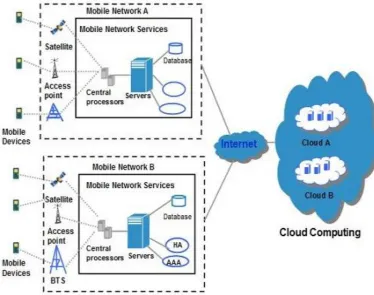
Mobile cloud computing connects to mobile computing, cloud computing, and remote systems where information management and capacity are external of the mobile device [1]. MCC migrates the client application proxy and information store from mobile devices to all popular cloud computing platforms. MCC is a most promising breakthroughs in the world’s transformation, providing bundled cloud resources with unlimited capacity, usability, and versatility for delivering heterogeneous mobile devices across Ethernet or the Internet at any given time [2, 3]. To get a top-down understanding of My Client Center, you need to be familiar with cloud computing and its services. Cloud computing has reclassified the importance of computing by replacing an authority-based client server with a model based on more versatile, efficient, and customizable information [4]. The cloud renders its services to purchasers by giving on-request access to a mutual pool of a few computing assets, for example, server, stockpiling zone, applications in pay-as-you-use way. There is no need amazing mobile gadget arrangement, for example, processor and memory, and all the asset serious handling is performed on cloud. Since mobile gadgets are asset compelled as far as battery life, memory, transmission capacity, and so forth., cloud specialist co-ops allow them to utilize foundation as-an administration or IaaS (register, system and capacity), platform-as an administration or PaaS (object stockpiling, personality, line, and so on.) and programming as-an administration or SaaS (applications, for example, checking, account, community oriented, ERP) at low expense and on-request premise [5]. In SaaS, the buyers can just utilize specialist organization's applications that are running on a cloud.
They are not in charge of overseeing fundamental cloud framework and computing assets (organize, servers, working framework, and memory) aside from little client explicit arrangement settings of the running application, e.g., salesforce.com. In PaaS, the buyer can convey onto cloud purchaser made applications utilizing apparatuses and dialects as given by the specialist co-ops. The purchaser isn't in charge of overseeing basic cloud framework yet has some degree of power over applications conveyed by buyers and their facilitating environment setups, e.g., Google applications. In IaaS, the purchaser can send and run programming (working framework and applications) on cloud. The shopper isn't at all in charge of overseeing fundamental cloud foundation yet has full degree of command over working framework, memory stockpiling and conveyed applications, e.g., Amazon's EC2. MCC still in its earliest stages is not quite the equal as cloud computing with reverence to portability, transfer speed usage, adaptation to non-critical failure, security, and so forth. Mobile administration is among the quickest spreading advances in the history. Some applications benefit from MCC and have a significant impact on the world selling area. Mobile business (m-commerce) has changed people's lives by offering various requests such as funds, online ticketing and mobile shopping. These applications faced tests such as low transmission capacity, battery control, complex mobile design, and security risks. MCC coordinates M-Business applications with the cloud to overcome previous difficulties. Mobile Learning which combines e-learning with portability, also faces some challenges, such as the low transfer rate and the incredible cost of mobile devices. These can be exceeded by using the cloud for tremendous capacity and high preparation skills. The point by point MCC engineering is portrayed in Figure. 1. The mobile gadgets, for example, PCs, PDA's, handheld gadgets can access cloud services either through mobile system or WAP. Mobile gadgets are associated with the mobile systems through base telephone stations (BTS) or satellites which are in charge of controlling the associations and useful interfaces between the mobile systems and mobile gadgets. They transmit the mobile clients' solicitations and information to the BSC which are additionally associated with mobile exchanging focus giving a wide scope of mobile system services, for example, AAA (authentication, approval and accounting) in light of home area register, guest area register, AAA focus, hardware __________________________
Research Scholar, Dept. of Computer Science, Sri SatyaSai University of Technology & Medical Sciences, Sehore, Bhopal-Indore Road, Madhya Pradesh, India
personality register and endorsers' information put away in databases. The endorsers' solicitations are then conveyed to a cloud through the Internet. In WAP case, the mobile gadgets associate with the passages through Wi-Fi which further interfaces with the Internet specialist co-op (ISPs) to give Internet network. Wi-Fi-based availability is more productive than mobile system GSM, GPRS, 3G, LTE, 4G
associations as it gives low inactivity and expends less vitality. Inside the cloud, cloud controllers associate with server farms and application servers to process the solicitations and give mobile clients the relating cloud services depending on omnipresent computing, virtualization and administration arranged design.
Figure 1 Architecture of Mobile Cloud Computing
Mobile Cloud Computing Security Issues
The far reaching advancement of MCC needs secure, solid and non-denied ID and authentication components. Security has developed as an obstruction in appropriation of cloud and mobile cloud computing [6, 19] despite the fact that it conveys a wide scope of assets. The fundamental security rules that any information security system must go along are secrecy, honesty, authentication and non-disavowal. Aside from these, there are two supplementary standards, accessibility and access control which are connected to whole framework all in all and not to specific information or message.
Confidentiality: This standard guarantees that lone sender and recipient(s) should get to the message. It averts unapproved access to information, and loss of classification prompts block attempt.
Integrity: It guarantees right conveyance of message to the planned recipient(s) with no change. Loss of trustworthiness prompts change attack.
Authentication: It helps in building up evidence of personalities that the imparting hub is the thing that it professes to be. Nonappearance of authentication estimates prompts creation attack.
Non-disavowal: This rule ensures that sender can't deny later on for not sending the message.
Access control: It guarantees the utilization of system's assets and services by just the approved clients. It acts like an extension between privacy, trustworthiness and genuineness. It starts with authentication and afterward recognizes who can "get to" what, where access involves perusing of information (privacy) and composing (respectability).
Availability: It guarantees that approved gatherings can get to the data when wanted. Denying access to data prompts forswearing of-administration attack in which genuine clients are deprived of access to assets.Data Security in Mobile Cloud Computing
291 strong encryption calculations and key administration
strategy is basic for achievement of any encryption arrangement. For better security, clients can embrace their very own key administration framework as opposed to receiving CSP's default key administration foundation. Out of this world Networks Inc., as of late investigated encryption controls of 12000 cloud suppliers and created an impression that 81.8% of CSP scramble information in-travel shielding information from MITM attacks as it in-travels through Internet, however just 9.4% of CSP encode information very still, making it powerless against unapproved get to, information ruptures and visually impaired government subpoenas. Among them, just 1.1% of CSP use client oversaw encryption keys. The most famous applications, for example, Facebook, Twitter, PayPal, Gmail, LinkedIn, eBay store information (client certifications, installment card numbers, financial balance numbers) in a decoded structure. Ebay endured greatest information rupture in 2014 when 145 million record qualifications were stolen. The potential conditions of information are as follows: Information in-travel: Data including voice, video, content, metadata are believed to be in movement once it leaves an undertaking control and moves over the system or to cloud and the other way around, and in this way, its encryption is fundamental. It includes not just correspondence with a part outside the
cloud administration, yet in addition correspondence between virtual systems. It must be ensured against listening stealthily attack through cryptographic conventions, for example, SSL or TLS by building up a scrambled and validated channel.
Methodology
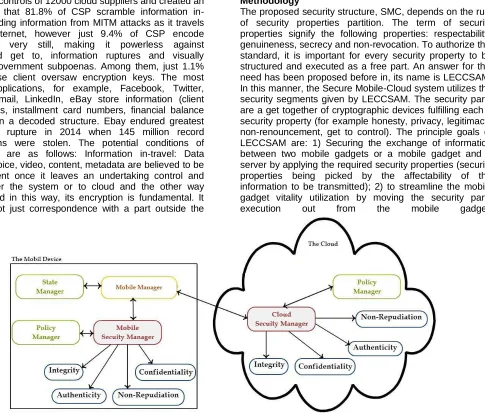
The proposed security structure, SMC, depends on the rule of security properties partition. The term of security properties signify the following properties: respectability, genuineness, secrecy and non-revocation. To authorize this standard, it is important for every security property to be structured and executed as a free part. An answer for this need has been proposed before in, its name is LECCSAM. In this manner, the Secure Mobile-Cloud system utilizes the security segments given by LECCSAM. The security parts are a get together of cryptographic devices fulfilling each a security property (for example honesty, privacy, legitimacy, non-renouncement, get to control). The principle goals of LECCSAM are: 1) Securing the exchange of information between two mobile gadgets or a mobile gadget and a server by applying the required security properties (security properties being picked by the affectability of the information to be transmitted); 2) to streamline the mobile gadget vitality utilization by moving the security parts execution out from the mobile gadget.
Figure 2 The Secure Mobile-Cloud Framework
The SMC Framework is made out of two sorts of segments, as it tends to be found in Figure 2: 1) security segments (LECCSAM segments) and 2) the board parts. As said in segment 4.2, the security segments have been intended to execute the eponym security properties. These security parts are sent in both mobile gadget and Cloud. The join of the security parts characterizes a security blend (model Table 1). Likewise in this work the straightforward security blend term shows just a single security property. The administration segments have been intended to recognize and apply the fitting security properties and in this way security segments to client's information. A portion of these administration parts are sent on the mobile gadget and some of them are conveyed in the Cloud. These directors have been isolated in three gatherings:
1) Security administrator's a. Mobile Security Manager: guarantees the coordination of the security parts in the mobile gadget.
b. Cloud Security Manager: guarantees the coordination of the security properties on the Cloud side.
2) Auxiliary administrators:
a. State Manager. It sends the data gathered from the sensors (for example vitality sensor) to the mobile administrator. It is sent on the mobile.
b. Approach Manager. It figures out which security parts are required for a particular security level. It is sent on both mobile gadget and Cloud.
3) Mobile Manager:
For instance, in a situation application (for example human services application), if a part on the mobile gadget needs to send information to another segment in the Cloud, the Mobile Manager gathers these information and sends them
to the Mobile Security Manager as to be verified. The job of these and their collaborations are portrayed in detail in the following sub-segments.
293
Table 1. Example of Security Combinations
Implementation
User Interface
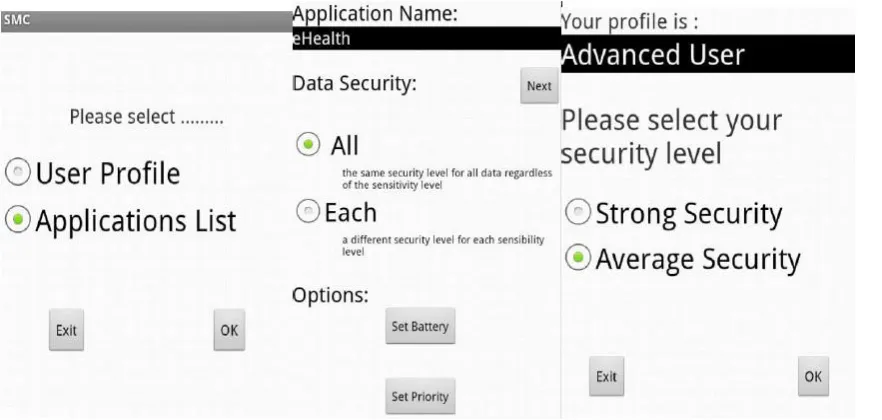
An element of this proposed structure is to allow the clients to express their decisions in regards to the security level they need to apply to their information. This segment will display the execution of the UI on the mobile gadget. The UI was structured so as to gather the client alternatives through admiration to the security level that she/he might want for her/his information and her/his choices on sparing
or not the gadget vitality. To make a UI running on Android, there are two techniques. The first is the ordinary strategy for Java and XML coding. The subsequent technique is to utilize the palette given into the Eclipse advancement environment. This technique gives the office to include a thing by simplified.
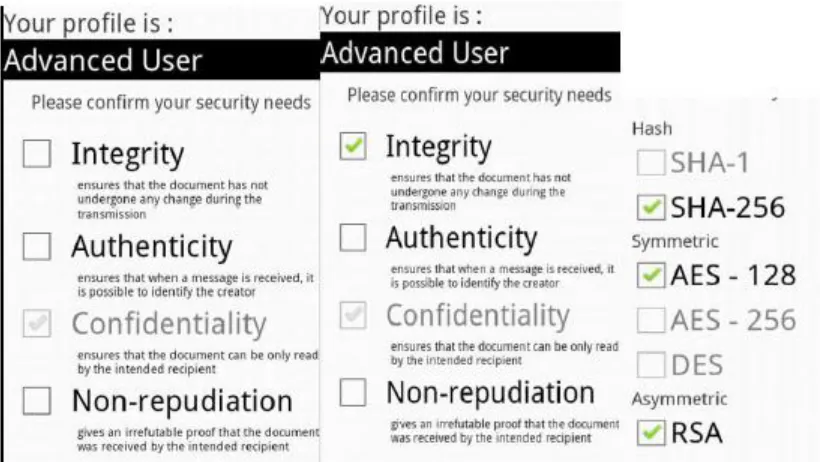
The objective of the UI is to: 1) set up the client profile and 2) gather the security alternatives chosen by the client
(Figure 3 and Figure 4).
Figure 4 Security options set (part b)
CONCLUSION
The Secure Mobile-Cloud Framework on the mobile gadget, all the more explicitly the security segments, the mobile security supervisor, the arrangement director, the state administrator and the mobile chief. It has been pointed the manner in which mobile security chief applies the suitable security properties by displaying the pseudo code for one of the strategies that have a place with the Mobile Security Manager class. Every security level got a code identifier; the association between this code identifier and the security properties is known uniquely by the approach chief. Along these lines it has been depicted the job of every technique contained by the Policy Manager class. For the Mobile Manager it was introduced the advancement of the examination usefulness.
REFERENCES
[1] AppBrain. (2014). Number of Android applications. Available: http://www.appbrain.com/stats/number-of-android-apps
[2] B. Chor, A. Fiat, and M. Naor, ―Tracing traitors,‖ in CRYPTO‟94. London, UK: Springer-Verlag, 1994, pp. 257–270.
[3] B. Waters, ―Ciphertext-Policy Attribute-Based Encryption: An Expressive, Efficient, and Provably Secure Realization‖, http://eprint.iacr.org/2008/290. [4] C. Lynch and F. O. Reilly, ―Processor choice for wireless sensor networks,‖ in REALWSN„05: Workshop on Real-World Wireless Sensor Networks, 2005, pp. 1–5.
[5] D. Boneh, X. Boyen, and H. Shacham, ―Short group signatures,‖ in CRYPTO‟04. LNCS 3152, 2004, pp. 41–55.
[6] D. Crockford. (2014). Introducing JSON. Available: http://json.org/
[7] Enck, W., Ongtang, M., McDaniel, P.: On lightweight mobile phone application certification. In: Proceedings of the 16th ACM Conference on Computer and Communications Security, CCS’09, Chicago, pp. 235–245. ACM, New York (2009). doi:10.1145/1653662.1653691
[8] F. Bao, R. H. Deng, X. Ding, and Y. Yang. Private query on encrypted data in multi-user settings. In ISPEC‟08, pages 71–85, Berlin, Heidelberg, 2008. Springer- Verlag.
[9] Gartner. (April 2013). Gartner Says By 2016, 40 Percent of Mobile Application Development Projects Will Leverage Cloud Mobile Back-End
Services. Available:
http://www.gartner.com/newsroom/id/2463615 [10]Google App Engine, Online at
http://code.google.com/appengine/.
[11]H. Harney, A. Colgrove, and P. D. McDaniel, ―Principles of policy in secure groups,‖ in Proc. of NDSS‟01, 2001.
[12]H. Lin, Z. Cao, X. Liang and J. Shao. ―Secure threshold multi authority attribute based encryption without a central authority‖, In Proc. of INDOCRYPT‟ 08 , Kharagpur, India, 2008.
[13]Juniper Research, ―Mobile Cloud Applications & Services: Monetising Enterprise & Consumer Markets 2009-2014,‖ Juniper Research, Tech. Rep., 2010.
[14]K. Sangani, "Rolling out the mobile future," Engineering & Technology, vol. 7, pp. 80-81, 2012. [15]L. Ballard, M. Green, B. Medeiros, F. Monrose.
―Correlation-Resistant Storage via
Keyword-Searchable Encryption‖.