R E S E A R C H A R T I C L E
Open Access
Criteria for assessing high-priority drug-drug
interactions for clinical decision support in
electronic health records
Shobha Phansalkar
1,2*, Amrita Desai
1, Anish Choksi
5, Eileen Yoshida
1, John Doole
1, Melissa Czochanski
1,
Alisha D Tucker
1, Blackford Middleton
1,2, Douglas Bell
3,4and David W Bates
1,2Abstract
Background:High override rates for drug-drug interaction (DDI) alerts in electronic health records (EHRs) result in the potentially dangerous consequence of providers ignoring clinically significant alerts. Lack of uniformity of criteria for determining the severity or validity of these interactions often results in discrepancies in how these are evaluated. The purpose of this study was to identify a set of criteria for assessing DDIs that should be used for the generation of clinical decision support (CDS) alerts in EHRs.
Methods:We conducted a 20-year systematic literature review of MEDLINE and EMBASE to identify characteristics of high-priority DDIs. These criteria were validated by an expert panel consisting of medication knowledge base vendors, EHR vendors, in-house knowledge base developers from academic medical centers, and both federal and private agencies involved in the regulation of medication use.
Results:Forty-four articles met the inclusion criteria for assessing characteristics of high-priority DDIs. The panel considered five criteria to be most important when assessing an interaction- Severity, Probability, Clinical Implications of the interaction, Patient characteristics, and the Evidence supporting the interaction. In addition, the panel identified barriers and considerations for being able to utilize these criteria in medication knowledge bases used by EHRs.
Conclusions:A multi-dimensional approach is needed to understanding the importance of an interaction for inclusion in medication knowledge bases for the purpose of CDS alerting. The criteria identified in this study can serve as a first step towards a uniform approach in assessing which interactions are critical and warrant interruption of a provider’s workflow.
Keywords:Clinical decision support, Drug-drug interaction, Medication-related decision support system, Electronic health record, Alerts
Background
Medication-related decision support (MDS) alerts gener-ated at the point of prescribing have the potential to pre-vent adverse drug epre-vents (ADEs) and improve patient safety [1]. Despite their potential benefit, these alerts are often ignored [2] as a result of ‘alert fatigue’[3]. Alert fa-tigue is the consequence of receiving a high volume of
alerts whereby users start ignoring critical alerts along with those that may be clinically insignificant [4-7]. Studies evaluating the reasons for these high override rates have found that the interactions for which the alerts are generated often lack clinical significance and may also have inadequate literature evidence supporting their validity [4-6]. Previous studies have identified over-alerting as a barrier to EHRs achieving their full poten-tial in improving patient safety [6,7].
The Stage 1 Meaningful Use (HIT) certification stan-dards required the implementation of drug-drug and drug allergy checking in EHRs [8]. In Stage 2, the rec-ommendation was for EHRs to employ interaction * Correspondence:[email protected]
1
Partners Healthcare Systems, Inc., 93 Worcester Street, 2nd Floor, Wellesley Gateway, Wellesley, MA 02481, USA
2
Division of General Medicine and Primary Care, Brigham and Women’s Hospital and Harvard Medical School, 1620 Tremont Street, Boston, MA 02120, USA
Full list of author information is available at the end of the article
checking -drug-drug and drug-allergy with the ability for the provider to refine DDI rules. In Stage 3, the criteria may well call for a nationally endorsed lists of high priority DDIs to be implemented in EHRs [9]. A major limitation in being able to develop such a list of high-priority DDIs was the lack of consensus on criteria that should be used to evaluate these interac-tions in order to prioritize them as clinically signifi-cant. While the significance of an interaction is largely dependent on the clinical context in which it presents itself, such as the patient’s status, medication profile, etc., there are a number of criteria that need to be evaluated when an interaction is considered for inclusion in a medication knowledge base. Currently, knowledge base vendors and in-house curators of knowledge bases employ disparate criteria, with varied relevance, resulting in a lack of consensus and low overlap on what are considered the most severe DDIs [10]. We employed a mixed approach, first, assessing the state-of-the-art in terms of DDI assessment as de-scribed in the literature. Second, we validated these criteria with a panel of experts, both from the con-tent and implementation perspective to assess both the validity and the feasibility of utilizing these cri-teria for the assessment of DDIs in medication know-ledge bases used in EHRs.
In 2010, the Office of the National Coordinator for Health Information Technology (ONC-HIT) commis-sioned an effort to address the challenges of alert burden and its impact on EHR adoption [11]. The larger effort was aimed at identifying key interactions that should be implemented in knowledge bases to reduce alert fa-tigue [12]. A first step in identifying these interactions was to assess what criteria these interactions need to meet in order to be deemed as high severity DDIs. The specific goal of this study is to describe important cri-teria for choosing interactions to include for CDS in an EHR.
Methods
We conducted a 20-year systematic literature review, from 1990 to 2010 of two bibliographic databases, MEDLINE and EMBASE, in order to identify articles that described characteristics of high-priority DDIs. The criteria identified from the review were then validated by a panel of subject matter experts (SMEs) representing various perspectives in the domain of medication deci-sion support in EHRs - EHR vendors, academic medical centers, and regulatory agencies, such as the Food and Drug Administration and professional organizations such as the American Society of Health-System Pharmacists. No human subjects or data from human subjects was used in this study.
Systematic literature review
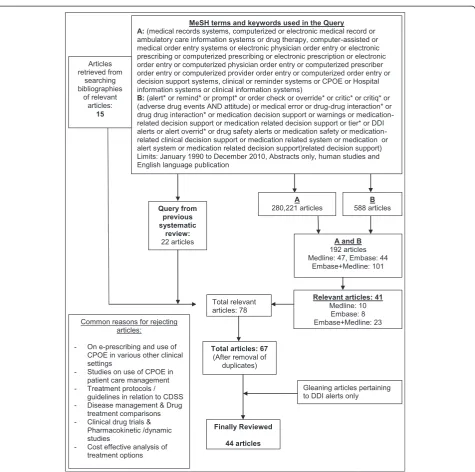
Two literature databases, MEDLINE and EMBASE were searched using keywords and MeSH terms for relevant studies on medication related decision support in clinical information systems. A detailed list of terms employed for this search is listed in Figure 1. The search was re-stricted to the time period of January 1990 to December 2010. We looked for the presence of specific keywords and MeSH terms in two categories in the title, abstract, and body of the articles. The categories employed were as follows:
i) Category (A) consisted of terms that described a clinical information system or electronic medical record.
ii) Category (B) consisted of terms referring to medication-related decision support interventions including mechanisms (alerts, warnings, reminders, etc.) of generating MDS.
or tailored to identify the high priority, clinically signifi-cant DDIs.
Expert panel discussions
Experts with a diverse background in the development, maintenance and implementation of medication-related decision support in EHRs were invited to participate on a panel to validate the criteria and barriers in implementing a list of high priority DDIs. Owing to the diversity of their expertise and the institutions
that they represented, the panelists provided view-points from the perspective of a variety of relevant stakeholders. Expert panelists represented the follow-ing categories:
6 participants representing 5 academic medical centers (University of Washington, University of Washington Medical Center, Arizona CERT, Columbia University, and Erasmus University Medical Center)
P
P
Figure 1Methodology for extracting relevant articles in the systematic review process.Provides an illustration of the methodology used in conducting the systematic review. The review focused on extracting articles on medication-related decision support in electronic
5 participants representing 5 commercial knowledge vendors (Thompson Reuters, Wolters Kluwer, Cerner Multum, First Data Bank and Lexi-Comp)
2 participants representing 2 organizations with in-house medical knowledge base maintenance and development (Partners Healthcare and the Veterans Administration)
2 participants representing federal or private agencies involved in the regulation of medication use (The Food and Drug Administration (FDA) and The American Society of Health-System Pharmacists (ASHP))
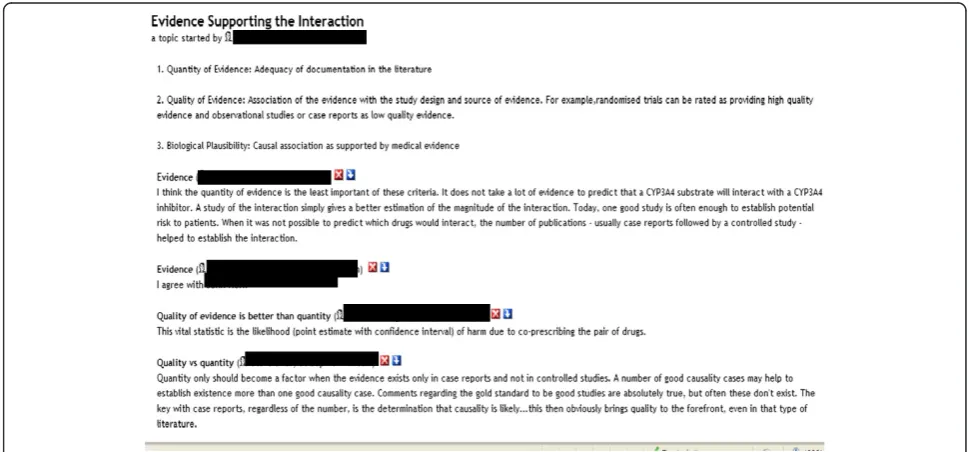
In addition, we conducted individual phone calls with representatives from the three leading medication know-ledge base (KB) vendors [Cerner Multum, First Databank, and Wolters Kluwer]. These phone calls provided in-depth discussion of the criteria identified via the literature review but also allowed discussion of practical consider-ations for the use of these criteria by knowledge base ven-dors in assessing DDIs. Additionally, the expert panel was provided the opportunity to discuss the criteria using an online portal called eRoom (EMC, version 7). An example of the discussion between expert panelists on the criteria of the‘Evidence supporting the interaction’is illustrated in Figure 2. Names associated with specific comments have been hidden to maintain the anonymity of the contributors.
The conversations during the calls were recorded with the permission of the participants and transcribed verba-tim for analysis. Panelists were not provided any
financial incentive for participation and were chosen be-cause of their expertise in the area of medication related decision support, especially drug-drug interactions in the context of use in medication knowledge bases for CDS in EHR systems.
Results
The criteria identified from the systematic literature re-view and validated with the panel are presented in Table 1. These criteria represent what the literature indicates are important considerations for how to choose which DDIs to include in an EHR. In addition, by validating these cri-teria with the medication knowledge base vendors we were able to arrive on barriers for employing these criteria and provide considerations for how they should be employed in order to improve DDI alerting in EHRs.
The panel considered five criteria to be most import-ant when assessing an interaction- Severity, Probability, and Clinical Implications of the interaction, Patient char-acteristics, and the Evidence supporting an interaction. In order to further assess each criterion, there are sev-eral sub-criteria that need to be taken into account. Twenty-four sub-criteria were identified for the 5 cri-teria: 4 for Severity of Interaction, 9 for Probability of Interaction, 3 for Clinical Implications, 5 for Patient characteristics, and 3 for Evidence Supporting the Inter-action. We have listed these in Table 1 and identified the citations from which the sub-criteria were derived. The panel also identified barriers and considerations in order to use these criteria in medication knowledge bases used by EHRs, which are described in Table 2.
Criteria for developing a list of clinically important drug-drug interactions
Severity of the interaction
Tiering alerts on the basis of severity is one of the most important measure to reduce alert overriding and was discussed in detail [26]. Experts agreed that severity of the interaction should primarily be related to the risk/benefit of using the drug pair concomitantly. Weighing the poten-tial benefit would require careful consideration of patient and disease characteristics. Clinical information that
provides context for an interaction is not readily available to knowledge base vendors thus their assessment of inter-actions accounts for generic situations rather than specific patient variables. In addition to the assessment of the risk/ benefit based on clinical context, one panelist opined that when easy to use alternatives are available, one ac-cepts less risk and therefore "severity" for such an interaction should be greater. More research is needed to understand this variation for assessing the severity of an interaction.
Table 1 Criteria for identifying clinically important drug-drug interactions for clinical decision support in electronic health records
Criteria Description of the criteria and key sub-criteria that emerged from the literature review and expert panel discussion
1. Severity of interaction [13-15] ■Clinical Importance: Hansten, Horn and Hazlet in their ORCA classification identify clinical importance as a function of both the inherent danger of the drug combination and the extent to which the presence of risk factors predisposes the patient to the interaction. Also consideration of potential severity of the adverse outcome (ORCA classification, Hansten, et al. [14])
■Likelihood of Mortality ■Likelihood of Morbidity
■Likelihood of Intervention: The probability of the suggested intervention being able to prevent harm caused by the interaction.
2. Probability of interaction
[13,14] ■
Likelihood of the Adverse Reaction ■Timing of Administration
■Consideration of the pharmacokinetic properties of the interaction: Some studies such as Siedling, et al. have evaluated pharmacokinetic characteristics of DDIs between statins and various drugs. The study revealed that more than half of the concentration-dependent ADEs related to statins were considered inappropriate if the upper dose limits were taken into account.
■Dose and Duration of Therapy ■Route of Administration ■Sequence of Administration ■Monitoring planned for the patient ■Therapeutic window of the object drug
■Combination of drugs commonly used for therapeutic reasons 3. Clinical implications
[14,16-18]
■Management burden: defined as the course of action a clinician may have to take for each potential drug interaction
■Monitoring planned for the interaction
■Awareness of the intervention: Likelihood that providers may be aware of the ability to intervene in order to prevent harm caused by an interaction.
4. Patient characteristics [13,14,18]
■Taking into account alcohol, diet, smoking and drug use which might alter the characteristics of the drug in consideration resulting in possible DDIs.
■Importance of age ■Importance of gender ■Concurrent diseases
■Other active medications on the patient's profile 5. Evidence supporting
interaction [13-15,19-21] ■
Quantity of evidence: Adequacy of documentation in the literature
■Quality of evidence: Association of the evidence with the study design and source of evidence. For example, randomized trials can be rated as providing high quality evidence and observational studies or case reports as low quality evidence.
■Biological plausibility: Causal association as supported by medical evidence
For the more practical consideration of how many levels of severity should exist, the literature review showed that there is no clear consensus on class designation and ter-minology. There is also a lack of a developed taxonomy for stratifying drug-drug interaction alerts, although a five-category operational classification has been suggested [13]. The Veterans Administration system classifies DDIs as “critical” or “significant,” [27] while First DataBank identifies three levels of DDIs-“contraindicated”,“severe”, and“moderate” [28]. This is much larger than a problem
of semantics since the interpretation of these labels varies and no clear definitions exist on how DDIs fit into one category versus another. While some medication know-ledge base vendors do have clear definitions, these distinc-tions are seldom obvious or available to the end-user who is presented with the interactions.
Probability of the interaction
According to the panelists the likelihood of causing harm is just as important as severity. However, it is
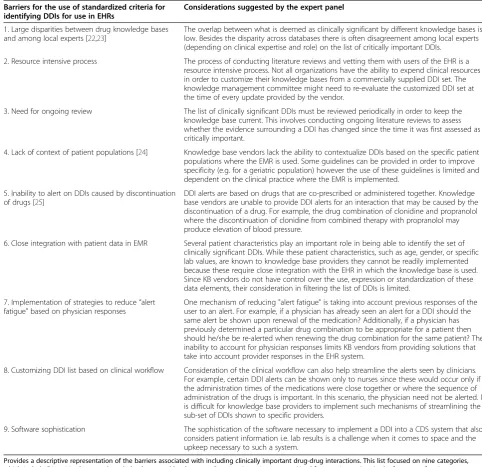
Table 2 Barriers and considerations for including clinically important drug-drug interactions (DDIs) in electronic health records (EHRs)
Barriers for the use of standardized criteria for identifying DDIs for use in EHRs
Considerations suggested by the expert panel
1. Large disparities between drug knowledge bases and among local experts [22,23]
The overlap between what is deemed as clinically significant by different knowledge bases is low. Besides the disparity across databases there is often disagreement among local experts (depending on clinical expertise and role) on the list of critically important DDIs.
2. Resource intensive process The process of conducting literature reviews and vetting them with users of the EHR is a resource intensive process. Not all organizations have the ability to expend clinical resources in order to customize their knowledge bases from a commercially supplied DDI set. The knowledge management committee might need to re-evaluate the customized DDI set at the time of every update provided by the vendor.
3. Need for ongoing review The list of clinically significant DDIs must be reviewed periodically in order to keep the knowledge base current. This involves conducting ongoing literature reviews to assess whether the evidence surrounding a DDI has changed since the time it was first assessed as critically important.
4. Lack of context of patient populations [24] Knowledge base vendors lack the ability to contextualize DDIs based on the specific patient populations where the EMR is used. Some guidelines can be provided in order to improve specificity (e.g. for a geriatric population) however the use of these guidelines is limited and dependent on the clinical practice where the EMR is implemented.
5. Inability to alert on DDIs caused by discontinuation of drugs [25]
DDI alerts are based on drugs that are co-prescribed or administered together. Knowledge base vendors are unable to provide DDI alerts for an interaction that may be caused by the discontinuation of a drug. For example, the drug combination of clonidine and propranolol where the discontinuation of clonidine from combined therapy with propranolol may produce elevation of blood pressure.
6. Close integration with patient data in EMR Several patient characteristics play an important role in being able to identify the set of clinically significant DDIs. While these patient characteristics, such as age, gender, or specific lab values, are known to knowledge base providers they cannot be readily implemented because these require close integration with the EHR in which the knowledge base is used. Since KB vendors do not have control over the use, expression or standardization of these data elements, their consideration in filtering the list of DDIs is limited.
7. Implementation of strategies to reduce“alert fatigue”based on physician responses
One mechanism of reducing "alert fatigue" is taking into account previous responses of the user to an alert. For example, if a physician has already seen an alert for a DDI should the same alert be shown upon renewal of the medication? Additionally, if a physician has previously determined a particular drug combination to be appropriate for a patient then should he/she be re-alerted when renewing the drug combination for the same patient? The inability to account for physician responses limits KB vendors from providing solutions that take into account provider responses in the EHR system.
8. Customizing DDI list based on clinical workflow Consideration of the clinical workflow can also help streamline the alerts seen by clinicians. For example, certain DDI alerts can be shown only to nurses since these would occur only if the administration times of the medications were close together or where the sequence of administration of the drugs is important. In this scenario, the physician need not be alerted. It is difficult for knowledge base providers to implement such mechanisms of streamlining the sub-set of DDIs shown to specific providers.
9. Software sophistication The sophistication of the software necessary to implement a DDI into a CDS system that also considers patient information i.e. lab results is a challenge when it comes to space and the upkeep necessary to such a system.
Provides a descriptive representation of the barriers associated with including clinically important drug-drug interactions. This list focused on nine categories, which include Disparities between knowledge bases and local experts; Resource intensive process, Need for ongoing review, Lack of context of patient
harder to determine the probability without knowing the patient context. In order to assess the likelihood of an adverse drug event (ADE), panelists suggested including the concentration response curve for the ADE of interest. This is especially important when the ADE is unrelated to the desired pharmacologic outcome, e.g., seizures caused by the use of an analgesic such as meperidine [29]. Con-sideration of the timing of administration is also import-ant in determining whether an interaction would actually take place. By adjusting the administration times in the medication administration record to account for the half lives of the drugs, a time-dependent drug-drug interaction can be prevented. For example, the interaction between quinolones and multivalent cations, resulting in the de-creased absorption of the former, can be avoided by a rule requiring separation in administering the drugs [30,31]. The formulation of the drug should be considered as an-other sub-criterion to rule out those which occur due to specific inactive ingredients present in certain formula-tions, e.g. alcohol, which can interfere with the release mechanism of sustained-release morphine causing too much of the drug to be released rapidly resulting a poten-tially fatal dose. In addition, the pharmacokinetic proper-ties of the drugs should also be evaluated to rule out presentation of inappropriate alerts. Seidling, et al. evalu-ated 73 high risk statin-drug combinations for their phar-macokinetic properties and concluded that more than half of the DDI alerts that presented in a clinical decision sup-port system were inappropriate since the DDI-specific upper dose limits were not taken into account [32].
Clinical implications of the interaction
Panelists suggested consideration of the management burden of the interaction, the monitoring planned and the awareness of the provider regarding the interaction. Management burden is defined as the course of action a clinician may have to take for each potential drug inter-action. Hansten and Horn describe three types of actions- a. considering alternative drugs that may be less likely to interact and thus avoiding the interaction b. circumventing the interaction by minimizing the conse-quence of the interaction and c. monitoring the patient to detect the consequence of the interaction and minim-izing the adverse outcome. For example the interaction between the aripiprazole, a drug used for the treatment of the symptoms of schizophrenia, and the antiarrhyth-mic agent, amiodarone can be managed in three ways. First, since the interaction occurs due to amiodarone’s ability to inhibit the enzyme CYP3A4 responsible for the metabolism of aripiprazole, another anti-arrhythmic agent which does not display this inhibitory effect, should be considered. For example, calcium, channel blockers other than diltiazem and verapamil are unlikely to inhibit CYP3A4. Second, if the provider decides to
co-prescribe the two drugs, the dose of aripiprazole should be reduced to one-half of the usual dose and if the inhibitor is subsequently withdrawn then the dose should be adjusted back to the usual dose. In addition, the patient should be carefully monitored for aripiprazole-related ad-verse reactions, such as shaking, vomiting or confusion and alter the dose if such effects are observed. Third, monitoring of the plasma concentration of aripiprazole is also recommended when used in combination with amiodarone [33]. Previous research conducted by Hines and Warholak on DDI alerts seen in pharmacy informa-tion systems, showed that over 35% of the systems evalu-ated in the study, did not provide strategies for managing an interaction [34]. This is an important piece of informa-tion that allows the clinician to make the right decision based on patient context. In the absence of information on clinical consequence of co-prescribing two interacting drugs providers would not be able to gauge the severity of the interaction as it relates to a specific patient.
Patient characteristics
supporting information should be visually distinct from the main message of the alert and brief so that it can be easily interpreted or ignored when not needed.
Evidence supporting an interaction
The quantity and quality of the evidence associated with an interaction which relates to the adequacy of its docu-mentation and the study design and source of evidence should be carefully assessed. In terms of study design, randomized trials can be rated as providing high quality evidence and observational studies or case reports as low quality evidence. Further, several studies have cited the limitations of relying on product labels as the source of the evidence. Product labels are often over inclusive and may result in over inclusion of interactions that may not necessarily be clinically proven. Assessment of pri-mary and secondary sources of literature, such as, the U.S. Food and Drug Administration (FDA) Adverse Event Reporting System (AERS) database of spontan-eous adverse event reports should be included when assessing the evidence associated with an interaction. Seidling, et al. compared the dosage recommendations provided in product labels and found that dosage rec-ommendations for specific DDIs are seldom provided in the drug label. When these authors evaluated the ef-fect of the upper dose limits recommended in the drug labels on the frequency of alerts, they found that fol-lowing recommendations from the published literature rather than the product labels could reduce the alert frequency by 55% [32]. Rigorous study designs offer better quality in making conclusions regarding an interaction. One study assessing the interaction be-tween warfarin and acetaminophen described how obser-vational studies were insufficient to make conclusions given the nonprescription or“over-the-counter” status of acetaminophen [38]. Thus, randomized studies allowed for the assessment of the temporal relationship, measur-able effect with de-challenge and challenge, dose re-sponse, exclusion or accounting of other possible etiologic factors, and biological plausibility. Panelists pointed out the limitations in the existence of randomized trials for every member in a class of drugs thus resulting in ex-trapolation across a class rather than specific assessment to ascertain the biological plausibility of the interaction for each member within the class. Gold standard studies do not exist and quantity of evidence is sometimes limited to case reports and not controlled studies. KB vendors iden-tified that there is limited availability of primary literature to assess the likelihood of an interaction compelling them to rely on package inserts which are inaccurate, have large inconsistencies across countries, out-dated and do not always match with the medical literature. The panel suggested that information from FDA, international regulatory agencies and treatment guidelines are a
good resource for confirming if drugs are safe to co-prescribe. Providing this information in an abbreviated manner within the alert rather than expecting the provider to read the resources at the time of clinical decision making, would also improve assessment of the evidence in order to make appropriate therapeutic decisions regarding a DDI.
Discussion
Current medication knowledge bases have overly sensi-tive rules causing excessive alerts and several design and implementation methods can be taken to reduce the number of disruptive alerts. Using a two pronged ap-proach using a literature review and then validating the findings with an expert panel brought deep insight on various criteria that need to be considered identifying critical DDIs for use in EHRs.
Consideration of patient characteristics in combination with drug characteristics (called probability of an inter-action) by far represented the most important criteria. The interplay between these two criteria provided a good risk assessment of the interaction. Panelists sug-gested several physician related strategies for reducing alert fatigue, such as assessing physician’s previous responses to the alert, consideration of the workflow and customizing alerts based on physician practice, know-ledge and comfort level [39]. Another suggestion was the suppression of DDI alerts for drugs within order sets and treatment guidelines since the appropriateness for these would have been agreed upon previously by physi-cians. However the panel agreed that limiting certain levels of alerts to physicians was not a good idea and not showing the same alerts to pharmacists and physicians may create challenges in communication. They felt that management options, including monitoring approaches, do not change the significance of a potential interaction, for, in spite of overriding an alert the clinician might actually take relevant clinical or biochemical monitoring measures. Thus, they believed that this information should be included in the alert message but should not be used to determine the severity of the interaction.
Patient characteristics allow the provider to determine the relevance of the risk of the DDI in the specific patient context. While this information regarding the pa-tient characteristics relevant to a DDI is readily available, several barriers exist in not being able to readily adopt it in the context of improving alert specificity. Some ven-dors described their frustration at the lack of support from EMR vendors or hospital sites in the implementa-tion of the patient contextualized logic used for DDI alerting. Since integration of patient characteristics in the CDS system is a resource intensive process and we do not have adequate technological support to incorpor-ate these additional features this parameter should be considered for development of more sophisticated deci-sion support systems in the future.
Another barrier is the lack of standardization of defini-tions due to localized definidefini-tions and customized ranges used by providers. For example, if a certain interaction was relevant only in the context of patients with renal failure then KB vendors need a standardized definition of what is meant by “renal failure” so that this logic can be programmatically implemented. Clinicians vary in their interpretations of this logic and often localization of such clinical definitions inhibits the incorporation of such logic into decision support rules. Further, even if there were standardization of such logic, its incorpor-ation in the knowledge base would require strong link-age between the EHR and the KB to combine the relevant data and logic to make a refined, patient-specific recommendation, though such linkages have many benefits [41]. In an environment where the above barriers exist, participants suggested that key pieces of information should be included in the textual informa-tion contained in an alert at least initially.
The second criterion which was considered most im-portant was an understanding of the drug characteris-tics, which we called the“probability of the interaction” in our discussion. This criterion takes into account con-siderations of the duration of therapy, dosage, route, regimen, etc. Similar to patient characteristics, informa-tion about the influence of specific drug or regimen characteristics is available in medication knowledge bases but has not been readily implemented in the deci-sion support systems. Participants discussed ways this information could be employed more effectively, such as, the timing, formulation and sequence of administra-tion could be considered within the realm of the medica-tion administramedica-tion record. For example, an interacmedica-tion between itraconazole with proton pump inhibitors occurs in capsule form but not the solution. Thus, in this example, in the context of an order entry system, a provider who chooses the solution should not re-ceive the alert whereas the provider who chooses the capsule should.
The consideration of the context of the setting is im-portant as availability of facilities for monitoring such as anticoagulation clinics, etc. could further lower the prob-ability that a patient would actually have the interaction. Thus, allowing healthcare institutions or providers to ma-nipulate the level of the interaction based on the consider-ation of the setting could provide another mechanism for assessing the priority of an interaction, though this may not be practical in the near term.
Lastly, development of a standardized scale with trans-parent criteria or editorial guidelines for evaluation of the evidence related to an interaction is needed. One ex-ample was the work that has been undertaken in the Netherlands where articles are categorized on a scale that allows scoring the evidence using explicit criteria. The scale also allows for coding extrapolated evidence in a manner that is distinguishable from evidence that has been gathered from empirical data. This allows transpar-ency into the scoring of the evidence and uniformity for comparison for the adjudication of the level of an alert. When there is a lack of reliable clinical evidence related to an interaction, participants suggested consideration of the likelihood of an interaction based on the pharmaco-dynamic and pharmacokinetic properties. The value of quantity of evidence was undermined in light of such a consideration. Added to this discussion were the consid-eration of a pharmacologic mechanism class rather than the simplistic concept of a drug class. This would allow consideration of the pharmacokinetic properties to de-termine possible interactions even in the absence of published evidence (i.e. biological plausibility).
Conclusions
This study describes the complexity of assessing DDIs for clinical decision support in EHRs. This is a first attempt to provide a comprehensive assessment of the literature and validate the criteria with an expert panel of knowledge base vendors. This approach enabled the insights discussed in the study to be pragmatic solutions for overcoming existing barriers to improve the specificity of DDI alerts in EHRs. While this represents a first step in identifying cri-teria and barriers for evaluating critical DDIs, future research is needed to develop standardized editorial guidelines for uniform adoption of these criteria across medication knowledge bases in EHRs.
Additional file
Additional file 1:Contains the final list of articles reviewed, and used to annotate tables 1 and 2, to determine both criteria and barriers needed for assessing high-priority DDIs.
Abbreviations
Administration; KB: Knowledge Base; MDS: Medication Decision Support; ONC-HIT: Office of the National Coordinator-Health Information Technology; SME: Subject Matter Expert.
Competing interests
The authors declare that they have no competing interests.
Authors' contributions
SP, AD, DB, DWB, and BM conceived the study idea and design. AD, SP, JD, and EY were responsible for data collection for the systematic review and the interpretation of data. SP, AD, MC, AC, and AT participated in writing and DB, DWB, and BM participated in revising the manuscript. All authors read and approved the final manuscript.
Acknowledgments
This work was funded by the U.S. Department of Health and Human Services, Contract # HHSP23320095649WC, Task order HHSP23337009T. Office of the National Coordinator ARRA Contract entitled“Advancing Clinical Decision Support”. The authors would like to acknowledge Dr. Qoua Liang Her, for his clinical perspective on options for managing the interaction between amiodarone and aripiprazole, which is discussed under the criterion of the Clinical implications of the interaction.
Author details
1Partners Healthcare Systems, Inc., 93 Worcester Street, 2nd Floor, Wellesley
Gateway, Wellesley, MA 02481, USA.2Division of General Medicine and Primary Care, Brigham and Women’s Hospital and Harvard Medical School, 1620 Tremont Street, Boston, MA 02120, USA.3RAND, 1776 Main Street, Santa Monica, CA 90401, USA.4Department of Medicine, University of California Los Angeles, 405 Hilgard Avenue, Los Angeles, CA 90095, USA. 5University of Chicago School of Medicine, Chicago, IL 60637, USA.
Received: 17 August 2012 Accepted: 17 May 2013 Published: 13 June 2013
References
1. Jha AK, Laguette J, Seger A, Bates DW:Can surveillance systems identify and avert adverse drug events? A prospective evaluation of a commercial application.J Am Med Inform Assoc2008,15(5):647–653. 2. Kuperman GJ, Bobb A, Payne TH, Avery AJ, Gandhi TK, Burns G, Classen DC,
Bates DW:Medication-related clinical decision support in computerized provider order entry systems: a review.J Am Med Inform Assoc2007,
14(1):29–40.
3. Taylor LK, Tamblyn R:Reasons for physician non-adherence to electronic drug alerts.Stud Health Technol Inform2004,107(Pt 2):1101–1105. 4. van der Sijs H, Aarts J, Vulto A, Berg M:Overriding of drug safety alerts in
computerized physician order entry.J Am Med Inform Assoc2006,13(2):138–147. 5. Mille F, Schwartz C, Brion F, Fontan JE, Bourdon O, Degoulet P, Jaulent MC:
Analysis of overridden alerts in a drug-drug interaction detection system.Int J Qual Health Care2008,20(6):400–405.
6. van der Sijs H, Aarts J, van Gelder T, Berg M, Vulto A:Turning off frequently overridden drug alerts: limited opportunities for doing it safely.J Am Med Inform Assoc2008,15(4):439–448.
7. Peterson JF, Bates DW:Preventable medication errors: identifying and eliminating serious drug interactions.J Am Pharm Assoc (Wash)2001,
41(2):159–160.
8. Stage 1 Meaningful Use Certification Criteria Standards: [http://healthit.hhs. gov/media/MU/n508/MU_SCC_CombinedGrid.pdf]
9. CMS EHR Meaningful Use Overview: [https://www.cms.gov/ EHRIncentivePrograms/30_Meaningful_Use.asp]
10. Wong CM, Ko Y, Chan A:Clinically significant drug-drug interactions between oral anticancer agents and nonanticancer agents: profiling and comparison of two drug compendia.Ann Pharmacother2008,42(12): 1737–1748.
11. Health Information Technology:Initial Set of Standards, Implementation Specifications, and Certifications Criteria for Electronic Health Record Technology.Title 45 Code of Federal Regulations, Pt. 170. 2010 ed. 12. Phansalkar S, Desai AA, Bell DS, Yoshida E, Doole J, Czochanski M, Middleton
B, Bates DW:High-priority drug-drug interactions for use in electronic health records.J Am Med Inform Assoc2012,19(5):735–743.
13. Hansten PD, Horn JR, Hazlet TK:ORCA: OpeRational ClassificAtion of drug interactions.J Am Pharm Assoc (Wash)2001,41(2):161–165.
14. Malone DC, Abarca J, Hansten PD, Grizzle AJ, Armstrong EP, Van Bergen RC, Duncan-Edgar BS, Solomon SL, Lipton RB:Identification of serious drug-drug interactions: results of the partnership to prevent drug-drug-drug-drug interactions.J Am Pharm Assoc (2003)2004,44(2):142–151.
15. Zwart-van Rijkom JE, Uijtendaal EV, ten Berg MJ, van Solinge WW, Egberts AC:Frequency and nature of drug-drug interactions in a Dutch university hospital.Br J Clin Pharmacol2009,68(2):187–193. 16. Krall MA, Sittig DF:Clinician's assessments of outpatient electronic
medical record alert and reminder usability and usefulness requirements.Proc AMIA Symp2002:400–404.
17. Agostini JV, Concato J, Inouye SK:Improving sedative-hypnotic prescribing in older hospitalized patients: provider-perceived benefits and barriers of a computer-based reminder.J Gen Intern Med2008,
23(Suppl 1):32–36.
18. Chazard E, Ficheur G, Merlin B, Serrot E, Beuscart R:Adverse drug events prevention rules: multi-site evaluation of rules from various sources.Stud Health Technol Inform2009,148:102–111.
19. Horn JR, Hansten PD, Chan LN:Proposal for a new tool to evaluate drug interaction cases.Ann Pharmacother2007,41(4):674–680.
20. Kawamoto K, Lobach DF:Clinical decision support provided within physician order entry systems: a systematic review of features effective for changing clinician behavior.AMIA Annu Symp Proc2003:361–365. 21. Ko Y, Abarca J, Malone DC, Dare DC, Geraets D, Houranieh A, Jones WN,
Nichol WP, Schepers GP, Wilhardt M:Practitioners' views on computerized drug-drug interaction alerts in the VA system.J Am Med Inform Assoc
2007,14(1):56–64.
22. Olvey EL, Clauschee S, Malone DC:Comparison of critical drug-drug interaction listings: the Department of Veterans Affairs medical system and standard reference compendia.Clin Pharmacol Ther2010,87(1):48–51. 23. Horn JR, Hansten PD:Drug interaction classification systems.Pharm Times
2004,8:8148.
24. Chaffee BW, Zimmerman CR:Developing and implementing clinical decision support for use in a computerized prescriber-order-entry system.Am J Health Syst Pharm2010,67(5):391–400.
25. Horn JR, Hansten PD:Stopping medications can cause adverse effects.
Pharm Times2008,1:8364.
26. Paterno MD, Maviglia SM, Gorman PN, Seger DL, Yoshida E, Seger AC, Bates DW, Gandhi TK:Tiering drug-drug interaction alerts by severity increases compliance rates.J Am Med Inform Assoc2009,16(1):40–46.
27. Grizzle AJ, Mahmood MH, Ko Y, Murphy JE, Armstrong EP, Skrepnek GH, Jones WN, Schepers GP, Nichol WP, Houranieh A,et al:Reasons provided by prescribers when overriding drug-drug interaction alerts.Am J Manag Care2007,13(10):573–578.
28. Weingart SN, Toth M, Sands DZ, Aronson MD, Davis RB, Phillips RS:
Physicians' decisions to override computerized drug alerts in primary care.Arch Intern Med2003,163(21):2625–2631.
29. Kaiko RF, Foley KM, Grabinski PY, Heidrich G, Rogers AG, Inturrisi CE, Reidenberg MM:Central nervous system excitatory effects of meperidine in cancer patients.Ann Neurol1983,13(2):180–185.
30. Lee LJ, Hafkin B, Lee ID, Hoh J, Dix R:Effects of food and sucralfate on a single oral dose of 500 milligrams of levofloxacin in healthy subjects.
Antimicrob Agents Chemother1997,41(10):2196–2200.
31. Lehto P, Kivisto KT:Effect of sucralfate on absorption of norfloxacin and ofloxacin.Antimicrob Agents Chemother1994,38(2):248–251.
32. Seidling HM, Storch CH, Bertsche T, Senger C, Kaltschmidt J, Walter-Sack I, Haefeli WE:Successful strategy to improve the specificity of electronic statin-drug interaction alerts.Eur J Clin Pharmacol2009,65(11):1149–1157. 33. Hansten PD, Horn JR:Drug Interactions: Analysis and Management.Wolters
Kluwer Health; 2006.
34. Hines LE, Warholak TL, Saverno KR, Boesen MD, Sisk MA, Malone DC: Drug-drug interaction software quality assurance: Lessons learned.J Am Pharm Assoc (2003)2011,51(5):570–572.
35. Ahearn MD, Kerr SJ:General practitioners' perceptions of the
pharmaceutical decision-support tools in their prescribing software.Med J Aust2003,179(1):34–37.
37. Nightingale PG, Adu D, Richards NT, Peters M:Implementation of rules based computerised bedside prescribing and administration: intervention study.BMJ2000,320(7237):750–753.
38. Lopes RD, Horowitz JD, Garcia DA, Crowther MA, Hylek EM:Warfarin and acetaminophen interaction: a summary of the evidence and biologic plausibility.Blood2011,118(24):6269–6273.
39. Isaac T, Weissman JS, Davis RB, Massagli M, Cyrulik A, Sands DZ, Weingart SN:Overrides of medication alerts in ambulatory care.Arch Intern Med
2009,169(3):305–311.
40. van Roon EN, Flikweert S, le Comte M, Langendijk PN, Kwee-Zuiderwijk WJ, Smits P, Brouwers JR:Clinical relevance of drug-drug interactions: a structured assessment procedure.Drug Saf2005,28(12):1131–1139. 41. Schiff GD, Klass D, Peterson J, Shah G, Bates DW:Linking laboratory and
pharmacy: opportunities for reducing errors and improving care.Arch Intern Med2003,163(8):893–900.
doi:10.1186/1472-6947-13-65
Cite this article as:Phansalkaret al.:Criteria for assessing high-priority drug-drug interactions for clinical decision support in electronic health records.BMC Medical Informatics and Decision Making201313:65.
Submit your next manuscript to BioMed Central and take full advantage of:
• Convenient online submission
• Thorough peer review
• No space constraints or color figure charges
• Immediate publication on acceptance
• Inclusion in PubMed, CAS, Scopus and Google Scholar
• Research which is freely available for redistribution