S O F T W A R E
Open Access
ODM2CDA and CDA2ODM: Tools to convert
documentation forms between EDC and EHR
systems
Martin Dugas
Abstract
Background:Clinical trials apply standards approved by regulatory agencies for Electronic Data Capture (EDC). Operational Data Model (ODM) from Clinical Data Interchange Standards Consortium (CDISC) is commonly used. Electronic Health Record (EHR) systems for patient care predominantly apply HL7 standards, specifically Clinical Document Architecture (CDA). In recent years more and more patient data is processed in electronic form.
Results:An open source reference implementation was designed and implemented to convert forms between
ODM and CDA format. There are limitations of this conversion method due to different scope and design of ODM and CDA. Specifically, CDA has a multi-level hierarchical structure and CDA nodes can contain both XML values and XML attributes.
Conclusions:Automated transformation of ODM files to CDA and vice versa is technically feasible in principle.
Keywords:EHR, EDC, CDA, ODM, Documentation form, Data model
Background
Inefficient and redundant documentation processes are a key problem in medical research. The documentation burden in clinical studies is huge and increasing: Ac-cording to Getz [1]–based on an analysis of approxi-mately 10.000 study protocols–the average amount of case report forms (CRFs) per patient in a clinical trial increased from 55 (1999-2002) to 180 pages (2003-2006). This surge is primarily caused by regulatory re-quirements, in particular regarding adverse drug events. High documentation workload is certainly a major cost factor for clinical research. It restricts recruitment of patients into clinical trials, simply because the number of available physicians is limited.
From an informatics point of view, routine documen-tation is performed in Electronic Health Record (EHR) systems. These are currently separated from Electronic Data Capture (EDC) systems for research purposes. From a process perspective, this leads to redundant data entry: Data from the same patient, regarding identical
medical problems, are managed in separate systems. It is well known that uncontrolled redundancy is inefficient and causes data inconsistency. Integrating the Health-care Enterprise (IHE) methods like IHE Retrieve Form for Data Capture (RFD) try to improve data integration, but are limited due to isolated systems. From a regulatory point of view, EHR systems are currently not validated for clinical trials–in contrast to EDC systems.
From a medical point of view, the overall purpose of high-volume documentation in EDC systems is very similar to EHR systems: The physician provides detailed reports about diagnostic and therapeutic actions. In the clinical context, this is needed to communicate within the clinical team and to provide evidence for treatment according to state-of-the-art. In a study context, detailed documentation is demanded to identify adverse events as early as possible.
It is necessary to analyze, compare and potentially harmonize data structures in EHR and EDC systems to address this problem of redundant documentation in EHR and EDC systems.
Quite different standards evolved because EHR and EDC systems are separated. At present, clinical docu-ment architecture (CDA) from HL7 [2] is the most Correspondence:[email protected]
Institute of Medical Informatics, University of Münster, Albert-Schweitzer-Campus 1, A11, D-48149 Münster, Germany
established industry standard in EHR systems. It is ap-proved by the American National Standards Institute (ANSI) and supported by major EHR vendors worldwide. Regarding EDC systems, standards reflect requirements from regulatory agencies, in particular Food and Drug Administration (FDA [3]) and European Medicines Agency (EMA [4]). Currently standards from the Clinical Data Interchange Consortium (CDISC [5]) are most ac-cepted industry standards for EDC systems. More specific-ally, CDISC’s Operational Data Model (ODM) is available to represent CRFs. ODM was introduced in 1999, the current version is 1.3.2. It is a platform independent format for exchange of clinical trial metadata and data. ODM is adopted by many EDC vendors (for example Medidata Rave®).
From a user’s point of view, data collection with elec-tronic forms is a laborious task, both in EHR and EDC systems. These contain 1.800+ data elements on average (180 pages per trial, 10+ items per page). In the past, automated conversion between different technical repre-sentations of these data elements was not available. The scope of conversion is on the metadata level, i.e., conver-sion of “empty” forms (list of data elements, no patient-level data).
The objectives of this work are:
1) To provide a transformation tool for data structures of CRFs, represented in CDISC ODM, into HL7 CDA format, thereby enabling to integrate CRF data structures into EHRs,
2) to provide a converter for EHR forms into EDC format, specifically HL7 CDA into CDISC ODM format and
3) to describe the limitations of this conversion process.
Implementation
Firstly, the meaning of “documentation form” will be explained, then a short explanation of the standards CDISC ODM and HL7 CDA will be provided. Secondly, the mapping process between ODM and CDA will be introduced with more details. Thirdly, an evaluation approach to test the transformation will be presented as well as some technical aspects of the reference implementation.
Documentation form
A documentation form is considered a list of data items. Each data item is characterized by a name, for example “patient weight”, and a data type, such as“float number”. This simple representation of forms is commonly used in statistical programs like IBM SPSS [6]. Additional properties of forms are not taken into account, such as layout information, business logic, font type or location coordinates of data items.
CDISC ODM
CDISC ODM [7] is an XML-based transport format for both metadata and data in clinical trials. It is applied in many EDC systems, which are accepted for clinical trials by FDA and EMA. Specifically, ODM enables to repre-sent CRFs. A form is structured into item groups. Each item group consists of items. For each item, a data type and an optional code list can be specified. Fig. 1 presents an example of a form in ODM format.
HL7 CDA
HL7 CDA [2] is an XML-based industry standard for exchange of clinical documents, for example discharge summaries or assessment forms. Basically, CDA can be used for any type of clinical content. Each CDA document consists of a header (descriptive metadata and data, for example title of document, creation time) as well as a body (structural metadata and data, for instance diagnosis codes). CDA includes a specification of document seman-tics and is based on the HL7 reference information model (RIM) [8]. CDA Release two has been adopted as ISO standard ISO/HL7 27932:2009 [9]. Dedicated CDA tem-plates are defined by the HL7 organisation, i.e., not all CDA structures can be considered CDA templates.
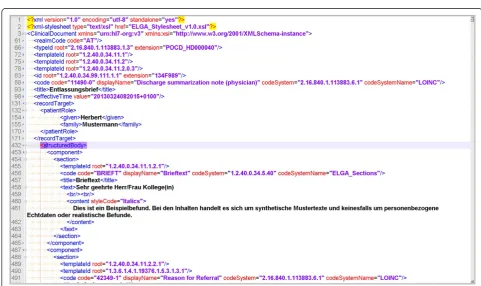
Figure 2 presents an example of a CDA document from the Austrian electronic health record project [10].
Mapping process ODM to CDA format
XML elements in the CDA standard were reviewed to identify suitable data structures for CRF items. A CDA document consists of several sections, including a generic assessment section. Because a CRF can be considered a patient assessment, it was decided to map each CRF in ODM format into an assessment section of a CDA docu-ment. Each data item from a CRF was mapped to an entry element within this CDA assessment section (see Fig. 3). CDA entry elements can contain semantic annotations like Unified Medical Language System (UMLS) codes [11].
Mapping process CDA to ODM format
ODM is designed to store patient data in item nodes, which are organised by itemgroups. In contrast, CDA uses different types of nodes and attributes to store patient data. The CDA standard was reviewed to identify XML nodes and XML attributes representing patient data.
Fig 2.Example CDA file. A small extract from a discharge summary file is presented. The header contains a document code (“11490-0”), time stamp (“20130324082015 + 0100”) and patient name (“Herbert Mustermann”). The structured body consists of several components, starting with a section of discharge letter text (“Brieftext”)
names “patient.name.given” and “patient.name.family” would be generated in this example.
CDA uses both XML node values and XML attributes to represent patient data. For example, the home town of the patient can be stored as < city > Münster</city > and the E-mail address can be stored as < telecom value =“mailto:[email protected]”>. There can be several XML attributes per node (e.g., patient telephone number as another attribute), therefore the number of re-quired ODM items cannot be directly determined from the number of CDA nodes. A suffix was added to the ODM item name for each attribute to generate unique names. For example:“telecom.attributes.value”as ODM item name for the attribute“value”of the CDA node < telecom >.
Evaluation approach
To test the transformation of ODM to CDA, ten ODM files were extracted from the portal of medical data models [12]. These ODM files were converted into CDA format and the result was reviewed regarding syntactical correctness and limitations of the transformation.
To assess the conversion of CDA to ODM, ten public CDA files from the Austrian electronic health record project [10] were converted into ODM format. The transformation result was checked for schema conform-ance. This is necessary, but not sufficient for ODM val-idity (additional constraints need to be considered). Therefore transformed files were manually reviewed.
Reference implementation
An open source reference implementation for conver-sion of documentation forms between ODM and CDA format was developed. ODM2CDA and CDA2ODM are implemented in R [13] and available with program documentation at http://cran.r-project.org within pack-age ODMconverter.
In addition, ODM2CDA was implemented as web ser-vice and is available to the scientific community as down-load option within the portal of medical data models [14].
Results
Transformation of ODM to CDA
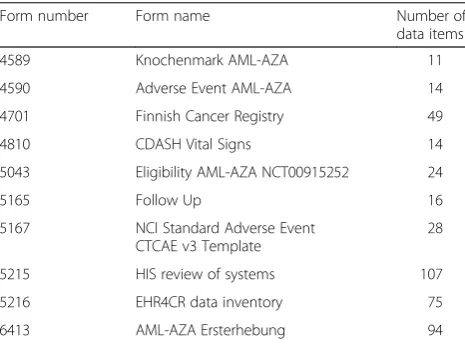
Table 1 provides details about ten ODM files which were converted into CDA format. Forms from different docu-mentation settings such as routine docudocu-mentation (e.g.,
HIS review of systems, Follow Up), clinical trials (e.g., Adverse Event AML-AZA) or clinical registries (e.g., Finnish cancer registry) were assessed. These forms are available at https://medical-data-models.org/forms/ {form number}.
Using the reference implementation of ODM2CDA, all ten forms were converted into CDA format. Conformance with CDA schema was tested successfully according to a public CDA XML schema definition [15]. In addition, these generated CDA files were manually reviewed to as-sess validity. Of note, these files are valid CDA structures, but no CDA templates, because these are defined by the HL7 organisation.
The transformation tool ODM2CDA was integrated as a web service into the portal of medical data models [14], therefore all available forms (>9.000) can be exported in CDA format.
It can be concluded that automated conversion from ODM to CDA format is technically feasible in principle. However, all ODM items are represented as CDA assess-ment items and other CDA sections are not taken into account for this transformation. In addition, ODM item-group information is not represented in CDA format.
Transformation of CDA to ODM
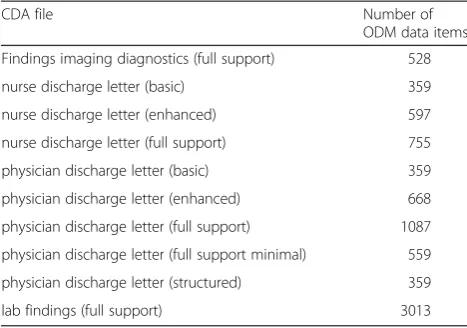
Ten public CDA files (see Table 2) from the Austrian electronic health record project [10] were converted into Fig. 3Example for an entry element of a CDA file. It corresponds to an ODM item named“Date of Birth”. C0421451 is the UMLS code for Date of Birth
Table 1Basic characteristics of ODM files used for transformation testing
Form number Form name Number of
data items
4589 Knochenmark AML-AZA 11
4590 Adverse Event AML-AZA 14
4701 Finnish Cancer Registry 49
4810 CDASH Vital Signs 14
5043 Eligibility AML-AZA NCT00915252 24
5165 Follow Up 16
5167 NCI Standard Adverse Event CTCAE v3 Template
28
5215 HIS review of systems 107
5216 EHR4CR data inventory 75
ODM format. The transformation result was tested for syntactical correctness according to CDISC ODM (ver-sion 1.3.2) [7]. These converted CDA files were reviewed manually. Of note, these converted CDA files contain a large number of items (between 359 and 3013).
In addition, the converted CDA file“physician discharge letter (basic)” was uploaded to the portal of medical data models [14] and is available at https://medical-data-models.org/forms/5217.
This transformation has several limitations: The hierarchical structure of CDA (see methods section “Mapping process CDA to ODM format”) was approxi-mated by concatenated ODM item names, for example “patient.name.family”. CDA nodes can contain both XML values and XML attributes, which need to be represented by separate ODM items. In addition, re-transformation of this ODM file into CDA does not generate the original CDA file: ODM2CDA stores ODM items only within the CDA assessment section.
Discussion
Currently, the documentation processes for routine pa-tient care and clinical research are disconnected. High regulatory requirements result in costly documentation processes [16]. Different technical standards are used in medical IT systems: Predominantly CDISC standards for clinical research and HL7 standards for EHR systems, in particular CDA. CDISC ODM is highly adopted by EDC vendors. ODM is used for data and metadata export, but recently more and more for metadata import. Regulatory authorities like FDA support CDISC standards, which is an important driver for this trend.
From a medical point of view, an EHR system and an EDC system collect information for the same patient. From a data analysis perspective, many data points in both systems–such as body weight–should be very simi-lar or the same, only stored in different representations.
CDISC and HL7 standards serve different purposes, so there will be differences between ODM and CDA.
Regarding data exchange between EHR and EDC sys-tems, it would be very useful to extract data points from one representation and transform it into another one. A prerequisite for such data exchange is a transformation of ODM data structures into CDA and vice versa. This enables clinicians and researchers to identify similarities and differences between EHR and EDC documents. Comparison between EHR and EDC data structures can be used at the trial design stage to optimize EHR and EDC documentation. In the trial execution phase it can be used to identify data elements for re-use.
Transformation of ODM to CDA was already de-scribed in the literature [17], however so far no imple-mentation was available to the scientific community. In this work we present an open source transformation program between ODM and CDA data structures. It was tested for two sets of files: ten ODM files from different documentation settings and ten public CDA files.
It was demonstrated that an automated transformation between ODM and CDA is technically feasible in principle. However, this transformation is “lossy”, i.e., has several limitations due to specific properties of ODM and CDA: ODM is much more generic, because it assigns data items to item groups, and these item groups to forms. In contrast, CDA consists mainly of predefined sections of XML nodes related to diagnosis, allergies, medication, findings etc. Many CDA documents contain a lengthy header with very detailed descriptive metadata regarding administrative patient data (name, address), physician and hospital-related data. From a data analysis perspective, most of these CDA header elements are not useful for clinical research questions. In contrast, the body section of many CDA files–which contains the interesting clinical data–is very short. From a technical perspective, processing CDA files is more complicated than ODM files: CDA combines XML node values with XML attributes and has a variable hierarchical structure.
There are several limitations of the proposed trans-formation between ODM and CDA.
In general, CDA is generated from data instances and it is not clear what data elements are optional or repeatable (by default, the conversion tool assigns attri-butes Mandatory =“Yes” and Repeating =“No”). CDA also provides narrative parts, i.e., non-structured data. In contrast, ODM defines a full schema with optional, mandatory and repeatable data elements. ODM items are represented as CDA assessment sections in the current implementation of the conversion tool. The hierarchical structure of CDA is approximated by concatenated item names in ODM format. ODM does not provide informa-tion about item classes, therefore act classes are generated in CDA. Narrative text from CDA is ignored when it
Table 2Transformation results of ten CDA files from the Austrian electronic health record project
CDA file Number of
ODM data items
Findings imaging diagnostics (full support) 528
nurse discharge letter (basic) 359
nurse discharge letter (enhanced) 597
nurse discharge letter (full support) 755
physician discharge letter (basic) 359
physician discharge letter (enhanced) 668
physician discharge letter (full support) 1087
physician discharge letter (full support minimal) 559
physician discharge letter (structured) 359
cannot be assigned to structured data elements. The transformation is designed for metadata: CDA files contain data for one patient while ODM files can contain data for large patient cohorts.
Many differences between EHR and EDC standards have been reported [18], and there is a long scientific debate about standardised medical data models.
Transformation and mapping between EHR and EDC standards is a first, but important step to enable com-parison and discussion of data items. From a data analysis perspective, a list of data items is a prerequisite for statistical analysis.
This requirement is addressed very well by the ODM standard. CDA was designed to represent the current heterogeneity of clinical data structures. From a meth-odological point of view, the large diversity of clinical documentation indicates that there is room for improve-ment by standardisation: It is highly unlikely that all the diverse documentation approaches are optimal. Trans-parency of data models and transformation between different standards like ODM and CDA are first steps to trigger a discussion about best practice in clinical and research documentation.
The proposed transformation approach can take into account semantic codes for data items. However, most publicly available medical forms are not (yet?) semantic-ally annotated. The high number of data elements per documentation unit (up to 3000) in this study indicate a need for automated metadata processing (for instance [19]), because manual mapping of many data elements is resource-intensive and error-prone.
Conclusion
Automatic transformation of ODM files to CDA and vice versa is technically feasible in principle, but has limitations due to the different scope of ODM and CDA standards. An open source reference implementation is available.
Availability and requirements
Project name:ODMconverter
Project home page: http://cran.r-project.org/web/pack-ages/ODMconverter/index.html
Operating System:Platform independent
Programming language:R
Other requirements:R packages XML and xlsx
License:GPL
Any restrictions to use be non-academics:N/A
Competing interests
The author declares that he has no competing interests.
Author’s contributions
MD designed and implemented ODM2CDA and CDA2ODM. MD wrote the manuscript.
Acknowledgements
Support by Deutsche Forschungsgemeinschaft and Open Access Publication Fund of University of Muenster is acknowledged.
Received: 2 April 2015 Accepted: 13 May 2015
References
1. Getz K. Protocol Design Trends and their Effect on Clinical Trial Performance. RAJ Pharma. 2008;5:315–6.
2. Dolin RH, Alschuler L, Boyer S, Beebe C, Behlen FM, Biron PV, et al. HL7 Clinical Document Architecture, Release 2. J Am Med Inform Assoc. 2006;13(1):30–9.
3. Food and Drug Administration. http://www.fda.gov/ (accessed February 7, 2014) 4. European Medicines Agency. http://www.ema.europa.eu/ (accessed
February 7, 2014)
5. CDISC: Clinical Data Interchange Standards Consortium. http://www.cdisc.org/ (accessed February 7, 2014)
6. IBM SPSS. http://www-01.ibm.com/software/analytics/spss/ (accessed February 7, 2014)
7. CDISC Operational Data Model (ODM). http://www.cdisc.org/odm (accessed February 7, 2014)
8. HL7 RIM. http://www.hl7.org/implement/standards/rim.cfm (accessed February 28, 2014)
9. International Organization for Standardization. ISO/HL7 27932:2009. http://www.iso.org/iso/iso_catalogue/catalogue_tc/
catalogue_detail.htm?csnumber=44429 (accessed February 28, 2014) 10. Elektronische Gesundheitsakte (ELGA). http://www.elga.gv.at/index.php?id=28
(accessed May 5, 2015)
11. UMLS. http://www.nlm.nih.gov/research/umls/ (accessed May 5, 2015) 12. Breil B, Kenneweg J, Fritz F, Bruland P, Doods D, Trinczek B, Dugas M.
Multilingual Medical Data Models in ODM Format. A Novel Form-based Approach to Semantic Interoperability between Routine Healthcare and Clinical Research. Applied Clinical Informatics. 2012;3(3):276–89. 13. R Core Team: R: A language and environment for statistical computing. R
Foundation for Statistical Computing, Vienna, Austria. http://www.R-project.org/ (accessed May 27, 2014)
14. Portal of Medical Data Models (MDM). http://www.medical-data-models.org/ (accessed May 7, 2014)
15. VHitG-Arztbrief according to HL7 CDA Release 2. http://www.bvitg.de/ arztbrief.html (accessed May 21, 2014)
16. Hearn J, Sullivan R. The impact of the‘Clinical Trials’directive on the cost and conduct of non-commercial cancer trials in the UK. Eur J Cancer. 2007;43(1):8–13.
17. El Fadly A, Daniel C, Bousquet C, Dart T, Lastic PY, Degoulet P. Electronic Healthcare Record and clinical research in cardiovascular radiology. HL7 CDA and CDISC ODM interoperability. AMIA Annu Symp Proc. 2007;11:216-20 18. Laleci G, Yuksel M, Dogac A. Providing Semantic Interoperability between
Clinical Care and Clinical Research Domains. IEEE J Biomed Health Inform. 2013;17(2):356–69.
19. Dugas M, Fritz F, Krumm R, Breil B. Automated UMLS-based Comparison of Medical Forms. PLoS One. 2013;8(7):e67883.
Submit your next manuscript to BioMed Central and take full advantage of:
• Convenient online submission
• Thorough peer review
• No space constraints or color figure charges
• Immediate publication on acceptance
• Inclusion in PubMed, CAS, Scopus and Google Scholar
• Research which is freely available for redistribution