DTDWS-DESIGN OF TESTBED FOR
DISTRIBUTED WEB SERVICE
ENVIRONMENT
D.CHANDRAMOHAN*, S.K.V.JAYAKUMAR, SHAILESH KHAPRE
Department of Computer Science, Pondicherry University, INDIA- 605014.
Abstract :
Designing and developing a testbed to evaluate the features of web service properties and their service interfaces in a distributed web service environment. This testbed interface helps the clients and their tools to build automatically with the corresponding web services and to identify its related issues in which it can communicate and cooperate among services in a distributed environment. By establishing set of policy and preferences for relevant supporting tools to evaluate the semantic technology of service and enhancing the tuning features by avoiding interoperability among web services. A light weighted application having unique and specific structure for designing testbed for distributed web service environment (DTDWS) with a build in concepts encoded with XML (Extensible Mark-up Language). This proposal breed a trustful zone in a distributed environment by an automated simulation, composition and testing techniques are put into service. Many service conflicts are resolved in a timely and consistent approach all the way through our proposed testbed.
Keywords: Web Service, Web Service Standards, Service Oriented Computing, Distributed Simulation, Service Oriented Architecture, Distributed Web Service, SOAP, WSDL, UDDI, XML Schema.
1. Introduction
In distributed web services the interfaced framework which allows the users/ clients to manage the services, web service based methodology for modelling and simulation are greatly interoperable with the extended features by allowing communications between the services requestors (client) and the service provider according to the various events. To achieve the goal set forth for service oriented computing a growing number of researchers are formulating a detailed concept, methods and techniques that can be used to build service based systems. To develop models is the most common approach for these system design structure. In order to develop and use the simulated services it’s important to leave a modelling and simulation framework that is theoretically sound enough and it has one or more robust implementation and is simple to use. To make natural progress over the work on SOA a grid simulator was introduced in a simulation component and to facilitate the composition of an application simulation. A state binding must conform to XML validation constraints, guarantee type safety and should preserve a framework for constructing loosely coupled web service architecture and the interoperability between services. Easier message level security with the introduction of turkey security scenarios, the interoperability with all platforms and communication foundations with all features and an improved policy framework with security tokens and ready to supports the updated web service specifications. These standard web services messaging system will be more flexible to use open standards. The flexible and familiar platforms and tools are used now a day will become the foundation for discovering the service globally. Models of web service composition that are both readable verifiable will benefit organization that integration purportedly reusable web service.
2. Related Work and Background
applications. It is an emerging for next-generation computing [3]. These ideas of a computational economy helps in creating a service oriented computing architecture where service providers offer paid service associated with a particular application and users. The ability to specify management policies, events, metrics, probes, service- level objectives, service level agreements, [4], [5], [9], [7] as well as business level objectives, the policy simulator tool intended to serve in the evaluation of policy based management solutions. The simulation used for the purpose of correcting / improving the design and also models and components can be building out of web services. QOS of web processes differs from the analysis of workflow due to the distribution, autonomy and heterogeneity of its components [2], [3], [6], and [9]. A new wave of development based upon XML has started they are semantic web and web services. It expresses synergy between web service tech and simulation. The services in this paradigm are loosely coupled autonomous software entities that can be deployed remotely across organization and IT infrastructure boundaries these services are described, [1], [9], [13], [14] discovered and monitored with service integrators and developers to provide collaborating services. The language such as WSDL, WSCL, BPEL4WS, OWL-S, and WSMO are used to discover the service. By using UML- sequence and class diagram they framed the system simulation modelling and service based system, service oriented queries models represent the functional aspects of the service based system being deployed that need to be fulfilled by the service. Semantic matching and behavioural signatures matching full service behavioural models which involved in service oriented system. A dynamic web service selection of web service to be invoked at runtime successfully by orchestrate a composite web service by aggregated reliability to measure the probability that give service during failing of service at rare cases. The computations of aggregated reliabilities are equivalent to eigenvector the computation and adopt the power method to efficiently derive aggregated reliable computation and to adopt the power more efficiently to device reliabilities. The formulation of dynamic web service selection problem in a dynamic failure-prone environment the proposed model to invocate the order of operations in each web service and to construct a web service composition that enumerates all possible delegations, by means of AR probability execution method the configuration will successfully terminated and the reliabilities can be shown in the form of square matrix by means of eigenvector. Two service selections strategies AR and CAR based are utilized to find the probability of failed services. A queuing model based adaptive control approach for performance regulation of computing systems. To obtain the desired target an approach of predictor and feedback controller operates concurrently in a complementary manner.
3. Proposed Model
This design and implementation of an advance application with necessary tools to support the service level control loops and utilization of clients / users of different services. It can be implemented in between the service providers and clients transparently to the existing servers and browsers.
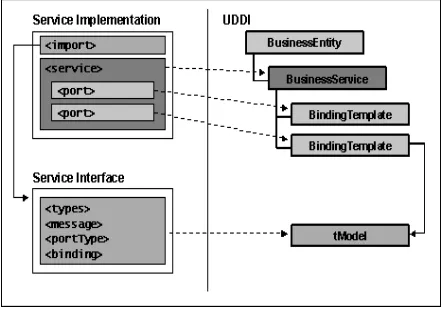
Fig. 1. Overlay of Service Interface
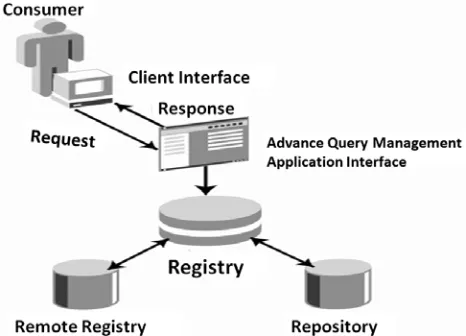
Fig. 2. Requesting and Proving Services
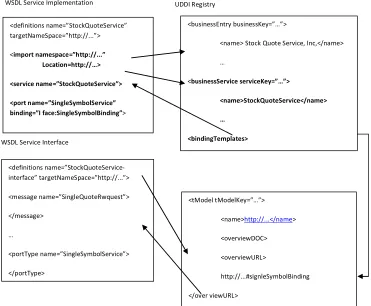
Users who are accessing the application through internet globally they can access the service through SOAP and the users who need service from internally they are also serviced through local remote service. The tool by itself impose different operational requirements for different users or clients and they provide assurance that it would not affect the clients applications rather than they are preserving the clients service request, granularity of service, preserving the semantics. A sample service over lay describes the general representation of service implementation along with service interface by means of UDDI registry, its components like import, message type, port type, binding etc. Web services emerged as a very huge powerful technology in the internet technology world for integrating heterogeneous application into internet. Which supports certain specifications like SOAP, WSDL, UDDI, XML schema standards and data interchange supportable standards which will act as an intermediate among different operating systems and application, this paper potentially steps up to provide a task associated with services in differentiated levels to the service requesters a strategic design flow is adapted by means of testbed in a distributed environment by achieving a high graphical application user interface which can process all type of query management and interpretation of different services through the automated management testbed and different service levels. It is more flexible to achieve the service level objectives and resource based management as per the different service providers’ agreements to the registry. Fig.3 This interface provides an entry point for clients/ user to access the functionality exposed by the service providers and it can be distributed across network which can be accessed from the registry like UDDI, the design of service interface is to decouple the implementation of testbed which are needed to communicate with other services and it provides more work for graining interface while preserving the semantics and granularity of web services and it will provides assurance that it wouldn’t affect the users interface and so on, it develops a good relation between these service providers and requestors which allows them to exchange information even if they are using different service platforms.
Fig.3 expresses the integrity of testbed to all platforms which act as an intermediate application among service repository and requestors, it does not have any knowledge about specific data formats among service providers rather then it will try to provide those services. It has a significant role in ensuring the service meat and its service level commitments to a specific set of clients and it will increase the response time and reduce the bandwidth consumption and also to achieve scalability, availability and fault-tolerance and it will change the minimal impact of services among the service requestor and the providers.
<definitions name=”StockQuoteService”
targetNameSpace=”http://...”>
<import namespace=”http://...” Location=http://…>
<service name=”StockQuoteService”>
<port name=”SingleSymbolService” binding=”I face:SingleSymbolBinding”>
<businessEntry businessKey=”…”>
<name> Stock Quote Service, Inc,</name>
…
<businessService serviceKey=”…”>
<name>StockQuoteService</name>
…
<bindingTemplates>
WSDL Service Implementation UDDI Registry
<definitions name=”StockQuoteService‐
interface” targetNameSpace=”http://...”>
<message name=”SingleQuoteRwquest”>
</message>
…
<portType name=”SingleSymbolService”>
</portType>
<tModel tModelKey=”…”> <name>http://...</name> <overviewDOC> <overviewURL>
http://...#signleSymbolBinding
</over viewURL>
WSDL Service Interface
Fig. 4. Service Interface, WSDL, UDDI Interior models
Remote Repository
Service Registry
Advanced API Testbed
Service Provider
Service Requestors
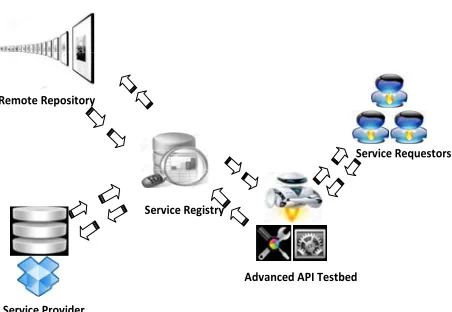
Fig. 5. Structure of Testbed for Distributed Web Service Environment
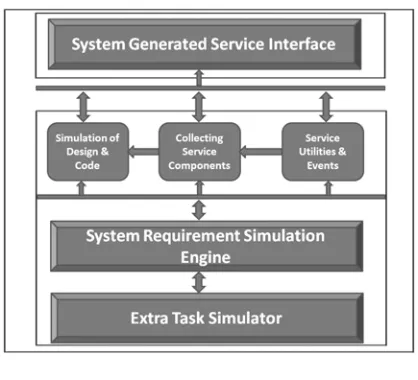
The main features and overall workflow of distributed web service testbed shown in Fig.5 due to its loosely coupling among components and its features will increases the scalability of the system service. The consumer of a service is not request to have a detailed knowledge of execution platform of this API. The proposed model aims to design an enterprise application in which some of its functionality available across the network. These functionality need to be accessible by various type of systems in the network. This model considering Interoperability as a key to design these testbed to achieve general objectives of all clients and the service providers to have a strong base for all kind of service oriented issues. Clients may have different scenarios to request for particular service and to get an optimal response from any kind of source. Proposed models view to have an encapsulated view of datasets to achieve the web service environment as a whole with the help of this advanced API testbed. This gambit would help the distributed network to organize all properties of various services to have an improved session with all possible optimized results for relevant client’s request. Design of required results are depends on the collective information given by the search query optimizer. The advanced API design introduced in Fig.6 which describes the functional characteristics of Testbed tool, this tool includes some of controllers which are used to find the various activities of web service. The following component gives an idea about testbed going to generate.
(1) System Generated Service Interface.
(2) Simulation of Design and Code.
(3) Collection of Service Components.
(4) Service Utilities and Events.
(5) System Requirements Simulator tools.
(6) Extra Task Simulator.
Fig. 6. Advanced API Testbed.
Service components are composed with all related aspects collectively in a well developed approach. Similarly it indicates its associated events and utilities which should be attached as a key feature. Minimum requirements of system design and devices are collected and enclosed in one model. The main advantage of this design will incorporate the extra tasks which are required based on the knowledge base and regular desires suggested by the users etc.
4. Conclusions and Future Work
In this paper, we explored the allocation of service and identifying the services in a distributed web service environment using our sample isolation procedures such as service scalability, approaches, availability, accuracy, optimization, stability, optimization of results etc as a negotiation factors, we considered these course of action in our proposal for designing the TDWS which gives an overall flow and its functional framework. The future research will focus on developing such testbeds as a concrete testing tool for all web services as an open source and free access in a distributed network and slowly try to inherit these features inside the cloud environment so that we can suggest a real world service testbed scenario.
References
[1] George Spanoudakis and Andrea Zisman, Member, IEEE Computer Society, JUNE 2010 ,“Discovering Services during Service-Based System Design Using UML”, IEEE TRANSACTIONS ON SOFTWARE ENGINEERING VOL. 36, No. 3, pp. 371-389”. [2] Rajkumar Buyya and Srikumar Venugopal, 2006, “The Gridbus Toolkit for Service Oriented Grid and Utility Computing: An
Overview and Status Report”, IEEE conference.
[3] Senthilanand Chandrasekaran, Gregory Silver, John A. Miller, Jorge Cardoso, Amit P. Sheth, 2002, “WEB SERVICE TECHNOLOGIES AND THEIR SYNERGY WITH SIMULATION”, IEEE 2002 Winter Simulation Conference, Department of Computer Science/LSDIS Lab, The University of Georgia, Athens, Georgia.
[4] G. Allen and E. Seidel, K. Davis and H. Kaiser, T. Goodale, A. Hutanu, A. Reinefeld, F. Schintke, T. Schütt, and B. Ullmer, T. Kielmann, A. Merzky, and R. van Nieuwpoort, Mar-2005 “The Grid Application Toolkit: Toward Generic and Easy Application Programming Interfaces for the Grid”, IEEE conference Vol.93,No.3.
[5] Issam Aib and Raouf Boutaba, University of Waterloo, April 2007,”PS: A Policy Simulator”, IEEE Communications Magazine, TOPICS IN NETWORK AND SERVICE MANAGEMENT.
[6] Ingo Pansa, Philipp Walter, Sebastian Abeck, Klaus Scheibenberger, 2010, “Model-based Integration of Tools Supporting Automatable IT Service Management Processes”, “IEEE/IFIP Network Operations and Management Symposium Workshops 2010”, Cooperation & Management, Karlsruhe Institute of Technology (KIT), Karlsruhe.
[7] Web Services Architecture: http://www.w3.org/TR/ws-arch/
[8] Using WSDL in a UDDI Registry, Version 2.0.2: http://www.oasis-open.org/committees/uddi-spec/doc/tn/uddi-spec-tc-tn-wsdl-v2.htm.
[9] UDDI specification, http://www.uddi.org/
[10] Microsoft’s UDDI resource, http://msdn.microsoft.com/uddi/ [11] SOAP specification, http://www.w3.org/TR/SOAP/
[12] IBM’s Web services site, http://www.alphaworks.ibm.com/webservices/ [13] Microsoft’s Web services site, http://msdn.microsoft.com/webservices/