Indian J. Plant P"lllol•• Vol. XXXV, No. l.pp. l(i..24. (Marett. 199Z) r
EFFECT OF RESTRICTED SOIL MOISTURE ON YIELD AND ITS ATTRIBUTES IN CHICKPEA
R. NANDA AND A.D. SAINI.
" Division of Plant Physiology. Indian Agricultural Research Institute,
New Delhi-llOOl2
Received on 2 July. J990
SUMMARY
TWG Chickpea (Cict!r arittinum L) varieties. C 235 and BG 268 were raised under restricted and bigh soil moisture on 4 sowing dates during the two seasons.
1987·88 and 1988·89. Variety C 235 gave 40% higher yield than BG 268 as it produced
"
more pod number/unit area. Under restricted soil moisture grain weight/pod was 35%bigher, which over compensated its lower pod number (15%) so that its grain yield was higher by 15.18% than crops raised under high soil moisture. Rate of dum., in yield with time showed that for every one day delay in sowing (1) grain yield/m' declined by 1 g. (2) pod number of BG 268 and C 235 declined by 5 and 7-10 pods/rnt respectively.
INTRODUCTION
•
Sufficient information is available which indicate that environment plays an important role in determining the yield of chickpea. The role of irrigation is most significant in north India. Irrigated crops experiencing heavy late winter rains during certain years in north India revert to vegetative growth and undergo forced matura tion by the following hot summer season resulting in too poor grains. This feature of excessive vegetative growth under high soil moisture js a peculiar feature of chickpea crops in north India. Experiments were conducted to find out the pattern of changes in yield and its contributing characters under four different sowing dates with restricted (two irrigations) and relatively higher (four irrigations) soil moisture levels during 1987-88 and 1988-89.
MATERIAL AND METHODS
Two varieties of Chickpea (Cicer arietinum L) of C 235 and DO 268 were raised during the rabi seasons of 1987-88 and 1988·89 in 3m x 5 m plots at 25 x 20
MOISTURE STRESS IN CHtCKPEA
em spacing in triplicate. The crops were sown on 17 October, 10 November, 29 Nov and 22 Dec, 1987 and 14 Oct, 9 November, 29 Nov and 19 Dec, 1988. Nitrogen and Phosphorus fertilizers @ 20 and 40 kg/h as Uiea and superphosphate, respec tively, were applied to the soil before sowing. Crops were thinned to 5 plants/m at uniform distance. Crops received uniform irrigation on 40th and 60th day after sowing (10)' Treatment for profuse irrigation (I) received two additional irrigations at 80th and 100th day after sowing. Last irrigation in I treatments of December sown crops could not be given due to early maturity. The split plot layout of the experiment had sowing dates as main treatments and irrigation Llevels as sub treatments.
Fifteen plants in each replicate were tagged for recording the beginning and end of the flowering. Data was daily recorded for number of fresh opened flowers. Least square regression (Y = a -+ bx) were used to calculate the rate of increase in flowering and total flowering duration. Pod development was studied by tagging about 300 flowers opening on a single day during peak flowering time in each plot. Beginning with first sample on third day after tagging, lO pods were collected from each replicate, followed by daily sampling till maturity to record grain yield and its components. On~ m2 area from each plot was harvested Fruit setting (%) was calculated from the total number of flowers per plant and number of pods/plant
harvested. Data were analysed statistically.
RESULTS AND DISCUSSION
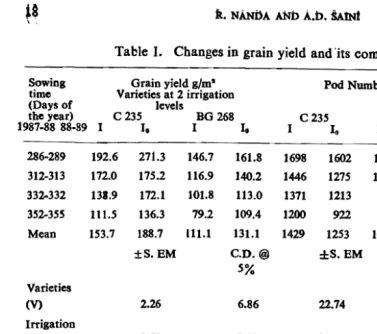
Grain Yield: The two chickpea varieties, BG 268 and C 235 raised on 4 sowing dates with 2 and 4 irrigation levels during 1987-88 and 1988-89 seasons gave a mean yield of 121 and 171 g/ m2 (Table 1). BG 268 had 40
%
lower grain yield than C 235. Both varieties raised on two irrigations gave 131 and 189 g/m2 ofglain yield which were 15 and 18% higher than when raised with 4 irrigations provi ding 111 and 154 g/m2 respecti vely. The results showed that irrigating chickpea
u
ft. NANDA AND A.D. SAINt
Table I. Changes in grain yield and 'its components of 2 varieties of Sowing Grain yield g/m" Pod Number/m" Grain weight
time Varieties at 2 irrigation g/pod
(Days of levels
the year) C235 BG268 C235 BG268 C 335
1987.88 88.89 I I. I I. I I. I I. I I.
286-289 192.6 271.3 146.7 161.8 1698 1602 1267 1092 0.115 0.156
312-313 172.0 175.2 116.9 140.2 1446 1275 1083 916 0.121 0.145
332-332 138.9 172.1 101.8 113.0 1371 1213 915 817 0.112 0.144
352-355 111.5 136.3 79.2 109.4 1200 922 890 772 0.093 0.149
Mean 153.7 ISS.7 111.1 131.1 1429 1153 1039 899 0.110 0.148
±S.EM
c.n.@
::I:S.EMc.n.@
::I:S.EM5% 5%
Varieties
(V) 2.26 6.86 22.74 68.94 NS
Irrigation
level (I) 2.79 8.37 21.46 64.33 .002
Sowing
dates (S) 3.19 9.70 32.16 97.56 .002
VxI NS NS NS
VxS 4.52 13.27 NS NS
IxS NS NS .003
VxIxS 7.90 22.35 NS NS
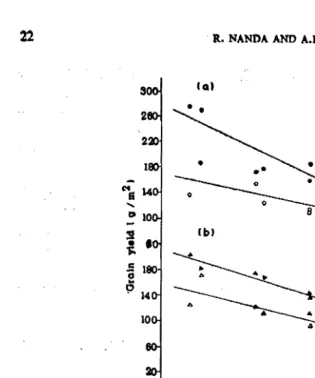
'--'---'~-progressively more closer to 4 irrigation levels as the sowing were delayed where as the same remained unaltered in BG 268 (Fig. I).
Pod Number: Variety C 235 showed about 40% higher Pod number/ml
(l341) than BG 268 (969). Contrary to grain yield pod number under restricted soil moisture (1076) were lower by about 15% than with 4 irrigations (1234); While pod number remained closely associated (r=YO.9) with yield in both varieties under each irrigation level (n = 8), pooled data of the 2 soil moisture levels of each variety (n=16), did not show such strong correlations (r=40.7).
MotsfoitE STRtlsS iN CmCKPBA
chickpea under two irrigation regimes when sown on different dates
iF··"
Orain No./Pod 100 grain weight
BG268 C 235 BO 268 C235 nG 268
I I. I I. I 10 I 10 I 10
0.118 0.148 1.79 129 1.15 1.08 10.51 11.92 12.07 13.32 0.131 0.153 1.01 1.27 1.20 1.21 11.55 11.34 11.21 13.03 0.1:6 0.142 1.00 J.17 1.09 1.10 11.24 12.18 10.63 11.42 0.082 0.150 0.87 1.18 0.83 0.95 10.52 12.47 10.11 12.56 0.112 0.148 1.0J 1.23 I.G7 1.10 10.96 11.98 11.02 12.58
C.D.@ ±S.EM CD@ ± S.EM CD@
5% 5% 5%
NS NS
.005 .012 .035 0.125 0.375
.007 .019 .059 NS
.017 .049 NS
.027 .081 0.256 0.749
.009 .024 .067 NS
NS NS
m2 for everyone day delay in sowings, which for C 235 (b=-9.61 ± 1.17 and
-7.IO±2 50 respectively. both coefficient non significant). it was 7-10 pods/m2. Tbe data on grain yield and pod number thus showed that a variety with lower yield and pod number (BG 268) was relatively less affected than the one with higher
yield and pod number(C 235) under late sown conditions.
R. NANnA AND A.D. blNt
lOO-grain weight and grain number/pod: Restricted soil moisture treatment increased both grain number/pod and 100 grain weight over sufficient moisture level. Grain number/pod were generally higher at all corresponding sowing dates in C 235 than BG 268 under restricted soil moisture treatment. However, 100 grain weight was higher in BG 268. The data point out that higher grain number/pod and 100 grain weight under restricted soil moisture contributed to higher grain weight/pod although the overall influence was more of the former in C 235 and of the later in JiG 268.
Flower Number/Plant: Variety C 23S had about 37% more :flowers/plant (119) than BG 269 (70) (Table-II). Under restricted irrigation, flower number/plant were reduced by 12-13% (85) than the profuse irrigation treatment (96). Flower number were also reduced as the sowings were delayed although this reduction
was
more prominent only under restricted water levels.
Table II. Flower initiation, flowering duration, Number of :flowers/plant and fruit
Sowing time Flower inItiation from days Average duration from
after sowing ftower initiation to
Days of tho Varieties at 2 irrigation end of OowaiDg
year levels
C23S BG268 C235 80268
1987-8888·89 I J. I I. I I. I I.
286-289 111.0 76.3 86.0 61.3 39.0 53.6 53.0 60.6
312-313 92.6 88.6 86.3 84.0 36.7 25.6 39.3 25.7
332-332 88.3 90.3 87.3 89.0 30.0 19.5 256 21.6
. 352-355 81.0 79.6 74.6 77.3 26.3 14.0 25.6 17.0
Mean 93.2 83.7 83.6 77.9 33.0 28.1 35.9 31.2
±S. EM CD@ ± S.EM CD@
5% 5"
Varieties (V) 0.277 0.81 0.268 0.79
Irrigation
levels (I) 0.389 1.01 0.358 1.01
Sowing
dates (S) 0.391 1.15 0.379 1.11
Vxl 0.549 1.55 NS
VxS 0.553 1.62 0.536 J.57
lxS 0.777 2.19 0.717 2.03
-
-MOISTURE S'ft.BSS IN CHICKPEA.
21
Fruit set (%) : Th~ fruit Setting was 4-6% bigber in BO 268 than C 235 in the respective soil moisture treatments. The pattern of change with sowing days of the
year showed a positive correlation (y 0.85) at the 2 soil moisture levels of the 2 varieties. The linear correlation coefficient under profuse and restricted soil moisture
in C 235 and BO 268 sbowed tbat fruit setting was improved by !O% for every 3 and 2 days, respectively, delay in sowing time.
Flowering time: C 235 and BC 268 took 93.2 (SD=±12.8) and 83.6 (±6.8) days under high soil moisture treatment and 83.7 (±6.0) and 77.0 (±12.1) days under restricted soil moisture condition. BO 268 flowered 8 days earlier than C 235, however, restricted soil moisture advanced onset of flowering by about 8 days uni formly in both varieties. There was no clear trend of its change on changing sowing time. The correlation between flowering time and sowing days of the year were not significant.
setting (%) of 2 varieties of chickpea under 2 irrigation levels on different dates of sowings
Number oftlowers Fruit setting
per plant (%>
e235 BG268 e 235 BG268
I I. I I. I I. I I.
111.0 177.0 120.6 157.0 41 37 33 29
163.6 111.0 70.0 47.0 43 43 45 S3
132.0 87.0 5S.3 40.0 S4 56 62 66
71.6 36.0 44.0 27.3 55 62 70 74
119.6 102.7 72.S 67.9 48.2 49.5 52.S 5S.S
±S.EM eD@ ±S.EM eD@
5% 5%
2.098 6.1S 0.589 1.73
2.923 8.26 NS
2,97 8.70 0.833 2.44
NS NS
4.19 12.31 1.179 3.46
5.85 16.5 NS
NS NS
_ _ w ' • ~_
· It. NANDA AND A.D. SAINI
Fig. 1. Grain yield of chickpea crops sown under 4 irrigation (open circles and triangles. and 2 irrigation levels (closed circles and triangles) of 2 varieties C.23S(a) and BG-268 (b); Least square regression equation for low and high level of irriga
tions for cultivar C·23S y=798.45-1.89xx (r=--O.94); y=SSI.37-1.23xx ~ (r=-6.91) and BG 268. y=396.20-0.82xx (r=-O.78); y-427.22-6.98xx
r
(r=--O.82) respectively. I
I
i ,
...
23
MOISTURE SUBSS IN CHICKPEA
was reduced almost twice as fast of crops raised under restricted soil moisture than crops raised under high soil moisture conditions,
Since neither the irrigation water nor the soil moisture content were quantified in these experiments, it is possible that in some sowings, the required soil moisture differences did not develop so that the grain yield differences of the 2 varieties under the 2 irrigation levels were not significantlY different in such sowings. The overall impact clearly indicated that a chickpea crop experiencing restricted soil moisture gave higher grain yield. Even when the sowings were as late as the end of December, the grain yield though reduced yet remained significantly higher than profuse soil moisture levels. It showed that more arid aerial environment during reproductive phase did not adversely affect the crop raised under restricted soil moisture. Shiv Kumar and Singh (1987) found increased seed yield with supplementary irrigations due to extension of seed filling period of chickpea crops sown between mid-·Nov to early Dec in Hyderabad, However, extended seed-filling period was not quantified. Haloi and Baldev (1986) have shown that irrigation delayed the flowering by 3-10 days in aU the dates of sowing, the delay being more in early sowings. Thus. inspite of increase in flowering duration of chickpea crops sown under high soil moisture, the grain yield remained lower than under restricted soil moisture. Extension of flowering duration under high soil moisture resulted in about 13
%
more flowers/plant, thereby, providing higher pod number/unit area than under restricted soil moisture. The only reason of lower grain yield under high soil moisture wou1d thus be its lower grain weight/pod which was as low as 35% over the restricted soil moisture. The higher grain weight/pod in the later treatment was contributed both by higher grain number/pod as well as grain size. Since flower number/plant increased as a result of increased flowering duration under high soil moisture, it follows that more leaves were formed providing more sites to bear these extra flowers. Thus, inspite of larger leaf surface progressively becoming available for assimilation in the former, its grain weight/pod still remained lower.It is possibJe that supplementary irrigation during reproductive growth phase promoted fresh root growth in the upper wet soil layers and got nodulated fresh. This additional nitrogen altered C/N ratio such that it continued forming vegetative parts. The synchronised growth of reproductive parts and senescence was thus postponed further into the season till a balanced C/N ratio is again achieved. Increasingly warming conditions during the reproductive growth period ~eemed to
24 R.. NANDA AND A.D. SAINI
leaf area, weight/pod remained lower.
I\.
similar situation would seem to prevail when chickpea crops experience heavy late winter rains resulting in its poor yield.REFERENCES
HaIoi, B. and Baldev, B. (1986). Effect of irrigation on growth attributes in chickpea when grown under different dates of sowing and population pressure. Indian J. Plant Phystoi.• 29 : 14-27.
Shivkumar, M.V.K. and Piara Singh (1987). Response of chickpea cultivara to water stress in a semi-arid environment. Expl. Agric., 13: 53·61.
: '
! !