BIROn - Birkbeck Institutional Research Online
Calì, Andrea and Martinenghi, D. and Torlone, R. (2015) Keyword search
in the Deep Web. In: Calì, Andrea and Vidal, M.E. (eds.) AMW 2015
-Alberto Mendelzon Workshop on Foundations of Data Management. CEUR
Workshop Proceedings 1378. CEUR.
Downloaded from:
Usage Guidelines:
Please refer to usage guidelines at
or alternatively
Keyword Search in the Deep Web
Andrea Cal`ı1,4, Davide Martinenghi2, and Riccardo Torlone3
1Birkbeck, University of London, UK [email protected]
2Politecnico di Milano, Italy [email protected]
3Universit`a Roma Tre, Italy [email protected]
4Oxford-Man Inst. of Quantitative Finance
University of Oxford, UK
Abstract. The Deep Web is constituted by data accessible through Web pages, but not readily indexable by search engines, as they are returned in dynamic pages. In this paper we propose a framework for accessing Deep Web sources, represented as relational tables with so-called ac-cess limitations, with keyword-based queries. We formalize the notion of optimal answer and investigate methods for query processing. To our knowledge, this problem has never been studied in a systematic way.
1
Problem definition
Basics. We model data sources as relations of a relational database and we assume that, albeit autonomous, they have “compatible” attributes. For this, we assume that the attributes of relations are defined over a set of abstract domains D={D1, . . . , Dm}, which, rather than denoting concrete value types
(such as string or integer), represent data types at a higher level of abstraction (for instance,car orcountry). The set of all values is denoted byD=Sni=1Di.
In the following, we shall denote by R(A1, . . . , Ak) a (relation) schema, by
dom(A) 2 D the domain of an attribute A, by r a relation over R, and by
r={r1, . . . , rn} a (database) instance of a database schemaR={R1, . . . , Rn}.
Access limitations. Anaccess pattern⇧for a schemaR(A1, . . . , Ak) is a mapping
sending each attribute Ai into an access mode, which can be either input or
output;Aiis correspondingly called aninput(resp.,output)attributeforRwrt.
⇧. For ease of notation, we shall mark input attributes with an ‘i’ superscript to distinguish them from the output ones. LetA01, . . . , A0lbe all the input attributes
forRwrt.⇧; any tuplehc1, . . . , clisuch thatci2dom(A0i) for 1ilis called
abindingforRwrt.⇧. Anaccess↵consists of an access pattern⇧ for a schema
R and a binding forR wrt.⇧; theoutput of such an access↵on an instancer
is the setT = A1=c1,...,Al=cl(r). Intuitively, we can only access a relation if we
can provide a value for every input attribute. Given an instancerfor a database schemaR, a set of access patterns⇧ for the relations inR, and a set of values
C ✓ D, an access path (for R, ⇧ and C) is a sequence of accesses ↵1, . . . ,↵n
onr such that each value in the binding of ↵i, 1 in, either occurs in the
output of an access↵j withj < i or is a value inC. A tupletin ris said to be
t31 t33
t23
t11 t21
t12
(a) Access paths
t31 t33
t23
t11 t21
t12
(b) Join graph
t31 t33
[image:3.612.157.458.126.218.2]t23 t11 t11 A2 A1 (c) Answers
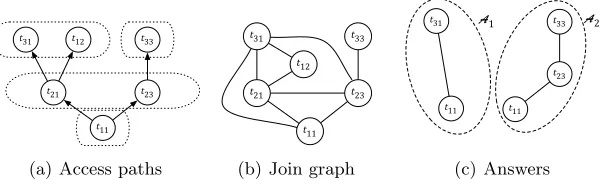
Fig. 1.Example 1: Reachable portion, corresponding join graph, and answers.
access inP; thereachable portion reach(r,⇧,C) ofr is the set of all reachable tuples inrgiven the values inC.
Keyword queries. Akeyword query is a set of values inDcalledkeywords.
Example 1 Consider a queryq={k1, k2}, a schema (with access patterns⇧)
R={R1(Ai1, A2), R2(Ai2, A1), R3(Ai1, A2, A3)}, and an instancer such that
r1= Ai
1A2
k1 c1 t11
c2 c3 t12 r2=
Ai
2A1
c1 c2 t21
c4 c2 t22
c1 c6 t23 r3=
Ai
1A2A3
c2 c1 k2 t31
c5 c4 k2 t32
c6 c7 k2 t33
Figure 1(a) shows the reachable portion ofrgiven the values inqalong with the access paths used to extract it, with dotted lines enclosing outputs of accesses.
Given a setT of tuples, thejoin graph ofT is a node-labelled undirected graph
T =hN, Eiconstructed as follows: (i)the nodesN are labelled with tuples of
T, and(ii) there is an arc between two nodesn1 and n2 if the tuples labelling
n1 andn2 have at least one value in common.
Example 1 (cont.) The join graph ofreach(r,⇧, q) is shown in Figure 1(b).
Definition 1 (Answer). An answer to a keyword query q against a database instance r over a schema R with access patterns ⇧ is a set of tuples A in
reach(r,⇧, q) such that: (1) each c 2 q occurs in at least one tuple t in A; (2) the join graph of A is connected; (3) for every subsetA0 ✓Asuch that A0 enjoys Condition 1 above, the join graph of A0 is not connected.
It is straightforward to see that there could be several answers to a keyword query; below we give a widely accepted criterium for ranking such answers [4].
Definition 2. Let A1,A2 be two answers of a keyword query q on an instance
r of size |A1|and |A2| respectively; we say thatA1 is better than A2, denoted
A1 A2, if |A1||A2|. The optimalanswers are those of minimum size.
Example 1 (cont.) The sets A1 ={t11, t31} and A2 = {t11, t23, t33} are
an-swers toq;A1 is better thanA2 and is the optimal answer toq.
2
Keyword-based answering in the Deep Web
We now present a vanilla algorithm to discuss the computational complexity of answering a keyword query q in the deep Web modeled as an instance r of a schema R with access patterns ⇧. Example 1 shows that, in the worst case, we need to extract the whole reachable portion to obtain the tuples involved in an optimal answer. In fact, s = reach(r,⇧, q) is actually a connected join graph, since every tuple in it is in some output of some access path starting from the values in the query (see for example Figure 1.a), but further paths may exist between tuples in s(see Figure 1.b). Therefore, query answering requires in general two main steps, described in Algorithm 1: (i)extract the reachable portion s of r; (ii) if possible, remove tuples from s so that the obtained set satisfies the conditions of Definition 1, while minimizing its size.
Algorithm 1: Computing an optimal answer (Answer(q,⇧,r))
Input: Keyword queryq, access patterns⇧, instanceroverR
Output: AnswerA
1. A:=reachableP ortion(r,⇧, q);// see Algorithm 2
2. ifAdoes not contain all values inqthen return nil;
3. elseprune(A, q);// see Algorithm 3 4. returnA;
A simple way of extracting the reachable portion, inspired by the procedure described in [1], is shown in Algorithm 2. This algorithm may be allowed to terminate early if the answer is not required to be optimal (flag!set tof alse), and thus can stop as soon as the reachable portion contains all the keywords in the query. This is coherent with thedistinct root-based semantics of keyword search in relational databases, which provides a tradeo↵between quality of the result and efficiency of the method to evaluate it [4].
Algorithm 2: Reachable portion (reachableP ortion(r,⇧, q))
Input: InstanceroverR, access patterns⇧, initial valuesq
Flag: boolean!// if!=truethe answer is guaranteed to be optimal
Output: Reachable portionRP
1. RP:=;;C:=;;
2. whilean access can be made with a new bindingbfor someR2Rwrt.⇧using values inC[q
3. O:= output of access toroverRwith bindingb;
4. RP:=RP[O;// cumulating all the obtained tuples intoRP
5. C:=C[SA2R,t2O{t(A)};// cumulating all the obtained values intoC
6. ifC◆q^¬!then break; 7. returnRP;
Algorithm 3: Pruning (prune(T, q))
Input: Set of tuplesT, keyword queryq
Flag: boolean!// if!=truethe answer is guaranteed to be optimal
Output: Minimal set of tuplesT
1. if!then returna minimal subtree of the join graph ofT that containsq; 2. T0:=T;T00:=;;
3. whileT006=T0
4. T00:=T0;
5. for eacht2T00ifT0\ {t}is connected andT0\ {t}◆qthenT0:=T0\ {t};
6. returnT0;
The extraction of the reachable portion of an instance r with access lim-itations can be implemented by a Datalog program over r [1], which can be evaluated in polynomial time in the size of the input [3]. In addition, in [2] it is shown that the optimalq-fragments ofr can be enumerated in ranked-order with polynomial delay, i.e., the time for printing the next optimal answer is again polynomial in the size ofr. Hence, we can state the following preliminary result.
Theorem 1. An optimal answer to a keyword query against a database instance with access limitations can be efficiently computed under data complexity.
3
Discussion and future work
In this paper, we have defined the problem of keyword search in the Deep Web and provided some preliminary insights on query answering in this context. We believe that several interesting issues can be investigated in the framework de-fined in this paper. In particular, we plan to:
– devise optimization strategies for query answering; in particular, identify conditions under which an optimal answer can be derived without extracting the whole reachable instance;
– leverage known values (besides the keywords), modeled as relations with only one (output) attribute, to speed up the search for an optimal answer;
– study the problem in a scenario in which the domains of the keywords are known in advance: in this case schema-based techniques can be used to plan an optimal search strategy;
– consider the case in which nodes and arcs of the join graph are weighted to model source availability and proximity, respectively.
References
1. A. Cal`ı, D. Martinenghi. Querying Data under Access Limitations. In ICDE, pag. 50–59, 2008.
2. B. Kimelfeld and Y. Sagiv. Finding and approximating top-k answers in keyword proximity search. InPODS, pag. 173–182, 2006.
3. M. Vardi.The complexity of relational query languages. InSTOC, pag. 137–146, 1982. 4. J. Xu Yu, L. Qin, and L. Chang. Search in Relational Databases: A Survey.IEEE
Data Eng. Bull., 33(1): 67–78, 2010.